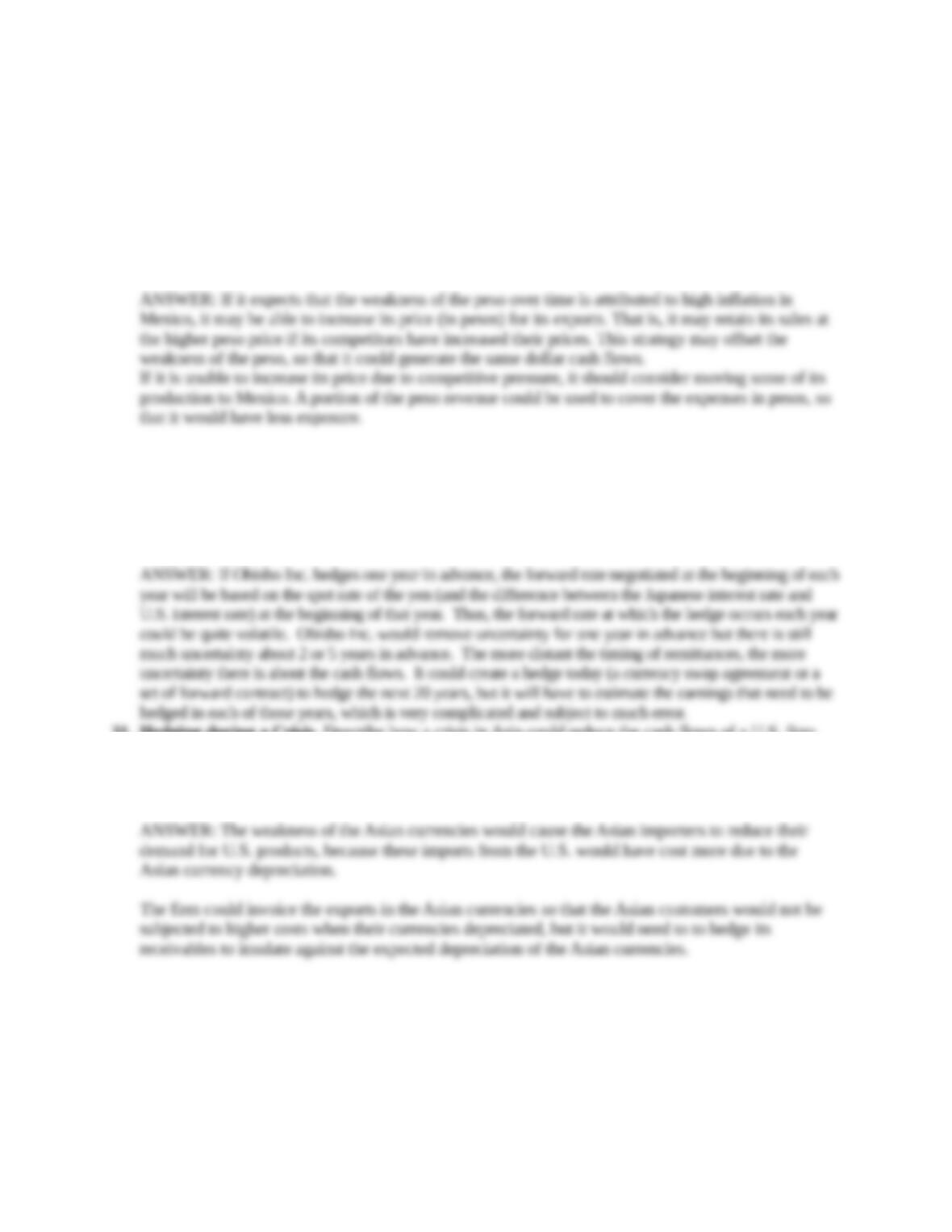
29. The Long-term Hedge Dilemma. St. Louis Inc., which relies on exporting, denominates its exports in
pesos and receives pesos every month. It expects the peso to weaken over time. St. Louis recognizes the
limitation of monthly hedging. It also recognizes that it could remove its transaction exposure by
denominating the exports in dollars but that it is still would be subject to economic exposure. The long-
term hedging techniques are limited and the firm does not know how many pesos it will receive in the
future, so it would have difficulty even if a long-term hedging method was available. How can this
business realistically deal with this dilemma to reduce its exposure over the long-term?
30. Long-term Hedging. Since Obisbo Inc. conducts much business in Japan, it is likely to have cash
flows in yen that will periodically be remitted by its Japanese subsidiary to the U.S. parent. What are
the limitations of hedging these remittances one year in advance over each of the next 20 years?
What are the limitations of creating a hedge today that will hedge these remittances over each of the
next 20 years?
31. Hedging during a Crisis. Describe how a crisis in Asia could reduce the cash flows of a U.S. firm
that exports products (denominated in U.S. dollars) to Asian countries. How could a U.S. firm that
exports products (denominated in U.S. dollars) to Asia insulate itself from any currency effects of a
future crisis while continuing to export to Asia?
Advanced Questions
32. Comparison of Techniques for Hedging Receivables.
a. Assume that Carbondale Co. expects to receive S$500,000 in one year. The existing spot rate of
the Singapore dollar is $.60. The one-year forward rate of the Singapore dollar is $.62.
Carbondale created a probability distribution for the future spot rate in one year as follows:
Future Spot Rate Probability
$.61 20%
.63 50
.67 30
Assume that one-year put options on Singapore dollars are available, with an exercise price of
$.63 and a premium of $.04 per unit. One-year call options on Singapore dollars are available
with an exercise price of $.60 and a premium of $.03 per unit. Assume the following money
market rates:
U.S. Singapore
Deposit rate 8% 5%
Borrowing rate 9 6
Given this information, determine whether a forward hedge, money market hedge, or a currency
options hedge would be most appropriate. Then compare the most appropriate hedge to an
unhedged strategy, and decide whether Carbondale should hedge its receivables position.
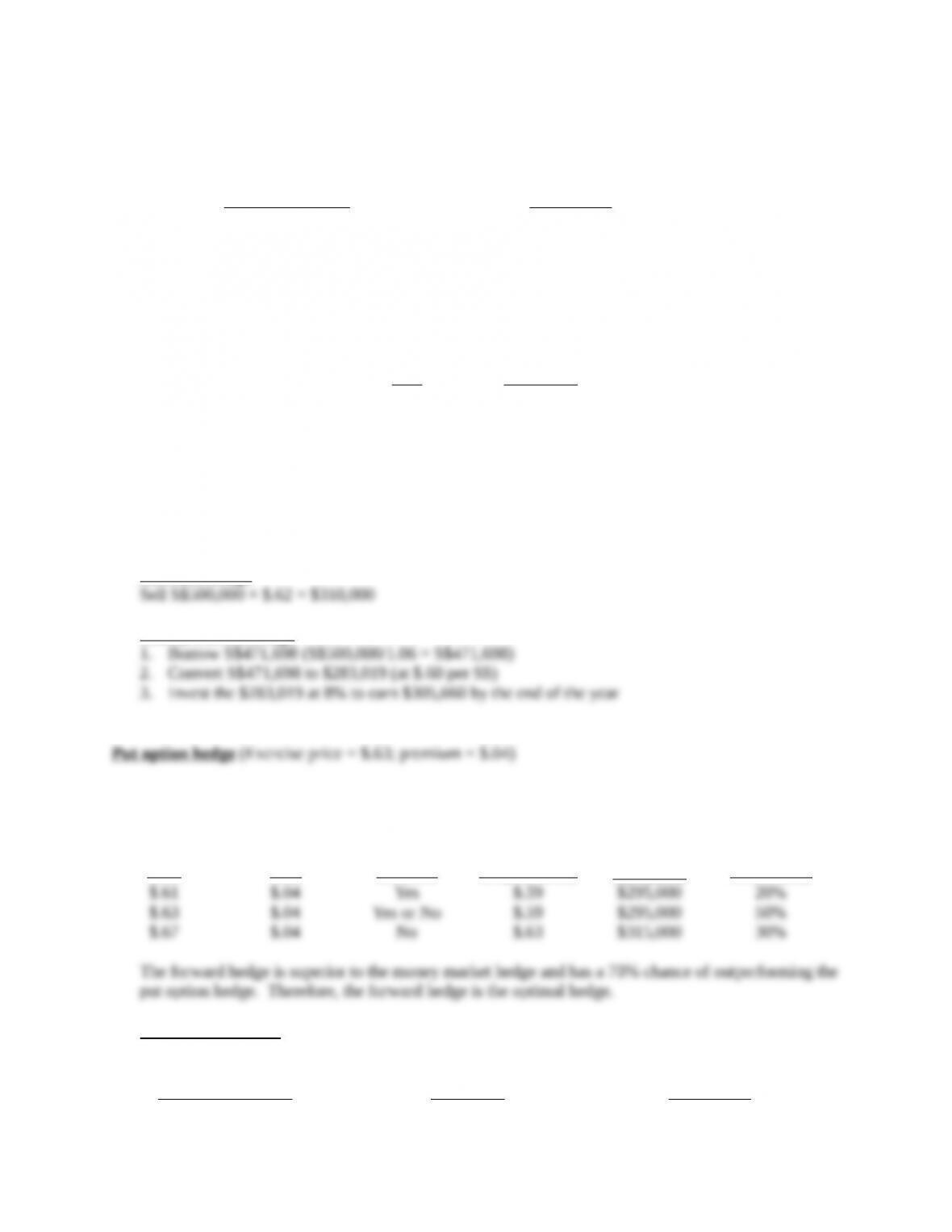
ANSWER:
Forward hedge
Money market hedge
Possible Spot
Rate
Option
Premium per
Unit Exercise
Amount
Received per
Unit (also
accounting
for premium)
Total Amount
Received for
S$500,000 Probability
Unhedged Strategy
Possible Spot Rate
Total Amount Received for
S$500,000 Probability
b. Assume that Baton Rouge, Inc. expects to need S$1 million in one year. Using any relevant
information in part (a) of this question, determine whether a forward hedge, a money market
hedge, or a currency options hedge would be most appropriate. Then, compare the most
appropriate hedge to an unhedged strategy, and decide whether Baton Rouge should hedge its
payables position.
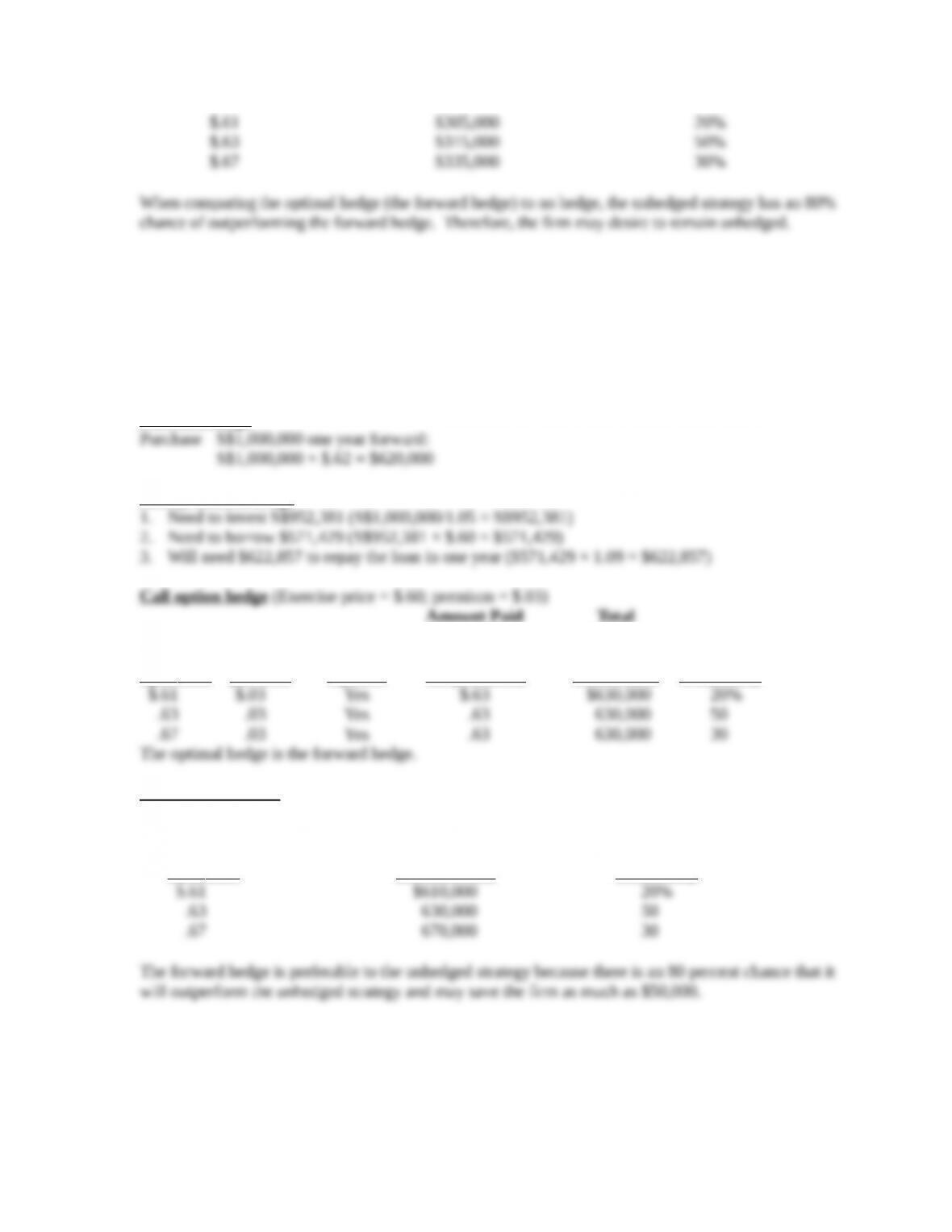
ANSWER:
Forward hedge
Money market hedge
Amount Paid Total
Option per Unit Amount
Possible Premium Exercise (including Paid for
Spot Rate per Unit Option? the premium) S$1,000,000 Probability
Unhedged Strategy
Total
Possible Amount Paid
Spot Rate for S$500,000 Probability
33. Techniques for Hedging Receivables. SMU Corp. has future receivables of 4,000,000 New Zealand
dollars (NZ$) in one year. It must decide whether to use options or a money market hedge to hedge
this position. Use any of the following information to make the decision. Verify your answer by
determining the estimate (or probability distribution) of dollar revenue to be received in one year for
each type of hedge.
Spot rate of NZ$ = $.54
One-year call option: Exercise price = $.50; premium = $.07
One-year put option: Exercise price = $.52; premium = $.03
U.S. New Zealand
One-year deposit rate 9% 6%
One-year borrowing rate 11 8
Rate Probability
Forecasted spot rate of NZ$ $.50 20%
.51 50
.53 30
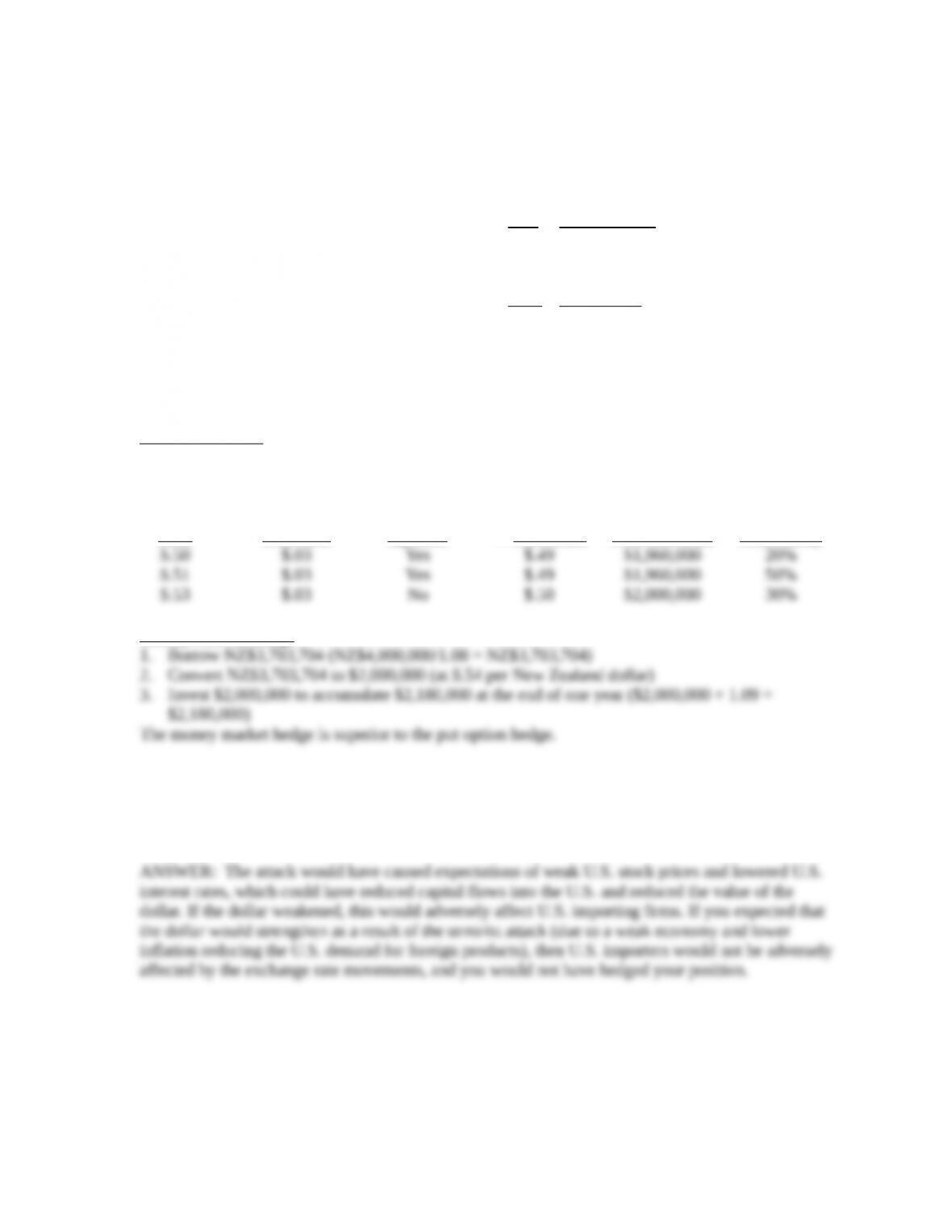
ANSWER:
Put option hedge (Exercise price = $.52; premium = $.03)
Possible Spot
Rate
Put Option
Premium
Exercise
Option?
Amount per
Unit Received
Accounting
for Premium
Total Amount
Received
for
NZ$4,000,000 Probability
Money market hedge
34. Exposure to September 11.If you were a U.S. importer of products from Europe, explain whether
the September 11, 2001 terrorist attack on the U.S. would have caused you to hedge your payables
(denominated in euros) due a few months later. Keep in mind that the attack was followed by a
reduction in U.S. interest rates.
35. Hedging with Forward versus Option Contracts. As treasurer of Tempe Corp., you are confronted
with the following problem. Assume the one-year forward rate of the British pound is $1.59. You
plan to receive 1 million pounds in one year. A one-year put option is available. It has an exercise
price of $1.61. The spot rate as of today is $1.62, and the option premium is $.04 per unit. Your
forecast of the percentage change in the spot rate was determined from the following regression
model:
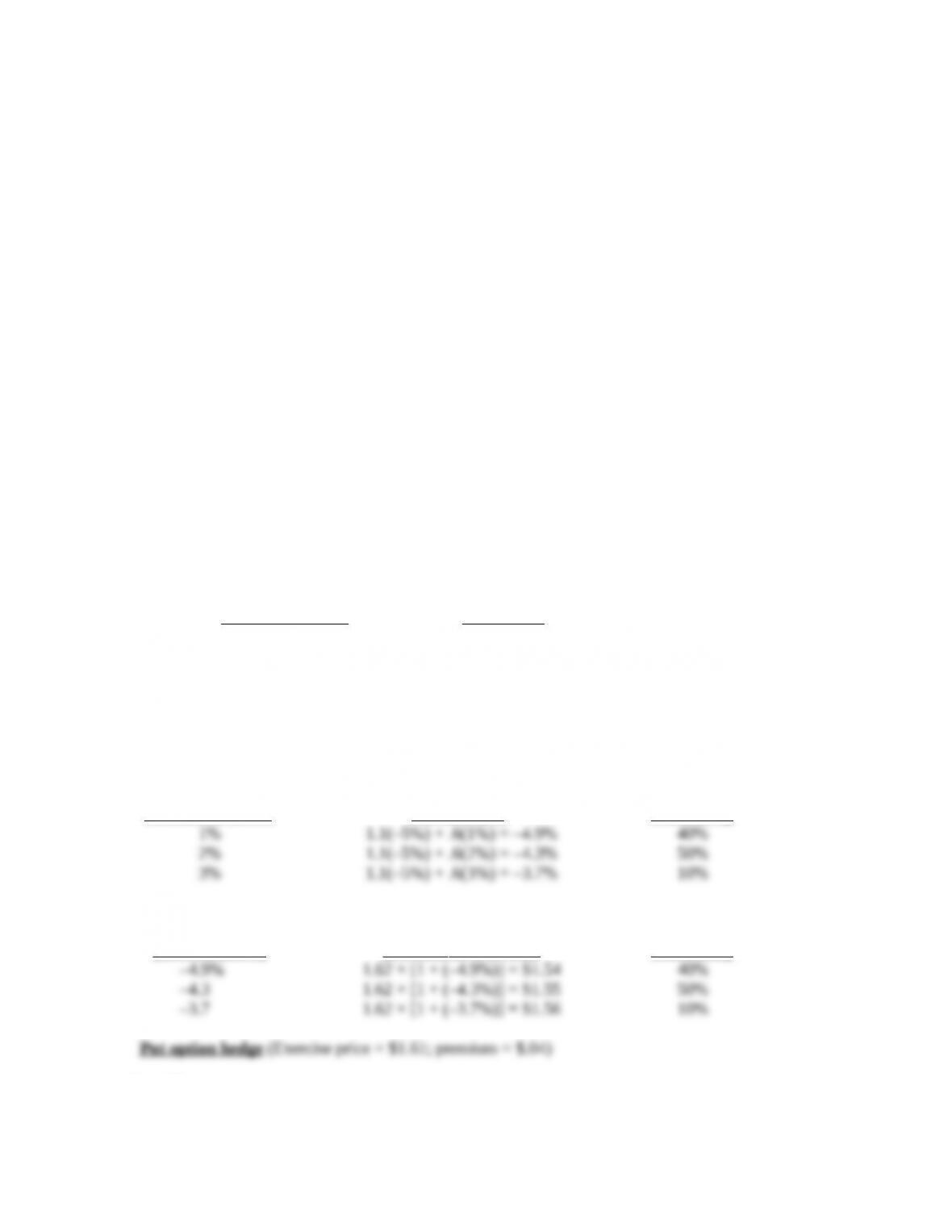
et = a0 + a1DINFt-1 + a2DINTt + u
where et= percentage change in British pound value over period t
DINFt-1 = differential in inflation between the United States and the United
Kingdom in period t–1
DINTt= average differential between U.S. interest rate and British
interest rate over period t
a0, a1, and a2= regression coefficients
u = error term
The regression model was applied to historical annual data, and the regression coefficients were
estimated as follows:
a0 =0.0
a1 =1.1
a2 =0.6
Assume last year’s inflation rates were 3 percent for the United States and 8 percent for the United
Kingdom. Also assume that the interest rate differential (DINTt) is forecasted as follows for this year:
Forecast of DINTtProbability
1% 40%
2 50
3 10
Using any of the available information, should the treasurer choose the forward hedge or the put
option hedge? Show your work.
ANSWER:
Forecast of DINTtForecast of et Probability
Approximate
Forecast of etForecasted Spot Rate
(derived above) of Pound in One Year Probability
Possible
Spot Rate of Amount
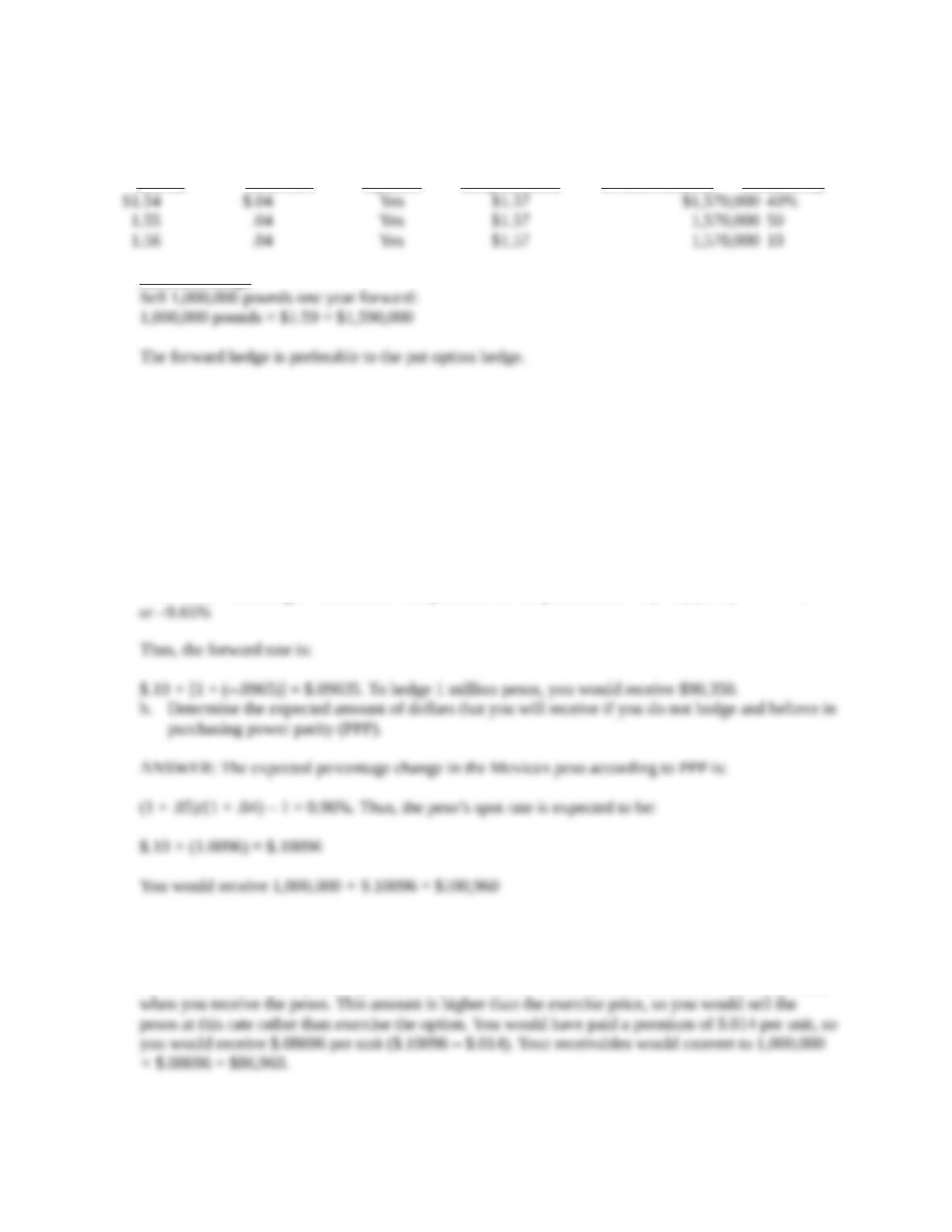
Pound in Received
One Year Put per Unit Total Amount
(derived Option Exercise (accounting Received for One
above) Premium Option? for premium) Million Pounds Probability
Forward hedge
36. Hedging Decision. You believe that IRP presently exists. The nominal annual interest rate in Mexico
is 14%. The nominal annual interest rate in the U.S. is 3%. You expect that annual inflation will be
about 4% in Mexico and 5% in the U.S. The spot rate of the Mexican peso is $.10. Put options on
pesos are available with a one-year expiration date, an exercise price of $.1008, and a premium of
$0.014 per unit.
You will receive 1 million pesos in one year.
a. Determine the amount of dollars that you will receive if you use a forward hedge.
ANSWER: According to IRP, the forward premium on the peso should be (1.03)/(1.14) – 1 = –.0965
c. Determine the amount of dollars that you will expect to receive if you use a currency put option
hedge. Account for the premium you would pay on the put option.
ANSWER: Since the expected spot rate is $.10096 based on PPP, you could receive $.10096 per unit
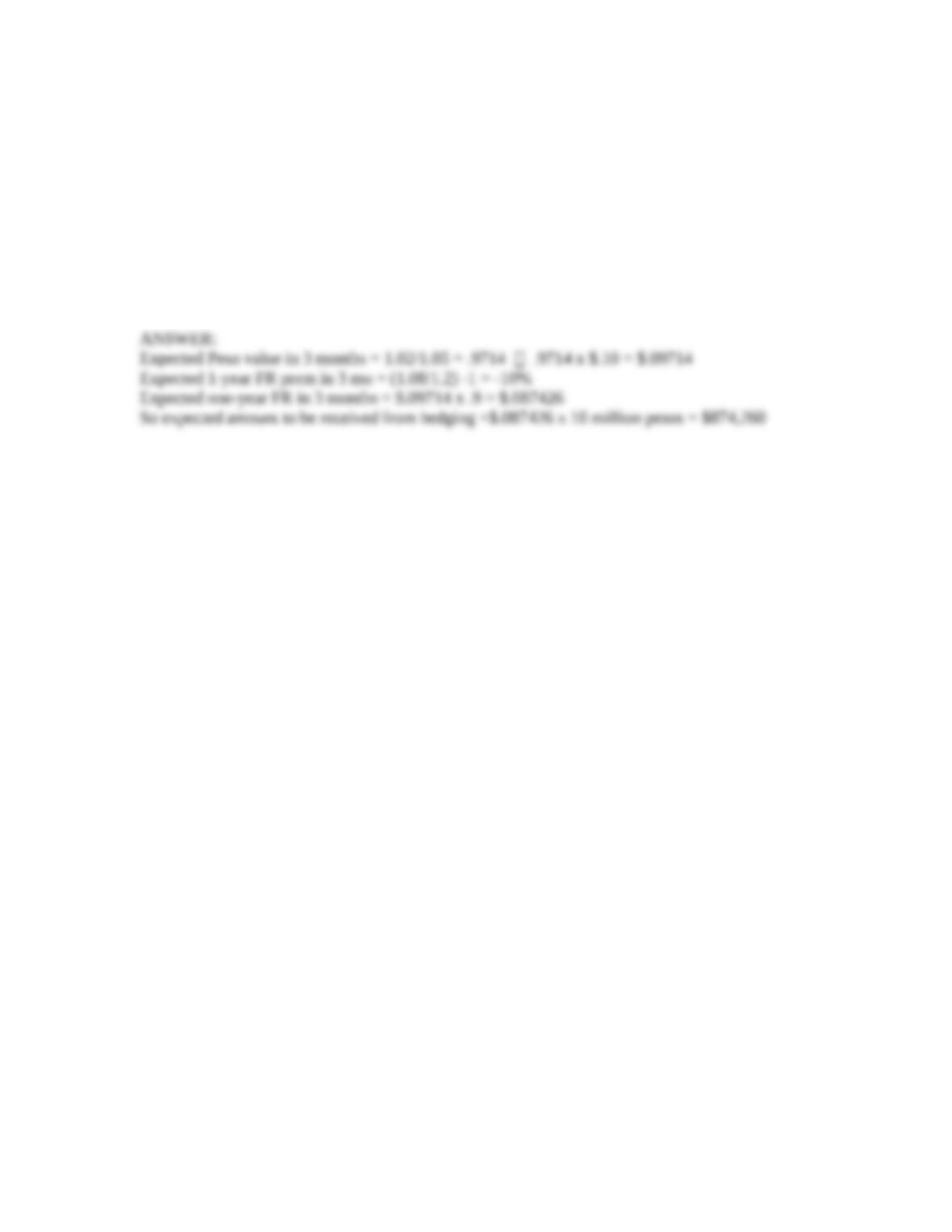
37. Forecasting with IFE and Hedging. Assume that Calumet Co. will receive 10 million pesos in
15 months. It does not have a relationship with a bank at this time, and therefore can not obtain a
forward contract to hedge its receivables at this time. However, in three months, it will be able to
obtain a one-year (12-month) forward contract to hedge its receivables. Today the three-month U.S.
interest rate is 2% (not annualized), the 12-month U.S. interest rate is 8%, the three-month Mexican
peso interest rate is 5% (not annualized), and the 12-month peso interest rate is 20%. Assume that
interest rate parity exists. Assume the international Fisher effect exists. Assume that the existing
interest rates are expected to remain constant over time. The spot rate of the Mexican peso today is
$.10. Based on this information, estimate the amount of dollars that Calumet Co. will receive in 15
months.
38. Forecasting from Regression Analysis and Hedging. You apply a regression model to annual data
in which the annual percentage change in the British pound is the dependent variable, and INF
(defined as annual U.S. inflation minus U.K. inflation) is the independent variable. Results of the
regression analysis show an estimate of 0.0 for the intercept and +1.4 for the slope coefficient. You
believe that your model will be useful to predict exchange rate movements in the future.
You expect that inflation in the U.S. will be 3%, versus 5% in the U.K. There is an 80% chance of
that scenario. However, you think that oil prices could rise, and if so, the annual U.S. inflation rate
will be 8% instead of 3% (and the annual U.K. inflation will still be 5%). There is a 20% chance that
this scenario will occur. You think that the inflation differential is the only variable that will affect the
British pound’s exchange rate over the next year.
The spot rate of the pound as of today is $1.80. The annual interest rate in the U.S. is 6% versus an annual
interest rate in the U.K. of 8%. Call options are available with an exercise price of $1.79, an expiration
date of one year from today, and a premium of $.03 per unit