REVIEW QUESTIONS & SUGGESTED ANSWERS
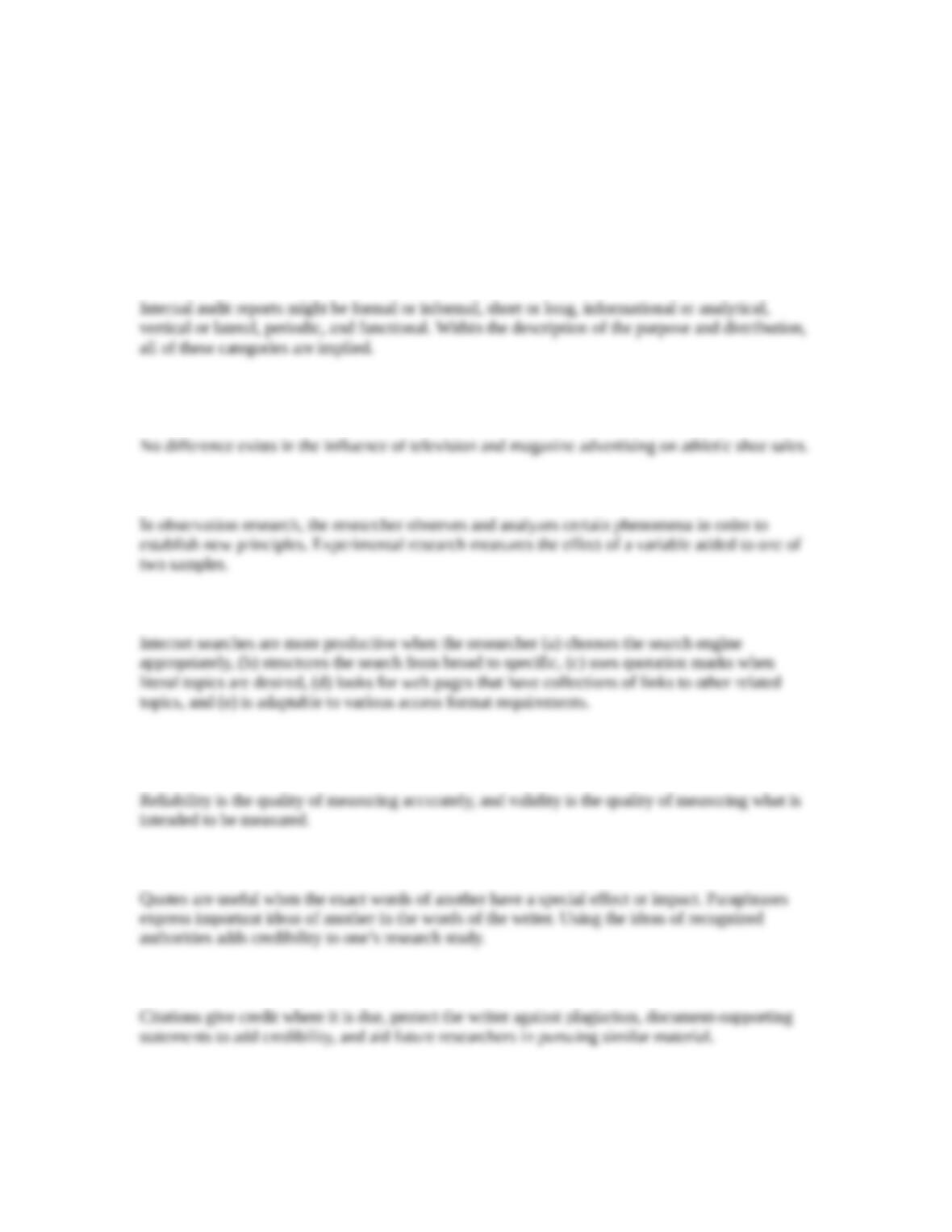
1 In a bank, the internal auditing division performs semiannual audits of each branch.
Then the audit reports are sent to the bank’s chief executive officer and chief financial
officer and to the manager of the audited branch. The purpose of the audits is to
determine whether policies and practices are properly followed. Into what report
classifications might the audit report fall? Explain.
1. How might a null hypothesis be stated for a research study attempting to determine
whether television or magazine advertising has greater influence on athletic shoe sales?
2. How are observational and experimental research different?
3. What techniques can help make the Internet search process more efficient?
4. Distinguish between reliability and validity. How are both important to quality
research?
5. What purpose do quotes and paraphrases serve in the findings of a report?
6. Why should a research study document information taken from other sources?
© 2015 Cengage Learning. All Rights Reserved. May not be scanned, copied or duplicated, or posted to a
publicly accessible website, in whole or in part.
1

7. What questions might you ask of someone who wants assistance in planning a
questionnaire survey to determine automobile-owner satisfaction with certain
after-the-sale services provided by dealers?
8. Gathering so much information that the researcher is “snowed under” by the amount is
often a barrier to good reporting. How might researchers protect themselves against this
possibility?
9. How does the assumption that human beings behave in consistent ways over time
present a danger in data interpretation?
10. How has the process of research changed in recent years? How have the changes been
both beneficial and detrimental?
11. What communication skills should an effective researcher possess?
FEATURED ASSIGNMENTS
1Identifying Challenges Posed by Human Subjects: Using an online database, locate and
read an article related to challenges associated with experimental research. What legal and
ethical challenges do researchers face when conducting experimental research with human
subjects? How can they be managed?
12. Writing a Hypothesis: Write positive and null hypotheses for each of the research topics
below.
© 2015 Cengage Learning. All Rights Reserved. May not be scanned, copied or duplicated, or posted to a
publicly accessible website, in whole or in part.
2

a. A study to determine functional business areas from which chief executive officers
advanced in their organizations. Functional areas are legal, financial, accounting,
marketing, production, and other.
Note: In a hypothesis, the word significant usually is added when tests of significance are to be
used. Of course, variations are easily possible.
b. A study to determine whether a person’s career success is related to mentoring
experiences.
c. A study to determine the relationship between college students’ gender and their final
grades in the business communication course.
13. Designing a Research Study: Prepare a one-page description of your plan to solve the
problem for one of the following research studies. Use the following headings for the
problem:
(a) Statement of the Problem,
(b) Research Method and Sources of Information,
(c) Nature of Data to Be Gathered and Analyzed,
(d) Hypothesis or Hypotheses to Be Proved or Disproved (if feasible).
Campus, Job, or Organization Problem. See the solution slide for a suggested solution.
As administrator of Greater Lewisville Health Services, a family health clinic, you have
mailed an informative brochure to each patient that describes the need to receive the
influenza vaccine. Although the flu season is approaching, very few patients have come
in to receive their injections.
Statement of the Problem: What actions can be implemented by Greater Lewisville Health
Services to motivate patients to come in to receive influenza injections?
Research Method and Sources of Information: A normative survey by telephone to patients
will be conducted.
© 2015 Cengage Learning. All Rights Reserved. May not be scanned, copied or duplicated, or posted to a
publicly accessible website, in whole or in part.
3

Nature of Data to Be Gathered and Analyzed: Data will be gathered on customer attitudes
about the value of preventive medicine, such as vaccinations; specifically, whether they are
willing to participate and, if so, what would attract them to take advantage of preventive medical
care.
Hypothesis or Hypotheses to Be Proved or Disproved: Given appropriate health services
information, patients will take initiative to get injections.
Karen’s Frozen Foods, Inc., is considering adding frozen breakfast pizza to its product
line in an effort to overcome the flat profit line it has experienced for several years. The
marketing staff intends to target the product to teenagers and working couples whose
busy schedules require foods that can be heated quickly. Because all production facilities
are currently operating at full capacity, introducing the frozen pizza will require adding
production capacity.
Statement of the Problem: Should Karen’s Frozen Foods add breakfast pizza to its product line?
Research Method and Sources of Information: A normative survey by questionnaire to a
random sample of teenagers and working couples will be conducted.
Nature of Data to Be Gathered and Analyzed: Data will be gathered on customer attitudes
about breakfast pizza, specifically, preference for breakfast pizza over other breakfast
alternatives, likelihood of purchasing breakfast pizza, and frequency of choosing breakfast pizza.
Hypothesis or Hypotheses to Be Proved or Disproved: Breakfast pizza will be an attractive
breakfast choice for teenagers and working couples.
14. Overcoming Problems in Data Collection and Interpretation: Locate an article using either
printed or electronic sources that address a problem that has occurred for some organization
when it failed to realize that research findings that were true for one country or culture were
not accurate for another. Make a brief presentation to the class about your findings.
15. Developing a Survey Instrument: Organize students into groups of three to four and have
them design a survey instrument for one of the scenarios in number 3.
ADDITIONAL ASSIGNMENTS
1Performing an Electronic Search: This assignment will allow you to perform an electronic
search of a business research topic selected by you or assigned by your instructor.
© 2015 Cengage Learning. All Rights Reserved. May not be scanned, copied or duplicated, or posted to a
publicly accessible website, in whole or in part.
4

16. Gathering Research Information: To learn more about the research process and using
various types of printed and electronic resources, complete the TILT tutorial at
17. Real-World Case: Analyzing the Use of “E-Research”: Meal times may be less likely to be
interrupted by telemarketing calls as e-research continues to catch on. Companies such as
InfoPoll offer downloadable software and other services for developing and executing online
surveys. Offered at an average of $1,000 per project, these polls are delivered via email or on
popup web windows and offer a significant savings over traditional phone and paper surveys
that can cost upwards of $25,000. Despite the advantages, many market researchers feel that
web audiences don’t give the random representation of the general population.
a. One organization that offers e-research services is InfoPoll. Visit their website at
http://www.infopoll.com and review the services offered.
b. Read the suggestions offered under “How to Write a Good Survey.”
c. Prepare a short written report or presentation that describes how to plan, conduct, and
interpret results of an e-poll.
18. Bidding for a Convention Site: Read the scenario and complete the activity below
© 2015 Cengage Learning. All Rights Reserved. May not be scanned, copied or duplicated, or posted to a
publicly accessible website, in whole or in part.
5

The National Insurance Appraisers Association is planning an upcoming convention. This
association of 500 members conducts a three-day conference during late October that
includes at least one general session and as many as five breakout groups of 50–75
participants. The chair of this group’s convention site committee has invited your city
(instructor will assign) to submit a proposal bidding for the convention’s 2010 national
convention
Activity:
As executive director of the Economic Development Council, write a proposal including specific
information to convince the group that your city (choose a location) can provide the needed
meeting facilities, hotel accommodations, economical transportation from major U.S. cities, and
a variety of social and recreational activities for members and guests. Obtain your information
via the Internet.
CASE ASSIGNMENT 1
COPING WITH INFORMATION OVERLOAD
The greatest challenge of our times is to reduce information, not to increase it. Until about 50
years ago, more information was always a good thing. Now we can’t see our way through the
“data smog.” An ever-growing universe of information translates to masses of data through which
people must search to find what is useful and meaningful to them. Consider the following
statistics:
Although the original intent of advanced communication technologies was to make
communication faster and more efficient, the result has been a communications gridlock and
heightened stress for many workers. “Actually, it is probably a fact of everyday life that we all
suffer from some degree of information overload,” says Barry Gordon, noted neurologist. “If you
wonder why our memories do not work as well as we need them to, consider this: Our brains
were not built for the modern world. In the Stone Age . . . there were no clocks, no papers, no
news flashes. Contrast that with everything we expect to remember today.”
Some companies are going so far in battling information overload as hiring people whose
job it is to filter and sort through the communications gridlock. These “information architects” are
the translators and traffic controllers who help to bridge the communication gaps in the
organization and deliver usable information in a concise way. The information architect
reorganizes information for more effective communication, gives structure and order to pertinent
information, and maps out the best way for the organization’s people to access it.
© 2015 Cengage Learning. All Rights Reserved. May not be scanned, copied or duplicated, or posted to a
publicly accessible website, in whole or in part.
6

Whether for improved job performance, a better product, or increased productivity, more
and more organizations are recognizing that good information means good business. And good
information must somehow be made available in spite of increasing information overload.
Sources: Roman Soucek, Klaus Moser, Coping with information overload in email communication: Evaluation of a
training intervention, Computers in Human Behavior, Volume 26, Issue 6, November 2010, Pages 1458-1466, ISSN
0747-5632, 10.1016/j.chb.2010.04.024; Strategies for coping with information overload, BMJ 2010;341:c7126; Coping
with information overload, Michelle Price, Financial News, 09 Jan 2012.
Activities
1 In teams of four, visit the listed sites and prepare a presentation on information overload
(IO). The presentation should include the following elements: (1) seriousness of the problem,
(2) suggestions for reducing IO in email usage, (3) suggestions for reducing IO in Internet
usage, and (4) suggestions for reducing stress that results from IO.
19. “The information age has brought about a reduction in the quality of life.” Choose to either
support or defend the statement; write a one- to two-page paper that explains your position
and gives supporting evidence and/or examples.
20. Select a personal example from your academic or work life in which you have experienced
information overload. Prepare a written analysis that (1) describes the situation, (2)
identifies the reasons for the IO that occurred, and (3) outlines strategies for reducing your
IO.
© 2015 Cengage Learning. All Rights Reserved. May not be scanned, copied or duplicated, or posted to a
publicly accessible website, in whole or in part.
7
CASE ASSIGNMENT 2
RESEARCH AND DEVELOPMENT STRATEGIES OFFER REVOLUTIONARY BEST
SELLER FOR APPLE
The video player is the latest iteration of popular iPod technology that has helped to transform
Apple from an also-ran computer maker into a cutting-edge entertainment and communications
giant and one of the world’s biggest sellers of digital music. Peter Boatwright, co-author of The
Design of Things to Come, says ”Apple is an example of successful companies that are
introducing new products more oriented toward what con-sumers want rather than just evolving
existing technolo-gies.”
The iPod was anything but a hit when Apple unveiled it in 2001. Stores were filled with big,
clunky digital music players that barely attracted a listen from shoppers. Critics complained that
the $400 iPod was hopelessly overpriced. Many said the same thing when Apple unveiled the
iPod Mini in early 2004, arguing that consumers would never pay $250 for just a few gigabytes of
storage. Then came the 1.5 ounce ipod Nano, so smartly conceived and engineered that even
skeptics were hard pressed to find anything to complain about. The iPod currently has 76 percent
of the MP3 music player market in the United States and over 50 percent in Japan.
The advent of the iPod, however, was not a random happening. Concerned over sagging
computer sales, Apple carefully considered research about young consumers being more nomadic
and expecting more control over their media experiences as it designed revolutionary technology
to respond to those demands. In 2002, music contributed only 2.6 percent to Apple’s total
revenues. By September 2005, music had grown to account for 40 percent of revenues; and by
2006 the majority of the company’s revenues came from iPod and iTunes sales rather than from
computers. Delivery from the iTunes Music Store of current episodes of popular TV series drives
momentum in sales of iPods. Apple continues to study and consider ways to reach 18- to
25-year-old males as primary consumers of online video products. But iPod’s wide audience also
includes baby boomer executives, stay-at-home moms, and their music-loving children.
The introduction of the iphone in 2007 blended the entertainment value of the ipod with the
functionality of a portable phone and PDA. A departure from the business-originated activities of
the computer, the iPod’s primary function is entertainment. Apple knows its continued success
rests in determining the needs of its entertainment-oriented market. Boatright says of Apple:
“They are transforming not just Apple, but the iPods have really helped people recognize a better
definition of innovation. It is not about advanced technology, but increasing consumer value.”
Allison Johnson, vice president of worldwide marketing communications at Apple, is in
charge of the company’s advertising and marketing around the world. Success in this role is
dependent on maintaining a true understanding of who the customer is. Johnson describes current
consumers as “a generation that values involvement, authenticity, fun, humor, and genuine
connection.”
Johnson, who prefers the nickname A.J., holds the top marketing job in a company that
defines high-tech hipness. She works closely with CEO Steve Jobs, who famously keeps a
care-ful eye on all Apple marketing efforts. Johnson returned to Apple in 2005 after serving as
senior vice president of marketing at Hewlett-Packard. Johnson is referred to as a “big thinker
with a creative side.” Described by many as fun-loving and personable, she is also known to be a
determined and serious businessperson, adept at marketing brands as well as herself.
Apple owns the product of the decade with its iPod and has received worldwide acclaim
for its creative advertising. Not resting on its laurels, however, the company faces continuing
challenges including the integration of iPod with several luxury car brands, and a cooperative
venture with Nike to produce special apparel that holds the iPod and an in-shoe sensor that sends
© 2015 Cengage Learning. All Rights Reserved. May not be scanned, copied or duplicated, or posted to a
publicly accessible website, in whole or in part.
8

audio fitness data to the iPod Nano during exercise. Johnson is also busy producing advertisement
to fend off increasing competion in the digital music business. Johnson knows that to successfully
market the iPod, the company must stay in touch with its customers and their demands. In
addition to the million of iPods sold worldwide, more than 1,000 iPod accessories are available,
ranging from high-end fashion cases to speaker systems to automobile integration kits. Additional
products are currently in development to respond to expanding customer needs and expectations.
Though the Mac holds a minority share of the computer market, it is considered a classic
“cult brand” that inspires legions of unwavering fanatics who serve as a long-term insurance
policy for continued success. Apple promotes its reputation as a company that listens to
customers through its twice-yearly Macworld trade convention, blogs, and customer requests for
updates and improvements. The Apple Stores, located in 29 states, are another aspect of Apple’s
branding efforts. In addition to showcasing product innovations, the stores host in-house events,
including appearances by musicians such as Moby and highprofile guests such as photographer
Howard Bingham and film director Spike Lee. Johnson sees good research as essential to
successful marketing, saying ”we are beginning to add much more analytics to our marketing
systems, processes and tools to make smarter decisions about how we spend money and where we
spend money.”
Fears that personal music players could cause irreversible hearing damage have prompted
calls for more research from Apple and other manufacturers. According to the National Institutes
of Health, new studies are needed of the effects of in-ear headphones used in music players such
as the Apple iPod. Critics say the iPod is capable of generating decibels at a dangerous noise level
and is not safe for prolonged used. In response to this criticism and to lawsuits, Apple released
software for iPods that allow users to set their own maximum volume limit.
Activities
1 Visit the Apple website at http://www.apple.com to learn what information the company
provides about its research and development activities into health and safety issues.
21. Locate the following article from a database available from your campus library that
describes how various groups and individuals are responding to the potential hearing loss
issue:
22. Prepare a list of strategies that Apple and iPod consumers can use for minimizing the risk of
hearing loss.
© 2015 Cengage Learning. All Rights Reserved. May not be scanned, copied or duplicated, or posted to a
publicly accessible website, in whole or in part.
9
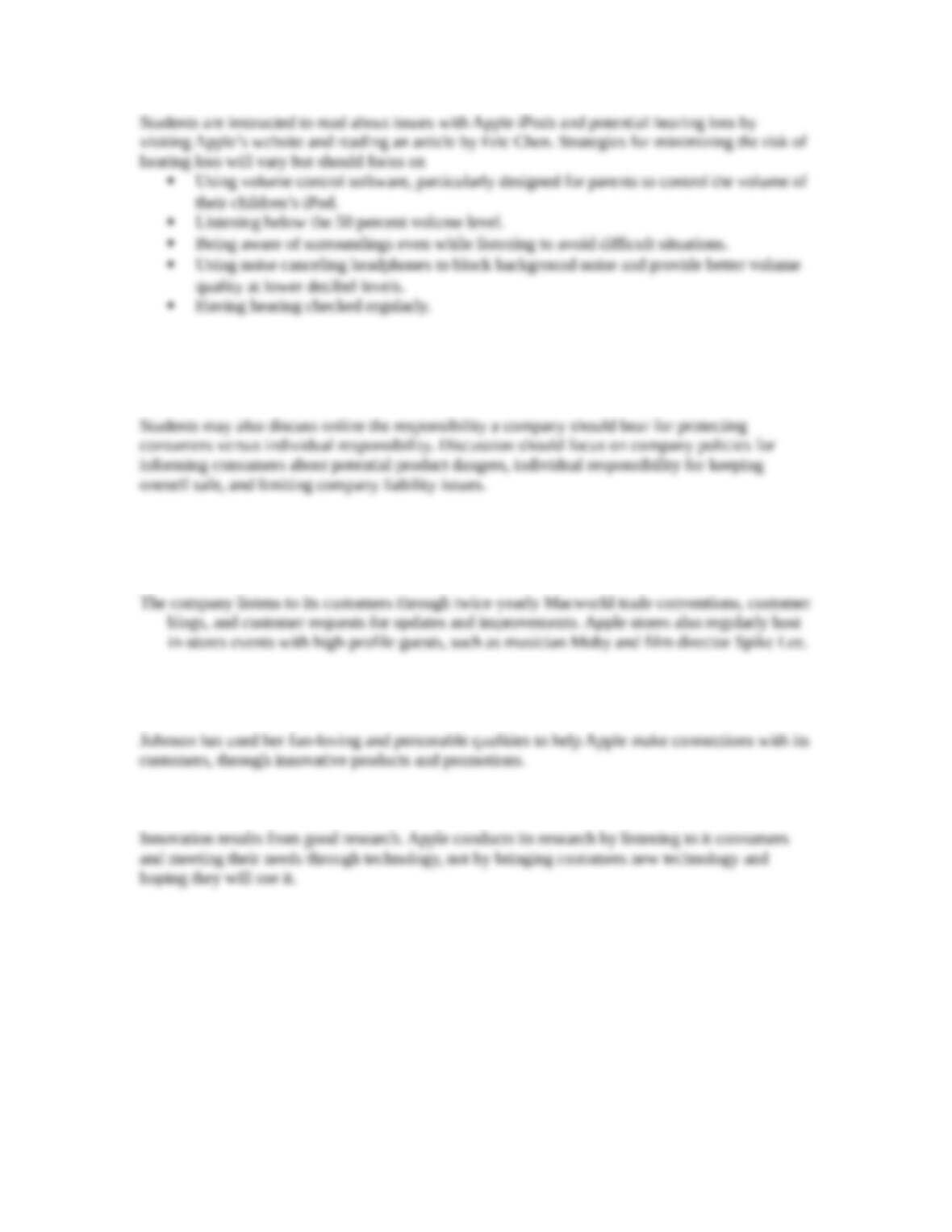
23. Following directions from your instructor, post an online comment that reflects your opinion
as to how much responsibility a company has for protecting consumers versus the
responsibility of the individual for his or her own safety.
24. How has Johnson’s perception of today’s consumer as “a generation that values involvement,
authenticity, fun, humor, and genuine connection” been reflected in the iPod product design
and promotion?
25. How has Johnson effectively combined her communication skills of being fun-loving and
personable with her adeptness at marketing brands and herself?
26. How is innovation at Apple related to the research process?
© 2015 Cengage Learning. All Rights Reserved. May not be scanned, copied or duplicated, or posted to a
publicly accessible website, in whole or in part.
10