REVIEW QUESTIONS & SUGGESTED ANSWERS
1 List the writing principles that are important in writing an effective persuasive
message.
2 What are the legal and ethical implications of persuasive messages?
Ethically, the writer should guard against becoming overzealous and painting less-than-accurate
1. Define “central selling feature.” Where should it appear in a persuasive message?
A “central selling feature” is the one idea that is stressed throughout the message. It is to the
2. What are the characteristics of a good attention-getter? List five techniques for getting
receivers’ attention.
A good attention-getter (a) is related to the product/service/idea and its virtues, (b) introduces a
3. What types of words and phrases are effective in persuasive messages?
4. In addition to the general guidelines for sales messages, what specific guidelines apply to
sales-oriented email messages?
Sales-oriented email messages should (1) be sent only when solicited (permission based), (2)
© 2015 Cengage Learning. All Rights Reserved. May not be scanned, copied or duplicated, or posted to a
publicly accessible website, in whole or in part.
1
5. How should price be handled in a sales message?
Effective techniques for presenting the price include the following: (a) introduce price after
6. Describe the characteristics of an effective action ending to a persuasive message.
7. What is meant by an “appeal” in a persuasive message?
8. When does one cross the line between being persuasive and being coercive or
overbearing?
9. How might a persuasive approach need to be modified when dealing with persons of
other cultures?
FEATURED ASSIGNMENTS
1Grading Junk Mail: Collect a selection of marketing materials from a variety of companies
and read over them. One way to do this is collect junk mail for a week. Once you have a
significant amount of marketing content, you should analyze a selection of 6 to 10 items and
determine how well each one uses the inductive approach. Assign each piece a grade as to
how persuasive it is and present your most and least persuasive materials to the class.
10. Channel, Medium, and Persuasive Messages: Think about situations you have experienced
for which writing a persuasive message would have been appropriate. Draft a list of
© 2015 Cengage Learning. All Rights Reserved. May not be scanned, copied or duplicated, or posted to a
publicly accessible website, in whole or in part.
2
situations past or present and select one to use as the basis of this writing activity. Write your
message to the appropriate recipient and specify the channel and medium you would use.
11. Persuasive Messages and the Inductive Approach: Identify a situation in which you need to
create a persuasive message. For example, you might be looking for volunteers for a
particular organization, need to persuade an advisor about a paper topic, or want to
convince a friend to share an apartment. Once you identify their situation, craft a persuasive
speech to deliver to the class.
12. Persuasive Request: Company Logo: It’s Time for a Change: In groups of three to four,
read the following scenario and then complete the related exercise: Company logos are often
the centerpiece of advertising and a crucial tool for developing consumer recognition. Do
you recognize the logos of Nike or McDonald’s? Companies sometimes change their logos to
project a new image or to give the logo a contemporary look.
ADDITIONAL ASSIGNMENTS
1Communication Success Stories: Conduct an electronic search to locate an article that deals
with the successful use of persuasive communication in a company or organization. Prepare
an abstract of the article that includes the following parts: (1) article citation, (2) name of
organization/company, (3) brief description of communication technique/situation, (4) and
outcome(s) of the successful communication. As an alternative to locating an article, write
about a successful communication situation in the organization/company for which you work.
Submit your abstract to your instructor as an email attachment. Be prepared to give a short
presentation in class.
© 2015 Cengage Learning. All Rights Reserved. May not be scanned, copied or duplicated, or posted to a
publicly accessible website, in whole or in part.
3
13. Promoting a Service Message: Music Video. Read the scenario below, then complete the
activity that follows.
Poor Example:
Problems with response:
Revised Example:
© 2015 Cengage Learning. All Rights Reserved. May not be scanned, copied or duplicated, or posted to a
publicly accessible website, in whole or in part.
4
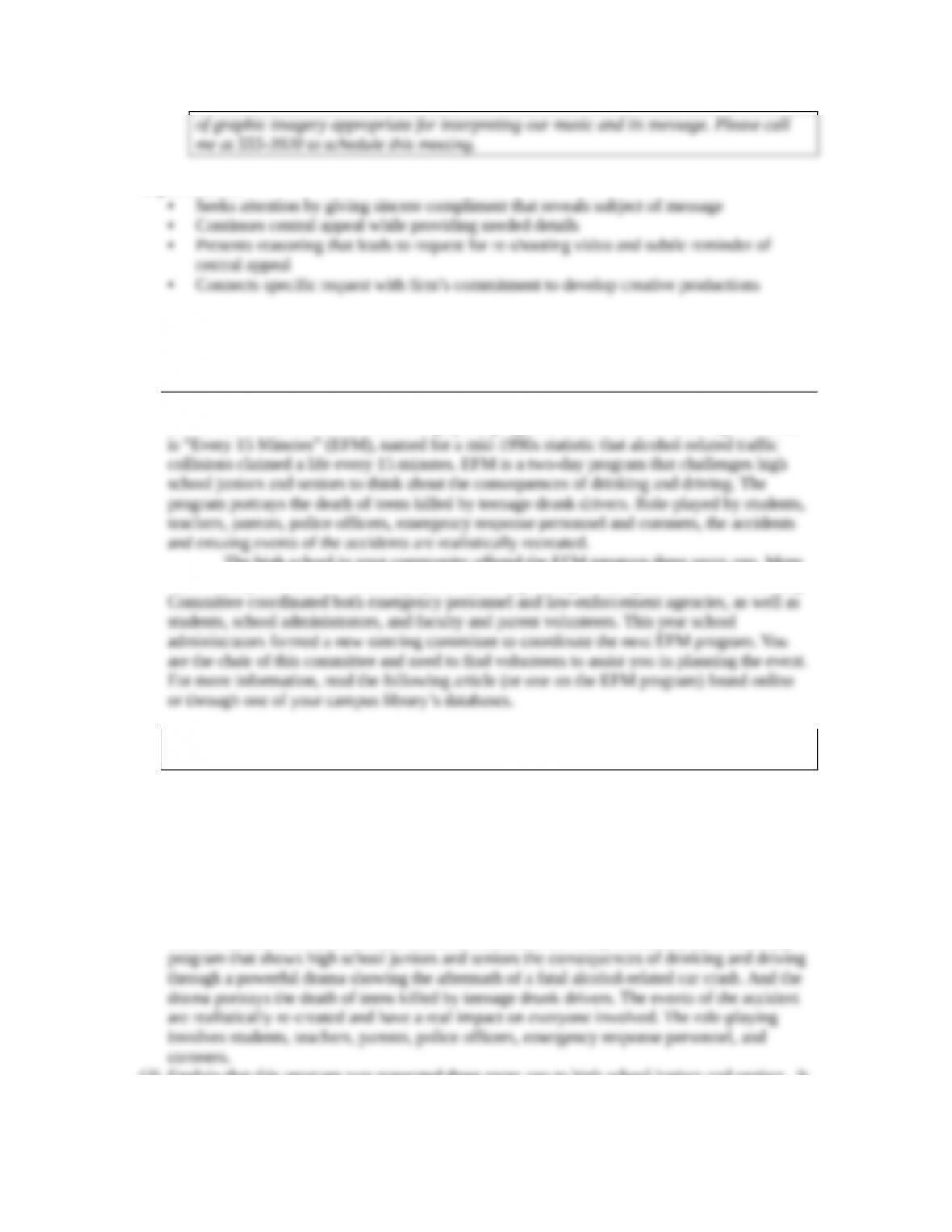
Improvements:
14. Persuasive Message Promoting a Program: (Q) What Happens Every 15 Minutes? (A)
Fatal Alcohol-Related Car Crash: Read the scenario below, then complete activity that
follows.
Educational efforts about the effects of drinking and driving have positively affected high
school students in the last decade. One popular program, tailored to individual high schools,
The high school in your community offered the EFM program three years ago. More
than 70 people from the community spent a year organizing this program. The EFM Steering
Insurance company helps police teach teens about the dangers of drinking
and driving. (2005, December 27). The Auto Channel.
Develop a script for the first meeting of volunteers explaining the importance of the EFM
program.
The script should follow this general pattern:
(1) As chair of this E15M Steering Committee, thank the volunteers for their willingness to plan
the two-day program.
(2) Relate facts about the program. Every 15 Minutes (EFM) was named for a mid-1990s
statistic that alcohol-related traffic collisions claimed a life every 15 minutes. It’s a two-day
(3) Explain that this program was presented three years ago to high school juniors and seniors. It
was very successful and sent a strong message to our students who talked about it for weeks
© 2015 Cengage Learning. All Rights Reserved. May not be scanned, copied or duplicated, or posted to a
publicly accessible website, in whole or in part.
5
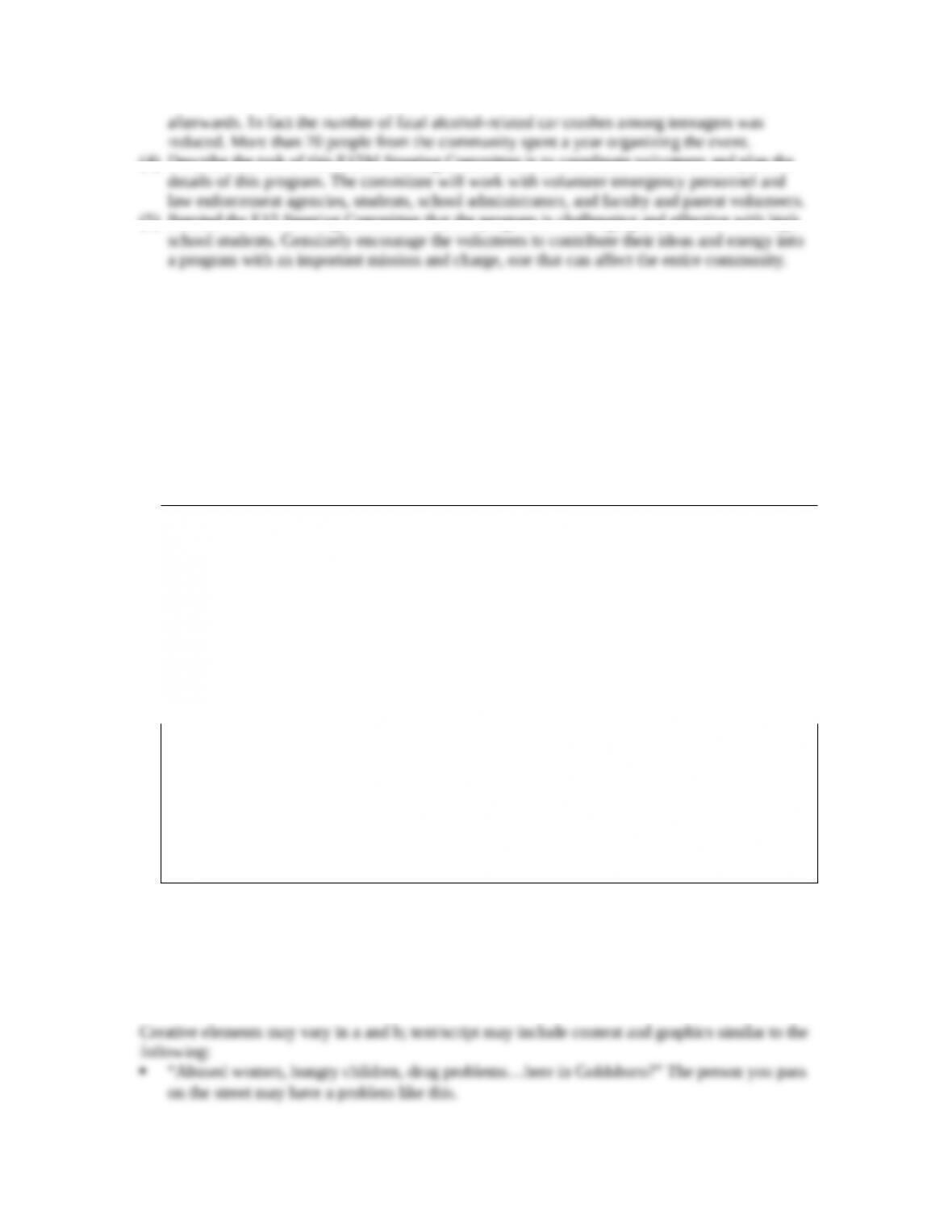
(4) Describe the task of this E15M Steering Committee is to coordinate volunteers and plan the
(5) Remind the E15 Steering Committee that the program is challenging and effective with high
15. Persuasive Claim: Your Dilemma: Identify a situation in which you believe an adjustment
is warranted but you doubt the company will comply without persuasion. Perhaps a retailer
has already refused to make an adjustment, but you believe the manufacturer should be
informed of your dissatisfaction. Write the claim letter to the appropriate recipient.
Student responses will vary, but should follow the guidelines of persuasive messages from the
chapter.
16. Persuasive Request Promoting a Service: “Loaned Executives” Raise Funds: Read the
scenario below, then complete activities a through c, which follow.
United Way started in 1887 as an effort to coordinate fund-raising activities among local
charitable organizations. Today, United Way helps many communities raise funds for local
charitable needs. It coordinates fund-raising activities among local health and human service
organizations. United Way contributions help communities provide resources to those in
need; for example, meals to the homebound, women shelters, drug and alcohol rehabilitation,
after-school programs, and counseling. The funds collected locally by United Way
fund-raising efforts positively impact each community that participates.
Local businesses within communities play a significant role in United Way annual
campaigns to raise funds for distribution to local charities. Many companies encourage
employees to make annual pledges or one-time contributions to the local United Way
campaigns. Some companies even provide volunteers for the “loaned executive” program.
In Goldsboro, North Carolina, 26 loaned executives from local businesses worked to
raise more than $1.3 million by soliciting pledges during a recent United Way fall campaign.
The loaned executive volunteered to lead employee coordinators from four or five businesses
to plan the campaign within each company. These coordinators helped organize employee
meetings and rallies, and arranged payroll deductions for donations.
Assume you are the United Way board president for Goldsboro, North Carolina.
Fifteen loaned executives from last year’s campaign have volunteered to help again for this
year’s campaign. You need 11 more executives.
Activities:
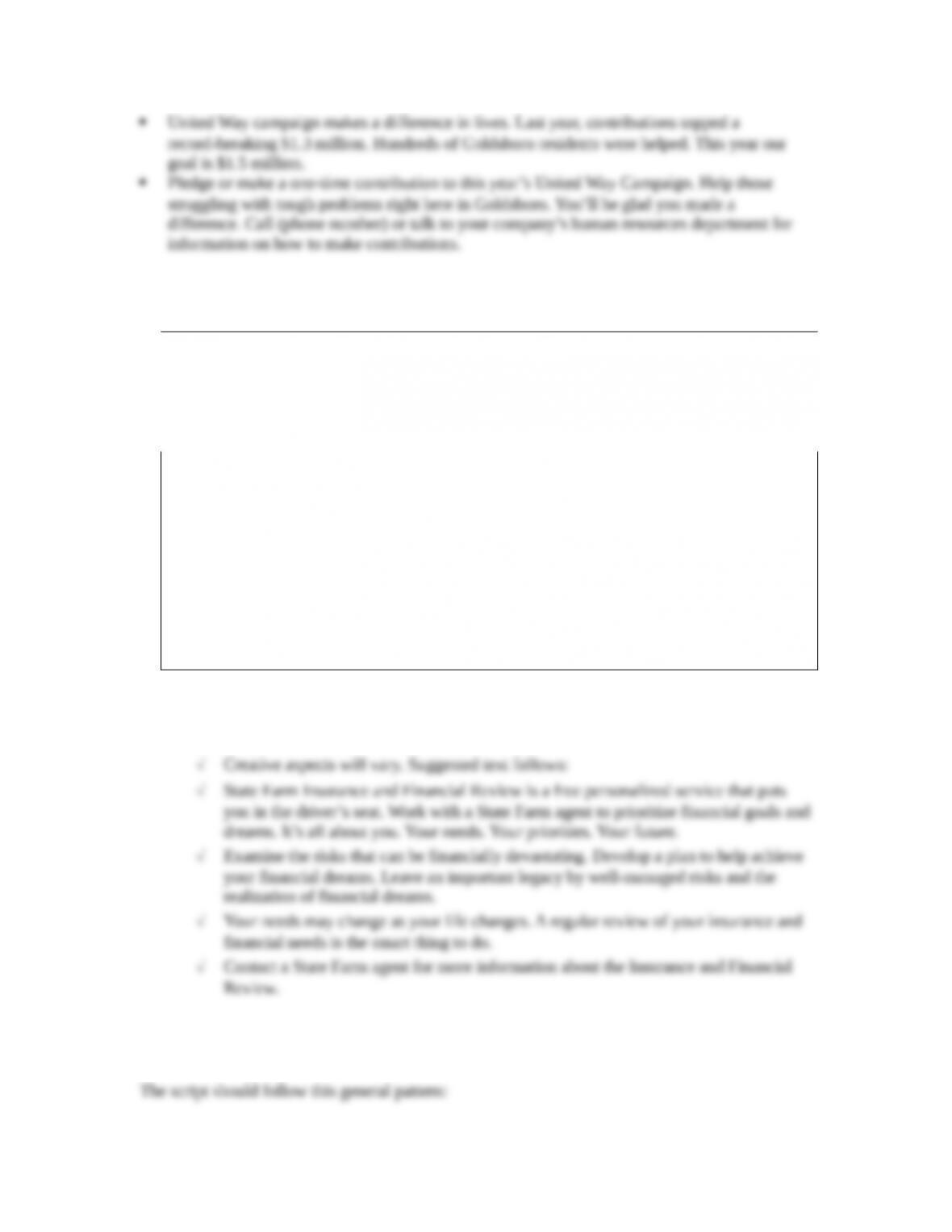
a. Develop a 30-second Public Service Announcement for your community’s
United Way campaign.
b. Develop an advertisement to appear in your local newspaper for this year’s
United Way campaign.
© 2015 Cengage Learning. All Rights Reserved. May not be scanned, copied or duplicated, or posted to a
publicly accessible website, in whole or in part.
6
17. Sales Message Promoting a Product: Achieve Financial Goals with State Farm: Read the
scenario below, then complete the activities that follow.
Many banks and insurance companies market a wide selection of customer services. This now
requires bank officers and insurance agents to be well versed in marketing products other than
traditional bank and insurance products. These employees need current, up-to-date
information on all company products so that they can market them to customers. In fact,
performance evaluation and employee income may be based on the number of products sold
for the bank or insurance company.
State Farm Insurance is one of many insurance companies that offer products and
services other than insurance policies. Insurance agents for State Farm may help customers
plan for retirement, save for college, budget, plan their estate, develop savings strategies, and
learn prevention/safety information. The State Farm mission, as noted on its website, is to
“help people manage risks of everyday life, recover from the unexpected and realize their
dreams.”
State Farm Insurance offers its customers a free personalized Insurance and Financial
Review to help them plan their financial future. Many customers who receive this
personalized review choose State Farm products and services to help them achieve financial
planning goals. Go to the official State Farm website (www.statefarm.com) for additional
information.
Activities:
a. Design an ad for your local newspaper promoting State Farm Insurance
products and services.
b. Develop a telephone script that responds to a customer’s request for
information on financial planning services.
© 2015 Cengage Learning. All Rights Reserved. May not be scanned, copied or duplicated, or posted to a
publicly accessible website, in whole or in part.
7
18. Persuasive Claim for Replacement Product: No One Wants Another Bum Cell Phone:
Read the scenario below, then complete activities that follow.
Many families purchase a “family plan” from cell phone service providers. This plan is
particularly convenient and cost effective for parents with college students. Long-distance
phone charges are eliminated. Family members can easily stay in touch with each other. You
are a college student, and your family recently purchased the family cell phone plan from
Radio Shack before you left for college. The contract is for a two-year period and includes an
upgrade on phones within 18 months. A penalty of $150 is charged for cancellation of the
contract.
The college student recently took the phone to a Radio Shack retail store for repair
because the volume could not be adjusted high enough to hear conversations. Radio Shack
shipped the phone to the service center, and the service center said that it cannot be repaired.
The model is discontinued and not available for new contracts because “there were problems
with the model.” However, the corporate policy states that the defective phone cannot be
replaced with a new model free of charge; the replacement phone must be the old model. The
customer is infuriated, saying “It’s unacceptable that the company would expect me to put up
with another ‘bum’ phone.”
Activities:
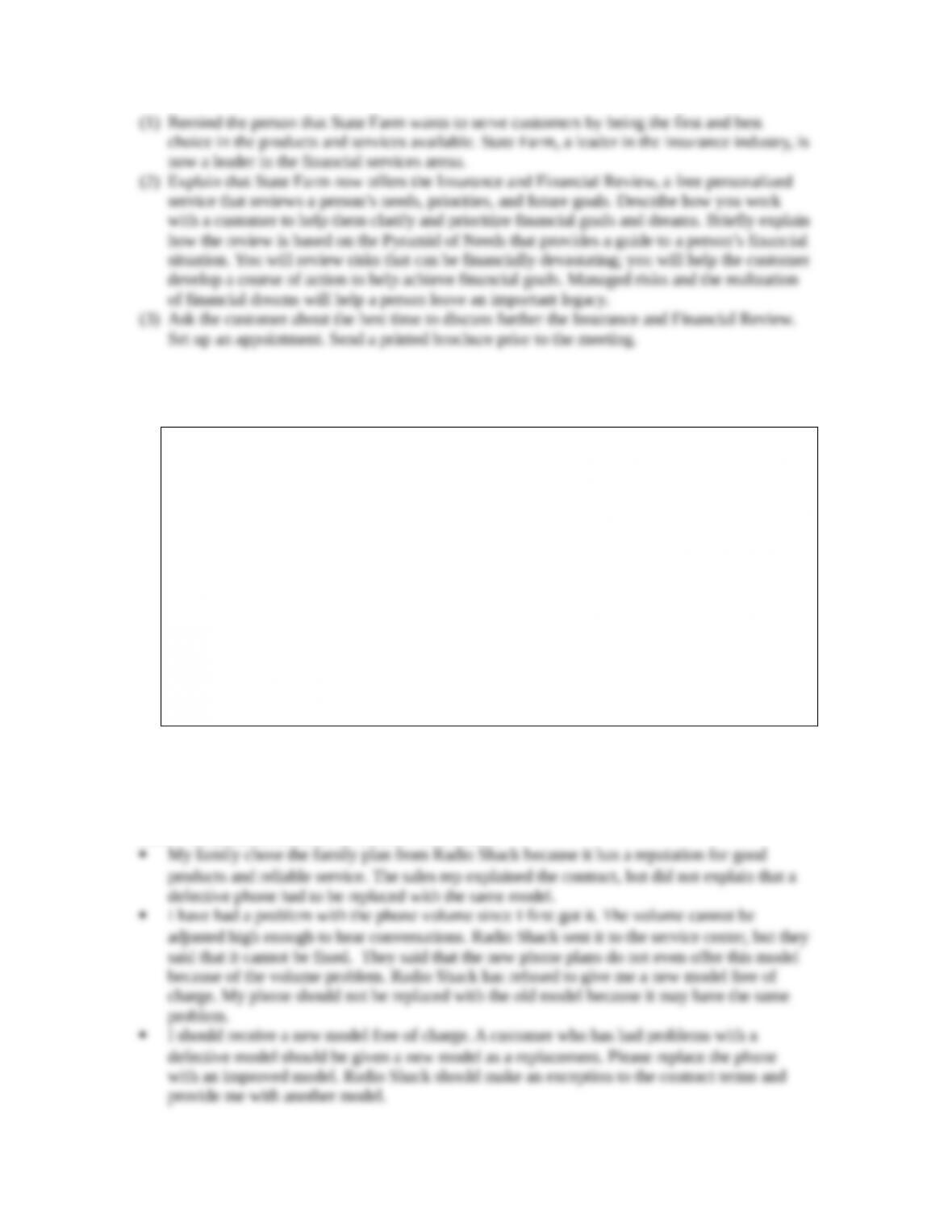
a. Develop a script for a phone conversation with (a) Radio Shack asking for a
phone replacement and/or (b) your parents explaining the problem.
Below are possible elements of student voice scripts:
© 2015 Cengage Learning. All Rights Reserved. May not be scanned, copied or duplicated, or posted to a
publicly accessible website, in whole or in part.
8
19. Sales Message: Practicing Sales Pitches: Form groups of two and select a tangible item
from a collection provided by your instructor or one of your own choice (your PDA, purple
stapler, nifty white-out pen, cool backpack, or favorite t-shirt or accessory, etc.). Then,
complete activities a and b below.
Activities:
a. Designate one member of the team as the buyer and one as the seller. The
seller will present a compelling sales pitch for the item to the buyer focusing on an
appropriate central appeal and convincing evidence. Following the sales pitch, the buyer
will give friendly feedback for making the pitch more convincing. Reverse roles except
the buyer will sell himself/herself as a potential employee of the company that makes the
item. Again, share friendly feedback for improving the presentation and discuss
differences you encountered in selling a product versus promoting yourself. Be prepared
to share your experiences with the class.
Evaluating the sales pitch:
Evaluating buyer feedback:
b. Use the experience gained from the previous activity to deliver a one- to
two-minute sales pitch on a pet project or idea you genuinely support. Choose at least
three points that prove your case.
In one-way sales pitch to the class, observe:
© 2015 Cengage Learning. All Rights Reserved. May not be scanned, copied or duplicated, or posted to a
publicly accessible website, in whole or in part.
9
20. Tackling Your Own Persuasion Challenge: Read the scenario then do the activity that
follows.
In small groups, identify a situation in your work, educational experience, or school and
community organizations that requires persuasion. How are you uniquely qualified for a
scholarship, award, internship, admission into graduate school or honorary organization, or
election to an officer position in a student or community organization? Could a fund-raising
event for a student organization or class project benefit from the development of a sales letter
and flyer? What changes could enhance services or operations on your campus (e.g., increase
number of concerts offered each semester, expand campus shuttle routes to locations off
campus, extend hours of operation for computer labs, etc.)? How could a change in a
procedure improve the quality and efficiency of your work? How could a particular software,
training program, or equipment improve your job effectiveness? Why should you be
promoted or your present job reclassified to a level of higher responsibility?
Group Activity:
As a group, write an out line of the persuasive message to the appropriate person, convincing
him or her to accept your idea or take the action you have recommended. Make a brief
presentation to the class.
CASE ASSIGNMENT
HOW TO GET OFF THE LISTS
Summary
The case addresses the problem of annoying and invasive problems caused to consumers by
solicitation calls and junk mail. Suggestions are provided for minimizing the intrusion through
proactive measures and application of legal protection.
Case
The solicitation phone call interrupts dinner once again. The mailbox and the email inbox are
stuffed with the usual array of junk mail. What can consumers do about these unwelcomed
contacts? Nine out of ten households have received at least one telemarketing call, according to
the American Teleservices Association, an industry trade group. By some estimates, telemarketers
make 18 million calls a day, or 12,500 a minute. Additionally, consumer mailboxes are crowded
with catalogs, sweepstakes offers, and credit card solicitations. The U.S. Postal Service reports
that the average household gets 10 pieces of unsolicited third-class mail each week. All that is
necessary to get on solicitation lists is to get a credit card, open a checking account, or complete a
survey. But there are ways to get off the lists:
© 2015 Cengage Learning. All Rights Reserved. May not be scanned, copied or duplicated, or posted to a
publicly accessible website, in whole or in part.
10
Opt out. The first step in preventing unwanted calls and mail is to “opt out” of sales lists
Maintain privacy. Though you might enjoy ordering from home, remember that companies
Be persistent. Laws do not prevent a company from sending you mail, unless it is
Know the law. Even after removing your name from sales lists, you may still get calls from
Follow through. Keep a log near the phone to document calls. Write down the telemarketer’s
name, company, and time of call. If you haven’t done business with them before,
© 2015 Cengage Learning. All Rights Reserved. May not be scanned, copied or duplicated, or posted to a
publicly accessible website, in whole or in part.
11
Protect yourself. Legally speaking, salespeople are not allowed to lie. Under the Federal
Trade Commission’s Telemarketing Sales Rule, callers must disclose the company’s identity,
the purpose of the call, the product or service offered and any requirements for obtaining it. If
a telemarketer won’t do those things, hang up. To determine whether a telemarketer or mail
offer is fraudulent, contact the NFIC at 800-876-7060 or visit them at http://www.fraud.org.
You can also check with your local consumer protection agency or Better Business Bureau.
Activities
1 Prepare a presentation that describes current legal provisions that address the problem of
unsolicited telephone calls, mailings, and email. Make recommendations for enforcement of
existing laws and/or the passage of further legal requirements.
21. Discuss the challenges faced by telemarketers. Prepare a list of suggestions for phone
solicitors to aid them in completing more successful contacts.
22. Prepare a short paper in which you argue for the right of sellers to offer products and
services via telephone, mail, or email.
© 2015 Cengage Learning. All Rights Reserved. May not be scanned, copied or duplicated, or posted to a
publicly accessible website, in whole or in part.
12