REVIEW QUESTIONS & SUGGESTED ANSWERS
1 Explain the appropriate channel and outline for a message that conveys bad news.
Under what conditions would a writer be justified in choosing an alternate outline or
channel?
The outline for bad-news messages is as follows: (a) begin with the neutral idea that leads to the
When possible, bad news should be conveyed face-to-face because this channel allows
1. What three functions does the first paragraph of a bad-news message serve? Does “i am
responding to your letter of the 25th” accomplish both of these functions? Explain.
The first paragraph (a) lets the receiver know what the letter is about (without stating the obvious)
2. Discuss how a counterproposal and implication can be used to de-emphasize the
bad-news statement to assist a communicator in achieving the human relations goal of
business communication.
3. What objectives should the final paragraph accomplish? Should the closing sentence
apologize for action taken? Should it refer to the statement of refusal to achieve unity?
Explain.
The final paragraph (a) de-emphasizes the unpleasant part of the message, (b) conveys some
© 2015 Cengage Learning. All Rights Reserved. May not be scanned, copied or duplicated, or posted to a
publicly accessible website, in whole or in part.
1
4. In which part of a refusal message would resale and sales promotional material be most
appropriate? Explain.
5. Discuss the legal implications involved in writing credit refusals.
The Equal Credit Opportunity Act (ECOA) requires that the credit applicant be notified of the
6. What elements make criticism “constructive”?
7. Why is the effective handling of negative information of such importance to a company?
8. Saying “no” is not difficult; the challenge is to do so while protecting goodwill. Explain
the rationale and significance of this statement.
Giving a receiver bad news is generally easy when the sender does not care about the receiver’s
9. Frequent channels for delivering business messages include written, electronic, and
face-to-face means. What criteria would you use in selecting the appropriate channel for
delivering bad news?
FEATURED ASSIGNMENTS
1 Communication Success Stories: Conduct an electronic search to locate an article that
deals with successful negative communication in a company or organization. Prepare an
© 2015 Cengage Learning. All Rights Reserved. May not be scanned, copied or duplicated, or posted to a
publicly accessible website, in whole or in part.
2
abstract of the article that includes the following parts: (1) article citation, (2) name of
organization/company, (3) brief description of communication technique/situation, and (4)
outcome(s) of the successful communication. As an alternative to locating an article, you
could write about a successful communication situation in the organization/company for
which you work. Be prepared to present your abstract in a memo and give a short
presentation in class.
10. Rejecting an Employee’s Suggestion: Read the following scenario and complete the related
exercise.
11. Bad-News Speeches: Refer to a recent political or business event in which bad news was
shared and prepare a written critique that includes (1) an assessment of the effectiveness of
the message and the manner in which it was delivered, (2) an analysis of the results, and (3)
a summary of what you learned from your analysis. Be prepared to share your critique with
the class in a brief presentation.
12. Critique of Bad-News Messages Produced by Real Companies: Locate an example of both a
well-written and a poorly written bad-news message and analyze the strengths and
weaknesses of each document. Prepare a visual of each and present your critique to the class.
Student content will vary.
13. Loan Denied for Poor Credit Customer: Assemble in groups of three to four and read the
following scenario and complete the related exercise.
As a group, develop a voice script explaining how you intend to deliver this negative news to
your customer.
ADDITIONAL ASSIGNMENTS
1Training for Employee Sensitivity: a Priority at Wilson Street Grill: Read the following
scenario, then complete activities a through c.
The Wilson Street Grill in Madison, Wisconsin, is one of many restaurants that have
successfully hired employees with mental disabilities. The federal Americans with
The Wilson Street Grill is no exception; more than one third of its employees have a
disability. All new employees receive orientation and training, which includes information on
As manager of the Wilson Street Grill, you recently hired Jonathan, who completed his
orientation a month ago. He regularly works with Sue, a mentally disabled employee with
a. Write a memo to Jonathan that will be placed in his personnel file. The memo should
adequately warn Jonathan about the consequences of his behavior and should contain
relevant facts to explain the law. Visit your campus library to complete additional
© 2015 Cengage Learning. All Rights Reserved. May not be scanned, copied or duplicated, or posted to a
publicly accessible website, in whole or in part.
4
research on the Americans with Disabilities Act so that you understand how this law
impacts management.
b. Develop a voice script that could be used by the manager for delivering this warning and
constructive criticism to Jonathan. Your instructor may ask you to role play your
conversation with another student in the class.
Student responses will vary but should follow these guidelines:
(1) Remind Jonathan that The Wilson Street Grill has a history of providing excellent work
(2) Review the federal Americans with Disabilities Act with Jonathan. The importance of
(3) Suggest that he observe how other employees relate positively to their co-workers who have
c. In a small group, produce a short video presentation that could be shown to new hires at
The Wilson Street Grill on working with those who have disabilities.
The video might start with a short bulleted list that explains the highlights of the Americans with
14. Employee Bad News: An Employee Video/Computer Lounge: Read the scenario below
before completing the related writing activity that follows.
Example of Poor Response:
Subject: No Employee Video/Computer Lounge
© 2015 Cengage Learning. All Rights Reserved. May not be scanned, copied or duplicated, or posted to a
publicly accessible website, in whole or in part.
5
Employees have requested the construction of a video/computer lounge where employees
can relax and check on personal email and computer work during their breaks. Write a
short memo denying this request. Consider a counterproposal or alternative idea to the
employees’ request.
separate area for these video breaks would be exorbitant. Our vice president would never
agree to spend money on this right now.
I will try to convince management to allow a fifteen-minute time frame every day for
personal Internet use within certain parameters, but you should not get your hopes up.
Weaknesses in response:
Improved Response:
Subject: No Employee Video/Computer Lounge
How can you even consider asking for our company to fund a video game/computer
lounge for employees?! Our employees are here to work, not to play.
Allowing our employees time with video games and unmonitored computer use goes
against every management principle I’ve ever learned. Employees should conduct their
personal computer business on personal time and use their spare time at home to play
video or computer games. An office is for work, not play. Besides, the cost of installing a
separate area for these video breaks would be exorbitant. Our vice president would never
agree to spend money on this right now.
I will try to convince management to allow a fifteen-minute time frame every day for
personal Internet use within certain parameters, but you should not get your hopes up.
Josie, in response to your idea, I have submitted a request to management that we
consider adding an “e-break” to our company Internet policy that will allow employees
to use the traditional 15-minute coffee break time to conduct personal business on their
computers or play short games likes Solitaire or Minesweeper. The article you sent me
last month provided some good research to support this idea. Let’s see how this goes, and
we will revisit the employee video game/computer lounge idea in the future.
Improvements in response:
© 2015 Cengage Learning. All Rights Reserved. May not be scanned, copied or duplicated, or posted to a
publicly accessible website, in whole or in part.
6
15. Constructive Criticism: Food Critic Gives Restaurant Thumbs Down: Read the following
scenario, then develop a full sentence outline below.
Student responses will vary, but a sample outline appears below:
I. Start the conversation with a neutral or positive opening.
II. Emphasize the important qualities of good restaurant service.
III. Provide additional training for Angelica.
© 2015 Cengage Learning. All Rights Reserved. May not be scanned, copied or duplicated, or posted to a
publicly accessible website, in whole or in part.
7
One of the Downtown Disney restaurants in Orlando, Florida, is Bongos Cuban Café
created by Gloria Estefan and her husband Emilio. Like many Disney restaurants, Bongos
Angelica is a new server from Brazil who has worked for a month at the Disney location
of Bongos Cuban Café. Although Angelica seems to communicate well with customers,
In the letter, the customer demands a credit for the cost of the total bill, which is about
$120 for the party of four. Most important, the customer is a food critic for a travel
IV. Summary
16. Adjustment Refusal: No Sympathy for Bank Customer with “Bounced Checks”: Read the
scenario below then complete the written activity that follows.
Banks that are located near universities frequently compete with each other to attract college
Many college students may be opening a checking account for the first time. Often these
students may not understand the responsibilities of handling a checking account or may fail to
Rachel is a new college freshman, living away from home for the first time. She has opened a
checking account with Regions Bank. During the first two months of the semester, she wrote
Activity:
17. Adjustment Refusal: Airline Passenger Struggles with Online Ticketing: Read the scenario
below, then respond to the customer in question with an email that explains the problem and
proposes a solution.
Most airline passengers who travel frequently are accustomed to booking their flights online
using one of the many available websites, such as Orbitz.com, Travelocity.com, Expedia.com,
© 2015 Cengage Learning. All Rights Reserved. May not be scanned, copied or duplicated, or posted to a
publicly accessible website, in whole or in part.
8
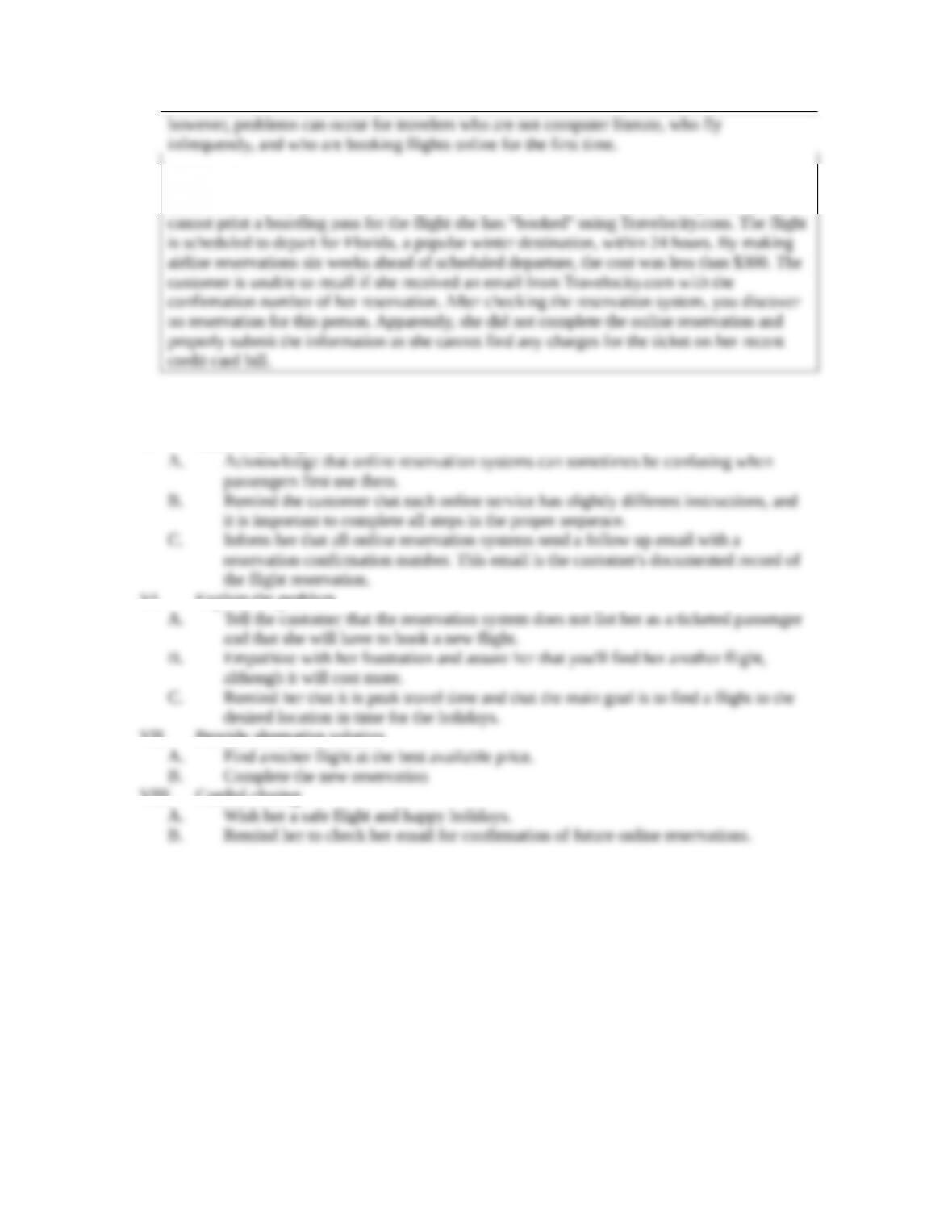
online sites. Today you receive a call from a customer who is frantic and complains that she
Responses will vary but should follow these guidelines:
V. Neutral opening to start conversation
VI. Explain the problem
VII. Provide alternative solution
VIII. Cordial closing
CASE ASSIGNMENT
ANONYMITY IN CYBERSPACE
Do you have a right to anonymity in cyberspace? Should you have this right? Two current views
prevail about the right of anonymity. One view sees it as limiting the free flow of information; by
having a wealth of information available, people can communicate, shop, and conduct business
with ease. Access to information allows you to find a friend’s email address that you had
forgotten or to track down an old friend in another city. The opposing view sees the right to
anonymity as a protection of individual privacy; without anonymity, unidentified parties can track
where you go in cyberspace, how often you go there, and with whom you communicate. At the
present time, you are typically required to reveal your identity when engaging in a wide range of
© 2015 Cengage Learning. All Rights Reserved. May not be scanned, copied or duplicated, or posted to a
publicly accessible website, in whole or in part.
9
activities. Every time you use a credit card, email a friend, or subscribe to an online magazine, an
identifiable record of each transaction is created and linked to you. But must this always be the
case? Are there situations where transactions may be conducted anonymously, yet securely?
Several methods currently exist for surfers to protect their anonymity in cyberspace:
Anonymous remailers: A completely anonymous remailer, or chain remailer, sends mail
through remailing locations. Each location takes the header information off the mail and
sends it to the next location. When the mail gets to its final destination, the recipient has no
idea where the mail originated. What makes the system truly anonymous is that the remailing
locations that the message goes through typically keep no records of the mail that comes in or
goes out. This procedure makes the mail impossible to track.
Pseudo-anonymous remailers: These single remailers work similarly to the chain remailer.
The mail is sent to a remailing location, the header information is stripped at this site, and the
mail is forwarded to its final destination. As with the chain remailer, the recipient has no idea
where the mail originated. What makes the single remailer pseudo-anonymous is the fact that
single remailers typically keep records of the mail that comes into and goes out of their
systems. This procedure makes the mail traceable.
Pseudonymity: This process consists of sending mail through cyberspace under a false name.
Like the single remailer, the recipient will not immediately know who the mail came from,
but the mail is completely traceable.
Anonymizer website: By visiting http://www.anonymizer.com, you can learn how to stop
any specified website from gathering information on you. When you use the anonymizer
software to access a particular website, the anonymizer goes to that website for you, grabs the
information, and sends you the information from the site. As far as the website knows, it has
been contacted only by the anonymizer website. This secures your transactions and keeps
“nosy” websites from gathering information on you.
In spite of consumer interest in protecting anonymity, the federal government opposes total
anonymity due to legitimate interests that are at stake. If total anonymity existed, the government
would be unable to track down people who use cyberspace to violate the laws of libel,
defamation, and copyrights.
Sources: M Kim, “The Right to Anonymous Association in Cyberspace: US Legal Protection for Anonymity in Name,
in Face, and in Action”, (2010) 7:1 SCRIPTed 51, http://www.law.ed.ac.uk/ahrc/script-ed/vol7-1/kim.asp; Makeever,
J.J. (1996, October 3). Privacy and anonymity in cyberspace. A law of cyberspace?
http://host1.jmlx.edu/cyber/1996/r-priv.html.
Activities
1. Locate an article on the issue of online anonymity. Print out the article and prepare a
two-page abstract that includes the following sections: (1) reference citation, (2) overview,
(3) major point, and (4) application.
2. Prepare a chart that summarizes the advantages and the disadvantages of online anonymity.
© 2015 Cengage Learning. All Rights Reserved. May not be scanned, copied or duplicated, or posted to a
publicly accessible website, in whole or in part.
10

3. Take a position on the anonymity issue, either to support the right to anonymity or to defend
the need for identification. In writing, present a defense of your position, giving reasons
and/or evidence.
© 2015 Cengage Learning. All Rights Reserved. May not be scanned, copied or duplicated, or posted to a
publicly accessible website, in whole or in part.
11