REVIEW QUESTIONS & SUGGESTED ANSWERS
1 List the steps in the deductive outline recommended for good- and neutral-news
messages.
1. Discuss guidelines for communicating with an international audience.
2. What suggestions will contribute to a warm, genuine tone in a thank-you or
appreciation messages?
3. Explain how claim messages and responses to requests both use the deductive message
pattern.
4. What is the difference between resale and sales promotional material? Provide an
example of each. Why should resale and sales promotional material be included in an
adjustment letter?
5. Distinguish between the two major types of request messages, and specify the outline
preferable for each type.
© 2015 Cengage Learning. All Rights Reserved. May not be scanned, copied or duplicated, or posted to a
publicly accessible website, in whole or in part.
1
6. Describe the procedure typically used by companies to acknowledge orders. Provide
three situations when sending an individualized order acknowledgment would be
appropriate and explain why?
7. Provide suggestions for writing a legally defensible credit information letter.
8. Provide guidelines for writing instructions that can be understood and followed
consistently.
When writing instructions, (a) begin each step with an action statement; (b) itemize each step on a
9. What criteria should be used in determining whether a good- or neutral-news message
would be best communicated on paper, electronically, or verbally?
In determining channel choice, the sender should consider (a) the receiver’s reaction to the
10. What considerations should be given to a message recipient’s culture when planning a
good-news or neutral-news message?
Senders should consider differences in societal values that influence social behavior, etiquette,
FEATURED ASSIGNMENTS
© 2015 Cengage Learning. All Rights Reserved. May not be scanned, copied or duplicated, or posted to a
publicly accessible website, in whole or in part.
2
1Communication Success Stories: Conduct an electronic search to locate an article that deals
with successful communication in a company or organization. Prepare an abstract of the
article that includes the following parts: (1) article citation, (2) name of
organization/company, (3) brief description of communication technique/situation, and (4)
outcome(s) of the successful communication. As an alternative to locating an article, you
could also write about a successful communication situation in the organization or company
for which you work.
Discuss Internet search strategies for the assignment. For instance, talk about full-text databases
11. Read the following routine claim letter. With students, discuss the weaknesses. In groups,
have them revise to improve the letter.
Yesterday evening I stopped by the construction site of the apartments you are under contract
to build. You appear to be well ahead of schedule.
Here’s a revised letter that better follows the suggested format.
Dear Mr. Jackson:
© 2015 Cengage Learning. All Rights Reserved. May not be scanned, copied or duplicated, or posted to a
publicly accessible website, in whole or in part.
3
12. Analyzing Good-News Messages: Find an example of both a well-written and a
poorly-written good-news or routine memo, email message, or letter; analyze the strengths
and weaknesses of each document; and prepare to discuss them in class.
13. Analyzing International Business Messages: Obtain a copy of a business letter written by
someone from another culture. Identify the major differences between this letter and a
traditional U.S. letter. Include information about cultural differences that might be reflected
in the message style. Create a visual of your letter and share your analysis with the class as
directed by your instructor.
After removing identifying information, make visuals of selected letters and memorandums
14. Analyzing Professional Apologies: Professional apologies are inevitable for companies if
they wish to prevent unfortunate situations from undermining even the strongest relationships
with customers, clients, and employees. Use an online database to find articles that provide
information and examples of apologies made by companies or individuals. Then assemble in
groups to write a sample written apology a team member might send for missing an
important team meeting.
Student presentations will vary. Appropriate presentation items might include the timing of the
ADDITIONAL ASSIGNMENTS
1R
e
a
d
the scenario before completing the exercise below:
Poor Example of a Procedural Memo:
TO: All Employees
© 2015 Cengage Learning. All Rights Reserved. May not be scanned, copied or duplicated, or posted to a
publicly accessible website, in whole or in part.
4
You are the HR Director for your company. You live in an earthquake prone area, and
there have been earthquakes in the recent past. You need to provide some procedural
information to company employees, particularly since you work in a high-rise building.
Write a short procedural memo detailing what employees should do in the event of an
earthquake and how you’ll prepare for the event of an earthquake.
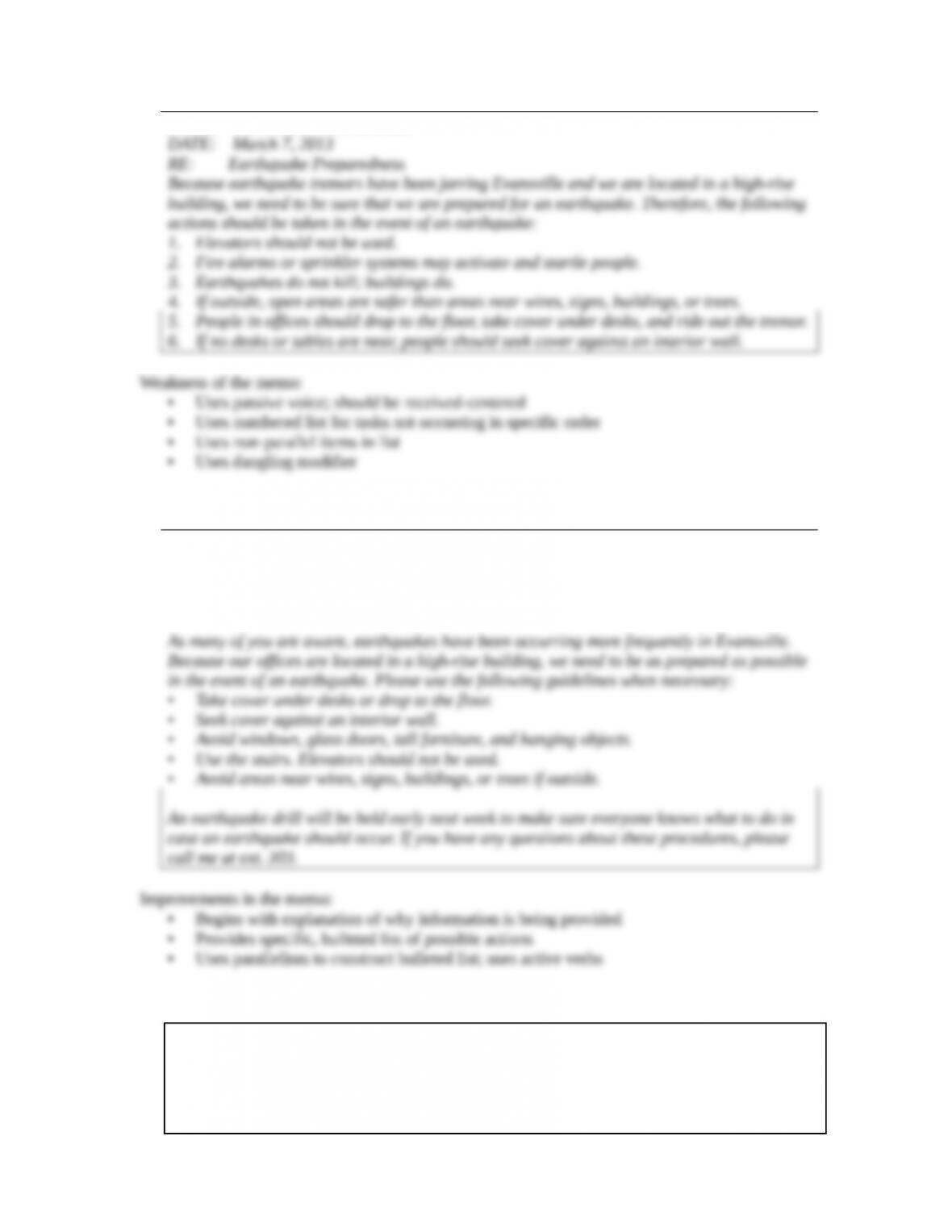
FROM: Joe Brown, HRM Director
Improved Example of a Procedural Memo:
TO: All Employees
FROM: Joe Brown, HRM Director
DATE: March 7, 2012
RE: What Do In Case of Earthquake
15. Read the scenario before completing the exercise below:
© 2015 Cengage Learning. All Rights Reserved. May not be scanned, copied or duplicated, or posted to a
publicly accessible website, in whole or in part.
5
One of your employees, Ren, led a department training effort with a ropes course at Camp
Horizon that was a training success for your department. Write a note of appreciation to him
for the work he did, expressing what you see as the benefit to the staff participating in the
course. Ropes courses typically help individuals learn to deal with limitations, work
together collaboratively, and show how obstacles can be overcome.
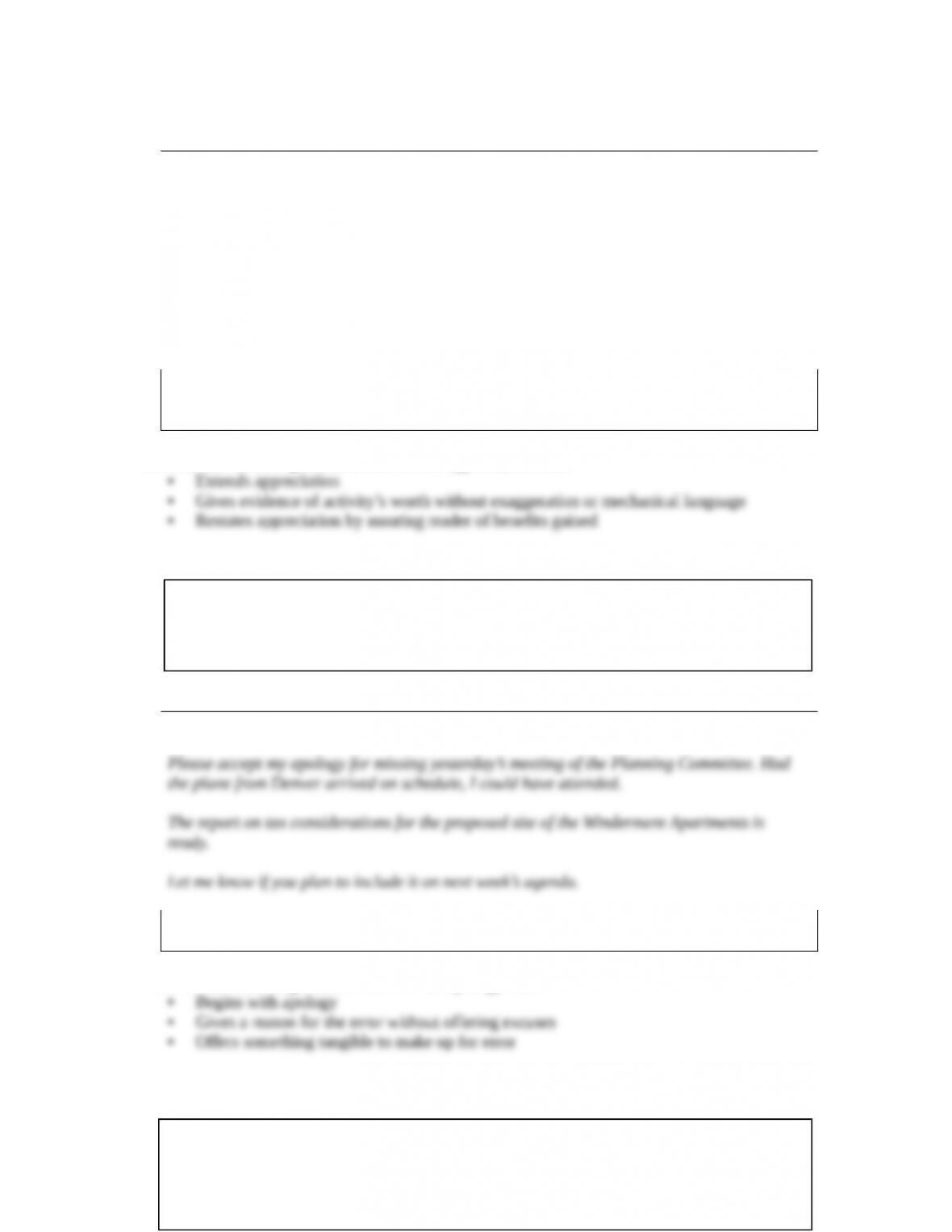
The following is a sample appreciation note:
Appreciation for Outstanding Work
Ren,
Completing the ropes course at Camp Horizon was a memorable and life-changing
experience for every member of our office staff.
Your facilitators were masterful in allowing our teams to take risks while ensuring their
safety. The course provided a diverse series of activities that enabled each staff member to
participate, regardless of our physical limitations. Identifying the real leaders in our office
was quite interesting.
In the words of one colleague, “The ropes course has shown me I can do more than I have
come to expect of myself.” Thank you for helping us see our potential.
Point out the following characteristics of the appreciation note:
16. Read the scenario before completing the exercise below:
Response:
Mike,
Thanks,
Jerry
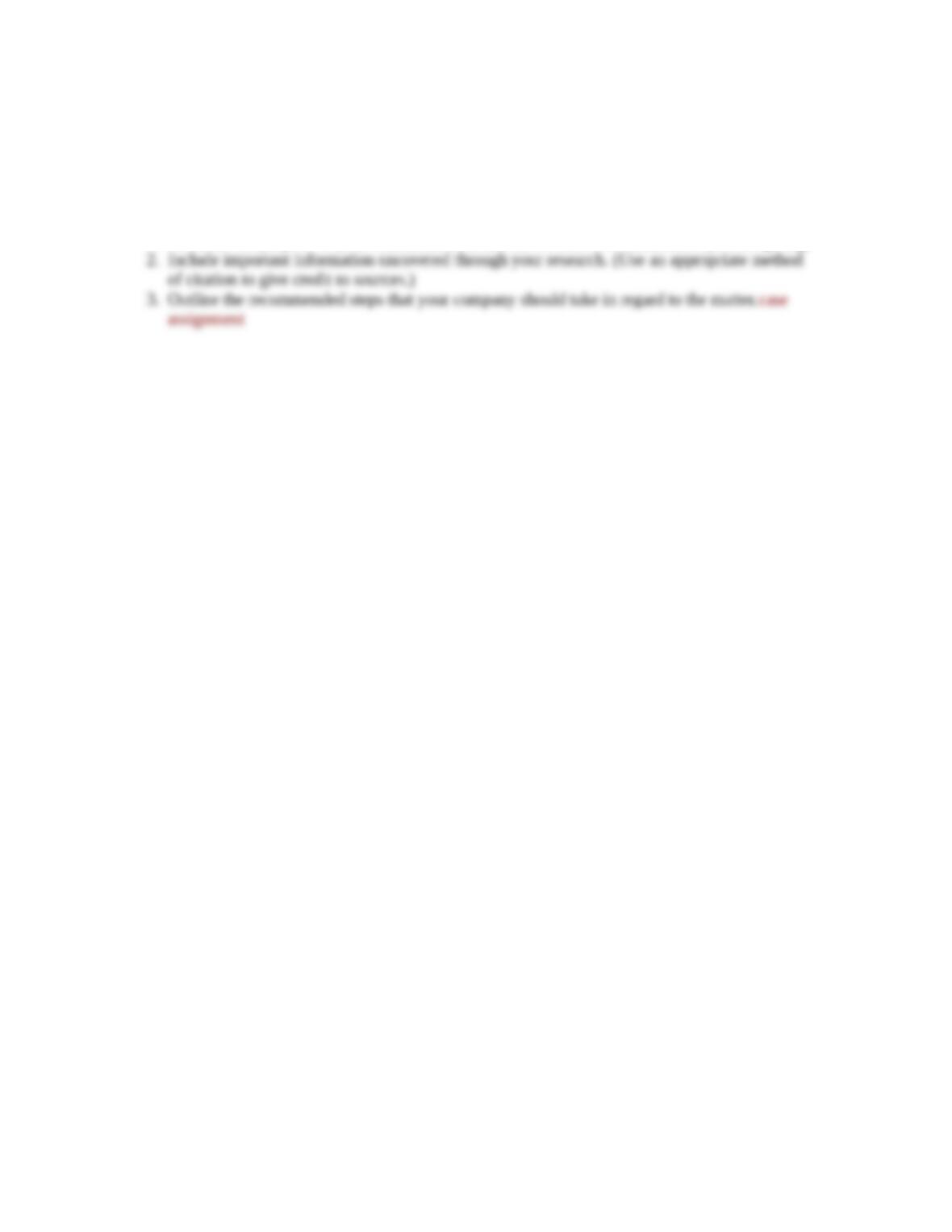
Point out the following characteristics of the apology note:
17. Read the scenario before completing the exercise below: Addressing Behavioral Issues
© 2015 Cengage Learning. All Rights Reserved. May not be scanned, copied or duplicated, or posted to a
publicly accessible website, in whole or in part.
6
You are part of a planning committee. Because of a plane delay, you missed a meeting.
However, you do have the requested report completed that you were responsible for, which
you’re hopeful can be discussed at next week’s meeting. Write a short apology message to
your supervisor.
As a manager you may become aware of problems requiring you to address sensitive
behavioral issues. The use of profanity in the workplace, the internal distribution of rude
jokes or cartoons, and improper attire are a sample of problems that, if not addressed, can
undermine corporate culture and potentially lead to charges of sexual and racial
discrimination.
In groups of three or four, select one of these issues or one assigned by your instructor. After
conducting necessary research, prepare a memo to your supervisor presenting a discussion of
the issue and outlining recommendations for your company.
Your memo should:
1. Establish the purpose of your communication and the overall recommendation you are giving.
SNOOP PROOF YOUR PC
SUMMARY
Ask students to visit the websites indicated on the text support website concerning computer
security and privacy on the Internet.
Assign students Application No. 3 from the case that requires them to summarize the
major snoop risks and what actions can be taken to avoid these risks. Discuss the risks and
solutions in class.
Use this case to prepare students for the Analytical Writing Assignment of the Graduate
Admission Test (GMAT) by having them write an essay relating the use of computers to the Mark
Twain quote presented.
Case
Protecting the security of data files and computer activities is high priority for individuals and
businesses alike. However, your PC is ready and able to reveal not only your data but what
you’ve been doing with your computer. Within a few hours, a snoop can determine and find the
incoming and outgoing mail you deleted, websites you visited, data you’ve entered on web forms,
and even phrases you deleted from documents. Fortunately, you can take steps to protect yourself.
Using effective password protection is a simple first step. Lock important files by using carefully
chosen passwords. The best passwords aren’t real words or dates; they use a combination of
letters, numbers, and punctuation. Knowing how to truly rid your computer of deleted and trashed
files is another important security step. Regularly clearing temporary menus and files, as well as
history listings, will assure that your recent file activities are not recorded for the would-be snoop
to peruse.
An obvious way to protect your information is to encrypt sensitive information. Good
encryption and locking solutions are increasingly user friendly and inexpensive. Numerous
products are available, with the most effective tools encrypting both file contents and passwords
used to access them. Encryption usually defeats casual efforts at intrusion and complicates even
advanced snooping attempts.
Cookies can also provide information from your computer to remote third parties.
Cookies are short pieces of data used by web servers to help identify the user and possibly to
track a user’s browsing habits. Cookies can tell a web server that you have been there before and
can pass short bits of information from your computer to the server. If you are concerned about
being identified or about having your activities traced, set your browser to not accept cookies or
use one of the new cookie blocking packages. Remember, though, that blocking all cookies
prevents some online services from working.
Another potential PC leak that is often overlooked is the discarded hard drive. About
150,000 hard drives are retired each year, but many find their way back onto the market. Stories
occasionally surface about personal and corporate information turning up on used hard drives,
© 2015 Cengage Learning. All Rights Reserved. May not be scanned, copied or duplicated, or posted to a
publicly accessible website, in whole or in part.
7
raising concerns about privacy and danger of identity theft. A Nevada woman bought a used
computer and discovered it contained prescription records on 2,000 customers of an Arizona
pharmacy. On most operating systems, simply deleting a file and even emptying it from the trash
folder does not necessarily make the information irretrievable. The information can live on until it
is overwritten by new files. Even reformatting a drive may not eradicate all data.
The most common breaches of computer privacy are committed by those who have the
most opportunity: coworkers, friends, and family members. But nameless, faceless hackers can
also invade your computer via your Internet connection. Installing a firewall can help protect you
from unauthorized access, possible file damage, and even identity theft.
Sources: “48% Of Used Hard Drives Contain Sensitive Data – How To Be Sure Yours Won’t” Ryan Faas (8:40 am
PDT, Apr 26th 2012). See
http://www.cultofmac.com/163354/48-of-used-hard-drives-contain-sensitive-data-how-to-be-sure-yours-doesnt;
“Discarded Computers Reveal Your Secrets.” Author: Michelle Blowers. Published: October 03, 2011 at 5:59 pm. See
http://technorati.com/technology/article/discarded-computers-reveal-your-secrets; Discarded hard drives prove a trove
of personal info. (2003, January 16). The Daily Sentinel.
Activities
1. Locate other articles that discuss ways to protect your computer files and activities. Prepare
an oral presentation about your findings.
2. Mark Twain once said, “There is no security in life—only opportunity.” How does this
philosophy relate to the use of computers in an environment of inherent security risks?
Prepare a one-page essay that explains your reasoning.
3. Make a chart that summarizes the major snoop risks on your PC and actions that can be
taken to minimize each risk.
© 2015 Cengage Learning. All Rights Reserved. May not be scanned, copied or duplicated, or posted to a
publicly accessible website, in whole or in part.
8