REVIEW QUESTIONS & SUGGESTED ANSWERS
1 How does a report writer decide the best organization for a formal report and
determine which preliminary or addenda parts to include in a report?
1. How does a report writer decide the best organization for a formal report and
determine which preliminary or addenda parts to include in a report?
2. Briefly discuss the primary principles involved in writing an executive summary. What
is the significance of other names given to this preliminary report part?
The executive summary, also called the abstract, overview, or précis, summarizes the essential
3. What purposes are served by the findings, conclusions, and recommendations sections?
How are they related, yet distinctive?
Findings are the facts (evidence) uncovered by the research. Conclusions are interpretations of the
4. Give two or three examples of emotional terms that should be avoided in a formal
report. Why is impersonal, third person style frequently used in formal reports? How is
it achieved?
© 2015 Cengage Learning. All Rights Reserved. May not be scanned, copied or duplicated, or posted to a
publicly accessible website, in whole or in part.
1

5. Explain the relationship between the content outline of a report and the placement of
headings within the body of a report.
6. In addition to length, what are the differences between long and short reports?
7. How are memorandum, letter, and email reports similar? In what ways are they
different?
8. What is the primary purpose of a proposal, and what can the writer do to assure that
the purpose is achieved?
9. What is meant by RFP? Why is it important to the preparation of a proposal?
10. How does team preparation of a proposal differ from preparation by an individual?
How can technology assist in team writing?
Original writing of sections of a long proposal is typically divided among the members of a
© 2015 Cengage Learning. All Rights Reserved. May not be scanned, copied or duplicated, or posted to a
publicly accessible website, in whole or in part.
2
11. How do diversity considerations impact the choices made in report style and and
format?
FEATURED ASSIGNMENTS
1Researching Information Security: Use the selection of databases to which the campus
library subscribes to find three articles on firewalls as a means to secure a company’s
intranet. Mark the main points of each article and create a bibliographic citation for each.
12. Practicing an Audit: Visit a computer lab on your campus. Through observation and
interviews, you should prepare an audit report of the lab’s offerings and include the following
items in your report: (1) the types of equipment available (e.g., PCs, Macs, mainframe
terminals), (2) the quantity of each type, and (3) the operating systems and applications
software available (product, version). Attach a table that summarizes their analysis and
submit their work as a letter report.
13. Experiencing Meetings: Attend a professional meeting of a campus or community
organization and take notes on the program presented, the issues discussed, and so on. You
should submit a short report summarizing the events of the meeting and include a section that
describes the benefits that might be derived from membership in that organization.
14. Obtain a copy of a report prepared by an organization and analyze it in the following ways:
a. Purpose
b. Intended audience
c. Degree of formality
d. Use of graphic support
e. Parts included (see Figure 12-1)
f. Referencing method
© 2015 Cengage Learning. All Rights Reserved. May not be scanned, copied or duplicated, or posted to a
publicly accessible website, in whole or in part.
3
15. Assemble a team of three to four students. Read the scenario below and then complete the
related exercise.
Your team plans to open a business establishment in your city. Do you obtain a franchise or
start your own independent restaurant? Select a franchise opportunity and research it. Include
in your findings the initial investment cost, start-up expenses, franchise requirements and
fees, and success and failure rate.
Exercise:
Using the information on team writing, prepare a report that compares the options of franchising
versus independent ownership. Make a recommendation as to the more desirable action to take.
ADDITIONAL ASSIGNMENTS
1Gathering Background Information for a Report: Using databases available through your
campus library, locate and read three articles on firewalls as a means of securing a
company’s intranet. Mark the main points of each article and prepare a bibliographic
citation for each.
Solutions will vary.
16. Developing a Report Outline: Think of and develop an outline for the described report.
Identify possible sources for locating the necessary information.
17. Summarizing a Professional Meeting: Attend a professional meeting of a campus or
community organization. Take notes on the program presented, the issues discussed, and so
on. Submit a short report to your instructor summarizing the events of the meeting, and
include a section that describes the benefits that might be derived from membership in that
organization.
18. Evaluating the Performance of a Stock Portfolio: Create a stock portfolio of ten stocks on a
financial website. Assume that you will purchase 100 shares of each of the ten stocks at the
prices listed at the market close on a particular day. The stock portfolio will record the
changes in each of the ten stocks for each trading day. Print this report for a one-week period
—five trading days.
Submit a memorandum report to your instructor on the purchase date reporting your ten
stocks according to the following format:
© 2015 Cengage Learning. All Rights Reserved. May not be scanned, copied or duplicated, or posted to a
publicly accessible website, in whole or in part.
4
Name of Stock Price per Share Total Cost (X 100)
19. Promoting International Understanding: Research the cultural differences between business
executives in the United States and China; write a memorandum report communicating this
information to U.S. managers working in China. Write another memo to Jeanne Pitman,
director of international assignments, persuading her to develop other ways to promote
international understanding in the company. You may vary this case by selecting a country of
your choice.
20. Communicating Concern for Employees: Review research related to cell phone safety and
identify ways to solve businesses’ problems resulting from accidents among workers. Write a
short informational report. To make the case more meaningful, address the issue in an
employee group or environment with which you are familiar.
21. Communicating During a Crisis: Review research and write an informational report related
to crisis communication and the sharing of information with employees about a financial,
ethical, health, or environmental crisis. Your instructor may vary this assignment so that your
report will be directed to stockholders, the public, or another specified group.
22. Assessing the Feasibility of Constructing a Recreational Complex: Read the following
scenario then complete the exercise below.
1. On average, how often do you exercise each week?
2. During a week, in which of the following activities do you participate? Check all that
apply.
© 2015 Cengage Learning. All Rights Reserved. May not be scanned, copied or duplicated, or posted to a
publicly accessible website, in whole or in part.
5
3. If you had access, in which of the following activities would you participate? Check all
that apply.
4. If a recreation center were constructed for employees, what is the maximum amount you
would be willing to pay per month to provide use of the center to your immediate family
members?
Exercise:
As a member of the committee, prepare a short report for the president, Michelle Karratassos.
You asked respondents to estimate the amounts they would be willing to pay a month for their
families to use the center as $0 to $10, $11 to $20, and so on. If you were to do mathematical
computations, you would probably use midpoints such as $5, $15.50, $25.50, and so on as values
for each class. In this case, however, write in generalities simply using percentages.
23. Preparing an Analytical Report: In teams of three or four, prepare a short report on one of
the following cases. Make any assumptions and collect any background information needed
to make an informed decision. Reviewing this list may help you identify a business-related
problem you have encountered that you would like to investigate; evaluate possible
alternative solutions, and make a recommendation.
a. Recommend a digital camera for your regional quality assurance inspectors of a
national convenience store chain. The inspectors will use the camera to enhance the
quality of periodic reports documenting each store’s adherence to company policies (e.g.,
visibility of company signage, friendliness of staff, cleanliness of restrooms).
b. Recommend one of three laptop computers for use by the company’s sales staff. The
computer must have wireless capability for transmitting and retrieving data from the
central office.
c. After suffering catastrophic losses following Super Storm Sandy, an insurance company
is seeking your advice on its plan to withdraw coverage from counties within the
devastated areas. Provide the insurance company with an analysis of the significant
issues and any ethical and legal implications of the decision.
d. As director of human resources, investigate the merits of adopting a corporate policy
banning cell usage by employees driving company vehicles. The legislature of your state
has not banned cell phone usage while driving.
© 2015 Cengage Learning. All Rights Reserved. May not be scanned, copied or duplicated, or posted to a
publicly accessible website, in whole or in part.
6
e. A local orchard has sold its line of jellies and jams only to specialty retailers. Consider
the feasibility of launching a website with online ordering capability for individual
consumers.
f. A national study suggests that employees who participate regularly in formal fitness
programs file fewer health insurance claims than those who do not. As a member of the
board of directors, weigh alternatives and present a plan that would provide employees
an incentive to participate actively in a fitness program.
g. As vice president of operations in a major hotel chain, investigate whether providing
housekeeping staff with MP3 players would improve productivity and employee morale.
h. Recommend how you would invest $2 billion of excess cash that your company will not
need until the plant expands in two more years.
i. Your government agency has always purchased the automobiles used by its social
workers. The cars are typically driven approximately 30,000 miles a year and are sold
for about 20 percent of their purchase value at the end of three years. Consider the cost
effectiveness of the current policy and a car dealer’s offer to lease the cars and
recommend appropriate action.
j. One of your sales staff has provided literature that cites health problems related to the
use of cellular telephones. Study the issue and make a recommendation to the company
as to how to respond to this issue.
SUGESSTED SOLUTIONS:
24. Considering Adoption of Linux Operating System: Read the scenario then complete the
exercise below.
Your company, Support, Inc., is considering the possibility of adopting Linux as your network
operating system. You have been asked by the owner and president of your organization to
research the possibility of converting from Windows 7 to Linux. You have surveyed 66
companies that are using the Linux operating system and have obtained the following results:
1. What operating system were you using prior to Linux? (Check one)
© 2015 Cengage Learning. All Rights Reserved. May not be scanned, copied or duplicated, or posted to a
publicly accessible website, in whole or in part.
7
2. In general, how would you rate the quality of Linux as compared to your previous
operating system? (Check one)
3. What, if anything, do you like about Linux? (Check all that apply)
4. What, if any, complaints do you have about Linux? (Check all that apply)
5. Where have you used Linux? (Check one)
6. How did you obtain your Linux operating system? (Check one)
7. What is your advice to a company considering converting to the Linux operating system?
(Circle one)
Exercise:
As director of information systems, write a report with findings, conclusions, and
recommendations. Prepare any preliminary and addenda parts you believe will enable the reader
to understand the report.
© 2015 Cengage Learning. All Rights Reserved. May not be scanned, copied or duplicated, or posted to a
publicly accessible website, in whole or in part.
8
25. Studying the Merits of Mentoring: Read the scenario below, then complete the related
exercise.
Your company, Ultron Oil, is considering implementing a formal mentoring program as a means
for developing managerial talent. Your supervisor, the division director, has commissioned you to
prepare a report on the effectiveness of mentoring. As a part of the study, you have surveyed 70
managers representing a variety of businesses; 44 were male, and 26 were female. They ranged in
age from 22 to 69, with the median age being 45. Their responses follow:
1. In your career development, have you ever had a mentor?
2. Which of the following describes your mentoring relationship(s)?
3. How long did the typical mentoring relationship last?
4. Did you perceive that you benefited from the mentoring relationship?
5. Did you perceive that your mentor benefited from the relationship?
6. Have you ever been a mentor to another person?
7. Does your company have a mentoring program in place?
Exercise:
Prepare the report for the division director. Present your findings, draw conclusions, and make
recommendations. Prepare any preliminary and addenda parts you believe will enable the reader
to understand the report.
In your evaluation of reports, consider how well students have integrated primary and secondary
data into the findings section. Require at least two types of graphic aids from the primary data; for
example, a pie chart, a bar chart, or a table. Conclusions and recommendations should reflect a
careful consideration of research gathered through both primary and secondary means.
© 2015 Cengage Learning. All Rights Reserved. May not be scanned, copied or duplicated, or posted to a
publicly accessible website, in whole or in part.
9
26. Assessing Attitudes Toward Software Piracy: Read the scenario, then complete the related
exercise.
You are conducting a study of college seniors concerning their awareness of and attitudes toward
software piracy. You have surveyed 100 students as a part of your project. The first category of
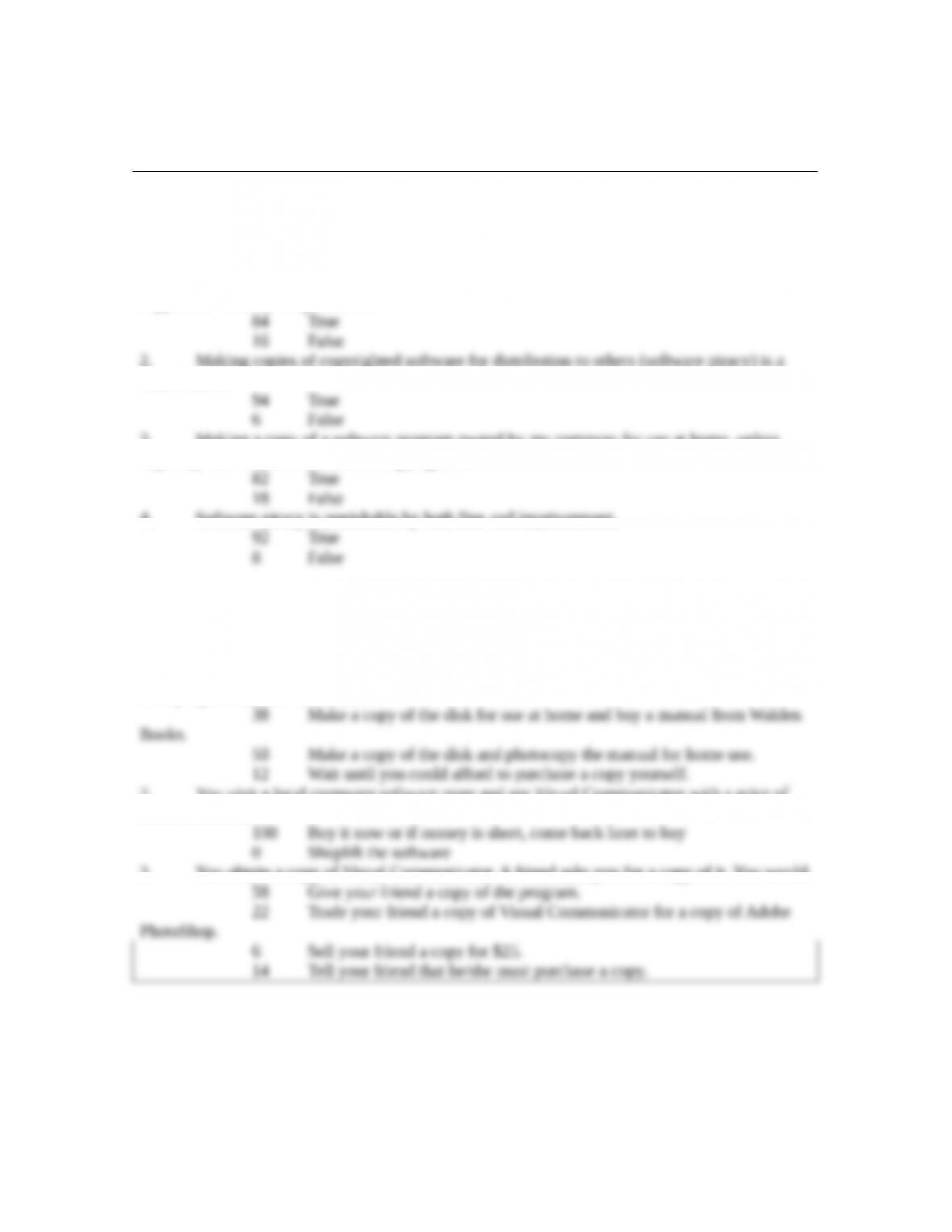
questions dealt with their knowledge of software piracy. The correct answer to each of these
questions is “true.” Their responses are as follows:
1. Purchased software is covered by copyright law and generally allows for only a backup
copy to be made by the purchaser.
2. Making copies of copyrighted software for distribution to others (software piracy) is a
federal crime.
3. Making a copy of a software program owned by my company for use at home, unless
expressly allowed, is a violation of copyright law.
4. Software piracy is punishable by both fine and imprisonment.
The second category of questions dealt with specific situations. To each, students were instructed
to give their honest responses. Their responses are as follows:
1. Your employer has purchased Visual Communicator for use on your computer at work.
You have a computer at home and would like to have a copy of the program for you and your
family’s personal use. You would
2. You visit a local computer software store and see Visual Communicator with a price of
$149. You would
3. You obtain a copy of Visual Communicator. A friend asks you for a copy of it. You would
Exercise:
Present your findings, conclusions, and recommendations in a formal report to your college
administrators. Prepare any preliminary and addenda parts you believe will enable the reader to
understand the report.
© 2015 Cengage Learning. All Rights Reserved. May not be scanned, copied or duplicated, or posted to a
publicly accessible website, in whole or in part.
10
In your evaluation of reports, consider how well students have integrated primary and secondary
data into the findings section. Require at least two types of graphic aids from the primary data; for
example, a pie chart, a bar chart, or a table. Conclusions and recommendations should reflect a
careful consideration of research gathered through both primary and secondary means.
27. Solving a Business Problem: Select one of the following problems to solve. Provide the
necessary assumptions and background data. Then write a formal report of your analysis,
conclusions, and recommendations. Include preliminary and ending parts you believe
appropriate. You may need to design a questionnaire and administer it to an appropriate
sample. Reviewing this list may help you identify a business-related problem you have
encountered during your employment or cooperative education and intern experiences. If you
choose to solve your own problem, provide the necessary assumptions and background data.
a. Investigate the feasibility of your company becoming the corporate sponsor of a
professional athletic team that is located in the same city as the company’s corporate
headquarters. The stadium name would be named for the company and the company
would control all advertising rights within the stadium.
b. You have read articles about the advantages of having Global Positioning Satellite (GPS)
trackers in automobiles to help stranded motorists. Propose how GPS trackers could be
used to monitor the movement of remote employees and investigate the implications of
this action.
c. Your human resources department is considering the implementation of a full criminal
background check in the selection of employees. Study the advisability of this practice.
d. Your department handles highly sensitive information and, as a result, requires extremely
reliable user identification. You are considering ocular scanning or perhaps some other
type of biometric identification. Investigate the advantages and disadvantages of such a
system and recommend whether your organization should pursue it.
e. Since its inception, your company has paid full employee health insurance premiums.
Because of spiraling premiums, the company is considering requiring a 20 percent
co-payment from employees for each medical claim. Investigate the implications of this
action.
f. Investigate the possibility of enlisting senior citizen volunteers to staff a city welcome
center scheduled to open next year.
g. A committee of employees has recommended that the company establish a hazardous
waste depository where employees can discard items not accepted in the landfill (e.g.,
paint, batteries, and insecticides). The president has asked you to think the idea through
and present a report of the cost, public relations implications, employee relations, and
logistics of operating the depository.
h. You have received reports that several of your major competitors have installed
electronic auditing procedures to monitor employees’ computer usage. The president
wants your immediate attention on this issue. Investigate the implications of using
technology to monitor employees’ computer activities. Will employees consider this
procedure an invasion of privacy? Anticipate all possible problems and present strategies
for dealing with them.
i. Although no employees have made formal complaints of sexual harassment in the
workplace, information from the grapevine has convinced you that the company needs a
formal policy concerning sexual harassment. To develop this company policy, research
the legalities related to this issue and gather information (strategies) from other
companies with sexual harassment policies.
j. The upcoming downsizing of your company will result in the displacement of
approximately 10 percent of your middle- and upper-level managers. Investigate
© 2015 Cengage Learning. All Rights Reserved. May not be scanned, copied or duplicated, or posted to a
publicly accessible website, in whole or in part.
11
strategies for supporting these managers in their search for new employment. Many of
these managers have worked for your company 15 to 20 years; therefore, they are quite
apprehensive about the job search process.
k. A client has $10,000 to invest for her children’s college education. Their ages are 12, 9,
and 4. Investigate alternatives and prepare a proposal for her consideration.
Students answers will vary. Evaluate based on, among other criteria, the thoroughness of their
analysis and inclusion of appropriate parts.
28. Bidding for a Convention Site: Read the following scenario and complete the activity below.
The National Insurance Appraisers Association is planning an upcoming convention. This
association of 500 members conducts a three-day conference during late October that
includes at least one general session and as many as five breakout groups of 50–75
participants. The chair of this group’s convention site committee has invited your city
(instructor will assign) to submit a proposal bidding for the convention’s 2010 national
convention.
Activity:
As executive director of the Economic Development Council, write a proposal including specific
information to convince the group that your city (choose a location) can provide the needed
meeting facilities, hotel accommodations, economical transportation from major U.S. cities, and
a variety of social and recreational activities for members and guests. Obtain your information
via the Internet.
29. Applying for a Franchise to Open a Coffee Shop: Read the following scenario and complete
the activity below.
Interested in opening a gourmet coffee shop, Leigh Holland wrote Oasis, Inc., a popular
franchiser of gourmet coffee shops, to solicit franchise information. In answer to his request,
Holland received an extremely receptive letter requesting standard information designed to
help Oasis determine the economic viability of the proposed location. After analyzing this
preliminary information, Oasis will decide whether to accept Holland’s franchise application.
Oasis has requested preliminary information regarding the economic and social environment
of the proposed site. Specifically, Holland must provide valid, objective data concerning the
population of the service area, the economic status of the population, the traffic flow in front
of the proposed site, the nature and extent of competing specialty franchises that offer patrons
© 2015 Cengage Learning. All Rights Reserved. May not be scanned, copied or duplicated, or posted to a
publicly accessible website, in whole or in part.
12
a place to socialize, and any other information that would support the economic success of
the proposed franchise.
Activity:
30. Proposing Additional Employee Benefit to Management: Read the following scenario and
complete the activity below.
As human resources manager at Innovative Solutions, you are preparing a proposal to be
submitted to company management that would institute a tuition reimbursement program for
employees who complete work-related college courses.
Activity:
Write a proposal that includes the following information: (1) an explanation of how the tuition
reimbursement program described in your proposal would increase overall morale and
productivity of employees, (2) a complete explanation of how the reimbursement program would
work, and (3) a budget for anticipated costs.
31. Responding to Problem of Computer Virus Hoaxes: Prepare an oral report on computer
virus hoaxes and the appropriate response to them. Include the following parts in your report
outline: (1) Why are virus hoaxes problematic for individuals and organizations? (2) What
are some common virus hoaxes? (3) How can virus hoaxes be “checked out”? Prepare
appropriate visuals for your presentation. End your report with a recommendation as to how
to best respond to virus hoaxes. Submit your report outline and a copy of your visuals to your
instructor after delivering your presentation.
CASE ASSIGNMENT 1
CYBERTHEFT: IT’S A BIG DEAL
One of the World Wide Web’s most attractive features, easy access to a universe of information
and data, is also one of its greatest vulnerabilities. Computer users can easily access, download,
copy, cut, paste, and publish any of the text, pictures, video, sound, program code, and other data
© 2015 Cengage Learning. All Rights Reserved. May not be scanned, copied or duplicated, or posted to a
publicly accessible website, in whole or in part.
13
forms available on the Internet. An inherent conflict of interest prevails because of the consumer’s
appetite for data and the creator’s right to remuneration for original work.
Copyrights provide an economic incentive for the development of creative works in
literature, computer applications, and the performing arts. For instance, songwriters in the United
States are paid royalties by radio stations for broadcasting their copyrighted musical works.
Because of copyrights, it is illegal to make and sell an authorized duplicate of a commercial CD,
video, or DVD. The law assures that creators receive remuneration from sales for their investment
of time, talent, and energy. The information superhighway, however, crosses borders where U.S.
copyright laws do not apply. With proper equipment and the aid of file sharing websites,
cyberfans can make high-quality digital copies of downloaded music and movies, effectively
bypassing copyright requirements.
Passage of the Patriot Act gave the FBI easier access to information about cyberspace
theft by allowing examination of Internet databases without search warrants. Internet service
providers have been compelled to turn over the names of subscribers traced by the music industry
to their IP addresses. The Recording Industry Association has also targeted college campuses in
its aggressive campaign to curtail unauthorized music downloading. In recent years, for example,
students have agreed to pay fines promised to stop illegally downloading music on their campus
computer servers as part of an out-of-court settlement. Some universities are also denying Internet
access to students who download films and music illegally.
Web pages are another type of creative expression falling victim to cybertheft. Dealernet,
an organization that helps car dealers sell vehicles over the Internet, was shocked to discover that
a Southern California company had downloaded Dealernet web pages and reproduced them on its
own website. The competing site deleted the pages when Dealernet threatened legal action.
Cybertheft deprives musicians, artists, and other creative parties from the income that
would otherwise result from the sale and licensing of their artistic works. The World Intellectual
Property Organization, sponsored by the United Nations, is working to ensure copyright
protection worldwide. Representatives of the United States and 183 other countries who are
members of the group have signed treaties that extend copyrights to the Internet and strengthen
copyright laws in many of the world’s nations. On the home front, various representatives of the
computer industry have joined entertainment groups such as the Recording Industry Association
of America and the Motion Picture Association of America to form the Creative Incentive
Coalition; a major activity of the group is to lobby Congress for legislation and treaties that would
provide better copyright protection.
Every business entity has a responsibility to avoid situations of copyright infringement
and to ensure that its employees do so as well. Companies are legally responsible for violations if
the copyright owner can prove that they knew or should have known about the infringement.
Texaco, for instance, agreed to a $1 million settlement after a federal appellate court ruled that it
was liable for copyright violations. While it is rare for employees to be taken to court for
copyright violation, it does occur and carries heavy penalties. Such liability makes it advisable for
organizations to develop policies against copyright violation and to provide training to employees
about the risks and responsibilities.
Sources: Download Uproar: Record Industry Goes After Personal Use, Marc Fisher, Washington Post, Sunday,
December 30, 2007, see http://www.washingtonpost.com/wp-dyn/content/article/2007/12/28/AR2007122800693.html;
Guilty Until Proven Innocent, By Sean Poulter, 26 June 2012, read more:
http://www.dailymail.co.uk/news/article-2165004/Illegal-downloading-Families-illegally-download-music-movies-onli
ne-face-court-action-copyright-theft.html#ixzz2McdZTaAJ; Jeff Stone,| September 12, 2012, How People Are Caught
Illegally Downloading Music, Movie Torrent, International Business Times.
Activities
© 2015 Cengage Learning. All Rights Reserved. May not be scanned, copied or duplicated, or posted to a
publicly accessible website, in whole or in part.
14

1. Locate websites with articles about current international copyright issues or cases. Provide a
one-page written summary to your instructor that describes the issue and the country(ies)
involved.
2. Write a short, informative report describing how a company’s website can violate the
copyrights of others and giving advice to organizational web page developers for avoiding
possible copyright infringement.
3. “The nature of cyberspace defies copyright enforcement.” In a one- to two-page report,
justify or refute this statement, giving reasons and/or examples.
CASE ASSIGNMENT 2
Summary
This case highlights the outstanding annual reports of Aflac Incorporated, spotlights Sid Cato,
judge for Chief Executive magazine’s annual report recognitions and author of the Official
Annual Report Website, and allows students to analyze the winning features of Aflac’s annual
report.
Annual reports guide investor decisions by offering a valuable glimpse into the workings and
financial performance as well as articulating company personality and philosophy. Aflac
Incorporated has received repeat recognition from Chief Executive magazine for its
accomplishments in producing one of the ten best annual reports. Aflac’s careful design and
organization of its report have led to positive public recognition and likely improved its
competitive edge. What do potential investors want to see in an annual report? Why is
organization and design so important?
AFLAC INCORPORATED: CAPITALIZING ON THE COMMUNICATION POWER OF
THE ANNUAL REPORT
Of all the documents corporations publish, none receives as much attention as the annual report.
Offering a valuable glimpse into the workings and financial performance of companies, these
annual scorecards guide investors’ decisions. Annual reports guide investor decisions by offering
a valuable glimpse into a company’s workings and financial performance as well as articulating
its personality and philosophy. Organizing the report’s information around a theme and providing
attractive visual elements assist in reading comprehension. Furthermore, annual reports serve as
an ideal public relations mechanism to influence various stakeholders, including employees and
the general public. Many managers are seizing the apparent opportunity to articulate their
company’s corporate personality and philosophy effectively.
© 2015 Cengage Learning. All Rights Reserved. May not be scanned, copied or duplicated, or posted to a
publicly accessible website, in whole or in part.
15
One company that is successfully capitalizing on the communication power of its annual
report is Aflac Incorporated. A Fortune 500 company, Aflac insures more than 40 million people
worldwide and is the largest life insurer in Japan. It has made its marketing fame as a leading
underwriter of supplemental insurance. While the Aflac duck catapulted the company’s brand
recognition from 12 percent to nearly 90 percent following its introduction in 2000, research has
shown that consumers want to learn more about the company’s products and services.
The annual report is an important tool Aflac is using to convey its positive message.
Aflac’s annual reports have been honorably recognized every year since the inception of Chief
Executive magazines’ rating system of the best annual reports. Aflac’s reports have consistently
been assigned “World-Class” status by scoring at least 100 of a potential 135 points on the
evaluation system. Commenting on the outstanding recognition, Aflac’s CEO Dan Amos said:
“We are extremely pleased to see Aflac’s annual report at the top of the list of the best annual
reports. Our shareholders are our most valuable customers, and we believe that effective
communication with our customers is crucial to the success of our business.”
The annual report rating is based on a 135-point copyrighted evaluation system that
factors in elements ranging from extensive CEO involvement to more financial disclosure than is
required by the Securities and Exchange Commission. According to Sid Cato, contributing editor
and judge for Chief Executive’s annual report listing, Aflac’s exemplary reports include
multiple-year financial data, biographical information on company officers, and fully captioned
graphs, all of which helped place it as one of the best.
Careful design and organization of Aflac’s annual report have led to positive public
recognition and likely improved the company’s competitive edge. In speaking of the annual
report, Sid Cato says, “This is the No. 1 document a company can produce. It’s the key corporate
communiqué. It indicates how the company feels about itself.” As contributing editor and the
judge for Chief Executive magazine’s annual report listing, Sid Cato is recognized by many as the
world’s foremost authority on annual reports. The annual listing, which has appeared in the
magazine’s November issue for over 20 years, is based on evaluations of reports submitted from
around the world, according to a 135-point copyrighted evaluation system.
Important factors that Cato looks for in effective annual reports include clear financial
disclosures, biographical data on corporate officers and board members, a brief and
forward-looking letter from the company’s chair, and design continuity that suggests the
company’s accountants work well with its communication people. The use of understandable
language with average sentence length of 16 words or less is important and four-color artwork
and photos are also valued. These design factors helped propel Aflac to the top of the numeric
scoring. Cato says, “If a company doesn’t know enough to produce an annual report that says
‘Open me, read me,’ you should toss it in the wastebasket.”
In addition to his annual report rating, Cato authors a monthly newsletter on annual
reports and provides report critiques at the request of companies that include tips for
improvement. While encouraging companies to develop a clear theme and to use their reports to
document their competitive advantages, Cato recognizes that the companies often fear revealing
so much that they erode their competitive edge. Instead of attempting to satisfy so many different
audiences with one annual report, some companies are spending time and energy breaking
information into component parts. Digital media such as the Internet and CD-ROMs have the
facility to present large amounts of information in different ways.
Cato feels that the worst thing that can happen in an annual report is for management not
to explain the numbers. According to Cato, a glossary of terms should be included, and every
graph should be fully captioned. He cautions readers of annual reports: If you see something in
the financial data that raises questions, such as an operating loss, and it’s not explained anywhere
in the report, that should raise suspicion.
Sources: Aflac takes next step in defining brand: Brand evolution of AFLAC. (2004, December 2). PR Newswire US.
Retrieved March 27, 2006, from LexisNexis database; Aflac’s annual report ranked first in Chief Executive magazine’s
© 2015 Cengage Learning. All Rights Reserved. May not be scanned, copied or duplicated, or posted to a
publicly accessible website, in whole or in part.
16

listing of 10 Best (1999, November 17). PR Newswire, Financial News; Aflac’s annual report ranked first in Chief
Executive magazine’s listing of 10 Best (1999, November 17). PR Newswire, Financial News; 7Moyer, L. (1999,
December 2). Ads libs: Annual report guru ranks those that measure up, or don’t. The American Banker, 4; Critic of
annual report hails Manitowoc Co. for readability, information. (1999, October 11). Milwaukee Journal Sentinel, p. 4;
Cato, S. (2006). Cato positive index. Retrieved May 30, 2006, from http://www.sidcato.com/ positiveindex.html.
Activities
1 Visit the Aflac website at http://www.aflac.com to identify the theme used in the
award-winning Aflac report and the strategies for reflecting company values throughout the
report.
32. Visit Sid Cato’s website at http://www.sidcato.com to read about his view of what makes a
good annual report.
33. Following instructions given by your instructor, electronically post your response to this
question: While Cato recommends full explanation of financial information, how much is too
much?
34. How does an annual report reveal what a company feels about itself?
35. What additional communication options are possible when annual reports are delivered over
the Internet or by CD-ROM instead of in traditional paper form?
36. What would cause you to want to open and read an annual report?
© 2015 Cengage Learning. All Rights Reserved. May not be scanned, copied or duplicated, or posted to a
publicly accessible website, in whole or in part.
17