
Chapter 3
Structure of Interest Rates
Outline
Explaining Yield Differentials
Credit (Default) Risk
Liquidity
Tax Status
Term to Maturity
Explaining Actual Yield Differentials
Yield Differentials of Money Market Securities
Yield Differentials of Capital Market Securities
Estimating the Appropriate Yield
A Closer Look at the Term Structure
Pure Expectations Theory
Liquidity Premium Theory
Segmented Markets Theory
Research on Term Structure Theories
Integrating the Theories of the Term Structure
Use of the Term Structure
Why the Slope of the Yield Curve Changes over Time
How the Yield Curve Has Changed over Time
International Structure of Interest Rates

Chapter 3: Structure of Interest Rates ❖ 2
Key Concepts
1. Use a current Wall Street Journal or other newspaper to show how yields vary among securities. The
chapter helps to explain the disparity in yields.
2. Provide logic behind how default risk, liquidity, tax status, and maturity can affect yields.
3. Offer various theories for the term structure of interest rates, and then combine these theories to
provide an integrated explanation.
POINT/COUNTER-POINT:
Should a Yield Curve Influence a Borrower’s Preferred Maturity of a Loan?
WHO IS CORRECT? Use the Internet to learn more about this issue and then formulate your own
opinion.
Questions
1. Characteristics That Affect Security Yields. Identify the relevant characteristics of any security that
can affect the security’s yield.
ANSWER: The relevant characteristics are:
2. Impact of Credit Risk on Yield. What effect does a high credit risk have on securities?
3. Impact of Liquidity on Yield. Discuss the relationship between the yield and liquidity of securities.


Chapter 3: Structure of Interest Rates ❖ 5
© 2018 Cengage Learning. All Rights Reserved. May not be copied, scanned, or duplicated, in whole or in part, except for use as
permitted in a license distributed with a certain product or service or otherwise on a password-protected website for classroom use.
ANSWER: If the Treasury borrowed heavily in the long-term markets, it could place upward pressure
on long-term rates without having as much of an impact on short-term rates. If the markets are
segmented, the effect of the Treasury’s actions would be more pronounced.
15. Yield Curve. If liquidity and interest rate expectations are both important for explaining the shape of
a yield curve, what does a flat yield curve indicate about the market’s perception of future interest
rates?
16. Global Interaction among Yield Curves. Assume that the yield curves in the United States, France,
and Japan are flat. If the U.S. yield curve suddenly becomes so positively sloped, do you think the
yield curves in France and Japan would be affected? If so, how?
17. Multiple Effects on the Yield Curve. Assume that (1) investors and borrowers expect that the
economy will weaken and that inflation will decline, (2) investors require a small liquidity premium,
and (3) markets are partially segmented and the Treasury currently has a preference for borrowing in
short-term markets. Explain how each of these forces would affect the term structure, holding other
factors constant. Then explain the effect on the term structure overall.
18. Effect of Crises on the Yield Curve. During some crises, investors shift their funds out of the stock
market and into money market securities for safety, even if they do not fear rising interest rates.
Explain how and why these actions by investors affect the yield curve. Is the shift due to the
expectations theory, liquidity premium theory, or segmented markets theory?


Chapter 3: Structure of Interest Rates ❖ 7
risk-free rate and the risk premium changed as the credit crisis occurred. Explain why the financial
markets can become paralyzed during a crisis? Is it because of changes in the risk-free rate or changes in
the risk premium?
ANSWER
During the credit crisis, the Fed attempted to ensure availability of funds in the financial system, by using
monetary policy to expand money supply. This resulted in a large increase in the supply of funds
cannot access funds at that rate, and may not even be able to access funds at all.
Interpreting Financial News
Interpret the following comments made by Wall Street analysts and portfolio managers.
a. “An upward-sloping yield curve persists because many investors stand ready to jump into the
stock market.”
b. “Low-rated bond yields rose as recession fears caused a flight to quality.”
c. “The shift from an upward-sloping yield curve to a downward-sloping yield curve is sending a
warning about a possible recession.”

Chapter 3: Structure of Interest Rates ❖ 8
Managing in Financial Markets
As an analyst at a bond rating agency, you have been asked to interpret the implications of the recent shift
in the yield curve. Six months ago, the yield curve exhibited a slight downward slope. Over the last six
months, the long-term yields declined, while short-term yields remained the same. Analysts stated that the
shift was due to revised expectations of interest rates.
a. Given the shift in the yield curve, does it appear that firms increased or decreased their demand
for long-term funds over the last six months?
b. Interpret what the shift in the yield curve suggests about the market’s changing expectations of
future interest rates.
c. Recently, an analyst argued that the underlying reason for the yield curve shift was that many of
the large U.S. firms anticipate a recession. Explain why an anticipated recession could force the
yield curve to shift as it has.
d. What could the specific shift in the yield curve signal about the ratings of existing corporate
bonds? What types of corporations would be most likely to experience a change in their bond
ratings as a result of the specific shift in the yield curve?
Problems
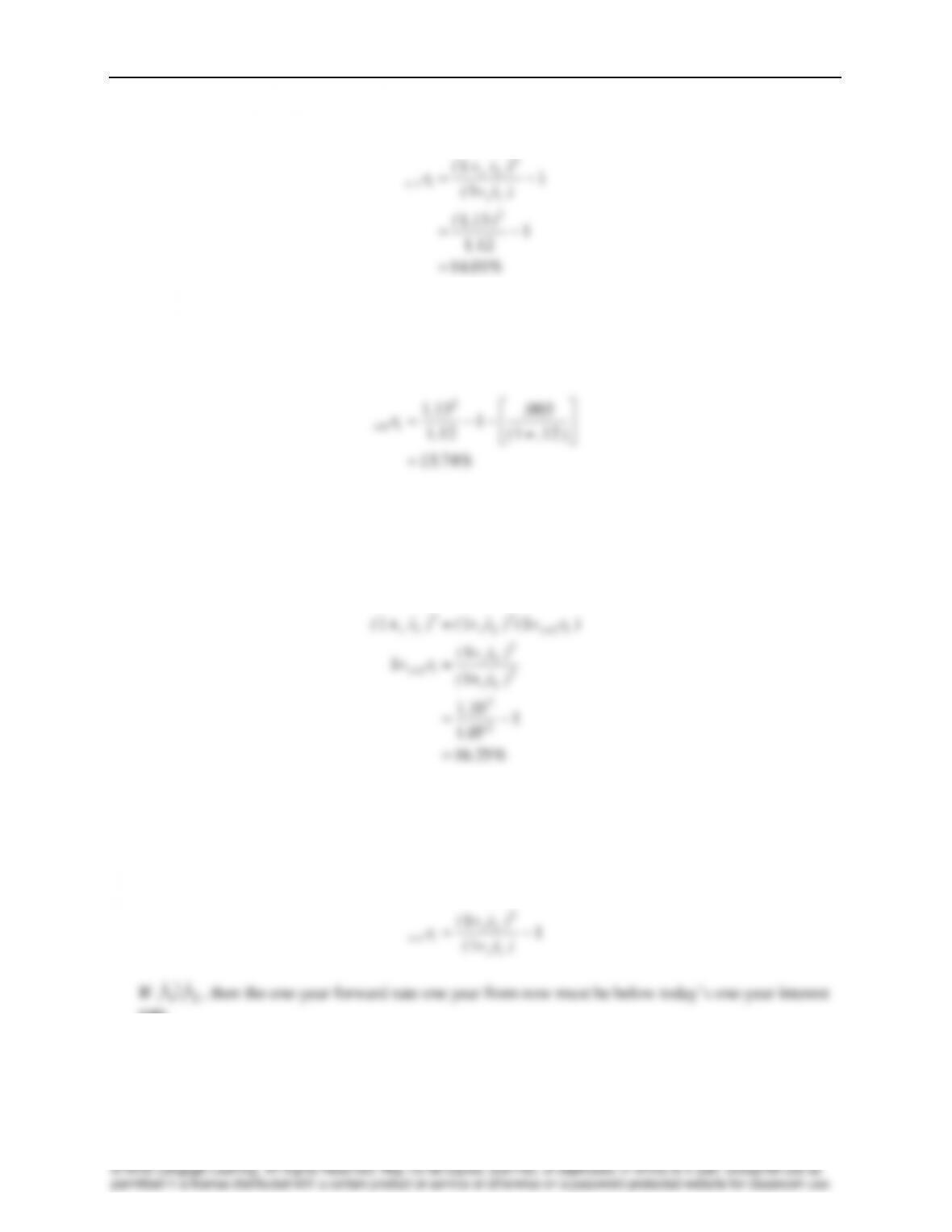
1. Forward Rate. a. Assume that as of today, the annualized two-year interest rate is 13 percent, while
the one-year interest rate is 12 percent. Use this information to estimate the one-year forward rate.
Chapter 3: Structure of Interest Rates ❖ 9
ANSWER:
%..
).(
)i(
)i(
r
t
t
t
0114
1
121
131
1
1
1
2
1
2
2
11
=
−=
−
+
+
=
+
b. Assume that the liquidity premium on a two-year security is 0.3 percent. Use this information to
estimate the one-year forward rate.
ANSWER:
%.
7413
=
2. Forward Rate. Assume that as of today, the annualized interest rate on a three-year security is 10
percent, while the annualized interest rate on a two-year security is 7 percent. Use this information to
estimate the one-year forward rate two years from now.
ANSWER:
%.
.
.
)i(
)i(
r
)r()i()i(
t
t
t
ttt
2516
1
071
101
1
1
1
111
2
3
2
2
3
3
12
12
2
2
3
3
=
−=
+
+
=+
++=+
+
+
3. Forward Rate. If
t 1 t 2
i i
, what is the market consensus forecast about the one-year forward rate one
year from now? Is this rate above or below today’s one-year interest rate? Explain.
ANSWER:
The one-year forward rate one year from now is:
1
1
1
1
2
2
11 −
+
+
=
+)i(
)i(
r
t
t
t
If
t 1 t 2
i i
, then the one-year forward rate one year from now must be below today’s one-year interest
rate.
4. After-tax Yield. You need to choose between investing in a one-year municipal bond with a 7
percent yield and a one-year corporate bond with an 11 percent yield. If your marginal federal income
tax rate is 30 percent and no other differences exist between these two securities, which would you
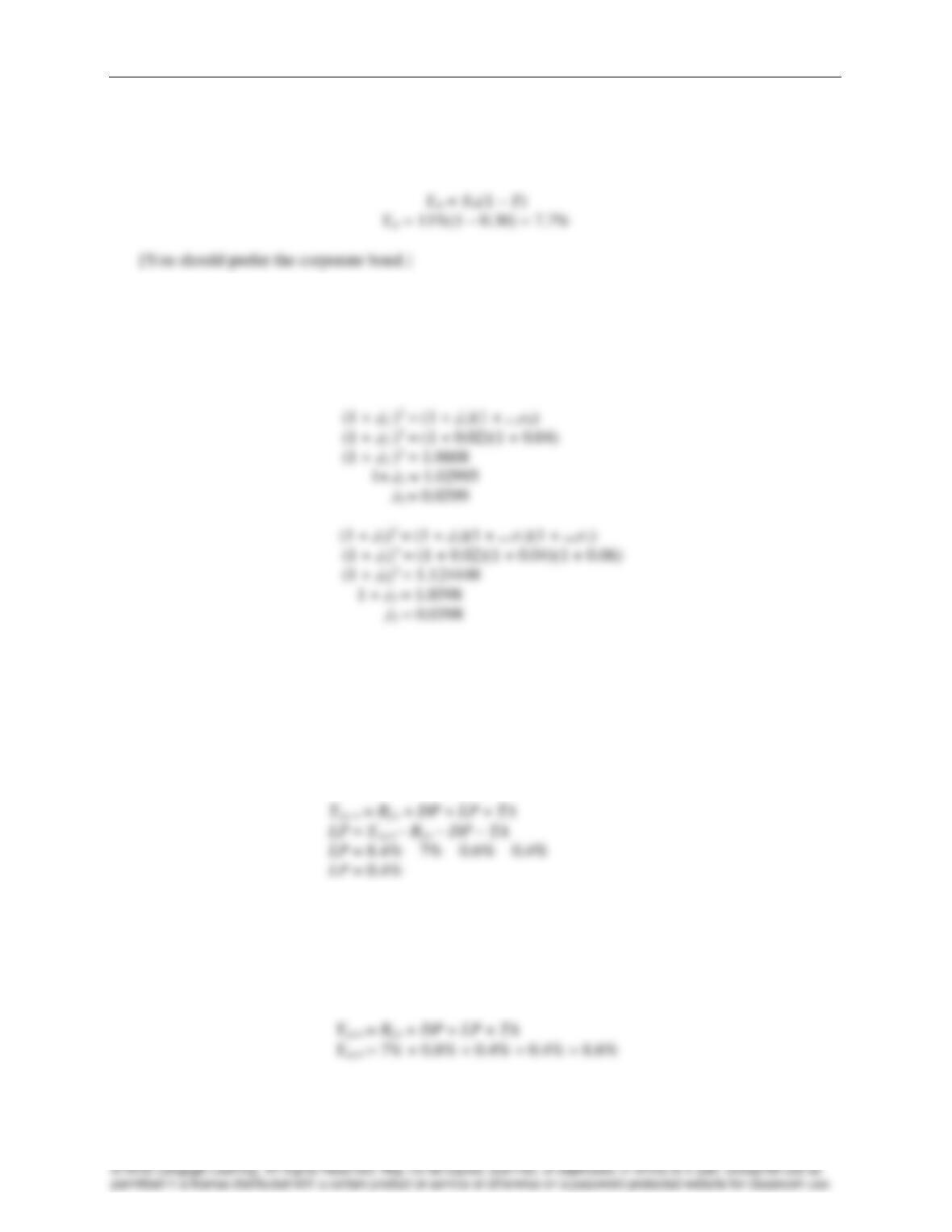
Chapter 3: Structure of Interest Rates ❖ 10
invest in?
ANSWER:
Yat = Ybt(1 – T)
5. Deriving Current Interest Rates. Assume that interest rates for one-year securities are expected to
be 2 percent today, 4 percent one year from now and 6 percent two years from now. Using only the
pure expectations theory, what are the current interest rates on two-year and three-year securities?
ANSWER:
6. Commercial Paper Yield.
a. A corporation is planning to sell its 90-day commercial paper to investors offering an 8.4 percent
yield. If the three-month T-bill’s annualized rate is 7 percent, the default risk premium is
estimated to be 0.6 percent and there is a 0.4 percent tax adjustment, what is the appropriate
liquidity premium?
ANSWER:
Ycp, n = Rf,n + DP + LP + TA
b. If due to unexpected changes in the economy the default risk premium increases to 0.8 percent,
what is the appropriate yield to be offered on the commercial paper (assuming no other changes
occur)?
ANSWER:

Chapter 3: Structure of Interest Rates ❖ 12
b. Determine how the appropriate yield to be offered on a security is affected by a higher default
risk premium. Explain the logic of this relationship.
Flow of Funds Exercise
Influence of the Structure of Interest Rates
Recall that Carson Company has obtained substantial loans from finance companies and commercial
banks. The interest rate on the loans is tied to the six-month Treasury bill rate (and includes a risk
premium) and is adjusted every six months. Thus, Carson’s cost of obtaining funds is sensitive to interest
rate movements. Because of its expectations that the U.S. economy will strengthen, Carson plans to grow
in the future by expanding its business and through acquisitions. Carson expects that it will need
substantial long-term financing to finance its growth, and plans to borrow additional funds either through
loans or by issuing bonds. It is also considering the issuance of stock to raise funds in the next year.
a. Assume that the market’s expectations for the economy are similar to those of Carson. Also
assume that the yield curve is primarily influenced by interest rate expectations. Would the yield
curve be upward sloping or downward sloping? Why?
b. If Carson could obtain more debt financing for 10-year projects, would it prefer to obtain credit at
a long-term fixed interest rate, or at a floating rate. Why?
c. If Carson attempts to obtain funds by issuing 10-year bonds, explain what information would help
to estimate the yield it would have to pay on 10-year bonds. That is, what are the key factors that
would influence the rate it would pay on the 10-year bonds?
d. If Carson attempts to obtain funds by issuing loans with floating interest rates every six months,
explain what information would help to estimate the yield it would have to pay over the next ten years.
That is, what are the key factors that would influence the rate it would pay over the 10-year period?
Chapter 3: Structure of Interest Rates ❖ 13
e. An upward-sloping yield curve suggests that the initial rate that financial institutions could charge
on a long-term loan to Carson would be higher than the initial rate that they could charge on a
loan that floats in accordance with short-term interest rates. Does this imply that creditors should
prefer to provide a fixed-rate loan rather than a floating-rate loan to Carson? Explain why
Carson’s expectations of future interest rates are not necessarily the same as those of some
financial institutions.
Solution to Integrative Problem for Part 1
Interest Rate Forecasts and Investment Decisions
1. The appropriate recommendation requires a rational forecast of U.S. interest rates based on the
information provided. A rational forecast can be created by recognizing what factors will or will not
influence future interest rates, and weighing the potential influence of any relevant factors. Each of
the nine pieces of information provided to the student is addressed below:
1. Movements in interest rates over the year surely affected bond prices, but this information does
not help forecast future interest rates.
7. An increase in the U.S. inflation rate causes an increase in the demand for loanable funds, and
therefore places upward pressure on U.S. interest rates.
8. The expectation of a weaker dollar by investors around the world could cause foreign investors to
reduce their investing in the United States, causing a net decline in the supply of funds in the
United States provided by foreign investors. Consequently, there is upward pressure on U.S.
interest rates.