
Chapter 20
Bank Performance
Outline
Valuation of a Commercial Bank
Factors That Affect Cash Flows
Factors That Affect the Required Rate of Return by Investors
Impact of the Credit Crisis on Bank Valuation
Assessing Bank Performance
Interest Income and Expenses
Noninterest Income and Expenses
Reliance on the Bank’s Financial Information
Evaluation of a Bank’s ROA
Reasons for a Low ROA
Chapter 20: Bank Performance ❖ 2
Key Concepts
1. Explain with the use of an income statement that the return on a bank’s assets is primarily a function
of net interest margin, noninterest income and expenses, and loan losses.
2. Explain how performance is influenced by management decisions, which is influenced by their
abilities to recognize risk and their incentives to take risk.
3. Explain how to evaluate a bank’s performance.
POINT/COUNTER-POINT:
Does a Bank’s Income Statement Clearly Indicate the Bank’s Performance?
WHO IS CORRECT? Use the Internet to learn more about this issue and then formulate your own
opinion.
Questions
1. Interest Income. How can gross interest income rise, while the net interest margin remains
somewhat stable for a particular bank?
2. Impact on Income. If a bank shifts its loan policy to pursue more credit card loans, how will its net
interest margin be affected?
3. Noninterest Income. What has been the trend in noninterest income in recent years? Explain.
4. Net Interest Margin. How could a bank generate higher income before tax (as a percentage of
assets) when its net interest margin has decreased?
5. Net Interest Income. Suppose the net income generated by a bank is equal to 1.5 percent of assets.
Based on past experience, would the bank experience a loss or a gain? Explain.
6. Noninterest Income. Why have large money center banks’ noninterest income levels typically been
higher than those of smaller banks?
7. Bank Leverage. What does the assets/equity ratio of a bank indicate?
8. Analysis of a Bank’s ROA. What are some of the more common reasons for a bank to experience a
low ROA?
9. Loan Loss Provisions. Explain why loan loss provisions of most banks could increase in a particular
period.
10. Bank Performance During the Credit Crisis. Why do you think some banks suffered larger losses
during the credit crisis than other banks?
11. Weak Performance. What are likely reasons for weak bank performance?
12. Bank Income Statement. Assume that SUNY Bank plans to liquidate Treasury security holdings and
use the proceeds for small business loans. Explain how this strategy will affect the different income
statement items. Also identify any income statement items for which the effects of this strategy are
more difficult to estimate.
Chapter 20: Bank Performance ❖ 4
ANSWER: Gross interest income would be expected to increase because small business loans
CRITICAL THINKING QUESTION
Bank Non-Interest Income In recent years, many banks rely more heavily on non-interest income as a
proportion of their total income. Write a short essay explaining whether banks that rely more heavily on
non-interest income will have better or worse performance than banks that rely more heavily on
traditional sources of income (such as loans)?
ANSWER
Interpreting Financial News
Interpret the following statements made by Wall Street analysts and portfolio managers.
a. “The three most important factors that determine a local bank’s bad debt level are the bank’s
location, location, and location.”
b. “The bank’s profitability was enhanced by its limited use of capital.”
c. “Low risk is not always desirable. Our bank’s risk has been too low, given the market conditions.
We will restructure operations in a manner to increase risk.”
Chapter 20: Bank Performance ❖ 5
Managing in Financial Markets
As a manager of Hawaii Bank, you anticipate the following information provided to you:
Loan loss reserves at end of year = 1 percent of assets
Gross interest income over the next year = 9 percent of assets
Noninterest expenses over the next year = 3 percent of assets
Noninterest income over the next year = 1 percent of assets
Gross interest expenses over the next year = 5 percent of assets
Tax rate on income = 30 percent
Capital ratio (capital/assets) at end of year = 5 percent
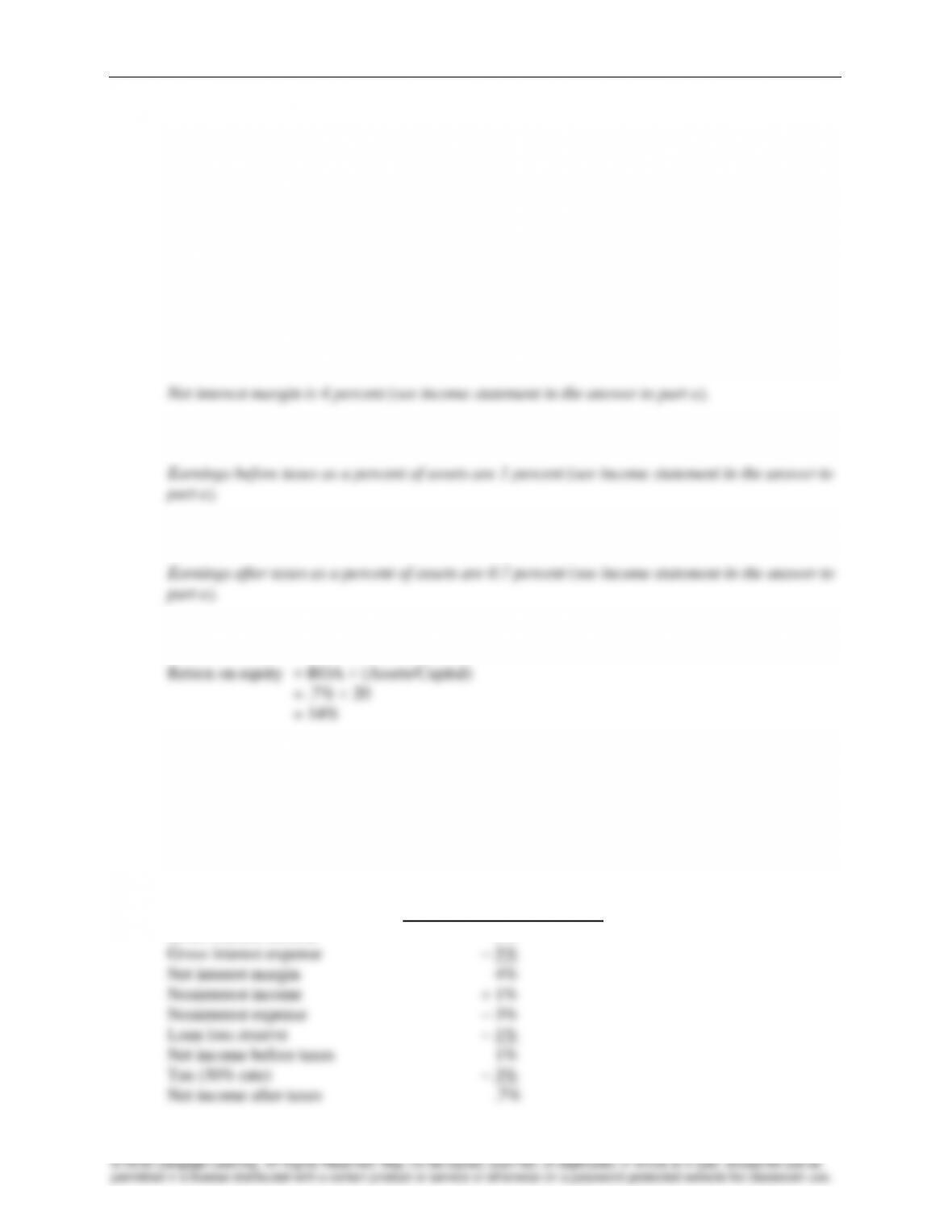
a. Forecast Hawaii Bank’s net interest margin.
b. Forecast Hawaii Bank’s earnings before taxes as a percentage of assets.
c. Forecast Hawaii Bank’s earnings after taxes as a percentage of assets.
d. Forecast Hawaii Bank’s return on equity.
e. Hawaii Bank is considering a shift in its asset structure to reduce its concentration of Treasury
bonds and increase its volume of loans to small businesses. Identify each income statement item
that would be affected by this strategy, and explain whether the forecast for that item would
increase or decrease as a result.
Gross interest income is now expected to be higher. Noninterest expenses are now expected to be
higher because of increased efforts on loan evaluation. Loan losses are expected to be higher.
Amount as a Percent of Assets
Gross interest income 9%
Chapter 20: Bank Performance ❖ 6
Problems
1. Assessing Bank Performance. Select a bank whose income statement data are available. Using
recent income statement data about a commercial bank, assess its performance. How does the
performance of this bank compare to the performance of other banks? Compared with other banks, is
its return on equity higher or lower than the ROE of other banks as reported in this chapter? What is
the main reason why its ROE is different from the norm? (Is it due to its interest expenses? Its
noninterest income?)
ANSWER: Answer will vary with the bank chosen. This question gives students experience in
assessing bank performance.
Flow of Funds Exercise
How the Flow of Funds Affects Bank Performance
In recent years, Carson Company has requested the services listed below from Blazo Financial, a financial
conglomerate. These transactions have created a flow of funds between Carson Company and Blazo.
a. Classify each service according to how Blazo benefits from the service.
advising on possible targets that Carson may acquire,
futures contract transactions,
options contract transactions,
interest rate derivative transactions,
loans,
line of credit,
purchase of short-term CDs,
checking account.
All the services except for the purchase of short-term CDs may generate fees for Blazo Financial,
b. Explain why Blazo’s performance from providing these services to Carson Company and other
firms will decline if economic growth is reduced.
If economic growth is reduced, the demand for advisory services, because there are less
commercial banks would prefer that the Fed use a restrictive monetary policy or an expansionary
monetary policy?
Chapter 20: Bank Performance ❖ 7
Solution to Integrative Problem for Part 6
Forecasting Bank Performance
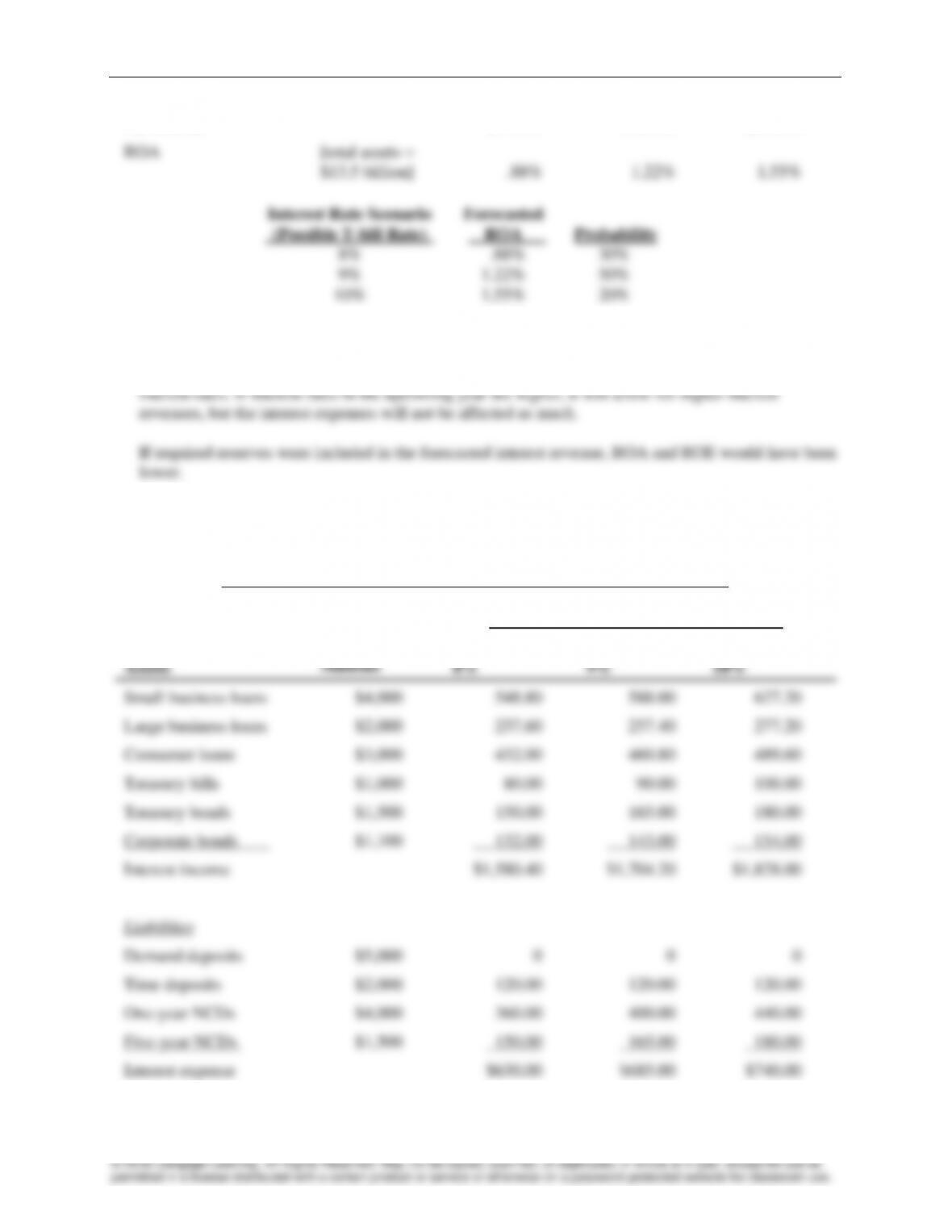
1. The interest income and expenses are determined by applying the specified interest rate on each asset
and liability to the dollar amount for each Treasury bill rate scenario. The loan losses must be
deducted from the loan amounts before determining the interest income on loans.
The noninterest income and expenses were given in the question. The loan losses are determined by
applying the assumed loan loss percentage to the dollar amount of each type of loan. The ROA for
each of the three Treasury bill rate scenarios is derived in the following table:
Income and Expenses (in millions) Based on Treasury Bill Rate Scenarios
Possible Treasury Bill Rate
Assets
Amount in
Millions
8%
9%
10%
Small business loans
$4,000
548.80
588.00
627.20
Large business loans
$2,000
237.60
257.40
277.20
Consumer loans
$3,000
432.00
460.80
489.60
Treasury bills
$1,000
80.00
90.00
100.00
Treasury bonds
$1,500
150.00
165.00
180.00
Corporate bonds
$1,100
132.00
143.00
154.00
Interest income
$1,580.40
$1,704.20
$1,828.00
Liabilities
Demand deposits
$5,000
0
0
0
Time deposits
$2,000
120.00
120.00
120.00
One-year NCDs
$3,000
270.00
300.00
330.00
Five-year NCDs
$2,500
250.00
275.00
300.00
Interest expense
$640.00
$695.00
$750.00
Noninterest income
200.00
200.00
200.00
Noninterest expenses
740.00
740.00
740.00
Loan losses
220.00
220.00
220.00
Income before taxes
180.40
249.20
318.00
Tax (34%)
61.30
84.70
108.10
Chapter 20: Bank Performance ❖ 8
Net income
$119.10
$164.50
$209.90
ROA
[total assets =
$13.5 billion]
.88%
1.22%
1.55%
Interest Rate Scenario Forecasted
(Possible T-bill Rate) ROA Probability
8% .88% 30%
9% 1.22% 50%
10% 1.55% 20%
2. Next year’s ROA will be higher if interest rates are higher as of the beginning of the year.
Much of the bank’s sources of funds (from its demand deposits and time deposits) are insensitive to
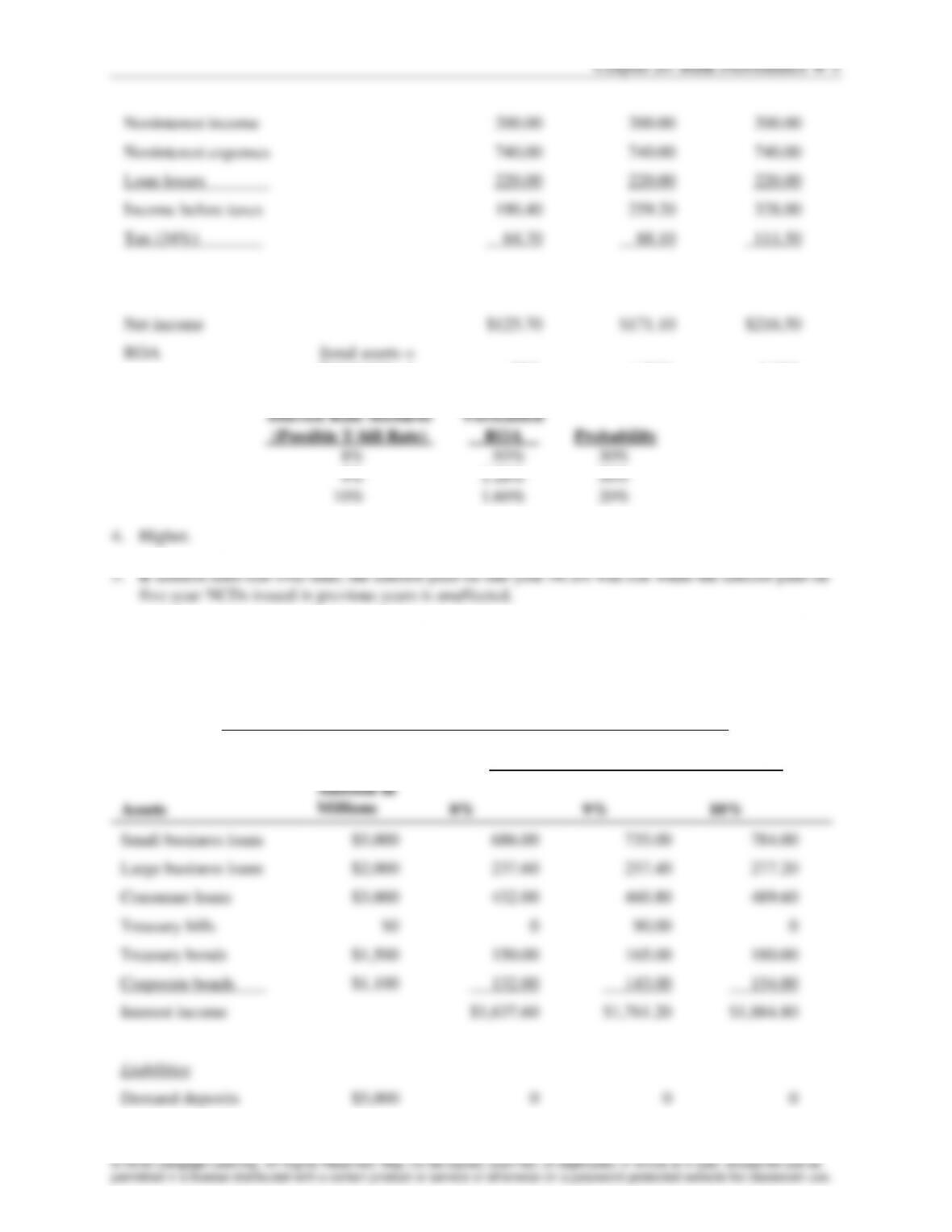
3. The two NCD expense items change, allowing for slightly lower total interest expenses and therefore
a slightly higher ROA, as shown in the following table:
Income and Expenses (in millions) Based on Treasury Bill Rate Scenarios
Possible Treasury Bill Rate
Assets
Amount in
Millions
8%
9%
10%
Small business loans
$4,000
548.80
588.00
627.20
Large business loans
$2,000
237.60
257.40
277.20
Consumer loans
$3,000
432.00
460.80
489.60
Treasury bills
$1,000
80.00
90.00
100.00
Treasury bonds
$1,500
150.00
165.00
180.00
Corporate bonds
$1,100
132.00
143.00
154.00
Interest income
$1,580.40
$1,704.20
$1,828.00
Liabilities
Demand deposits
$5,000
0
0
0
Time deposits
$2,000
120.00
120.00
120.00
One-year NCDs
$4,000
360.00
400.00
440.00
Five-year NCDs
$1,500
150.00
165.00
180.00
Interest expense
$630.00
$685.00
$740.00
Chapter 20: Bank Performance ❖ 11
Large business loans
$1,000
118.80
128.70
138.60
Consumer loans
$4,000
576.00
614.40
652.80
Treasury bills
$1,000
80.00
90.00
100.00
Treasury bonds
$1,500
150.00
165.00
180.00
Corporate bonds
$1,100
132.00
143.00
154.00
Interest income
$1,605.60
$1,729.10
$1,852.60
Liabilities
Demand deposits
$5,000
0
0
0
Time deposits
$2,000
120.00
120.00
120.00
One-year NCDs
$4,000
360.00
400.00
440.00
Five-year NCDs
$1,500
150.00
175.00
180.00
Interest expense
$640.00
$695.00
$750.00
Noninterest income
200.00
200.00
200.00
Noninterest expenses
740.00
740.00
740.00
Loan losses
250.00
250.00
250.00
Income before taxes
175.60
244.10
312.60
Tax (34%)
59.70
83.00
106.30
Net income
$115.90
$161.10
$206.30
ROA
[total assets =
$13.5 billion]
.86%
1.19%
1.53%
Chapter 20: Bank Performance ❖ 12
9% 1.19% 50%
10% 1.53% 20%
11. If interest rates rise after the loans are provided, the interest received on consumer loans will be
12. Interest Rate
9% 16.47% 13.73% 50%