
Chapter 2
Determination of Interest Rates
Outline
Loanable Funds Theory
Household Demand for Loanable Funds
Business Demand for Loanable Funds
Government Demand for Loanable Funds
Foreign Demand for Loanable Funds
Aggregate Demand for Loanable Funds
Supply of Loanable Funds
Equilibrium Interest Rate
Factors That Affect Interest Rates
Impact of Economic Growth on Interest Rates
Impact of Inflation on Interest Rates
Impact of Monetary Policy on Interest Rates
Impact of the Budget Deficit on Interest Rates
Impact of Foreign Flows of Funds on Interest Rates
Summary of Forces That Affect Interest Rates
Forecasting Interest Rates
Chapter 2: Determination of Interest Rates ❖ 2
Key Concepts
1. Explain the Loanable Funds Theory by deriving demand and supply schedules for loanable funds.
2. Explain the Fisher Effect, and tie it in with Loanable Funds Theory by explaining how inflation
affects the demand and supply schedules for loanable funds.
3. Provide additional applications (especially current events) one at a time to help illustrate how events
can affect the demand and supply schedules, and therefore influence interest rates.
4. Explain how forecasts of interest rates are needed to make financial decisions, which require forecasts
of shifts in the demand and supply schedules for loanable funds.
5. Introduce several possible events simultaneously to illustrate how difficult it can be to forecast
interest rate movements when several events are occurring at once.
POINT/COUNTER-POINT:
Does a Large Fiscal Budget Deficit Result in Higher Interest Rates?
WHO IS CORRECT? Use the Internet to learn more about this issue and then formulate your own
opinion.
Questions
1. Interest Rate Movements. Explain why interest rates changed as they did over the past year.
2. Interest Elasticity. Explain what is meant by interest elasticity. Would you expect federal
government demand for loanable funds to be more or less interest-elastic than household demand for
loanable funds? Why?
© 2018 Cengage Learning. All Rights Reserved. May not be copied, scanned, or duplicated, in whole or in part, except for use as
permitted in a license distributed with a certain product or service or otherwise on a password-protected website for classroom use.
3. Impact of Government Spending. If the federal government planned to expand the space program,
how might this affect interest rates?
4. Impact of a Recession. Explain why interest rates tend to decrease during recessionary periods.
Review historical interest rates to determine how they react to recessionary periods. Explain this
reaction.
5. Impact of the Economy. Explain how the expected interest rate in one year depends on your
expectation of economic growth and inflation.
6. Impact of the Money Supply. Should increasing money supply growth place upward or downward
pressure on interest rates?
7. Impact of Exchange Rates on Interest Rates. Assume that if the U.S. dollar strengthens, it can
place downward pressure on U.S. inflation. Based on this information, how might expectations of a
strong dollar affect the demand for loanable funds in the United States and U.S. interest rates? Is there
any reason to think that expectations of a strong dollar could also affect the supply of loanable funds?
Explain.
8. Nominal versus Real Interest Rate. What is the difference between the nominal interest rate and
real interest rate? What is the logic behind the implied positive relationship between expected
inflation and nominal interest rates?
Chapter 2: Determination of Interest Rates ❖ 4
© 2018 Cengage Learning. All Rights Reserved. May not be copied, scanned, or duplicated, in whole or in part, except for use as
permitted in a license distributed with a certain product or service or otherwise on a password-protected website for classroom use.
ANSWER: The nominal interest rate is the quoted interest rate, while the real interest rate is defined
as the nominal interest rate minus the expected rate of inflation. The real interest rate represents the
recent nominal interest rate minus the recent inflation rate.
Investors require a positive real return, which suggests that they will only invest funds if the nominal
interest rate is expected to exceed inflation. In this way, the purchasing power of invested funds
increases over time. As inflation rises, nominal interest rates should rise as well since investors would
require a nominal return that exceeds the inflation rate.
9. Real Interest Rate. Estimate the real interest rate over the last year. If financial market participants
overestimate inflation in a particular period, will real interest rates be relatively high or low? Explain.
10. Forecasting Interest Rates. Why do forecasts of interest rates differ among experts?
Advanced Questions
11. Impact of Stock Market Crises. During periods when investors suddenly become fearful that stocks
are overvalued, they dump their stocks, and the stock market experiences a major decline. During
these periods, interest rates also tend to decline. Use the loanable funds framework discussed in this
chapter to explain how the massive selling of stocks leads to lower interest rates.
12. Impact of Expected Inflation. How might expectations of higher global oil prices affect the demand
for loanable funds, the supply of loanable funds, and interest rates in the United States? Will this
affect the interest rates of other countries in the same way? Explain.
© 2018 Cengage Learning. All Rights Reserved. May not be copied, scanned, or duplicated, in whole or in part, except for use as
permitted in a license distributed with a certain product or service or otherwise on a password-protected website for classroom use.
13. Global Interaction of Interest Rates. Why might you expect interest rate movements of various
industrialized countries to be more highly correlated in recent years than in earlier years?
14. Impact of War. War tends to cause significant reactions in financial markets. Why might a war in the
Middle East place upward pressure on U.S. interest rates? Why might some investors expect a war
like this to place downward pressure on U.S. interest rates?
15. Impact of September 11. Offer an argument for why the terrorist attack on the United States on
September 11, 2001 could have placed downward pressure on U.S. interest rates. Offer an argument
for why that attack could have placed upward pressure on U.S. interest rates.
16. Impact of Government Spending. Jayhawk Forecasting Services analyzed several factors that could
affect interest rates in the future. Most factors were expected to place downward pressure on interest
rates. Jayhawk also expected that although the annual budget deficit was to be cut by 40 percent from
the previous year, it would still be very large. Thus, Jayhawk believed that the deficit’s impact would
more than offset the effects of other factors, so it forecast interest rates to increase by 2 percent.
Comment on Jayhawk’s logic.
17. Decomposing Interest Rate Movements. The interest rate on a one-year loan can be decomposed
into a one-year risk-free (free from default risk) component and a risk premium that reflects the
potential for default on the loan in that year. A change in economic conditions can affect the risk-free
rate and the risk premium. The risk-free rate is normally affected by changing economic conditions to
a greater degree than the risk premium. Explain how a weaker economy will likely affect the risk-free
component, the risk premium, and the overall cost of a one-year loan obtained by (a) the Treasury,
and (b) a corporation. Will the change in the cost of borrowing be more pronounced for the Treasury
or for the corporation? Why?
18. Forecasting Interest Rates Based on Prevailing Conditions. Consider the prevailing conditions for
inflation (including oil prices), the economy, the budget deficit, and the Fed’s monetary policy that
could affect interest rates. Based on these conditions, do you think interest rates will likely increase or
decrease during this semester? Offer some logic to support your answer. Which factor do you think
will have the greatest impact on interest rates?
19. Impact of Economic Crises on Interest Rates. When economic crises in countries are due to a weak
economy, local interest rates tend to be very low. However, if the crisis was caused by an unusually
high rate of inflation, interest rates tend to be very high. Explain why.
20. U.S. Interest Rates During the Credit Crisis. During the credit crisis, U.S. interest rates were
extremely low, which enabled businesses to borrow at a low cost. Holding other factors constant, this
should result in a higher number of feasible projects, which should encourage businesses to borrow
more money and expand. Yet, many businesses that had access to loanable funds were unwilling to
borrow during the credit crisis. What other factor changed during this period that more than offset the
potentially favorable effect of the low interest rates on project feasibility, therefore discouraging
businesses from expanding?
21. Political Influence on Interest Rates. Offer an argument for why a political regime that favors a
large government will cause interest rates to be higher. Offer at least one example of why a political
regime that favors a large government will cause interest rates to be lower [Hint: Recognize that the
government intervention in the economy can influence other factors that affect interest rates.]
22. Impact of Stock Market Uncertainty. Consider a period in which stock prices are very high, such
that investors begin to think that stocks are overvalued and their valuations are very uncertain. If
investors decide to move their money into much safer investments, how do you think this would
affect general interest rate levels? In your answer, use the loanable funds framework by explaining
how the supply or demand for loanable funds would be affected by the investor actions, and how this
force would affect interest rates.
23. Impact of the European Economy. Use the loanable funds framework to explain how European
economic conditions might affect U.S. interest rates.
ANSWER: Weak European conditions could weaken U.S. economic conditions, because the
CRITICAL THINKING QUESTION
How a Credit Crisis Can Affect Interest Rates Interest rates are influenced by various factors
reflecting the demand for funds and the supply of funds available in the credit markets. Write a
short essay in which you identify the key factors that changed the demand for and supply of
funds during the credit crisis and offer an explanation for why those factors caused a major
decline in market interest rates. What lessons may be learned from the credit crisis that could
prevent such an abrupt decline in the demand for funds in the future?
Chapter 2: Determination of Interest Rates ❖ 8
ANSWER
During the crisis, the housing market crashed, resulting in an excessive surplus of homes relative to the
Interpreting Financial News
Interpret the following comments made by Wall Street analysts and portfolio managers.
a. “The flight of funds from bank deposits to U.S. stocks will pressure interest rates.”
b. “Since Japanese interest rates have recently declined to very low levels, expect a reduction in
U.S. interest rates.”
c. “The cost of borrowing by U.S. firms is dictated by the degree to which the federal government
spends more than it taxes.”
Managing in Financial Markets
As the treasurer of a manufacturing company, your task is to forecast the direction of interest rates. You
plan to borrow funds and may use the forecast of interest rates to determine whether you should obtain a
loan with a fixed interest rate or a floating interest rate. The following information can be considered
when assessing the future direction of interest rates:
Economic growth has been high over the last two years, but you expect that it will be stagnant
over the next year.
Chapter 2: Determination of Interest Rates ❖ 9
© 2018 Cengage Learning. All Rights Reserved. May not be copied, scanned, or duplicated, in whole or in part, except for use as
permitted in a license distributed with a certain product or service or otherwise on a password-protected website for classroom use.
Inflation has been 3 percent over each of the last few years, and you expect that it will be about
the same over the next year.
The federal government has announced major cuts in its spending, which should have a major
impact on the budget deficit.
The Federal Reserve is not expected to affect the existing supply of loanable funds over the next
year.
The overall level of savings by households is not expected to change.
a. Given the preceding information, assess how the demand for and the supply of loanable funds
would be affected (if at all), and predict the future direction of interest rates.
b. You can obtain a one-year loan at a fixed-rate of 8 percent or a floating-rate loan that is currently
at 8 percent but would be revised every month in accordance with general interest rate
movements. Which type of loan is more appropriate based on the information provided?
c. Assume that Canadian interest rates have abruptly risen just as you have completed your forecast
of future U.S. interest rates. Consequently, Canadian interest rates are now 2 percentage points
above U.S. interest rates. How might this specific situation place pressure on U.S. interest rates?
Considering this situation along with the other information provided, would you change your
forecast of the future direction of U.S. interest rates?
Problems
1. Nominal Rate of Interest. Suppose the real interest rate is 6 percent and the expected inflation is 2
percent. What would you expect the nominal rate of interest to be?
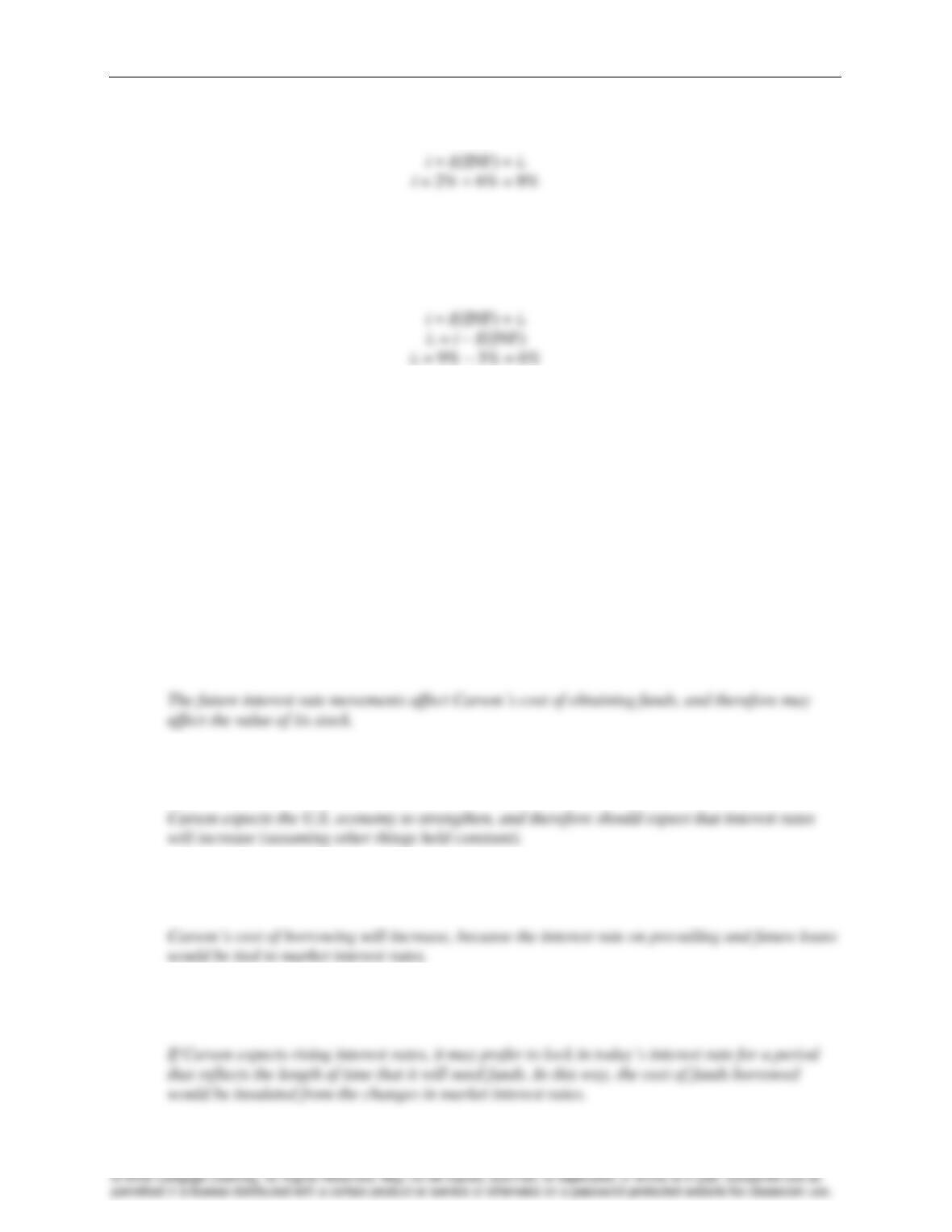
Chapter 2: Determination of Interest Rates ❖ 10
ANSWER:
i = E(INF) + ir
2. Real Interest Rate. Suppose that Treasury bills are currently paying 9 percent and the expected
inflation is 3 percent. What is the real interest rate?
ANSWER:
Flow of Funds Exercise
How the Flow of Funds Affects Interest Rates
Recall that Carson Company has obtained substantial loans from finance companies and commercial
banks. The interest rate on the loans is tied to market interest rates, and is adjusted every six months.
Thus, its cost of obtaining funds is sensitive to interest rate movements. Given its expectations that the
U.S. economy will strengthen, Carson plans to grow in the future by expanding its business and through
acquisitions. Carson expects that it will need substantial long-term financing to pay for this growth, and it
plans to borrow additional funds either through loans or by issuing bonds. The company is considering
the issuance of stock to raise funds in the next year.
a. Explain why Carson should be very interested in future interest rate movements.
b. Given Carson’s expectations, do you think that the company anticipates that interest rates will
increase or decrease in the future? Explain.
Carson expects the U.S. economy to strengthen, and therefore should expect that interest rates
c. If Carson’s expectations of future interest rates are correct, how would this affect its cost of
borrowing on its existing loans and on future loans?
Carson’s cost of borrowing will increase, because the interest rate on prevailing and future loans
d. Explain why Carson’s expectations about future interest rates may affect its decision about when
to borrow funds and whether to obtain floating-rate or fixed-rate loans.