
Chapter 15
Swap Markets
Outline
Background
Use of Swaps for Hedging
Use of Swaps to Accommodate Financing
Use of Swaps for Speculating
Participation by Financial Institutions
Types of Interest Rate Swaps
Plain Vanilla Swaps
Forward Swaps
Callable Swaps
Putable Swaps
Extendable Swaps
Zero-Coupon-for-Floating Swaps
Rate-Capped Swaps
Equity Swaps
Other Types of Swaps
Risks of Interest Rate Swaps
Basis Risk
Credit Risk
Sovereign Risk
Pricing Interest Rate Swaps
Prevailing Market Interest Rates
Availability of Counterparties
Credit and Sovereign Risk
Performance of Interest Rate Swaps
Interest Rate Caps, Floors, and Collars
Interest Rate Caps
Interest Rate Floors
Interest Rate Collars
Credit Default Swaps
Secondary Market for CDS Contracts
Collateral on CDS Contracts
Payments on a Credit Default Swap
How CDSs Affect Debtor-Creditor Negotiations
Chapter 15: Swap Markets ❖ 2
.
Development of the CDS Market
Impact of the Credit Crisis on the CDS Market
Reform of CDS Contracts
Globalization of Swap Markets
Currency Swaps
Key Concepts
1. Remind students as to how interest rate movements can adversely affect the performance of various
financial institutions.
2. Describe how financial institutions participate in swap markets.
3. Explain in general terms how interest rate swaps can hedge interest rate risk.
4. Identify the various types of interest rate swaps, and the advantages of each.
POINT/COUNTER-POINT:
Should Financial Institutions Engage in Interest Rate Swaps for Speculative
Purposes?
WHO IS CORRECT? Use the Internet to learn more about this issue and then formulate your own
opinion.
Questions
1. Hedging with Interest Rate Swaps. Bowling Green Savings & Loan uses short-term deposits to
fund fixed-rate mortgages. Explain how Bowling Green can use interest rate swaps to hedge its
interest rate risk.
.
2. Decision to Hedge with Interest Rate Swaps. Explain the types of cash flow characteristics that
would cause a firm to hedge interest rate risk by swapping floating-rate payments for fixed payments.
Why would some firms avoid the use of interest rate swaps, even when they are highly exposed to
interest rate risk?
3. Role of Securities Firms in Swap Market. Describe the possible roles of securities firms in the swap
market.
4. Hedging with Swaps. Chelsea Finance Company receives floating inflow payments from its
provision of floating-rate loans. Its outflow payments are fixed because of its recent issuance of long-
term bonds. Chelsea is concerned that interest rates will decline in the future. Yet, it does not want to
hedge its interest rate risk, because it believes interest rates may increase. Recommend a solution to
Chelsea’s dilemma.
5. Basis Risk. Comiskey Savings provides fixed-rate mortgages of various maturities, depending on
what customers want. It obtains most of its funds from issuing certificates of deposit with maturities
ranging from one month to five years. Comiskey has decided to engage in a fixed-for-floating swap to
hedge its interest rate risk. Is Comiskey exposed to basis risk?
6. Fixed-for-Floating Swaps. Shea Savings negotiates a fixed-for-floating swap with a reputable firm
in South America that has an exceptional credit rating. Shea is very confident that there will not be a
default on inflow payments because of the very low credit risk of the South American firm. Do you
agree? Explain.
.
7. Fixed-for-Floating Swaps. North Pier Company entered into a two-year swap agreement, which
would provide fixed-rate payments for floating-rate payments. Over the next two years, interest rates
declined. Based on these conditions, did North Pier Company benefit from the swap?
8. Equity Swap. Explain how an equity swap could allow Marathon Insurance Company to capitalize
on expectations of a strong stock market performance over the next year without altering its existing
portfolio mix of stocks and bonds.
9. Swap Network. Explain how the failure of a large commercial bank could cause a worldwide swap
credit crisis.
10. Currency Swaps. Markus Company purchases supplies from France once a year. Would Markus be
favorably affected if it establishes a currency swap arrangement and the dollar strengthens? What if it
establishes a currency swap arrangement and the dollar weakens?
11. Basis Risk. Explain basis risk as it relates to a currency swap.
12. Sovereign Risk. Give an example of how sovereign risk is related to currency swaps.
.
13. Use of Interest Rate Swaps. Explain why some companies that issue bonds engage in interest rate
swaps in financial markets. Why do they not simply issue bonds that require the type of payments
(fixed or variable) that they prefer to make?
14. Use of Currency Swaps. Explain why some companies that issue bonds engage in currency swaps.
Why do they not simply issue bonds in the currency that they would prefer to use for making payments?
Advanced Questions
15. Rate-Capped Swaps. Bull and Finch Company wants a fixed-for-floating swap. It expects interest
rates to rise far above the fixed rate that it would pay and remain very high until the swap maturity
date. Should it consider negotiating for a rate-capped swap with the cap set at two percentage points
above the fixed rate? Explain.
16. Forward Swaps. Rider Company negotiates a forward swap to begin two years from now, in which it
will swap fixed payments for floating-rate payments. What will be the effect on Rider if interest rates
rise substantially over the next two years? That is, would Rider be better off by using this forward
swap than if it had simply waited two years before negotiating the swap? Explain.
17. Swap Options. Explain the advantage of a swap option to a financial institution that wants to swap
fixed payments for floating payments.
.
18. Callable Swaps. Back Bay Insurance Company negotiated a callable swap involving fixed payments
in exchange for floating payments. Assume that interest rates decline consistently up until the swap
maturity date. Do you think Back Bay might terminate the swap prior to maturity? Explain.
19. Credit Default Swaps. Credit default swaps were once viewed as a great innovation for making
mortgage markets more stable. Yet, the swaps were sometimes criticized for making the credit crisis
worse. Why?
20. Credit Default Swap Prices. Explain why the failures of Lehman Brothers caused prices
on credit default swap contracts to increase.
21. Reform of CDS Contracts. Explain how the Financial Reform Act of 2010 and the rules issued to
implement it attempted to reduce the risk in the financial system resulting from the use of credit
default swaps.
CRITICAL THINKING QUESTION
Credit Default Swaps and the Credit Crisis A critic recently mentioned that the creation of credit
default swaps caused the credit crisis in the 2008-2009 period. Write a short essay that supports or refutes
this statement.
Chapter 15: Swap Markets ❖ 7
.
ANSWER
Interpreting Financial News
Interpret the following statements made by Wall Street analysts and portfolio managers.
a. “The swaps market is another Wall Street–developed house of cards.”
b. “As a dealer in interest rate swaps, our bank takes various steps to limit our exposure.”
c. “The regulation of commercial banks, securities firms, and other financial institutions that
participate in the swaps market could create a regulatory war.”
Managing in Financial Markets
As a manager of a commercial bank, you have just purchased a three-year interest rate collar, with
LIBOR as the interest rate index. The interest rate cap specifies a fee of 2 percent of notional principal
valued at $100 million and an interest rate ceiling of 9 percent. The interest rate floor specifies a fee of 3
percent of the $100 million notional principal and an interest rate floor of 7 percent. Assume that LIBOR
is expected to be 6 percent, 10 percent, and 11 percent, respectively, at the end of each of the next three
years.
a. Determine the net fees paid, and also determine the expected net payments to be received as a
result of purchasing the interest rate collar.
Chapter 15: Swap Markets ❖ 8
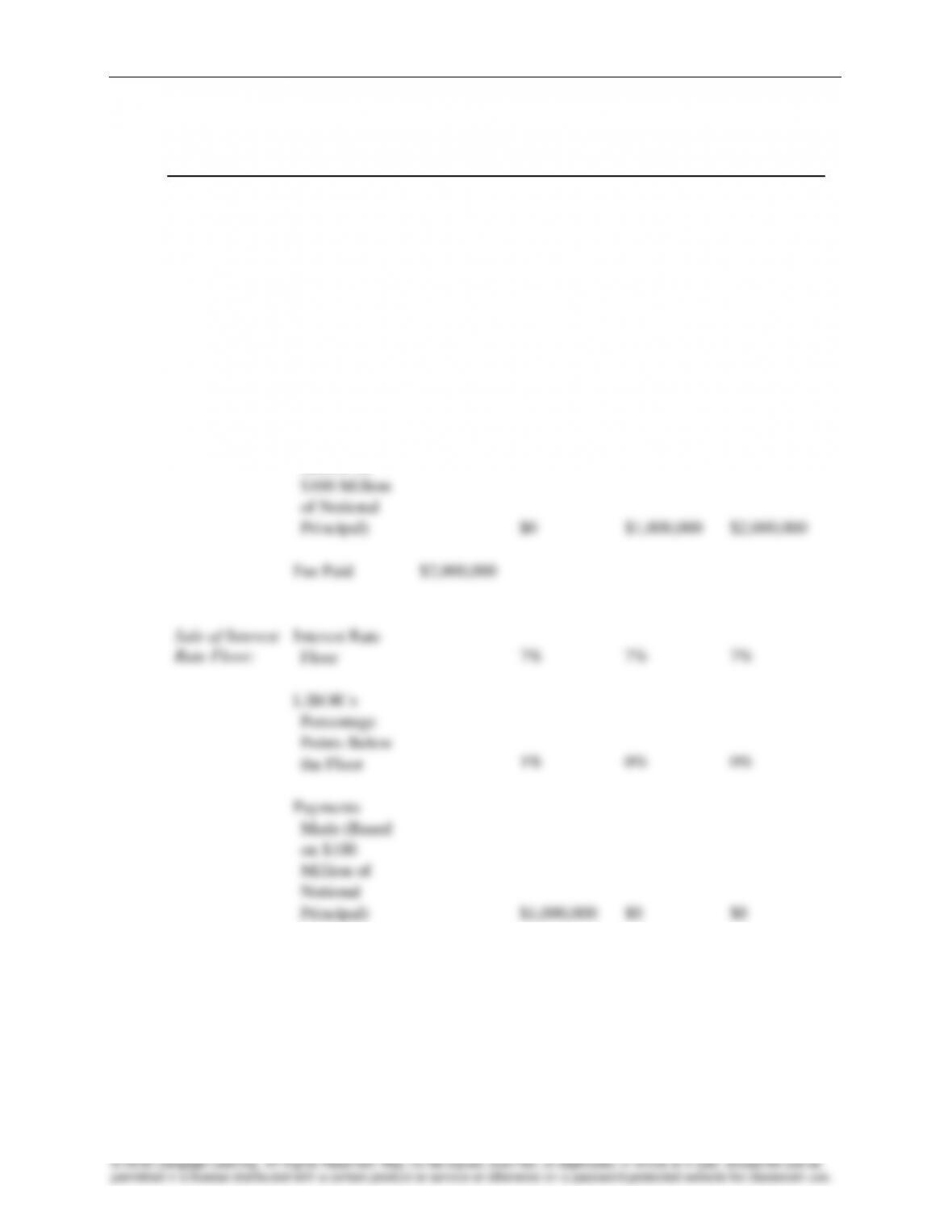
The net payments are derived as follows:
0
1
2
3
LIBOR
6%
10%
11%
Purchase of
Interest Cap:
Interest Rate
Ceiling
9%
9%`
9%
LIBOR’s
Percentage
Points Above
the Ceiling
0%
1%
2%
Payments
Received
(Based on
$100 Million
of Notional
Principal)
$0
$1,000,000
$2,000,000
Fee Paid
$2,000,000
Sale of Interest
Rate Floor:
Interest Rate
Floor
7%
7%
7%
LIBOR’s
Percentage
Points Below
the Floor
1%
0%
0%
Payments
Made (Based
on $100
Million of
Notional
Principal)
$1,000,000
$0
$0
Chapter 15: Swap Markets ❖ 9
.
b. Assuming you are very confident that interest rates will rise, should you consider purchasing a
callable swap instead of the collar? Explain.
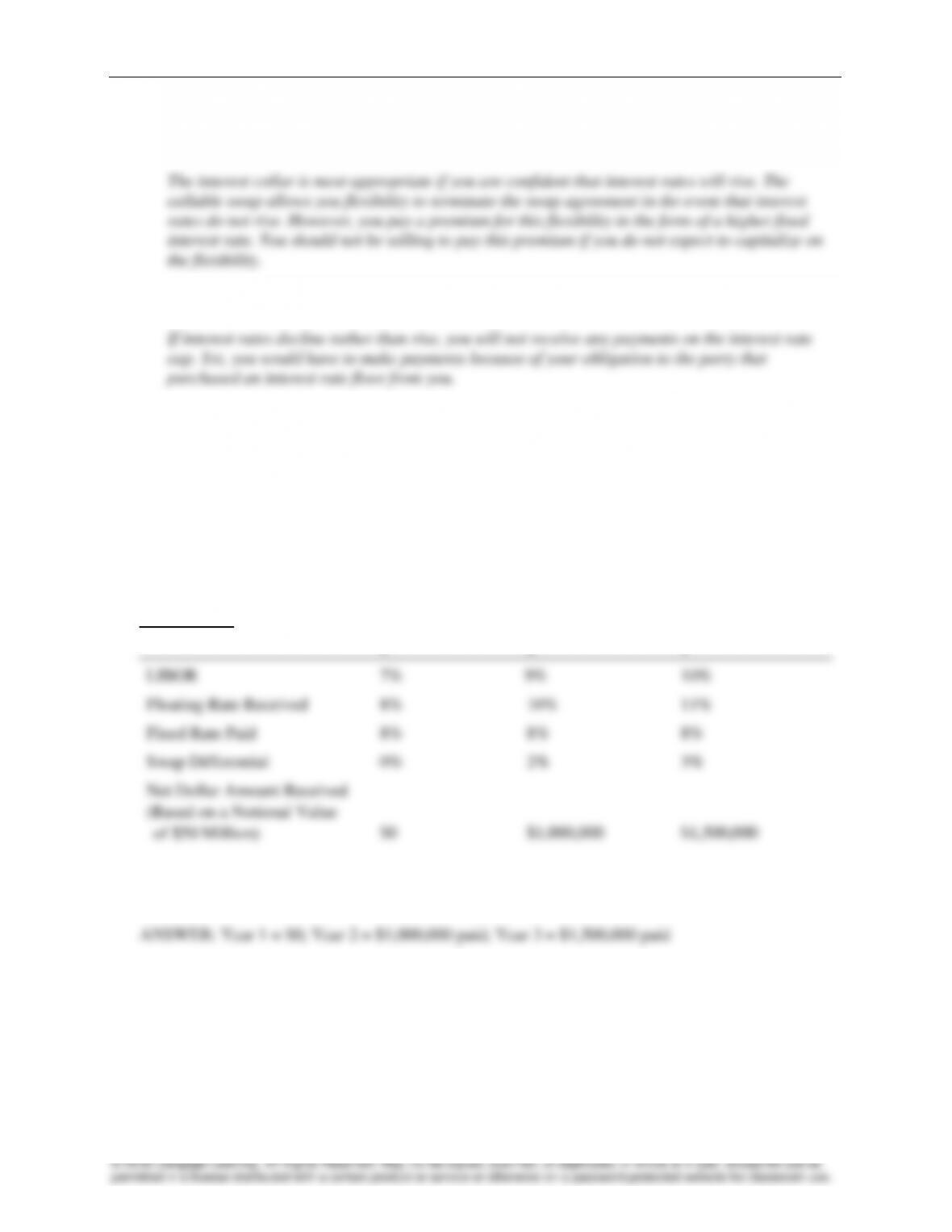
The interest collar is most appropriate if you are confident that interest rates will rise. The
c. Explain the conditions under which your purchase of an interest rate collar could backfire.
If interest rates decline rather than rise, you will not receive any payments on the interest rate
Problems
1. Vanilla Swaps. Cleveland Insurance Company has just negotiated a three-year plain vanilla swap in
which it will exchange fixed payments of 8 percent for floating payments of LIBOR + 1 percent. The
notional principal is $50 million. LIBOR is expected to 7 percent, 9 percent, and 10 percent,
respectively, at the end of each of the next three years.
a. Determine the net dollar amount to be received (or paid) by Cleveland each year.
ANSWER:
End of Year:
1
2
3
LIBOR
7%
9%
10%
Floating Rate Received
8%
10%
11%
Fixed Rate Paid
8%
8%
8%
Swap Differential
0%
2%
3%
Net Dollar Amount Received
(Based on a Notional Value
of $50 Million)
$0
$1,000,000
$1,500,000
b. Determine the dollar amount to be received (or paid) by the counterparty on this interest rate
swap each year based on the assumed forecasts of LIBOR.
2. Interest Rate Caps. Northbrook Bank purchases a four-year cap for a fee of 3 percent of notional
principal valued at $100 million, with an interest rate ceiling of 9 percent, and LIBOR as the index
representing the market interest rate. Assume that LIBOR is expected to be 8 percent, 10 percent, 12
percent, and 13 percent, respectively, at the end of each of the next four years.
a. Determine the initial fee paid, and also determine the expected payments to be received by
Northbrook if LIBOR moves as forecasted.
Chapter 15: Swap Markets ❖ 10
.
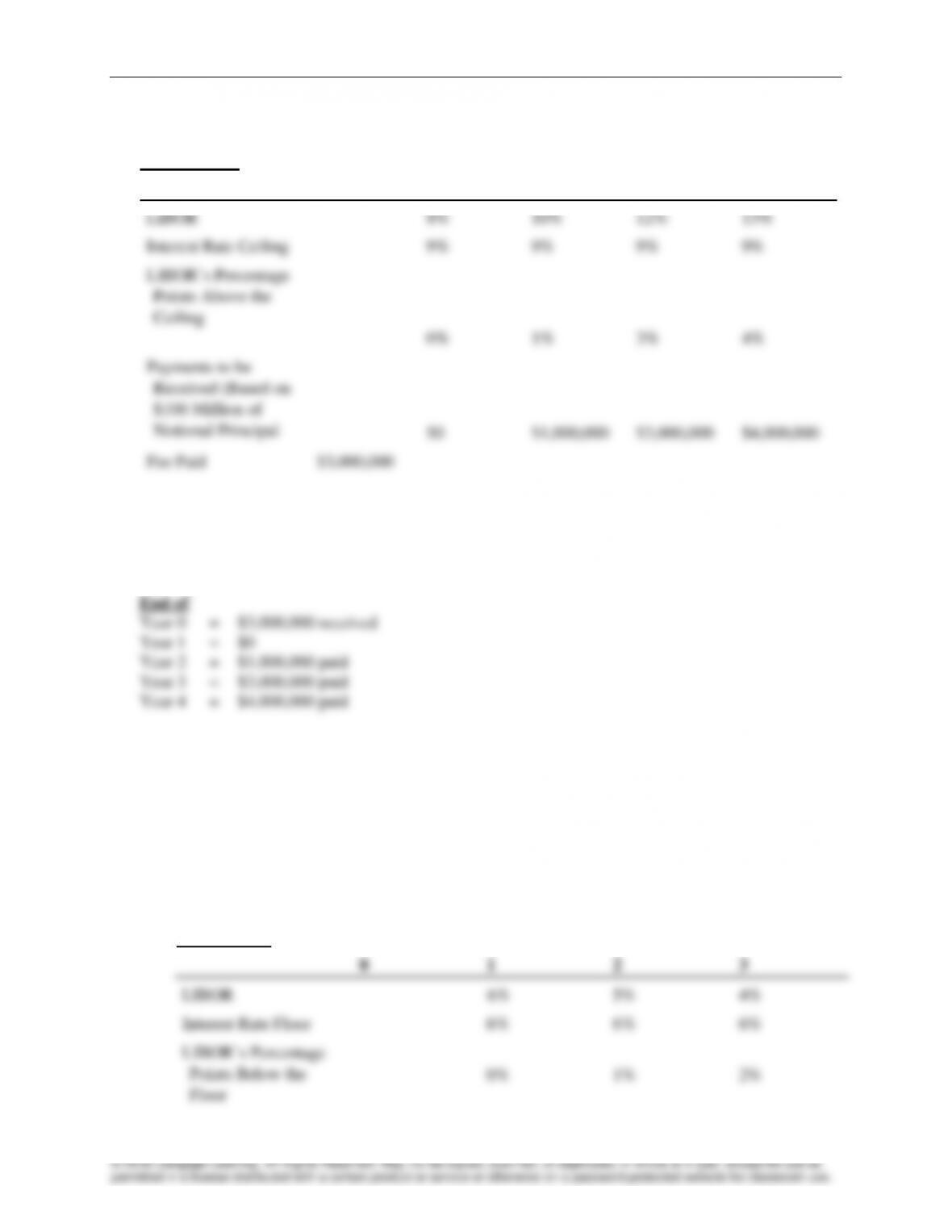
ANSWER:
End of Year:
0
1
2
3
4
LIBOR
8%
10%
12%
13%
Interest Rate Ceiling
9%
9%
9%
9%
LIBOR’s Percentage
Points Above the
Ceiling
0%
1%
3%
4%
Payments to be
Received (Based on
$100 Million of
Notional Principal
$0
$1,000,000
$3,000,000
$4,000,000
Fee Paid
$3,000,000
b. Determine the dollar amount to be received (or paid) by the seller of the interest rate cap based on
the assumed forecasts of LIBOR.
ANSWER:
3. Interest Rate Floors. Iowa City Bank purchases a three-year interest rate floor for a fee of 2 percent
of notional principal valued at $80 million, with an interest rate floor of 6 percent, and LIBOR
representing the interest rate index. The bank expects LIBOR to be 6 percent, 5 percent, and 4 percent
respectively at the end of each of the next three years.
a. Determine the initial fee paid, and also determine the expected payments to be received by Iowa
City if LIBOR moves as forecasted.
ANSWER:
End of Year:
0
1
2
3
LIBOR
6%
5%
4%
Interest Rate Floor
6%
6%
6%
LIBOR’s Percentage
Points Below the
Floor
0%
1%
2%
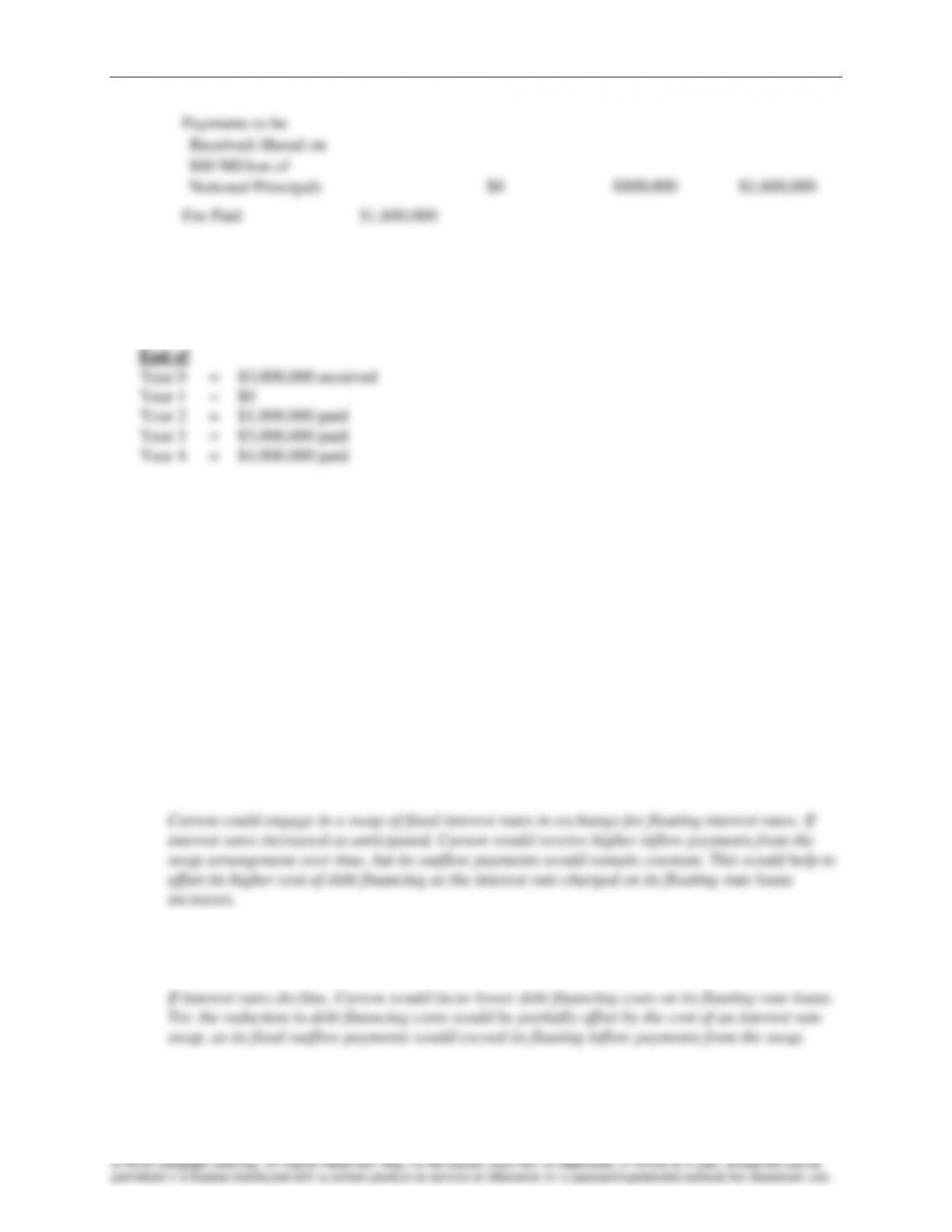
Chapter 15: Swap Markets ❖ 11
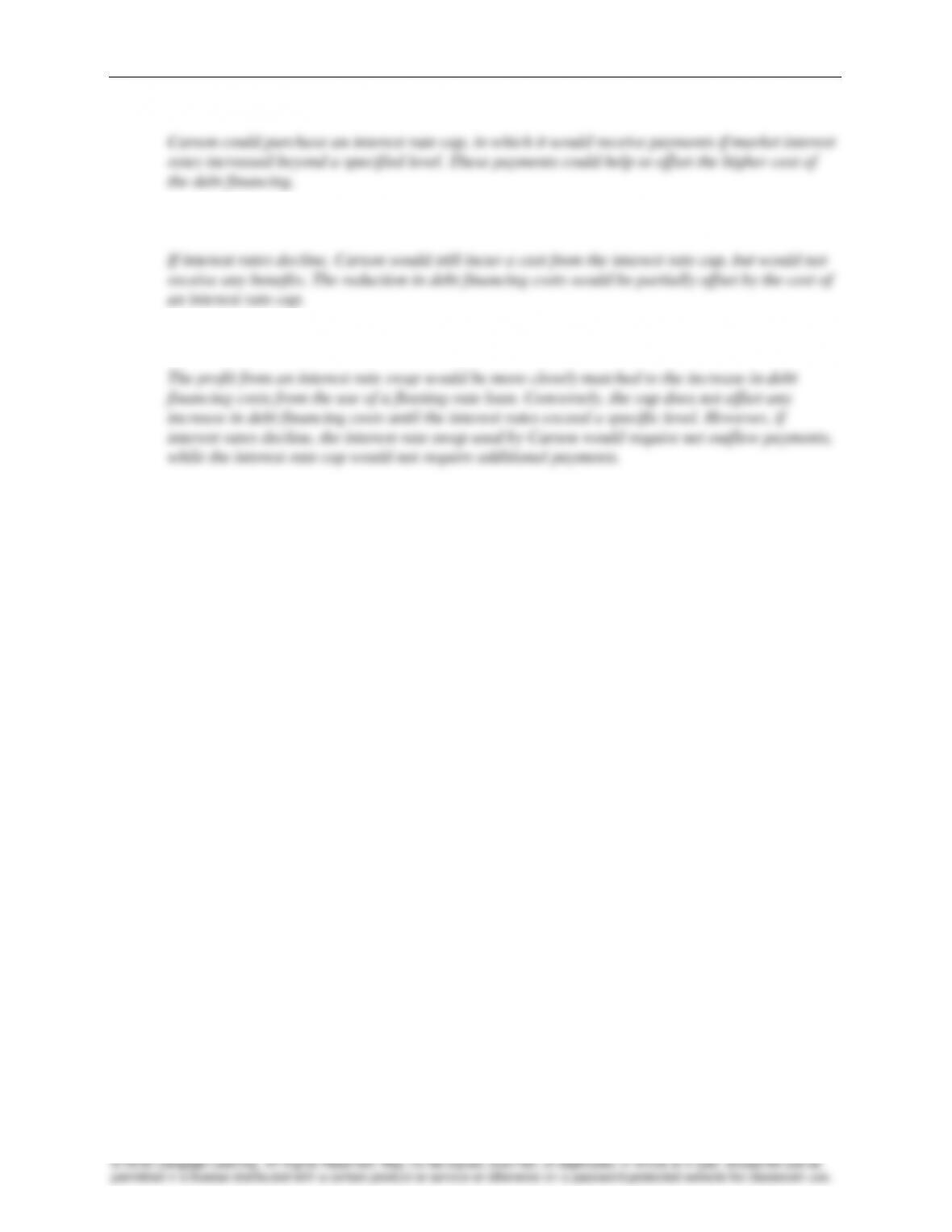
Payments to be
Received (Based on
$80 Million of
Notional Principal)
$0
$800,000
$1,600,000
Fee Paid
$1,600,000
b. Determine the dollar amounts to be received (or paid) by the seller of the interest rate based on
the assumed forecasts of LIBOR.
ANSWER:
Flow of Funds Exercise
Hedging with Interest Rate Derivatives
Recall that if the economy continues to be strong, Carson Company may need to increase its production
capacity by about 50 percent over the next few years to satisfy demand. It would need financing to
expand and accommodate the increase in production. Recall that the yield curve is currently upward
sloping. Also recall that Carson is concerned about a possible slowing of the economy because of
potential Fed actions to reduce inflation. Carson currently relies mostly on commercial loans with floating
interest rates for its debt financing. It has contacted Blazo Bank about the use of interest rate derivatives
to hedge the risk.
a. How could Carson use interest rate swaps to reduce the exposure of its cost of debt to interest rate
movements?
b. What is a possible disadvantage of Carson using the interest rate swap hedge as opposed to no
hedge?
c. How could Carson use an interest rate cap to reduce the exposure of its cost of debt to interest
rate movements?
Chapter 15: Swap Markets ❖ 12
.
d. What is a possible disadvantage of Carson using the interest cap hedge as opposed to no hedge?
e. Explain the tradeoff from using an interest rate swap versus an interest rate cap.
The profit from an interest rate swap would be more closely matched to the increase in debt