
Chapter 13
Financial Futures Markets
Outline
Background on Financial Futures
Popular Futures Contracts
Market for Financial Futures
Purpose of Trading Financial Futures
Trading Process
Trading Requirements
Interest Rate Futures Contracts
Valuing Interest Rate Futures
Speculating with Interest Rate Futures
Hedging with Interest Rate Futures
Stock Index Futures
Valuing Stock Index Futures
Speculating in Stock Index Futures
Hedging with Stock Index Futures
Dynamic Asset Allocation with Stock Index Futures
Arbitrage with Stock Index Futures
Circuit Breakers on Stock Index Futures
Single Stock Futures
Risk of Trading Futures Contracts
Market Risk
Basis Risk
Liquidity Risk
Credit Risk
Prepayment Risk
Operational Risk
Exposure of Futures Market to Systemic Risk
Globalization of Futures Markets
Non-U.S. Participation in U.S. Futures Contracts
Foreign Stock Index Futures
Currency Futures Contracts
Chapter 13: Financial Futures Markets ❖ 2
Key Concepts
1. Explain why speculators take positions in financial futures, and how the outcome is determined.
2. Explain how institutional investors hedge with interest rate futures, and the tradeoff involved.
3. Explain how stock index futures can be used by institutional investors.
POINT/COUNTER-POINT:
Has the Futures Market Created More Uncertainty for Stocks?
WHO IS CORRECT? Use the Internet to learn more about this issue. Offer your own opinion on this
issue.
direct effect on the stock price.
Questions
1. Futures Contracts. Describe the general characteristics of a futures contract. How does a
clearinghouse facilitate the trading of financial futures contracts?
2. Futures Pricing. How does the price of a financial futures contract change as the market price of the
security it represents changes? Why?
3. Hedging with Futures. Explain why some futures contracts may be more suitable than others for
hedging exposure to interest rate risk.
Chapter 13: Financial Futures Markets ❖ 3
© 2018 Cengage Learning. All Rights Reserved. May not be copied, scanned, or duplicated, in whole or in part, except for use as
permitted in a license distributed with a certain product or service or otherwise on a password-protected website for classroom use.
ANSWER: Ideally, the underlying instrument represented by the futures contract would be similarly
sensitive to interest rate movements as the assets that are being hedged.
4. Treasury Bond Futures. Will speculators buy or sell Treasury bond futures contracts if they expect
interest rates to increase? Explain.
5. Gains from Purchasing Futures. Explain how purchasers of financial futures contracts can offset
their position. How is their gain or loss determined? What is the maximum loss to a purchaser of a
futures contract?
6. Gains from Selling Futures. Explain how sellers of financial futures contracts can offset their
position. How is their gain or loss determined?
7. Hedging with Futures. Assume a financial institution has more rate-sensitive assets than rate-
sensitive liabilities. Would it be more likely to be adversely affected by an increase or decrease in
interest rates? Should it purchase or sell interest rate futures contracts in order to hedge its exposure?
8. Hedging with Futures. Assume a financial institution has more rate-sensitive liabilities than rate-
sensitive assets. Would it be more likely to be adversely affected by an increase or a decrease in
interest rates? Should it purchase or sell interest rate futures contracts in order to hedge its exposure?
9. Hedging Decision. Why do some financial institutions remain exposed to interest rate risk, even
when they believe that the use of interest rate futures could reduce their exposure?
10. Long versus Short Hedge. Explain the difference between a long hedge and a short hedge used by
financial institutions. When is a long hedge more appropriate than a short hedge?
11. Impact of Futures Hedge. Explain how the probability distribution of a financial institution’s returns
is affected when it uses interest rate futures to hedge. What does this imply about its risk?
12. Cross-Hedging. Describe the act of cross-hedging. What determines the effectiveness of a cross-
hedge?
13. Hedging with Bond Futures. How might a savings and loan association use Treasury bond futures to
hedge its fixed-rate mortgage portfolio (assuming that its main source of funds is short-term
deposits)? Explain how prepayments on mortgages can limit the effectiveness of the hedge.
14. Stock Index Futures. Describe stock index futures. How could they be used by a financial institution
that is anticipating a jump in stock prices but does not yet have sufficient funds to purchase large
amounts of stock? Explain why stock index futures may reflect investor expectations about the
market more quickly than stock prices.
15. Selling Stock Index Futures. Why would a pension fund or insurance company consider selling
stock index futures?
16. Systemic Risk. Explain systemic risk as it relates to the futures market. Explain how the Financial
Reform Act of 2010 attempts to monitor systemic risk in the futures market and other markets.
Chapter 13: Financial Futures Markets ❖ 5
© 2018 Cengage Learning. All Rights Reserved. May not be copied, scanned, or duplicated, in whole or in part, except for use as
permitted in a license distributed with a certain product or service or otherwise on a password-protected website for classroom use.
ANSWER: Financial institutions could take excessive risks by speculating in the futures market. If
they have agreements over-the-counter, the failure of one party might prevent payment to another
party. This could cause a string of bankruptcies. The Financial Reform Act in 2010 resulted in
the creation of the Financial Stability Oversight Council, which is responsible for identifying
risks to financial stability in the U.S., and makes regulatory recommendations that could
reduce any risks to the financial system. The council consists of 10 members that represent
the head of regulatory agencies that regulate key components of the financial system,
including the Commodity Futures Trading Commission (CFTC), which regulates financial
futures trading.
17. Circuit Breakers. Explain the use of circuit breakers.
Advanced Questions
18. Hedging with Futures. Elon Savings and Loan Association has a large number of 30-year mortgages
with floating interest rates that adjust on an annual basis and obtains most of its funds by issuing five-
year certificates of deposit. It uses the yield curve to assess the market’s anticipation of future interest
rates. It believes that expectations of future interest rates are the major force affecting the yield curve.
Assume that a downward-sloping yield curve with a steep slope exists. Based on this information,
should Elon consider using financial futures as a hedging technique? Explain.
19. Hedging Decision. Blue Devil Savings and Loan Association has a large number of 10-year fixed-
rate mortgages and obtains most of its funds from short-term deposits. It uses the yield curve to assess
the market’s anticipation of future interest rates. It believes that expectations of future interest rates
are the major force in affecting the yield curve. Assume that an upward-sloping yield curve exists
with a steep slope. Based on this information, should Blue Devil consider using financial futures as a
hedging technique? Explain.
20. How Futures Prices May Respond to Prevailing Conditions. Consider the prevailing conditions
for inflation (including oil prices), the economy, the budget deficit, and other conditions that could
affect the values of futures contracts. Based on these conditions, would you prefer to buy or sell
Treasury bond futures at this time? Would you prefer to buy or sell stock index futures at this time?
Assume that you would close out your position at the end of this semester. Offer some logic to
support your answers. Which factor is most influential on your decision regarding Treasury bond
futures and on your decision regarding stock index futures?
Chapter 13: Financial Futures Markets ❖ 6
© 2018 Cengage Learning. All Rights Reserved. May not be copied, scanned, or duplicated, in whole or in part, except for use as
permitted in a license distributed with a certain product or service or otherwise on a password-protected website for classroom use.
ANSWER: This question is open-ended. It requires students to apply the concepts that were presented
in this chapter in order to develop their own view. This question can be useful for class discussion
because it will likely lead to a variety of answers, which reflects the dispersed opinions of market
participants.
21. Use of Interest Rate Futures When Interest Rates Are Low Short-term and long-term interest
rates are presently very low. You believe that the Fed will use a monetary policy to maintain interest
rates at a very low level. Do you think financial institutions that could be adversely affected by a
decline in interest rates would benefit from hedging their exposure with interest rate futures? Explain.
ANSWER: The financial institutions with this type of exposure would not benefit much from
CRITICAL THINKING QUESTION
Stock Index Futures and Systemic Risk. Write a short essay on how financial futures might reduce
systemic risk, and how financial futures might increase systemic risk within financial markets.
ANSWER
Interpreting Financial News
Interpret the following comments made by Wall Street analysts and portfolio managers.
a. “The existence of financial futures contracts allows our firm to hedge against temporary market
declines without liquidating our portfolios.”
b. “Given my confidence in the market, I plan to use stock index futures to increase my exposure to
market movements.”
Chapter 13: Financial Futures Markets ❖ 7
© 2018 Cengage Learning. All Rights Reserved. May not be copied, scanned, or duplicated, in whole or in part, except for use as
permitted in a license distributed with a certain product or service or otherwise on a password-protected website for classroom use.
futures position the way they would with stocks. Instead, they only invest the initial margin, but
stand to incur large gains or losses when the futures contracts are closed out. As a result of this
leverage, the gains or losses are magnified more than if the manager simply used their funds to
purchase stock.
c. “We used currency futures to hedge the exchange rate exposure of our international mutual fund
focused on German stocks.”
Managing in Financial Markets
As a portfolio manager, you are monitoring previous investments that you made in stocks and bonds of
U.S. firms, and in stocks and bonds of Japanese firms. Though you plan to keep all of these investments
over the long run, you are willing to hedge against adverse effects on your investments that result from
economic conditions. You expect that over the next year, U.S. and Japanese interest rates will decline, the
U.S. stock market will perform poorly, the Japanese stock market will perform well, and the Japanese yen
(the currency) will depreciate against the dollar.
a. Should you consider taking a position in U.S. bond index futures to hedge your investment in
U.S. bonds? Explain.
b. Should you consider taking a position in Japanese bond index futures to hedge your investment in
Japanese bonds? Explain.
c. Should you consider taking a position in U.S. stock index futures to hedge your investment in
U.S. stocks? Explain.
d. Should you consider taking a position in Japanese stock index futures to hedge your investment in
Japanese stocks? (Note: The Japanese stock index is denominated in yen, and therefore is used to
hedge stock movements, not currency movements).
e. Should you consider taking a position in Japanese yen futures to hedge the exchange rate risk of
your investment in Japanese stocks and bonds?
Chapter 13: Financial Futures Markets ❖ 8
© 2018 Cengage Learning. All Rights Reserved. May not be copied, scanned, or duplicated, in whole or in part, except for use as
permitted in a license distributed with a certain product or service or otherwise on a password-protected website for classroom use.
Yes. The Japanese stocks and bonds are denominated in yen. Even if the stocks and bonds
perform well from a Japanese perspective, they may be adversely affected from a U.S. perspective
by a decline in the value of the yen. Therefore, you should consider selling yen futures contracts
to hedge the exchange rate risk.
Problems
1. _______________________________________
ANSWER:
2. _______________________________________
= –$14,000
3. _______________________________________
ANSWER:
4. _______________________________________
ANSWER:
Problems
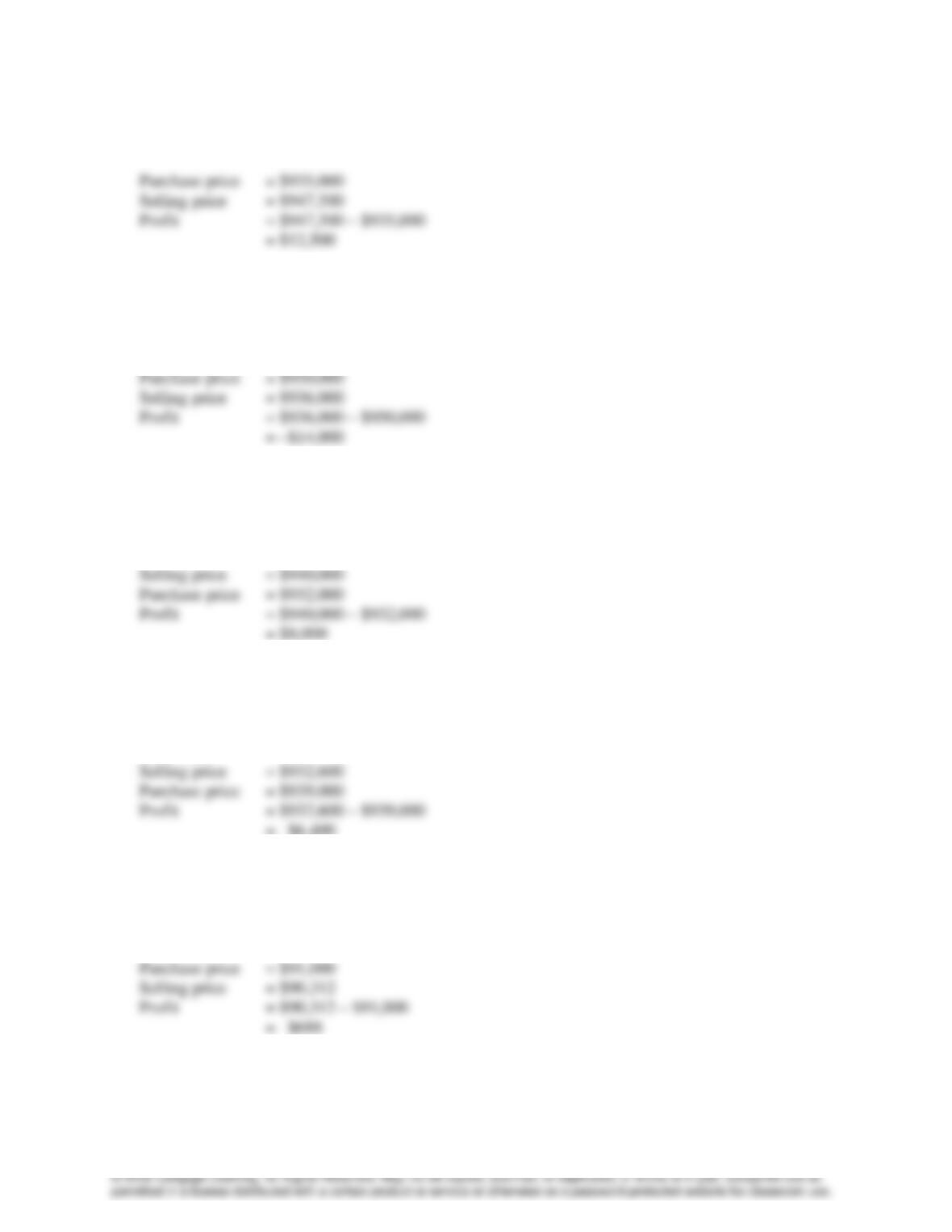
1. Profit from T-Bond Futures Spratt Company purchased Treasury bond futures contracts when the
quoted price was 93-50. When this position was closed out, the quoted price was 94-75.
Determine the profit or loss per contract, ignoring transaction costs.
Chapter 13: Financial Futures Markets ❖ 9
ANSWER:
2. Profit from T-Bond Futures Suerth Investments, Inc., purchased Treasury bond futures contracts
when the quoted price was 95-00. When this position was closed out, the quoted price was 93-60.
Determine the profit or loss per contract, ignoring transaction costs.
ANSWER:
3. Profit from T-Bond Futures Toland Company sold Treasury bond futures contracts when the quoted
price was 94-00. When this position was closed out, the quoted price was 93-20. Determine the
profit or loss per contract, ignoring transaction costs.
ANSWER:
4. Profit from T-Bond Futures Rude Dynamics, Inc., sold T-bill futures contracts when the quoted
price was 93-26. When this position was closed out, the quoted price was 93-90. Determine the
profit or loss per contract, ignoring transaction costs.
ANSWER:
= –$6,400
5. Profit from T-bond Futures. Egan Company purchased a futures contract on Treasury bonds that
specified a price of 91-00. When this position was closed out, the price of the Treasury bond futures
contract was 90-10. Determine the profit or loss, ignoring transaction costs.
ANSWER:
6. Profit from T-bill Futures. R. C. Clark sold a futures contract on Treasury bonds that specified a
price of 92-10. When the position was closed out, the price of Treasury bond futures contract
was 93-00. Determine the profit or loss, ignoring transaction costs.
Chapter 13: Financial Futures Markets ❖ 10
ANSWER:
7. Profit from Stock Index Futures. Marks Insurance Company sold S&P 500 stock index futures that
specified an index of 1690. When the position was closed out, the index specified by the futures
contract was 1,720. Determine the profit or loss, ignoring transaction costs.
ANSWER:
Flow of Funds Exercise
Hedging With Futures Contracts
Recall that if the economy continues to be strong, Carson Company may need to increase its production
capacity by about 50 percent over the next few years to satisfy demand. It would need financing to
expand and accommodate the increase in production. Recall that the yield curve is currently upward
sloping. Also recall that Carson is concerned about a possible slowing of the economy because of
potential Fed actions to reduce inflation. Carson currently relies mostly on commercial loans with floating
interest rates for its debt financing.
a. How could Carson use futures contracts to reduce the exposure of its cost of debt to interest rate
movements? Be specific about whether it would use a short hedge or a long hedge.
b. Will the hedge that you described in the previous question perfectly offset the increase in debt
costs if interest rates increase? Explain what drives the profit from the short hedge, versus what
drives the higher cost of debt to Carson if interest rates increase.
No. The short position is not a perfect hedge. The profit from the short hedge is influenced by the