
Chapter 12
Market Microstructure and Strategies
Outline
Stock Market Transactions
Placing an Order
Margin Trading
Short Selling
How Stock Transactions Are Executed
Floor Brokers
Market Makers
The Spread on Transaction Costs
Electronic Communication Networks (ECNs)
Program Trading
High Frequency Trading
Program Trading
Bots and Algorithms
Impact of High Frequency Trading on Stock Volatility
High Frequency Insider Trading
High Frequency Front Running
Impact of High Frequency Trading on Spreads
Regulation of Stock Trading
Circuit Breakers
Trading Halts
Taxes Imposed on Stock Transactions
Securities and Exchange Commission (SEC)
Trading International Stocks
Reduction in Transaction Costs
Reduction in Information Costs
Reduction in Exchange Rate Risk
Chapter 12: Market Microstructure and Strategies ❖ 2
Key Concepts
1. Explain how transactions are executed, from the point of the order until the trade is made.
2. Explain the development of electronic communication networks (ECNs), and how they can improve
the structure for executing transactions.
3. Explain how regulation is needed to ensure orderly and fair trading.
POINT/COUNTER-POINT:
Is a Market-maker Needed?
WHO IS CORRECT? Use the Internet or some other source search engine to learn more about this issue
and then formulate your own opinion.
Questions
1. Orders. Explain the difference between a market order and a limit order.
2. Margins. Explain how margin requirements can affect the potential return and risk from investing in
a stock. What is the maintenance margin?
3. Short Selling. Under what conditions might investors consider short selling a specific stock?
© 2018 Cengage Learning. All Rights Reserved. May not be copied, scanned, or duplicated, in whole or in part, except for use as
permitted in a license distributed with a certain product or service or otherwise on a password-protected website for classroom use
4. Short Selling. Describe the short selling process. Explain the short interest ratio.
Investors can engage in short selling by selling a stock that they do not own. They must borrow the
stock that they sell.
5. Stock Trading. Describe the roles of market makers.
6. ECNs. What are electronic communication networks (ECNs)?
7. SEC Structure and Role. Briefly describe the structure and role of the Securities and Exchange
Commission (SEC).
8. SEC Enforcement. Explain how the Securities and Exchange Commission attempts to prevent
violations of SEC regulations.
Chapter 12: Market Microstructure and Strategies ❖ 4
© 2018 Cengage Learning. All Rights Reserved. May not be copied, scanned, or duplicated, in whole or in part, except for use as
permitted in a license distributed with a certain product or service or otherwise on a password-protected website for classroom use
ANSWER: The Division of Enforcement assesses possible violations of the SEC’s regulations
and can take action against individuals or firms. An investigation can involve the
examination of securities data or transactions. When the SEC finds that action is warranted, it
may negotiate a settlement with the individuals or firms that are cited for violations, file a
case against them in federal court, or even work with law enforcement agencies if the
violations involve criminal activity.
9. Circuit Breakers. Explain how circuit breakers are used to reduce the likelihood of a large stock
market crash.
10. Trading Halts. Why are trading halts sometimes imposed on particular stocks?
Advanced Questions
11. Reg FD. What are the implications of Regulation FD?
12. Stock Exchange Transaction Costs. Explain how foreign stock exchanges have reduced transactions
costs.
© 2018 Cengage Learning. All Rights Reserved. May not be copied, scanned, or duplicated, in whole or in part, except for use as
permitted in a license distributed with a certain product or service or otherwise on a password-protected website for classroom use
13. Bid-Ask Spread of Penny Stocks. Your friend just told you about a penny stock he purchased,
which increased in price from $0.10 to $0.50 per share. You start investigating penny stocks, and
after conducting a large amount of research, you find a stock with a quoted price of $0.05. Upon
further investigation, you notice that the ask price for the stock is $0.08 and that the bid price is $0.01.
Discuss the possible reasons for this wide bid-ask spread.
14. Ban on Short Selling. Why did the SEC impose a temporary ban on short sales of specific stocks
in 2008? Do you think a ban on short selling is effective?
15. Dark Pools. What are dark pools? How can they help investors accumulate shares without other
investors knowing about the trades? Why are dark pools criticized by public stock exchanges?
Explain the strategy used by public stock exchanges to compete with dark pools.
16. Inside Information. Describe inside information as applied to the trading of stocks. Why is it illegal
to trade based on inside information? Describe the evidence that suggests some investors use inside
information.
Chapter 12: Market Microstructure and Strategies ❖ 6
© 2018 Cengage Learning. All Rights Reserved. May not be copied, scanned, or duplicated, in whole or in part, except for use as
permitted in a license distributed with a certain product or service or otherwise on a password-protected website for classroom use
ANSWER: Insiders of a publicly-traded company (such as managers or board members) sometimes
have inside information about the company, which has not yet been publicized. For example, they
might know that a company has just invented a patent that will be very valuable. It is illegal for
insiders to take positions in the stock based on their inside information, because this would give them
an unfair advantage over other investors. It is also illegal for insiders to pass the inside information on
to other investors, or for those investors to take positions in the stock based on that information.
Investors who can obtain the stock before an acquisition bid is announced can sometimes earn a
return of 30% or more in just a few weeks. In many cases, the stock price of a public company that is
targeted for an acquisition experiences an increase in stock price of 10% or more a few weeks before
the acquisition announcement. Such an abnormal increase in price for many targeted companies
suggests that some traders have inside information that the company will be acquired, and their trades
to obtain shares place upward pressure on the stock price.
17. Galleon Insider Trading Case. Explain how the Galleon case led to stronger enforcement against
insider trading.
18. Strategy of High Frequency Trading Firms Explain the strategy of high frequency trading firms.
Describe the typical time horizon of an investment that is relevant to high frequency traders, and how
that varies from other institutional investors.
19. Flash Crash of May 6, 2010 Describe the Flash Crash on May 6, 2010, and explain why it caused
so much concern to investors and regulators.
© 2018 Cengage Learning. All Rights Reserved. May not be copied, scanned, or duplicated, in whole or in part, except for use as
permitted in a license distributed with a certain product or service or otherwise on a password-protected website for classroom use
20. Front Running by High Frequency Traders Explain how some high frequency traders used a form
of front running to capitalize on faster access to specific markets.
20. Impact of High Frequency Trading on Spreads Explain how and why high frequency trading
affects spreads.
CRITICAL THINKING QUESTION
Regulation of Insider Trading. Some critics argue that insider trading should not be regulated, because
it allows market prices to more quickly reflect the inside information. Write a short essay that supports or
refutes this opinion.
ANSWER
Chapter 12: Market Microstructure and Strategies ❖ 8
Interpreting Financial News
Interpret the following comments made by Wall Street analysts and portfolio managers.
a. “Individual investors who purchase stock on margin might as well go to Vegas.”
b. “During a major market downturn, market makers are suddenly not available.”
forces push the stock price to a lower equilibrium price.
c. “The trading floor may become extinct due to ECNs.”
Managing In Financial Markets
Focus on Heavily Shorted Stocks. As a portfolio manager, you commonly take short positions in stocks
that have a high short interest margin. What is the advantage of focusing on these types of firms? What is
a possible disadvantage?
ANSWER:
Problems
1. Buying on Margin. Assume that Vogl stock is priced at $50 per share and pays a dividend of $1 per
share. An investor purchases the stock on margin, paying $30 per share and borrowing the remainder
from the brokerage firm at 10 percent annualized interest. If after one year, the stock is sold at a price
of $60 per share, what is the return to the investors?
ANSWER:
INV

Chapter 12: Market Microstructure and Strategies ❖ 9
© 2018 Cengage Learning. All Rights Reserved. May not be copied, scanned, or duplicated, in whole or in part, except for use as
permitted in a license distributed with a certain product or service or otherwise on a password-protected website for classroom use
$30
1$22$30$60$+−−
=
%30=
2. Buying on Margin. Assume that Duever stock is priced at $80 per share and pays a dividend of $2
per share. An investor purchases the stock on margin, paying $50 per share and borrowing the
remainder from the brokerage firm at 12 percent annualized interest. If after one year, the stock is
sold at a price of $90 per share, what is the return to the investor?
ANSWER:
INV
LOANINV DSP
R+−−
=
$50
2$60.33$50$90$+−−
=
%8.16=
3. Buying on Margin. Suppose that you buy a stock for $48 by paying $25 and borrowing the
remaining $23 from a brokerage firm at 8 percent annualized interest. The stock pays an annual
dividend of $0.80 per share, and after one year, you are able to sell it for $65. Calculate your return
on the stock. Then, calculate the return on the stock if you had used only personal funds to make the
purchase. Repeat the problem, assuming that only personal funds are used, and that you sell the stock
for $40 at the end of one year.
ANSWER:
INV
LOANINV DSP
R+−−
=
$25
80$.84.24$25$65$+−−
=
%84.63=
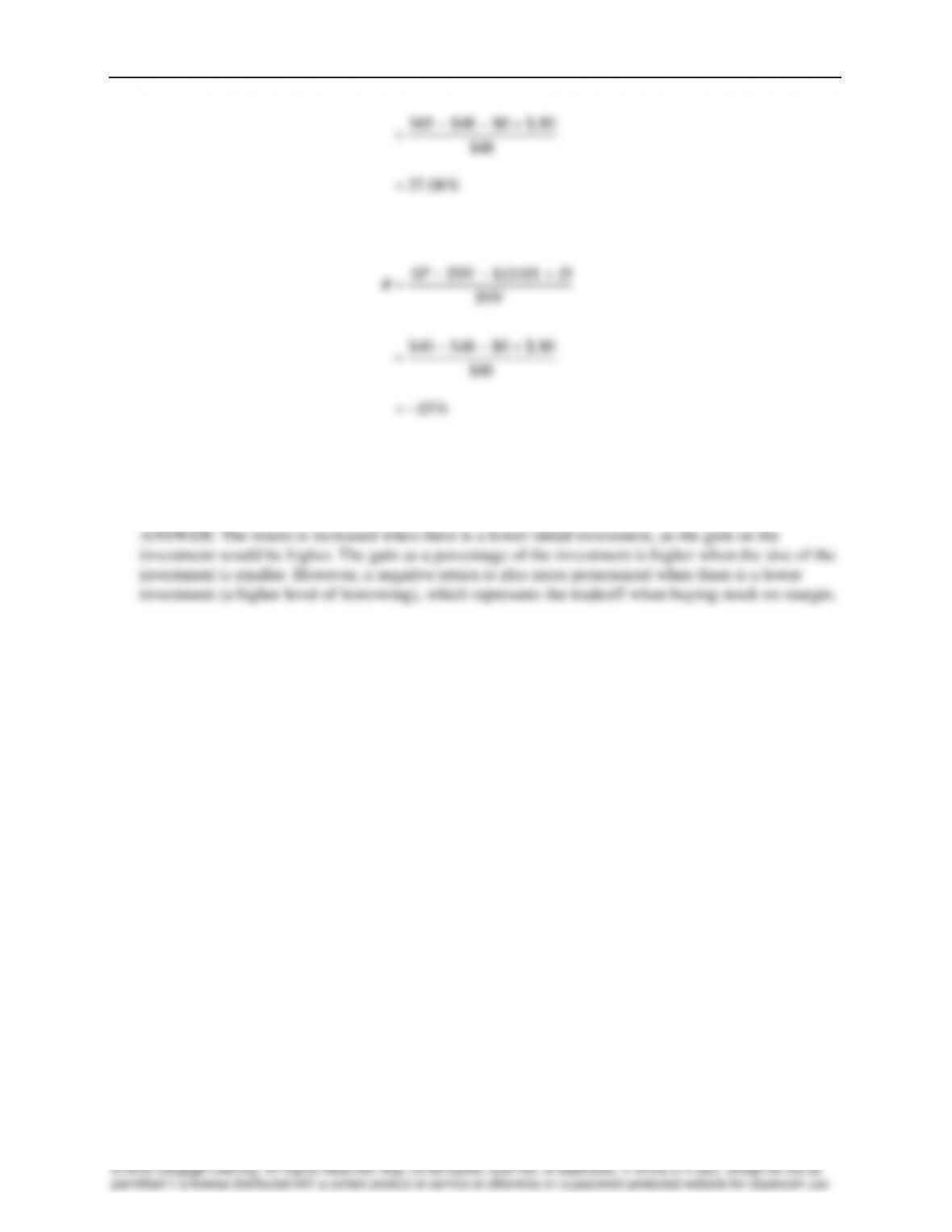
If only personal funds are used:
INV
LOANINV DSP
R+−−
=
Chapter 12: Market Microstructure and Strategies ❖ 10
© 2018 Cengage Learning. All Rights Reserved. May not be copied, scanned, or duplicated, in whole or in part, except for use as
permitted in a license distributed with a certain product or service or otherwise on a password-protected website for classroom use
$48
80$.0$48$65$+−−
=
%08.37=
If only personal funds are used, and you sell stock for $40:
4. Buying on Margin. How would the return on a stock be affected by a lower initial investment (and
higher loan amount)? Explain the relationship between the proportion of funds borrowed and the
return.
Flow of Funds Exercise
Shorting Stocks
Recall that if the economy continues to be strong, Carson Company may need to increase its production
capacity by about 50 percent over the next few years to satisfy demand. It would need financing to
expand and accommodate the increase in production. Recall that the yield curve is currently upward
sloping. Also recall that Carson is concerned about a possible slowing of the economy because of
potential Fed actions to reduce inflation. It is also considering the issuance of stock or bonds to raise
funds in the next year.
a. In some cases, a stock’s price is too high or too low because of asymmetric information,
information known by the firm but not by investors. How can Carson attempt to minimize
asymmetric information?
It could provide timely and detailed financial reports, and could use a reporting system that
allows for transparency so that its operations can be easily monitored.
b. Carson Company is concerned that if it issues stock, its stock price over time could be adversely
affected by certain institutional investors that take large short positions in a stock. When this is
happening, the stock’s price may be undervalued because of the pressure on the price caused by
the large short positions. What can Carson do to counter major short positions taken by
institutional investors if it really believes that its stock price should be higher? What is the
potential risk involved in this strategy?

Chapter 12: Market Microstructure and Strategies ❖ 11
© 2018 Cengage Learning. All Rights Reserved. May not be copied, scanned, or duplicated, in whole or in part, except for use as
permitted in a license distributed with a certain product or service or otherwise on a password-protected website for classroom use
It could repurchase some of its shares in the market, which would allow it to obtain shares at a
low price. It could issue more shares later once the share price rises. Its actions would be
beneficial to its shareholders.
The risk is that Carson is wrong in its perception, which could cause it to repurchase shares
before the price declines further. In this case, its actions would not satisfy shareholders.
Solution to Integrative Problem for Part 4
Stock Market Analysis
1. Olympic stock’s future earnings should improve because it will not incur the restructuring charges in
the future. Its most recent earnings were reduced due to a one-time restructuring charge, so it could be
2. Kenner stock deserves its low P/E because its growth prospects are lower than the competition. Since
it has not kept up with technology, its growth prospects are limited. A P/E ratio implicitly captures
3. While the discount rate used to discount future cash flows generated by stocks may increase, the cash
flows should also increase. Thus, it is not clear whether stock prices would decline because of the