
Chapter 10
Stock Offerings and Investor Monitoring
Outline
Private Equity
Financing by Venture Capital Funds
Financing by Private Equity Funds
Financing by Crowdfunding
Public Equity
Ownership and Voting Rights
Preferred Stock
Participation in Stock Markets
How Investor Decisions Affect Stock Prices
Investor Reliance on Information
Initial Public Offerings
Process of Going Public
Underwriter Efforts to Ensure Price Stability
Timing of IPOs
Initial Returns of IPOs
Google’s IPO
Facebook’s IPO
Abuses in the IPO Market
Long-Term Performance Following IPOs
Stock Offerings and Repurchases
Secondary Stock Offerings
Stock Repurchases
Stock Exchanges
Organized Exchanges
Over-the-Counter Market
Extended Trading Sessions
Stock Quotations Provided by Exchanges
Stock Index Quotations
Private Stock Exchanges
Monitoring Publicly Traded Companies
Role of Analysts
Accounting Irregularities
Sarbanes-Oxley Act
Shareholder Activism
Limited Power of Governance

Chapter 10: Stock Offerings and Investor Monitoring ❖ 2
Market for Corporate Control
Use of LBOs to Achieve Corporate Control
Barriers to the Market for Corporate Control
Globalization of Stock Markets
Privatization
Emerging Stock Markets
Variation in Characteristics Among Stock Markets
Methods Used to Invest in Foreign Stocks
Key Concepts
1. Explain the role of venture capital funds and private equity funds provide equity financing to firms.
2. Describe the process of an engaging in an initial public offering.
3. Describe the process of engaging in a secondary offering.
4. Explain how firms are monitored within the stock market.
POINT/COUNTER-POINT:
Should a Stock Exchange Enforce Some Governance Standards on the Firms
Listed on the Exchange?
WHO IS CORRECT? Use the Internet to learn more about this issue and then formulate your own
opinion.
Questions
1. Shareholder Rights. Explain the rights of common stockholders that are not available to other
individuals.
2. Stock Offerings. What is the danger of issuing too much stock? What is the role of the securities firm
that serves as the underwriter, and how can it ensure that the firm does not issue too much stock?
3. IPOs. Why do firms engage in IPOs? What is the amount of fees that the lead underwriter and its
syndicate charge a firm that is going public? Why are there many IPOs in some periods and few IPOs
in other periods?
4. Venture Capital. Explain the difference between obtaining funds from a venture capital firm and
engaging in an IPO. Explain how the IPO may serve as a means by which the venture capital firm can
cash out.
5. Prospectus and Road Show. Explain the use of a prospectus developed before an IPO. Why does a
firm do a road show before its IPO? What factors influence the offer price of stock at the time of the
IPO?
6. Bookbuilding. Describe the process of bookbuilding. Why is bookbuilding sometimes criticized as a
means of setting the offer price?
7. Lockups. Describe a lockup provision and explain why it is required by the lead underwriter.
8. Initial Return. What is the meaning of an initial return for an IPO? Were initial returns of Internet
IPOs in the late 1990s higher or lower than normal? Why?
9. Flipping. What does it mean to “flip” shares? Why would investors want to flip shares?
10. Performance of IPOs. How do IPOs perform over the long run?
11. Asymmetric Information. Discuss the concept of asymmetric information. Explain why it may
motivate firms to repurchase some of their stock.
12. Stock Repurchases. Explain why the stock price of a firm may rise when the firm announces that it
is repurchasing its shares.
13. Corporate Control. Describe how the interaction between buyers and sellers affects the market value
of a firm, and explain how that value can subject a firm to the market for corporate control.
14. ADRs. Explain how ADRs enable U.S. investors to become part owners of foreign companies.
15. NYSE. Explain why stocks traded on the NYSE generally exhibit less risk than stocks that are traded
on other exchanges.
16. Role of Organized Exchanges. Are organized stock exchanges used to place newly issued stock?
Explain.
Advanced Questions
17. Role of IMFs. How have international mutual funds (IMFs) increased the international integration of
capital markets among countries?
18. Spinning and Laddering. Describe spinning and laddering in the IPO market. How do you think
these actions influence the price of a newly issued stock? Who is adversely affected as a result of
these actions?
ANSWER: Spinning is the process in which an investment bank allocates shares from an IPO to
Chapter 10: Stock Offerings and Investor Monitoring ❖ 8
26. Limitations of an IPO. Businesses valued at less than $50 million or so rarely go public. Explain
the limitations to such businesses if they did go public.
27. Private Equity Funds. Explain the incentive for private equity funds to invest in a firm and improve
its operations.
28. VCs and Lockup Expiration Following IPOs. Venture capital firms commonly attempt to cash out
as soon as is possible following IPOs. Describe the likely effect that would have on the stock price at
the time of lockup expiration. Would the effect be different for a firm that relied more heavily on VC
firms than other investors for its funds?
29. Impact of SOX on Going Private. Explain why some public firms decided to go private in response
to the passage of the Sarbanes-Oxley (SOX) Act.
30. Pricing Facebook’s IPO Stock Price. Describe the dilemma of securities firms that served as
underwriters for Facebook’s IPOs, when attempting to satisfy Facebook and the institutional investors
that invested in Facebook’s stock. Do you think that the securities firms that served as underwriters
for Facebook’s IPO satisfied Facebook or its investors in the IPO? Explain.
Chapter 10: Stock Offerings and Investor Monitoring ❖ 9
31. Private Stock Market. What are some possible disadvantages to investors who invest in stocks
listed on a private stock market?
32. Use of Financial Leverage by Private Equity Funds Explain why private equity funds use a very
high degree of financial leverage, and how this affects their risk and potential return on investment.
ANSWER:
Private equity funds tend to rely heavily on borrowing to finance their investments. This enables them
33. Overallotment Option in IPOs. Explain how underwriters use the overallotment option in IPOs.
ANSWER:
34. Designated Market Maker on NYSE. Describe the role of the designated market maker on the New
York Stock Exchange.
ANSWER:
CRITICAL THINKING QUESTION
Valuations of IPOs. Write a short essay on why there is so much uncertainty surrounding the valuation
of a firm that is engaged in an IPO. Why do you think some investors overvalue firms at the time of their
IPO?
ANSWER
Firms that pursue IPOs tend to be young firms that have grown substantially in recent years, and need
Interpreting Financial News
Interpret the following statements made by Wall Street analysts and portfolio managers:
a. “The recent wave of IPOs is an attempt by many small firms to capitalize on the recent run-up in
stock prices.”
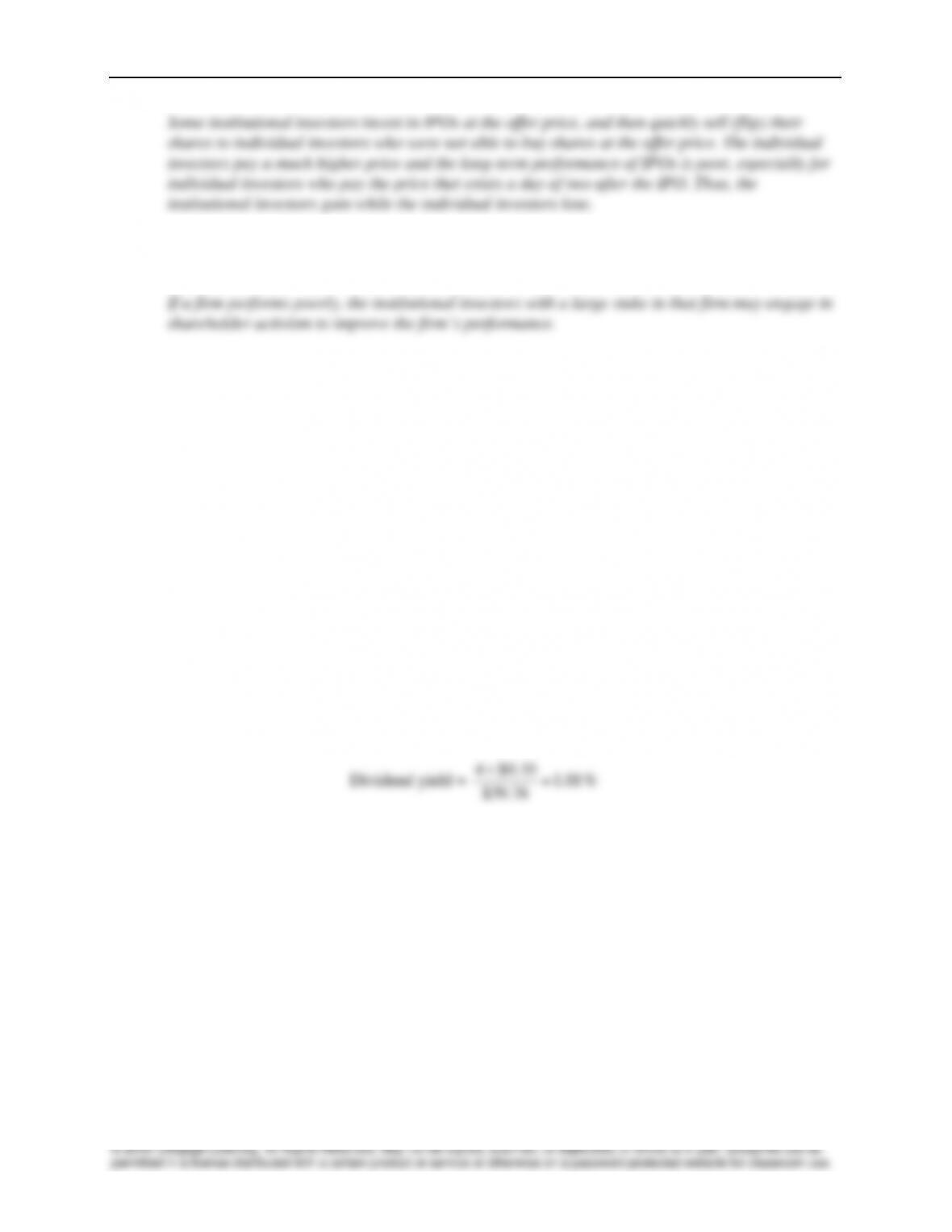
b. “IPOs transfer wealth from unsophisticated investors to large institutional investors who get in at
the offer price and get out quickly.”
Chapter 10: Stock Offerings and Investor Monitoring ❖ 11
c. “Firms must be more accountable to the market when making decisions because they are subject
to indirect control by institutional investors.”
Managing in Financial Markets
As a portfolio manager of a financial institution, you are invited to numerous road shows at which firms
that are going public promote themselves, and the lead underwriter invites you to invest in the IPO.
Beyond any specific information about the firm, what other information would you need to decide
whether to invest in the upcoming IPO?
Market conditions should be assessed. As stock market conditions change, valuations change. In addition,
industry conditions change over time, which affect valuations of firms within a particular industry.
Problem
1. Dividend Yield. Over the last year, Calzone Corporation paid a quarterly dividend of $0.10 in each of
the four quarters. The current stock price of Calzone Corporation is $39.78. What is the dividend
yield for Calzone stock?
ANSWER:
78.39$
10.0$4 =
Flow of Funds Exercise
Contemplating an Initial Public Offering (IPO)
Recall that if the economy continues to be strong, Carson Company may need to increase its production
capacity by about 50 percent over the next few years to satisfy demand. It would need financing to
expand and accommodate the increase in production. Recall that the yield curve is currently upward
sloping. Also recall that Carson is concerned about a possible slowing of the economy because of
potential Fed actions to reduce inflation. It is also considering the issuance of stock or bonds to raise
funds in the next year.
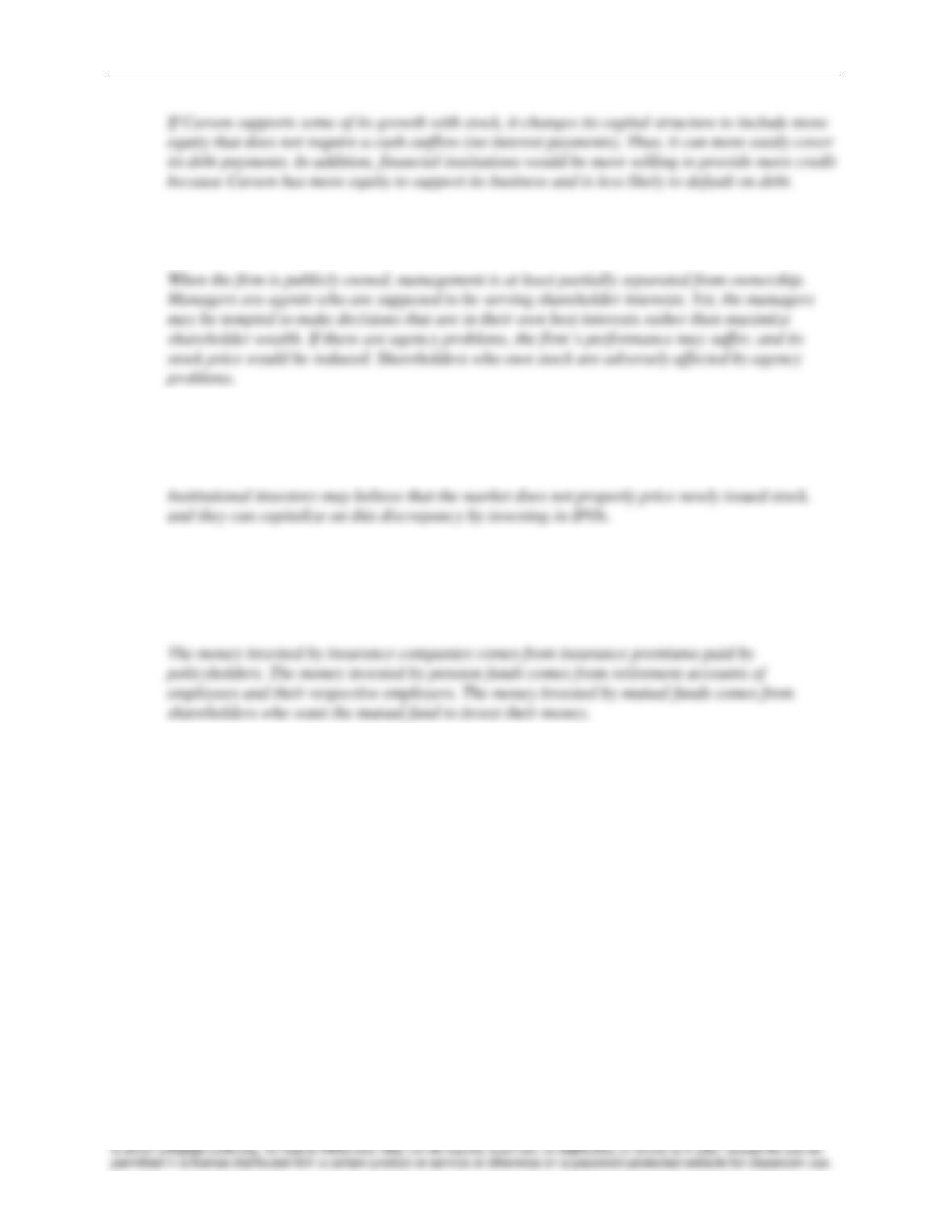
a. If Carson issued stock now, it would have the flexibility to obtain more debt and would also be
able to reduce its cost of financing with debt. Why?
Chapter 10: Stock Offerings and Investor Monitoring ❖ 12
b. Why would an IPO result in heightened concerns in financial markets about Carson Company’s
potential agency problems?
c. Explain why institutional investors such as mutual funds and pension funds that invest in stock
for long-term periods (at least a year or two) may prefer to invest in IPOs rather than to purchase
other stocks that have been publicly traded for several years?
Institutional investors may believe that the market does not properly price newly issued stock,
d. Given that institutional investors such as insurance companies, pension funds, and mutual funds
are the major investors in IPOs, explain the flow of funds that results from an IPO. That is, what
is the original source of the money that is channeled through the institutional investors and
provided to the firm going public?