Chapter 8
Analysis of Risk and Return
CHAPTER 8
ANALYSIS OF RISK AND RETURN
ANSWERS TO QUESTIONS:
1. a. Risk refers to the chance for some unfavorable event to occur. In finance, risk is the
b. Probability distributions define the percentage chance of occurrence of each of one or
c. The standard deviation is a statistical measure of the dispersion of a variable about the
d. The required rate of return of an investment is the level of return investors demand,
e. The coefficient of variation is a measure of relative risk. It is defined as the ratio of the
f. A portfolio is efficient if, for a given standard deviation, there is no other portfolio with a
h. The capital market line is a line joining the risk-free rate and the market portfolio. It
i. Beta is a measure of the systematic risk of an asset or security. It is defined as the ratio of
j. CAPM is the Capital Asset Pricing Model, a theory which describes the relationship
k. The correlation coefficient is a relative statistical measure of the degree to which two
8-&
Chapter 8
Analysis of Risk and Return
m. The characteristic line is a regression line relating the periodic holding period returns for
n. The security market line defines the relationship between systematic risk and the
o. The covariance is an absolute statistical measure of the degree to which two series of
p. Systematic risk is that portion of the variability in a security’s return that is caused by
2. The probability distribution of a security whose returns are known with certainty is a single
3. “Risk-free” U.S. Government bonds have virtually no risk of default, but they are exposed to
4. With increased inflation expectations, required returns on bonds would tend to increase and
5. The coefficient of variation and the standard deviation of a security’s return will give the
6. Diversification can reduce the risk of a portfolio of assets below that of the weighted average
7. The primary variables that influence the risk of a portfolio of assets are the risk of the
8. Systematic risk refers to that portion of the variability of an individual security’s return that
Unsystematic risk is risk that is unique to the firm. It is the variability of a security’s returns
8-&
Chapter 8
Analysis of Risk and Return
9. An increase in the expected future inflation rate increases the investors’ required rates of
10. A beta of 1.4 indicates that Amrep has more than an average level of systematic risk (an
11. A security’s beta value is computed as the slope of a regression line between holding period
12. The beta concept can be used to estimate the cost of equity capital for a firm, assuming that
investors tend to hold well-diversified portfolios of securities, making systematic risk the
When computing the cost of equity using the beta concept, an analyst must estimate the
13. a. C, D, E, and F
14. The term structure of interest rates is the pattern of interest rate yields for debt securities
15. The risk structure of interest rates is the pattern of interest rate yields for debt securities that
16. Risk in a financial sense is defined as variability of returns. The greater the variability of a
18. Required rates of return on all securities include a default-risk-free rate of return, composed
8-&
Chapter 8
Analysis of Risk and Return
of a real rate of return and a purchasing power loss premium. Government and corporate
bonds also have a maturity risk premium, reflecting the term structure of interest rates
prevailing in the capital markets. Corporate bonds and equities have a default risk premium
19. Downward sloping yield curves usually indicate that investors expect interest rates (and
20. There is virtually no risk of default on U.S. Government bonds, because the U.S. government
21. No. The cost of equity capital for a firm must always be greater than the cost of debt capital
to that same firm, because equity capital has the lowest priority of payment in case of
SOLUTIONS TO PROBLEMS:
1. a. E(RX) = .1(-10%) + .2(10%) + .4(15%) + .2(20%) + .1(40%)
= 15%
b. X = [(-10-15)2.1 + (10-15)2.2 + (15-15)2.4 + (20-15)2.2 +
c. Stock X is riskier because it has a higher standard deviation of returns
8-&
Chapter 8
Analysis of Risk and Return
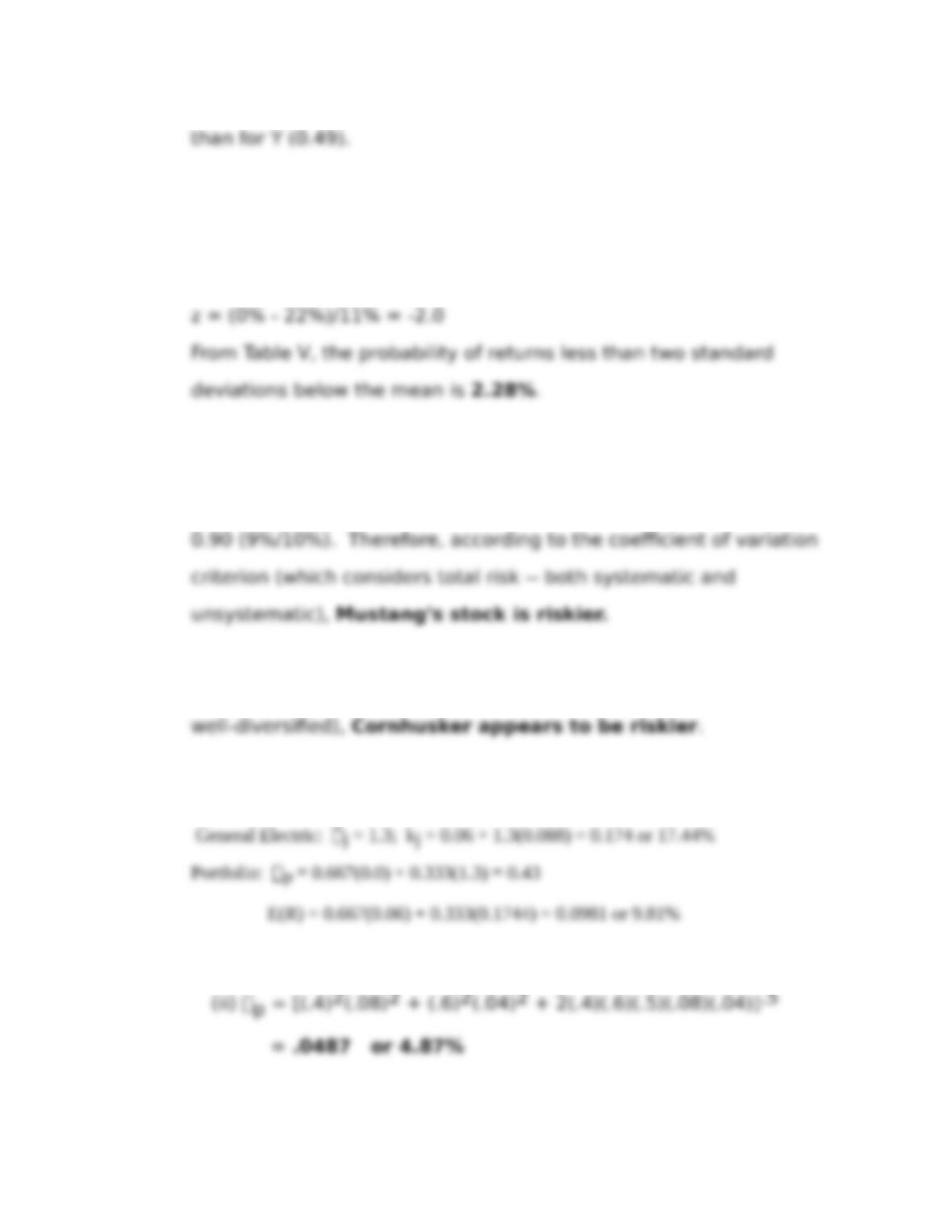
2. z = (33% – 22%)/11% = +1.0
From Table V, the probability of returns in excess of one standard
deviation above the mean is 15.87%.
3. a. The coefficient of variation of returns for Cornhusker’s stock is 0.75
(15%/20%). The coefficient of variation of returns for Mustang’s stock is
b. Looking only at systematic risk (i.e., assuming that investors are
4. Treasury bills: j = 0.0; kj = rf = 0.06
5. a. (i) E(R) = .4(.10) + .6(.07) = .082 or 8.2%
b. (i) E(R) = .7(.10) + .3(.07) = .091 or 9.1%
8-&
Chapter 8
Analysis of Risk and Return
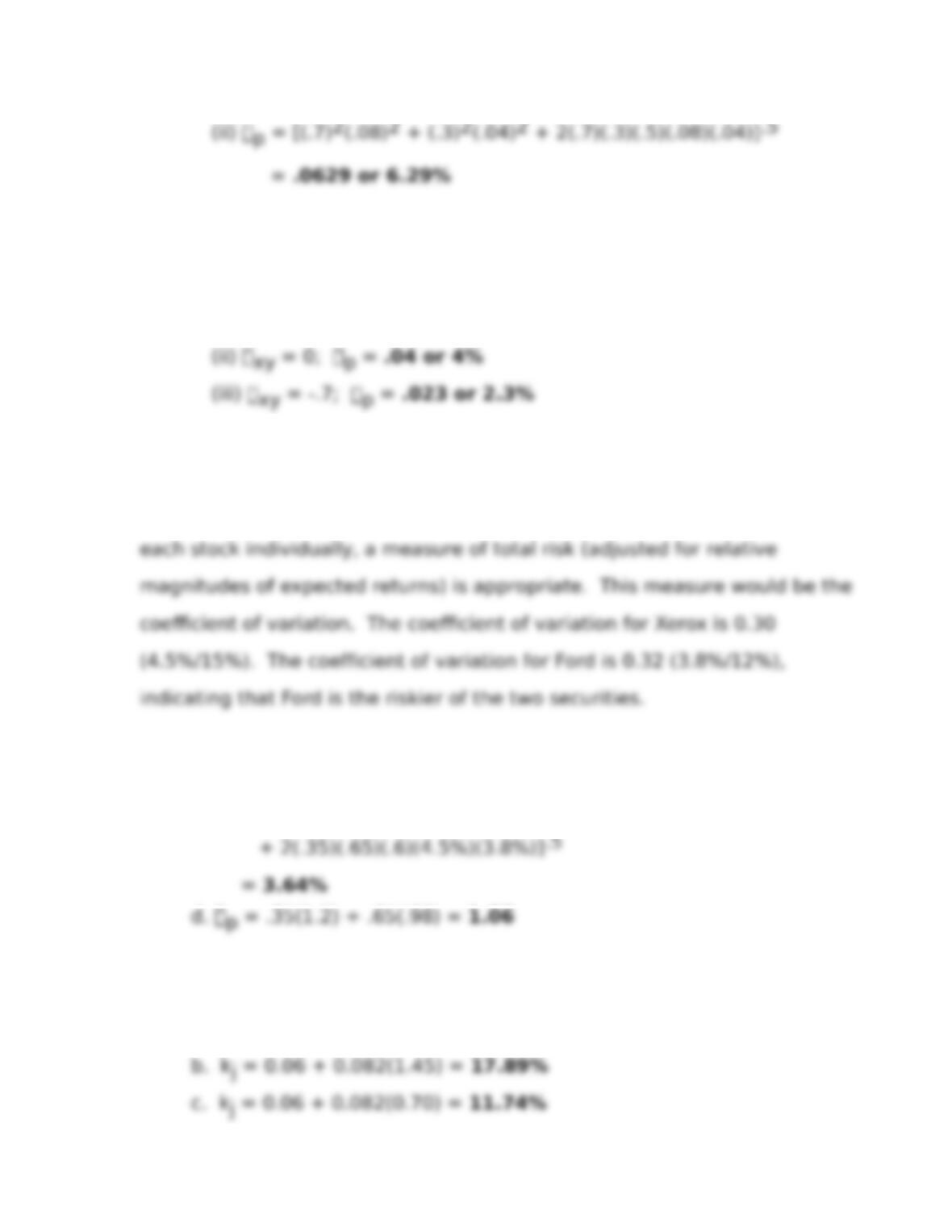
c. Expected returns remain the same. They do not depend on the
correlation of returns among securities.
(i) xy = +1; p = .056 or 5.6% (by substituting +1 for + 0.5 in
part 5. a. (ii) above.
6. a. From a portfolio risk perspective, Xerox would be considered the riskier
stock because it has a larger beta (1.2) than Ford (0.98). When considering
b. E(R) = .35(15%) + .65(12%) = 13.05%
c. p = [(.35)2(4.5%)2 + (.65)2(3.8%)2
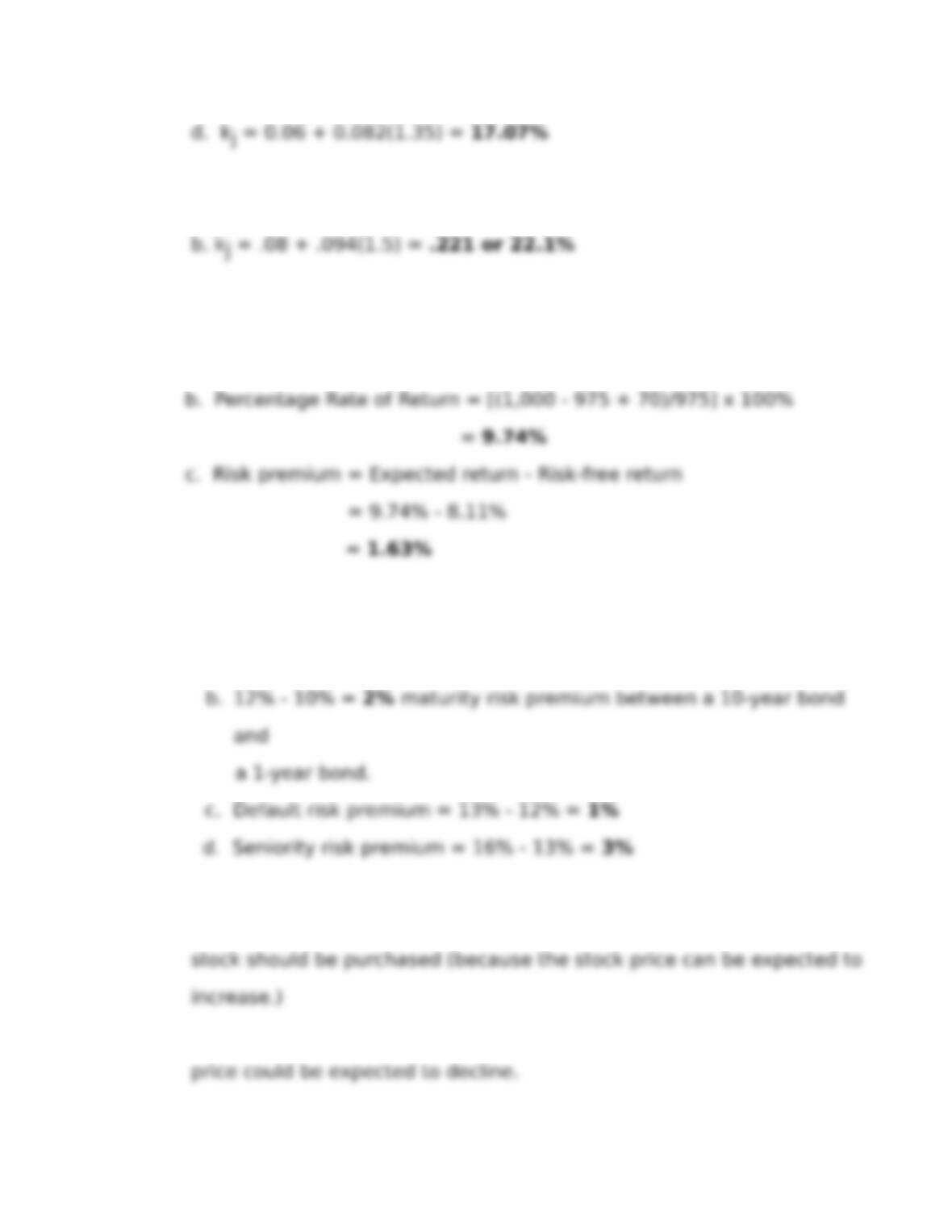
7. a. kj = 0.06 + 0.082j
= 0.06 + 0.082(0.70) = 11.74%
8-&
Chapter 8
Analysis of Risk and Return
8. a. kj = .06 + .094(1.5) = .201 or 20.1%
9. a. Percentage Rate of Return = [(100,000 – 92,500)/92,500] x 100%
= 8.11%
10. a. rf = 3% real return + 7% inCation premium = 10%
11. a. Because the expected return exceeds the required return, Bulldog’s
b. If the expected return were less than the required return, the stock
8-&
Chapter 8
Analysis of Risk and Return
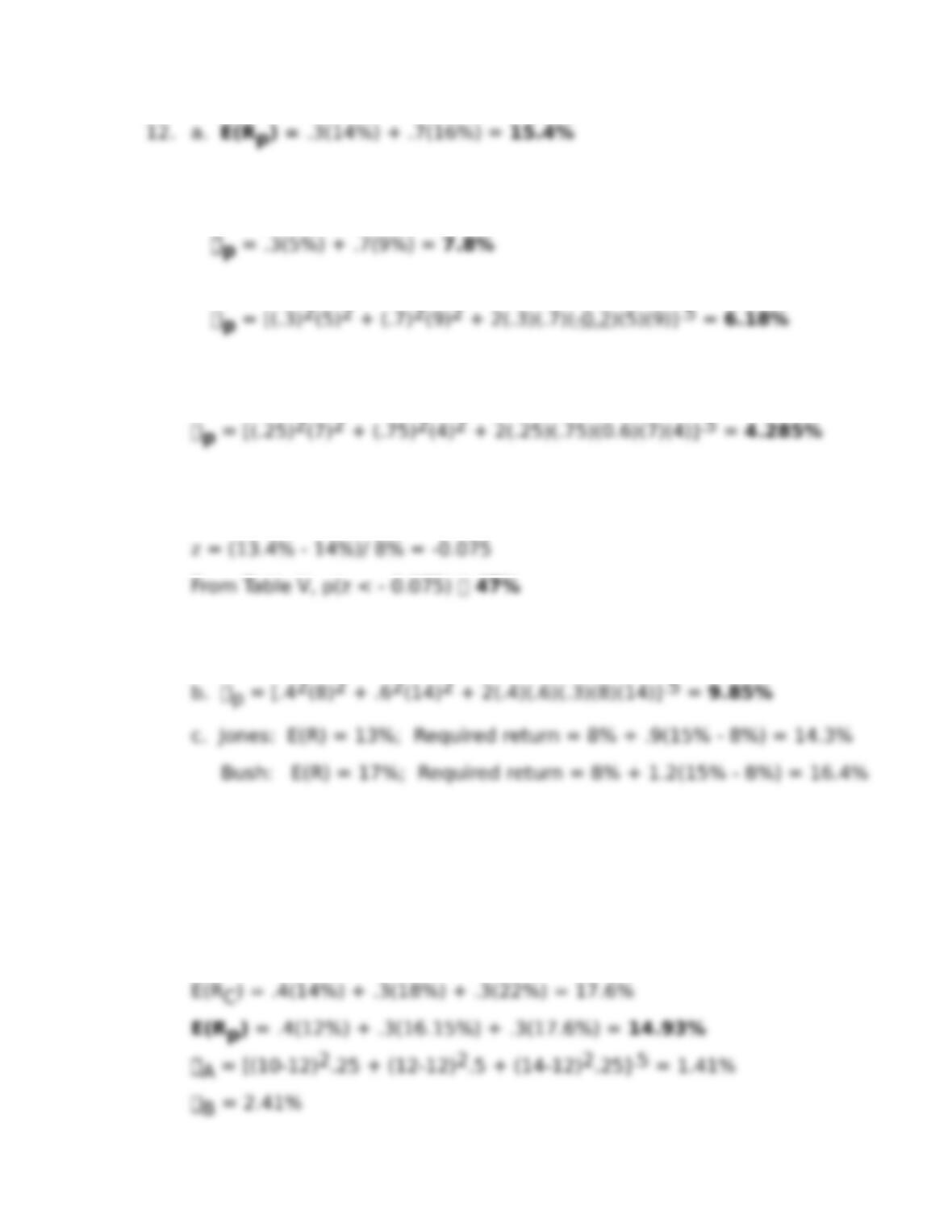
b. i. With perfect positive correlation, the risk of the portfolio is the
weighted average risk of the individual securities, or:
ii. When the correlation is -0.2, the portfolio risk can be computed as:
13. E(Rp) = .25(15%) + .75(9%) = 10.5%
14. Expected return = 14%; Required return = 7 + .8(15 – 7) = 13.4%
15. a. E(Rp) = .4(.13) + .6(.17) = .154 or 15.4%
Therefore, the Bush stock is the better buy because the
expected return exceeds the required return.
16. E(RA) = .25(10%) + .5(12%) + .25(14%) = 12%
E(RB) = .3(13%) + .35(16%) + .35(19%) = 16.15%
8-&
Chapter 8
Analysis of Risk and Return
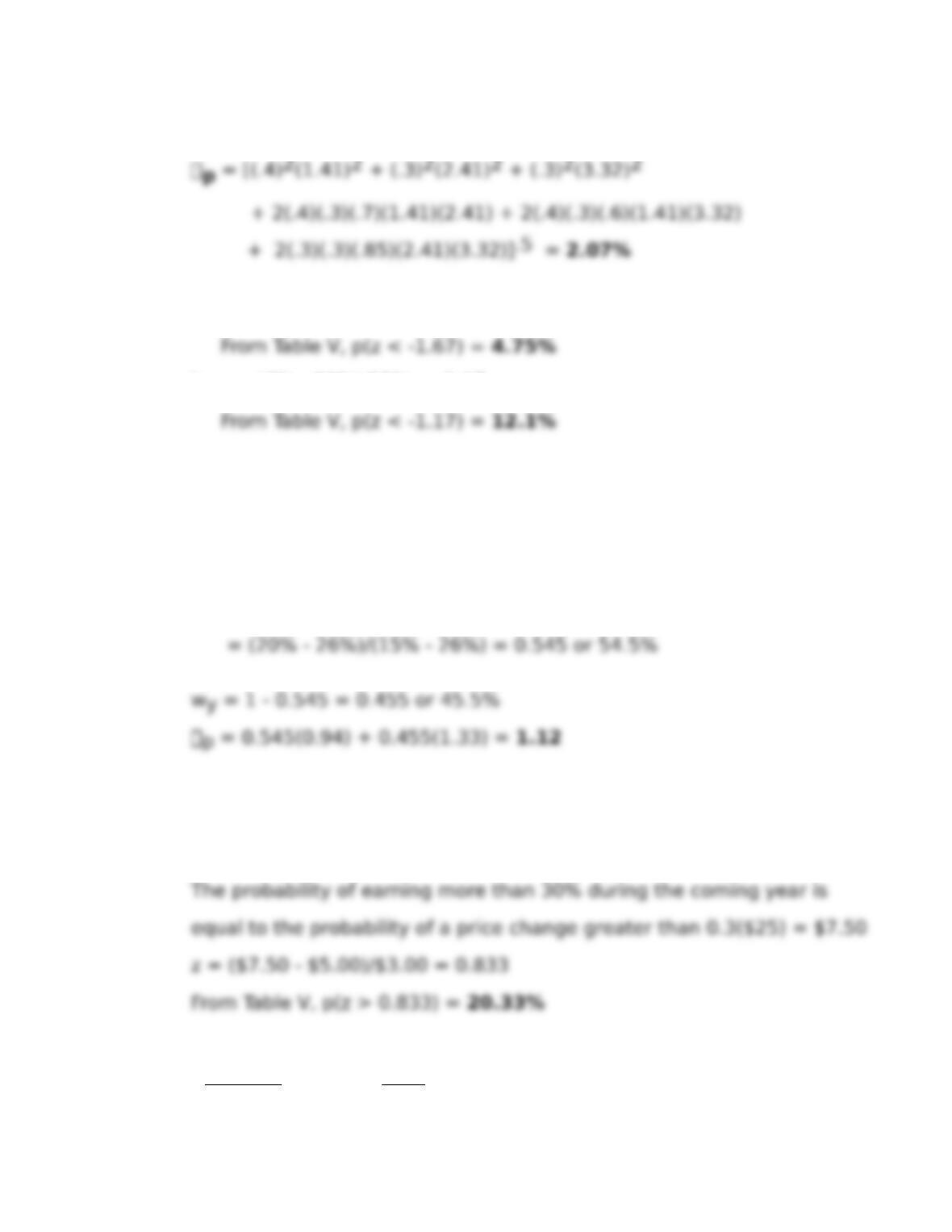
C = 3.32%
17. a. z = (0% – 20%)/12% = -1.67
b. z = (6% – 20%)/12% = -1.17
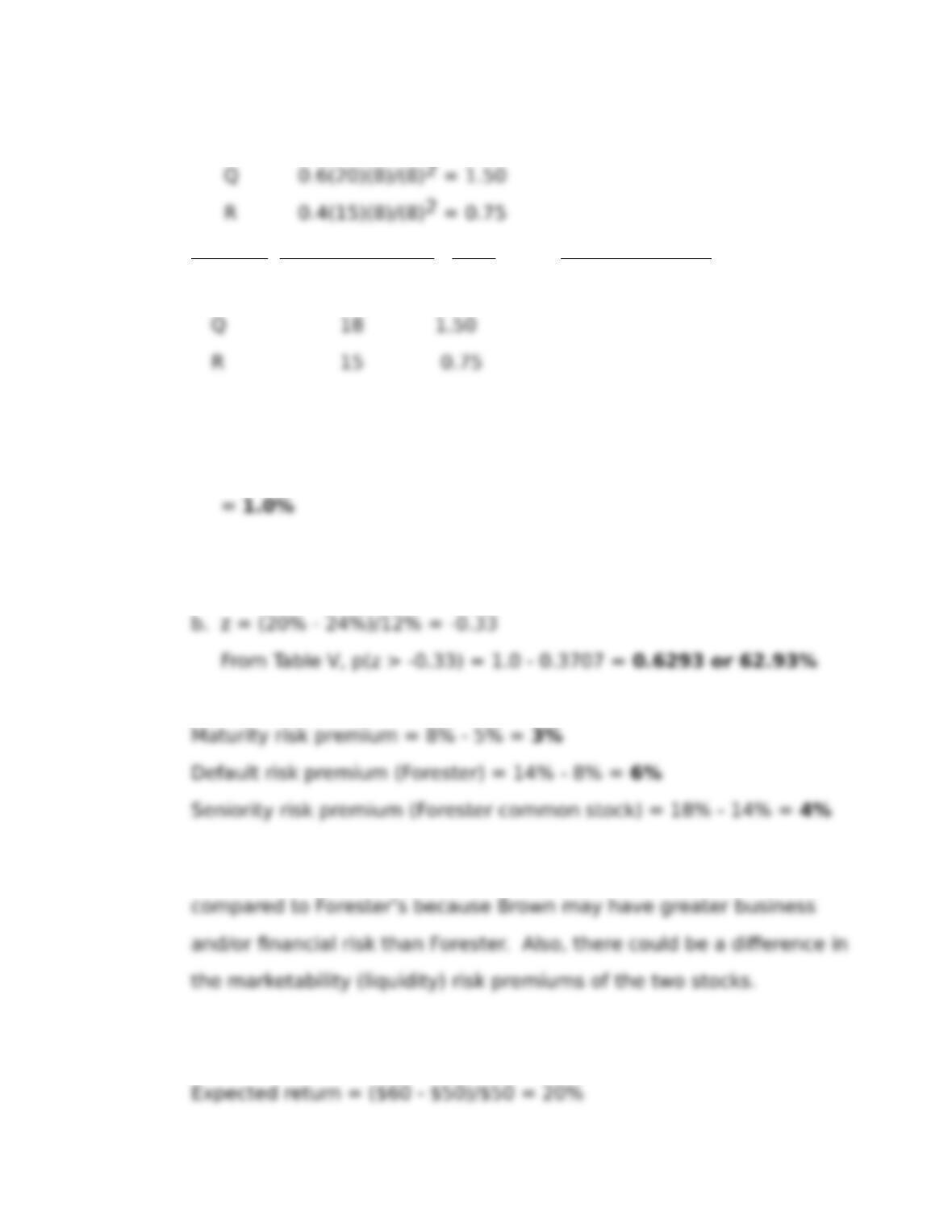
18. wx + wy = 1
wy = 1 – wx
E(Rp) = wx E(Rx) + wy E(Ry)
wx = [E(Rp) – E(Ry)]/[E(Rx) – E(Ry)]
19. Expected price change = $5
Standard deviation of price change = $3
20. a. Security Beta
8-&
Chapter 8
Analysis of Risk and Return
P 0.8(10)(8)/(8)2 = 1.00
b. Security Expected Return Beta Required Return
P 12% 1.00
Only security R appears to be an attractive investment at this time.
21. p = [(0.5)2 (4)2 + (0.5)2 (6)2 + 2(0.5)(0.5)(-1.0)(4)(6)].5
22. a. ke = 8% + 1.5(8%) = 20%
23. InCation premium = 5% – 2% = 3%
Investors may require a higher rate of return on Brown’s common stock
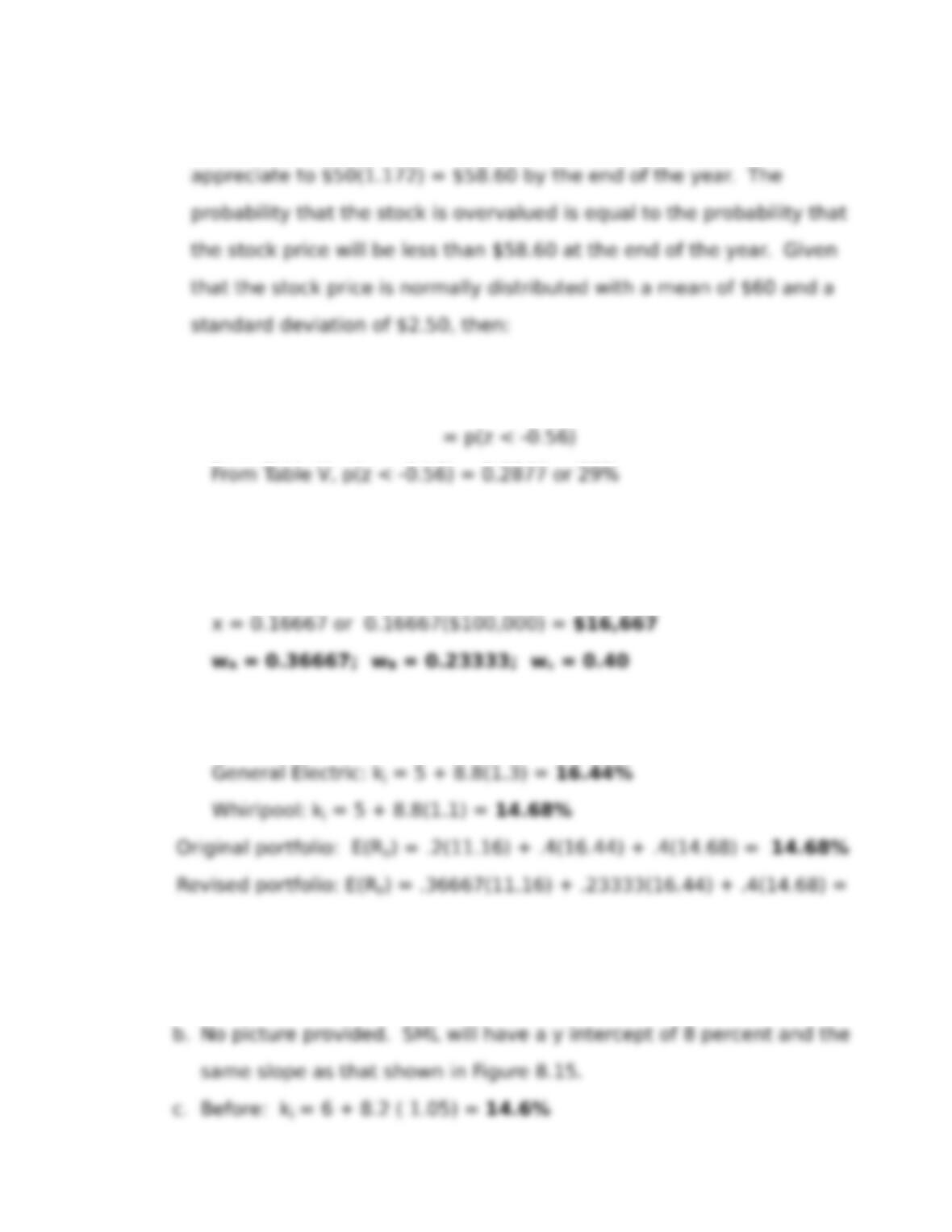
24. kj = 4% + 8.8%(1.5) = 17.2%
8-&
Chapter 8
Analysis of Risk and Return
A required rate of return of 17.2% implies that the stock must
p(Stock price < $58.60) = p(z < ($58.60 – $60)/$2.5)
25. a. p = .2 (0.7) + .4 (1.3) + .4 (1.1) = 1.10
b. 1.00 = (.2 + x)(0.7) + (.4 – x)(1.3) + .4(1.1)
c. kj = 5 + 8.8j
Chevron: kj = 5 + 8.8(0.70) = 11.16%
13.80%
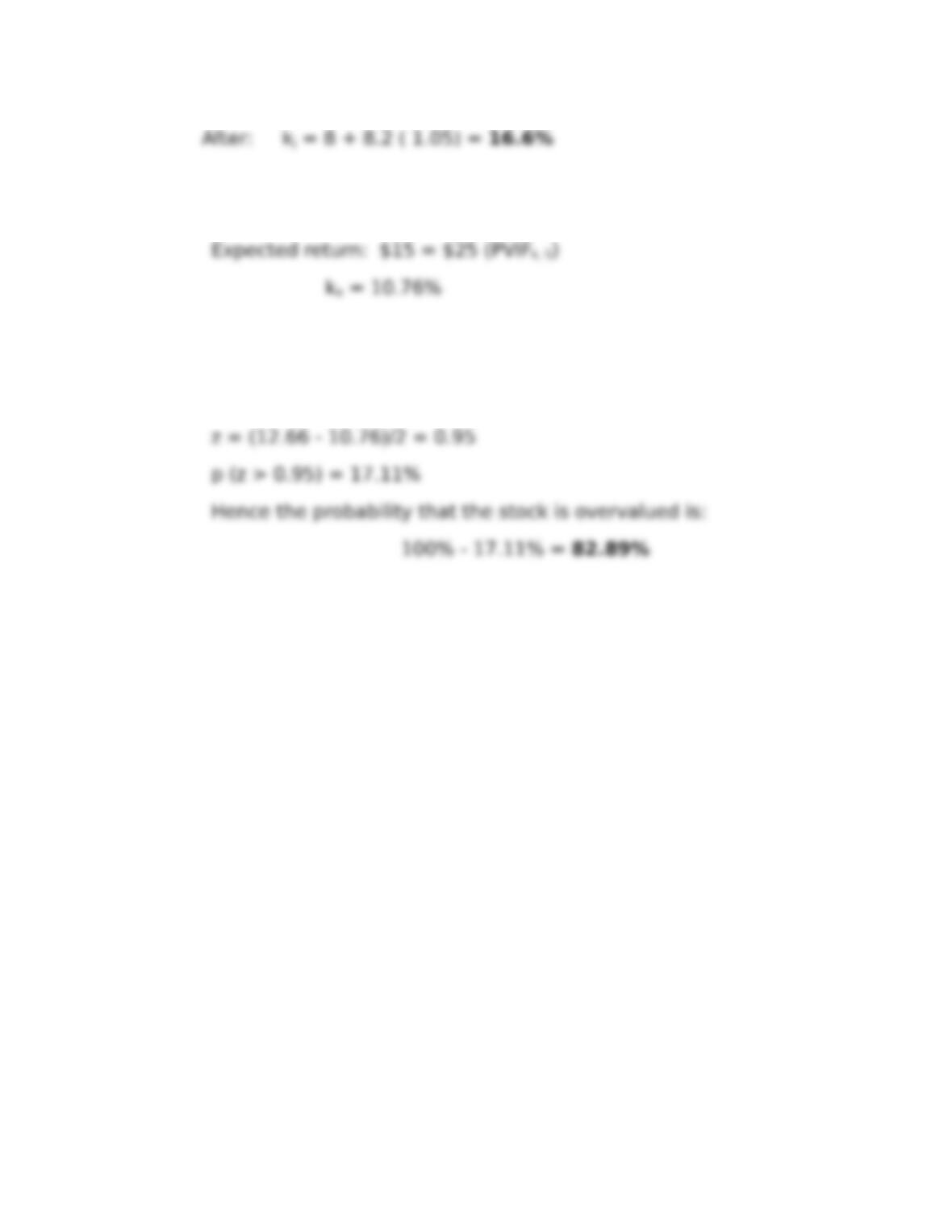
26. a. kj = 8 + 8.2 j
8-&
Chapter 8
Analysis of Risk and Return
27. Required return = 6% + 0.9(7.4%) = 12.66%
The stock appears to be overvalued because the expected return is
Less than the required return.
28. No recommended solution.
8-&