Chapter 7
Common Stock: Characteristics, Valuation and Issuance
CHAPTER 7
COMMON STOCK:
CHARACTERISTICS, VALUATION AND
ISSUANCE
ANSWERS TO QUESTIONS:
1.a. Nonvoting stock – common stock that is issued when the firm wishes to raise additional
b. Stock split – the issuance of a number of new shares in exchange for each old share held
c. Reverse stock split – the issuance of one new share in exchange for a number of old
d. Stock dividend – a dividend to stockholders in the form of additional shares of stock
e. Book value – total common stockholders’ equity divided by the number of shares
2. No, the retained earnings figure on the balance sheet is simply the cumulative amount of
earnings that have been retained over time. At the time when income is retained, these dollars
3. Reasons for stock repurchases:
•tax considerations – Under current tax laws, capital gains income is taxed at lower rates than
•financial restructuring – the firm can gain the benefits of increased financial leverage
7-.
Chapter 7
Common Stock: Characteristics, Valuation and Issuance
•future corporate needs – repurchased stock can be used in future acquisitions of other
•disposition of excess cash – funds that the company does not feel can be profitably
•reduction of takeover risk – by increasing the price of the firm’s stock and concentrating
4. For common stock, par value typically is a low figure of little significance. Book value is
common stockholders’ equity divided by the number of common shares issued and outstanding.
5. Stockholder rights often include the following:
•Dividend rights – right to share equally on a per share basis in any dividend
•Asset rights – in the event of liquidation, the right to assets that remain after the
•Voting rights – the right to vote on stockholder matters, such as the election of the
6. The valuation of common stock is more complicated than the valuation of bonds and
preferred stocks due to the following factors:
a. Common stock returns can take two different forms–cash dividend payments and/or
b. Common stock dividend payments normally are expected to grow and not remain
c. The future returns from common stocks (i.e., cash dividends and/or price appreciation) are
7. A firm that reinvests all its earnings and pays no cash dividends can still have a value greater
than zero when evaluated using the general dividend valuation model because at some future
7-.
Chapter 7
Common Stock: Characteristics, Valuation and Issuance
8. The financial decisions of the firm affect both expected future dividend payments of the firm
9. a. An upward shift in interest rates and investors’ required rates of return would cause ke
b. A reduction in the future growth potential of the firm’s earnings and dividends due to
c. An increase in the riskiness of the firm’s common stock due to larger South American
10. a. Dividend yield (D1/Po)
11. In the perpetual bond, preferred stock, and (constant dividend) common stock valuation
models, the returns to the investor (i.e., interest, preferred dividends, and common dividends
12. Book value per share, which equals total common stockholders’ equity divided by the
number of shares outstanding, can change as the result of
* Additions to (or subtractions from) retained earnings provided by current period
earnings (losses)
7-.
Chapter 7
Common Stock: Characteristics, Valuation and Issuance
13. With majority voting, each stockholder has one vote for each share held. Shareholders are
allowed to cast one vote for each director candidate of their choice. As a result, if two slates of
14. An investment banker is a financial institution which acts as a financial advisor to client
15. In a direct placement (also termed a private placement) the sale of an entire security
offering is made to one or more institutional investors rather than the general public. In a
16. A best efforts offering is more risky than an underwritten offering for a firm trying to raise
capital. However, the opposite is true for investment bankers. As a result, well established,
17. Direct issuance costs include the underwriting spread and other direct costs, including legal
and accounting fees, taxes, the cost of SEC registration, and printing costs. Other issuance
18. With a shelf registration, a firm initially files a master registration statement with the SEC.
Then the firm is free to sell small increments of the offering over a 2-year period merely by
7-.
Chapter 7
Common Stock: Characteristics, Valuation and Issuance
SOLUTIONS TO PROBLEMS:
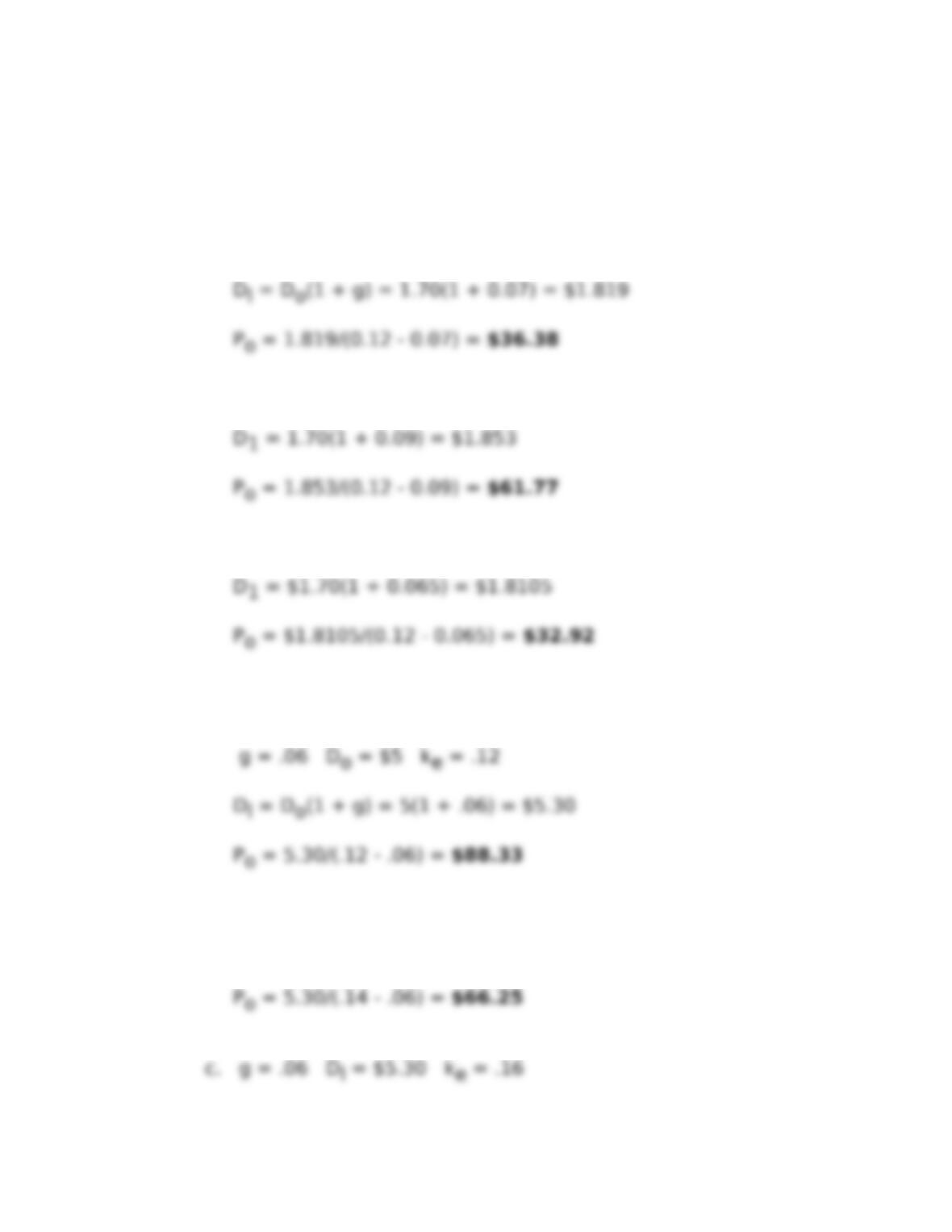
1. a. Po = D1/(ke – g)
g = 0.07 Do = $1.70 ke = .12
b. g = 0.09 Do = $1.70 ke = 0.12
c. g = 0.065 Do = $1.70 ke = 0.12
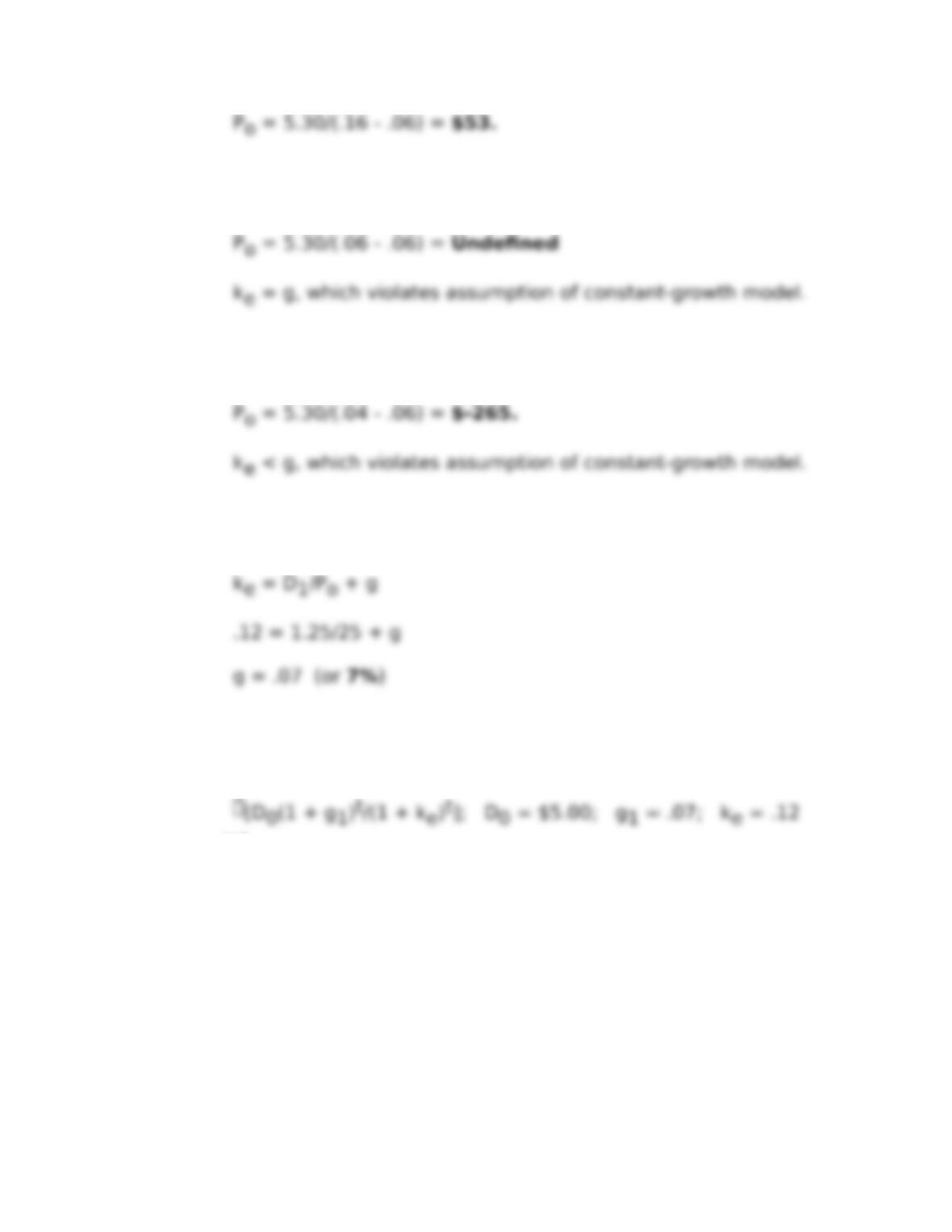
2. a. Po = D1/(ke – g)
b. g = .06 D1 = $5.30 ke = .14
7-.
Chapter 7
Common Stock: Characteristics, Valuation and Issuance
d. g = .06 D1 = $5.30 ke = .06
e. g = .06 D1 = $5.30 ke = .04
3. Po = $25 D1 = $1.25 ke = .12
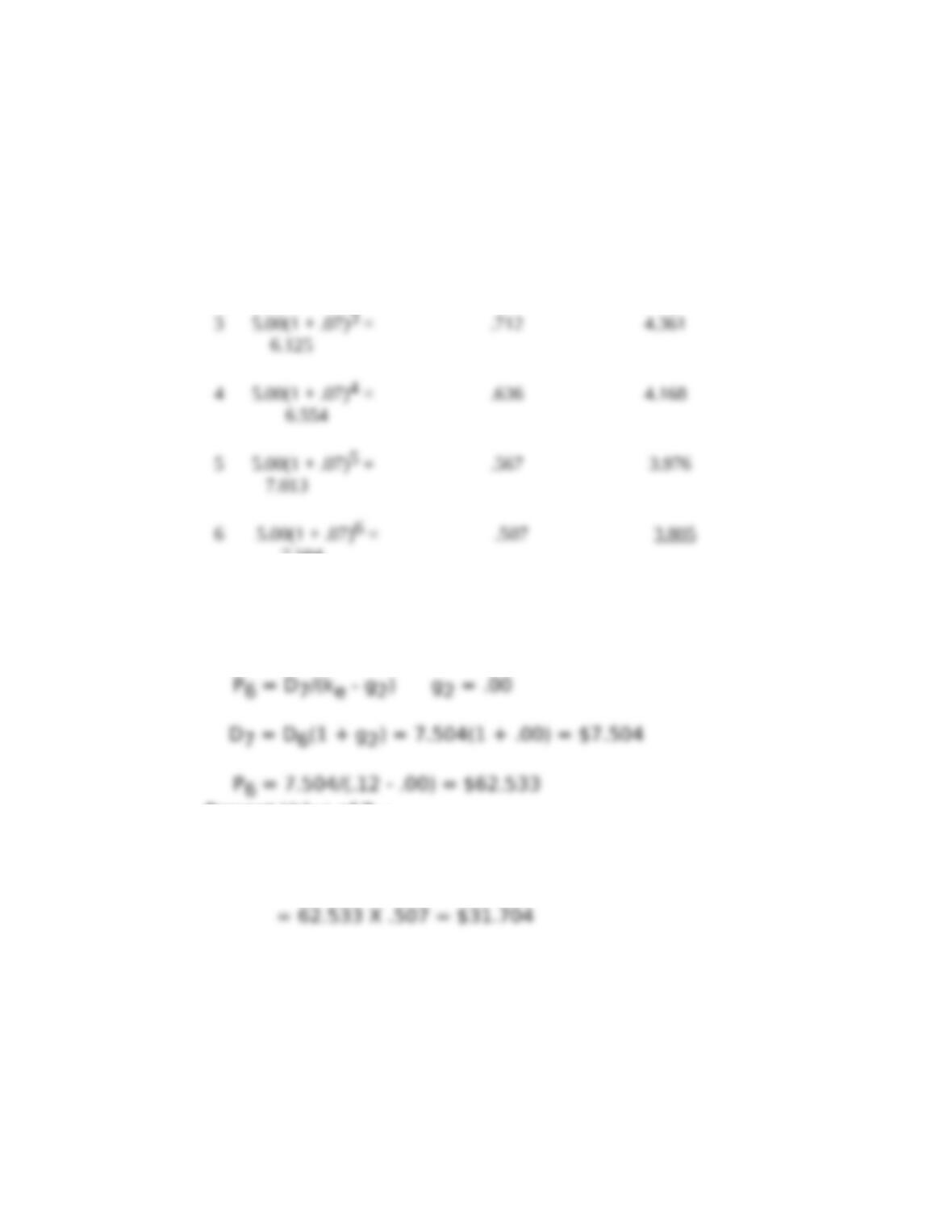
4. Present Value of First 6-Years’ Dividends:
6
t=1
Present Value
Year Dividend Interest Factor Present Value
7-.
Chapter 7
Common Stock: Characteristics, Valuation and Issuance
t Dt = 5.00(1 + .07)t PVIF.12,t Dt x PVIF.12,t
1 5.00(1 + .07)1 = .893 $ 4.778
$5.35
2 5.00(1 + .07)2 = .797 4.563
5.725
7.504
PV (First 6-Years’ Dividends) $25.651
Value of Stock at End of Year 6:
Present Value of P6:
PV(P6) = P6/(1 + ke)6 = 62.533/(1 + .12)6 = 62.533 x PVIF.12,6
Value of Common Stock (P0):
P0 = PV (First 6-Years’ Dividends) + PV(P6)
7-.
Chapter 7
Common Stock: Characteristics, Valuation and Issuance
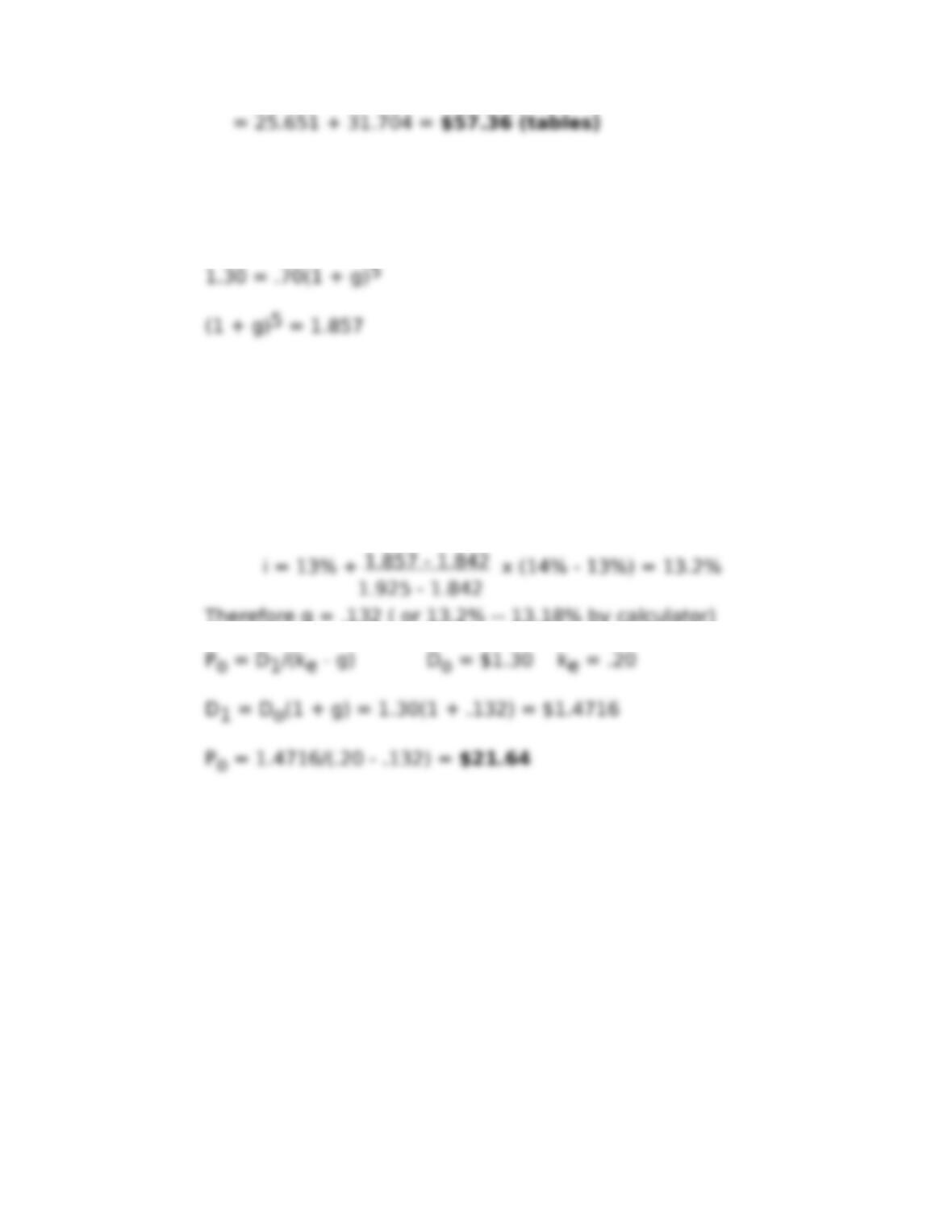
5. FVn = PVo(1 + g)n
PVo = $.70 FV5 = $1.30 n = 5
The term (1 + g)5 represents the future value interest factor
(FVIFg,5) found in Table I at the back of the book. Reading
across the Period = 5 row, one ?nds (1 + g)5 between the i = 13%
and i = 14% columns. Interpolating between these values yields
Therefore g = .132 ( or 13.2% — 13.18% by calculator)
7-.