Chapter 6
Fixed Income Securities: Characteristics and Valuation
CHAPTER 6
FIXED INCOME SECURITIES:
CHARACTERISTICS AND VALUATION
ANSWERS TO QUESTIONS:
1. a. Indenture – the contract between the issuing firm and the lenders in a debt obligation,
b. Trustee – the bondholders representative in a public debt offering. The trustee is
c. Call feature – a provision that permits the bond issuer to retire the obligation prior to
d. Sinking fund – a method of providing for the gradual retirement of a bond issue. The
e. Conversion feature – a provision that allows the holder to exchange the bond for shares
f. Coupon rate – the annual rate of interest paid to bondholders. It is expressed as a
b. Debenture – an unsecured debt issue. The quality of the debt issue depends on the
c. Subordinated debenture – an unsecured debt issue that is junior to other types of debt. In
d. Equipment trust certificate – used largely by railroad and trucking companies to
6-(
Chapter 6
Fixed Income Securities: Characteristics and Valuation
e. Collateral trust bond – a bond that is backed by stocks or bonds of other corporations.
f. Income bond – a bond that promises to pay interest only if the issuing firm earns
3. Investors would have a potential tradeoff between the 9 1/8% senior issue (which promises
4. a. Long-term debt – Most long-term debt is issued at par and put on the firm’s books at par.
b. Preferred stock – Some preferred stock is issued at par and put on the firm’s books at par.
5.a. Cumulative feature – a provision which provides that if a firm fails to pay its preferred
b. Participation – a preferred stock issue in which the holders share in any increased
c. Call feature – a provision that gives the company the option to redeem (i.e., retire) its
6. The variables which must be known (or estimated) are the expected cash returns during each
7. a. Market value of an asset is the value placed on the asset by the marginally satisfied
b. Market equilibrium occurs at a point in time when there is no tendency for the price of
8. Book value is a function of the historical acquisition cost of the asset, whereas market value
6-(
Chapter 6
Fixed Income Securities: Characteristics and Valuation
9. a. A bond will sell at a discount if the required rate of return is greater than the coupon rate.
10. The yield-to-maturity is the rate of return expected to be earned if a bond is purchased at a
given price and held until maturity. The coupon or current yield is equal to the annual interest
11. The current yield will be equal to the yield to maturity when the current price of the bond is
12. Preferred stock is similar to long-term debt in that dividends on preferred stock, like interest
13. A sinking fund provision is used to reduce the amount owed on the maturity date and hence
reduce the risk that the borrower will default on the bond issue. Also, a sinking fund provision
14. Interest rate risk represents the variation in the market price of a bond and hence its
15. A bond is classified as a fixed income security because the holder expects to receive
16. a. Floating rate bonds – bonds with coupon rates that are adjusted periodically (e.g.
b. Original issue deep discount bonds – bonds that have coupon rates below prevailing
6-(
Chapter 6
Fixed Income Securities: Characteristics and Valuation
c. Zero coupon bonds – bonds that pay no explicit rate of interest and are sold at a substantial
d. Extendable notes (put bonds) – bonds that are redeemable at par value at the option of
17. Reinvestment rate risk
is the potential decrease in interest income that results when a bond issue matures (or is
18. No recommended solution.
SOLUTIONS TO PROBLEMS:
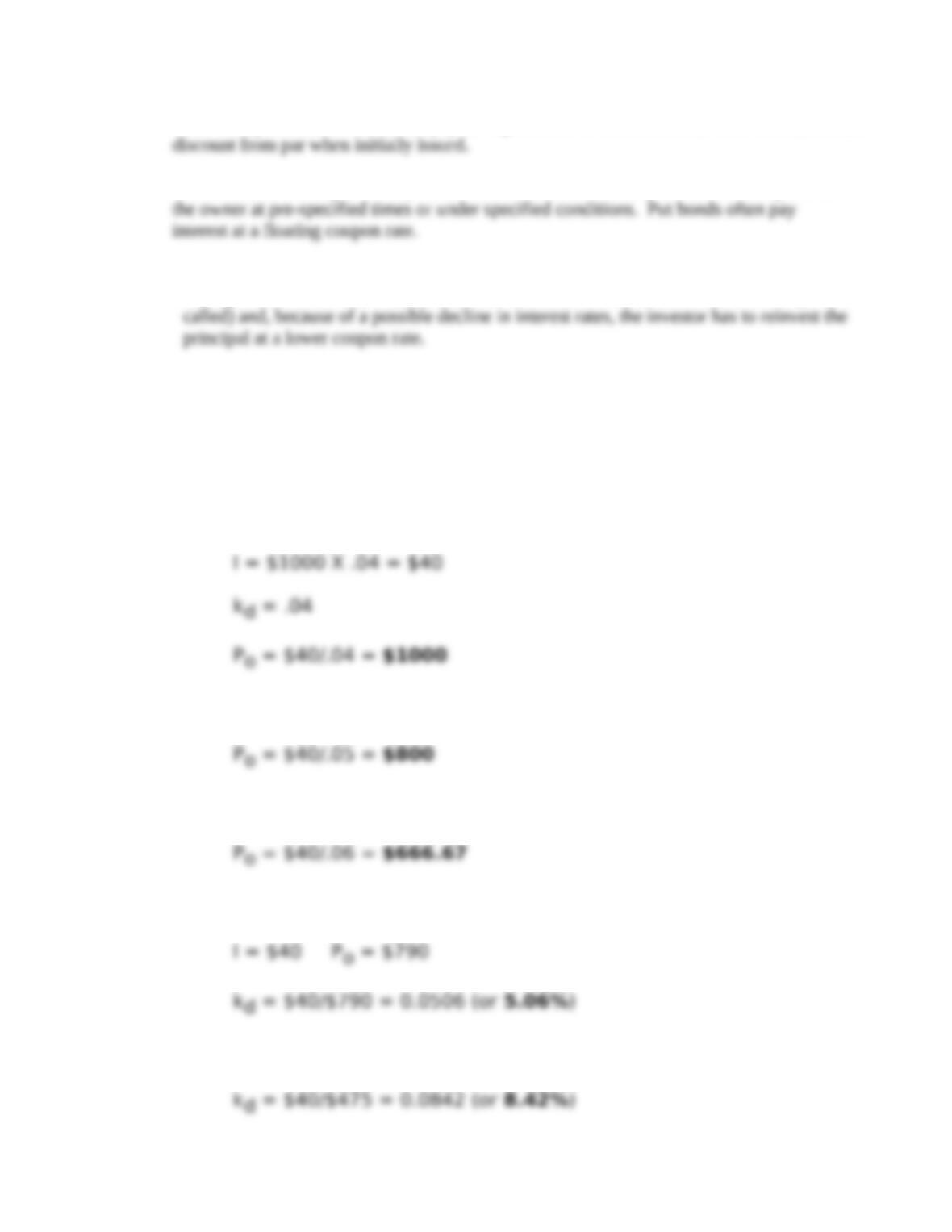
1. a. Po = I/kd
b. I = $40 kd = .05
c. I = $40 kd = .06
2. a. kd = I/Po
b. I = $40 Po = $475
6-(
Chapter 6
Fixed Income Securities: Characteristics and Valuation
n
3. a. Po = I/(1 + kd)t + M/(1 + kd)n
t=1
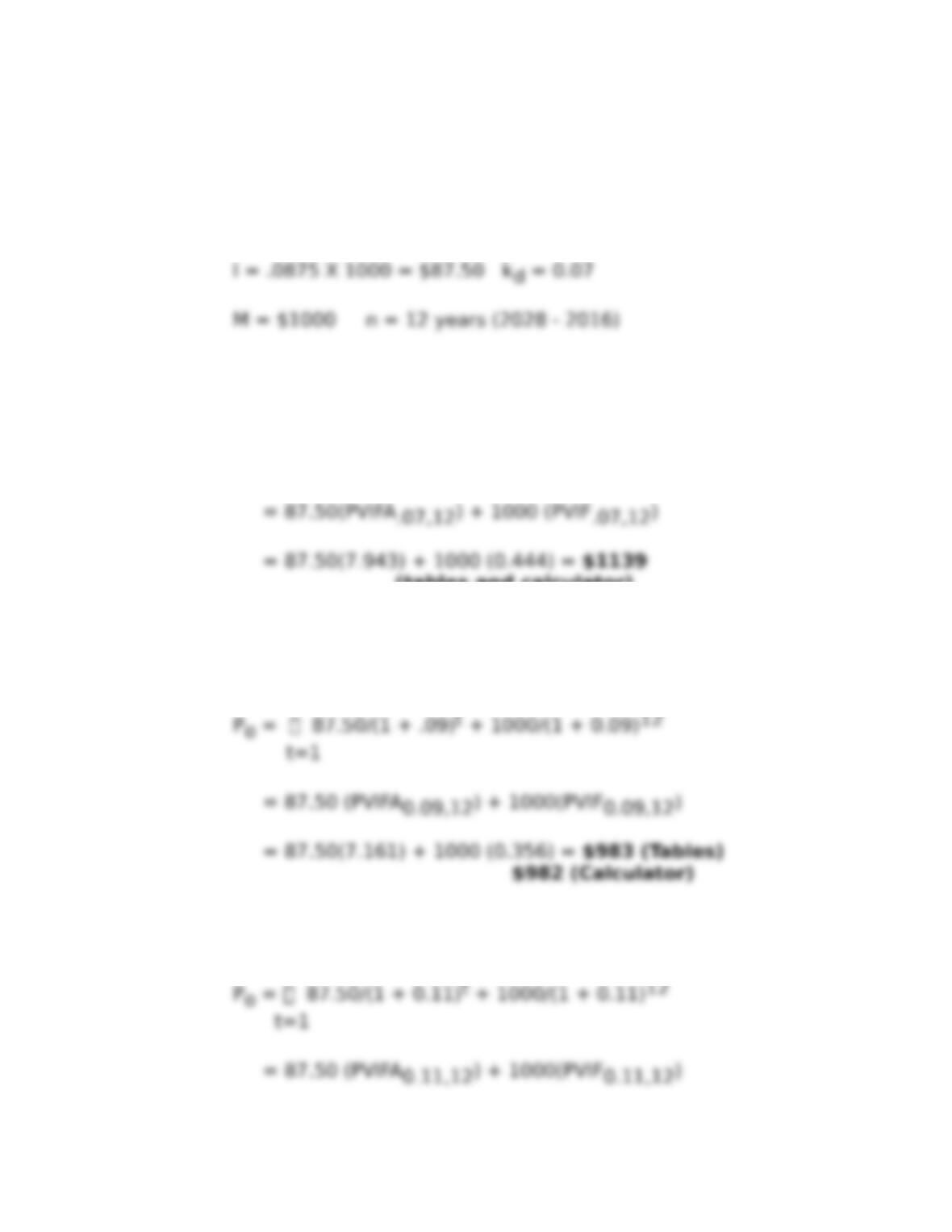
12
Po = 87.50/(1 + 0.07)t + 1000/(1 + 0.07)12
t=1
(tables and calculator)
b. I = $87.50 kd = .09 M = $1000 n = 12
12
c. I = $87.50 kd = .11 M = $1000 n = 12
12
6-(
Chapter 6
Fixed Income Securities: Characteristics and Valuation
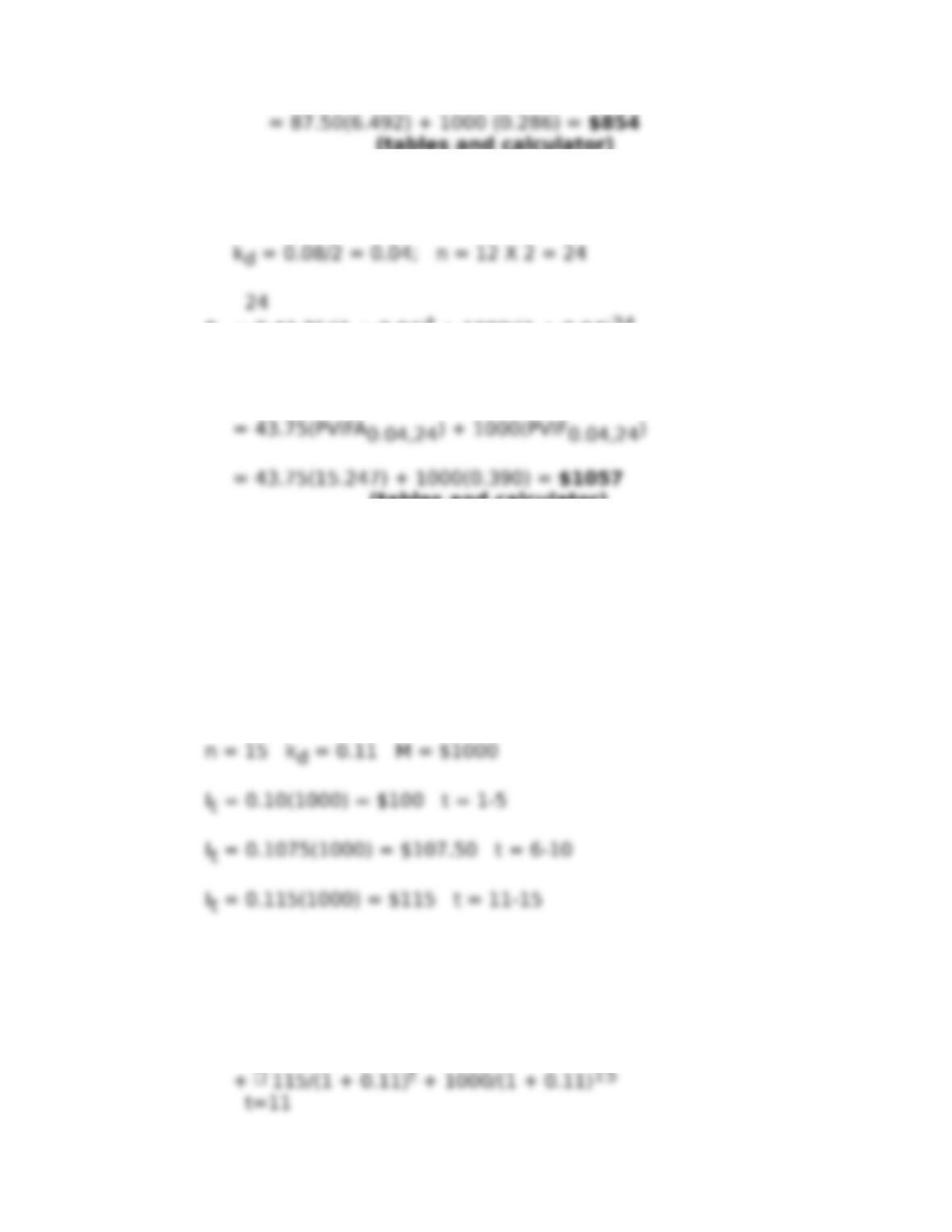
(tables and calculator)
Solution to the last question in the problem:
I = .0875(1000)/2 = $43.75 M = $1000
Po = 43.75/(1 + 0.04)t + 1000/(1 + 0.04)24
t=1
(tables and calculator)
** Note: This solution assumes that 8 percent is the nominal return
requirement, not the effective return requirement. If 8 percent is
the effective return requirement, then the semi-annual discount
rate would be 3.92 percent.
n
4. P0 = It/(1 + kd)t + M/(1 + kd)n
t= 1
5 10
P0 = 100/(1 + 0.11)t + 107.50/(1 + 0.11)t
t=1 t=6
15
6-(
Chapter 6
Fixed Income Securities: Characteristics and Valuation
n
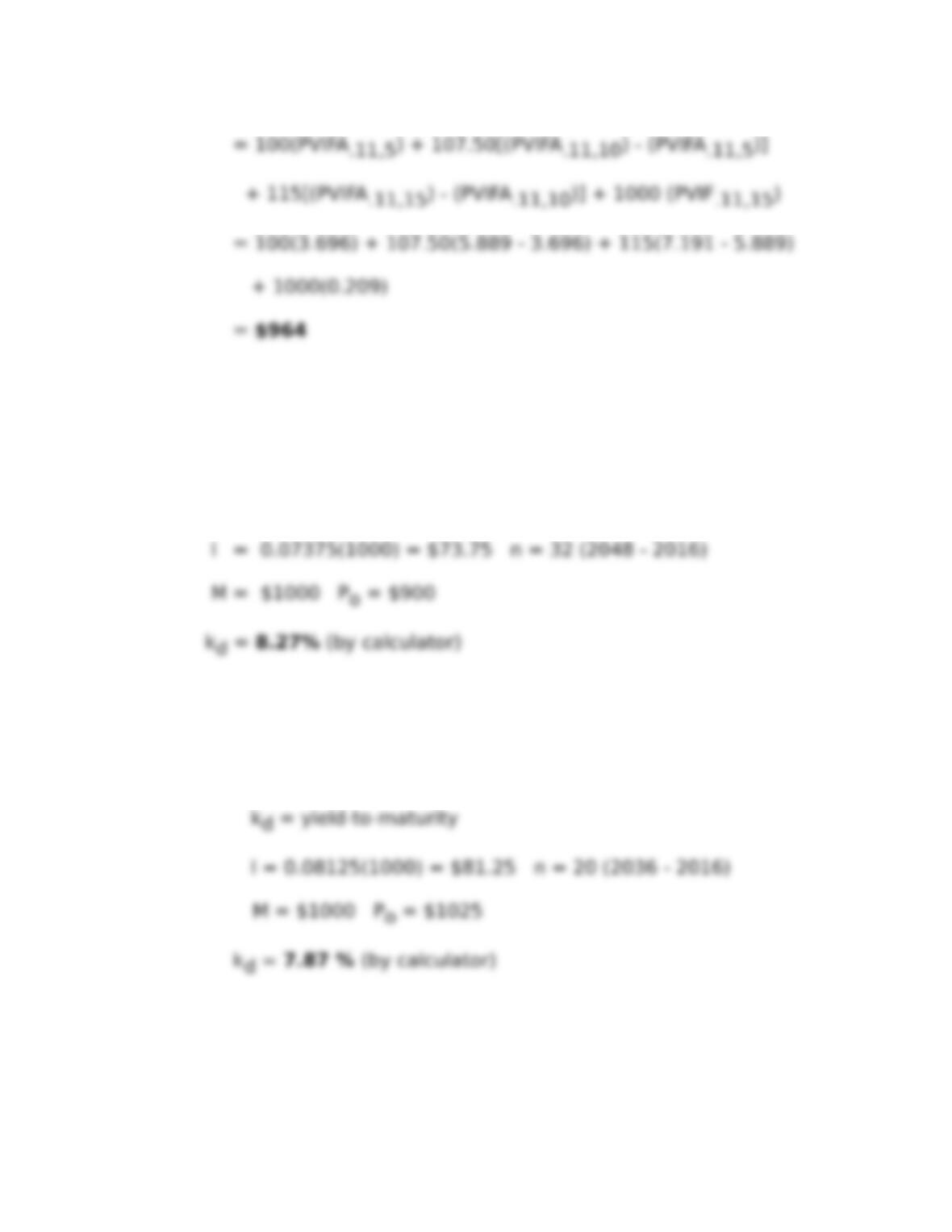
5. Po = I/(1 + kd)t + M/(1 + kd)n
t=1
kd = yield-to-maturity
n
6. Po = I/(1 + kd)t + M/(1 + kd)n
t=1
6-(