Chapter 5
The Time Value of Money
CHAPTER 5
THE TIME VALUE OF MONEY
ANSWERS TO QUESTIONS:
1. The investment paying five percent compound interest is more attractive because you will
2. The future value interest factor for 10 percent and two years is 1.210, whereas the present
3. As the interest rate increases, any annuity amount is being discounted by a higher value,
4. Daily compounding is preferred because you will earn interest on the interest earned in the
5. Annuity due computations are common for lease contracts and insurance policies, where
6. As can be seen in Table 5-7, the more frequent the compounding period, the lower the
7. a. A marketing manager might use present value concepts to evaluate the success of an
b. A personnel manager may need to use present value concepts to evaluate alternative
8. The Rule of 72 can be used to determine the approximate number of years it takes for an
9. Present value and future value concepts are closely related. For example, PVIF factors are
5-4
Chapter 5
The Time Value of Money
10. An ordinary annuity involves a series of equal, end-of-period payments or receipts. The
11. As the required rate of return increases, (a) the present value of an annuity decreases and (b)
12. The sinking fund problem tries to find the annuity amount that must be invested each year
13. In order to set up a loan amortization schedule, the annual loan payment must first be
computed using the appropriate PVIFA from Table IV. The interest portion of each period’s
14. The insurance company is willing to take on the known loss because the settlement of
15. This means that the basis for interest rate compounding is continuous. However, interest is
16. The dividend payments on many preferred stocks are perpetuities. These preferred stocks
17. The present value of an uneven cash flow stream is found by summing the present values
18. This statement is not correct. The powerful microcomputer can be used efficiently to help
19. The net present value of an investment represents the contribution of that investment to the
5-4
Chapter 5
The Time Value of Money
SOLUTIONS TO PROBLEMS:
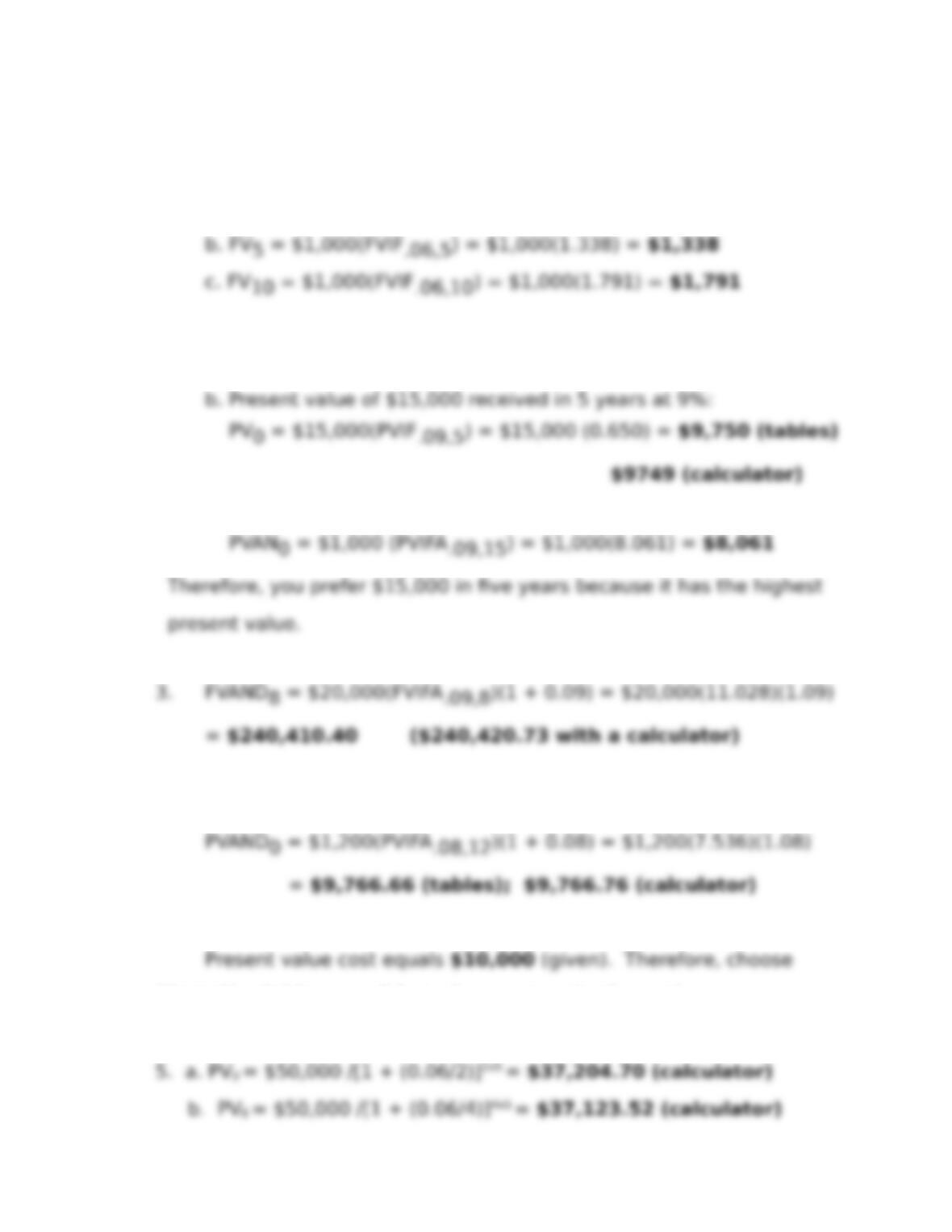
1. a. FV3 = $1,000(FVIF.06,3) = $1,000(1.191) = $1,191
2. a. Present value of $5,000 today = $5,000
c. Present value of a 15 year, $1,000 annuity at 9%:
4. Alternative a:
Alternative b:
Alternative (a) because it has a lower present value cost.
5-4
Chapter 5
The Time Value of Money
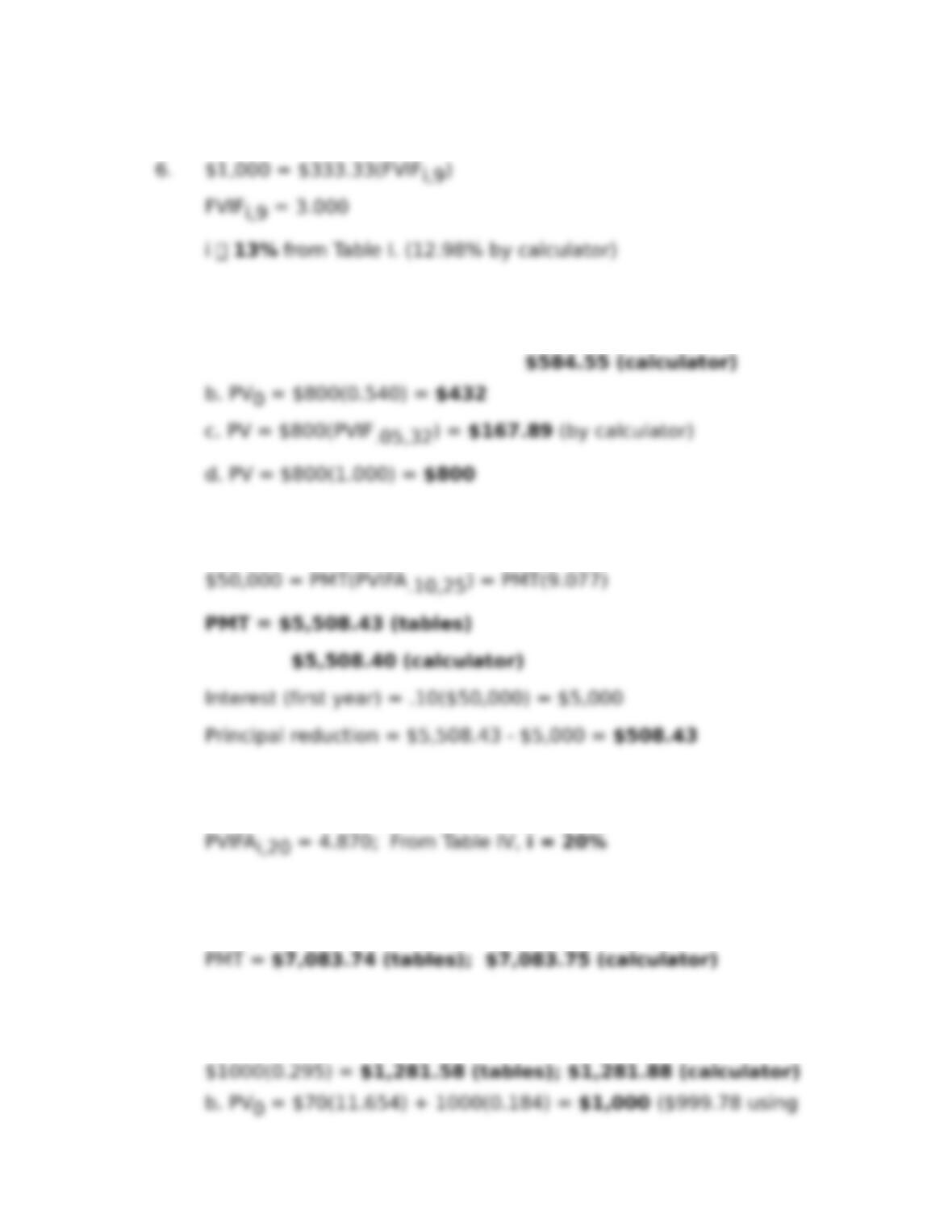
7. a. PV0 = $800(PVIF.04,8) = $800 (0.731) = $584.80 (tables)
8. PVAN0 = $60,000 – $10,000 = $50,000
9. $200,000 = $41,067(PVIFAi,20)
10. $600,000 = PMT(FVIFA.09,25) = PMT(84.701)
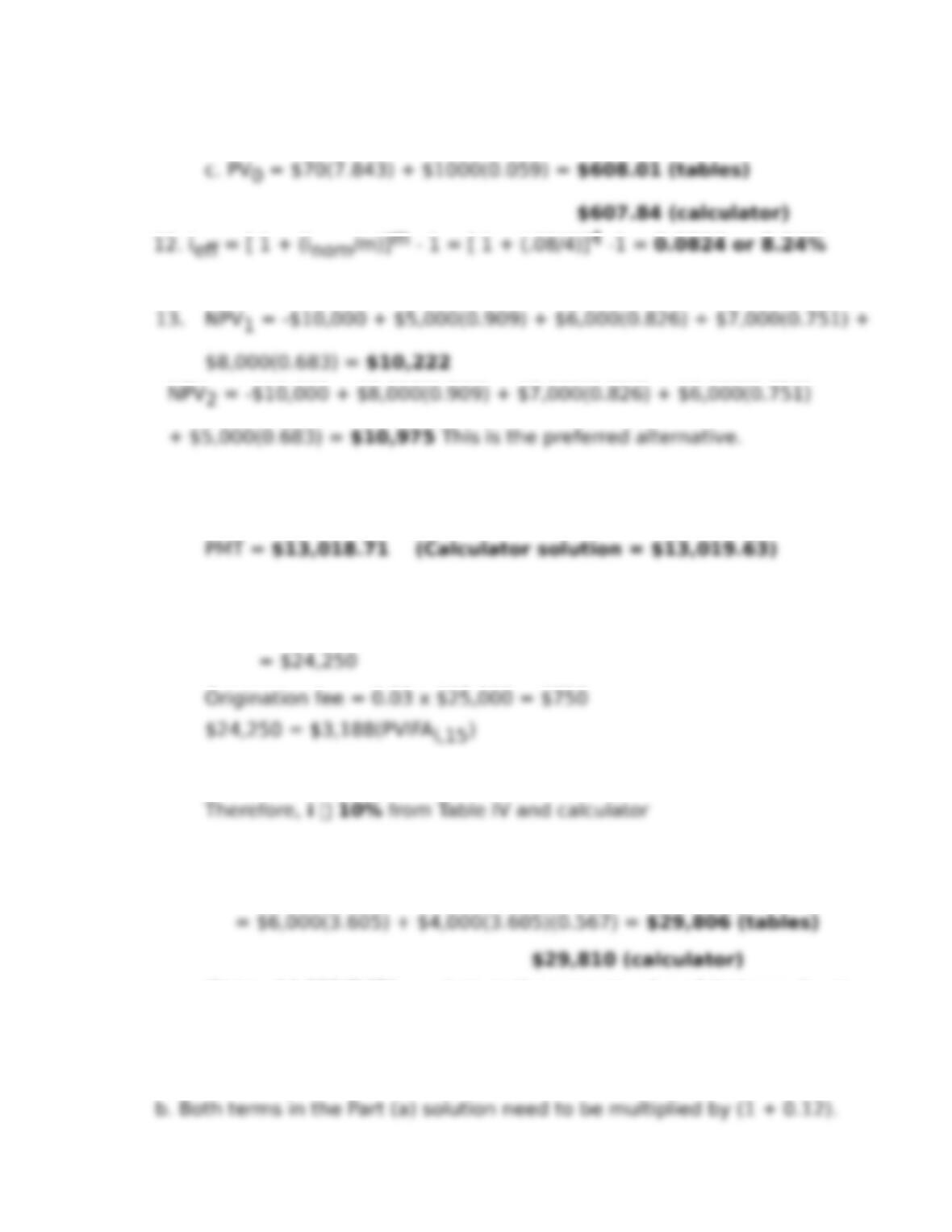
11. a. PV0 = $70(PVIFA.05,25) + $1000(PVIF.05,25) = $70(14.094) +
5-4
Chapter 5
The Time Value of Money
tables; di<erence from $1,000 due to rounding)
14. PVAN0 = $80,000 = PMT(PVIFA.10,10) = PMT(6.145)
15. PVAN0 = $30,000 – $5,000(down) – $750 (loan origination fee)
PVIFAi,15 = 7.607
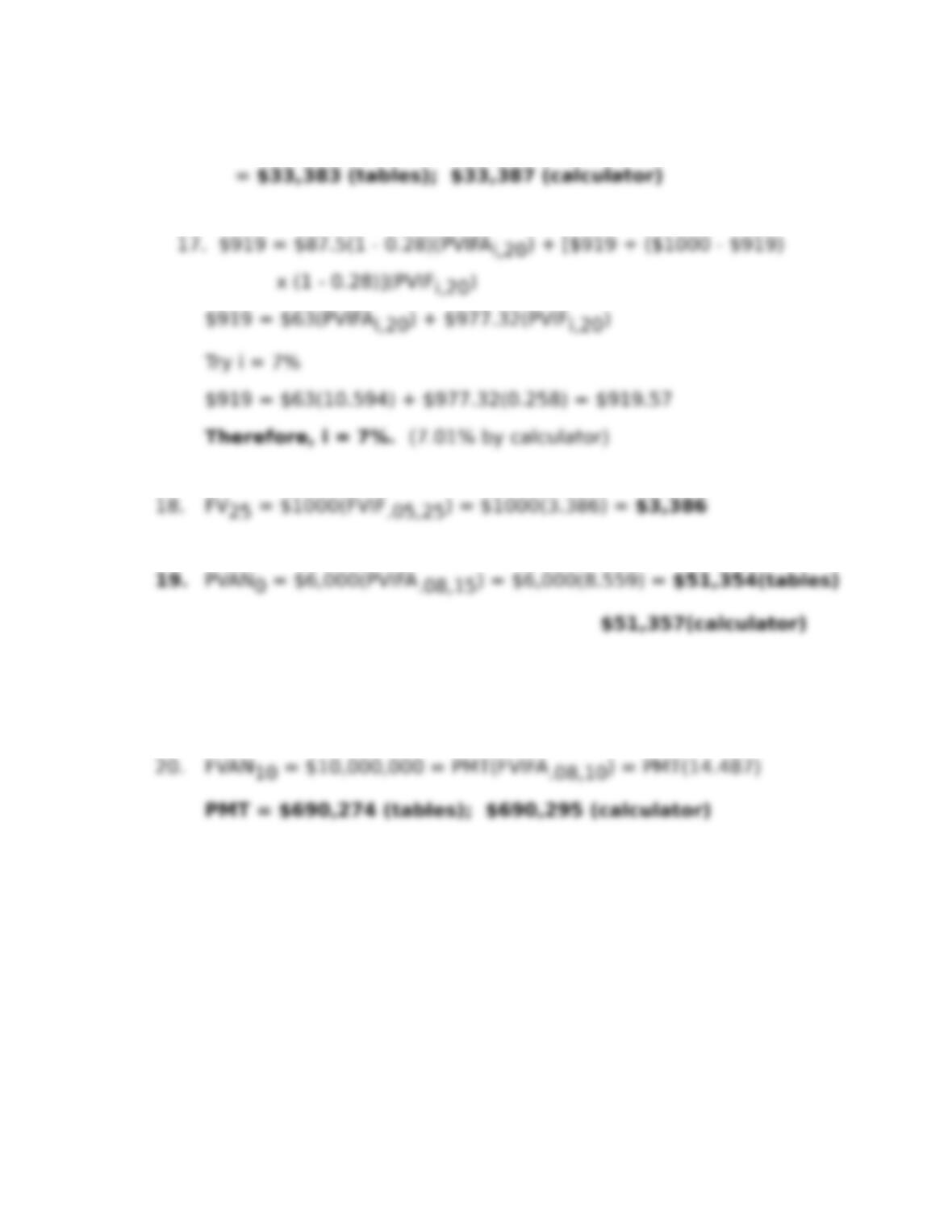
16. a. PV0 = $6,000(PVIFA.12,5) + $4,000(PVIFA.12,5)(PVIF.12,5)
(Note: $4,000(PVIFA.12,5) gives the present value of that annuity at
the end of ,ve years. Hence, it must be discounted back to time 0 at
a 12% rate.)
5-4
Chapter 5
The Time Value of Money
Hence, the annuity due solution to this problem is equal to $29,806 (1.12)
Because the lifetime annuity has a higher expected present value
than the $50,000 lump sum payment, she should take the annuity.
5-4
Chapter 5
The Time Value of Money
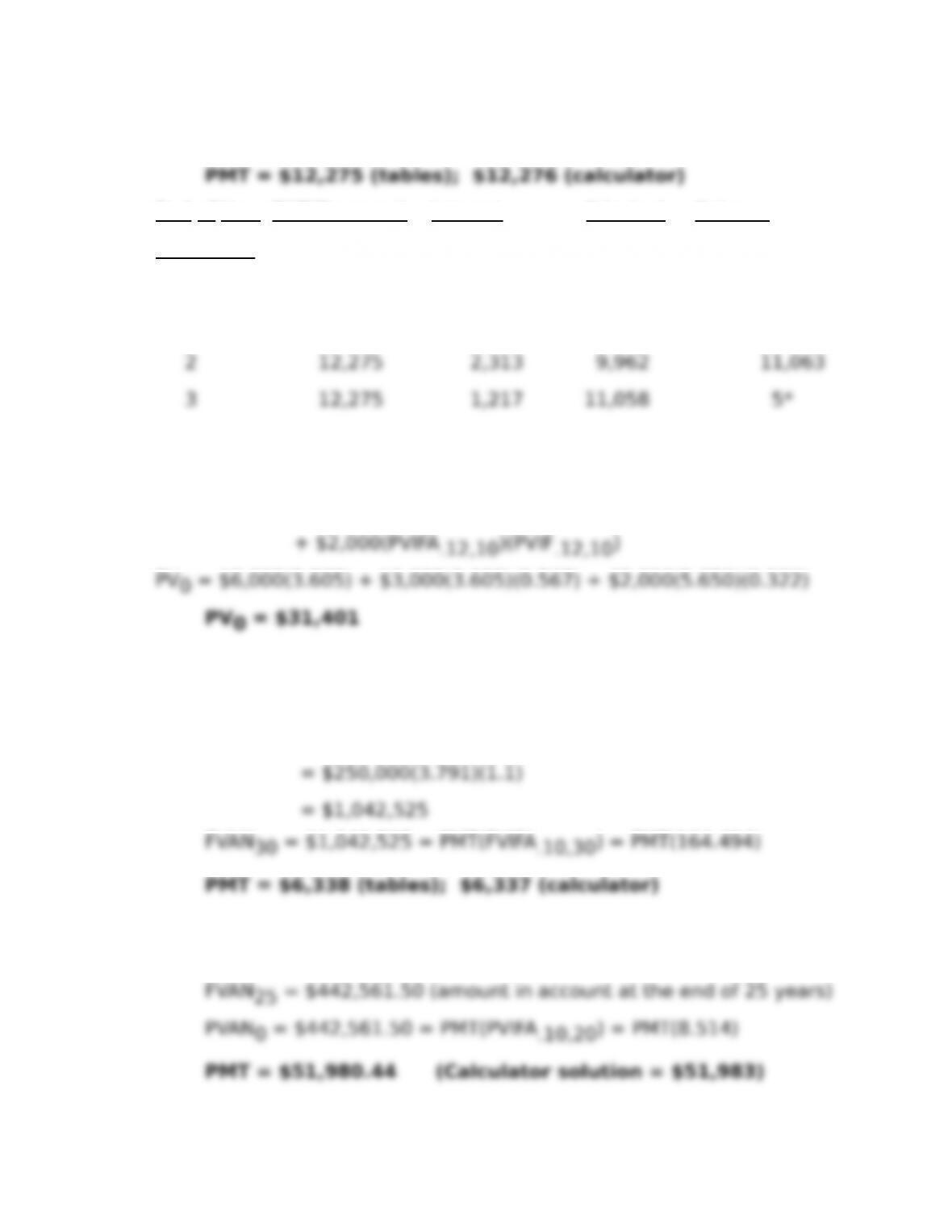
21. $30,000 = PMT(PVIFA.11,3) = PMT(2.444)
End of Year PMT(Payment) Interest Principal Balance
Remaining
0 – – – $30,000
1 $12,275 $3,300 $8,975 21,025
* di<erence from zero due to rounding in tables
22. a. PV0 = $6,000(PVIFA.12,5) + $3,000(PVIFA.12,5)(PVIF.12,5)
b. PV of beginning of year receipts = $31,401(1.12) = $35,169
23. PVAND30 = $250,000(PVIFA.10,5)(1 + .10)
24. FVAN25 = $4,500(FVIFA.10,25) = $4,500(98.347)
5-4
Chapter 5
The Time Value of Money
in the account at the end of four years)
account at the end of ten years) (tables); $94,335 (calculator)
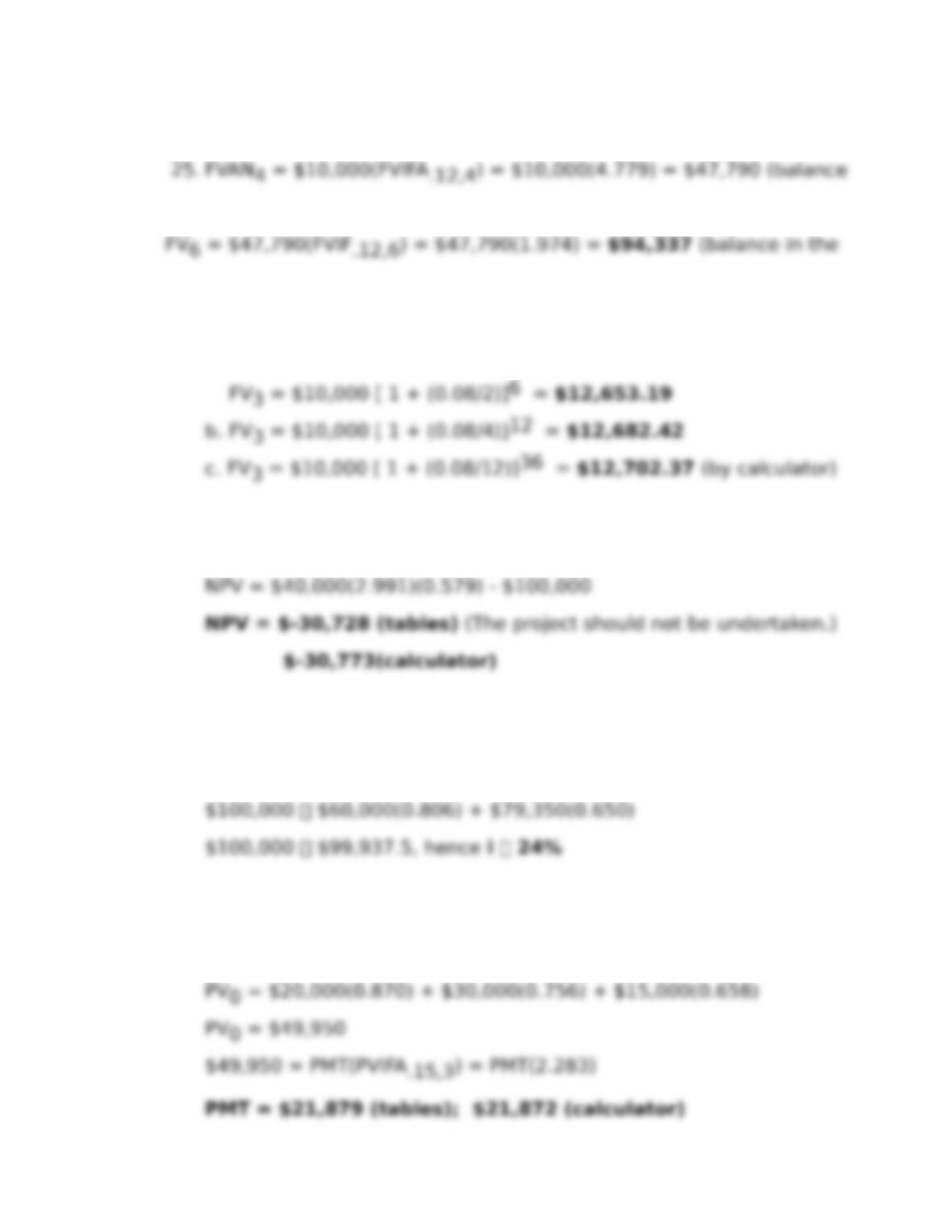
26. a. FVn = PV0 [ 1 + (inom /m)]mn
27. NPV = $40,000(PVIFA.20,5)(PVIF.20,3) – $100,000
28. $100,000 = $60,000(PVIFi,1) + $79,350(PVIFi,2)
Try i = 24%
29. PV0 = $20,000(PVIF.15,1) + $30,000(PVIF.15,2)
+ $15,000(PVIF.15,3)
5-4
Chapter 5
The Time Value of Money
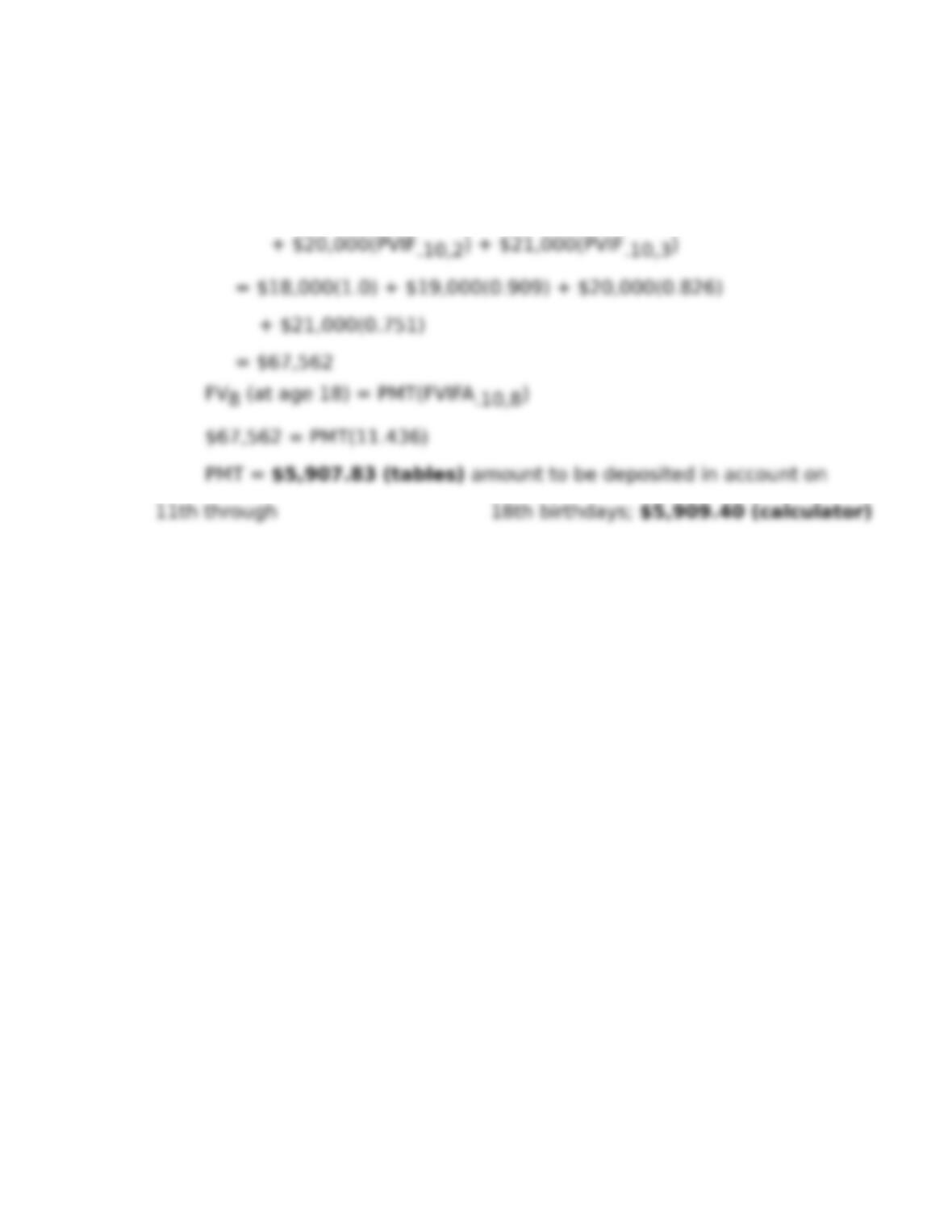
30. Amount needed by 18th birthday:
PV0 = $18,000(PVIF.10,0) + $19,000(PVIF.10,1)
5-4