Chapter 23
Corporate Restructuring
CHAPTER 23
CORPORATE RESTRUCTURING
ANSWERS TO QUESTIONS:
1. a. A merger is technically a combination of two or more companies in which all but one of
b. A consolidation is a combination in which all of the combining companies are dissolved
c. A holding company is a form of business combination in which the acquiring company
2. Anti-takeover measures include
* Staggering the terms of the board of directors over several years instead of having the
entire board come up for election at one time.
* Giving key executives “golden parachute” contracts under which these executives receive
large benefits if they lose their jobs as a result of a takeover.
* Using supermajority voting rules to approve any takeover proposals.
3. In a stock purchase, the acquiring company buys the stock of the to-be-acquired company
23-4
Chapter 23
Corporate Restructuring
4. An operational restructuring involves changing the asset side of a company’s balance sheet,
5. Mergers are generally classified according to whether they are horizontal, vertical, or
conglomerate. A horizontal merger is a combination of two or more companies that compete
6. Some of the reasons why a firm might consider acquiring another firm rather than choosing to
grow internally are
a. A firm may be able to acquire certain desirable assets at a lower cost by combining with
another firm than it could if it purchased the assets directly;
b. A firm may be able to achieve greater economies of scale by merging with another firm
(this is particularly true in the case of a horizontal merger);
7. Financial analysts typically use three major methods to value merger candidates – the
comparative price-earnings method, the adjusted book value method, and the discounted cash
8. The post merger earnings per share figure increases. This is illustrated in the example in
Tables 23-5 and 23-6.
9. In the purchase method, the total value paid or exchanged for the acquired firm’s assets is
recorded on the acquiring company’s books. The tangible assets acquired are recorded at their
In the pooling of interests method, the acquired company’s assets are recorded on the
23-4
Chapter 23
Corporate Restructuring
10. A leveraged buyout is a transaction in which the buyer of a company borrows a large portion
of the purchase price, using the purchased assets as partial collateral for the loans. Mezzanine
11. A merger is “tax-free” if the acquired firm’s stockholders do not have to recognize for tax
12. From an economic perspective, business failure refers to firms that earn an inadequate return
13. a. Technical insolvency – a situation in which a firm is unable to meet its current obligations
b. Legal insolvency – a situation in which the recorded value of a firm’s assets is less than
c. Bankruptcy – a situation in which a firm is unable to pay its debts and it files a bankruptcy
14. In general, a failing firm has two alternatives: (a) it can attempt to resolve its difficulties
15. An important aspect of the bankruptcy procedures involves what to do with the failing firm.
16. In a composition, a failing business is permitted to discharge its debt obligations by paying
17. An informal settlement avoids the legal and administrative expenses associated with formal
18. Chapter 7 of the Bankruptcy Reform Act is the liquidation chapter. Under Chapter 7, a
23-4
Chapter 23
Corporate Restructuring
19. Basically, the term fairness means that the claims be settled in order of their priority. A
20. The reorganized firm can be recapitalized giving it less debt and fewer fixed charges. The
23-4
Chapter 23
Corporate Restructuring
SOLUTIONS TO PROBLEMS
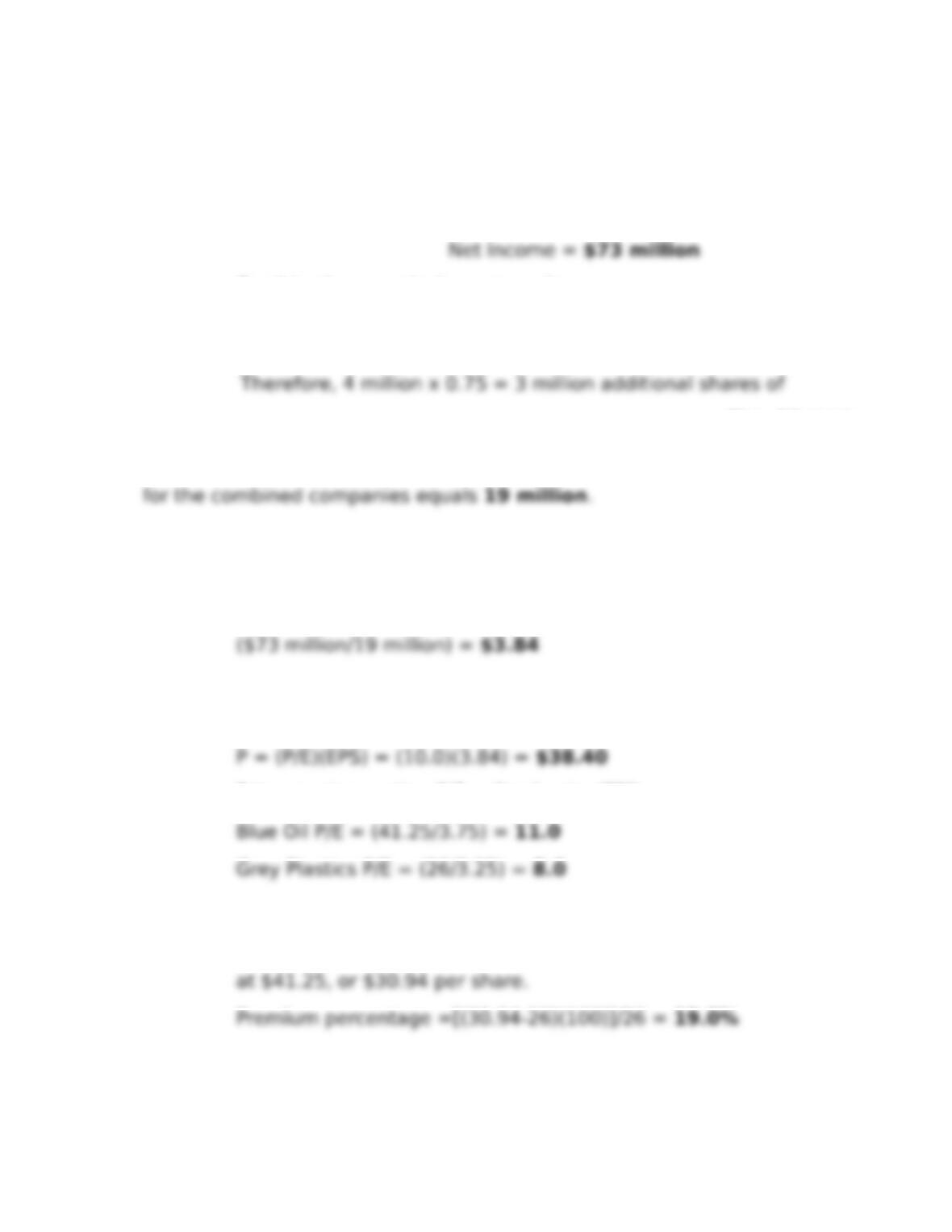
1. a. Combined companies: Sales = $625 million
Combined companies’ common shares:
For each Grey Plastics share, 0.75 shares of Blue Oil is received.
Blue Oil stock
are issued. Thus, the total common shares out- standing
Combined companies’ earnings per share:
EPSc = (Net income/No. of shares outstanding) =
Combined companies: Common stock price
Price-earnings ratio: P/E = Stock price/EPS
b. The Grey Plastics stockholders received 0.75 shares of Blue Oil
23-4
Chapter 23
Corporate Restructuring
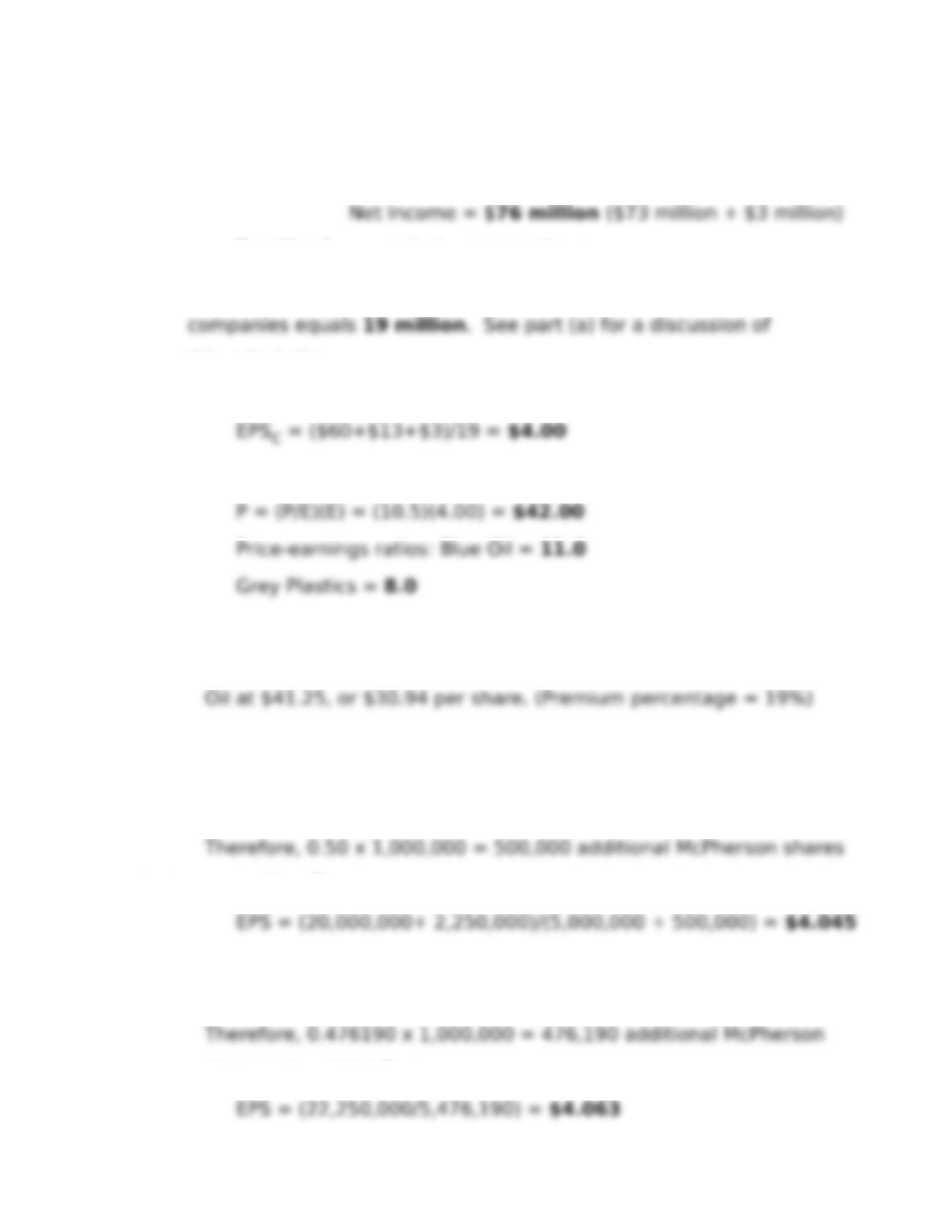
c. Combined companies: Sales = $625 million
Combined companies’ common shares:
The total common shares outstanding for the combined
this calculation.
Combined companies’ earnings per share:
Combined companies’ common stock price
d. The Grey Plastics stockholders still receive 0.75 shares of Blue
2. a. $20 a share means an exchange ratio of 0.50 shares of McPherson
for each share of McAlester.
are outstanding.
b. Exchange ratio = (20/42) = 0.476190
shares are outstanding.
23-4
Chapter 23
Corporate Restructuring
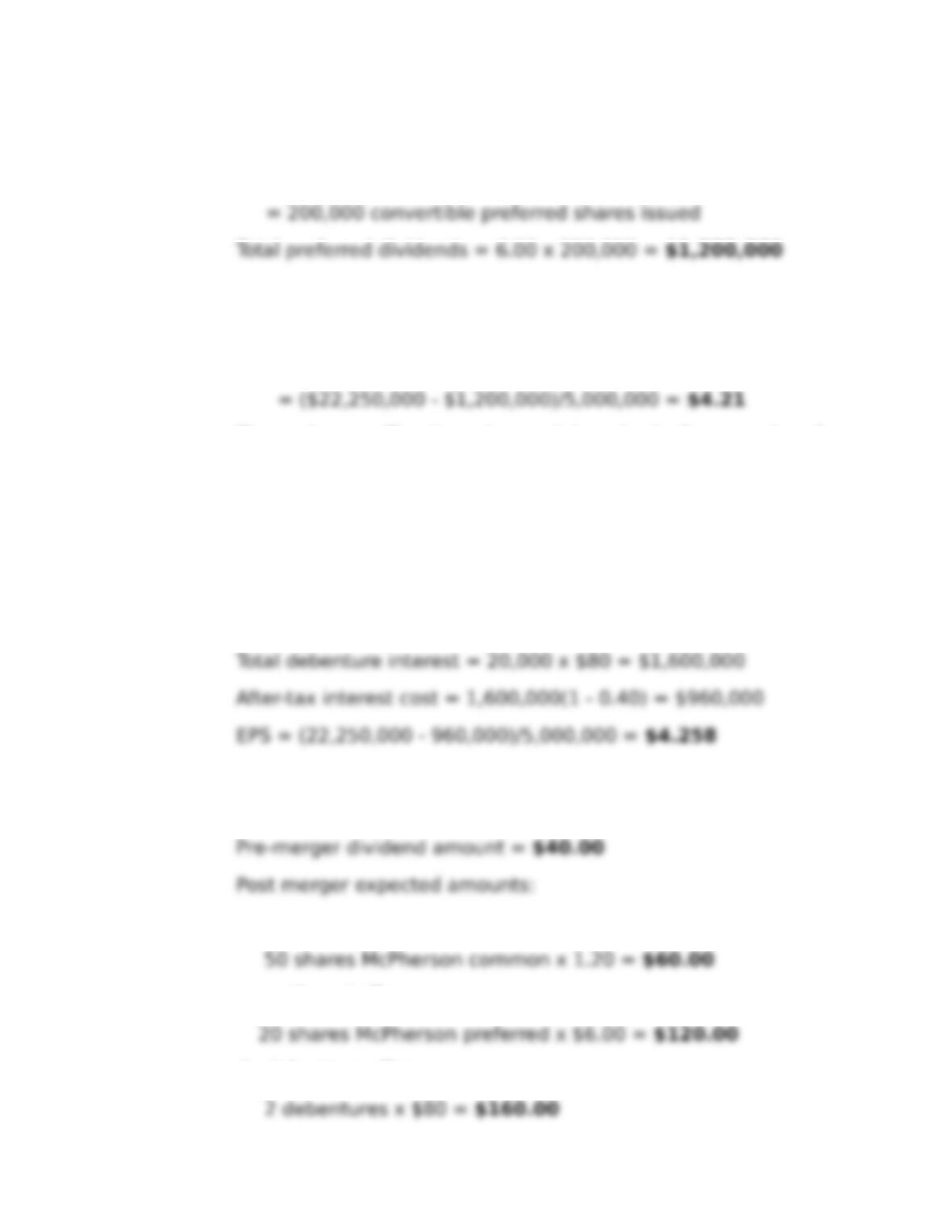
c. (1,000,000 common shares/5 common shares/1 preferred share)
EPS = Net income available to common stock /
No. of common shares outstanding
The exchange o>ers in parts c and d are basically examples of
?nancial leverage, because common stock is being replaced with
?xed income
securities.
d. (1,000,000/50 shares/debenture) = 20,000 debentures
e. E.g., 100 shares of McAlester stock:
a. stock-for-stock:
c. preferred o>er:
d. debenture o>er:
23-4
Chapter 23
Corporate Restructuring
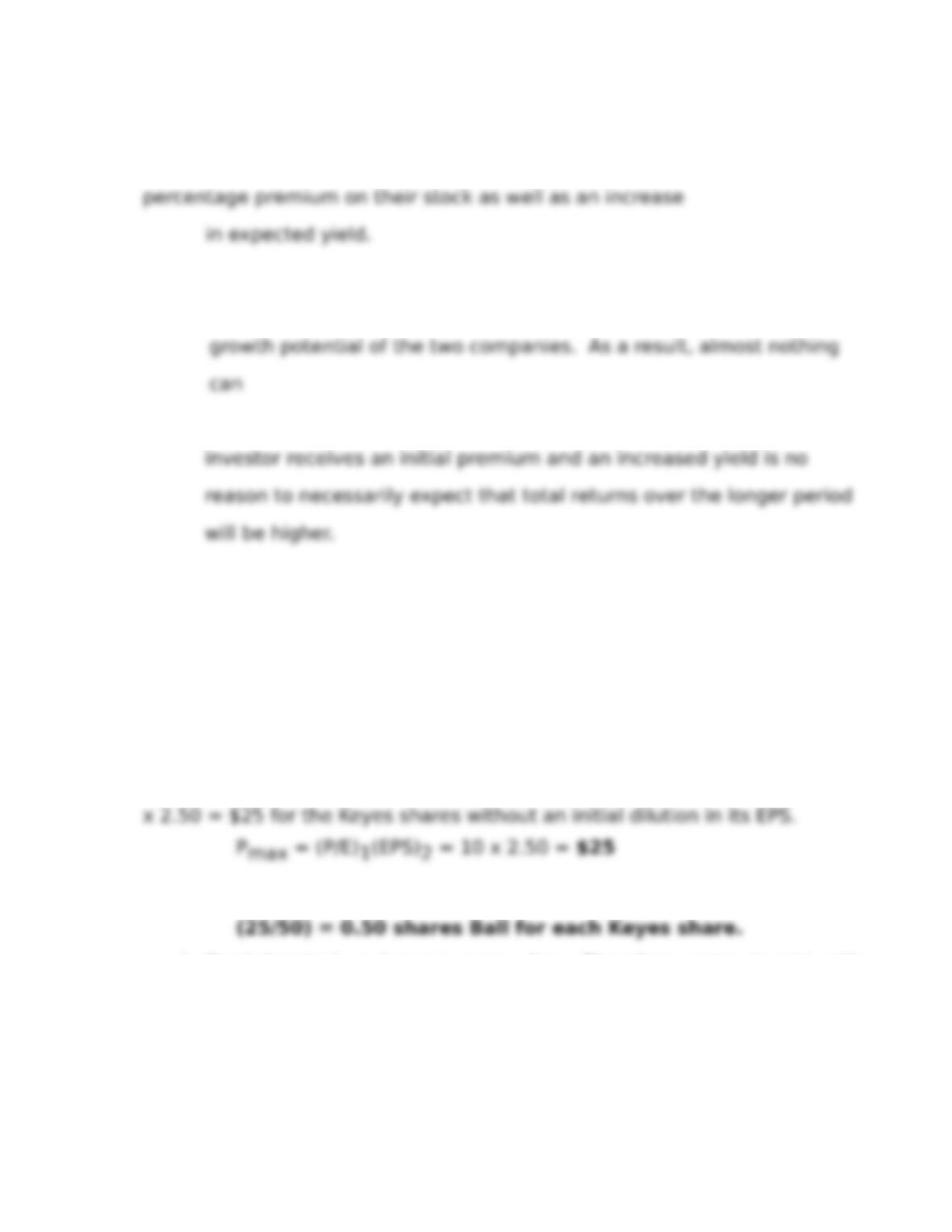
Most merger o>ers give the shareholders of the acquired ?rm an initial
f. No information is given in the problem concerning the expected
be said about the expected total return. However, just because an
3. a. In stock-for-stock exchange, there is no initial dilution if the
acquiring company
o>ers to pay the same price-earnings
multiple for the acquired shares as presently exists for its own shares.
In this problem, Ball’s P/E is 10. Therefore, it could o>er up to 10
Thus, the maximum ratio is:
b. Stock-for-stock exchanges are tax-free. Therefore, no tax is paid until
the Ball shares are sold.
c. EPSc = (EAT1 + EAT2 + EAT1,2)/[NS1 + NS2(ER)]
23-4
Chapter 23
Corporate Restructuring
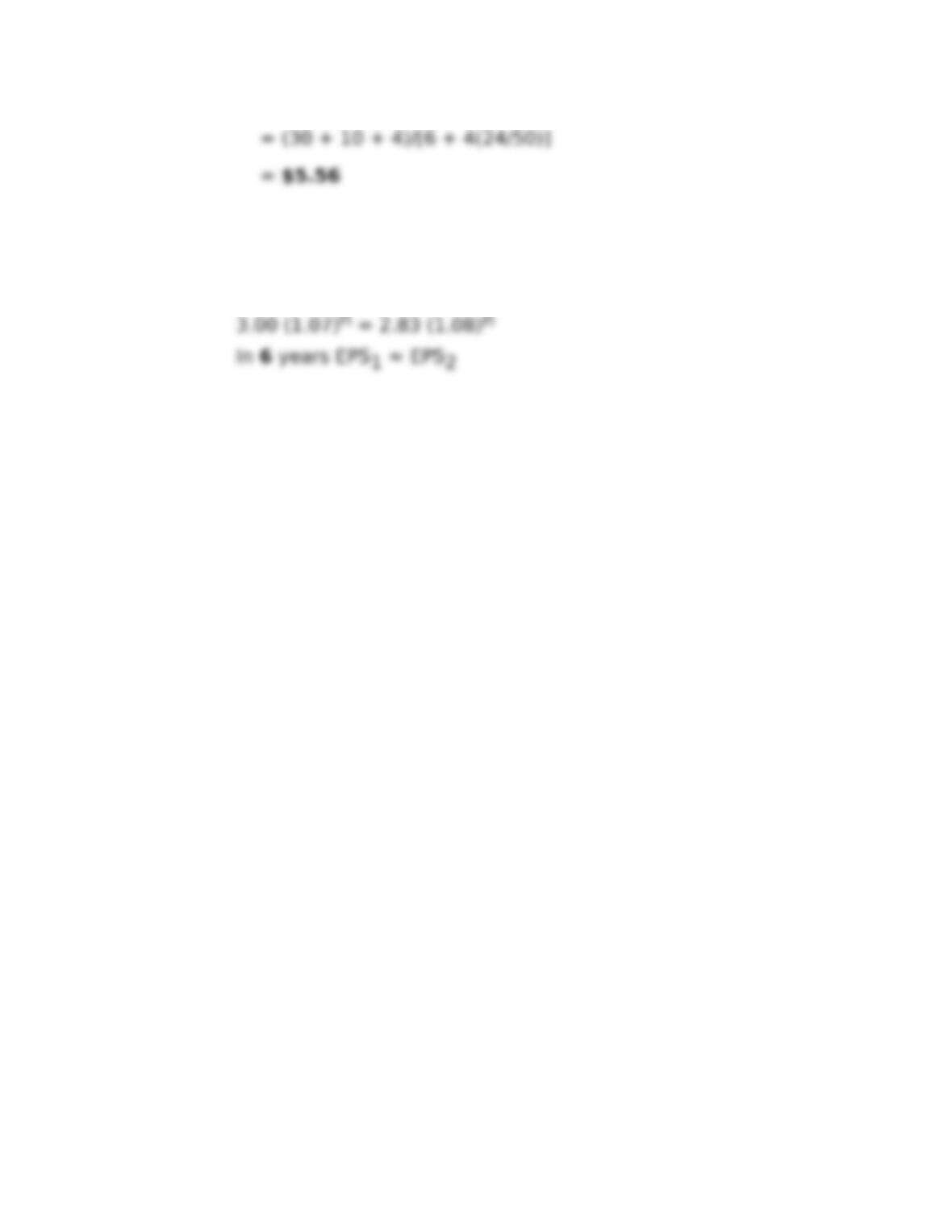
4. EPS1(1 + g1)n = EPS2(1 + g2)n
23-4