Chapter 22
International Financial Management
CHAPTER 22
INTERNATIONAL FINANCIAL
MANAAGEMENT
ANSWERS TO QUESTIONS:
1. The theory of interest rate parity states that the annual percentage differential in the forward
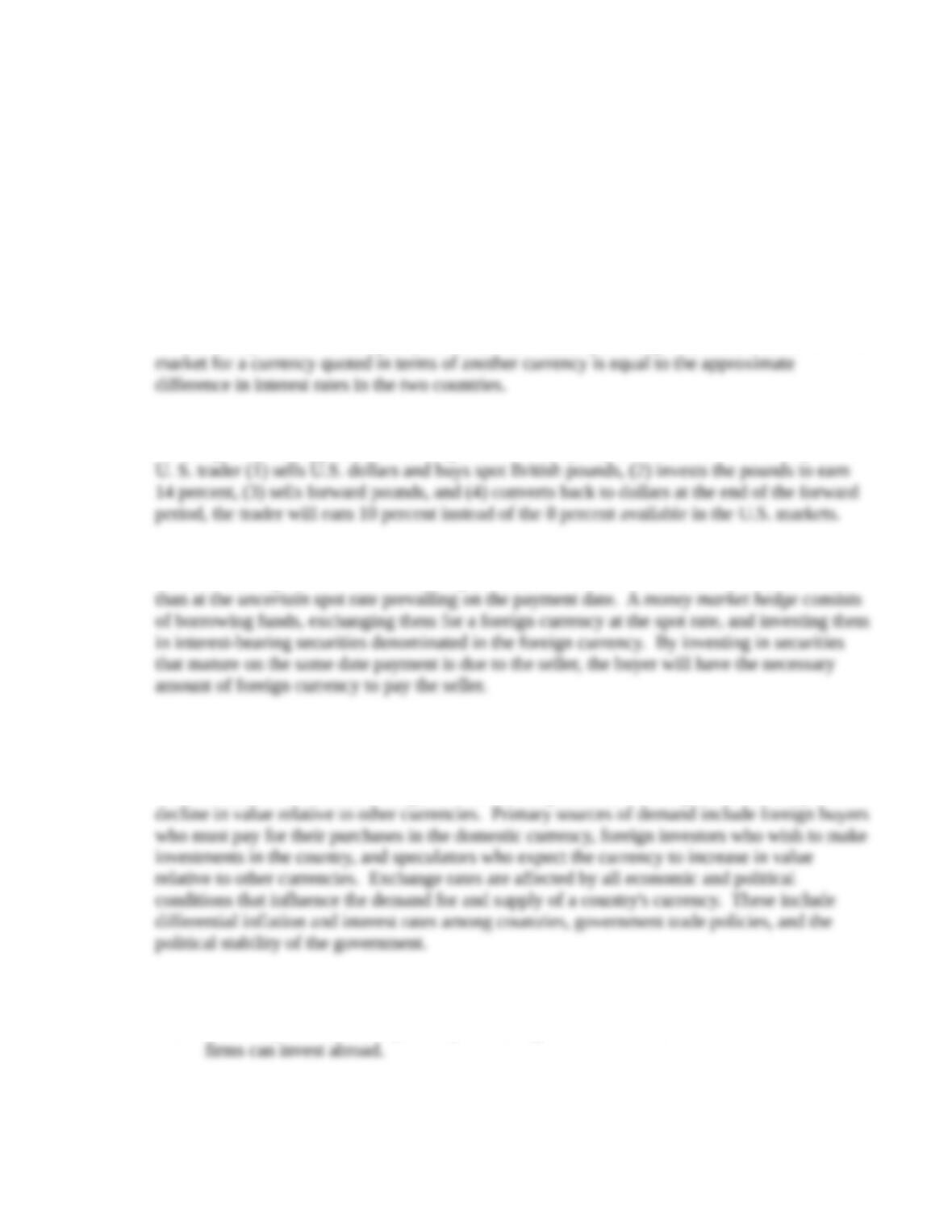
2. Covered interest arbitrage is a riskless technique used by foreign exchange traders to take
advantage of profit opportunities arising if interest rate parity does not hold. For example, if a
3. A forward market hedge (or a futures market hedge) consists of executing a contract in the
forward exchange (or the futures exchange) market at a known forward (or futures) rate rather
4. Exchange rates between currencies change over time based on the supply of and demand for
each currency. Primary sources of supply of a country’s currency include importers who need
to convert their domestic currency into foreign currency to pay for purchases, investors who
wish to make investments in foreign countries, and speculators who expect the currency to
5. Advantages to U.S. firms of financing foreign investments with funds raised abroad:
a. Avoids any restrictions imposed by the U.S. government on the amount of funds U.S.
b. Helps to minimize any losses that might occur if the foreign currency is devalued
22-2

Chapter 22
International Financial Management
c. Avoids the disclosure requirements (and associated costs) imposed by the SEC when
6. Refer to Figure 22-1.
22-2
Chapter 22
International Financial Management
SOLUTIONS TO PROBLEMS:
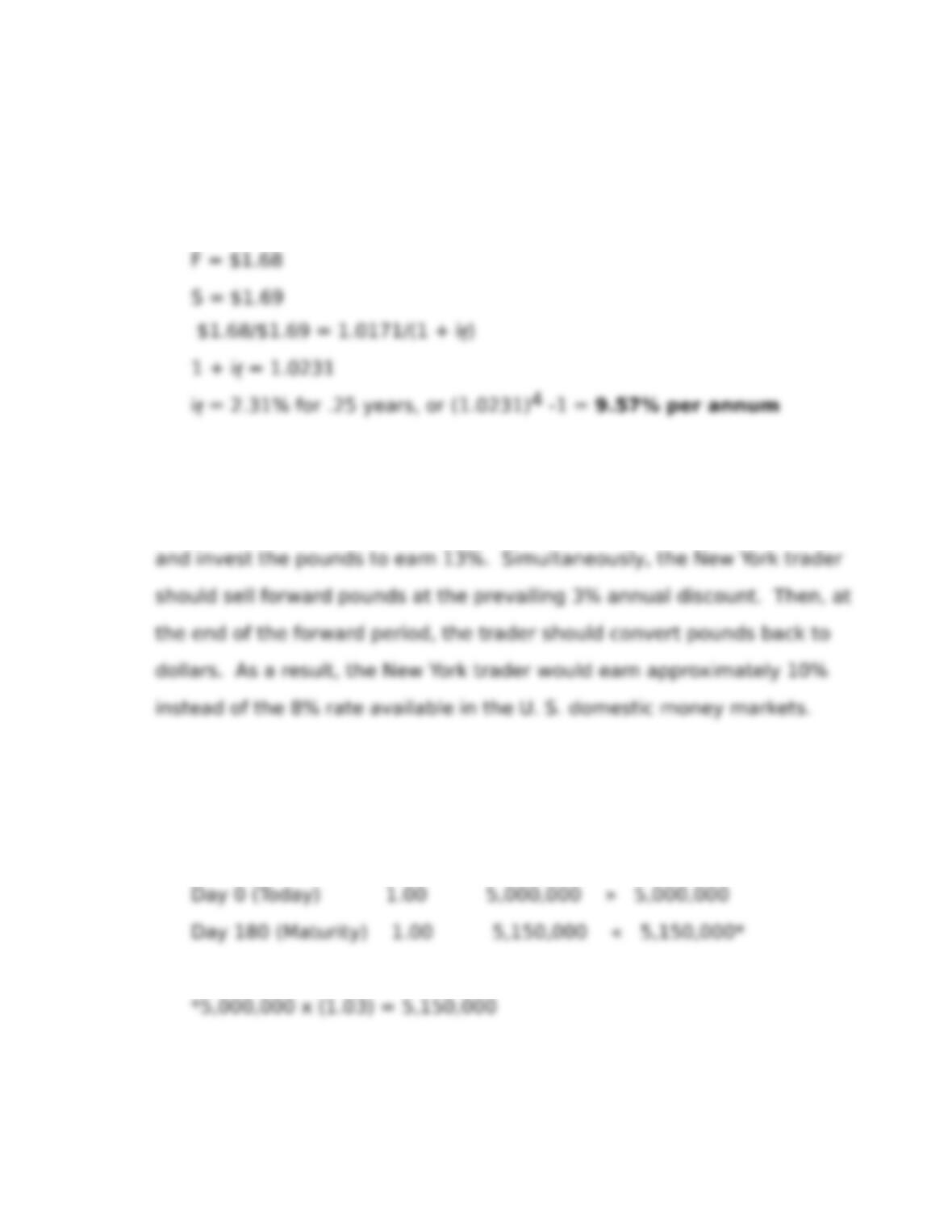
1. F/S = (1+ ih)/(1 + if)
1 + ih = (1.07).25 = 1.0171
2. The conditions do present an opportunity for covered interest arbitrage.
The trader in New York should sell U.S. dollars and buy spot British pounds
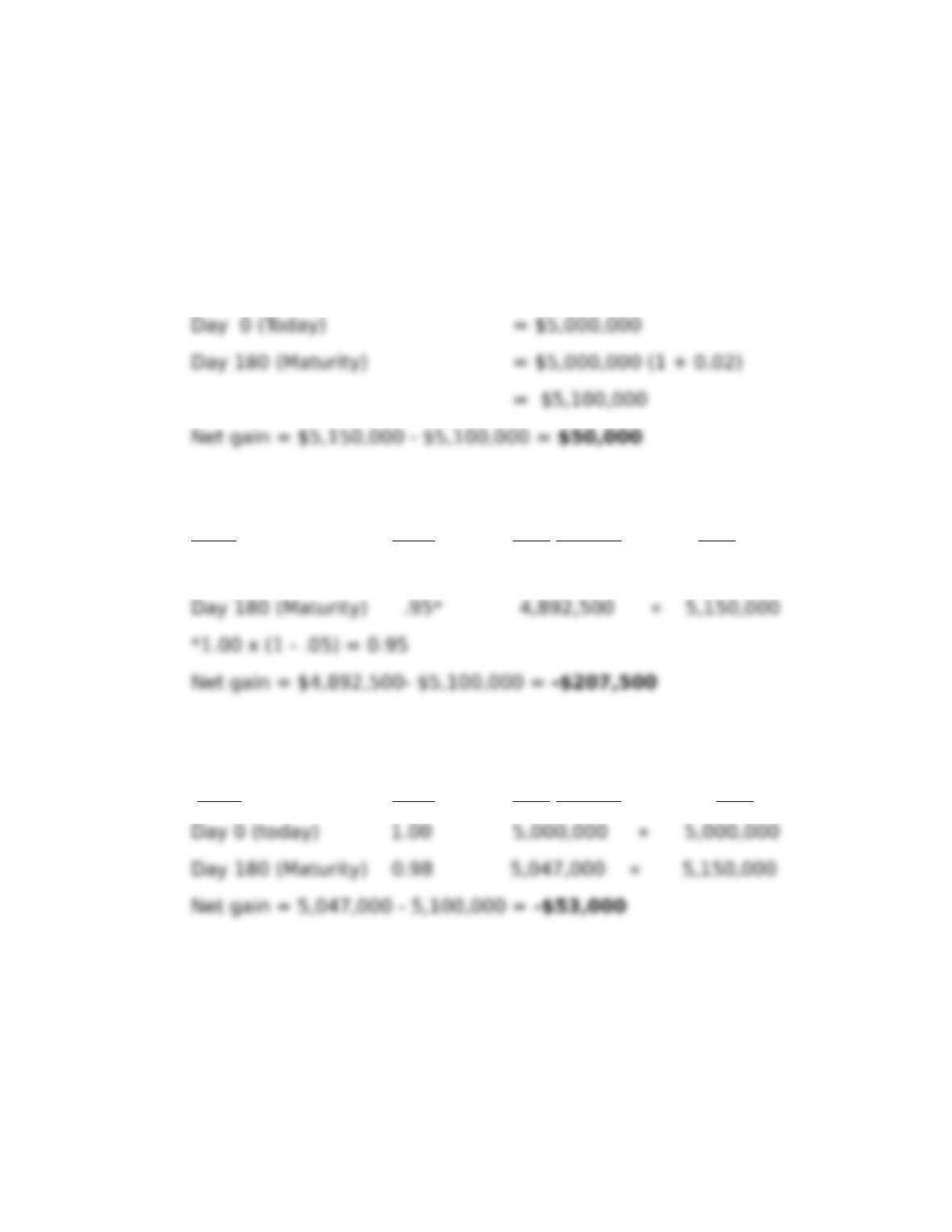
3. a. Zurich Bank CD: 1/2 x 6% = 3%
Exchange Value of Investment
Date Rate U.S. Dollars Swiss Francs (CHF)
22-2
Chapter 22
International Financial Management
Note: In this problem, because the exchange rate is assumed to remain
constant over the 180 day period, the $5,150,000 Bgure can be calculated
simply by multiplying $5,000,000 by 1.03.
PNB CD: 1/2 x 4.0% = 2.0%
b. Exchange Value of Investment
Date Rate U.S. Dollars CHF
Day 0 (Today) 1.00 5,000,000 » 5,000,000
c.
Exchange Value of Investment
Date Rate U.S. Dollars CHF
d. Exchange restrictions; Fees to execute currency exchange contracts.
22-2
Chapter 22
International Financial Management
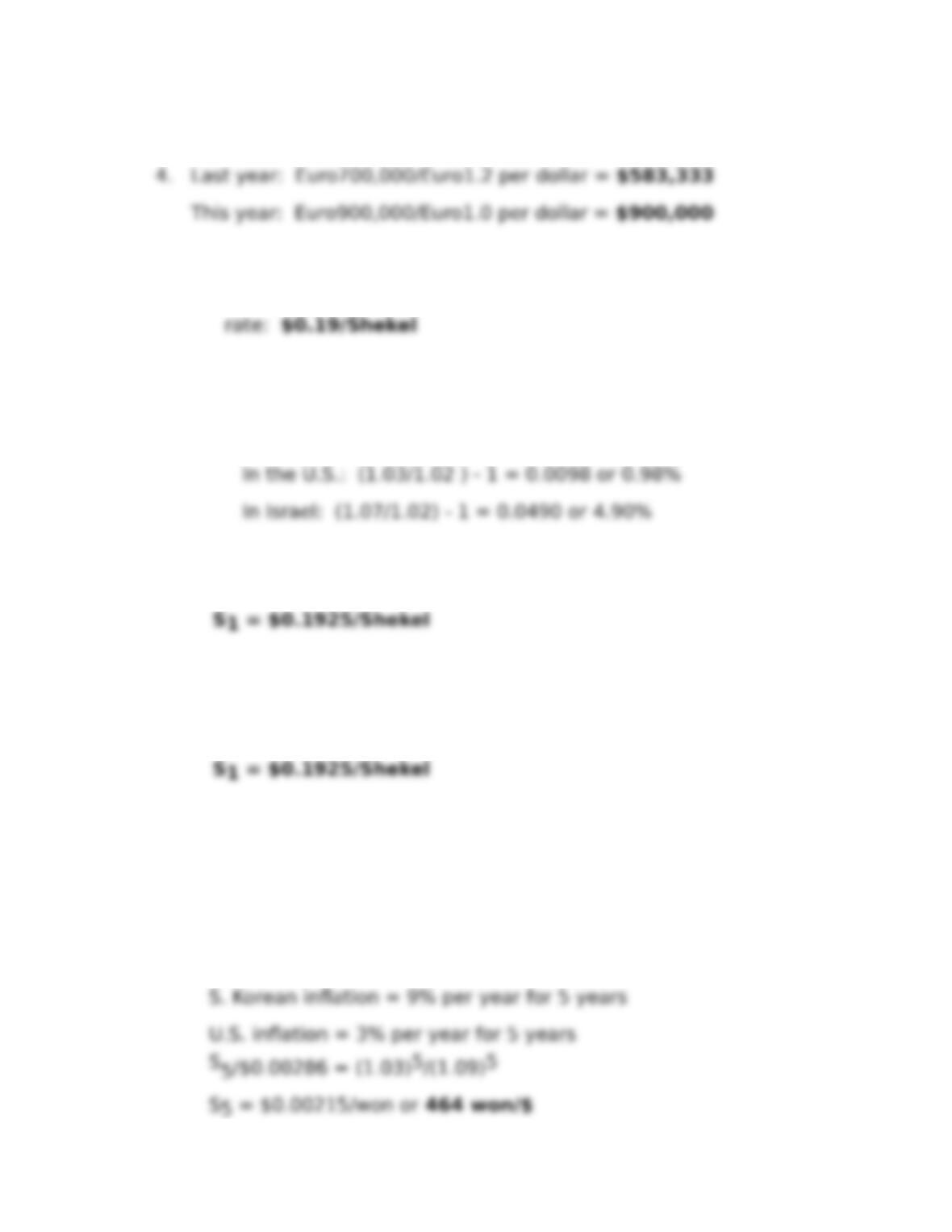
5. a. Forward rate equals an unbiased estimate of the future spot
b. Purchasing Power Parity:
Using Fisher eGect relationship, expected inHation is:
S1/ $0.20 = 1.0098/1.0490
c. International Fisher EGect:
S1/$0.20 = 1.03/1.07
Note: information on the call option premium cannot be used to
determine the expected future spot rate.
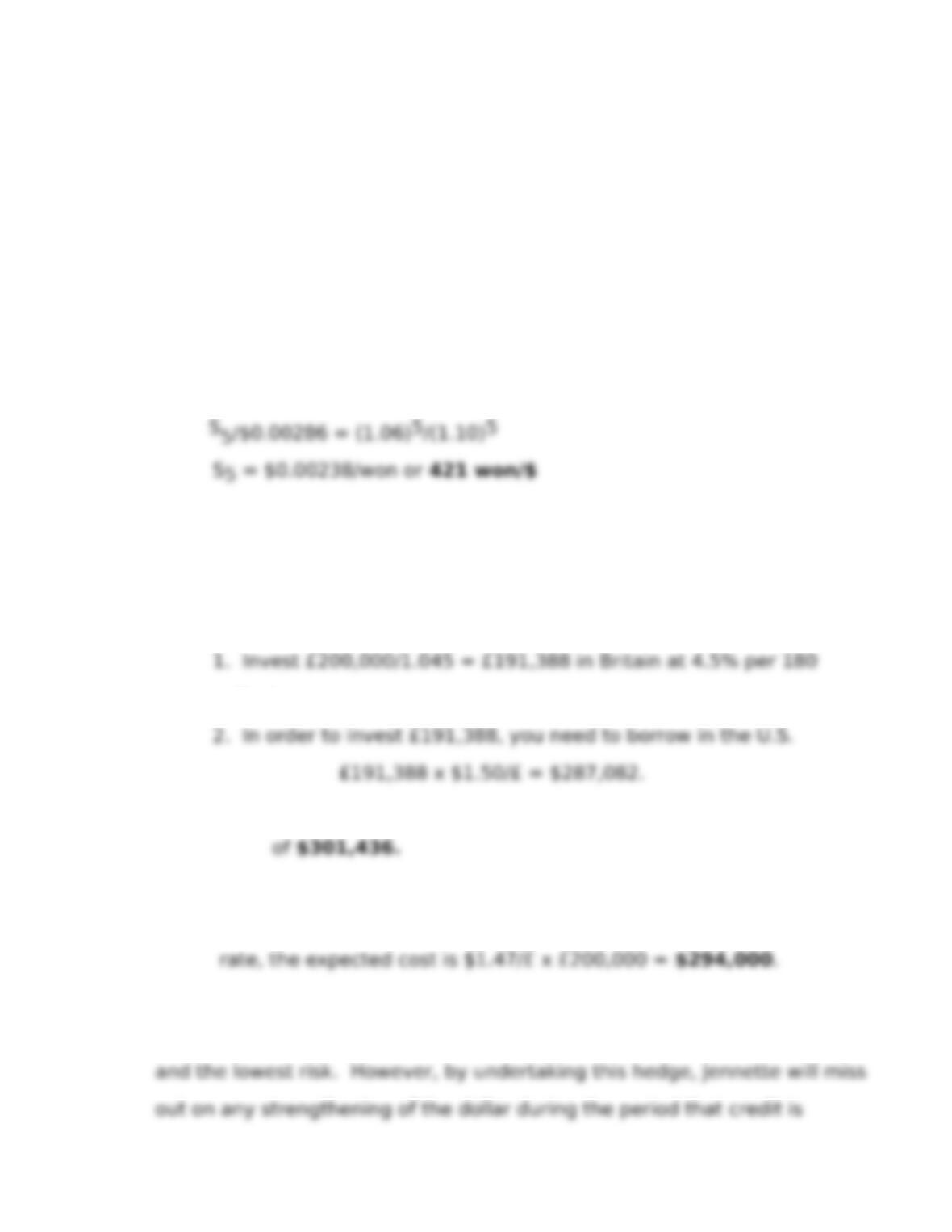
6. Direct Quote for Won = 1/350 = $0.00286
Shoesmith Wave Forecast:
22-2
Chapter 22
International Financial Management
International Fisher EGect Forecast:
Note: One percent of the yield diGerential is attributable to political
risk diGerences. Net of this risk, the S. Korean interest rate
is 10 percent
per Annum.
7. a. Buy £ forward at $1.47: Cost = $1.47/£ x £200,000 = $294,000
b. Money market hedge:
days.
3. Hence borrow $287,082 at 5 percent per 180 days for a net cost
c. Assuming the forward rate is an unbiased estimate of the future spot
d. The forward hedge is preferred because it has the lowest net cost
22-2
Chapter 22
International Financial Management
granted.
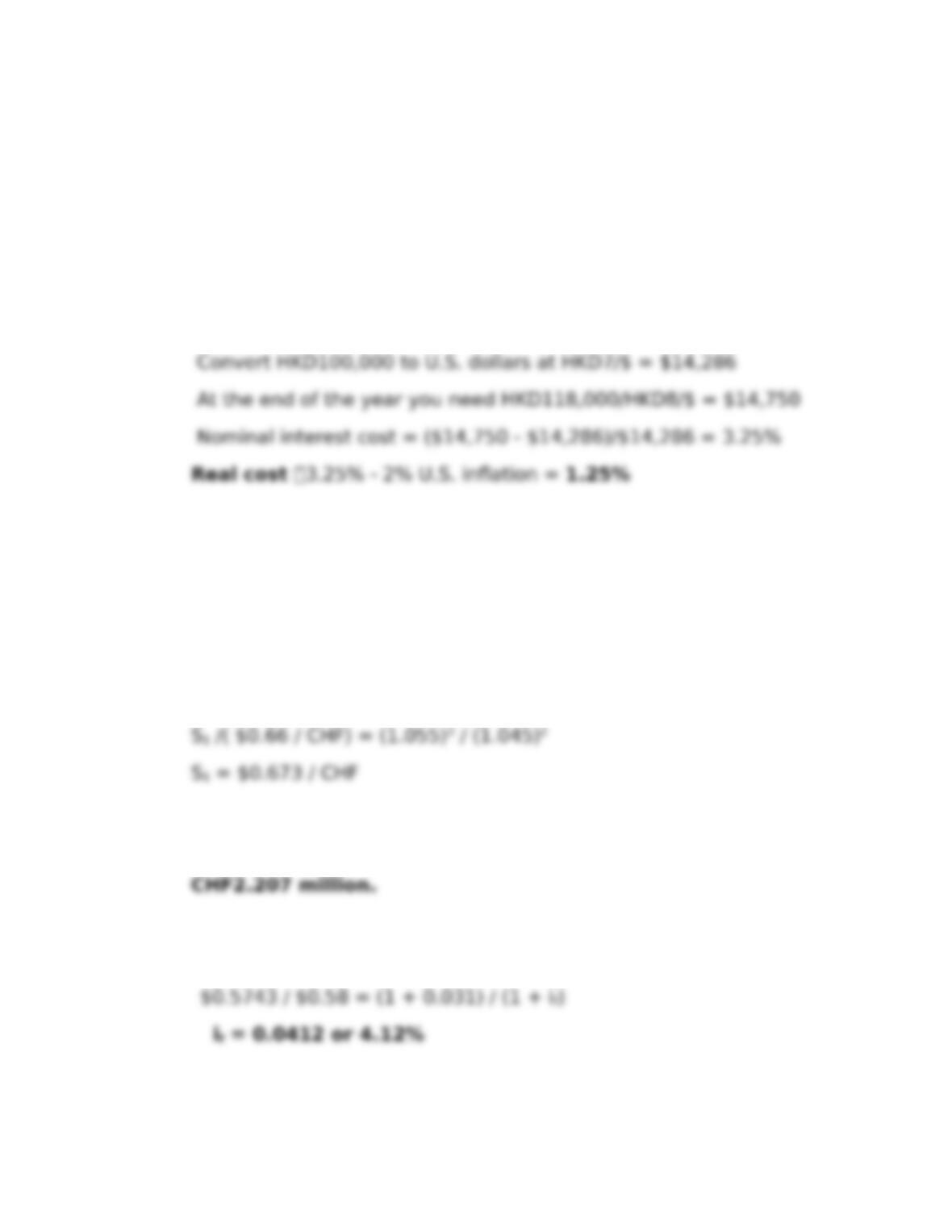
8. Borrow HKD100,000.
Pay back at the end of the year HKD100,000 x 1.18 = HKD118,000.
9. Proceeds needed in dollars = $1.4 million x 1.03 x 1.03 = $1.4853 million
Expected future spot rate: Use the International Fisher EGect
relationship for an unbiased estimate of the expected future spot rate:
Expected price to charge in CHF = $1.4853 million / ($0.673/CHF) =
10. F / S = (1 + ih) / (1 + if)
Since the CHF is expected to decline in value relative to the dollar,
Swiss securities must oGer higher rates to oGset the expected loss of value
22-2
Chapter 22
International Financial Management
of the CHF.
22-2