Chapter 20
Financing with Derivatives
CHAPTER 20
FINANCING WITH DERIVATIVES
ANSWERS TO QUESTIONS:
1. a. An option is a contract that gives holders the right to buy or sell a commodity (such as
100 shares of a particular stock) at a set price during a specified time period.
2. Call options and warrants are similar in that both securities give holders the right to buy
3. The value of a call option is dependent upon four variables:
* The relationship between the option’s exercise price and the price
4. At a time when interest rates are relatively low, option prices in general will be relatively
5. The greater the expected stock price volatility, the higher the call option value is, all other
6. The major similarities between convertible securities and warrants are:
a. Both convertibles and warrants tend to lower agency costs.
The major differences between convertible securities and warrants are:
a. The company receives additional funds when (and if) the warrants are exercised, whereas
20-1
Chapter 20
Financing with Derivatives
b. The fixed income security remains on the company’s books after exercise of warrants,
7. Companies issue convertible securities for the following reasons:
* To lower agency costs.
8. See Figure 20-2 for the relationships.
9. A company effectively can force conversion of a convertible security by exercising the call
10. The preemptive right gives common stockholders the right to buy, on a pro rata basis, any
11. An interest rate swap may be used to hedge against the risk associated with fluctuations in
SOLUTIONS TO PROBLEMS:
1. a. Value of a call option at maturity
= Stock price – Exercise price
c. Its value is $0, because the exercise price ($60) is much greater
20-1
Chapter 20
Financing with Derivatives
than the stock price ($50).
d. Its value will be greater than zero.
2. a. Value of a put option at maturity = Exercise price – Stock price
b. Its value will be greater than zero.
c. Value of a put option at maturity = Exercise price – Stock price
d. Its value will be greater than $10.
3. a. Conversion ratio = (Par value of security/conversion price)
Conversion value = (conversion ratio)(stock price)
b. Bond value = $60(PVIFA .09,20) +$1,000(PVIF.09,20)
20-1
Chapter 20
Financing with Derivatives
c. A realistic estimate of market value is the $1000-$1100 range.
Because the conversion value and bond value are somewhat close together,
d. Conversion value = (conversion ratio)(stock price)
e. A realistic estimate of the market value is $1,400. At this price,
f. At $26.75 per share, the conversion value of the bond is equal
g. Bond value = $60(PVIFA .10,20) + $1,000(PVIF .10,20)
20-1
Chapter 20
Financing with Derivatives
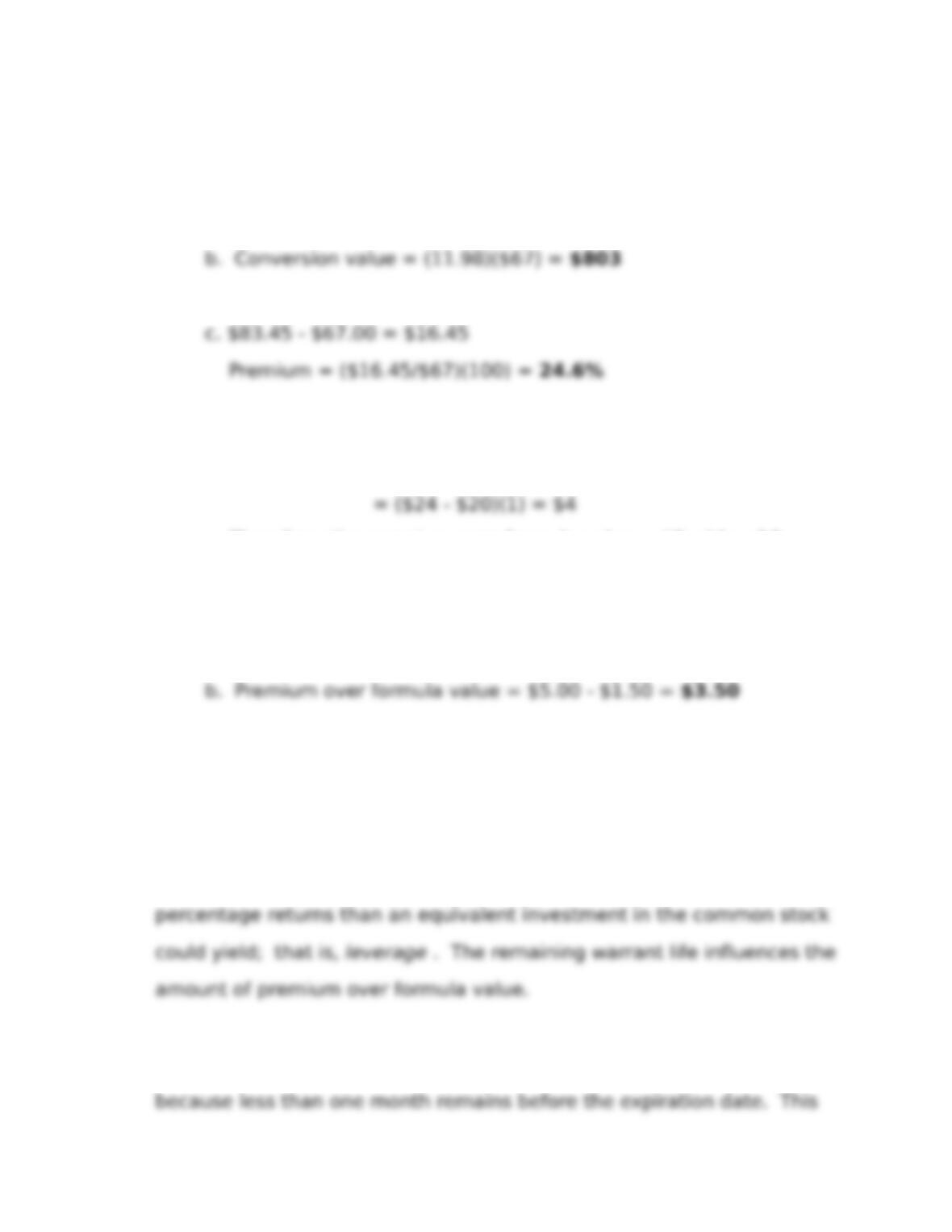
4. a. Conversion ratio = 1000/$83.45 = 11.98 shares
5. Formula value = (Common stock price – Exercise price)
x No. of shares obtainable with each warrant
Therefore, the premium over formula value = $8 – $4 = $4
6. a. Formula value = ($21.50 – $20.00)(1) = $1.50
c. The principal reason investors are willing to pay more than
formula value for these warrants is the potential for higher
d. The warrant price would be very close to $1.50, the formula value,
20-1
Chapter 20
Financing with Derivatives
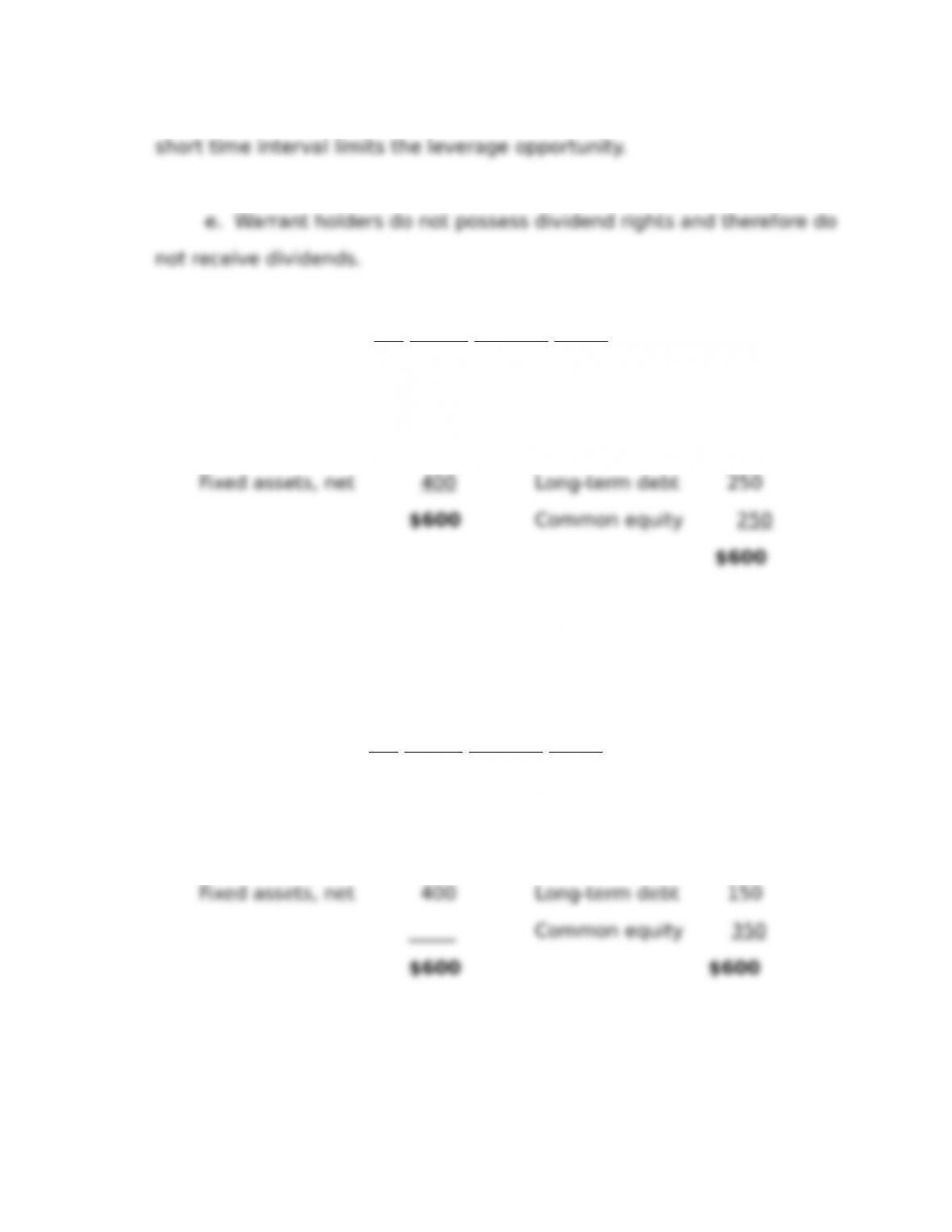
7. a. Pro Forma Balance Sheet
(millions of dollars)
Current assets $200 Current liabilities $100
b. Pro Forma Balance Sheet
(millions of dollars)
Current assets $200 Current liabilities $100
c. No additional funds are raised at the time of conversion.
20-1
Chapter 20
Financing with Derivatives
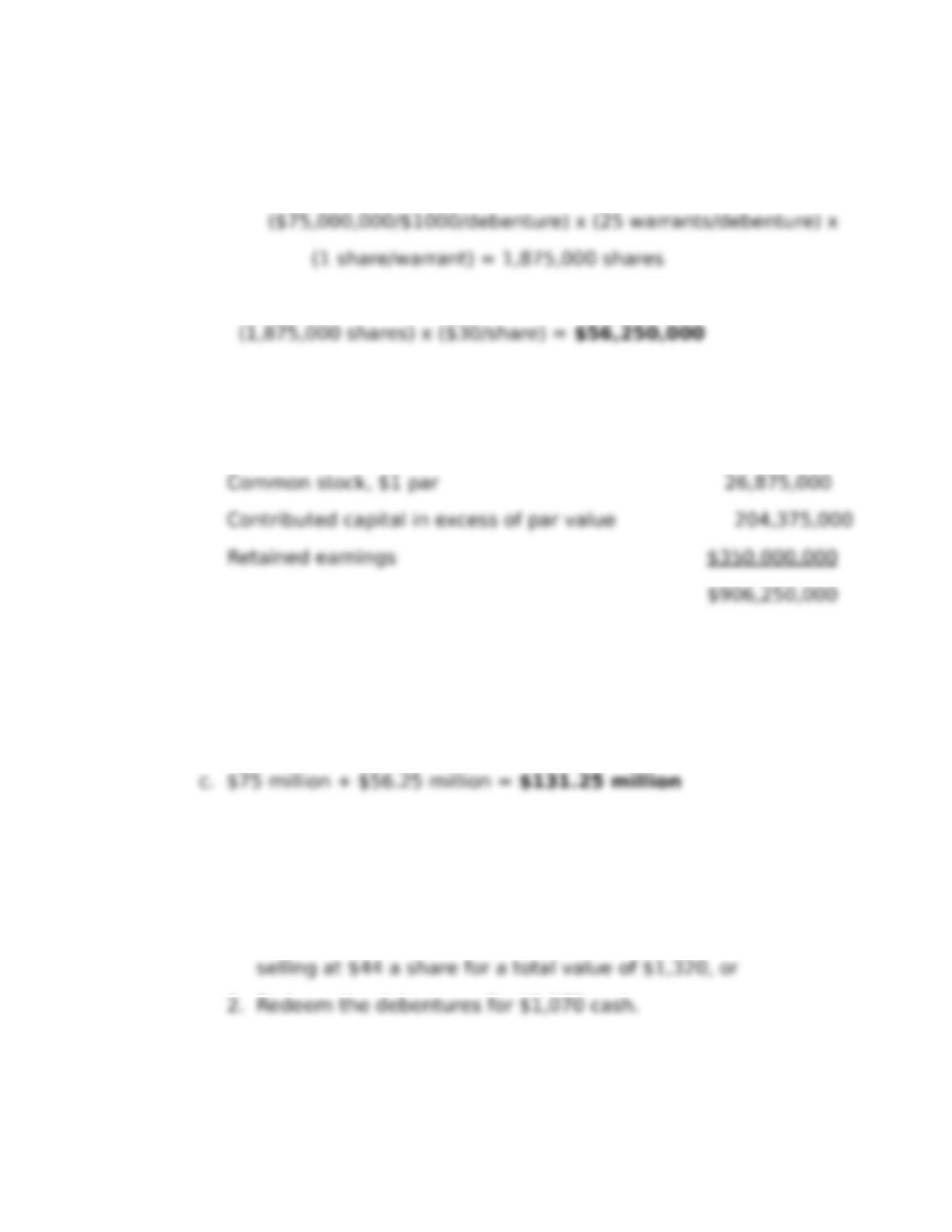
8. a. Number of additional shares issued =
Additional funds raised from warrant exercise =
Capital Structure
Long-term debt $325,000,000
b. Common stock price has to be above $30 a share at warrant
expiration date.
9. a. Alternatives:
1. Convert, and receive 30 shares of common stock presently
20-1
Chapter 20
Financing with Derivatives
b. Conversion: The reason is obvious (conversion has a greater
10
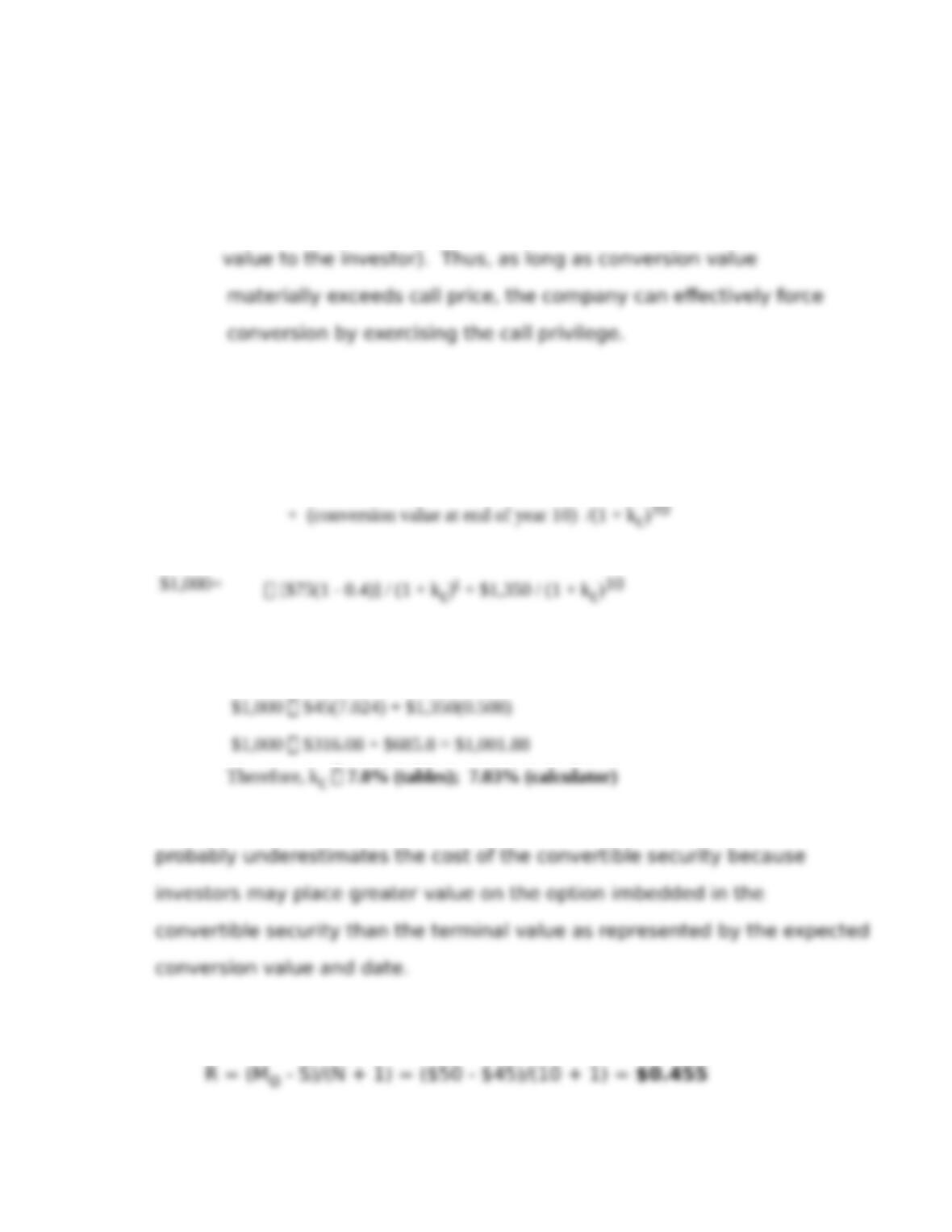
10. Issue price = [(interest)(1 – tax rate)] / (1+kc)t
t=1
10
t=1
Using kc = 7.0%:
This calculation is based on the expected conversion value. Hence it
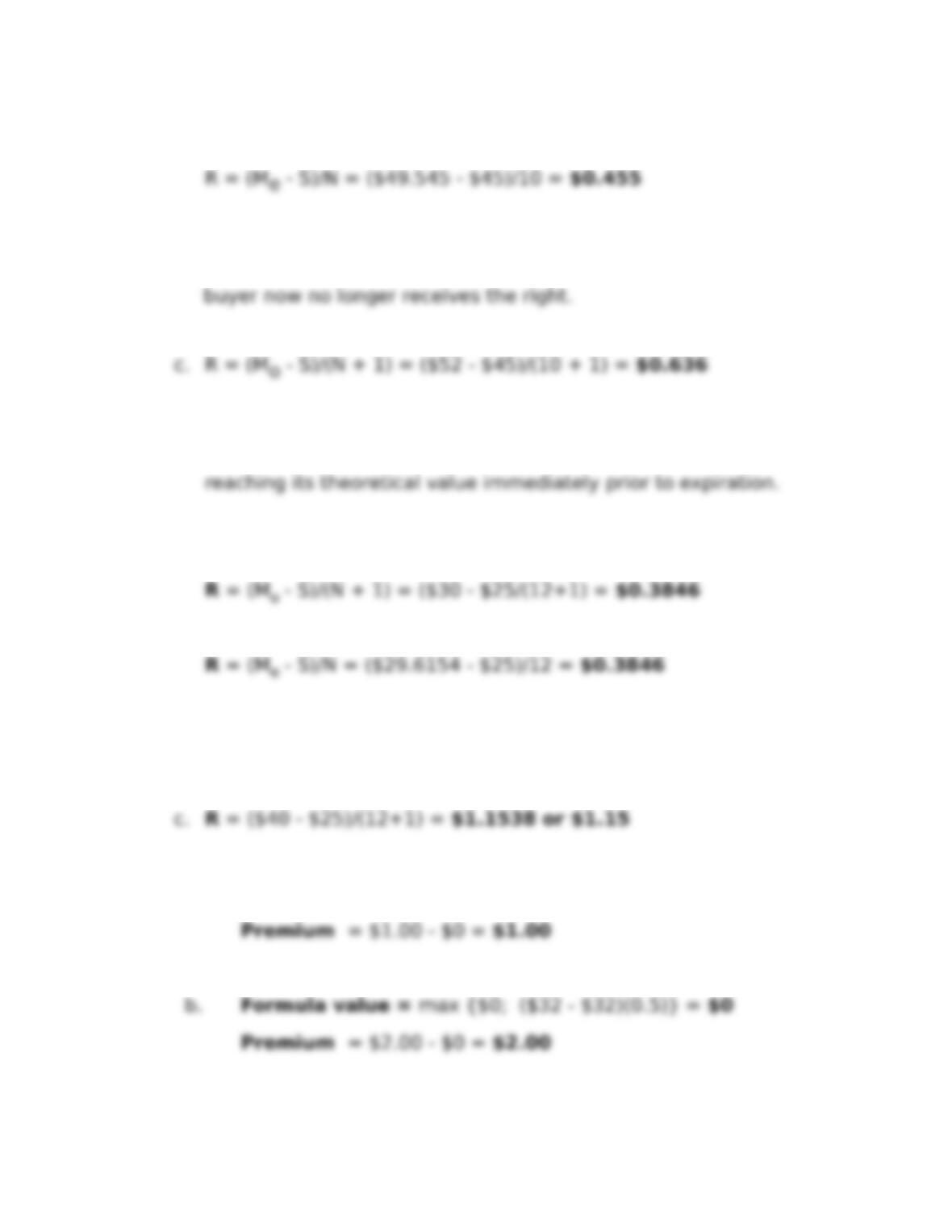
11.a. Rights-on case:
20-1
Chapter 20
Financing with Derivatives
Ex-rights case:
b. Stock is expected to drop by the value of the right, because the
d. Trend would be for the market price of the right to decrease,
12.a. Rights on case:
Ex-rights case:
b. Stock is expected to drop by the value of the right, i.e., $0.3846.
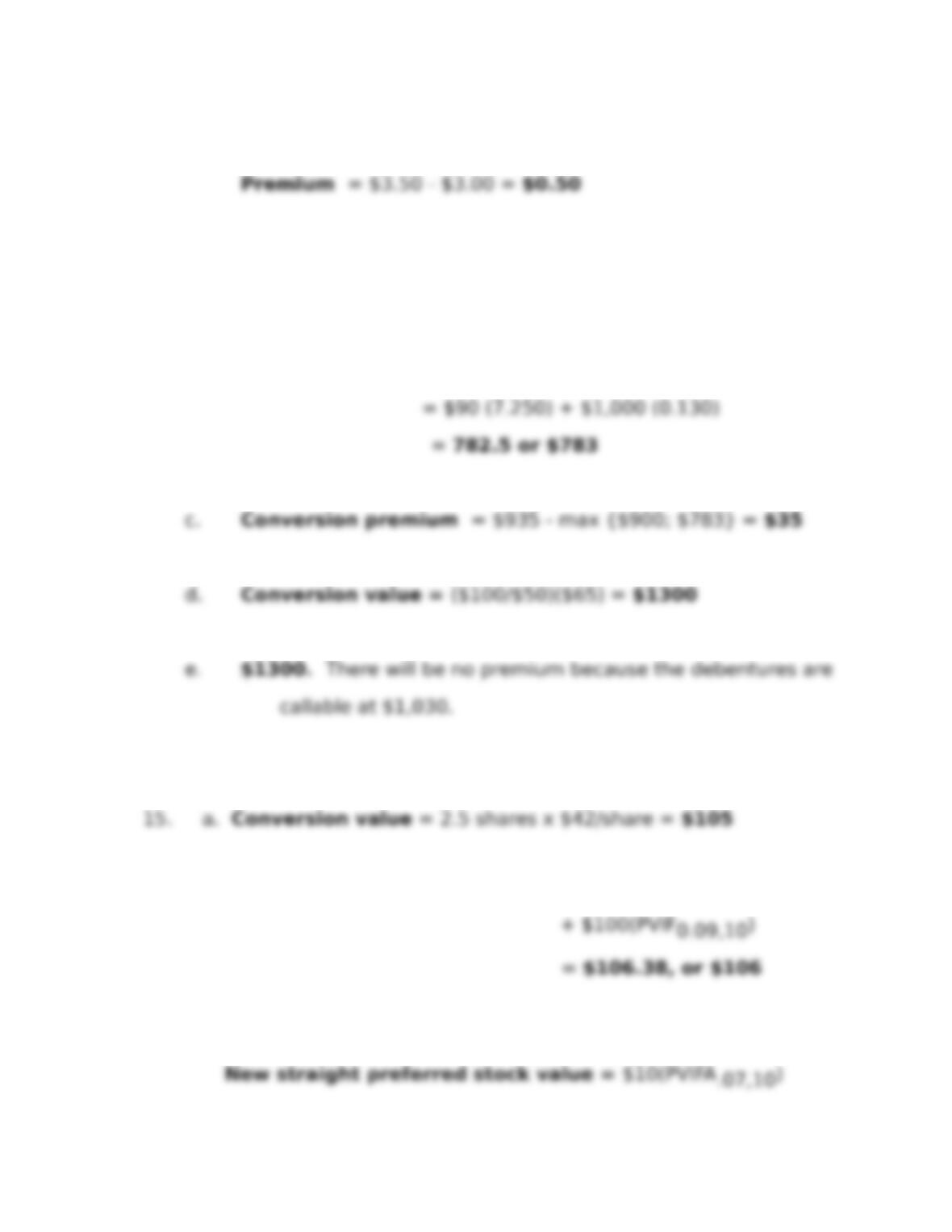
13. a. Formula value = max {$0; ($30 – $32)(0.5)} = $0
20-1
Chapter 20
Financing with Derivatives
c. Formula value = max {$0; ($38 – $32)(0.5)} = $3.00
14. a. Conversion value = ($1,000/$50)$45 = $900
b. Straight bond value = $90 (PVIFA0.12,18) + $1,000 (PVIF0.12,18)
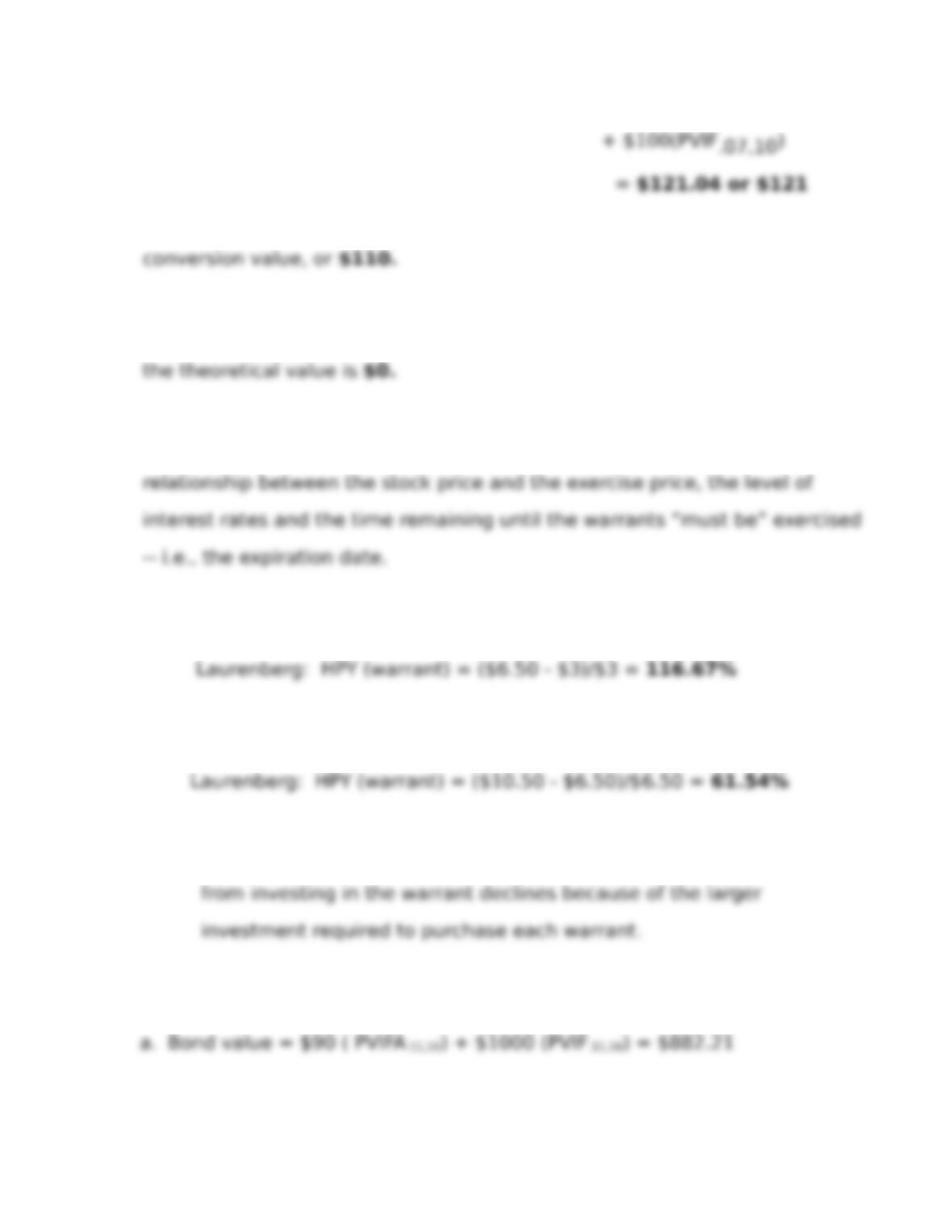
b. Straight preferred stock value = $10(PVIFA0.09,10)
c. New conversion value = 2.5 shares x $44 = $110
20-1
Chapter 20
Financing with Derivatives
Because of the threat of a call at 103, the maximum value will be the
16. a. Because the exercise price on the warrant exceeds the stock price,
b. Warrant values are in8uenced by the volatility of the stock price, the
c. Laurenberg: HPY (stock) = ($20 – $15)/$15 = 33.33%
d. Laurenberg: HPY (stock) = ($25 – $20)/$20 = 25%
e. As the stock price rises above the exercise price, the rate of return
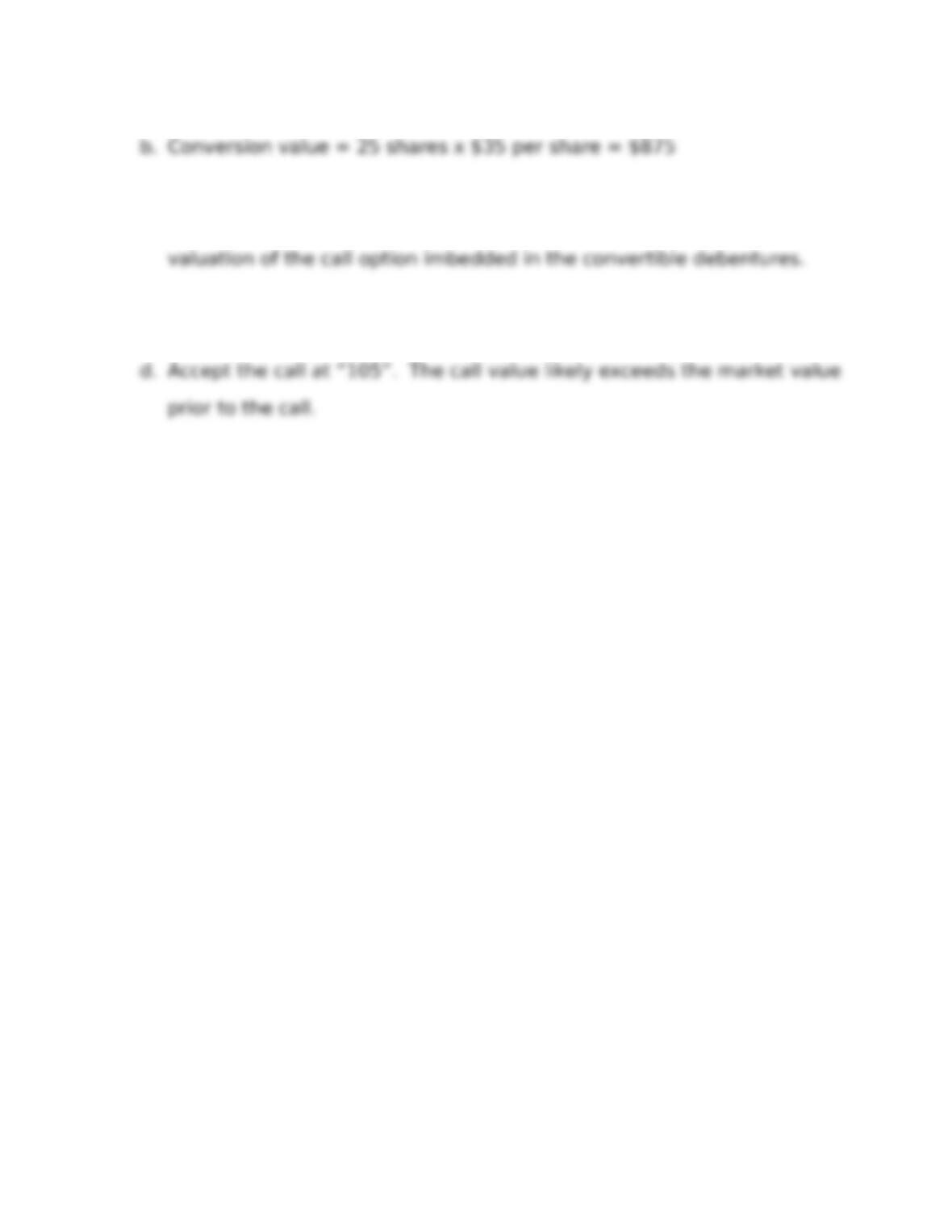
17. Conversion ratio = $1000 / $40 = 25 shares
20-1
Chapter 20
Financing with Derivatives
c. These debentures will sell for more than $882.21, depending on the
20-1