Chapter 19
Lease and Intermediate-Term Financing
CHAPTER 19
LEASE AND INTERMEDIATE-TERM
FINANCING
ANSWERS TO QUESTIONS:
1. Operating leases provide for the use of an asset on a period by period basis. They are
cancelable and frequently provide for maintenance, insurance and taxes to be paid by the lessor.
Financial leases are non-cancelable agreements that obligate the lessee to make payments to the
2. A leveraged lease differs from a non-leveraged financial lease in that the lessor may advance
Leveraged leases are most attractive to not-for-profit or marginally profitable enterprises that are
3. IRS guidelines:
*The term of the lease must be substantially less than the expected useful life of the asset.
A favorable IRS ruling is important because otherwise the lease is treated as if the property were
4. FASB Standard #13 requires that many financial leases must be capitalized and shown on the
19-3
Chapter 19
Lease and Intermediate-Term Financing
5. When a building is leased, the lease rate charged is normally enough to compensate the lessor
for his/her investment in both the building and the land on which it is placed. Since the entire
6. Because leases require a contractually set series of equal payments, they have the tendency to
7. Leasing is usually more expensive than ownership because it interjects another middleman in
Leasing may be more desirable than direct ownership when it is the only feasible source of
8. Financially distressed firms find it easier to obtain lease financing than bank loan financing
9. Intermediate term borrowing may be preferred to long-term borrowing in a situation where a
firm is not large enough to economically offer long-term securities in the public markets. In this
10. a. Equal periodic payments: This method reduces the outstanding balance slowly at first, as
b. Equal periodic principal reductions: This method reduces outstanding principal in a uniform
c. Balloon loan: This method leaves the firm with a greater average borrowed balance than any
19-3
Chapter 19
Lease and Intermediate-Term Financing
d. Bullet loan: This method leaves the firm with a maximum outstanding balance on the loan.
11. The major factors influencing the cost of a loan are the general level of interest rates, the size
12. a. Affirmative covenants are actions that management agrees to take as a condition for
b. Negative covenants are actions that a firm agrees not to take during the life of the loan,
c. Restrictive covenants limit the scope of certain actions the firm may wish to take,
13. The primary suppliers of business term loans are commercial banks, insurance companies,
14. a. Conditional sales contract: The seller of the equipment retains title to the equipment
b. Chattel mortgage: Used by commercial banks and sales finance companies that make
15. A fixed rate loan would be preferred if interest rates were expected to rise. In contrast, a
19-3
Chapter 19
Lease and Intermediate-Term Financing
SOLUTIONS TO PROBLEMS:
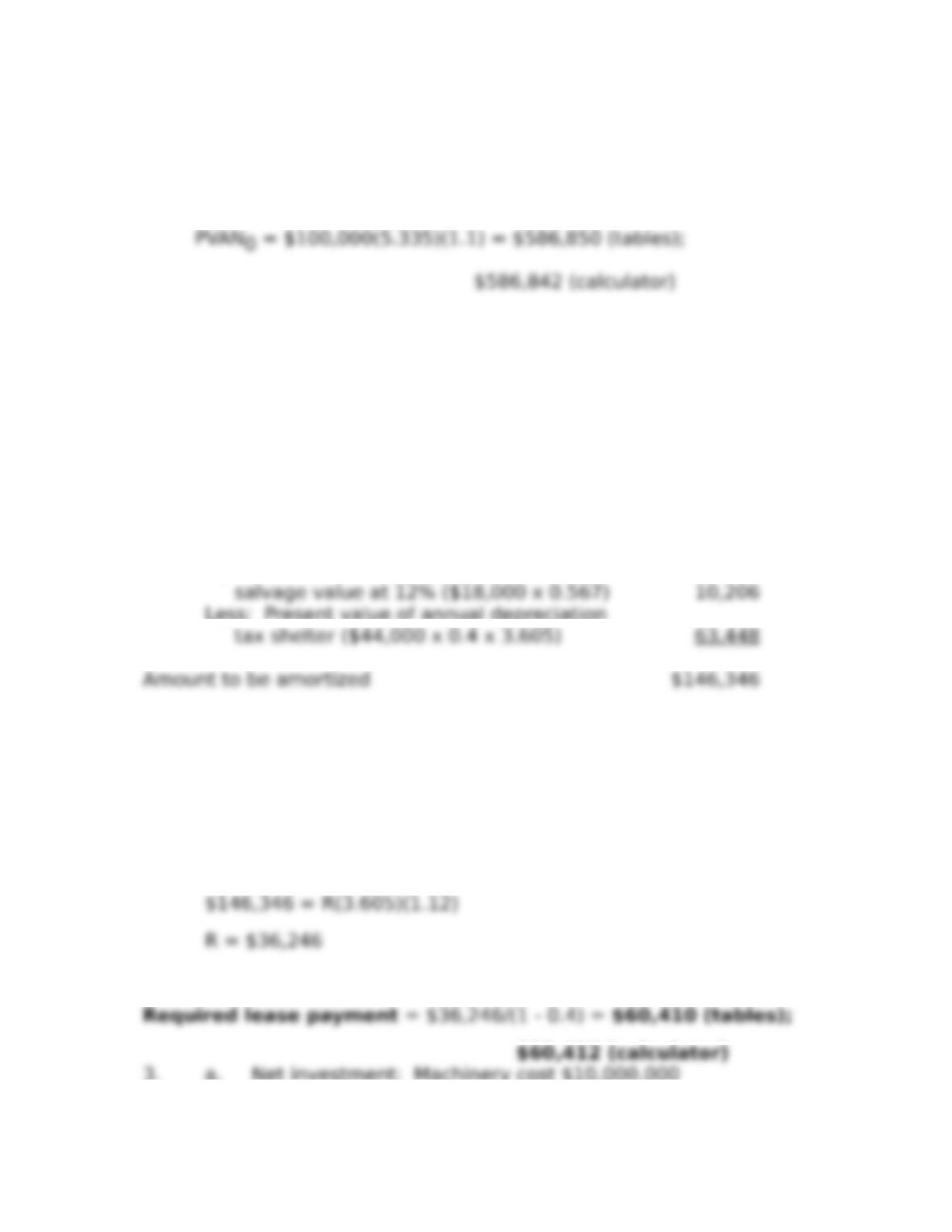
1. PVAN0 = $100,000(PVIFA.10,8)(1.10)
The balance sheet would immediately show an asset with a
value of $586,850.
Similarly, an initial liability would be recorded equal to
$586,850.
2. Calculation of amount to be amortized:
Initial outlay $220,000
Less: Present value of $18,000 after-tax
Less: Present value of annual depreciation
Calculation of annual after-tax lease income required to be received
by lessor:
Amount to be amortized = $146,346 = R(PVIFA.12,5)(1.12)
Calculation of lease payment required from lessee:
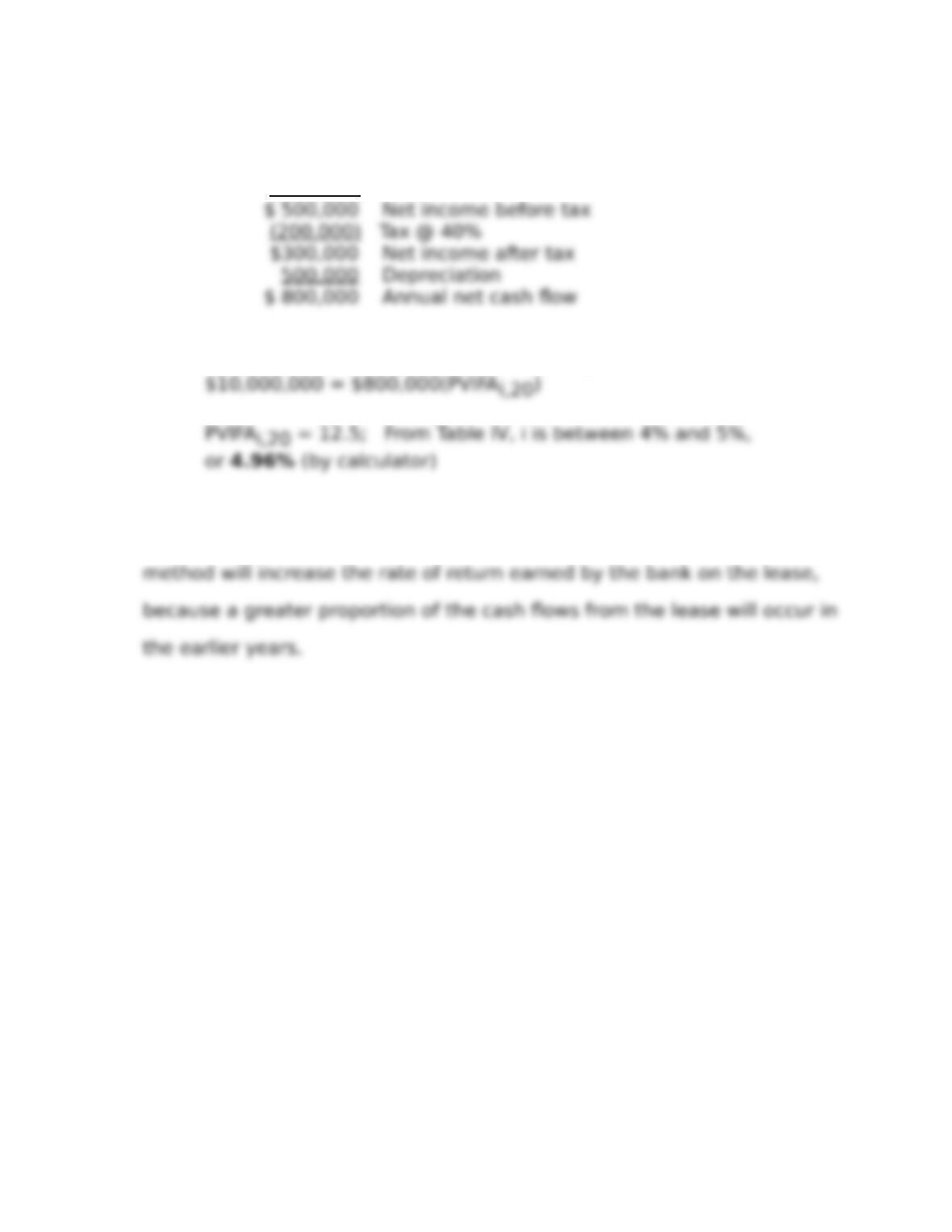
3. a. Net investment: Machinery cost $10,000,000
19-3
Chapter 19
Lease and Intermediate-Term Financing
Net cash 5ow:
$1,000,000 Revenue
(500,000) Depreciation
Net investment = Present value of net cash 5ows
b. The use of MACRS depreciation or some other accelerated depreciation
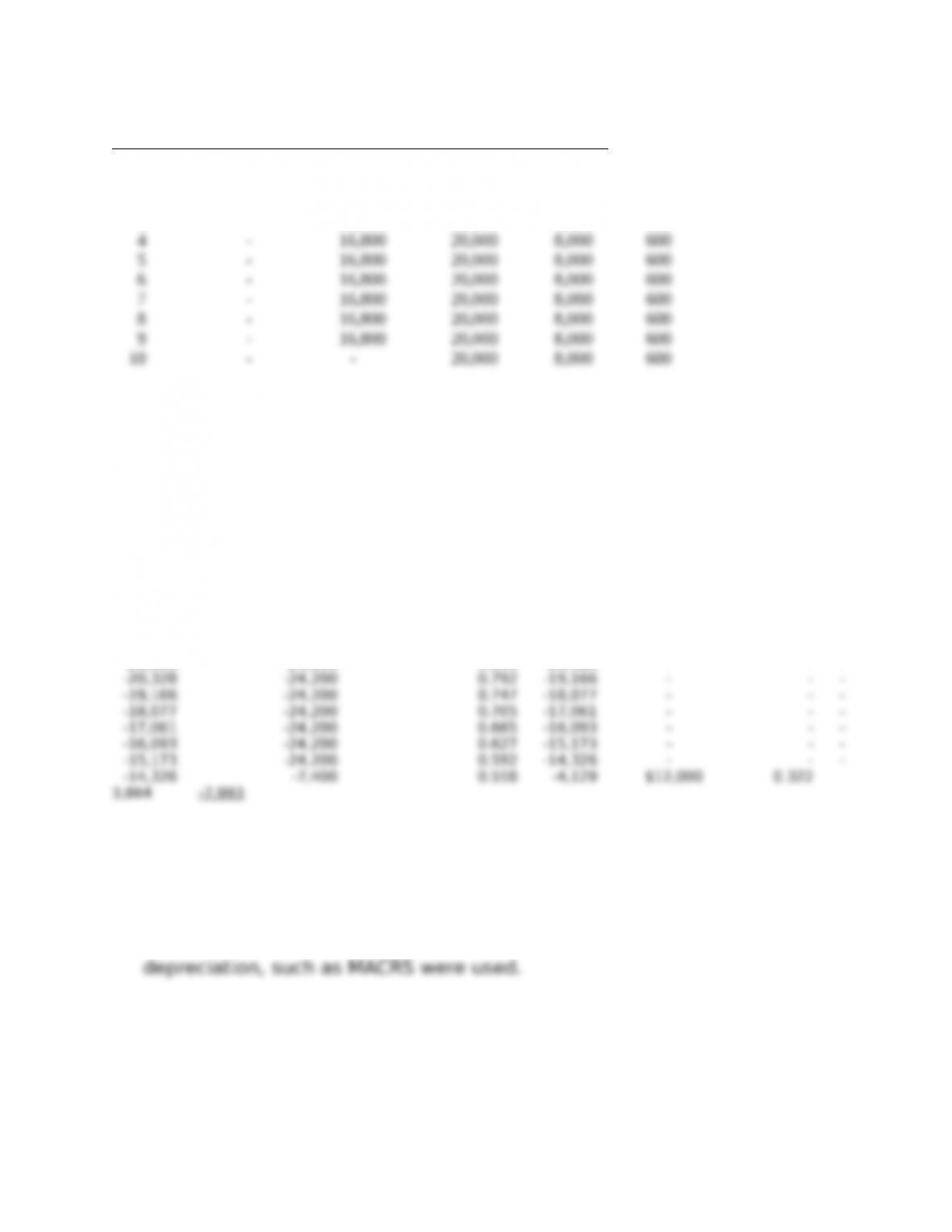
4. a.
________________________________________________________
(1) (2) (3) (4) (5) (6)
End of Installed Asset Lease Payment Depreciation Depreciation Additional Operating
Year Cost After-tax tax shield Costs if Owned
19-3
Chapter 19
Lease and Intermediate-Term Financing
After-tax
__________________________________________________________
0 $200,000 $16,800 – – –
1 – 16,800 $20,000 $8,000 $600
2 – 16,800 20,000 8,000 600
3 – 16,800 20,000 8,000 600
______________________________________________________
(7)=(2)-(3)-(5)+(6) (8) (9)=(7)x(8) (10) (11) (12)=(10)x(11) (13)=(9)-(12)
NAL Cash Flows Except PVIF@6% Present After–Tax PVIF Present Value NAL
Salvage Value Salvage @ 12% Salvage
________________________________________________________________________________
$183,200 1.000 $183,200 – – – $183,200
-24,200 0.943 -22,821 – – – –
22,821 -24,200 0.890 -21,538 – – –
-21,538 –24,200 0.840 -20,328 – – –
Net Advantage to Leasing = $10,624 (tables)
$10,603 (calculator)
b. The net advantage to leasing would be reduced if an accelerated form of
c. The leasing alternative is preferred because the NAL is positive.
19-3
Chapter 19
Lease and Intermediate-Term Financing
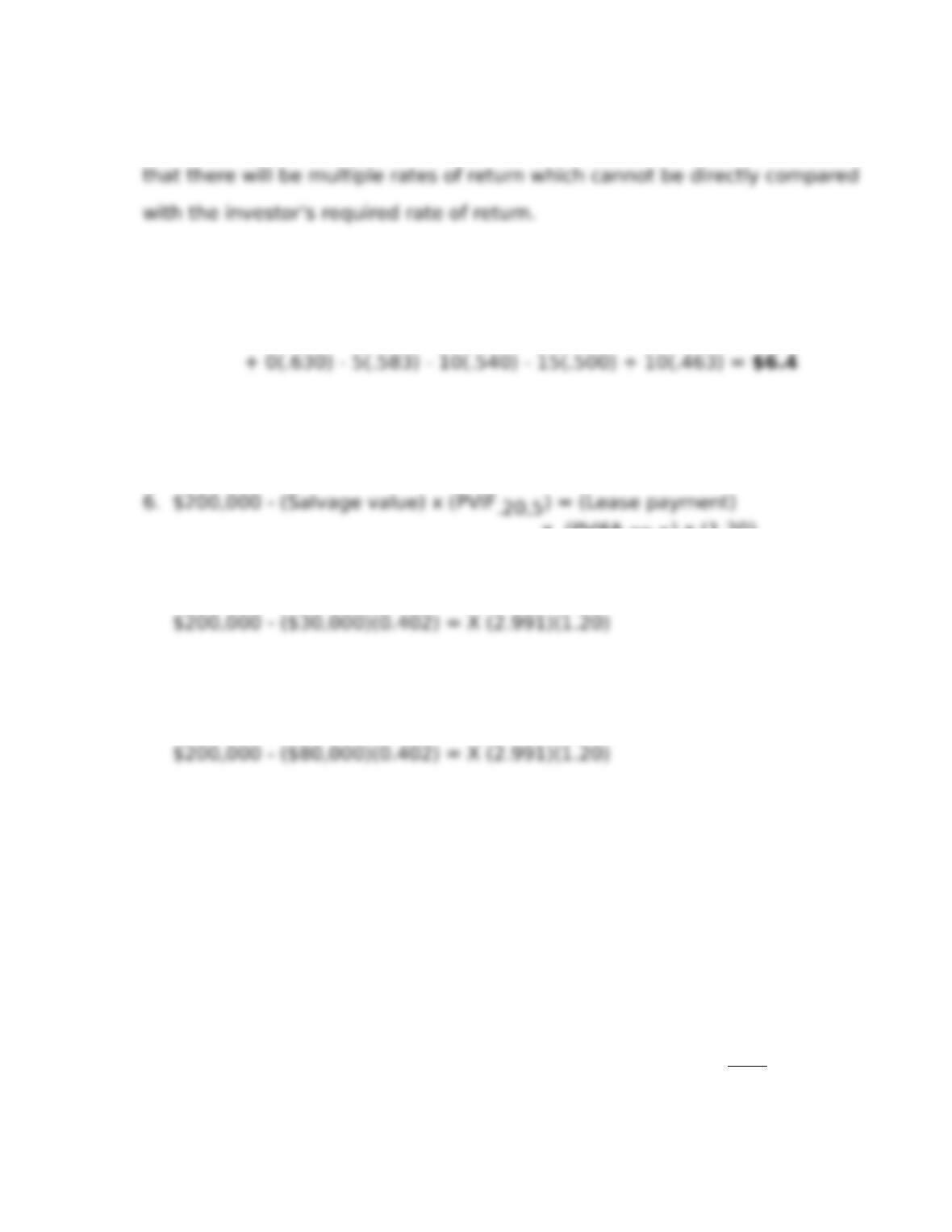
5. a. Because this stream of cash 5ows has 3 sign changes, it is possible
b. Net present value at 8%:
NPV = -50 + 30(.926) + 20(.857) + 15(.794) + 10(.735) + 5(.681)
Yes, at an 8% opportunity rate, the investment has a positive NPV.
x (PVIFA.20,5) x (1.20)
First Manufacturers:
Lease payment = X = $52,363
Commercial Associates:
Lease payment = X = $46,763
7.
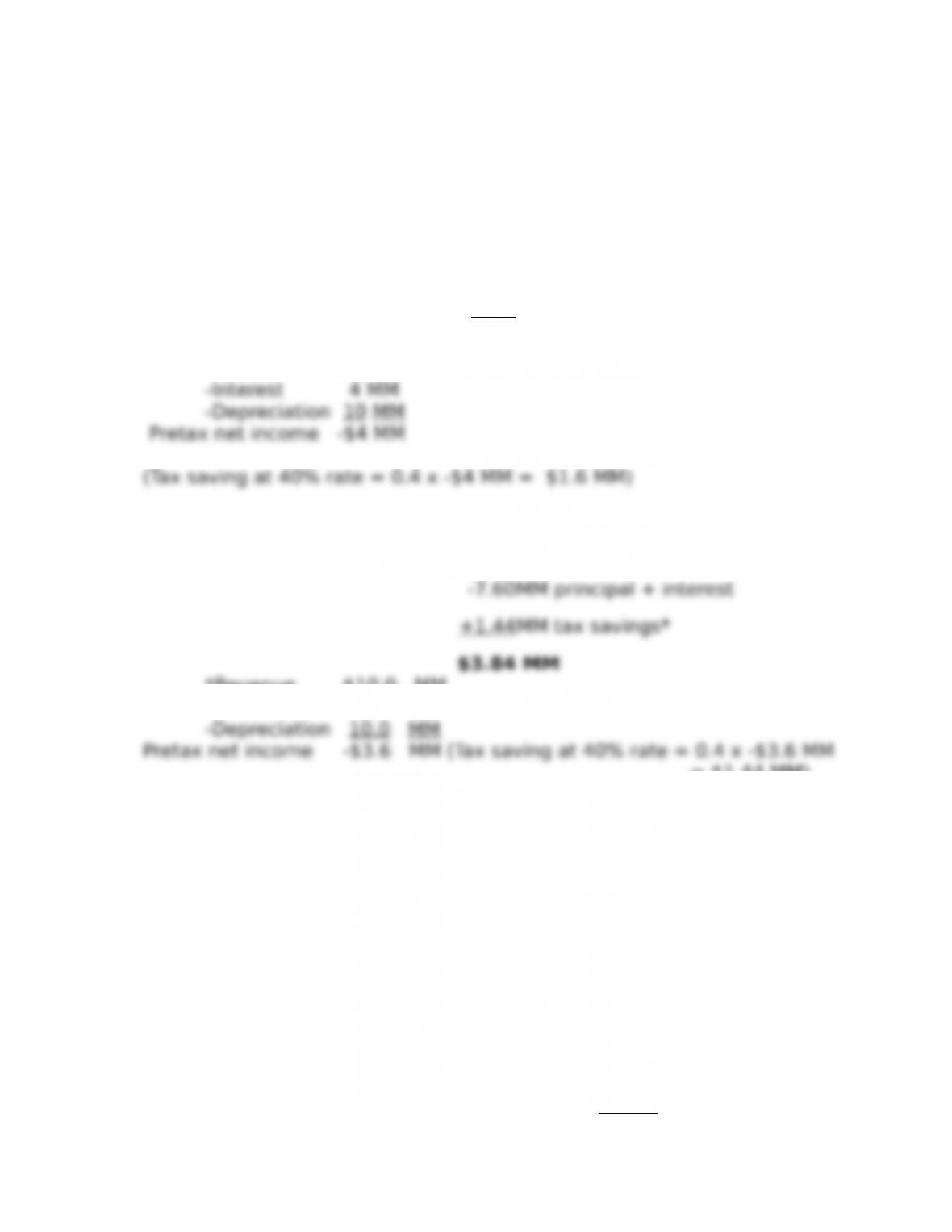
Cash outflow at time 0: -$50 MM asset cost
+40 MM loan
from pension fund -$10 MM cash
19-3
Chapter 19
Lease and Intermediate-Term Financing
out5ow
Cash in@ow at time 1: $10 MM lease payment
-8 MM principal +
interest
+1.6 MM tax savings*
$3.6 MM
*Revenue $10 MM
Cash in@ow at time 2: $10.00MM lease payment
*Revenue $10.0 MM
-Interest 3.6 MM
= $1.44 MM)
8. a.
_____________________________________________________________
(1) (2) (3) (4) (5) (6)
End of Installed Asset Lease Payment Depreciation* Depreciation Additional Operating
Year Cost After-tax tax shield Costs if Owned
After-tax
19-3
Chapter 19
Lease and Intermediate-Term Financing
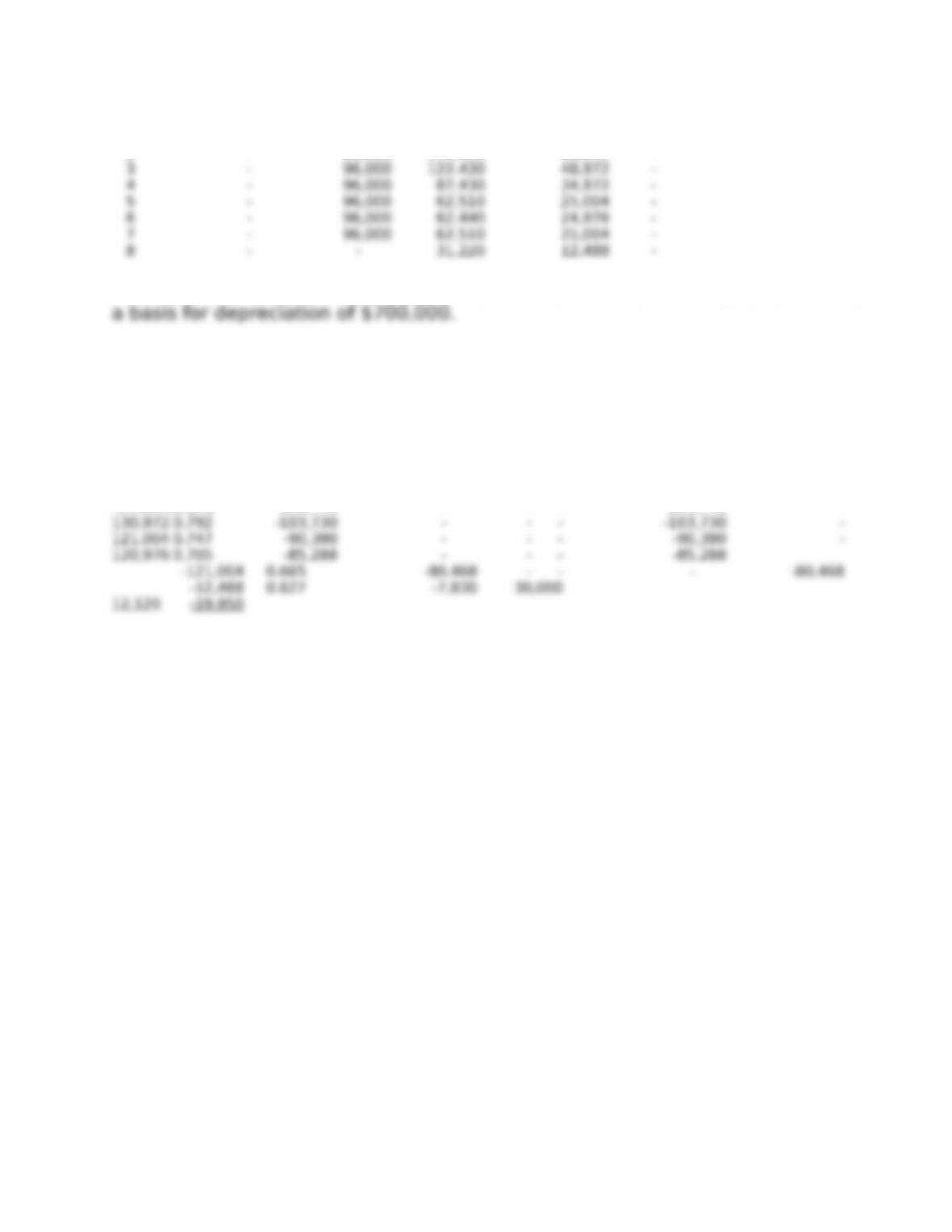
0 $700,000 $96,000 – – –
1 – 96,000 $100,030 $40,012 –
2 – 96,000 171,430 68,572 –
6 – 96,000 62,440 24,976 –
7 – 96,000 62,510 25,004 –
*Depreciation is computed using post-1986 MACRS rates for a 7- year asset and
(7)=(2)-(3)-(5)+(6) (8) (9)=(7)x(8) (10) (11) (12)=(10)x(11) (13)=(9)-(12)
NAL Cash Flows Except PVIF@6% Present After–Tax PVIF Present Value NAL
Salvage Value Salvage @ 12% Salvage
___________________________________________________________________________________________
$604,000 1.000 $604,000 – – – $604,000
-136,012 0.943 -128,259
– – -128,259 -164,572
-146,469 – – – -146,469
-144,9720.840 -121,776 – – – -121,776 –
Net Advantage to Leasing –$172,330
b. Based on the very large (relative to the cost of the asset) negative NAL, the
asset should be owned.
19-3