Chapter 18
The Management of Accounts Receivable and Inventories
CHAPTER 18
THE MANAGEMENT OF
ACCOUNTS RECEIVABLE
AND INVENTORIES
ANSWERS TO QUESTIONS:
1. The marginal returns associated with a more liberal extension of credit to the firm’s customers
are the increased sales and gross profits. The marginal costs are the additional costs of the funds
2. The major credit policy variables that the firm can use to control its level of receivables are:
a. credit standards –the criteria used by the firm in screening the credit worthiness of credit
b. credit terms –length of the credit period, the cash discount (if any) given for prompt payment,
c. collection effort –methods used by the firm in attempting to collect payments for past-due
3. a. average collection period –the average number of days between when a credit sale is made
b. bad-debt loss ratio –the proportion (or percentage) of total receivables volume that is never
c. aging of accounts –analysis of a company’s receivables by classifying the accounts into
4. Two reasons for offering seasonal datings to customers are
a. to enable retailers, who might be unable to finance an inventory buildup in advance of a
b. to reduce the firm’s inventory storage costs–these costs are transferred to the retailer by
5. a. The marginal costs are the increased costs (i.e., required return) on the higher level of
18-)
Chapter 18
The Management of Accounts Receivable and Inventories
b. The marginal costs are the increased cash discount costs. The marginal benefits are the
c. The marginal costs are the increased costs (i.e., required return) on the higher level of
d. The marginal costs are the additional collection expenditures. The marginal benefits are the
6. The three steps in evaluating individual credit applicants are
a. gathering relevant information on the credit applicant
7. The primary sources of information about the creditworthiness of the applicant are
a. financial statements supplied by the credit applicant
8. The “five Cs of credit” are:
a. character –the willingness on the part of the applicant to meet credit obligations
b. capacity –the ability (i.e., liquidity and cash generation) of the applicant to meet financial
obligations
9. The required rate of return enters the analysis whenever a change in credit or collection policies
increases or decreases the firm’s investment in receivables. An increase in receivables investment
10. The firm could attempt to reduce its average collection period by instituting more stringent credit
18-)
Chapter 18
The Management of Accounts Receivable and Inventories
11. The objective of the firm’s credit and collection policies is to maximize profits and not necessarily to
12. a. If the firm experiences a shortage of working capital, then it would need to reduce its
b. If the firm is operating at full production capacity, then it would need to take into account
c. If the firm’s profit margin increases, then it would want to consider relaxing its credit
d. If interest rates increase, then the firm would probably want to increase the required rate of
13. a. Holding large raw materials inventories allows the firm to take advantage of quantity discounts
b. Holding large work-in-process inventories gives each operation in the production cycle a
c. Holding large finished goods inventories minimizes lost sales and shipment delays due to
14. Carrying costs are all the costs of holding items in inventory for a given period of time. They
15. Ordering costs for items purchased from external sources include the costs of preparing the
purchase requisition, expediting the order, receiving and inspecting the shipment, and handling
16. a. The costs associated with a stockout in raw materials inventory include the costs incurred in
b. The costs associated with a stockout in work-in-process inventory include costs to reschedule
c. The costs associated with a stockout in finished goods inventory include the immediate
18-)
Chapter 18
The Management of Accounts Receivable and Inventories
17. The ABC inventory classification method consists of dividing inventory items into three
groups—those with a relatively large dollar value but a small percentage of the total items,
18. Assumptions underlying the basic EOQ model:
a. Annual demand is known with certainty and is stationary or uniform throughout the
year
b. Orders to replenish inventory are filled instantaneously (i.e., zero lead time)
19. a. Constant (non-zero)
replenishment lead time known with certainty – under this condition, the
optimal order quantity is not affected. The only change is that orders should be
b. Demand and replenishment lead time are subject to uncertainty – under this
20. The required rate of return affects inventory carrying costs since an increase (decrease)
in
the required rate of return increases (decreases) inventory carrying costs per unit. An increase
21. Just-in-time inventory models are based on the concept that required inventory items are
22. a. A stockout is the chance of not having inventory on hand when it is needed.
b. A deterministic inventory control model assumes that demand and lead times are know
18-)

Chapter 18
The Management of Accounts Receivable and Inventories
c. A probabilistic inventory control model assumes that demand, lead time, or both are
a. Safety stock is additional inventory that is carried to meet unexpectedly high demand
18-)
Chapter 18
The Management of Accounts Receivable and Inventories
SOLUTIONS TO PROBLEMS:
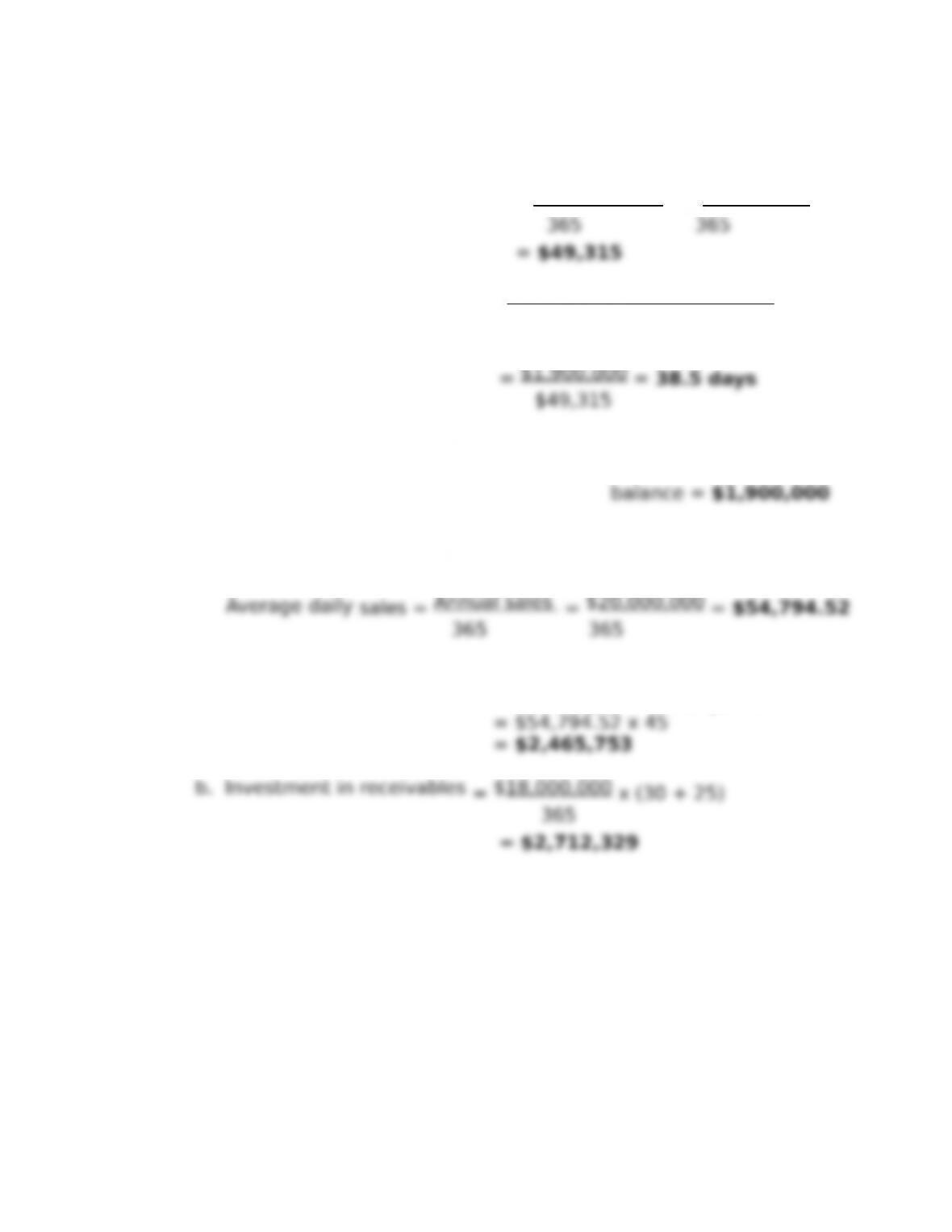
1. a. Average daily credit sales = Annual sales = $18,000,000
b. Average collection period = Accounts receivable balance
Average daily credit sales
c. Average investment in receivables = Average receivables
2. a. Average collection period = 30 + 15 = 45 days.
Investment in receivables = Average daily sales
x average collection period
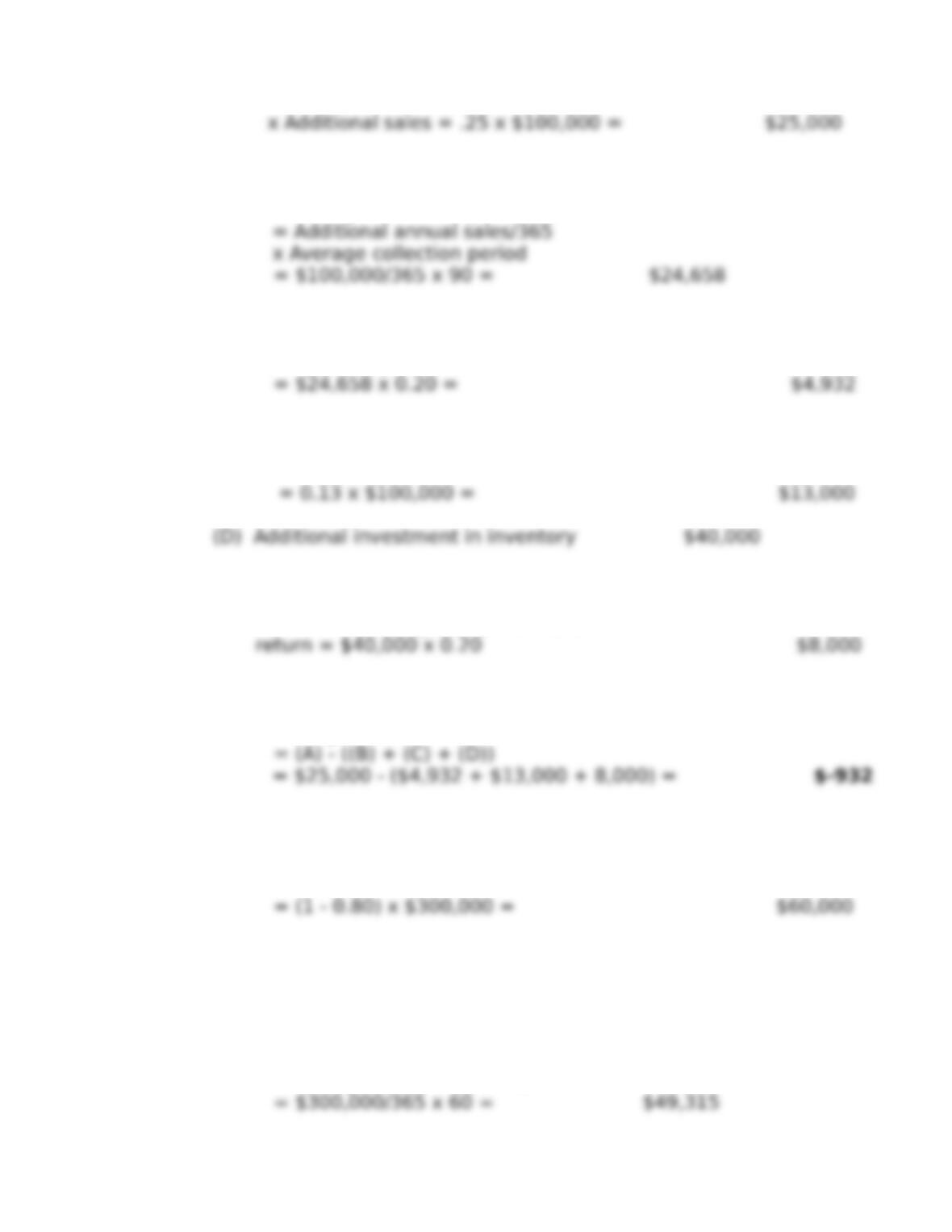
3. (A) Additional sales $100,000
Marginal pro)tability of additional sales
= Pro)t contribution ratio
18-)
Chapter 18
The Management of Accounts Receivable and Inventories
(B) Additional investment in receivables
= Additional average daily sales
x Average collection period
Cost of the additional investment in receivables
= Additional investment in receivables
x Required pre-tax rate of return
(C) Additional bad-debt loss
= Bad debt loss ratio
x Additional sales
Cost of additional investment in
inventory = Additional investment
in inventory x Required pretax rate of
(E) Net change in pre-tax pro)ts
= Marginal returns
– Marginal costs
4. (A) Additional sales $300,000
Marginal pro)tability of additional sales
= Pro)t contribution ratio
x Additional sales
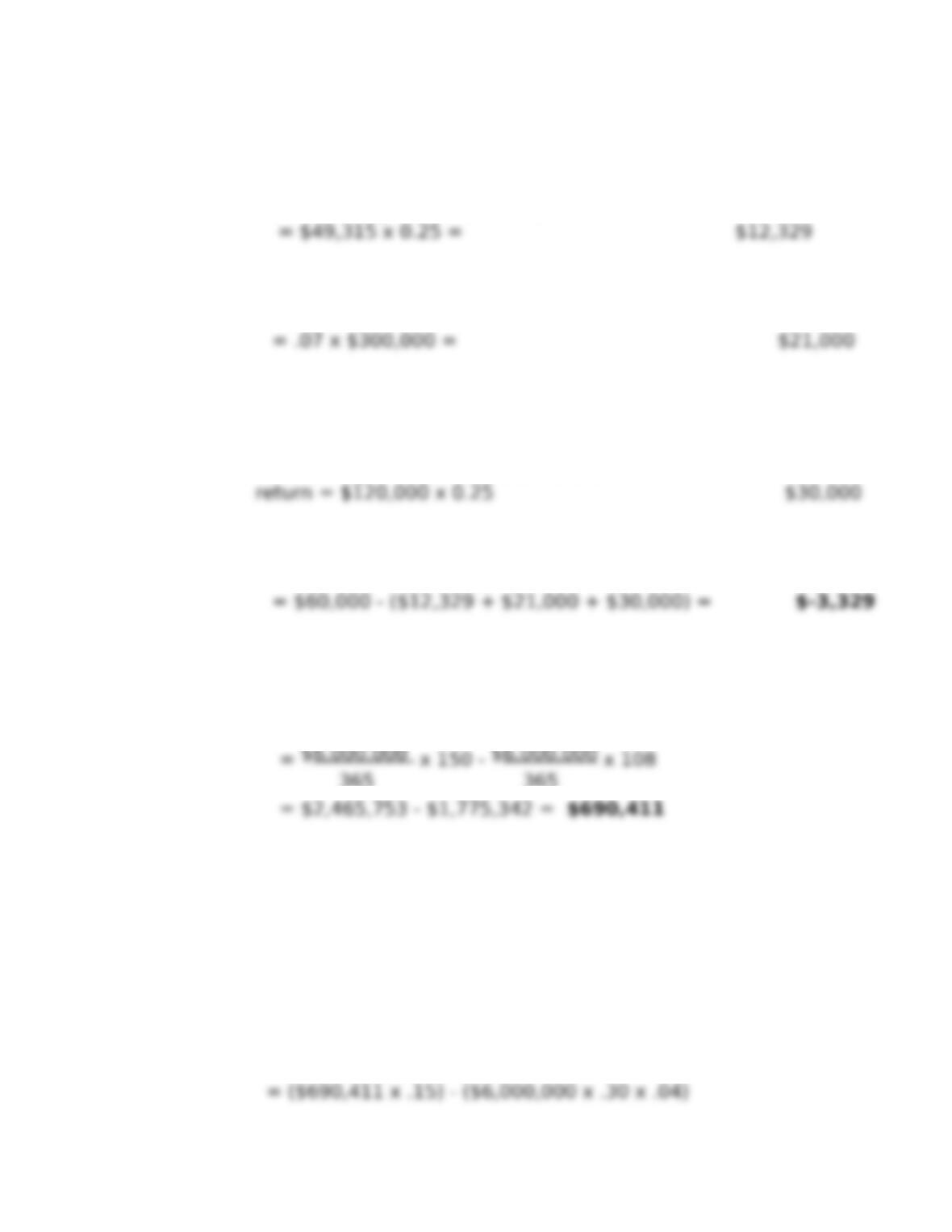
(B) Additional investment in receivables
= Additional average daily sales
x Average collection period
= Additional annual sales/365
x Average collection period
18-)
Chapter 18
The Management of Accounts Receivable and Inventories
Cost of the additional investment in receivables
= Additional investment in receivables
x Required pre-tax rate of return
(C) Additional bad-debt loss ratio
= Bad debt loss ratio
x Additional sales
(D) Additional investment in inventory $120,000
Cost of additional investment in
inventory = Additional investment
in inventory x Required pretax rate of
(E) Net change in pre-tax pro)ts
= Marginal returns – Marginal costs
= (A) – ((B) + (C) + (D))
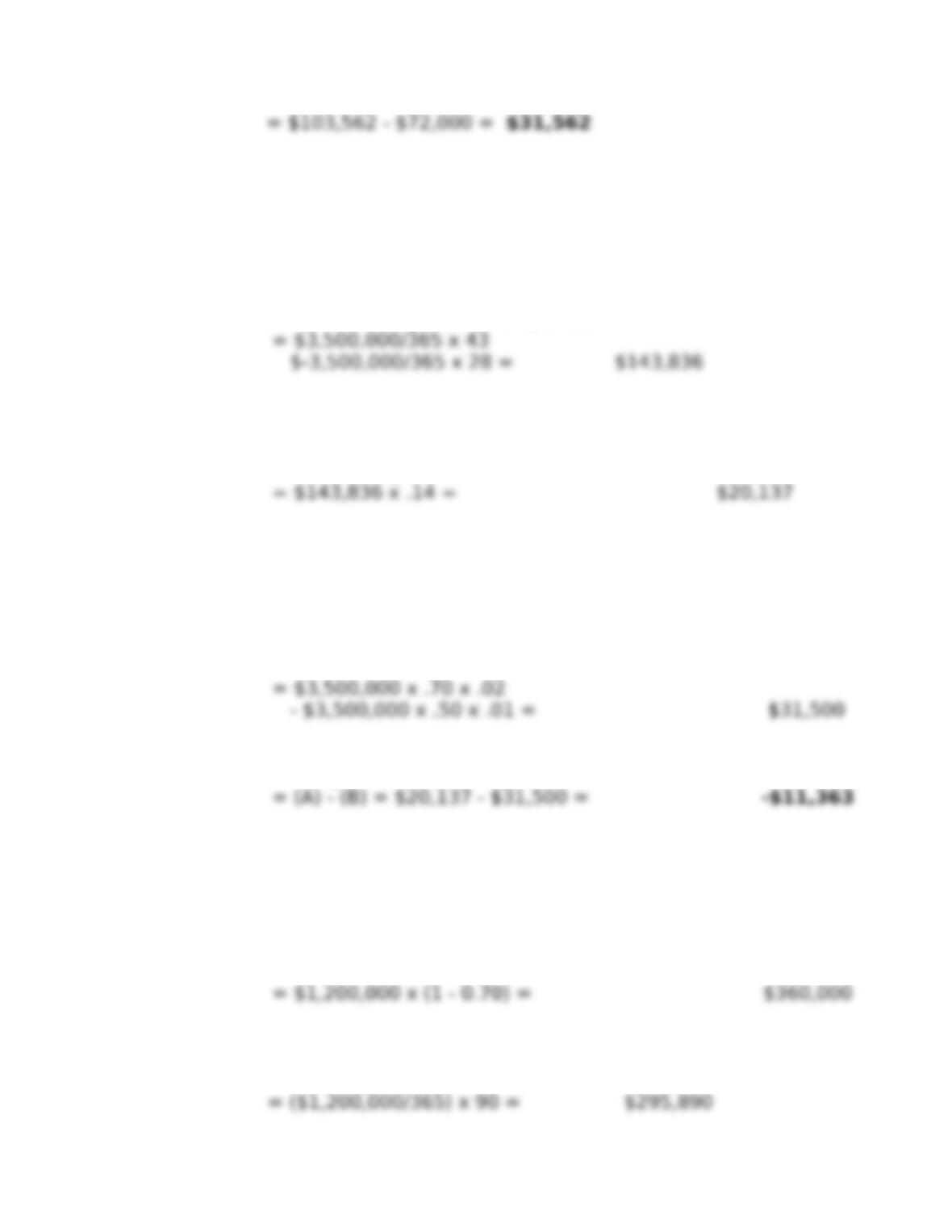
5. a. Reduction in A/R = Old average A/R balance
– New average A/R balance
= (Annual sales/365) x Old average
collection period – (Annual sales/365)
x New average collection period
365 365
b. Net change in pre-tax pro)ts
= Earnings on released funds
– Cost of cash discounts
= Reduction in A/R x Required rate
of return – Annual sales
x Percent taking discount
x Percent cash discount
18-)
Chapter 18
The Management of Accounts Receivable and Inventories
6. a. (A) Decrease in average receivables balance
= Present average balance
– New average balance
= Annual sales/365
x Present average collection period
– Annual sales/365
x New average collection period
Earnings on the funds released by the
decrease in receivables
= Decrease in receivables
x required pre-tax rate of return
b. (B) Cost of additional cash discounts
= New cash discounts
– Present cash discounts
= Annual sales x percent taking new discount
x New percent discount
– Annual sales x percent taking present discount
x Present percent discount
c. (C) Net change in pre-tax pro)ts
= Marginal returns – Marginal costs
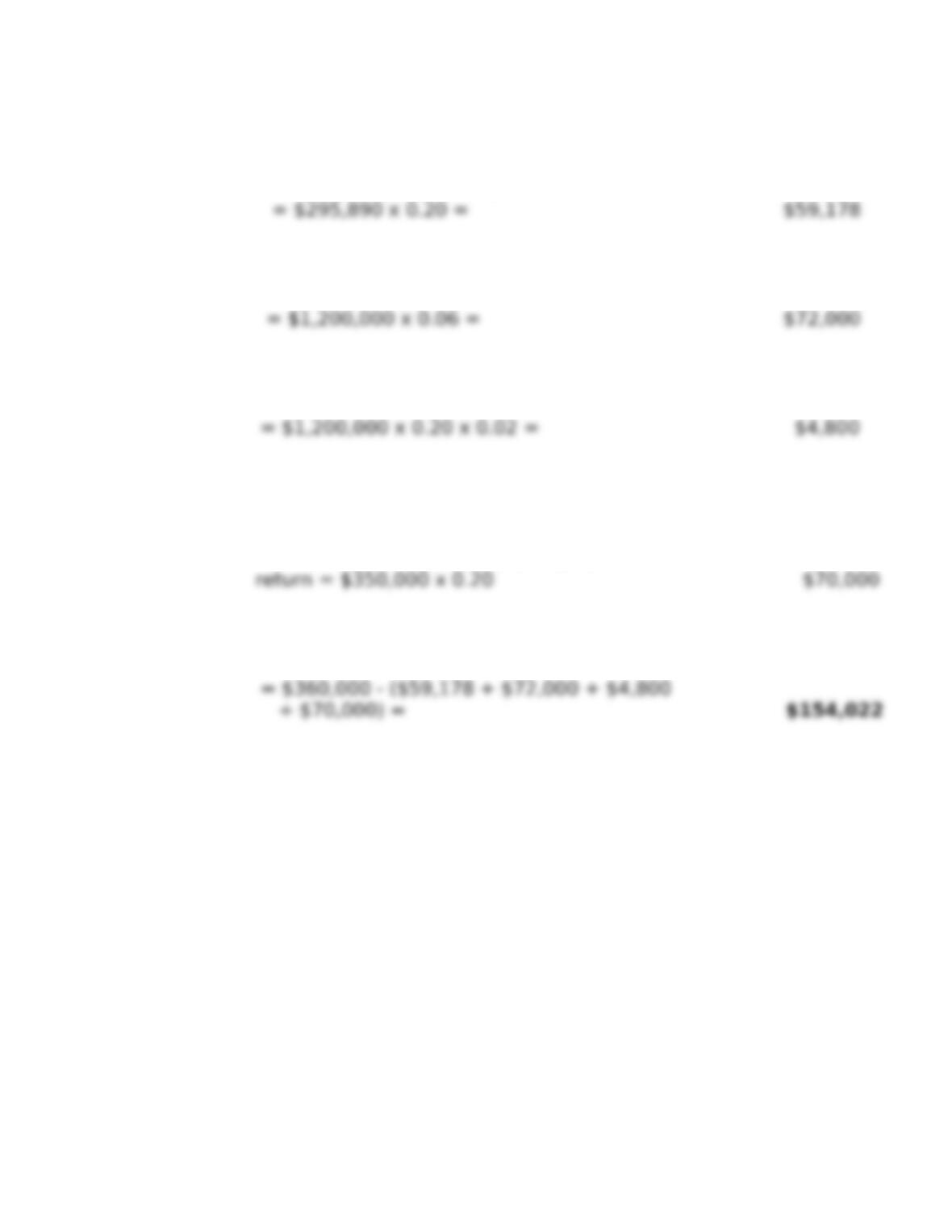
7. (A) Additional sales $1,200,000
Marginal pro)tability of additional sales
= Additional sales
x Pro)t contribution ratio
(B) Additional investment in receivables
= (Additional annual sales/365)
x Average collection period
18-)
Chapter 18
The Management of Accounts Receivable and Inventories
Cost of additional investment in receivables
= Additional investment in receivables
x Required rate of return
(C) Additional bad-debt loss
= Additional sales
x Bad-debt loss ratio
(D) Additional cash discounts
= Additional sales x Percent taking discount
x Cash discount percent
(E) Additional investment in inventory $350,000
Cost of additional investment in
inventory = Additional investment
in inventory x Required pretax rate of
(F) Net change in pre-tax pro)ts
= Marginal returns – Marginal costs
= (A) – ((B) + (C) + (D) + (E))
18-)