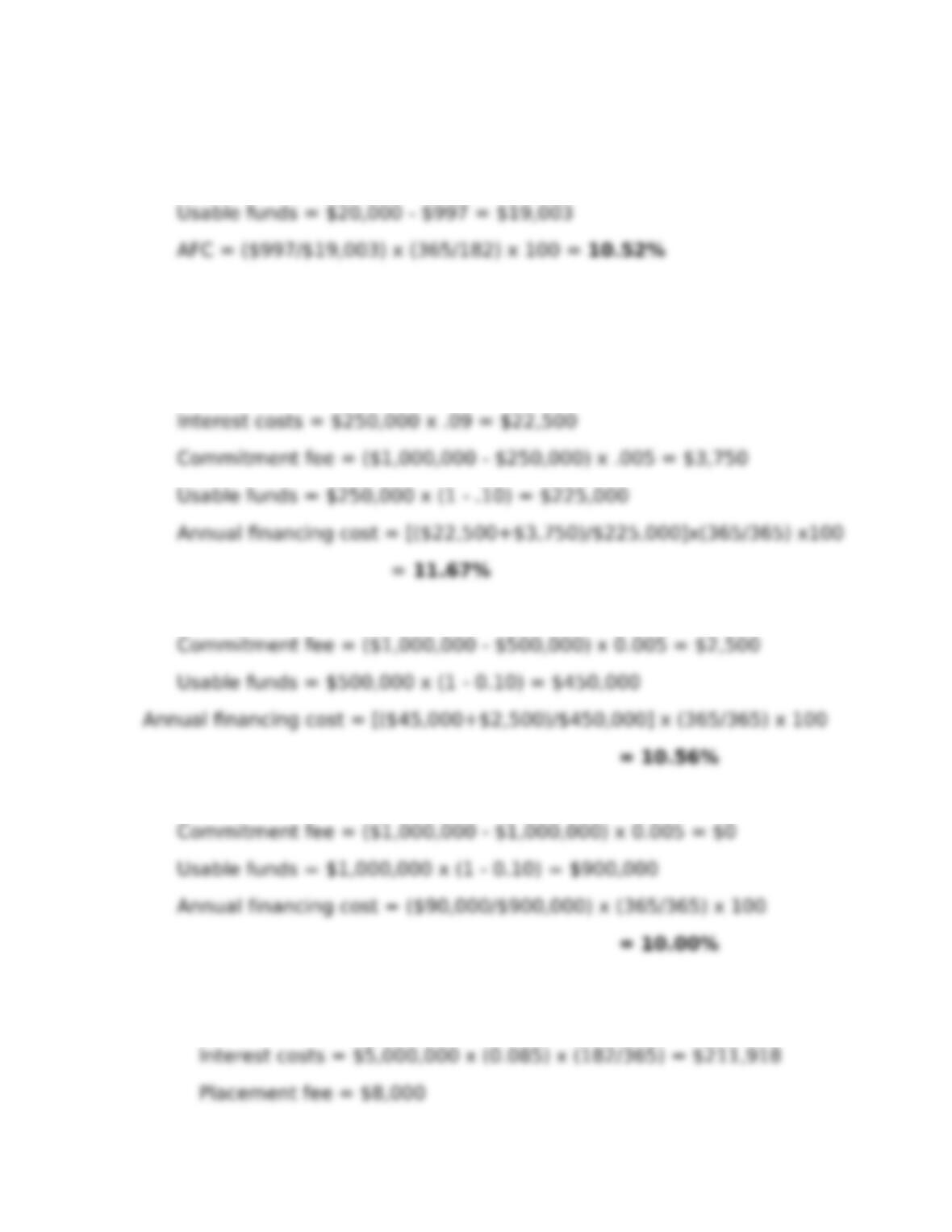
20. Interest costs = $20,000 x 0.10 x 182/365 = $997.26
21. Assume a 365-day borrowing period
a. Annual ,nancing cost = (Interest costs + Commitment fee)/
(Usable funds) x (365/number of days) x 100
b. Interest costs = $500,000 x 0.09 = $45,000
c. Interest costs = $1,000,000 x 0.09 = $90,000
22. Annual ,nancing cost = [(Interest costs + Placement fee)/(Usable
funds)] x (365/number of days) x 100
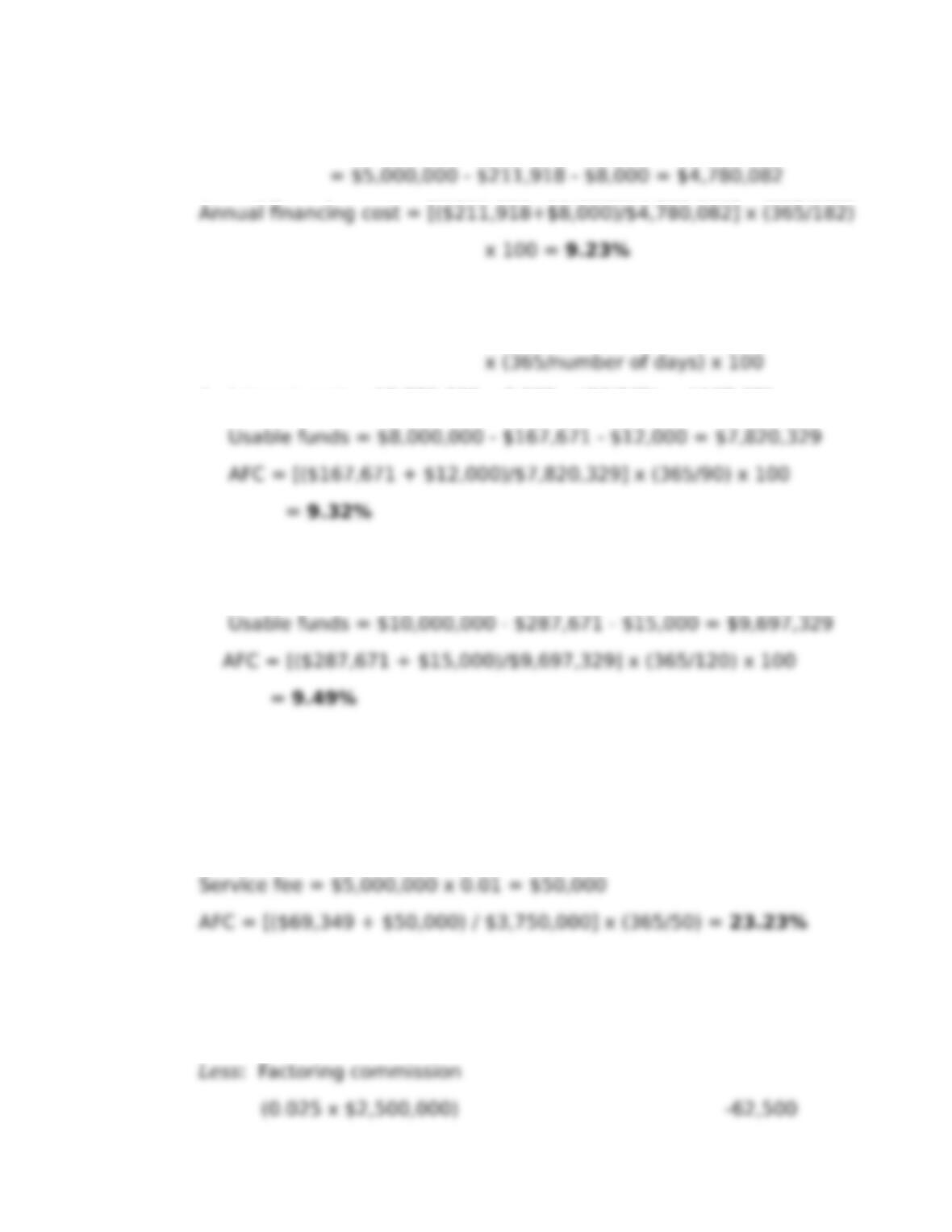
Usable funds = Amount of C.P. issue – Interest – Placement fee
23. Annual ,nancing cost = [(Interest costs + Fees)/(Usable funds)]
A: Interest cost = $8,000,000 x 0.085 x (90/365) = $167,671
B: Interest cost = $10,000,000 x 0.0875 x (120/365) = $287,671
Therefore, choose dealer A.
24. Usable funds (pledged receivables) = 0.75 x $5,000,000 = $3,750,000
Interest costs = $3,750,000 x 0.135 x (50/365) = $69,349
25. Calculation of usable funds:
Average level of receivables $2,500,000
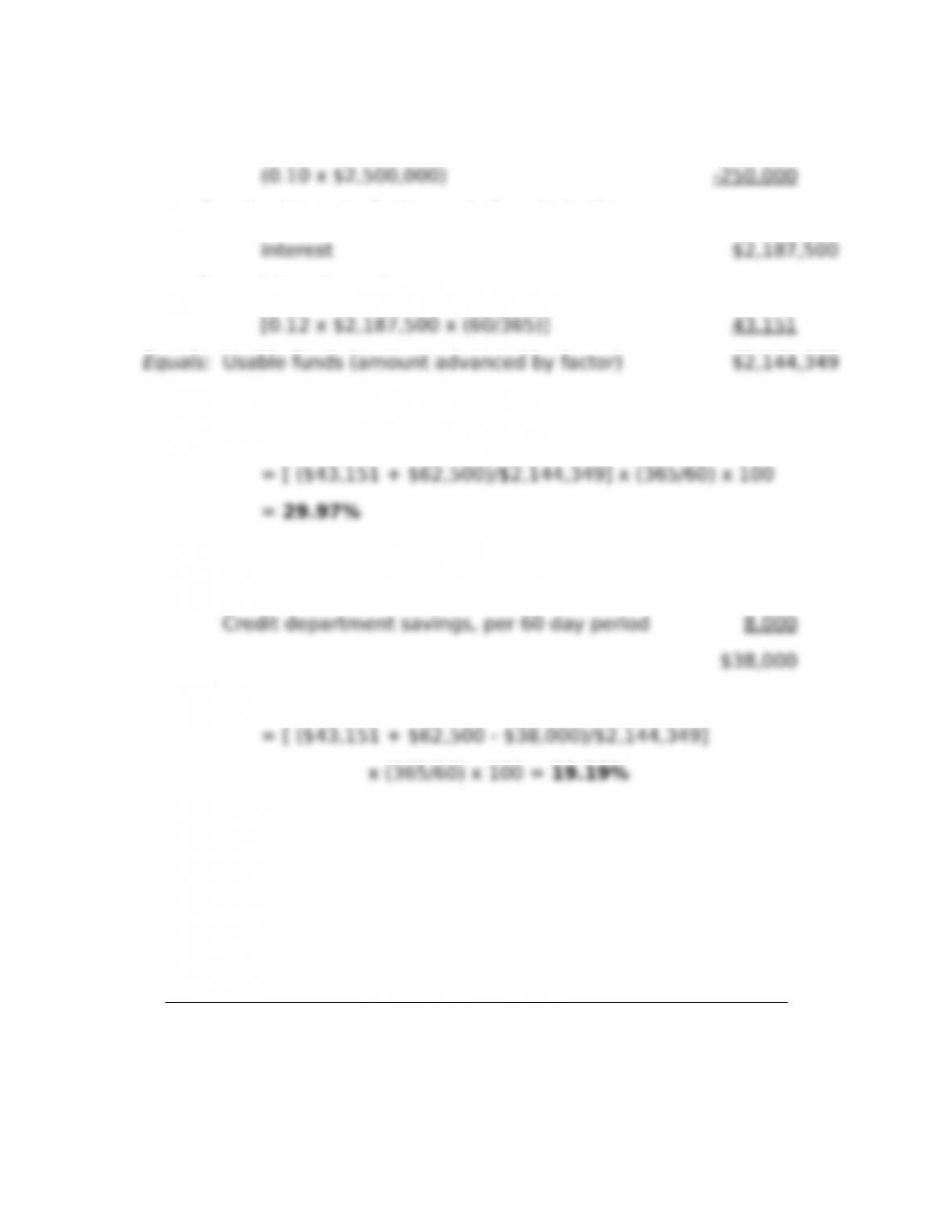
Less: Reserve for returns
Equals: Amount of advance before deducting
Less: Interest on advance
a. AFC (before cost savings and bad-debt loss savings):
b. Average bad-debt losses per 60-day period $30,000
AFC (after cost savings and bad-debt loss savings):
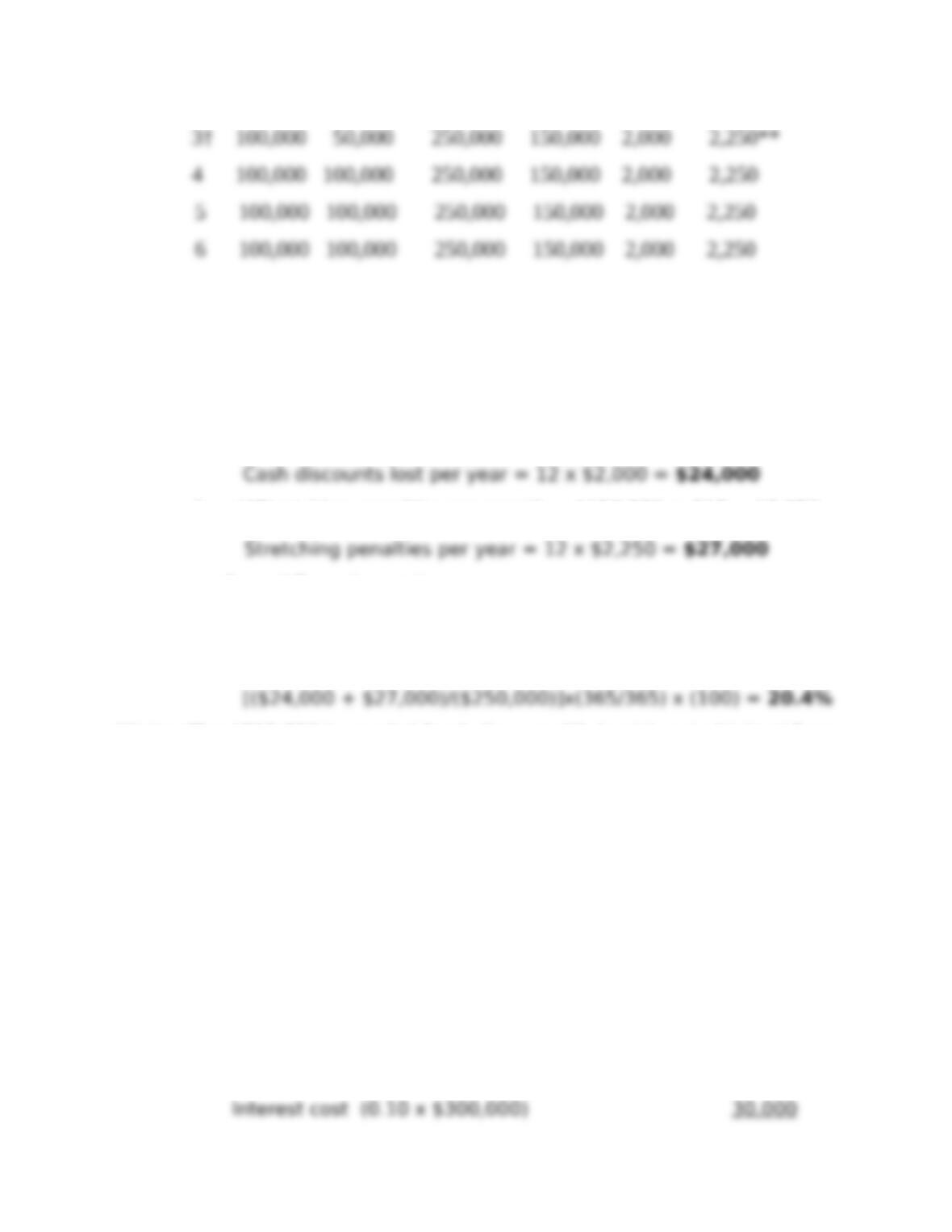
26. Pay- Balance Amount Lost Stretching
Month Purchases ments Due Past-due Discount Penalties
1 $100,000 $0 $100,000 $0 $2,000* —
2 100,000 0 200,000 100,000 2,000 $1,500

. . . . . . .
. . . . . . .
. . . . . .
a. *Cash discounts lost per month = .02 x $100,000 = $2,000
b. **Stretching penalties per month = $150,000 x .015 = $2,250
c. Annual ,nancing cost =
[(Lost discounts + Stretching penalties)/
Funds raised from stretching A/P] x (365/# of days) x 100 =
† Note: The $250,000 in needed funds (i.e., equilibrium) is not obtained from
stretching payables until the third month.
27. Alternative (c) is preferred since it o?ers the greatest discount (2%) and
the longest deferral period in those cases where the discount is not taken.
28. a. Field warehousing fee $16,000
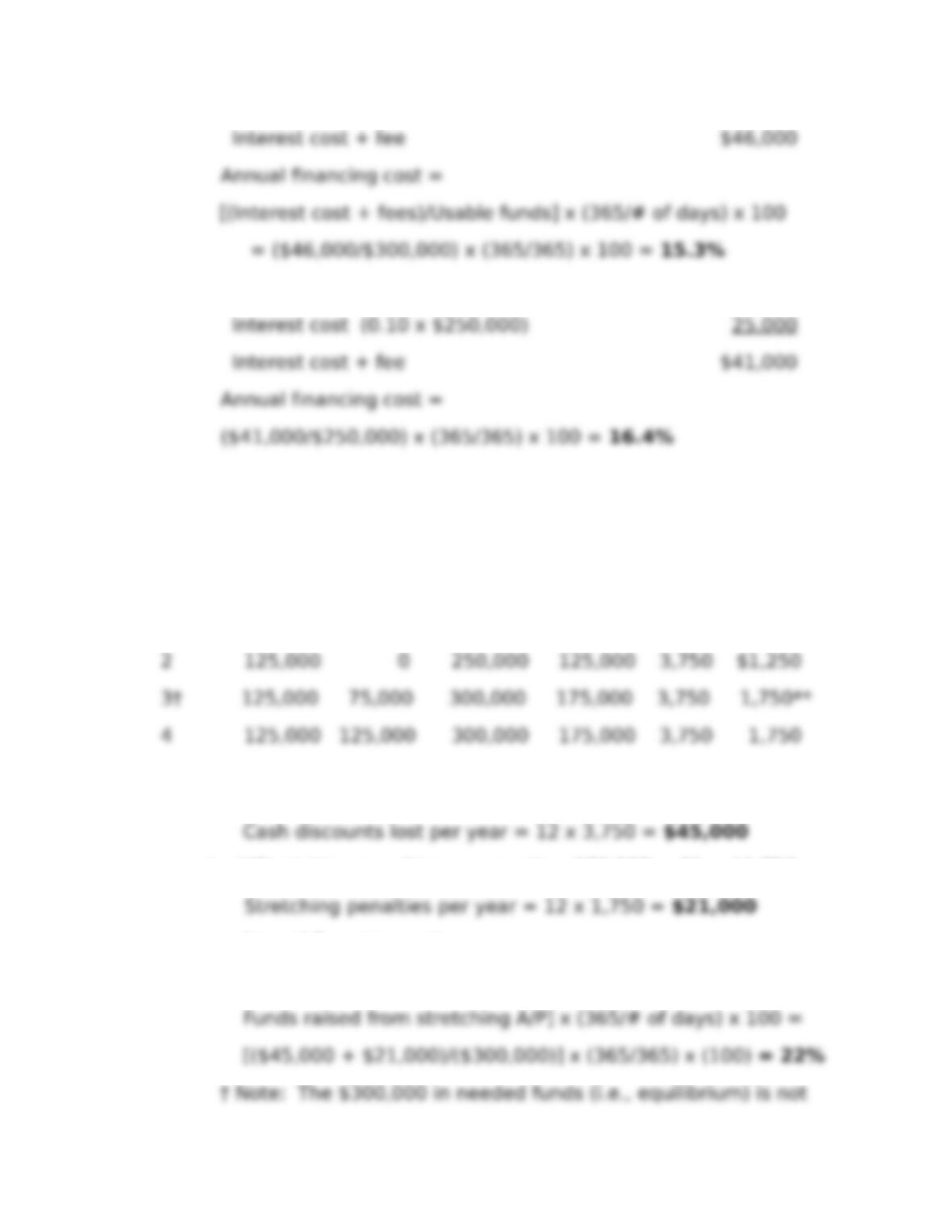

b. Field warehousing fee $16,000
29. Pay- Balance Amount Lost Stretching
Month Purchases ments Due Past-due Discount Penalties
1 $125,000 $0 $125,000 $0 $3,750* —
a. *Cash discounts lost per month = .03 x 125,000 = $3,750
b. **Stretching penalties per month = 175,000 x .01 = $1,750
c. Annual ,nancing cost =
[(Lost discounts + Stretching penalties)/
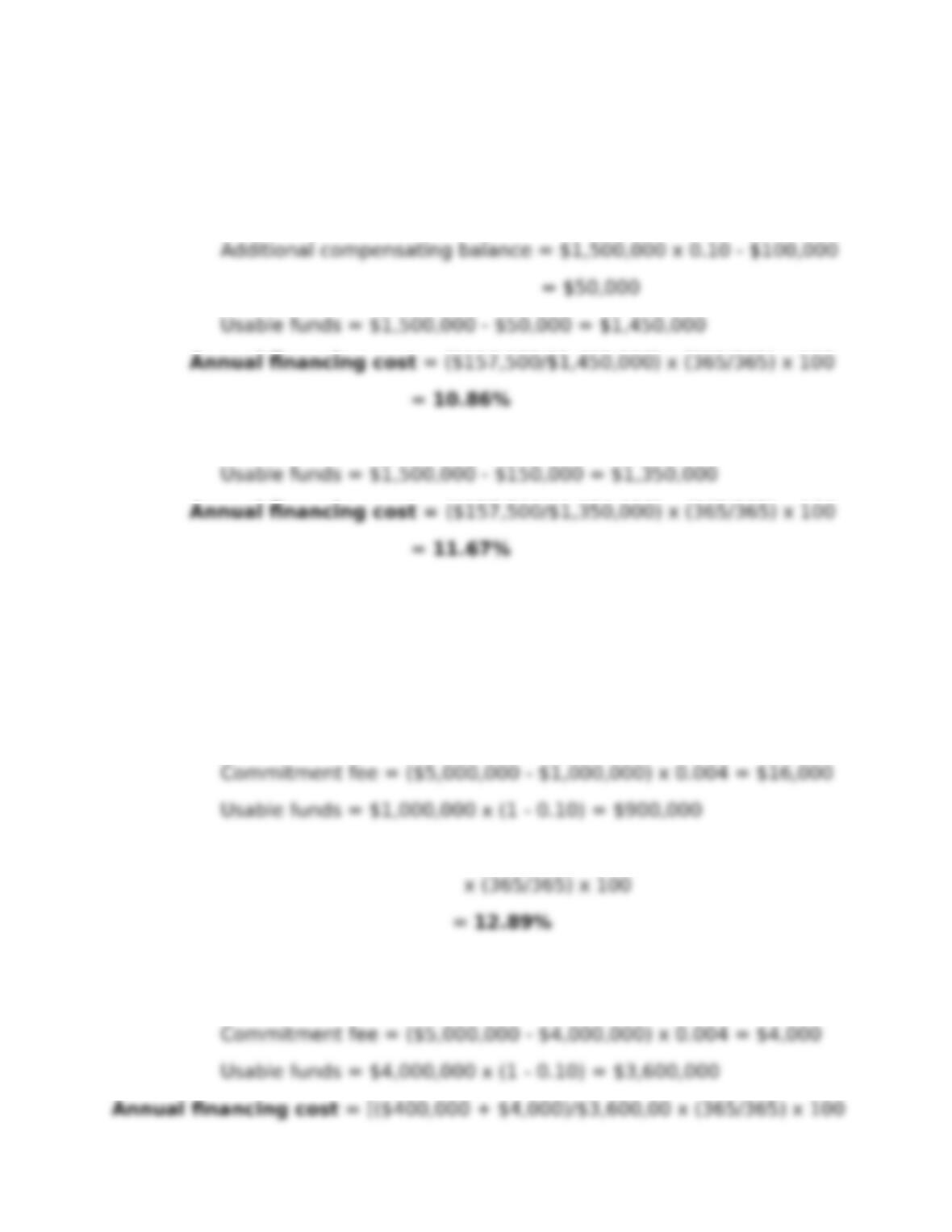
obtained from stretching payables until the third month.
30. a. Interest costs = $1,500,000 x 0.105 = $157,500
b. Additional compensating balance = $1,500,000 x 0.10 = $150,000
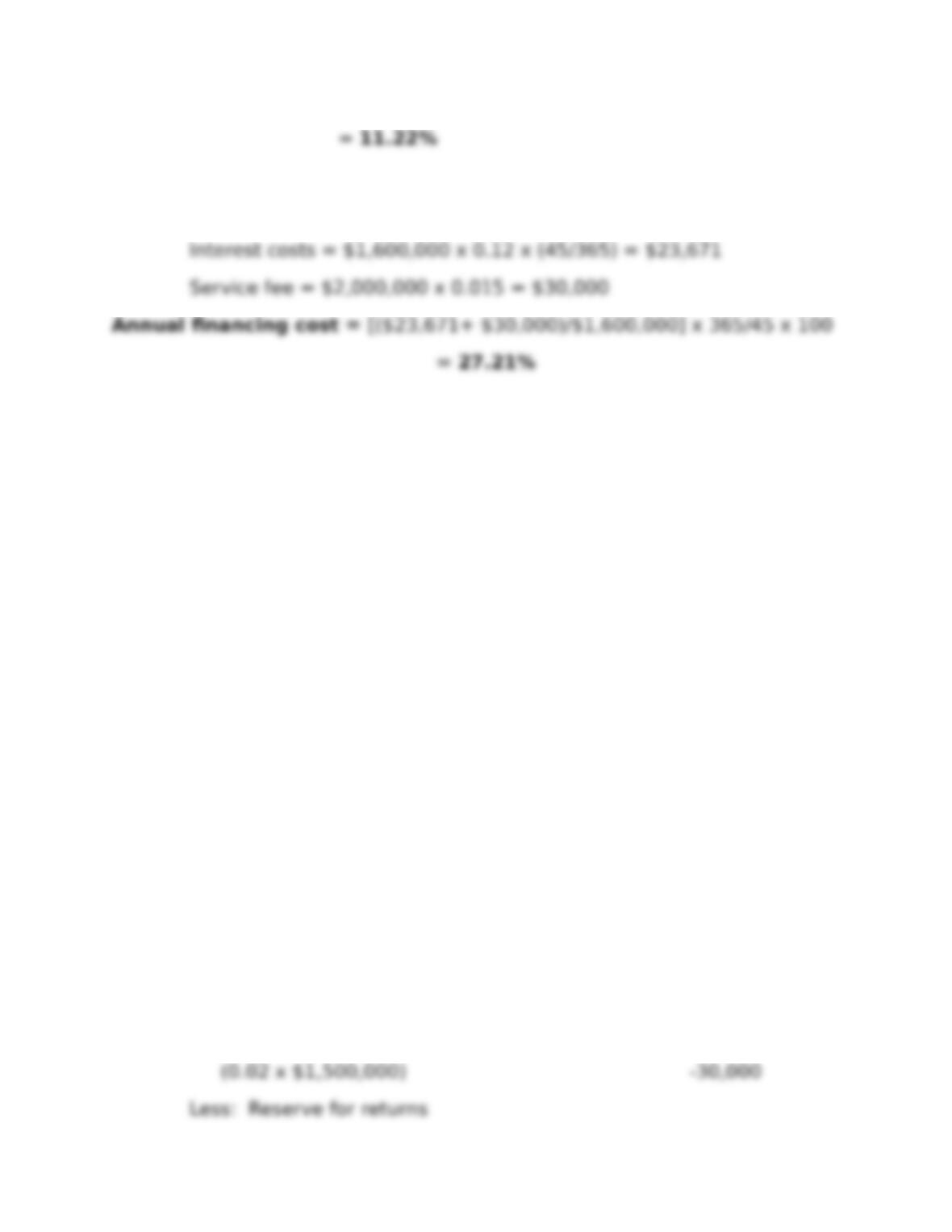
31. a. Annual ,nancing cost = [(Interest costs + Commitment fee)/(Usable
funds)] x
(365/number of days) x 100
Interest costs = $1,000,000 x 0.10 = $100,000
Annual financing cost = [($100,000 + $16,000)/$900,000]
b. Interest costs = $4,000,000 x 0.10 = $400,000
32. Usable funds = 0.8 x $2,000,000 = $1,600,000
33. Calculation of usable funds:
Average level of receivables $1,500,000
Less: Factoring commission
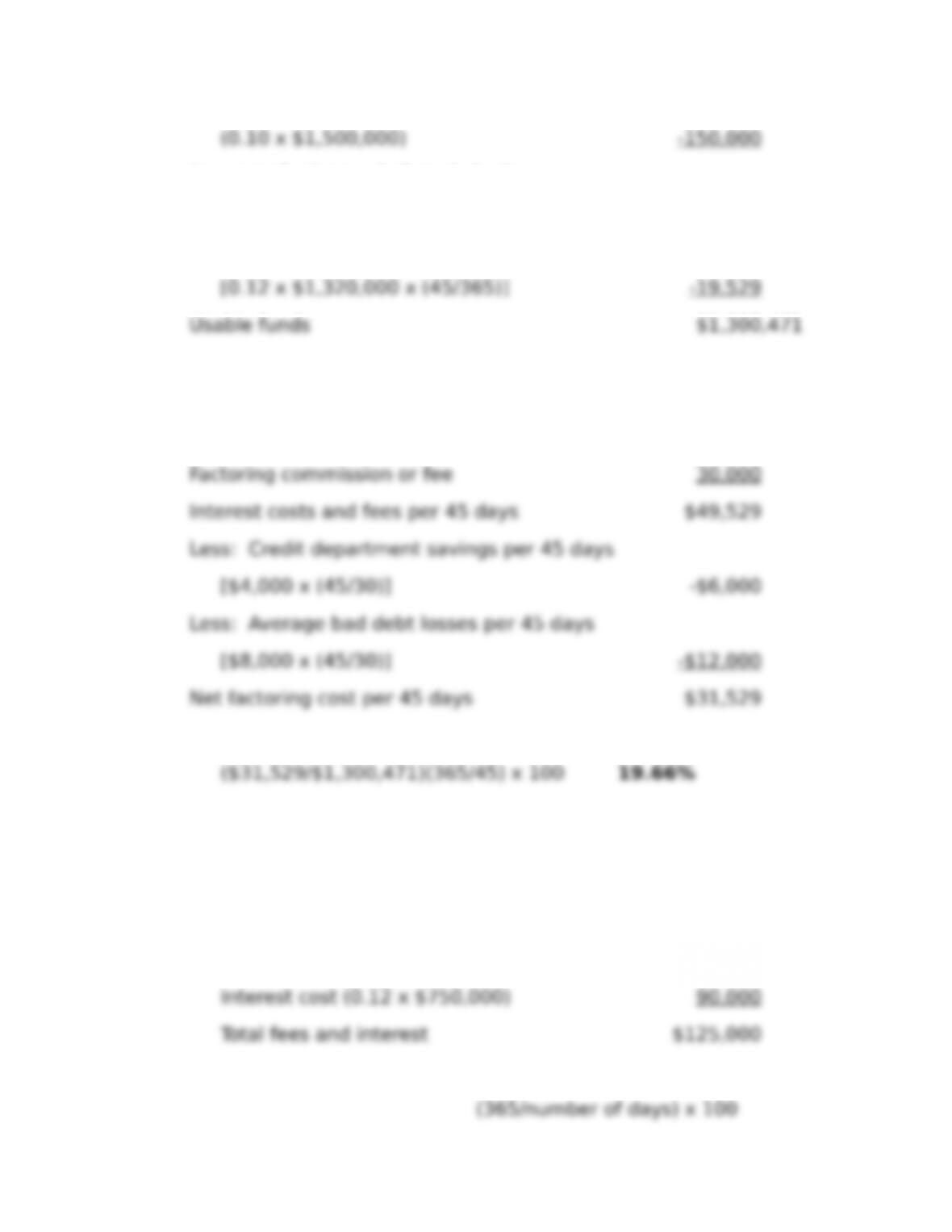

Amount of advance before deducting
interest $1,320,000
Less: Interest on advance
Calculation of net factoring cost:
Interest costs $19,529
Annual financing cost
34. a. Field warehousing fee $35,000
Annual financing cost = [(Fees + Interest cost)/Usable funds] x
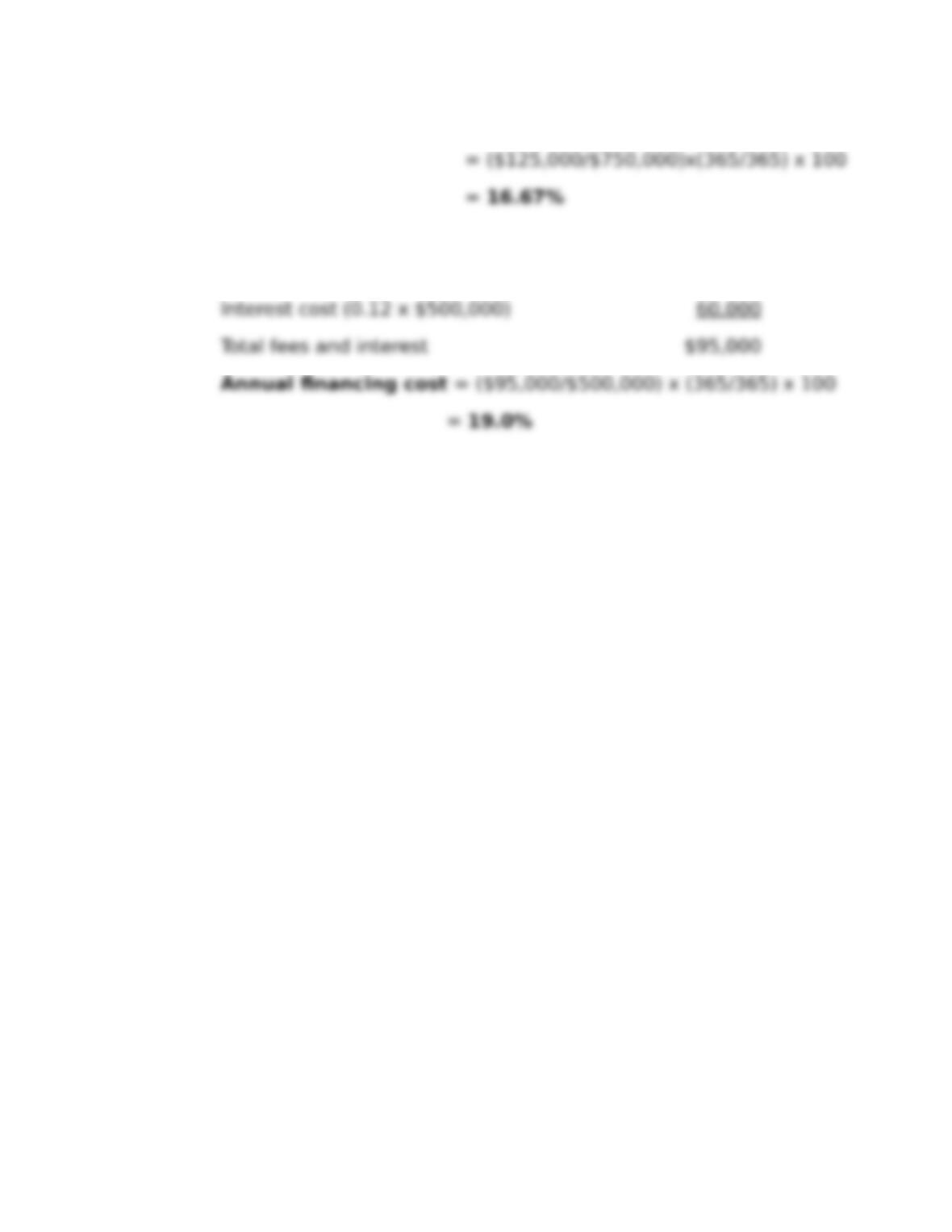

b. Field warehousing fee $35,000

SOLUTION TO INTEGRATIVE CASE PROBLEM:
WORKING CAPITAL MANAGEMENT
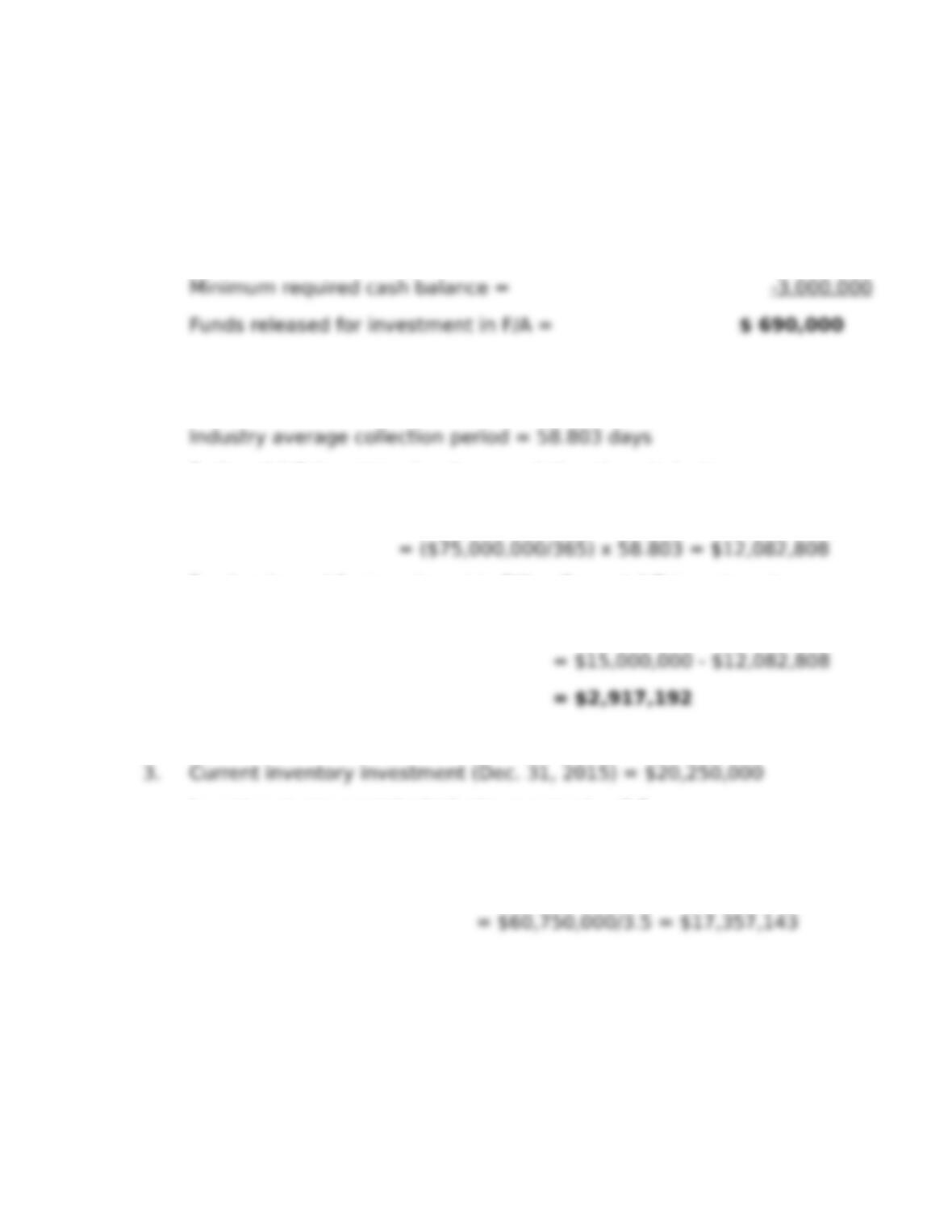
1. Current cash balance (Dec. 31, 2015) = $3,690,000
2. Current A/R investment (Dec. 31, 2015) = $15,000,000
Reduced A/R investment = Average daily sales x Industry average
collection period
Funds released for investment in F/A = Current A/R investment
– Reduced A/R investment
Inventory turnover ratio (industry average) = 3.5
Reduced inventory investment = Cost of goods sold/Inventory
turnover ratio
Funds released for investment in F/A = Current inventory investment
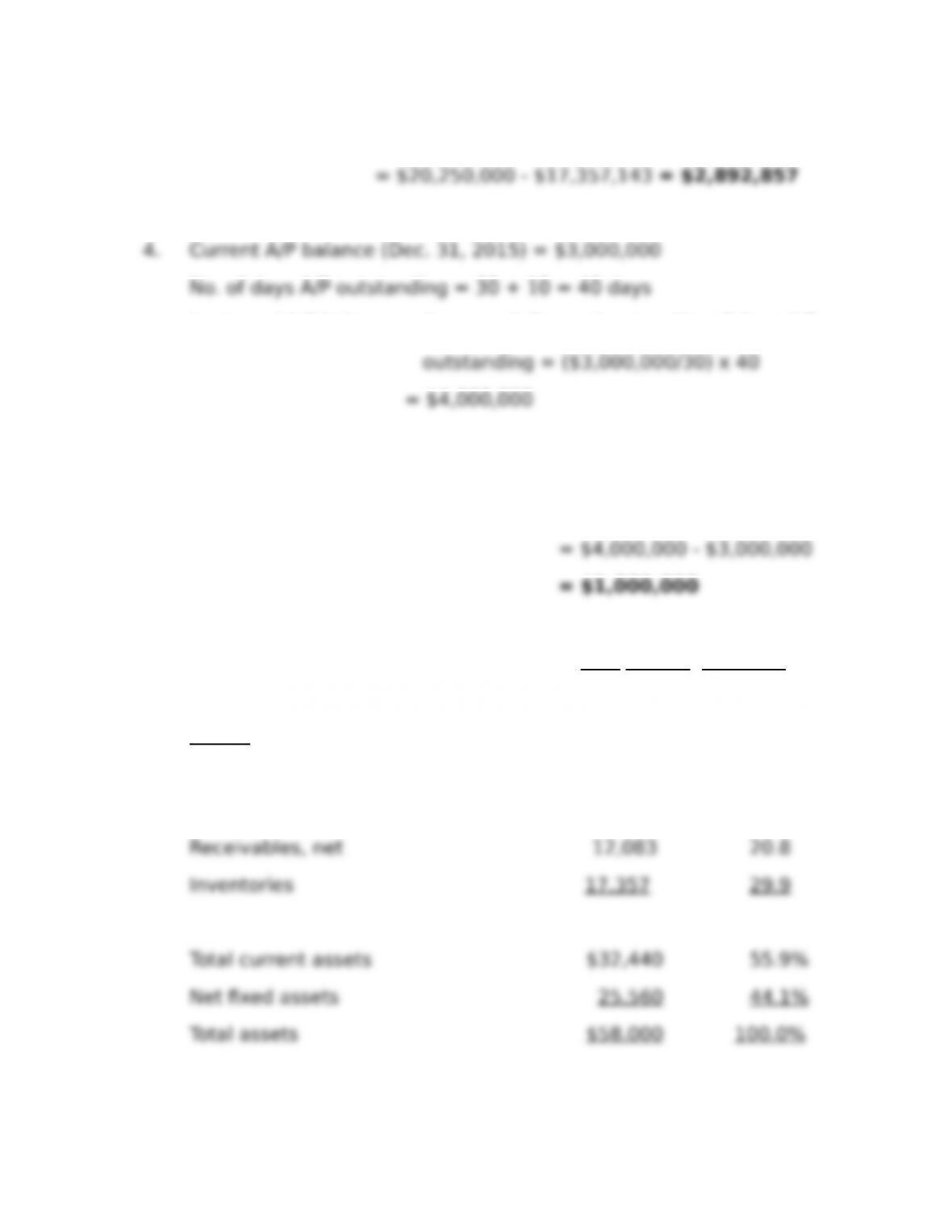
– Reduced inventory investment
Increased A/P balance = Average daily purchases x No. of days A/P
Additional funds for investment in F/A = Increased A/P balance
– Current A/P balance
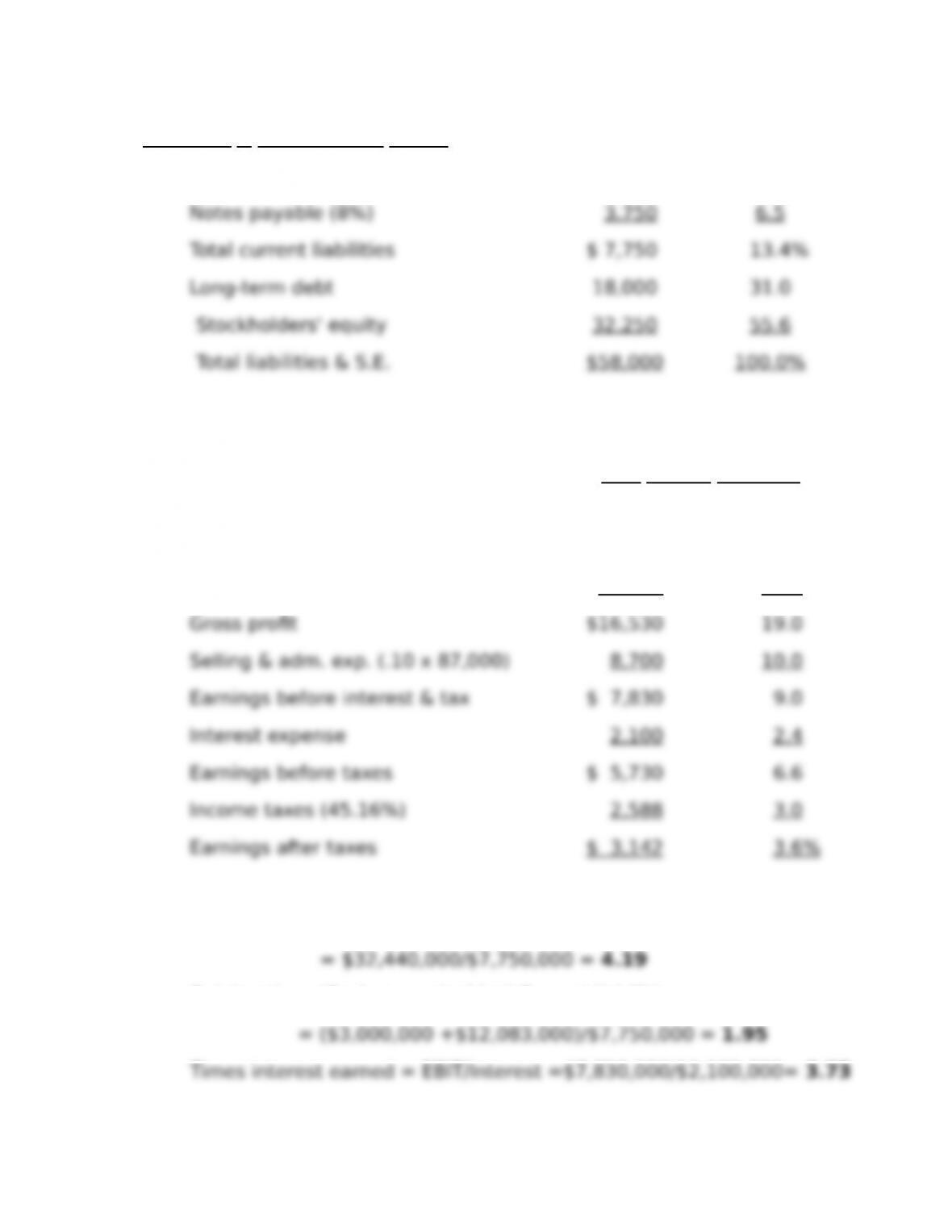
Liabilities & Stockholders’ Equity
Accounts payable $ 4,000 6.9%
6. Pro forma Income Statement Year Ending 12/31/16
($000) (%)
Net sales $87,000 100.0%
Cost of sales (.81 x 87,000) 70,470 81.0
7. Current ratio = Current assets/Current liabilities
Quick ratio = (Cash + receivables)/Current liabilities
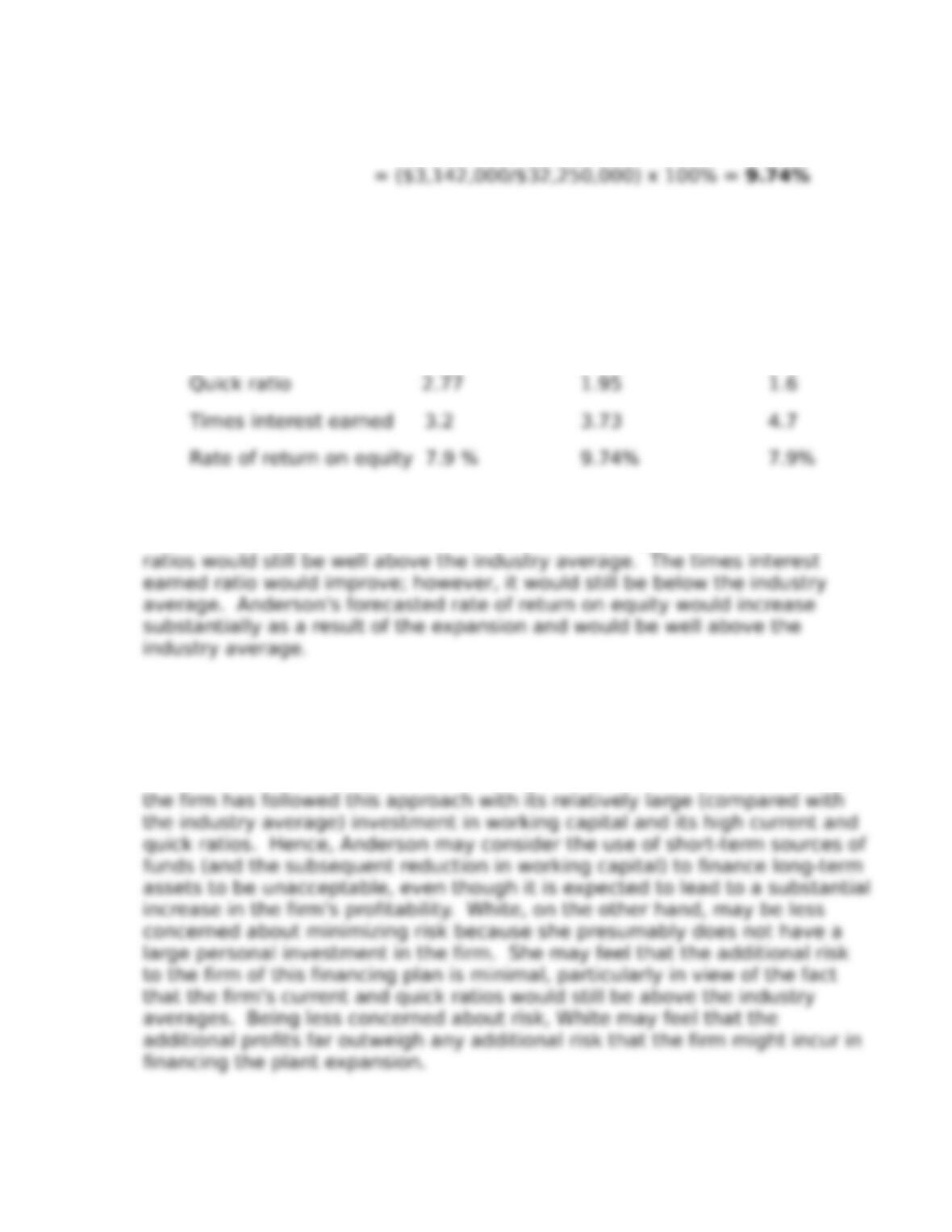
Rate of return on equity = (EAT/Stockholders’ Equity) x 100%
Industry
Actual 2015 Forecasted 2016 Average
Current ratio 5.76 4.19 3.5
The ,rm’s current and quick ratios would decline substantially if short term
sources of funds are used to ,nance the plant expansion. However, both
8. The attitudes toward risk of Anderson and White may lead them to
disagree about the desirability of the proposed ,nancing plan. With a sizable
personal investment in the ,rm, Mr. Anderson’s primary concern may be to
protect his investment from losses. He will tend to favor policies that
minimize the risk of the ,rm encountering ,nancial diNculties. Historically,
9. Other possible sources of ,nancing include receivable loans (pledging or