Chapter 16
Working Capital Policy and Short-Term Financing
CHAPTER 16
WORKING CAPITAL POLICY AND
SHORT-TERM FINANCING
ANSWERS TO QUESTIONS:
1. The need for working capital arises because the normal operating cycle of the firm requires
2. The operating cycle represents the length of time involved in purchasing raw materials,
manufacturing the product, and distributing (selling) the product. The cash conversion cycle
3. A relatively large investment in working capital results in lower expected profitability and
lower risk for the firm. The rate of return on current assets is normally less than the rate of return
4. Permanent current assets are held to meet the company’s long-term minimum needs (e.g.,
5. The cost of long-term debt can exceed the cost of short-term debt, even when short-term
interest rates are higher than long-term rates, because of the reduced flexibility of long-term debt
6. With the matching approach, the maturity structure of the firm’s financing instruments is
“matched” (i.e., made to correspond) exactly to the maturity structure of its assets. Fixed and
16-.
Chapter 16
Working Capital Policy and Short-Term Financing
7. The use of a relatively high proportion of long-term debt to finance its assets results in lower
expected profitability and lower risk for the firm. The cost of long-term debt is generally greater
than the cost of short-term debt and hence the use of a relatively high proportion of long-term
8. The smaller the difference between the costs of long-term and short-term debt, the lower will
be the additional expected returns associated with an aggressive financing plan compared with a
9. No one working capital investment and financing policy is necessarily optimal for all firms
10. a, b. A policy of financing permanent current assets with short-term debt (policy (i)) will
11. Collateral protects the lender against default on a loan by the borrower. If the borrower
12. The annual financing cost is calculated by dividing the interest costs plus any fees by the
13. Spontaneous short-term credit arises in the normal purchasing (trade credit), production
(accrued expenses), and selling (deferred income) activities of the firm. They normally expand
16-.
Chapter 16
Working Capital Policy and Short-Term Financing
14. If the firm forgoes the cash discount (if one is offered) or if it “stretches” the payments
15. a. Accrued expenses are liabilities for services rendered to the firm that have not yet been
b. Deferred income represents payments received by the firm for goods and services that are
c. The prime rate historically was the lowest interest rate that large banks charge on loans
d. A compensating balance provision requires the firm to keep a certain percentage of the
e. A discounted loan is one in which the bank deducts the interest in advance, so that the
f. A commitment fee is a fee, usually in the range of 0.25 to 0.50 percent, paid to the bank
16. A line of credit is an agreement permitting a company to borrow funds up to a
predetermined limit any time during the life of the agreement. While a bank usually feels
A revolving credit agreement is a guaranteed line of credit in that the bank is legally
committed to making loans to the company up to the predetermined credit limit specified in the
17. The major disadvantages of relying too heavily on commercial paper as a source of funds
are
a. Commercial paper financing is not always a reliable source of funds because the market is
b. The amount of loanable funds in the commercial paper market is limited to the amount of
16-.
Chapter 16
Working Capital Policy and Short-Term Financing
c. Unlike bank loans that can be repaid prior to maturity, commercial paper usually cannot
18. When accounts receivable are pledged, the firm retains title to the receivables and continues
to carry them on its balance sheet. The firm also must assume the risk of default on the pledged
19. Under a floating lien arrangement the lender receives a general claim on all the inventory of
20. The annual financing cost of secured credit is generally higher than that of unsecured credit
21. A “clean up” provision helps to assure the bank that the line of credit is being used to finance
22. A firm that factors its receivables does not incur credit investigation and collection costs.
23. a. A rise in the prime rate will increase the annual financing cost because the interest rate
b. A lower compensating balance requirement will decrease the annual financing cost
c. An increase in the firm’s average bank balance will decrease the annual financing cost
24. A firm might find it desirable to borrow funds from a bank or other lending institution in
16-.
Chapter 16
Working Capital Policy and Short-Term Financing
16-.
Chapter 16
Working Capital Policy and Short-Term Financing
SOLUTIONS TO PROBLEMS:
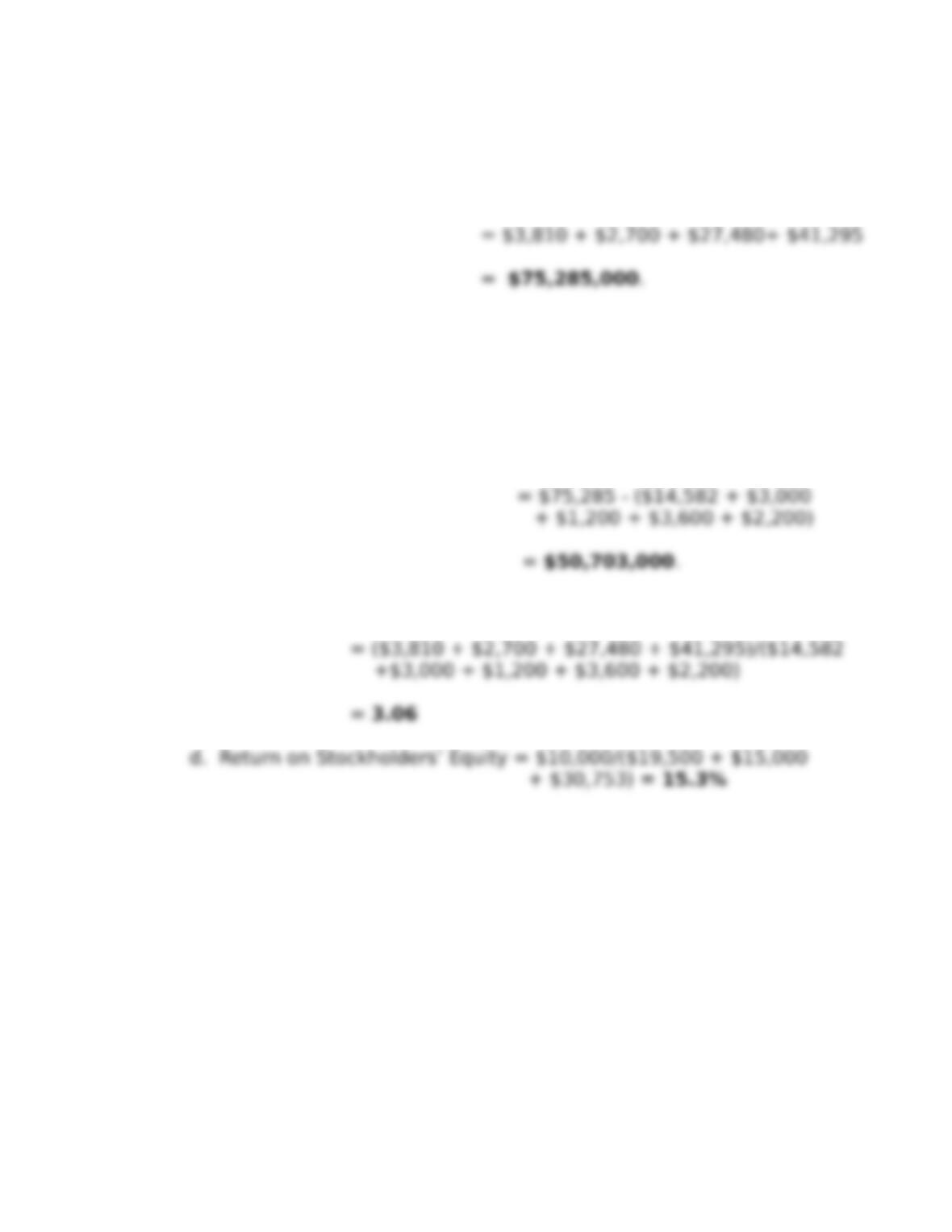
1. a. Current Assets = Cash + Marketable Securities
+ Accounts Receivable + Inventories
b. Working Capital Investment = Current Assets – Current
Liabilities
= Current Assets – (Accounts
Payable + Current Portion of LTD
+ Accrued Wages + Accrued Taxes
+ Other Current Liabilities)
c. Current Ratio = Current Assets/Current Liabilities
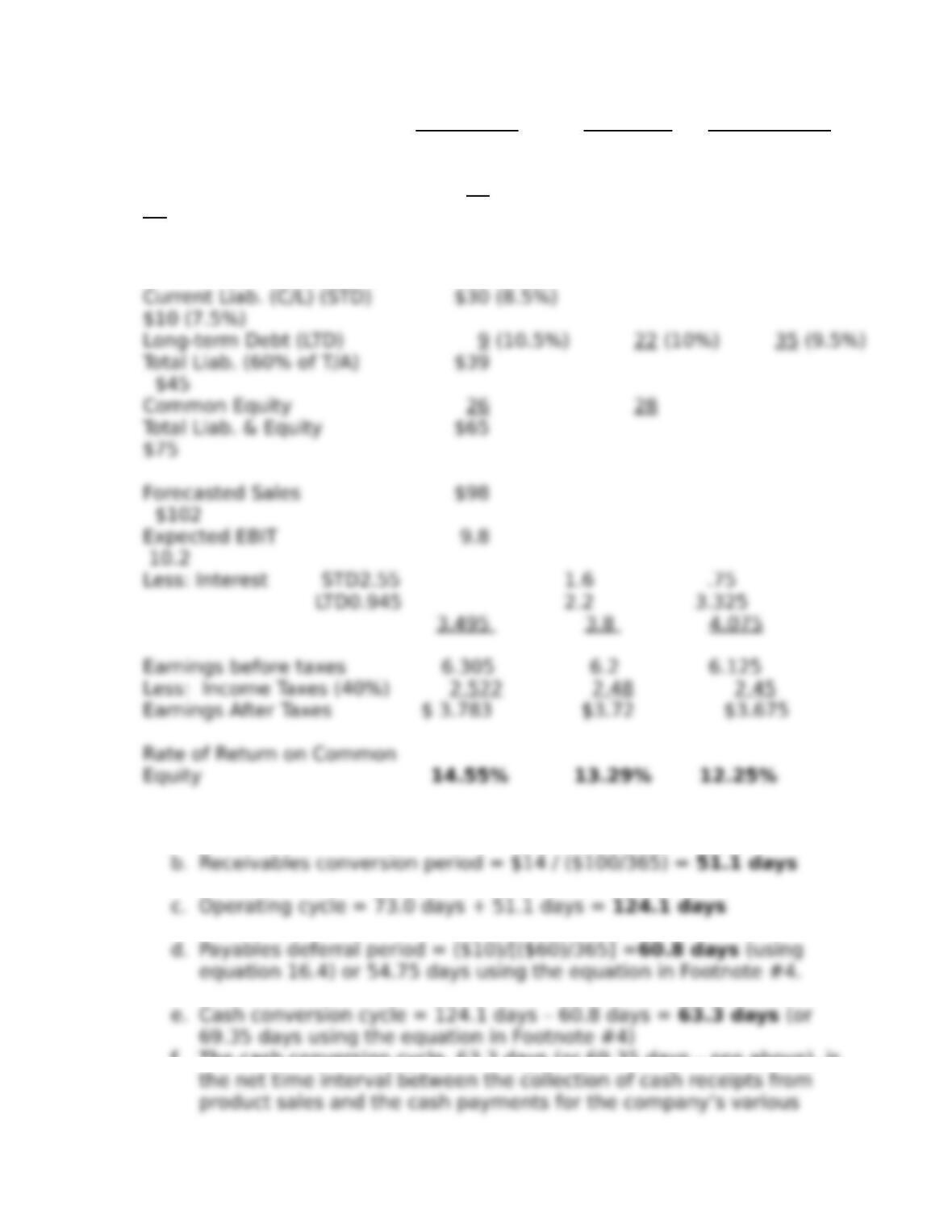
2.
Alternative Working Capital Investment
and Financing Policies
(millions of dollars)
16-.
Chapter 16
Working Capital Policy and Short-Term Financing
Aggressive Moderate Conservative
Current Assets (C/A) $35 $40 $45
Fixed Assets (F/A) 30
30
Total Assets (T/A) $65
$75
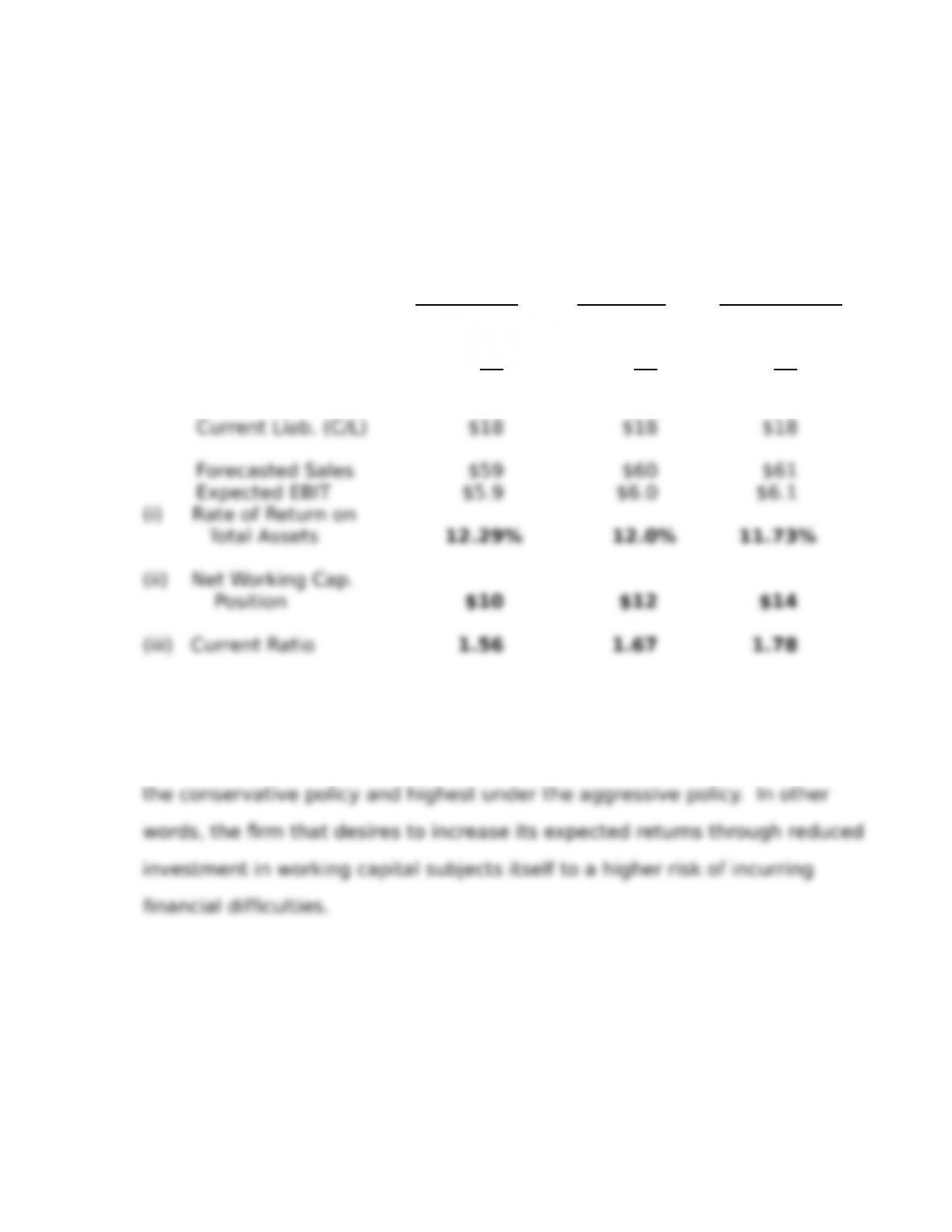
3. a. Inventory conversion period = $12 / ($60/365) = 73.0 days
f. The cash conversion cycle, 63.3 days (or 69.35 days – see above), is
16-.
Chapter 16
Working Capital Policy and Short-Term Financing
resource purchases.
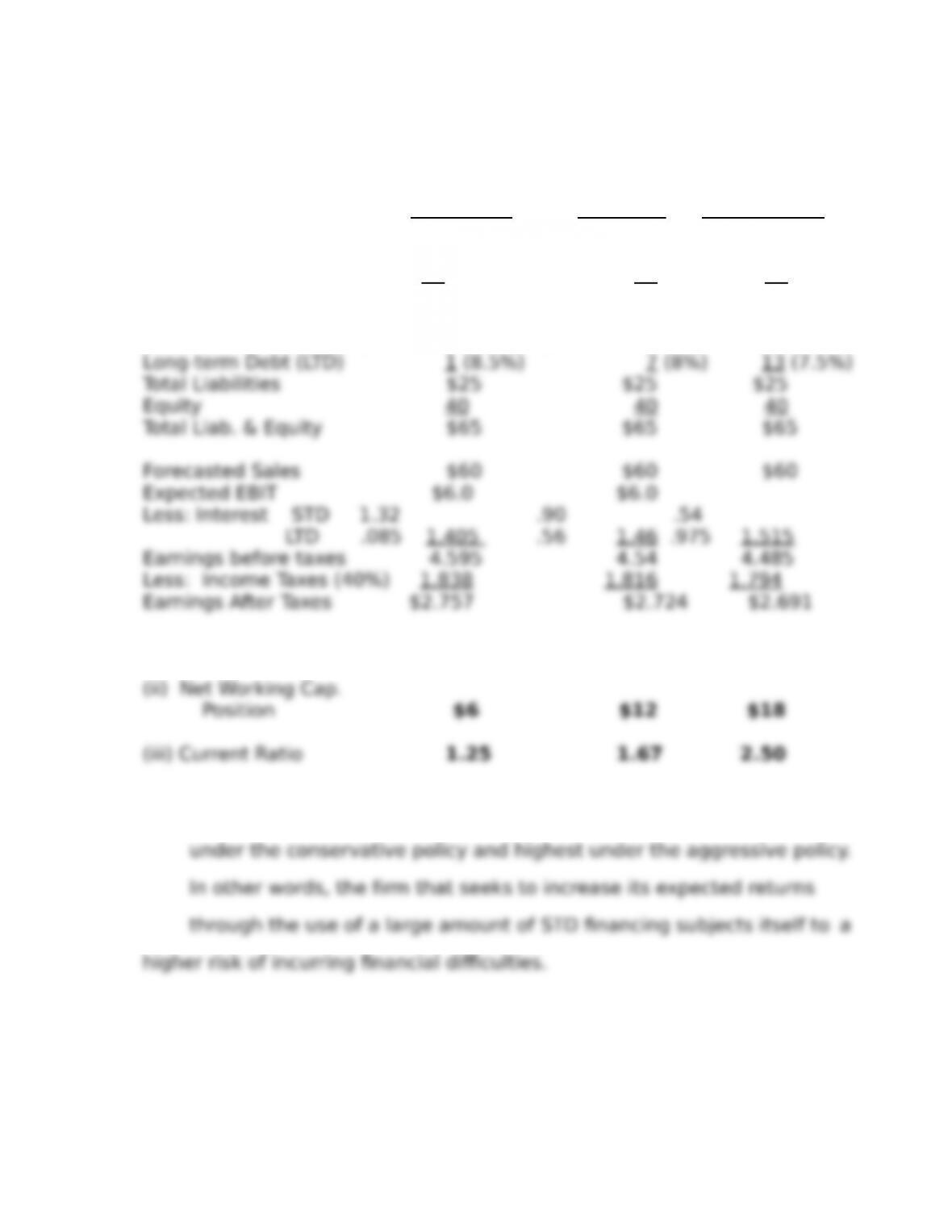
4. a.
Alternative Working Capital
Investment Policies
(millions of dollars)
Aggressive Moderate Conservative
Current Assets (C/A) $28 $30 $32
Fixed Assets (F/A) 20 20 20
Total Assets (T/A) $48 $50 $52
b. Expected proEtability (rate of return on total assets) and risk (as
measured by net working capital position or current ratio) are lowest under
16-.
Chapter 16
Working Capital Policy and Short-Term Financing
5. a.
Alternative Financing Policies
(millions of dollars)
Aggressive Moderate Conservative
Current Assets (C/A) $30 $30 $30
Fixed Assets (F/A) 35 35 35
Total Assets (T/A) $65 $65
Current Liab. (C/L) (STD) $24 (5.5%)
(i) Rate of Return on Equity 6.89% 6.81%
b. Expected proEtability (rate of return on equity) and risk are lowest
16-.