Chapter 15
Dividend Policy
CHAPTER 15
DIVIDEND POLICY
ANSWERS TO QUESTIONS:
1. Legal constraints:
• Capital cannot be impaired as a result of dividend payments.
2. a. The IRS code prohibits corporations from retaining an excessive amount of profits in an
b. Prior to the 1986 Tax Reform Act, personal (marginal) tax rates were higher on dividend
income than on capital gains income. This encouraged corporations to keep dividends low so
that shareholders could receive a larger proportion of their pretax returns in the form of capital
gains income and thus increase their after-tax returns. The 1986 Tax Reform Act eliminated the
differential between tax rates on dividend and capital gains income. The Revenue
Reconciliation Act of 1993 restored some tax rate advantage to capital gains income by
3. Other external factors limiting cash dividends include restrictive covenants in loan
4. The “clientele effect,” as originally developed by Modigliani-Miller, suggests that investors
will tend to be attracted to firms that have dividend policies consistent with the investors’
15-<
Chapter 15
Dividend Policy
5. The “informational content” of dividend policy indicates that, for a firm following a stable
6. A change in dividend policy represents an unambiguous signal to investors concerning
7. In the world of Miller and Modigliani the value of a firm is determined solely by the firm’s
investments. Dividend payouts are a mere detail to the firm given an investment policy and do
8. Most practitioners believe that dividends are important because they help to resolve
uncertainty for investors. Furthermore, in the “real” world where the transactions costs
9. There is evidence that although many firms follow a “passive residual” dividend policy,
these firms still strive to maintain a stable dividend record. For example, a firm with growing
10. A policy of paying out stable dividends is usually preferred to a policy of paying out a
constant percentage of earnings as dividends for a number of reasons. First, many investors
11. A firm faced with an unusually large number of attractive investment opportunities or a
15-<
Chapter 15
Dividend Policy
12. Investors who rely on dividend payments for their current income needs prefer that the firm
make cash dividend payments and then raise new funds externally if needed. For these
13. Shareholders of a firm with a dividend reinvestment plan can automatically have their
dividends reinvested in additional shares of the company’s common stock. A dividend
14. Stock dividends, by increasing the number of shares outstanding, tend to reduce the price
of each share outstanding. A firm may pursue a policy of paying regular stock dividends in
15. The IRS does not permit a firm to follow a policy of regular stock repurchases as an
16. Ignoring taxes, transaction costs, and other market imperfections, the value of the firm
should not be affected by an equivalent amount of returns from cash dividends or share
repurchases. However, empirical evidence suggests that share repurchases do increase the
17. It is impossible to tell from the information provided. The answer depends on additional
factors, such as:
• Current shareholders, who are accustomed to a high dividend payout, may be
15-<
Chapter 15
Dividend Policy
• Other investors, who prefer earnings retention and no cash dividends, may be
attracted to the firm’s new dividend policy, thus raising the stock price. The net
18. A firm that is facing financial distress might be tempted to pay out a portion of its
SOLUTIONS TO PROBLEMS:
1. a. EPS = 2,000,000/1,600,000 = $1.25
2. a. Ex-dividend day is Wednesday, February 10.
b. Stock price should decline by $0.50 to $21.50 per share. Other
c. Dividends = ($0.50)(200,000) = $100,000
and
total assets.
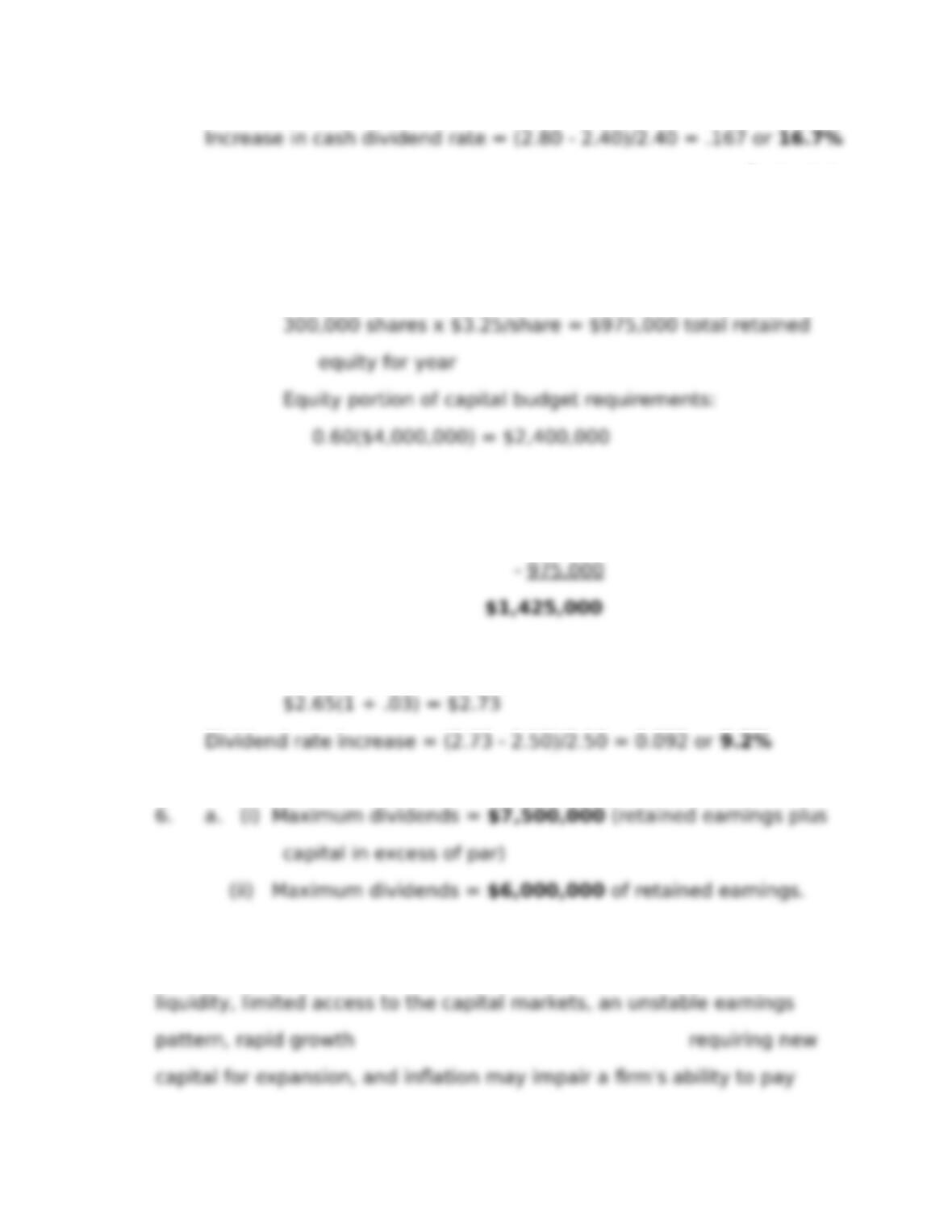
3. Pre-split dividend equivalent:
15-<
Chapter 15
Dividend Policy
increase
4. Retention for coming year:
$6.25 – $3.00 = $3.25/share
External equity needed: $2,400,000
5. Equivalent (pre-stock dividend) dividend per share:
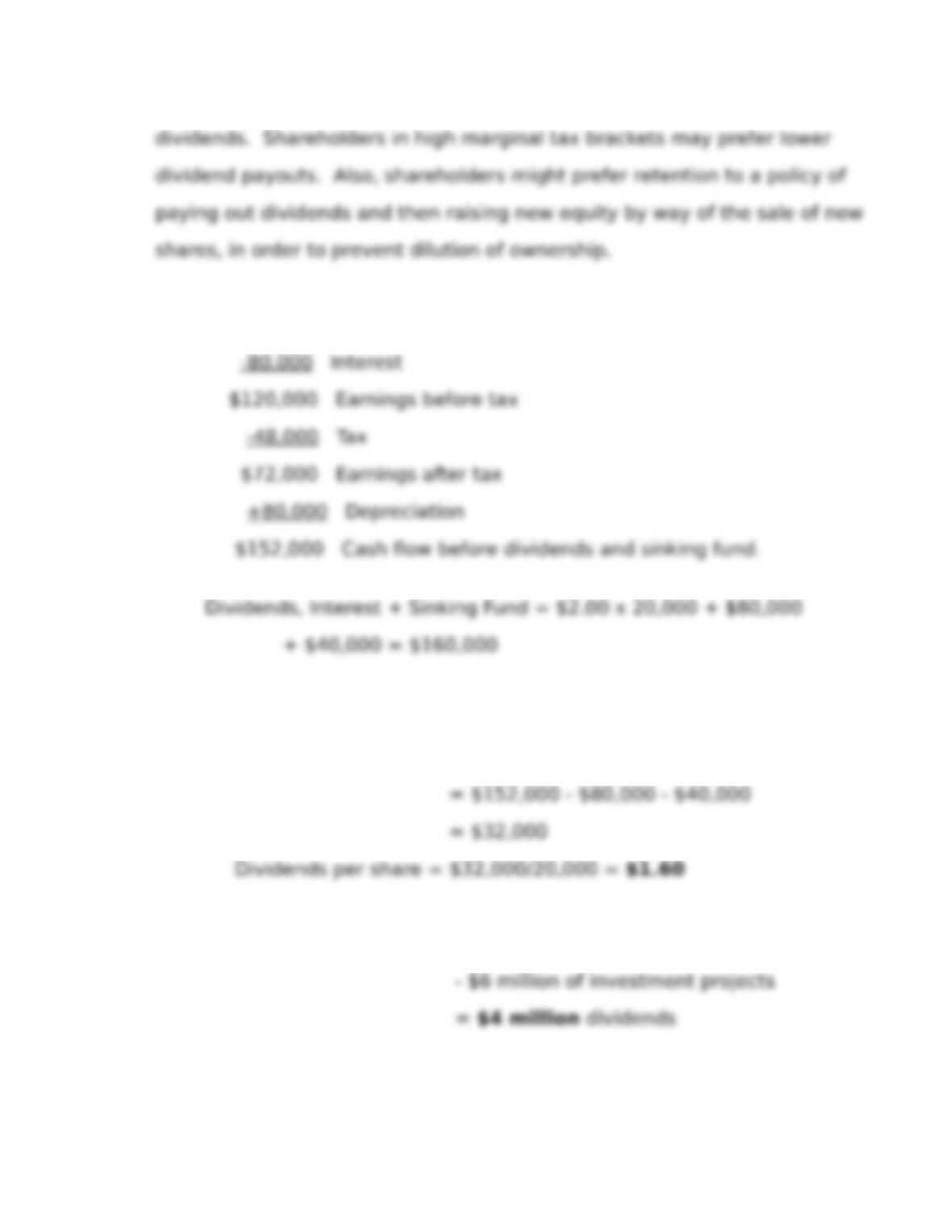
b. Restrictive covenants in the firm’s loan agreements, the need for
15-<
Chapter 15
Dividend Policy
7. a. $200,000 EBIT
The proposed dividend cannot be paid.
b. Maximum total dividend = $152,000 – interest – sinking fund
8. a. Total dividend payment = $10 million earnings
b. The firm should pay no dividends and raise $2 million
15-<
Chapter 15
Dividend Policy
externally to
finance the entire $12 million in projects.
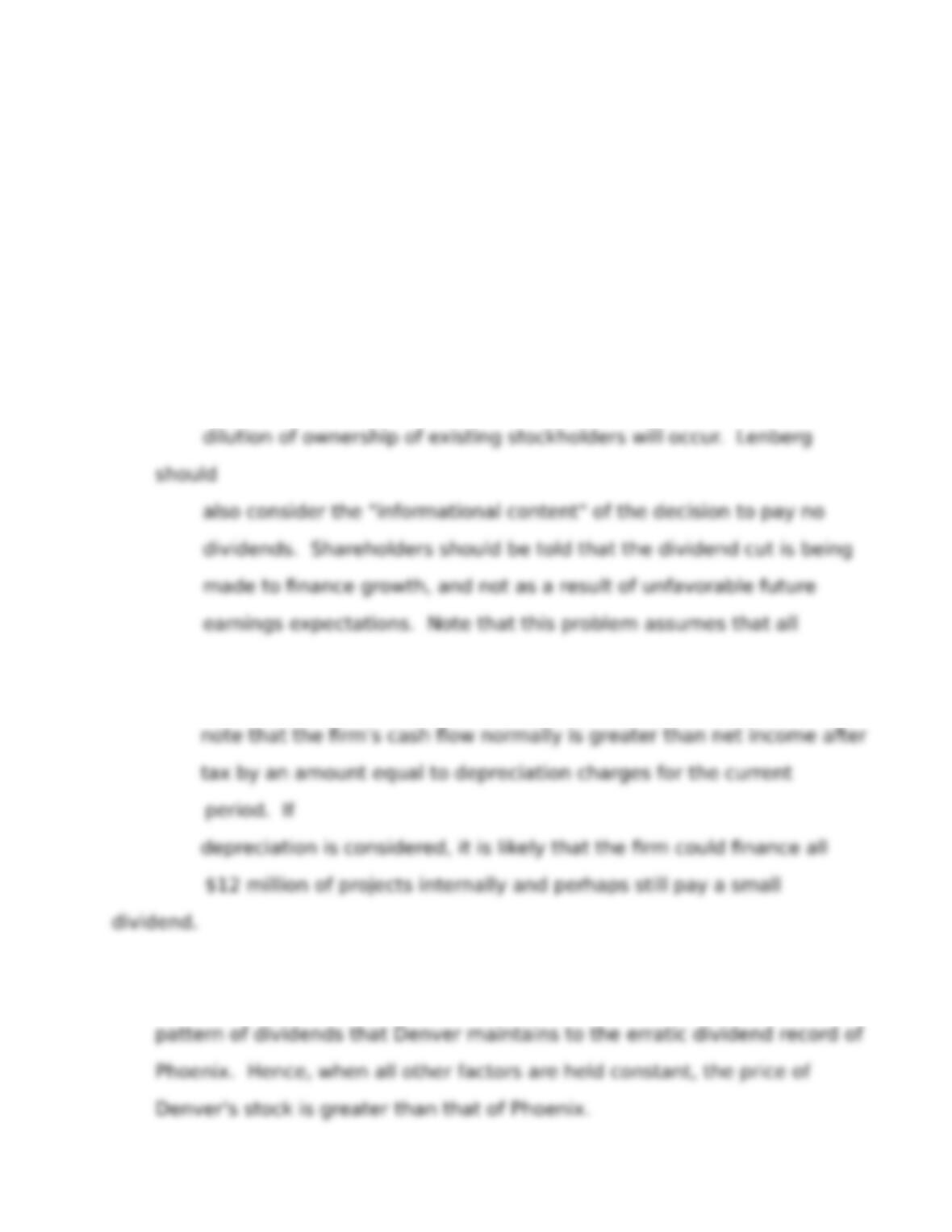
c. Lenberg should consider shareholder preferences for dividends.
The decision to raise an additional $2 million means that some potential
internally
generated funds come from net income. Some students may correctly
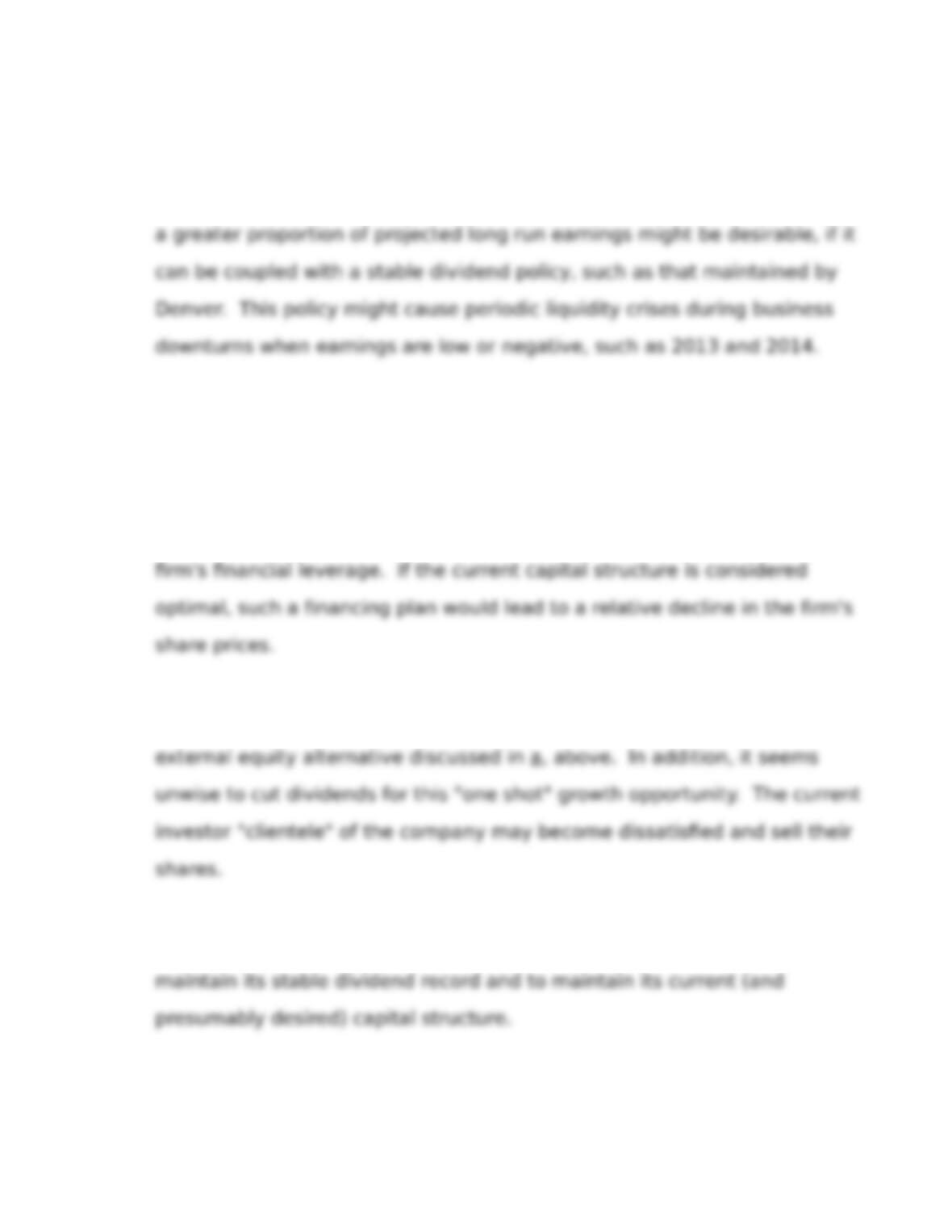
9. a. Investors in Denver’s stock obviously prefer the more predictable
15-<
Chapter 15
Dividend Policy
b. Neither firm appears to be a growth company. In fact, the record of
earnings for both firms suggests the opposite. Hence, a policy of paying out
10. a. If the firm currently has a mix of debt and equity in its capital
structure, financing the project entirely with external equity will reduce the
b. The same arguments apply to this alternative as apply to all of the
c. This alternative seems the best because it permits the firm to
15-<
Chapter 15
Dividend Policy
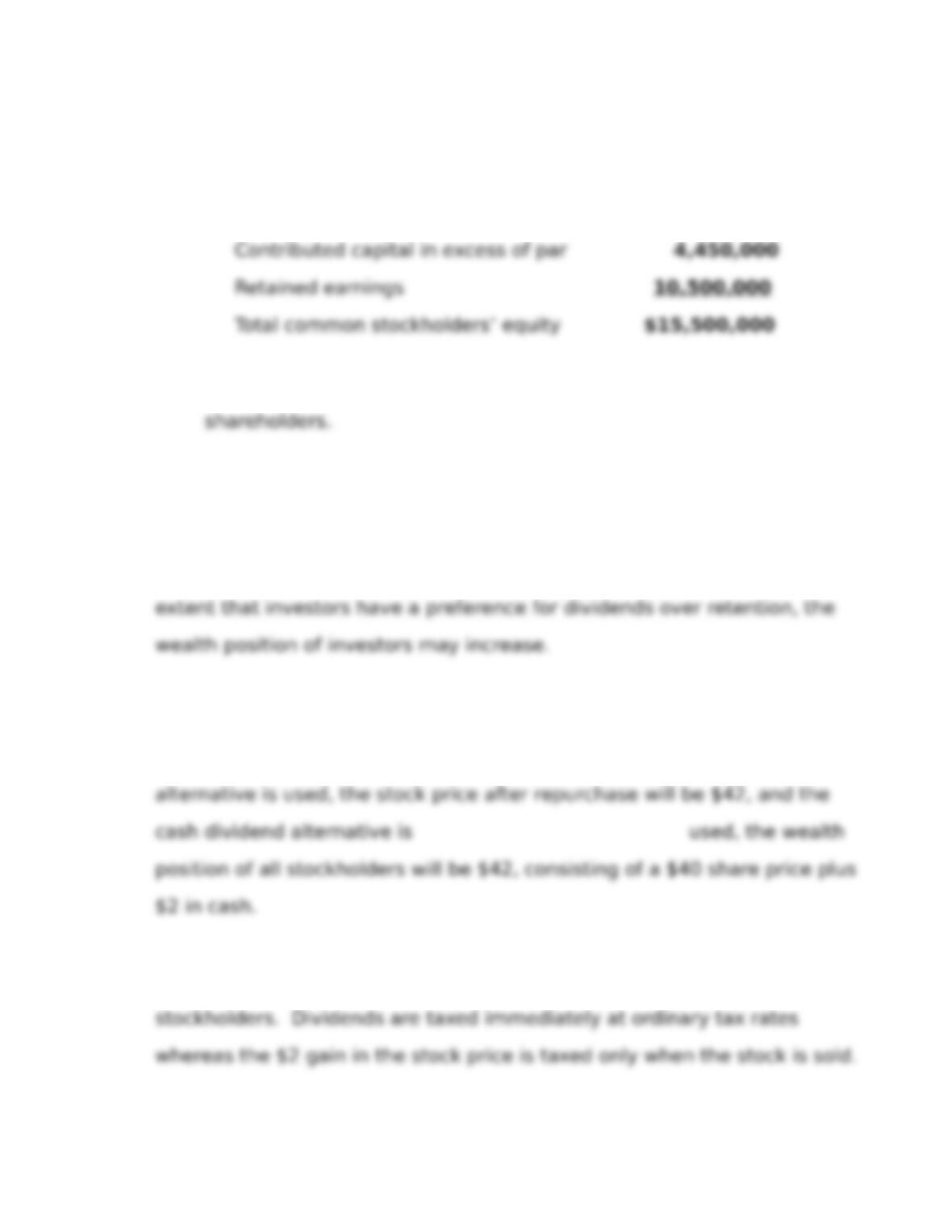
11. a. Capital accounts after 10% stock dividend:
Common stock ($1 par, 550,000 shares) $ 550,000
b. A stock dividend by itself has no impact on the wealth position of
c. This is the same as a 10 percent cash dividend increase. To the
12. a. Ignoring taxes, the wealth position of the stockholders remains
unchanged, regardless of the alternative chosen. If the repurchase
b. The share repurchase will be preferred by high tax bracket
15-<
Chapter 15
Dividend Policy
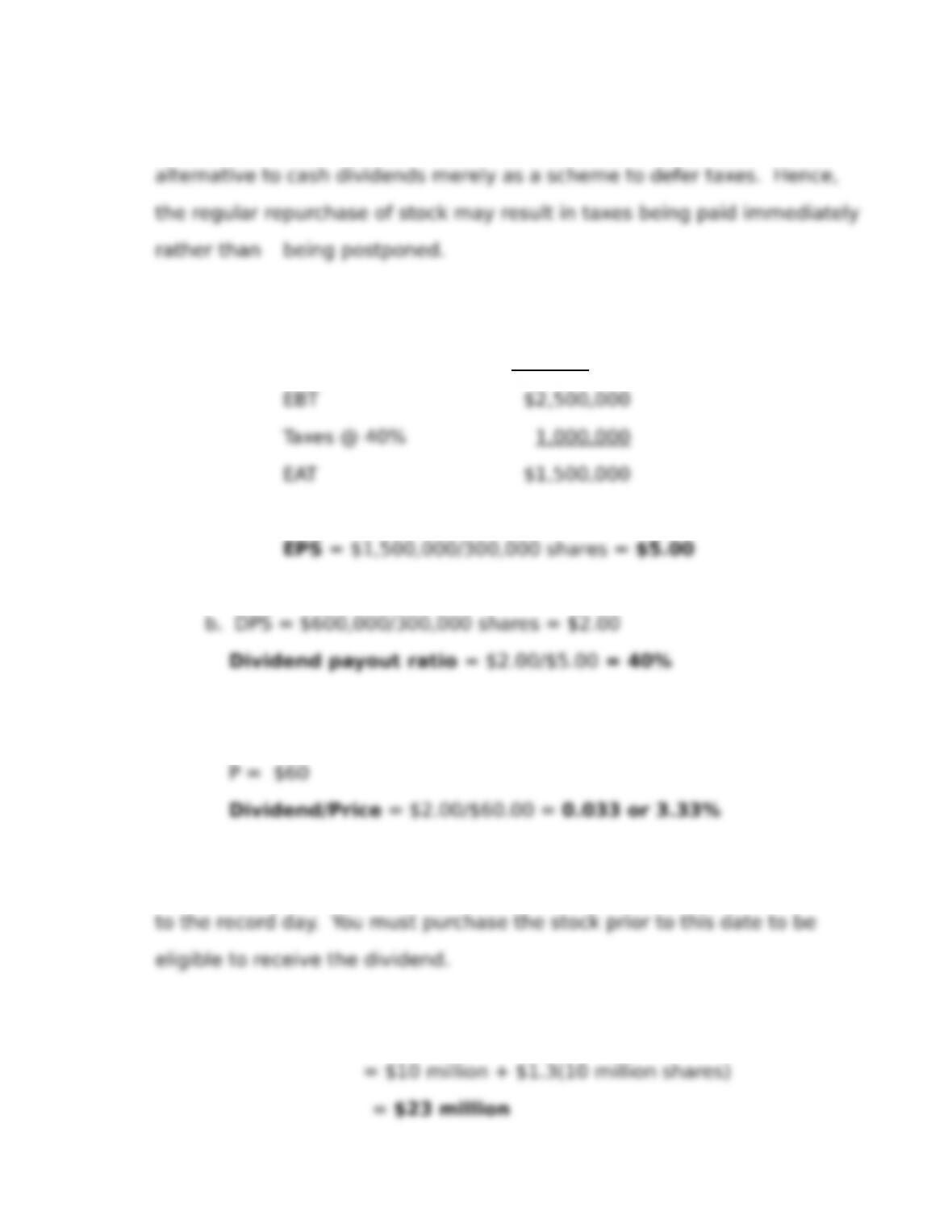
c. The Internal Revenue Service views regular repurchases as an
13. a. EBIT $3,000,000
Interest 500,000
c. P/E = 12 = P/$5.00
14. The ex-dividend date is Friday, August 20, which is 2 business days prior
15. a. Capital outlays = debt funds raised plus equity retained
15-<

Chapter 15
Dividend Policy
b. Assuming that Clynne’s capital structure equaled its target before
15-<