Chapter 14
Capital Structure Management in Practice
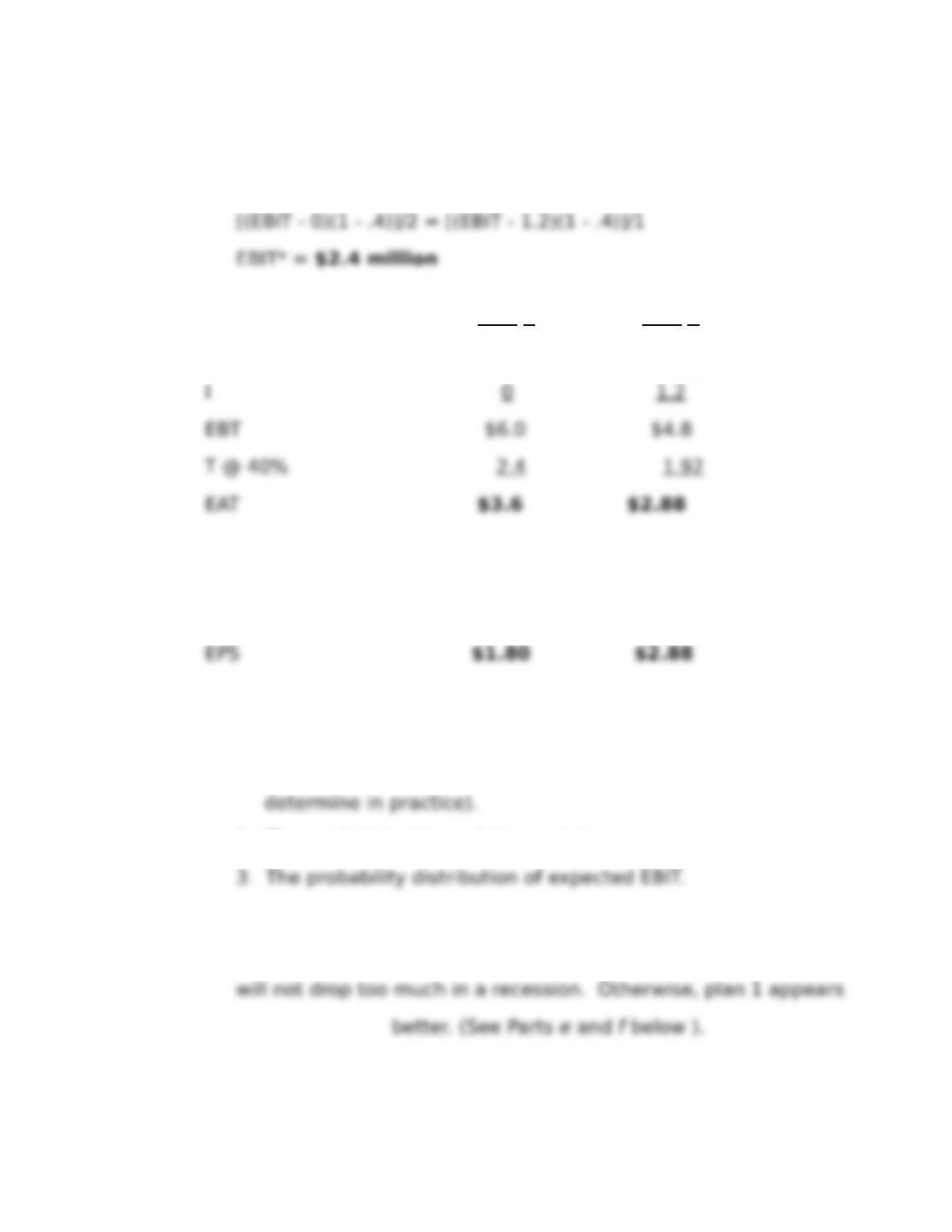
20. a. EPS (Plan 1) = EPS (Plan 2)
b. Plan 1 Plan 2
EBIT $6.0 $6.0
Shares Outstanding 2.0 1.0
c. The factors the company should consider include the following:
1. The plan’s effect on the company’s stock price (di5cult to
2. The capital structure of the parent company.
d. Adopt plan 2 if the company can be reasonably sure that EBIT
e. T.I.E. = (EBIT/I) = (6.0/1.2) = 5 times
14-
Chapter 14
Capital Structure Management in Practice
Note: This calculation assumes no short-term debt, either
permanent or seasonal.
f. Required EBIT level = (Interest)(Required T.I.E.)
company would still be in compliance with the loan agreement.
Note: In practice, the lenders also likely would require the parent
company to guarantee the loan.
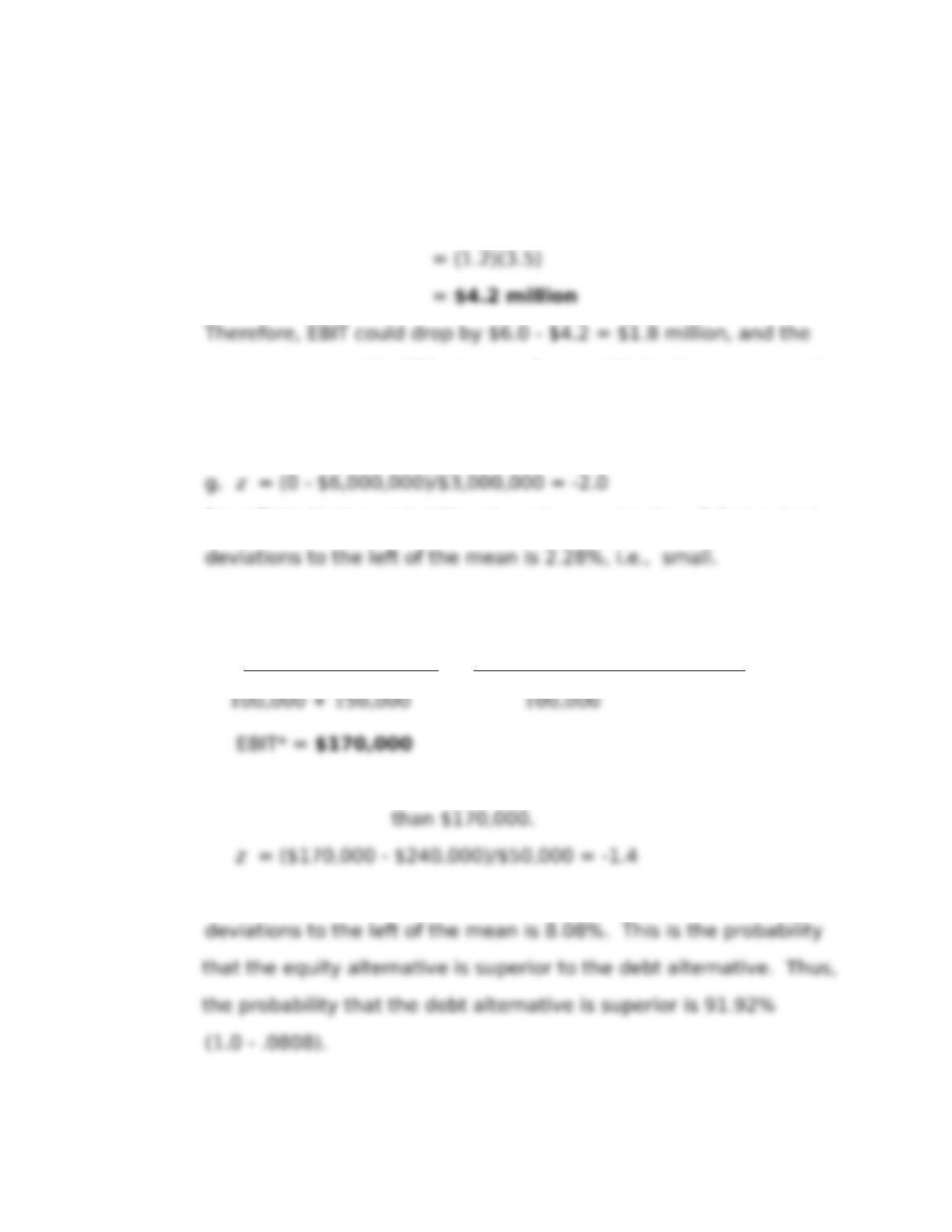
From Table V, the probability of a value greater than 2.0 standard
21.a. (EBIT – 60,000)(1 – .4) = (EBIT – 60,000 – 66,000)(1 – .4)
b. Compute the probability that the actual EBIT will be greater
From Table V, the probability of a value less than 1.4 standard
c. The probability of negative earnings is the probability that
14-
Chapter 14
Capital Structure Management in Practice
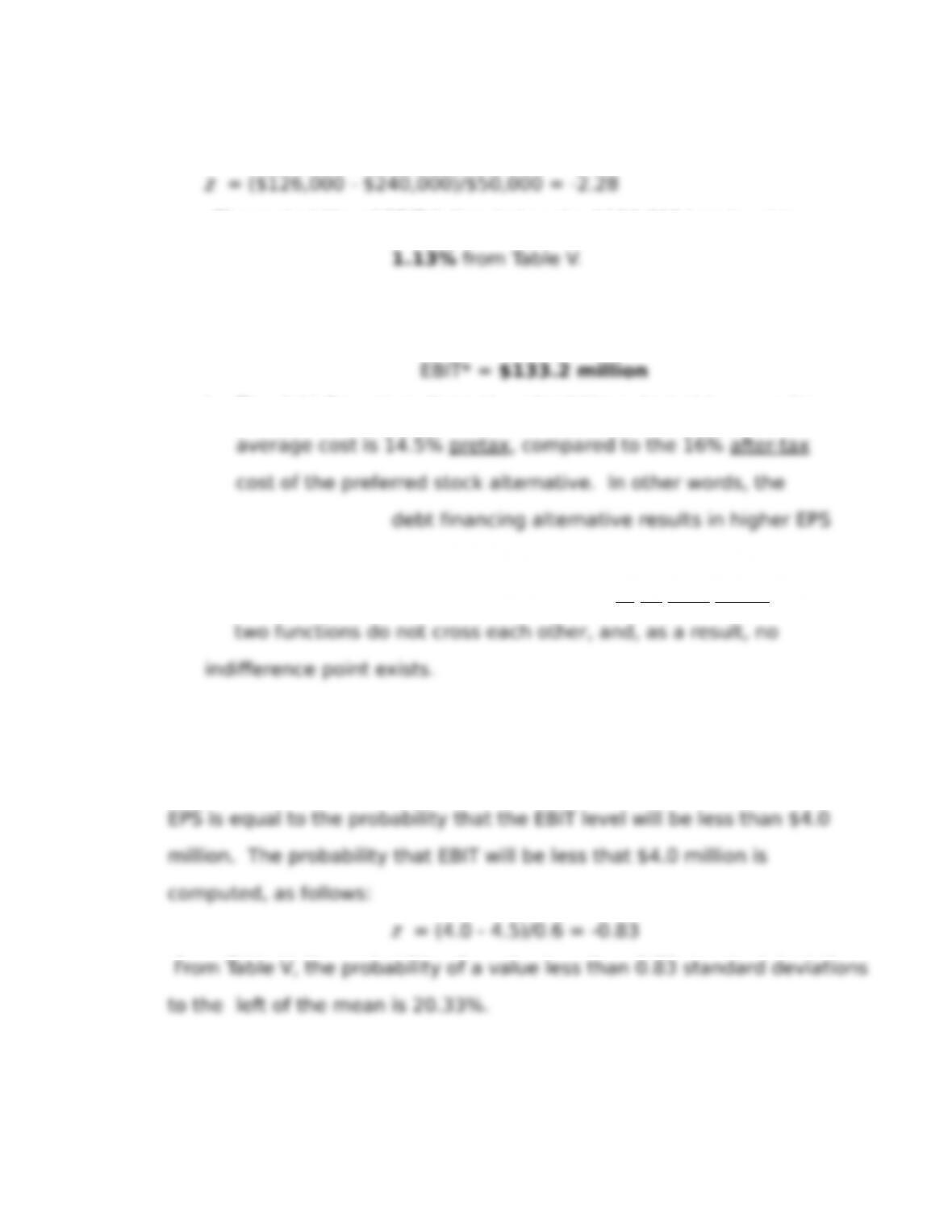
actual EBIT will fall below the loss level ($126,000).
The probability of EBIT falling below the $126,000 loss level is
22. a. [(EBIT – 46.2)(0.6)]/30 = [(EBIT – 37.5)(0.6)]/33
b. The debt Cnancing alternative should be selected because its
values than
the preferred stock Cnancing alternative at all EBIT levels. The
23.a. The probability that the equity Cnancing option will result in a higher
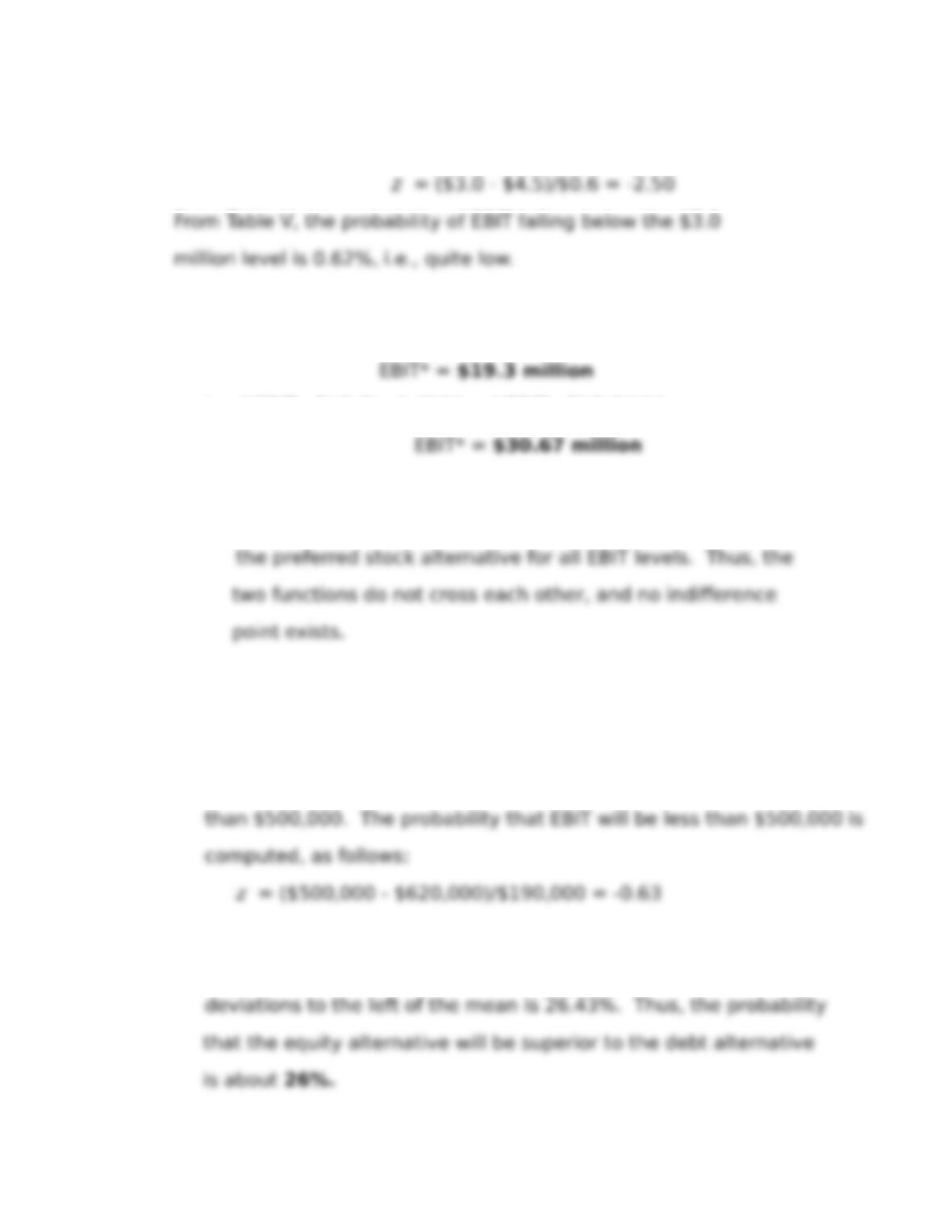
b. The probability of losing money is the probability that the actual EBIT
14-
Chapter 14
Capital Structure Management in Practice
will fall below the $3 million level.
24. a. [(EBIT – 6.3)(0.6)]/10 = [(EBIT – 5)(0.6)]/11
b. [(EBIT – 5)(0.6) – 1.4]/10 = [(EBIT – 5)(0.6)]/11
c. The debt Cnancing alternative results in higher EPS values than
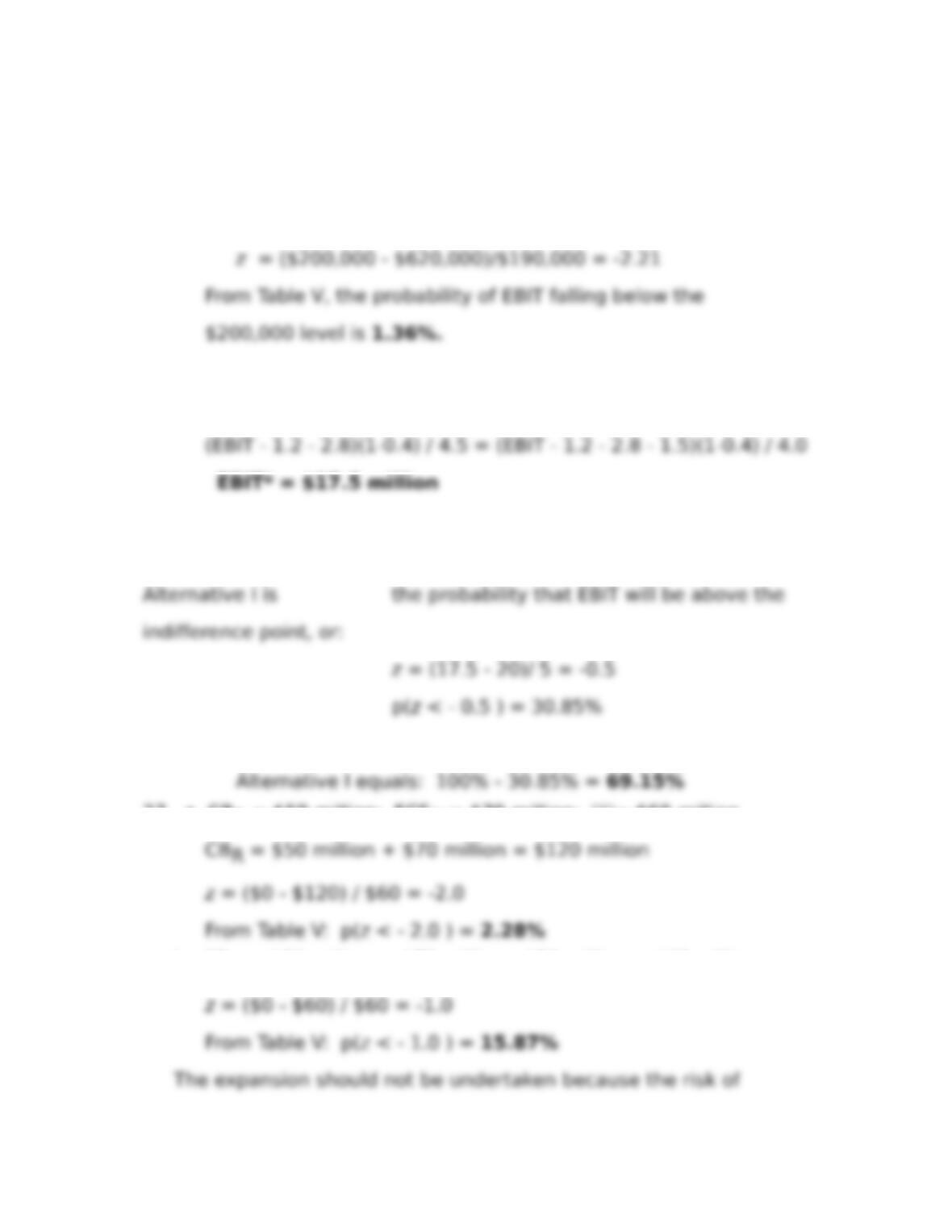
25. a. The probability that the equity Cnancing option will result in a
higher EPS is equal to the probability that the EBIT level will be less
From Table V, the probability of a value less than 0.63 standard
14-
Chapter 14
Capital Structure Management in Practice
b. The probability that the Crm will incur losses is the
probability that the actual EBIT will fall below the $200,000 level.
26. a. Equity Alternative Debt Alternative
b. The probability that Alternative II will result in higher EPS than
Hence the probability that Alternative II will yield higher EPS than
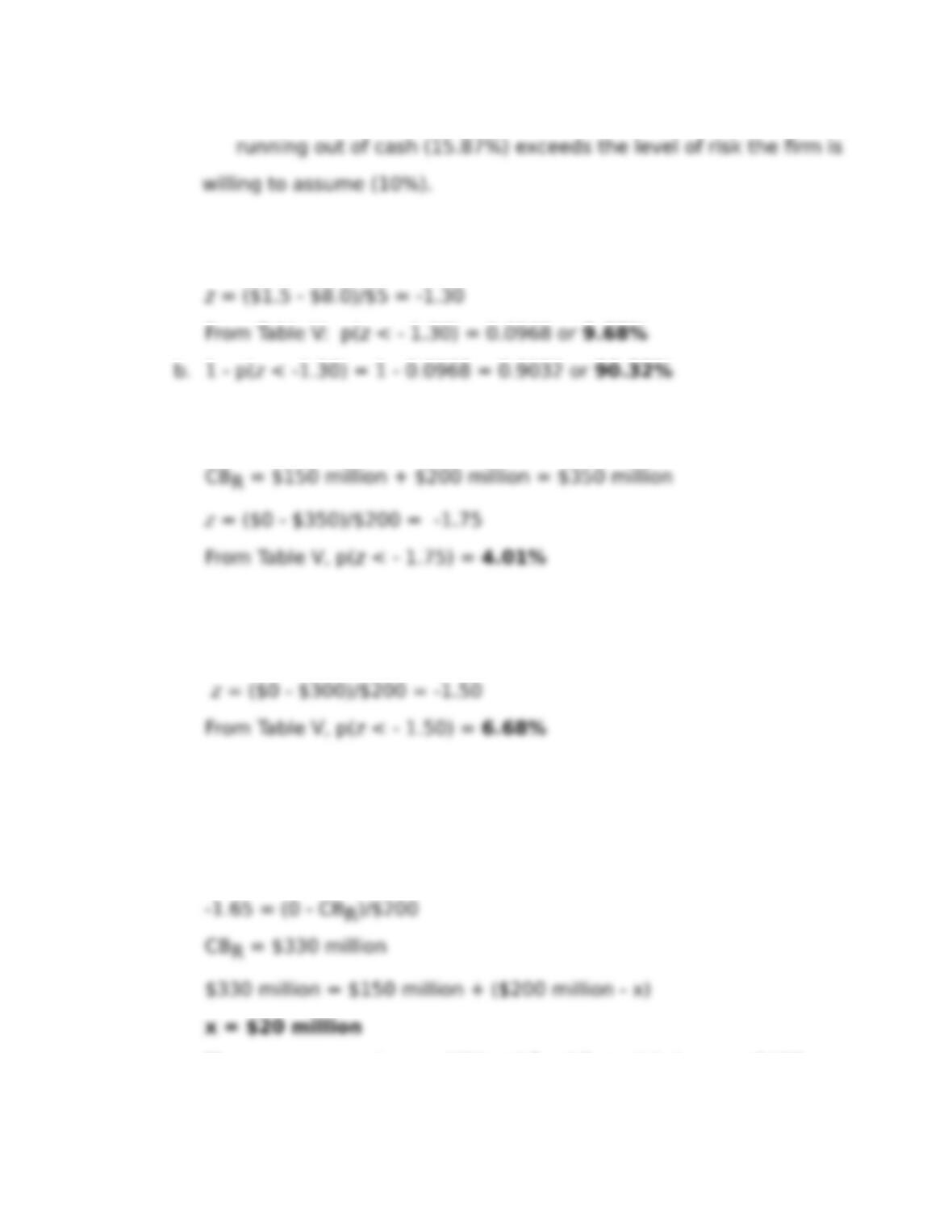
27. a. CB0 = $50 million; FCFR = $70 million; = $60 million
b. CBR = $50 million + $70 million – $60 million = $60 million
14-
Chapter 14
Capital Structure Management in Practice
28. a. EBIT = $8.0 million; = $5 million
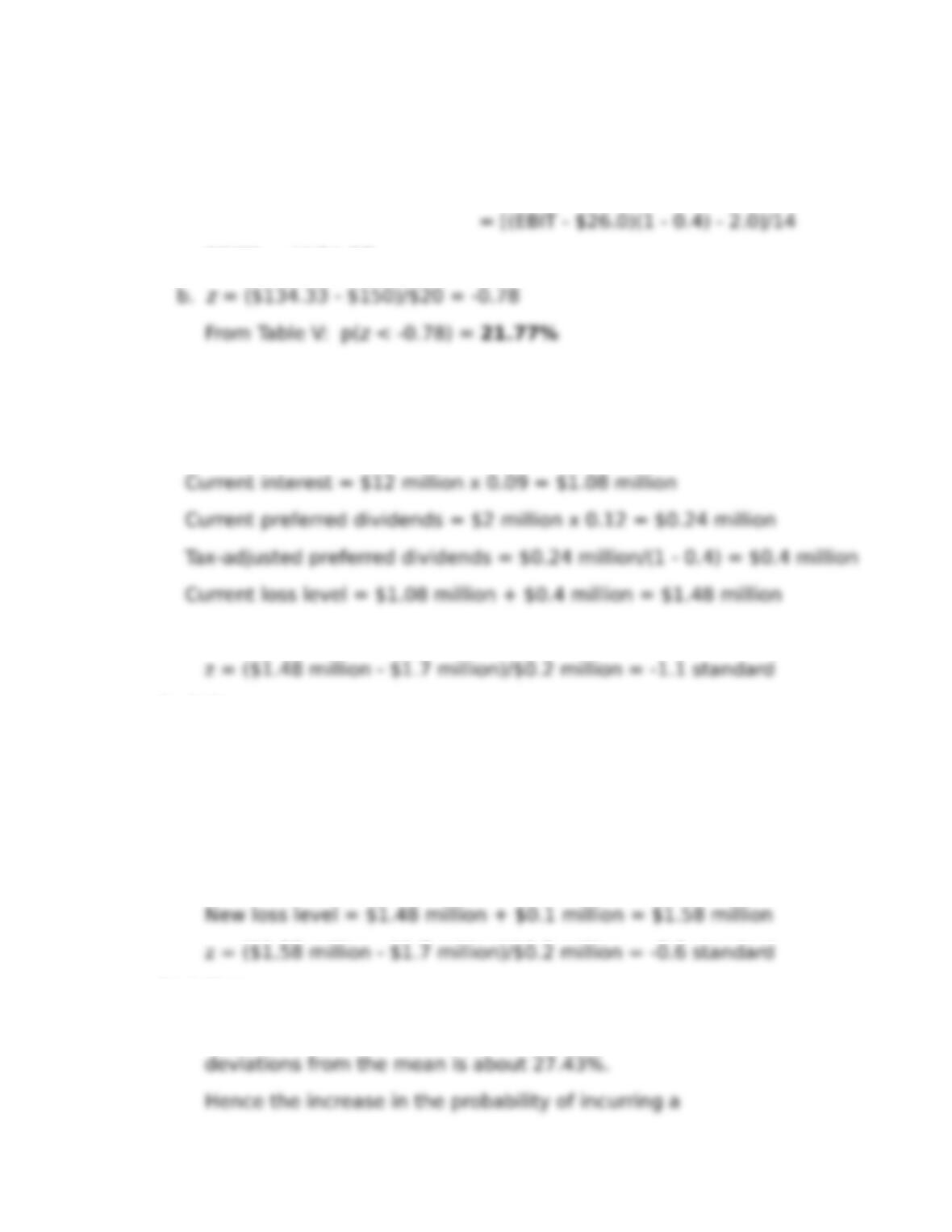
29. a. CB0 = $150 million; FCFR = $200 million; = $200 million
b. CBR = $150 million + $200 million – $50 million = $300 million
c. From Table V, p(z < zo) = 5.0% for zo = -1.65
The company can incur additional Cxed Cnancial charges of $20
million.
14-
Chapter 14
Capital Structure Management in Practice
30. a. [(EBIT – $26.0 – $30.0)(1 – 0.4) – $2.0]/10
EBIT* = $134.33
31. Debt = 0.6 ($20 million) = $12 million
Preferred = 0.1($20 million) = $2 million
deviations
From Table V, the probability of a value less than -1.1 standard
deviations from the mean is about 13.57%.
deviations.
From Table V, the probability of a value less than -0.6 standard
14-
Chapter 14
Capital Structure Management in Practice
32. a. Equity Alternative Debt Alternative
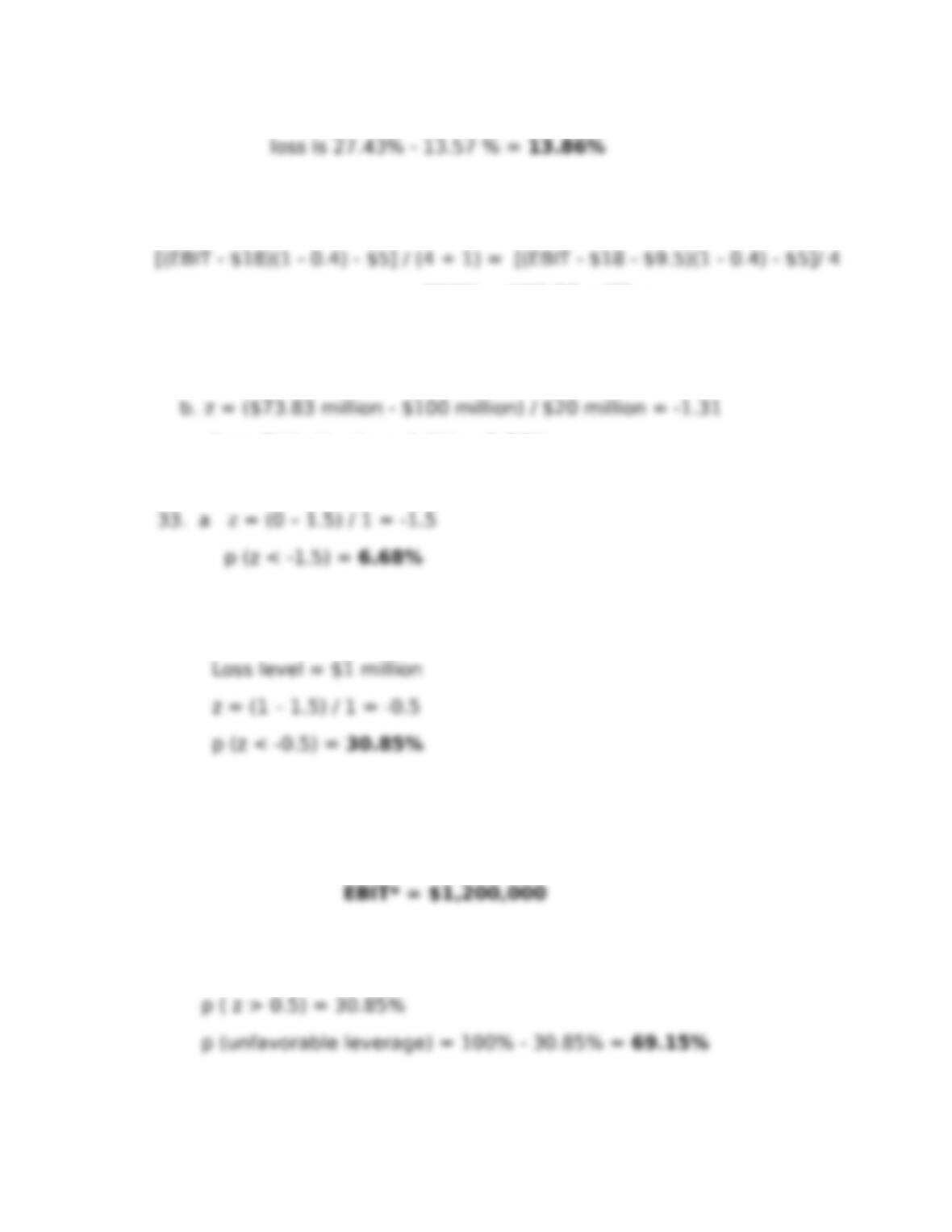
EBIT* = $73.83 million
EPS @ EBIT* = $5.70
From Table V: p(z < -1.31) = 9.51%
b. Interest = 0.10 x $ 10 million = $1 million
34. a.
[(EBIT – 0)(1 – 0.4)] / 600,000 = [(EBIT – 800,000)(1 – 0.4)] / 200,000
b. z = (1.2 – 1.0) / 0.4 = 0.5
14-
Chapter 14
Capital Structure Management in Practice
14-