Chapter 14
Capital Structure Management in Practice
CHAPTER 14
CAPITAL STRUCTURE MANAGEMENT
IN PRACTICE
ANSWERS TO QUESTIONS:
1. Leverage is the use of assets and liabilities with fixed costs in order to increase the returns to
2. a. Fixed costs are operating costs that are independent of sales levels in the short-run.
b. Variable costs are operating costs that move in close relationship to changes in sales.
3. a. Operating leverage is the employment of assets with fixed operating costs in an attempt
b. Financial leverage is the employment of funds having fixed capital costs in an attempt to
4. The degree of combined leverage (DCL) is equal to the degree of operating leverage (DOL)
5. Yes. The level of business risk of a firm relates to the variability of that firm’s operating
6. Yes. If a firm has stable sales revenues and stable operating costs over time, the total risk of
7. Use of EBIT-EPS analysis can determine which financing alternative maximizes EPS.
14-7
Chapter 14
Capital Structure Management in Practice
8. A firm cannot tell exactly when it is at the optimal capital structure point. However, this is
not a great problem because the optimal capital structure, in practice, is best depicted as a
range. Many companies are able to conclude they are operating near the optimal range as a
9. A firm should use more debt if it traditionally has been more profitable than the average firm
in the industry, or if its operating income is more stable than the operating income of the
10. Public utilities typically incur more financial risk than major oil companies because public
11. Cash insolvency analysis is a tool that can be used to analyze the effects of a proposed
capital structure change. Cash insolvency analysis looks at the effects of a worst-case scenario
14-7
Chapter 14
Capital Structure Management in Practice
SOLUTIONS TO PROBLEMS:
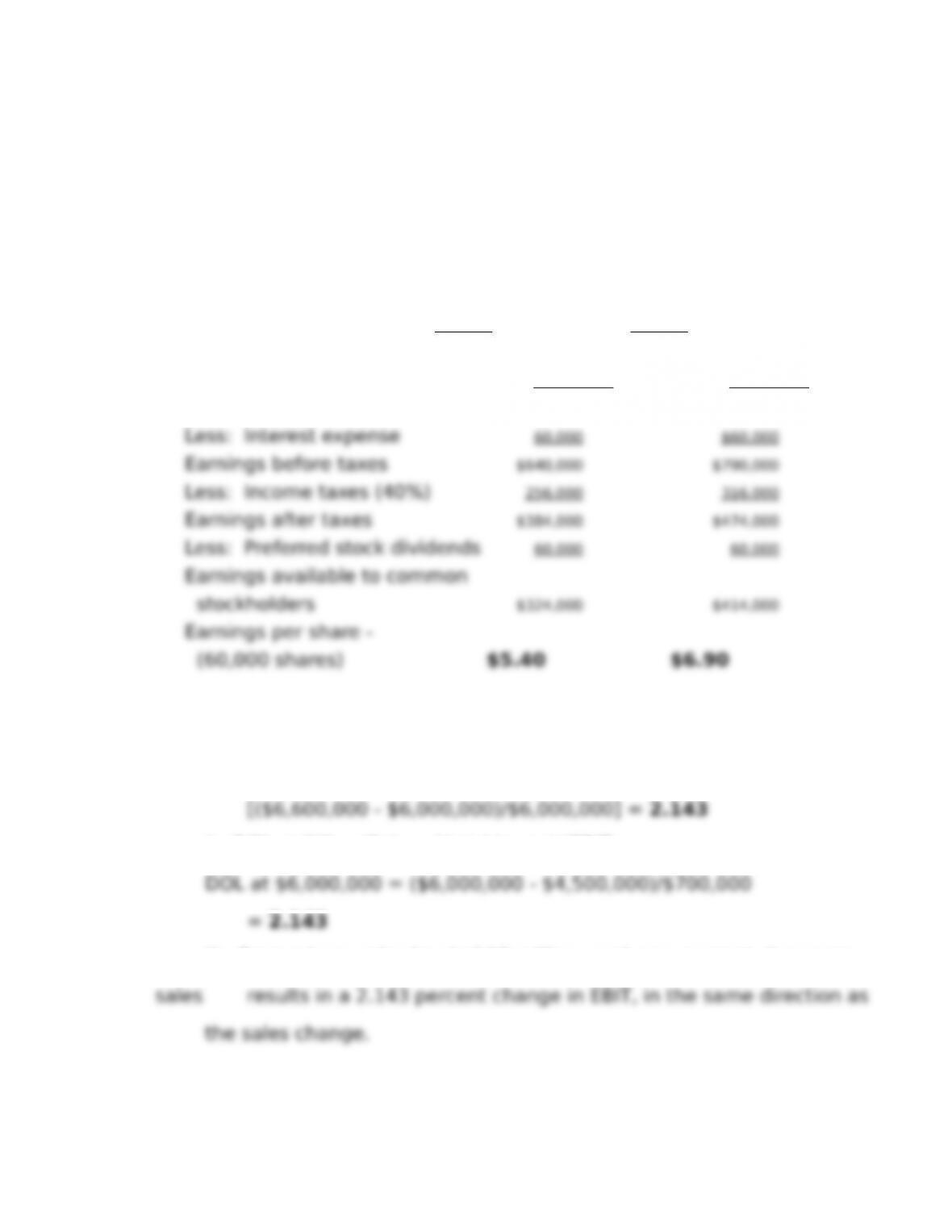
1.a. Sales $6,000,000 $6,600,000
Less: Variable operating
costs $4,500,000 $4,950,000
Fixed operating
costs 800,000 800,000
Total operating
costs $5,300,000 $5,750,000
EBIT $700,000 $850,000
b. i. DOL at “X” = (EBIT/EBIT)/(Sales/Sales)
DOL at $6,000,000 = [($850,000-$700,000) / $700,000] /
ii. DOL at “X” = (Sales – Variable cost)/EBIT
iii. From a base sales level of $6 million, each one percent change in
c. i. DFL at “X” = (EPS/EPS)/(EBIT/EBIT)
14-7
Chapter 14
Capital Structure Management in Practice
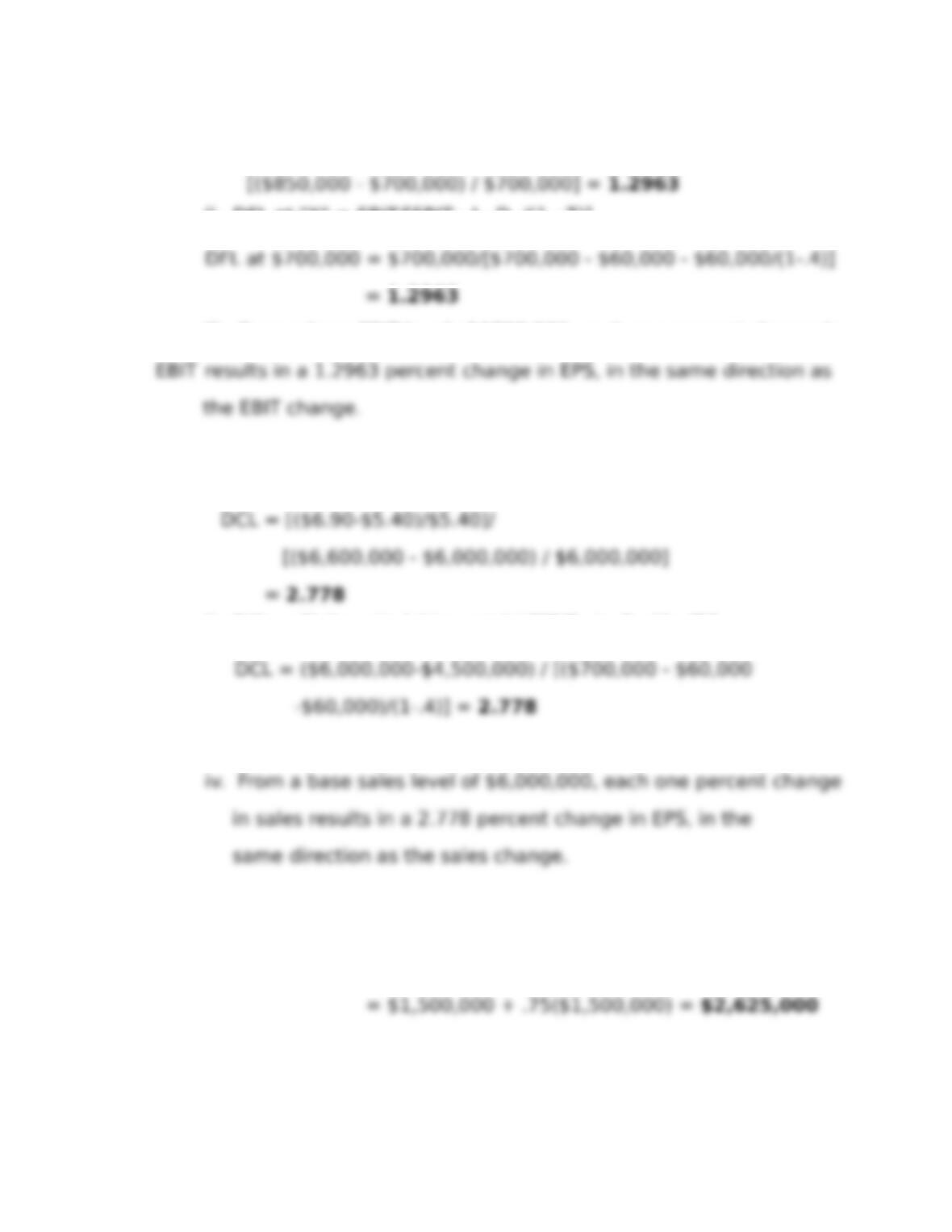
DFL at $700,000 = [($6.90 – $5.40)/$5.40]/
ii. DFL at “X” = EBIT/[EBIT – I – Dp/(1 – T)]
iii. From a base EBIT level of $700,000, each one percent change in
d. i. DCL = (EPS/EPS)/(Sales/Sales)
ii. DCL = (Sales – Variable costs) / [EBIT – I – Dp/(1 – T)]
iii. DCL = DOL x DFL = 2.143 x 1.2963 = 2.778
2. a. Fixed operating costs = Depreciation + .75(General,
administrative, and selling expenses)
14-7
Chapter 14
Capital Structure Management in Practice
Variable operating costs = Total operating costs minus >xed
operating costs
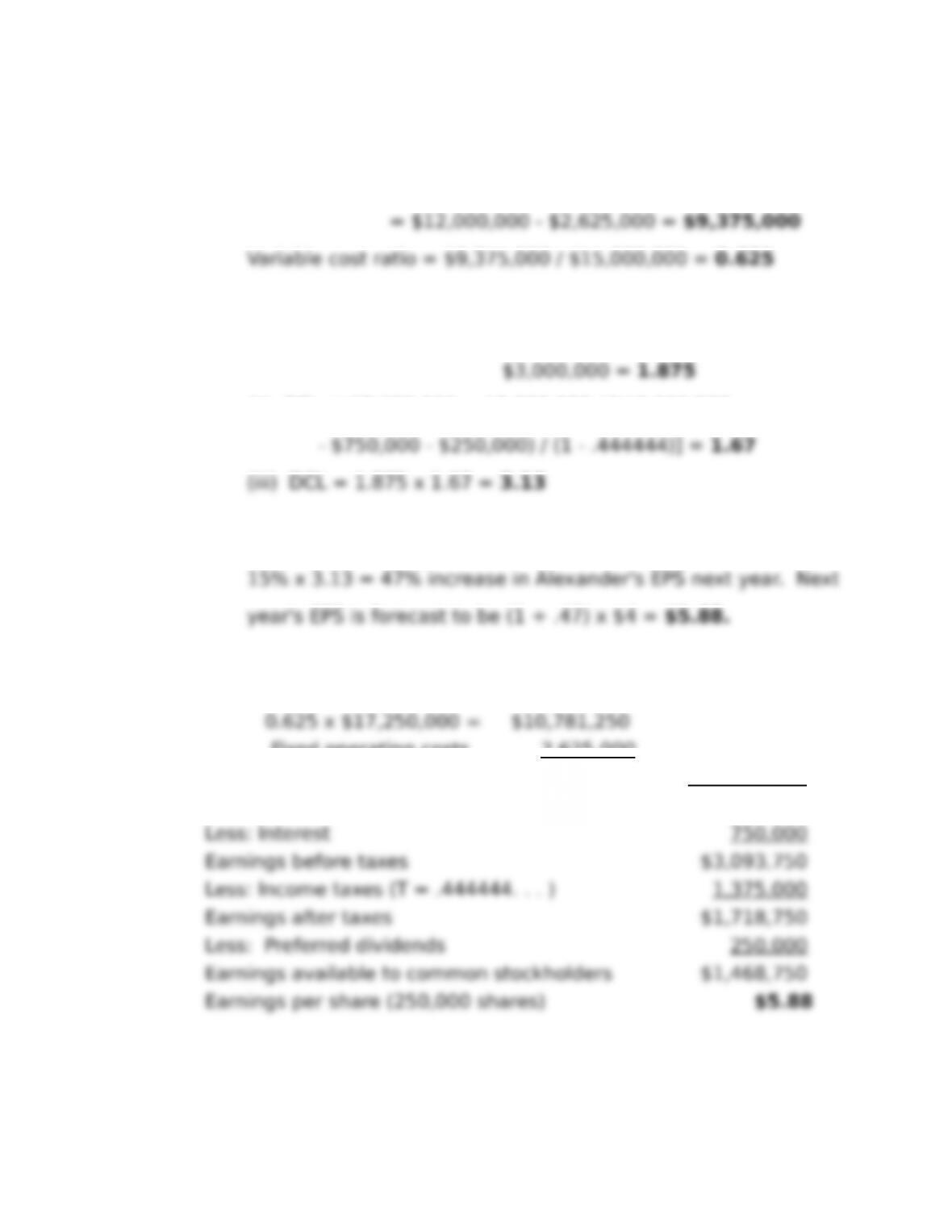
b. (i) DOL at $15 million = ($15,000,000 – $9,375,000) /
(ii) DFL at $3,000,000 = $3,000,000 / [($3,000,000
c. DCL = 3.13, therefore a 15% increase in sales will yield a
d. Sales ($15,000,000 x 1.15) = $17,250,000
Less: Variable operating costs
Fixed operating costs 2,625,000
Total operating costs $13,406,250
EBIT $3,843,750
e. No solution provided
3. a. Sales = $3,000,000
14-7
Chapter 14
Capital Structure Management in Practice
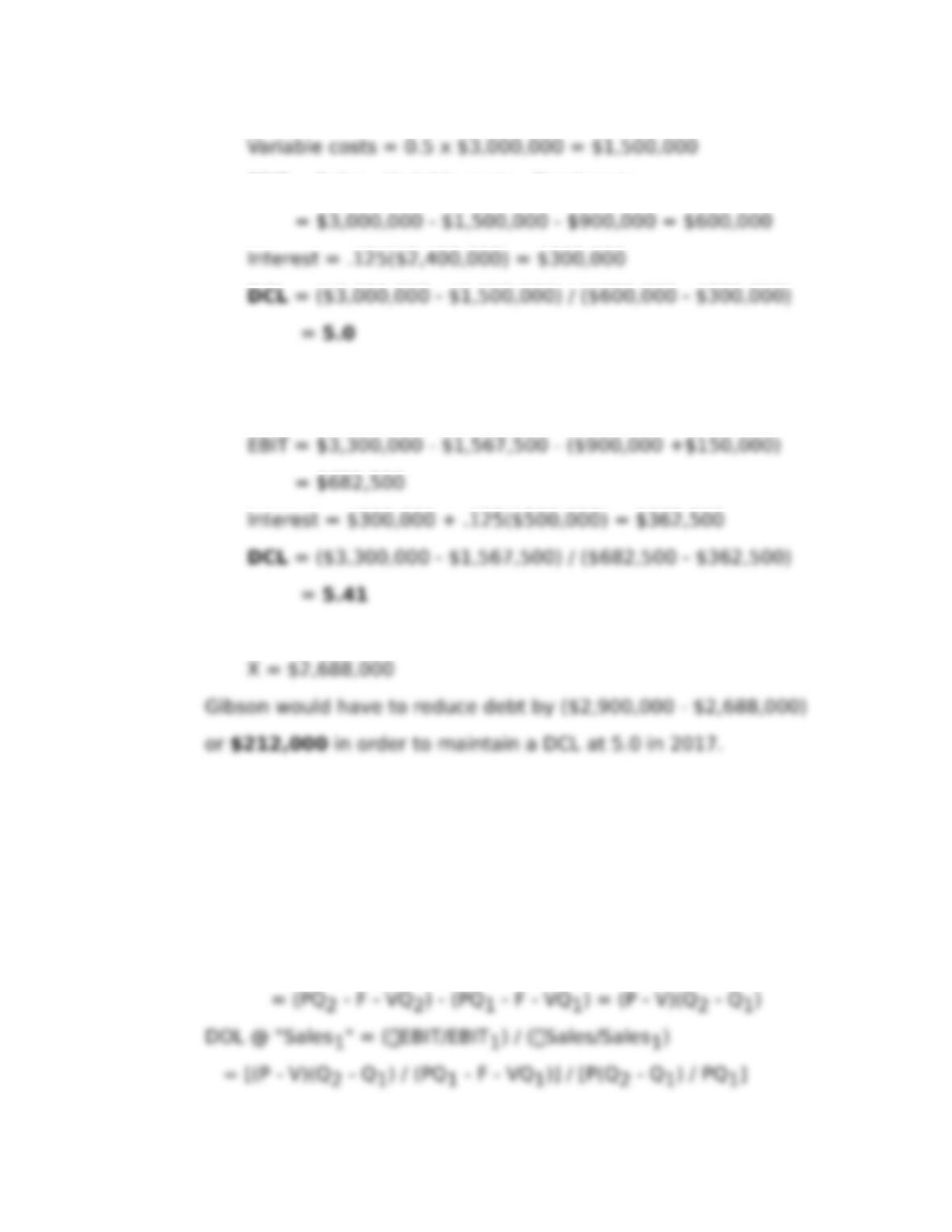
EBIT = Sales – Variable costs – Fixed costs
b. Sales = 1.1 x $3,000,000 = $3,300,000
Variable costs = .475 x $3,300,000 = $1,567,500
c. 5.0 = ($3,300,000 – $1,567,500) / ($682,500 – .125X)
4. Sales = P x Q
EBIT = P x Q – F – V x Q, where P = price/unit; F = >xed cost;
V = variable cost/unit
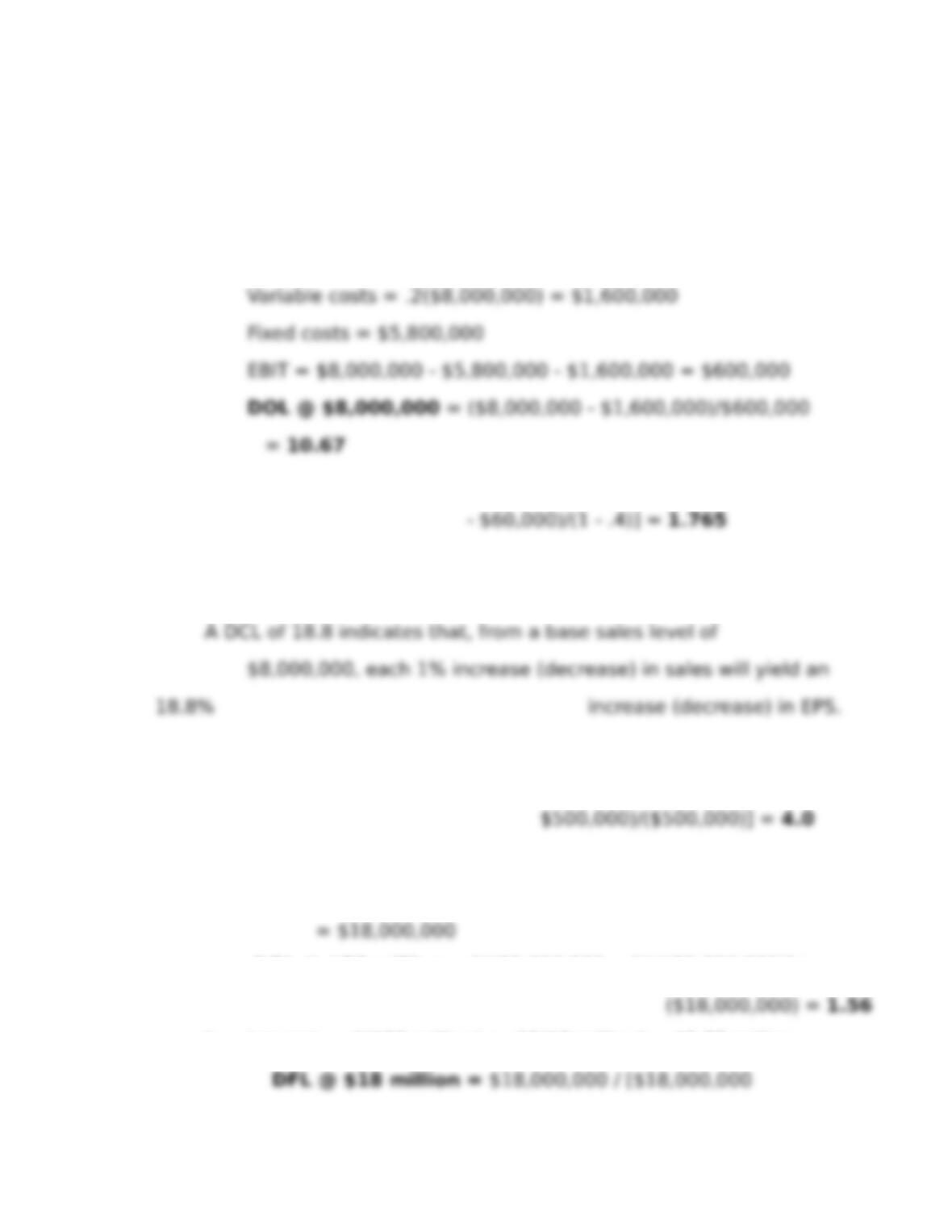
Sales = Sales2 – Sales1 = PQ2 – PQ1 = P(Q2 – Q1)
EBIT = EBIT2 – EBIT1
14-7
Chapter 14
Capital Structure Management in Practice
= (P – V)Q1 /(PQ1 – F – VQ1) = (PQ1 – VQ1)/(PQ1 – F – VQ1)
= (Sales1 – Variable cost1)/EBIT1
5. a. Sales = $8,000,000
b. DFL @ $600,000 = $600,000 / [($600,000 – $160,000
c. DCL = DOL x DFL = 10.67 x 1.765 = 18.8
6. DCL @ $500,000 = [($1.56 – $1.00)/$1.00] / [($570,000 –
7. a. EBIT = $80,000,000 – .65($80,000,000) – $10,000,000
DOL @ $80 million = [($80,000,000 – .65($80,000,000)] /
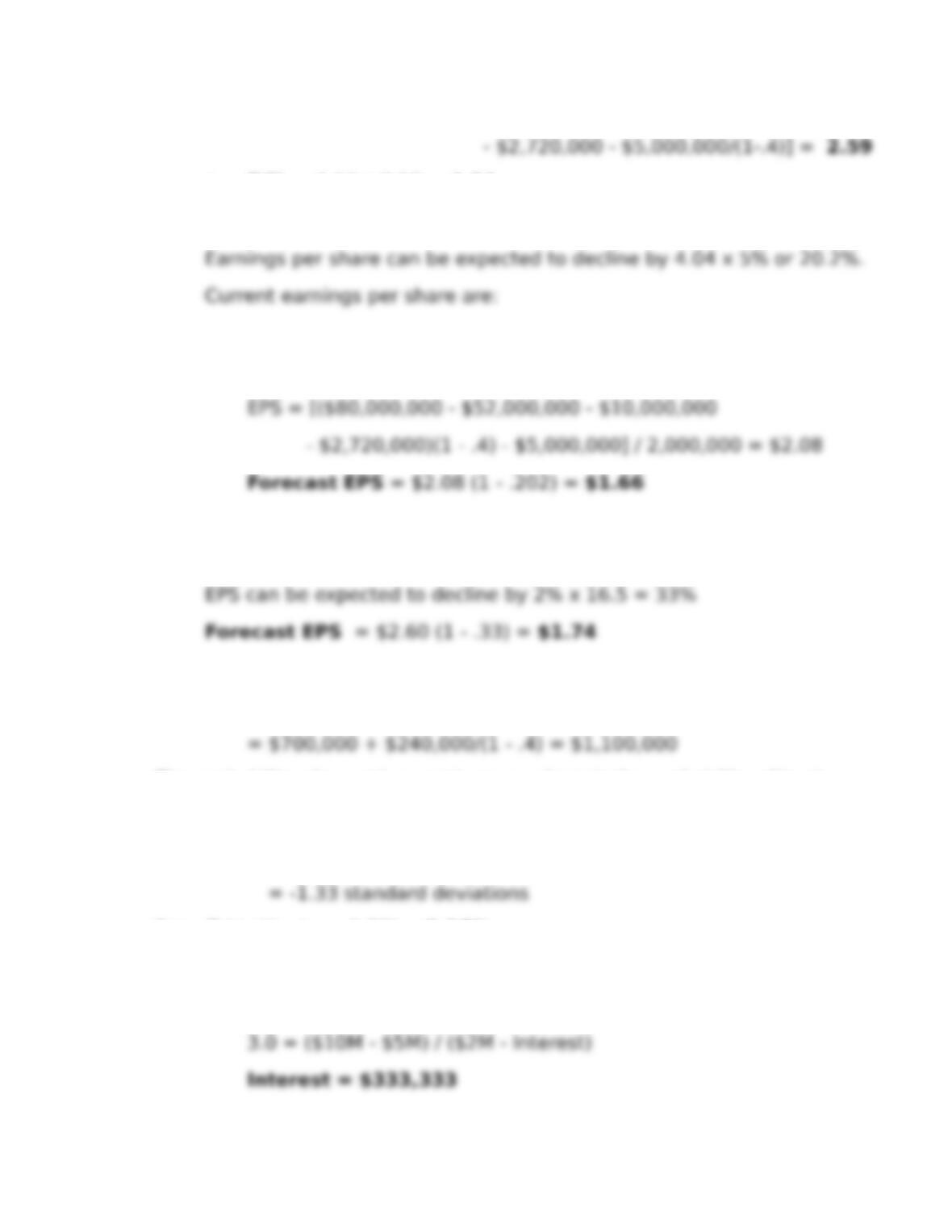
b. Interest = .1($20 million) + .12($6 million) = $2.72 million
14-7
Chapter 14
Capital Structure Management in Practice
c. DCL = 1.56 x 2.59 = 4.04
A sales decline to $76 million represents a 5 percent sales decline.
EPS = (Sales – Variable operating cost – Fixed operating cost – Interest
– Taxes – Preferred dividends) / Number of common shares
8. DCL = DOL x DFL = 3.0 x 5.5 = 16.5
9. Loss level of EBIT = Interest plus pretax preferred stock dividends
The probability of negative earnings per share is the probability of having
operating income less than the loss level.
z = ($1,100,000 – $1,500,000)/$300,000
From Table V, p(z < -1.33) = 9.18%
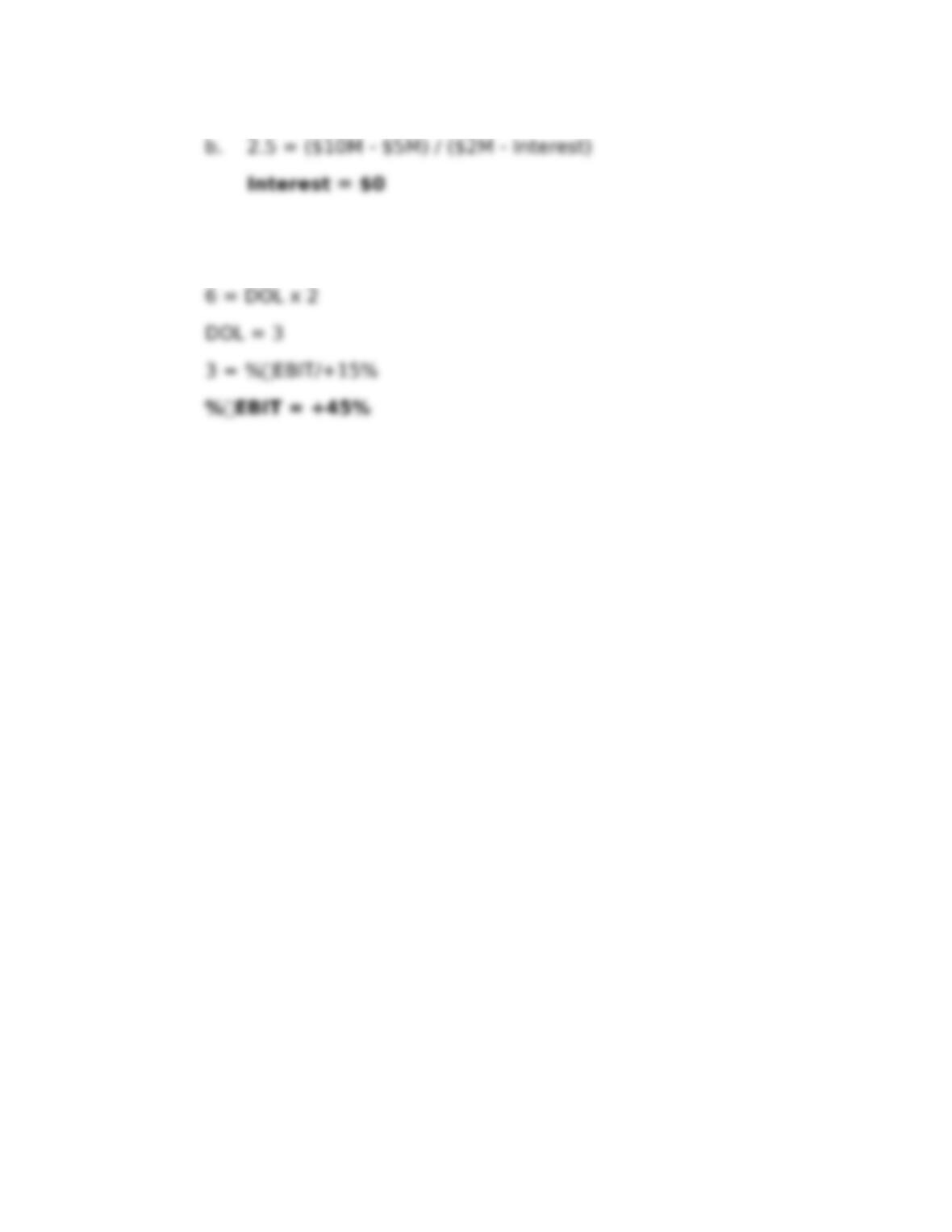
10. a. DCL = (Sales – Variable cost)/[EBIT – Interest – Dp/(1-T)]
14-7
Chapter 14
Capital Structure Management in Practice
11. DCL = DOL x DFL
14-7