Chapter 13
Capital Structure Concepts
CHAPTER 13
CAPITAL STRUCTURE CONCEPTS
ANSWERS TO QUESTIONS:
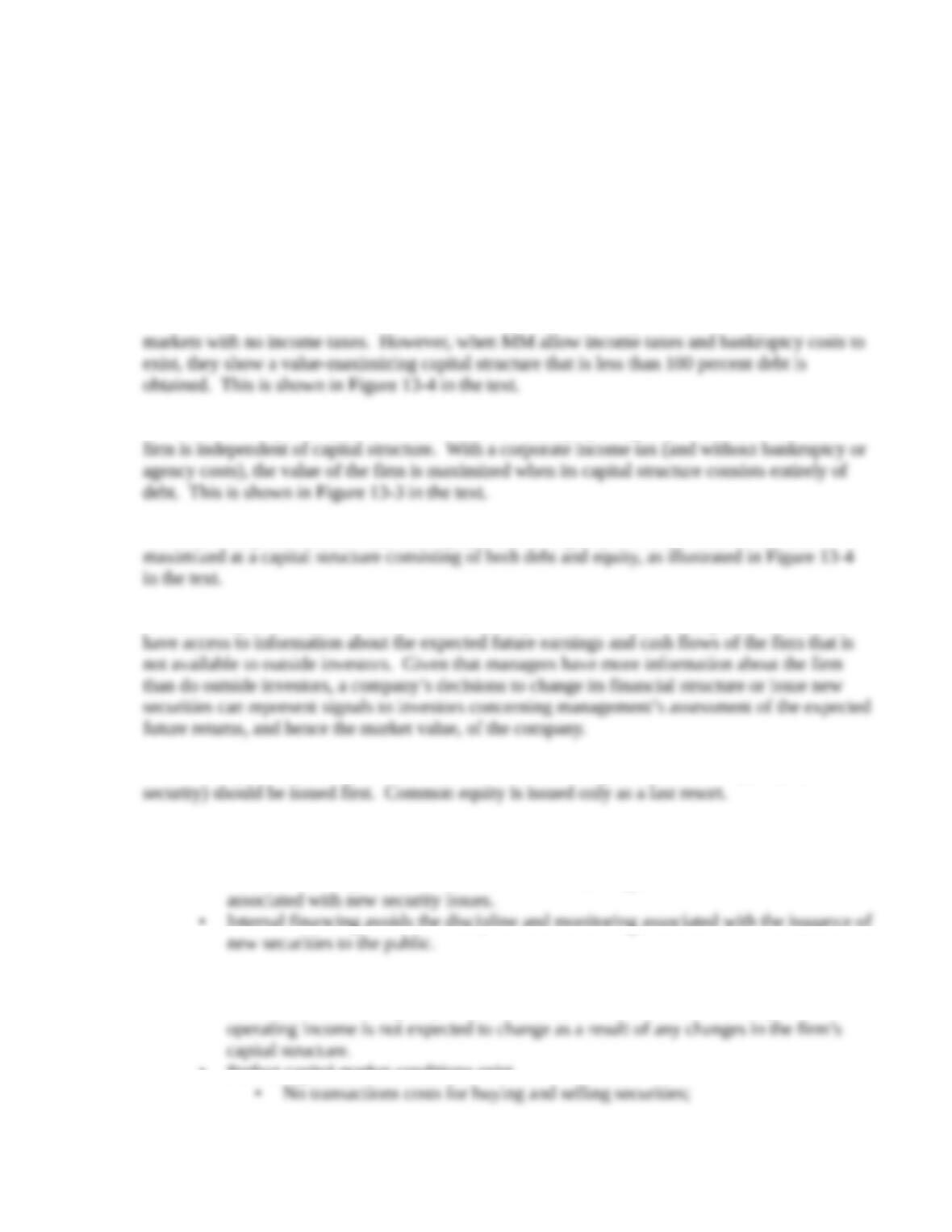
1. MM conclude that the value of a firm is independent of its capital structure in perfect capital
2. Without a corporate income tax (and without bankruptcy or agency costs), the value of the
3. With a corporate income tax, bankruptcy costs and agency costs, the value of the firm is
4. According to the asymmetric information concept, the officers and managers (i.e., insiders)
5. According to the pecking order theory, if external financing is required, debt (the safest
6. According to the pecking order theory, firms prefer internal financing to external financing for
two primary reasons:
• Internal financing is less costly than external financing because of the flotation costs
• Internal financing avoids the discipline and monitoring associated with the issuance of
7. Assumptions:
• The firm’s investment policy is held constant, i.e. the level and variability of
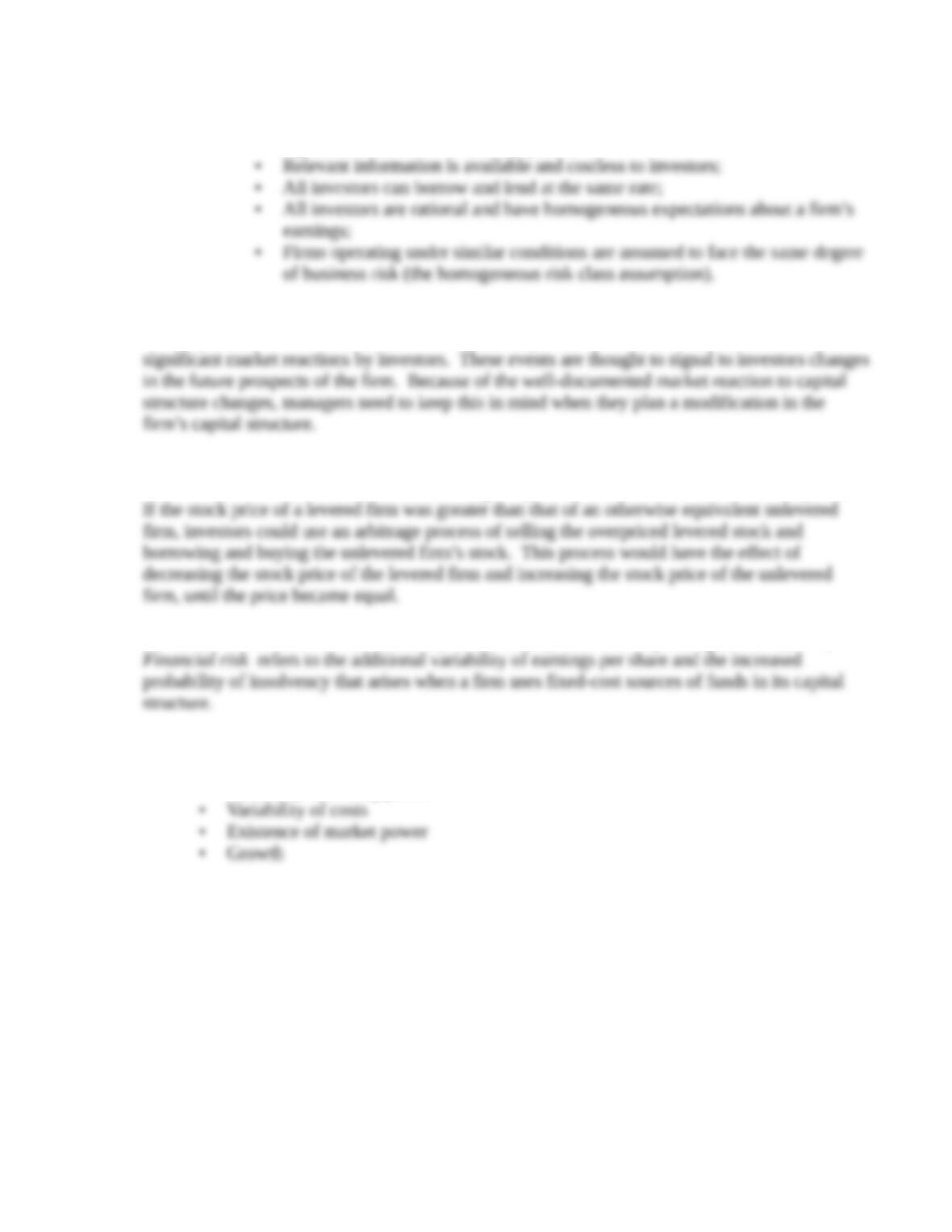
• Perfect capital market conditions exist
13-7
Chapter 13
Capital Structure Concepts
• Large number of buyers and sellers so that no one investor can have a
significant influence on security prices;
8. Changes in capital structure, such as the issuance of new equity, new debt, or the retirement of
debt, repurchase of common stock, or retirement of preferred stock have been associated with
9. Arbitrage is the process of simultaneously buying and selling the same or equivalent
securities in different markets to take advantage of price differences and make a riskless profit.
10. Business risk refers to the variability or uncertainty of a firm’s operating income (EBIT).
11. Additional factors affecting business risk include:
• Variability of sales volumes over the business cycle
• Variability of selling prices
13-7
Chapter 13
Capital Structure Concepts
SOLUTIONS TO PROBLEMS:
1. Value of firm L = D/ke + I/kd
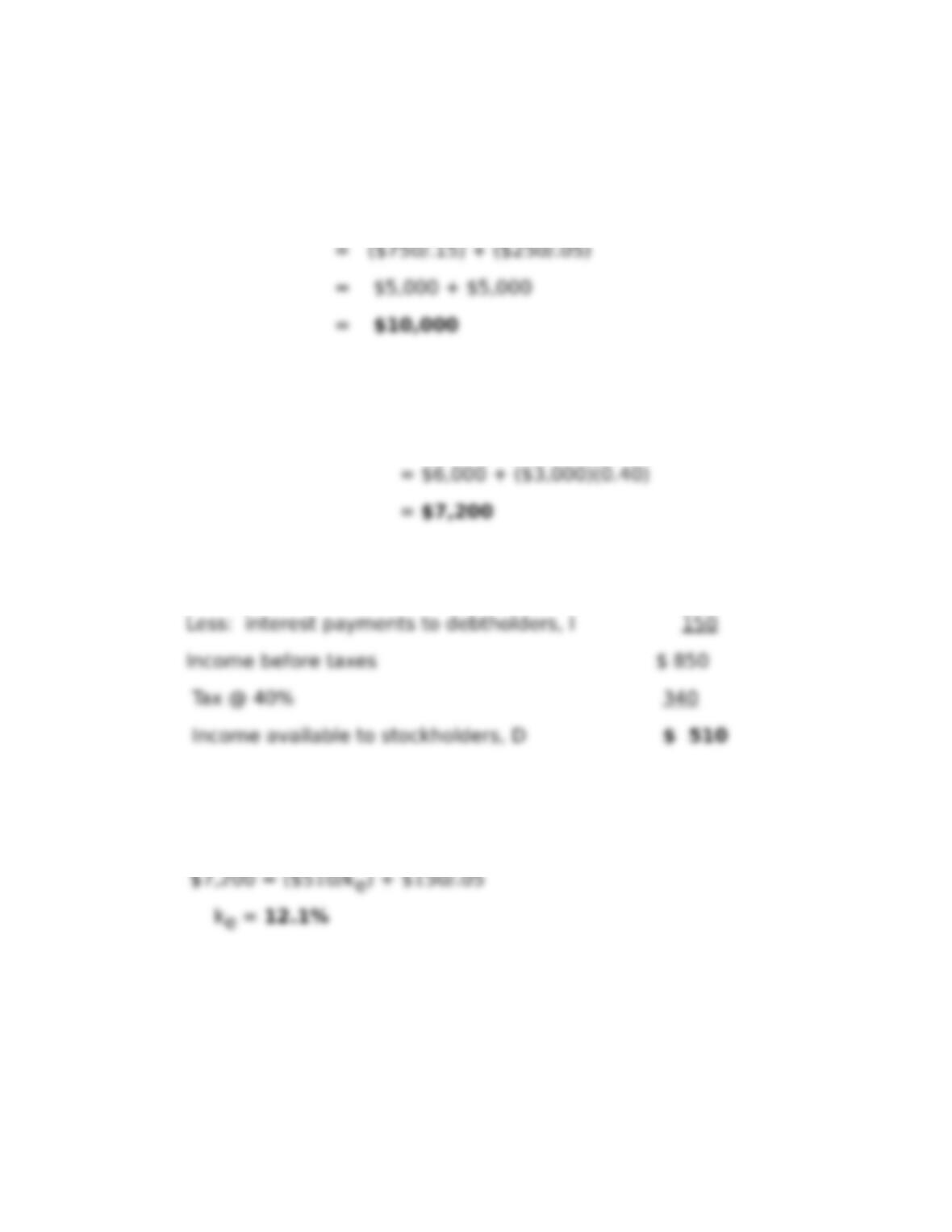
2. a. Value of levered firm = Value of unlevered firm
+ Value of tax shield
b. Net operating income (EBIT) $1,000
Value of levered firm = $7,200 (from Part a)
Value of levered firm = D/ke + I/kd
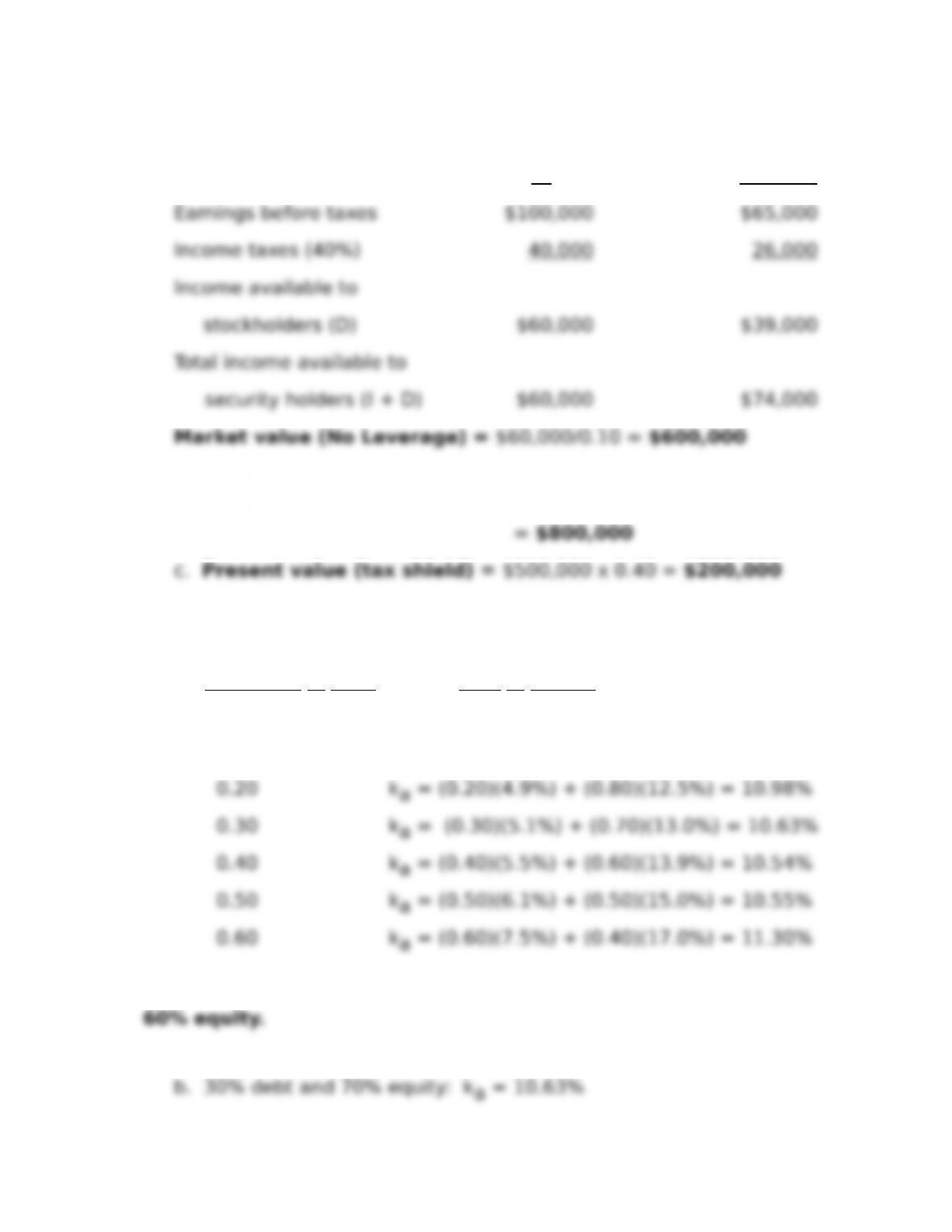
3. a. No Leverage, Inc. High Leverage, Inc.
13-7
Chapter 13
Capital Structure Concepts
Net operating income (EBIT) $100,000 $100,000
Less: interest payments (I) — $35,000
b. Market value (High Leverage) = $39,000/0.13 + $35,000/0.07
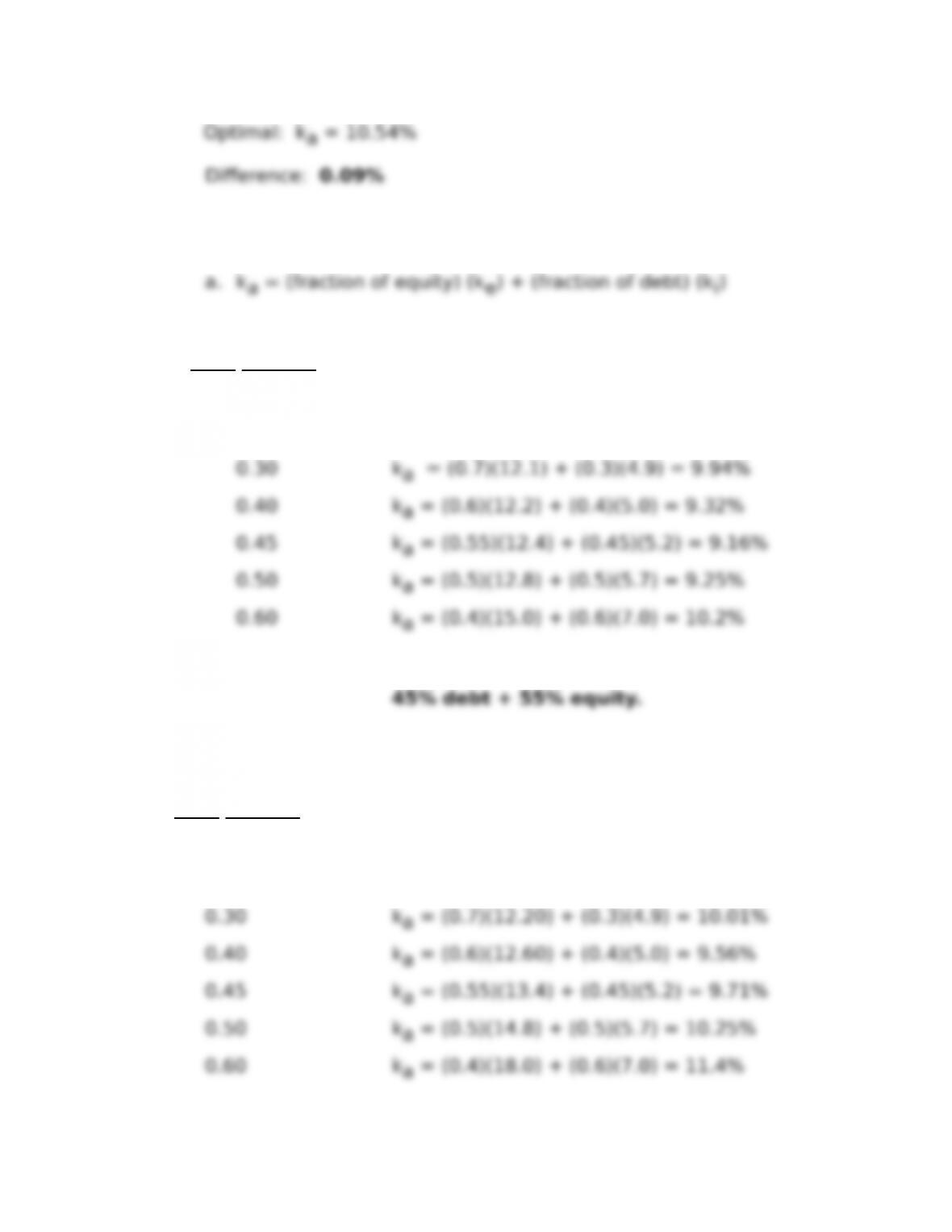
4. a.
Proportion of Debt Cost of Capital
0.00 ka = 12.0%
0.10 ka = (0.10)(4.7%) + 0.90(12.1%) = 11.36%
Therefore, the optimal capital structure is approximately 40% debt and
13-7
Chapter 13
Capital Structure Concepts
5. Piedmont Instrument
(i) With financial distress costs and without agency costs:
Debt Fraction
0.00 ka = 12.0%
0.10 ka = (0.9)(12.05) + (0.1)(4.8) = 11.33%
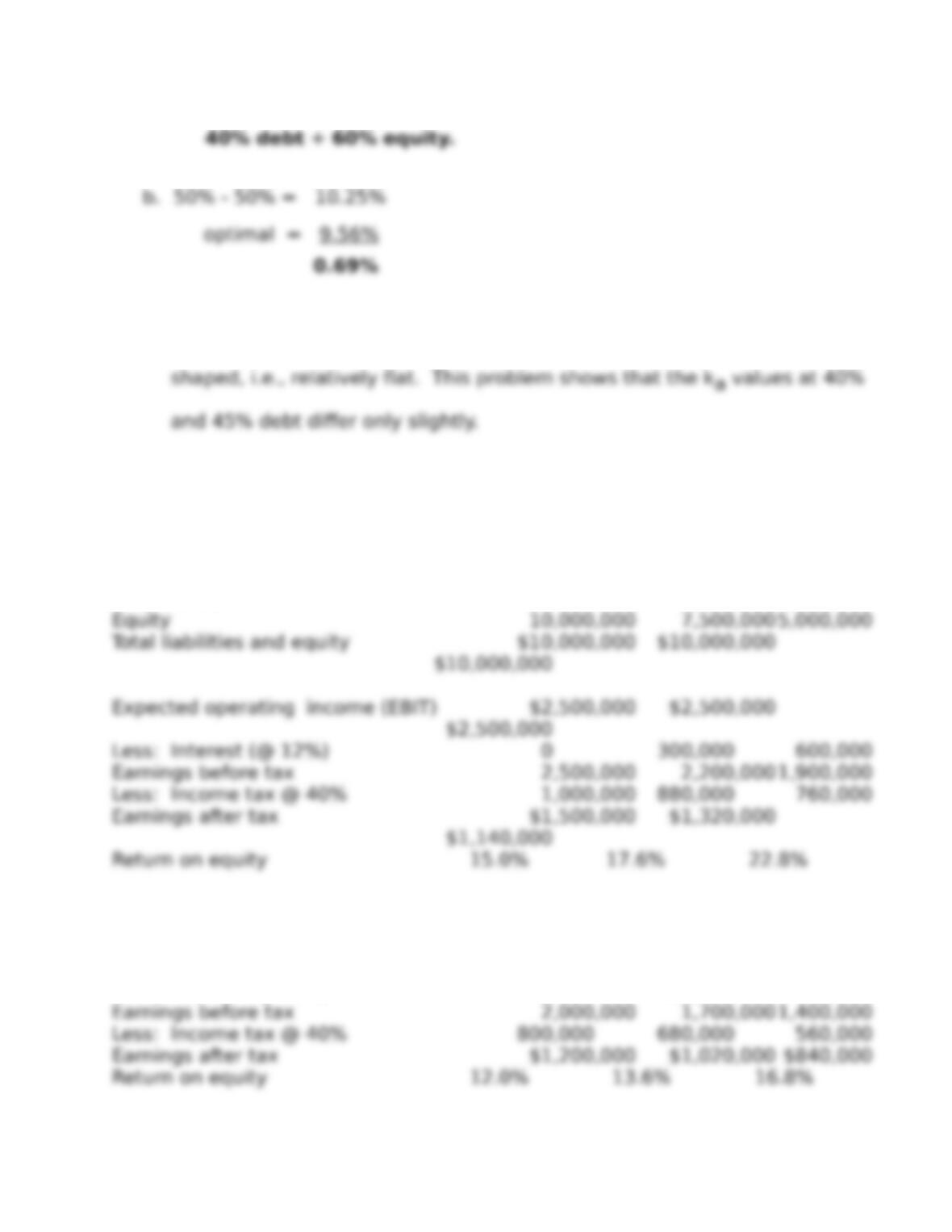
Therefore, the optimal capital structure is approximately
(ii.) With financial distress and agency costs:
Debt Fraction
0.00 ka = 12.0%
0.10 ka = (0.9)(12.05) + (0.1)(4.8) = 11.33%
Therefore, the optimal capital structure is approximately
13-7
Chapter 13
Capital Structure Concepts
c. No, because in practice the optimal portion of the ka curve is saucer–
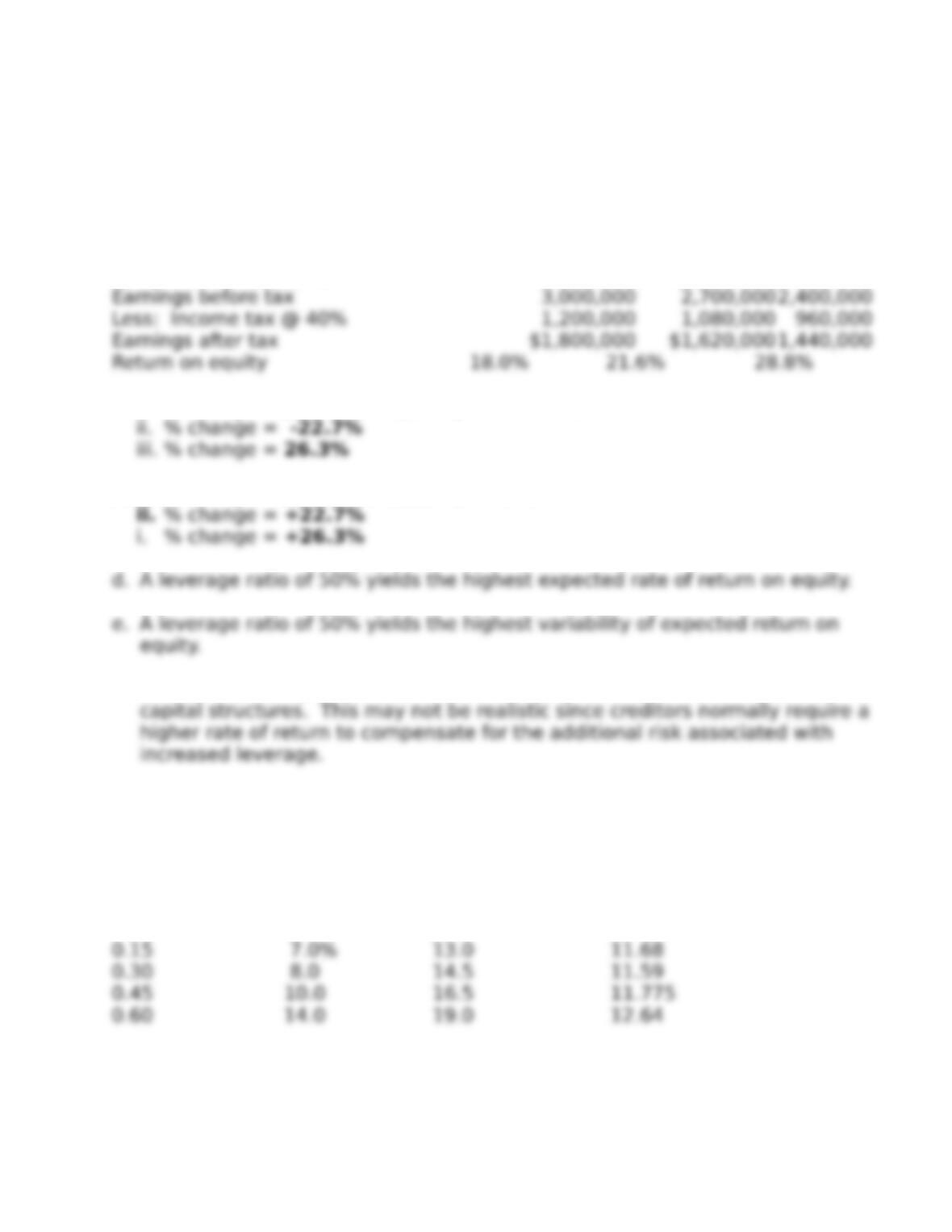
6. a. Leverage Ratio (Debt/Total Assets)
0% 25% 50%
Total assets $10,000,000 $10,000,000
$10,000,000
Debt (12%) 0 2,500,0005,000,000
Effect of a 20% Decrease in EBIT to $2,000,000
Expected operating income (EBIT) $2,000,000 $2,000,000
$2,000,000
Less: Interest (@ 12%) 0 300,000 600,000
13-7
Chapter 13
Capital Structure Concepts
Effect of a 20% Increase in EBIT to $3,000,000
Expected operating income (EBIT) $3,000,000 $3,000,000
$3,000,000
Less: Interest (@ 12%) 0 300,000 600,000
b. i. % change = [(12% – 15%)/15%] x 100% = -20%
c. i. % change = [(18% – 15%)/15%] x 100% = +20%
f. The cost of debt (12%) was assumed to remain constant under the various
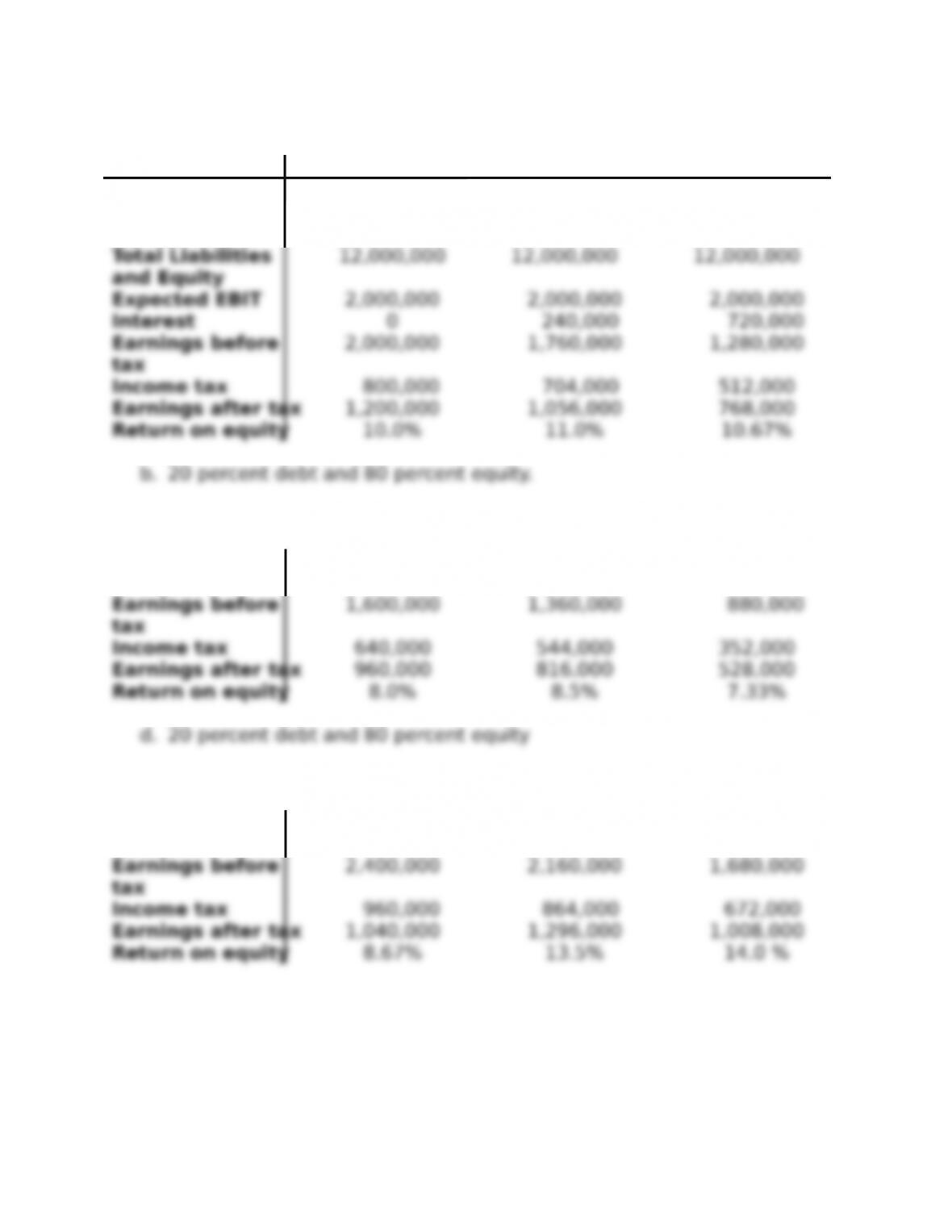
7. a.
Debt ratio Pre-tax cost Cost of equity Weighted average cost
[B / (B + E)] of debt (kd) ke of capital (ka)
0.00 – 12.0% 12.00%
b. 30% debt and 70% equity minimizes the firm’s weighted cost of capital.
13-7
Chapter 13
Capital Structure Concepts
8. a.
Debt/Total Assets 0% 20% 40%
Total Assets $12,000,000 $12,000,000 $12,000,000
Debt 0 2,400,000 4,800,000
Equity 12,000,000 9,600,000 7,200,000
c. 20 percent decrease in EBIT to $1,600,000
Expected EBIT 1,600,000 1,600,000 1,600,000
Interest 0 240,000 720,000
e. 20 percent increase in EBIT to $2,400,000
Expected EBIT 2,400,000 2,400,000 2,400,000
Interest 0 240,000 720,000
f. 40 percent debt and 60 percent equity.
13-7
Chapter 13
Capital Structure Concepts
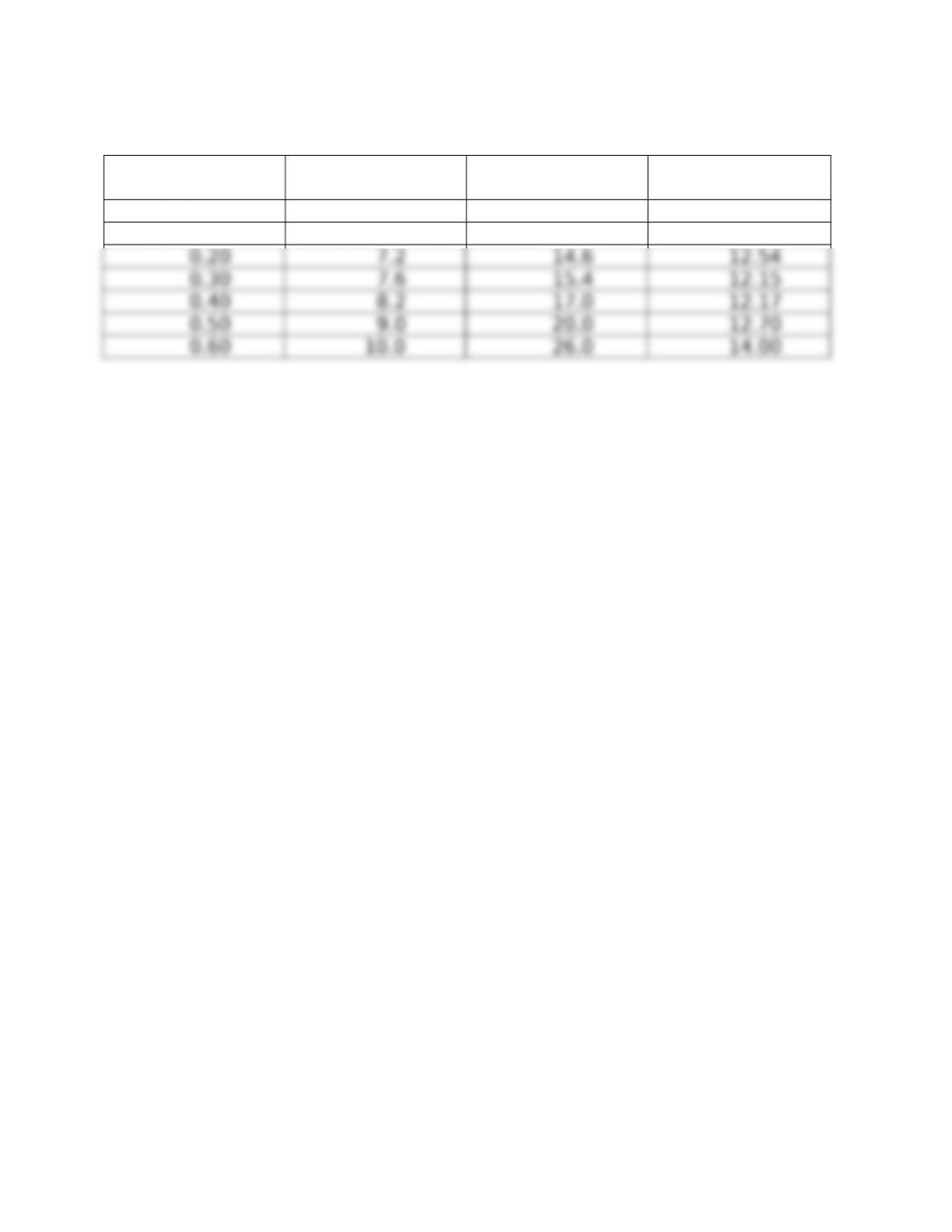
9.
Debt Ratio Pre-tax cost of
debt
Cost of equity Weighted Cost of
Capital
0.00 — 14.0% 14.0%
0.10 7.0% 14.2 13.20
The optimal capital structure is 30 percent debt and 70 percent equity.
10. No recommended solution.
13-7