Chapter 12
Cost of Capital
CHAPTER 12
COST OF CAPITAL
ANSWERS TO QUESTIONS:
1. Retained earnings are an internally generated source of financing whereas other sources of
2. The retained earnings figure on a firm’s balance sheet represents the cumulative earnings that
have been retained in the business (assuming no stock dividends or other accounting entries have
3. Corporate long-term debt is more risky than government long-term debt because the corporate
debt is subject to business and financial risk whereas the government debt is not subject to these
4. Common stock is more risky than preferred stock because the dividends paid to common
5. Because the cost of external common stock exceeds the cost of retained earnings at any given
While such a policy may be sensible for a firm whose established dividend policy is residual, it
may not be the best policy for a company whose clientele expect stable dividends. The company
The literature of agency theory argues that dividend payments at the same time that new equity is
12-2
Chapter 12
Cost of Capital
6. The optimal capital budget occurs at the point where the investment opportunities curve and
7. Depreciation-generated funds have an opportunity cost equal to the firm’s weighted marginal
8. The breakpoints in the marginal cost of capital schedule are determined by dividing the
9. The best estimates of the future earnings and dividends growth rates for a company generally
are those which are available from security analysts. Research has supported the forecasting
10. a. When the risk-free rate is the 90-day Treasury bill rate, the market risk premium that
b. When the risk-free rate is the 20-year Treasury bond rate, the market risk premium that
11. The factors that determine the required rate of return for a security include the risk-free rate
12. Both preferred stock and debt are normally fixed cost sources of financing. Payments of
13. The marginal cost of capital reflects the current opportunity cost of the funds available to a
12-2
Chapter 12
Cost of Capital
SOLUTIONS TO PROBLEMS:
1. ki = kd(1 – t) = (9.375%)(1 – 0.4) = 5.63%
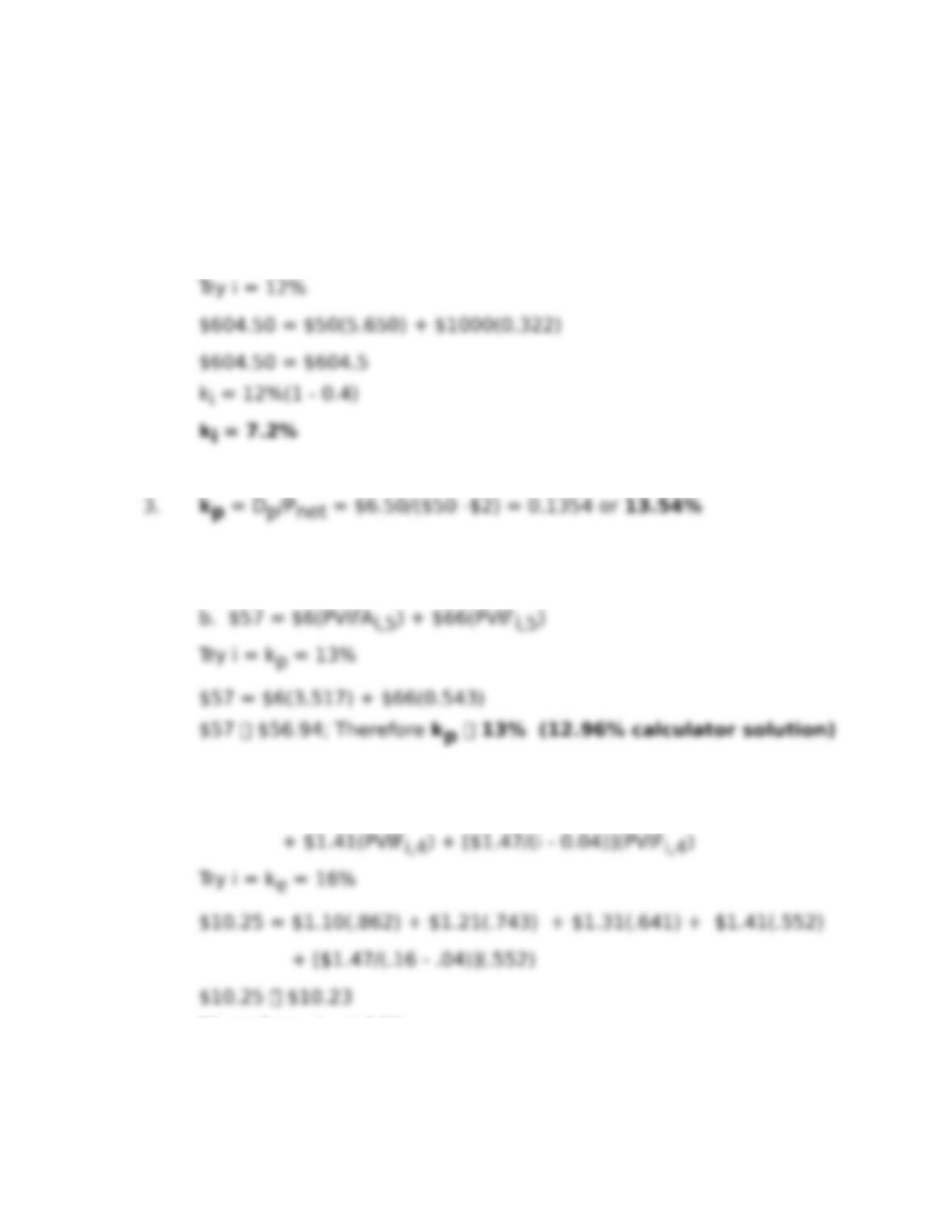
2. $604.50 = $50(PVIFAi,10) + $1000(PVIFi,10)
4. a. kp = $6.00/$57 = 0.1053 or 10.53%
5. $10.25 = $1.10(PVIFi,1) + $1.21(PVIFi,2) + $1.31(PVIFi,3)
Therefore, ke 16%
6. ke = 10% + 0.9(16% – 10%) = 15.4%
12-2
Chapter 12
Cost of Capital
Because the expected return (17%) exceeds the cost of capital
(15.4%), Hartley should invest.
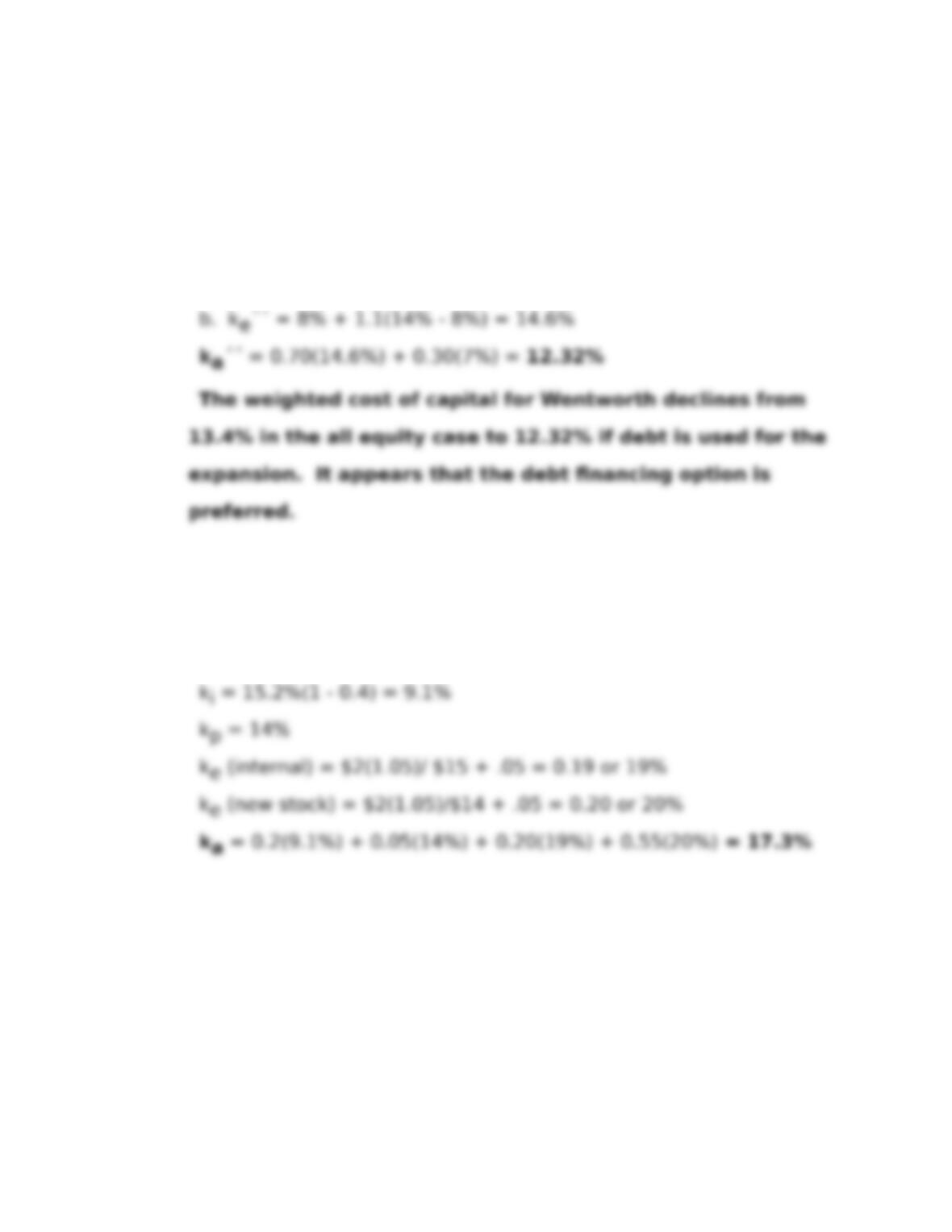
7. a. ke = 8% + 0.9(14% – 8%) = 13.4% = ka in the all equity case.
8. Cost of debt:
$990 = $150(PVIFAi,10) + $1000(PVIFi,10)
i = kd = 15.2% by calculator
(Note: Because this is a single project, this weighted cost of capital is
an average across 2 levels in the marginal cost of capital schedule.)
12-2
Chapter 12
Cost of Capital
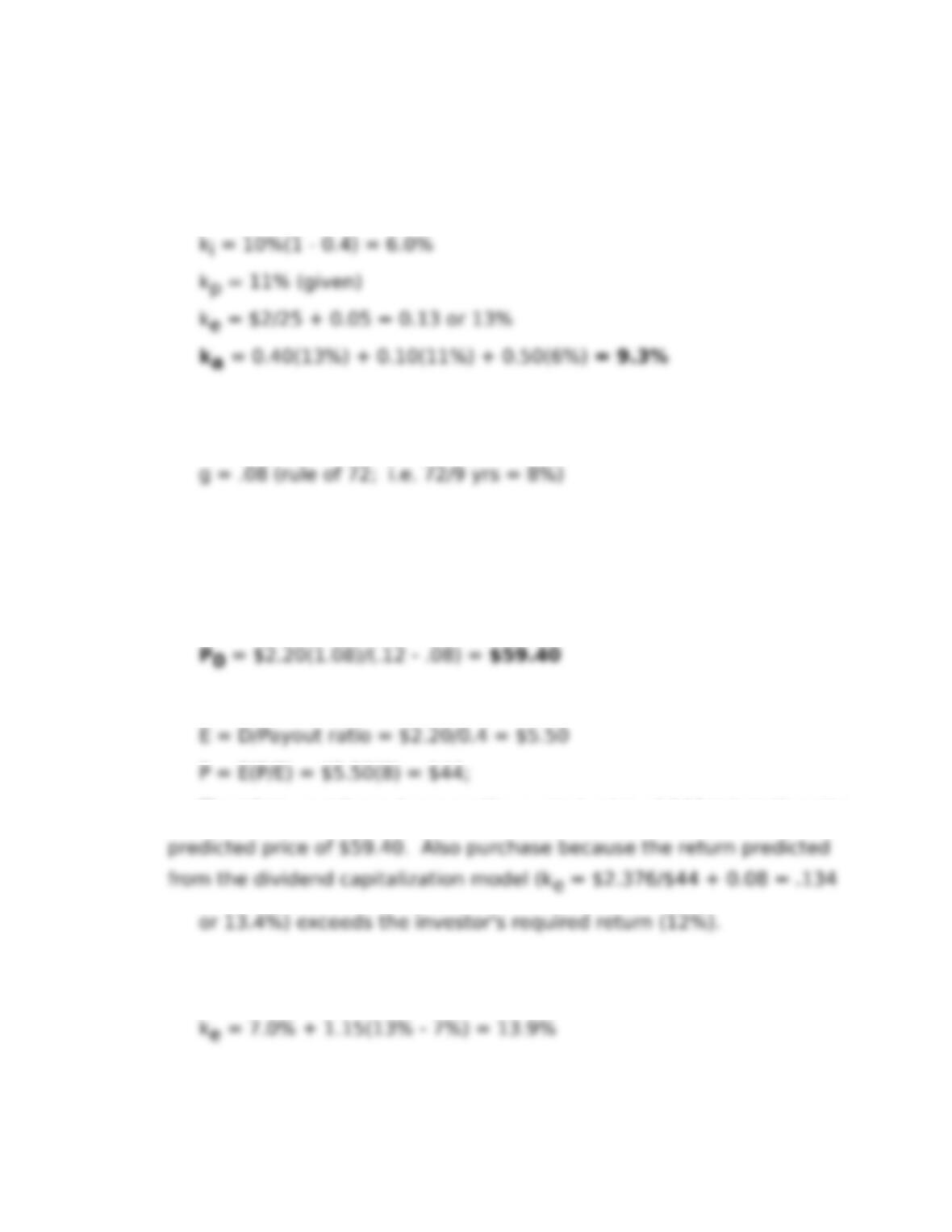
9. Paci=c Intermountain Utilities Company:
Retained earnings = Net income – dividends = $106 MM – 25 MM($2)
= $56 million
10. Panhandle Industries, Inc.
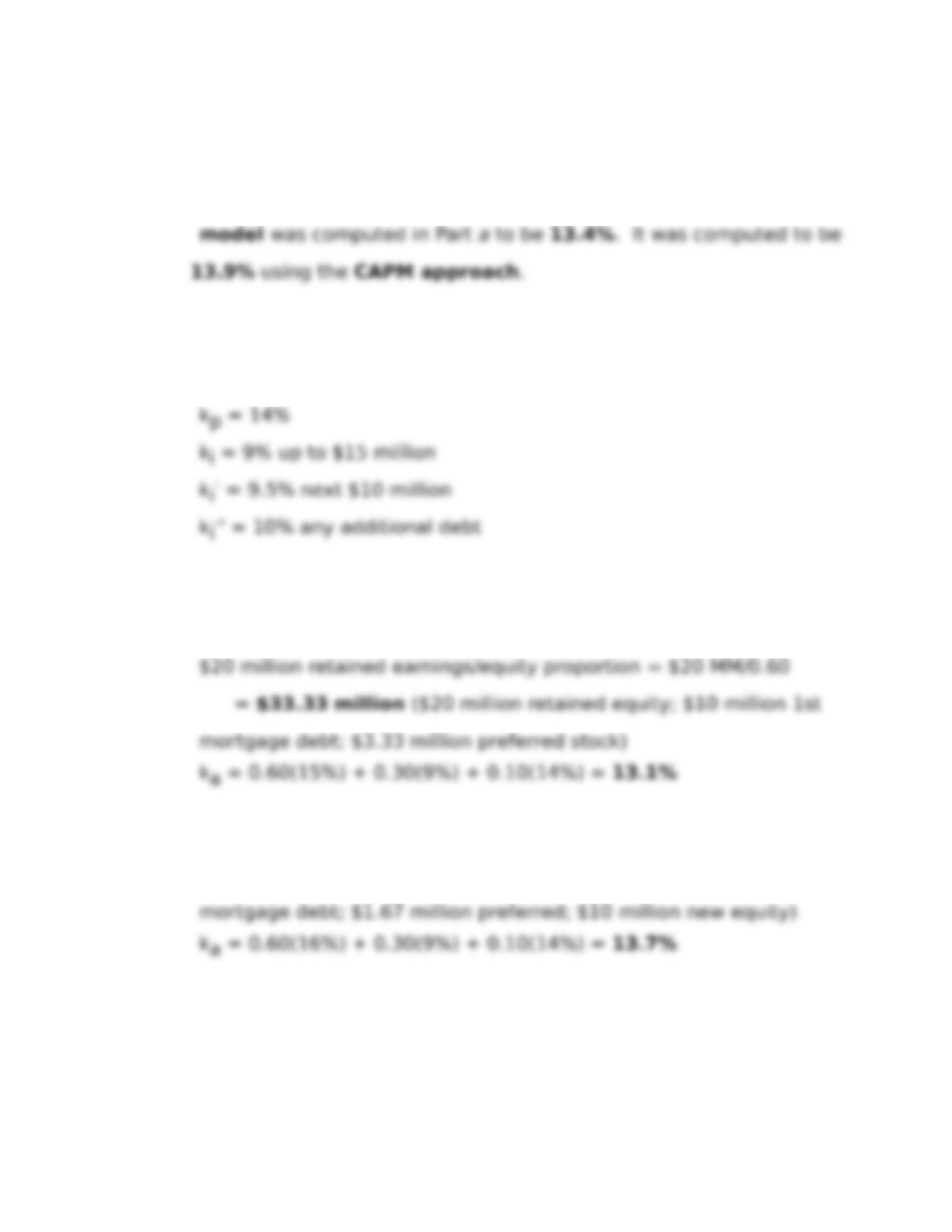
a. Using the dividend capitalization model, this individual investor
would
value the stock as follows:
The present price is calculated as follows:
Therefore, purchase, because the current price of $44 is less than the
Using the CAPM, the expected return is:
Because the expected return from the CAPM exceeds the investor’s
required return, the stock should be purchased.
12-2
Chapter 12
Cost of Capital
b. The cost of equity capital using the dividend capitalization
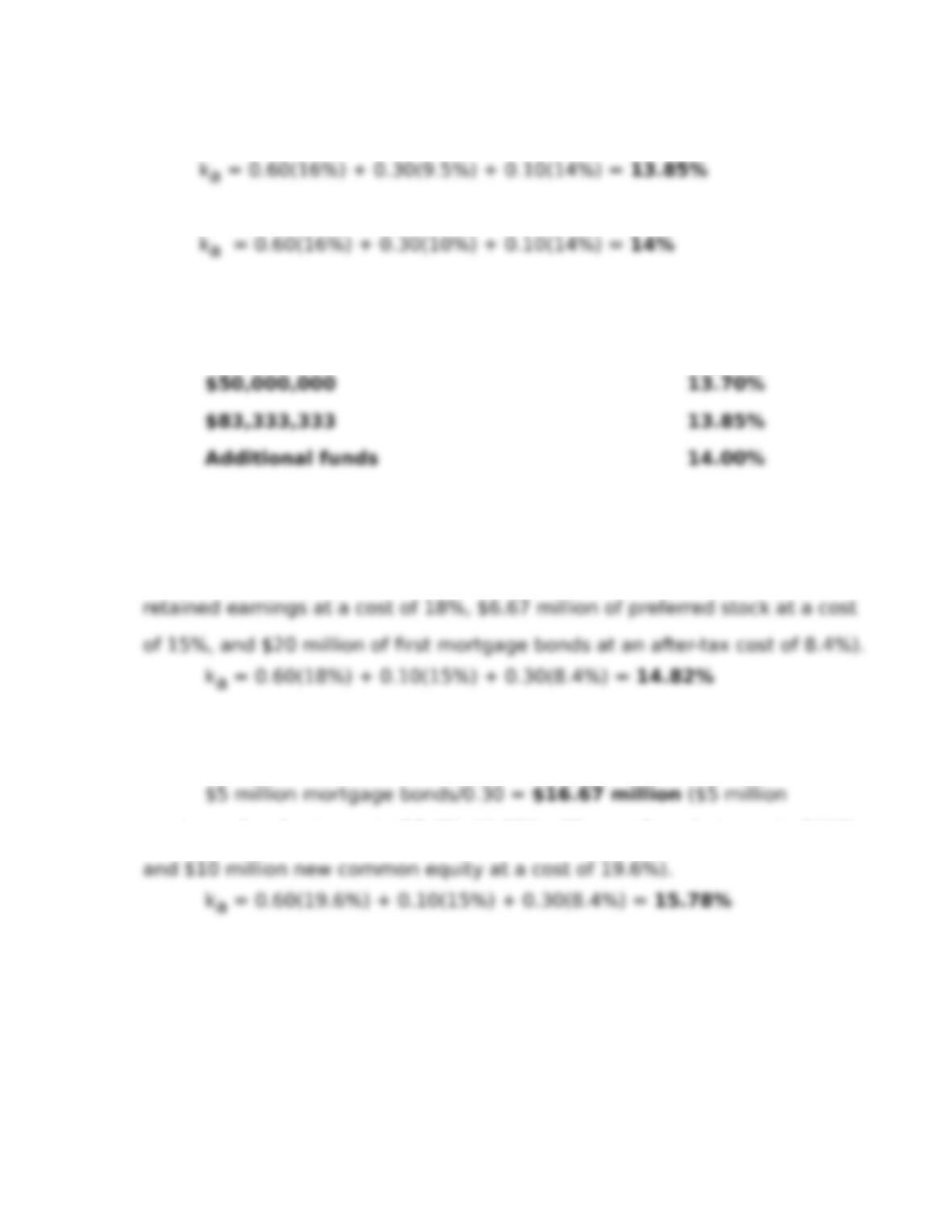
11. ke = 15% up to $20 million (retained earnings)
ke‘ = 16% beyond $20 million (new equity)
Capital structure = 60% common equity, 30% debt, 10% preferred
First break point (and size of first block):
Size of second block :
$5 million mortgage bonds/0.30 = $16.67 million ($5 million 1st
Size of third block:
12-2
Chapter 12
Cost of Capital
$10 million debentures/0.30 = $33.33 million
Cost of additional funds:
Break point Weighted marginal cost of capital
$33,333,333 13.10%
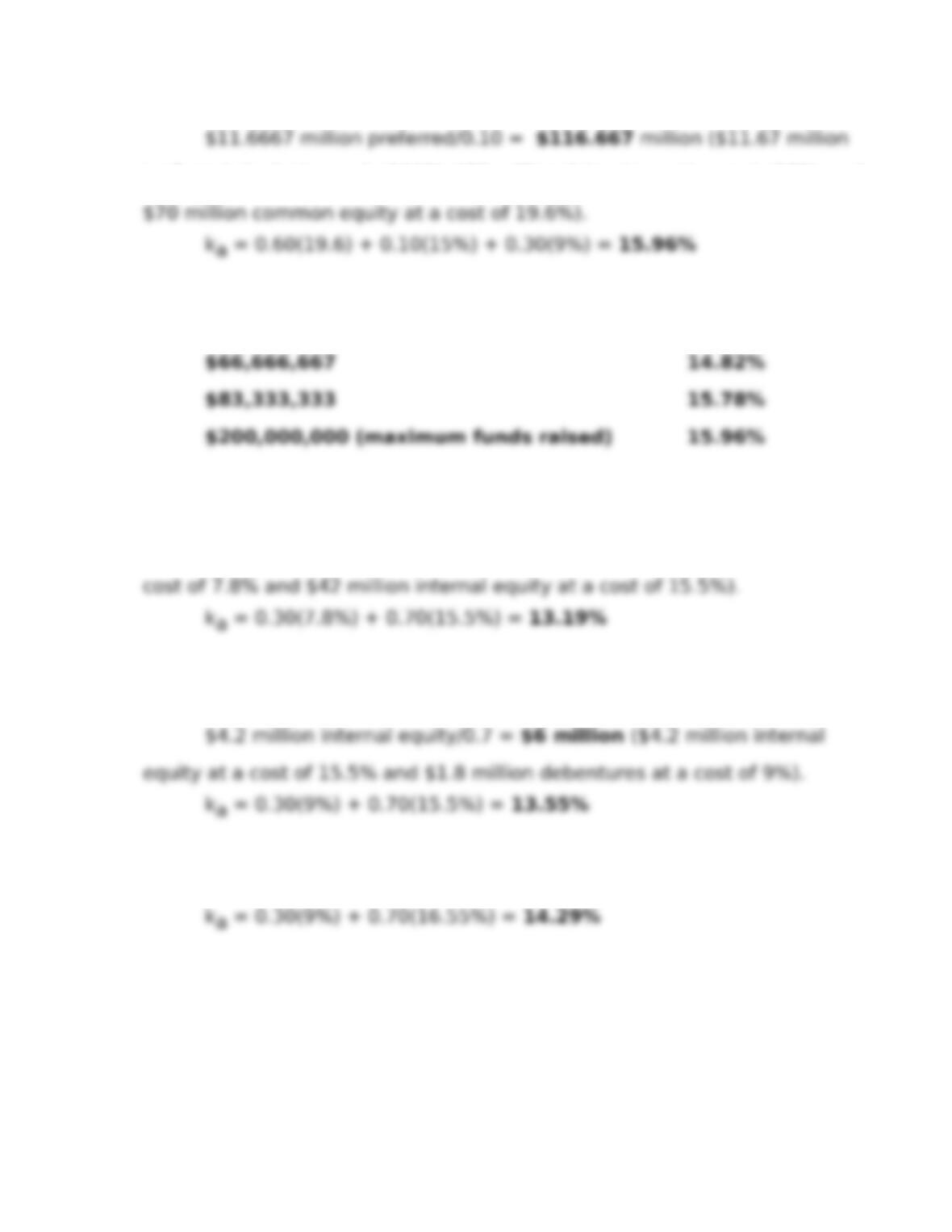
12. Size of first increment:
$40 million retained earnings/0.60 = $66.67 million ($40 million
Size of second increment:
mortgage bonds at a cost of 8.4%, $1.667 million preferred at a cost of 15%,
Size of third increment:
12-2
Chapter 12
Cost of Capital
preferred stock at a cost of 15%, $35 million debentures at a cost of 9%, and
Break point Weighted marginal cost of capital
13. Size of first increment:
$18 million bank debt/0.30 = $60 million ($18 million bank debt at a
Size of second increment:
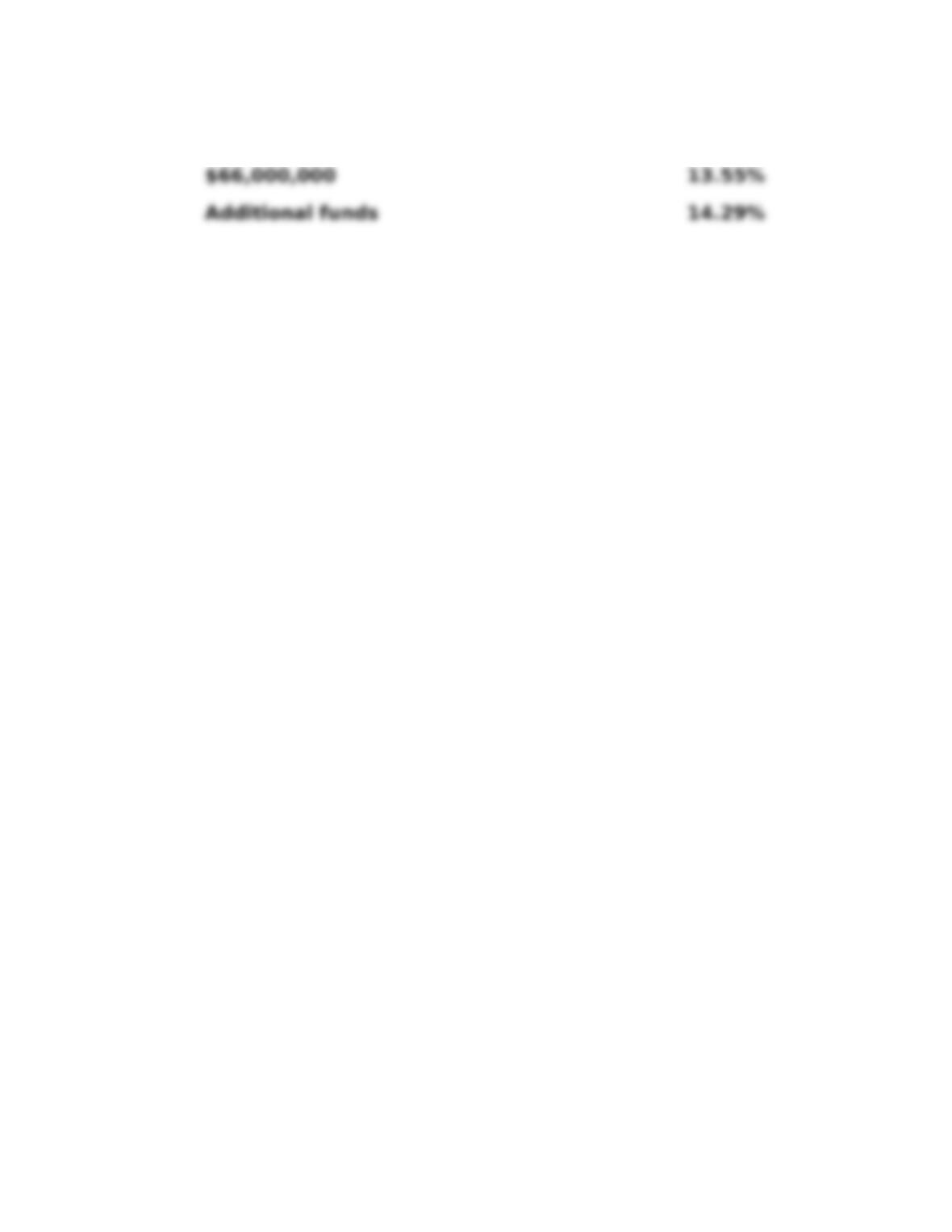
Additional funds:
Break point Weighted marginal cost of capital
12-2
Chapter 12
Cost of Capital
$60,000,000 13.19%
12-2