Chapter 11
Capital Budgeting and Risk
CHAPTER 11
CAPITAL BUDGETING AND RISK
ANSWERS TO QUESTIONS:
1. The net present value model handles risk by discounting expected cash flows from a project
by the firm’s cost of capital. This discount rate is based upon the firm’s average risk level. To
2. Risk, in the context of capital budgeting, is the possibility that actual returns from a project
3. The standard deviation is an appropriate measure of risk when independent projects are
4. The basic NPV model considers increasing risk over time by using a discount rate that is a
5. The portfolio effect of a new project on the risk of a firm should be considered when the
6. Advantages:
1. Explicitly recognizes the interactions among all variables that influence the NPV or
2. Provides a mean and standard deviation for a project’s returns that enable a decision
Disadvantages:
1. Expensive to construct detailed simulation models.
7. Simulation provides the decision maker with a “best” estimate of the outcome of a project
11-3
Chapter 11
Capital Budgeting and Risk
of time.
8. Insurance policies are purchased because they are a way of contractually reducing risk. The
9. Certainty equivalent cash flow estimates are obtained by multiplying expected cash flows
10. No, the certainty equivalent factors which various individuals will assign to the cash flows
SOLUTIONS TO PROBLEMS:
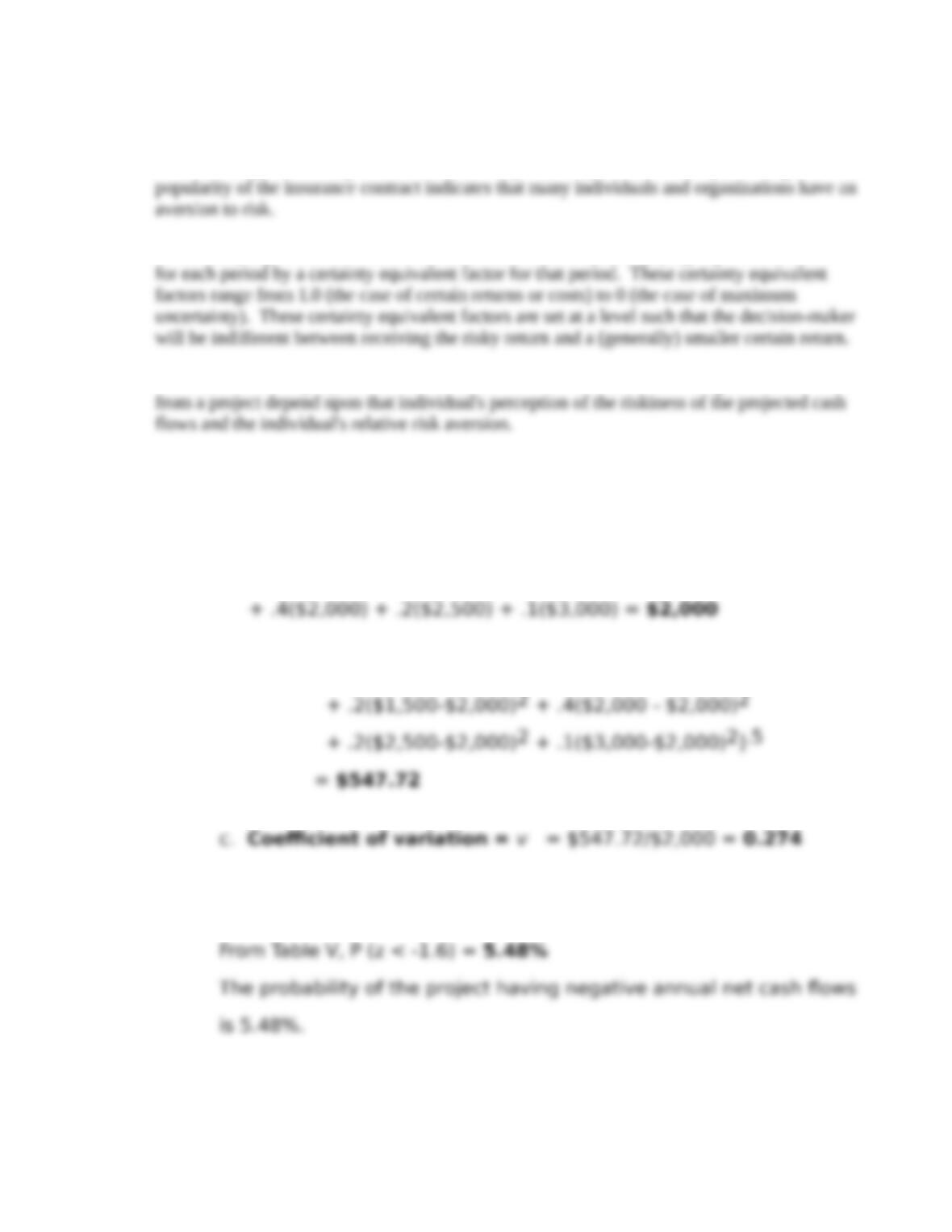
1. a. Expected annual cash ow = .1($1,000) + .2($1,500)
b. Standard deviation = [.1($1,000-$2,000)2
2. a. z = ($0 – $400,000)/$250,000 = -1.60
b. z = ($575,000 – $400,000)/$250,000 = 0.70
11-3
Chapter 11
Capital Budgeting and Risk
3. z = ($0 – $100,000) / $50,000 = – 2.0
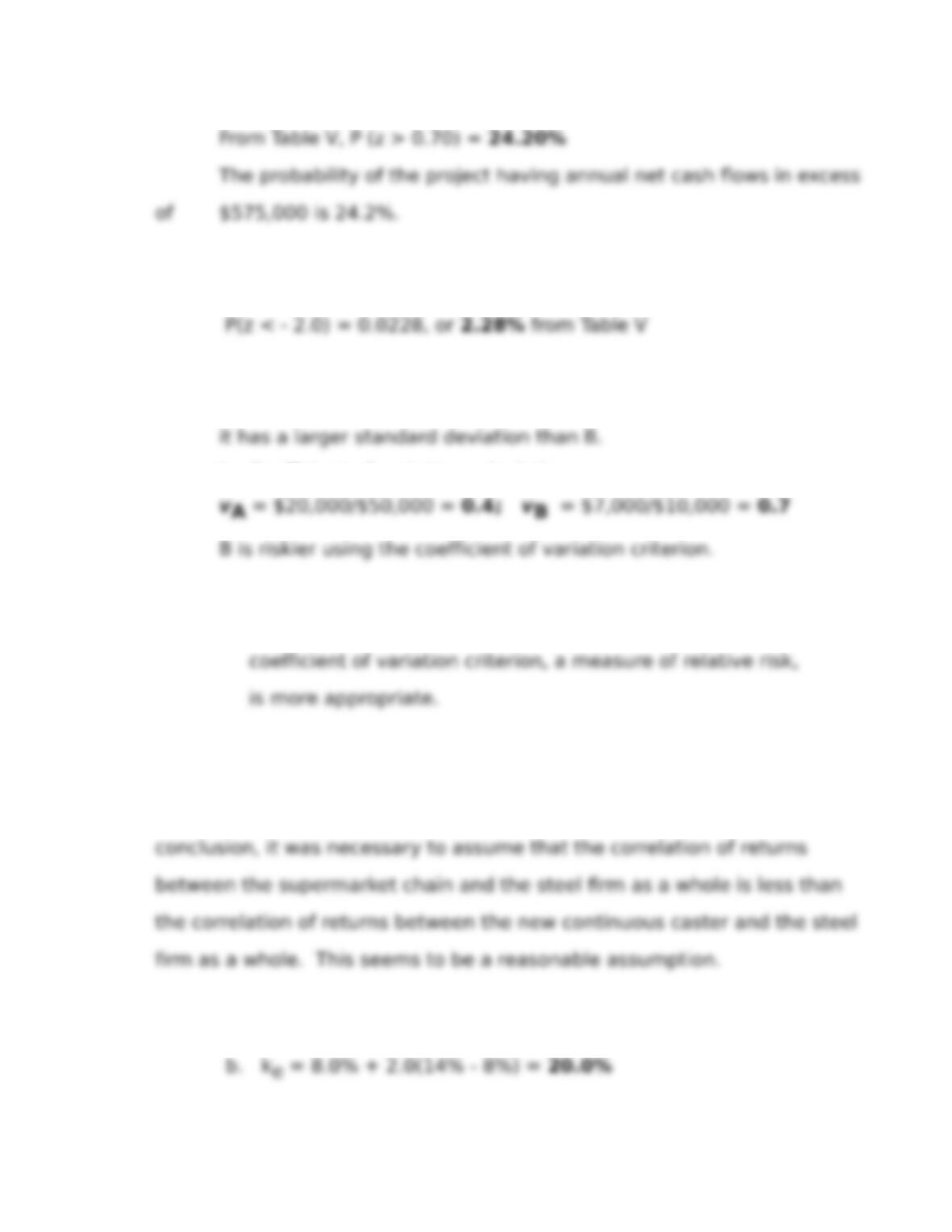
4. a. Project A is riskier using the standard deviation criterion because
b. Coe:cient of variation calculation:
c. Because the projects are signi<cantly different in size, the
5. If reducing the variability of the <rm’s earnings is the desired objective,
purchasing the supermarket chain is probably best. To reach this
6. a. ke = 8.0% + 1.5 (14% – 8%) = 17.0%
11-3
Chapter 11
Capital Budgeting and Risk
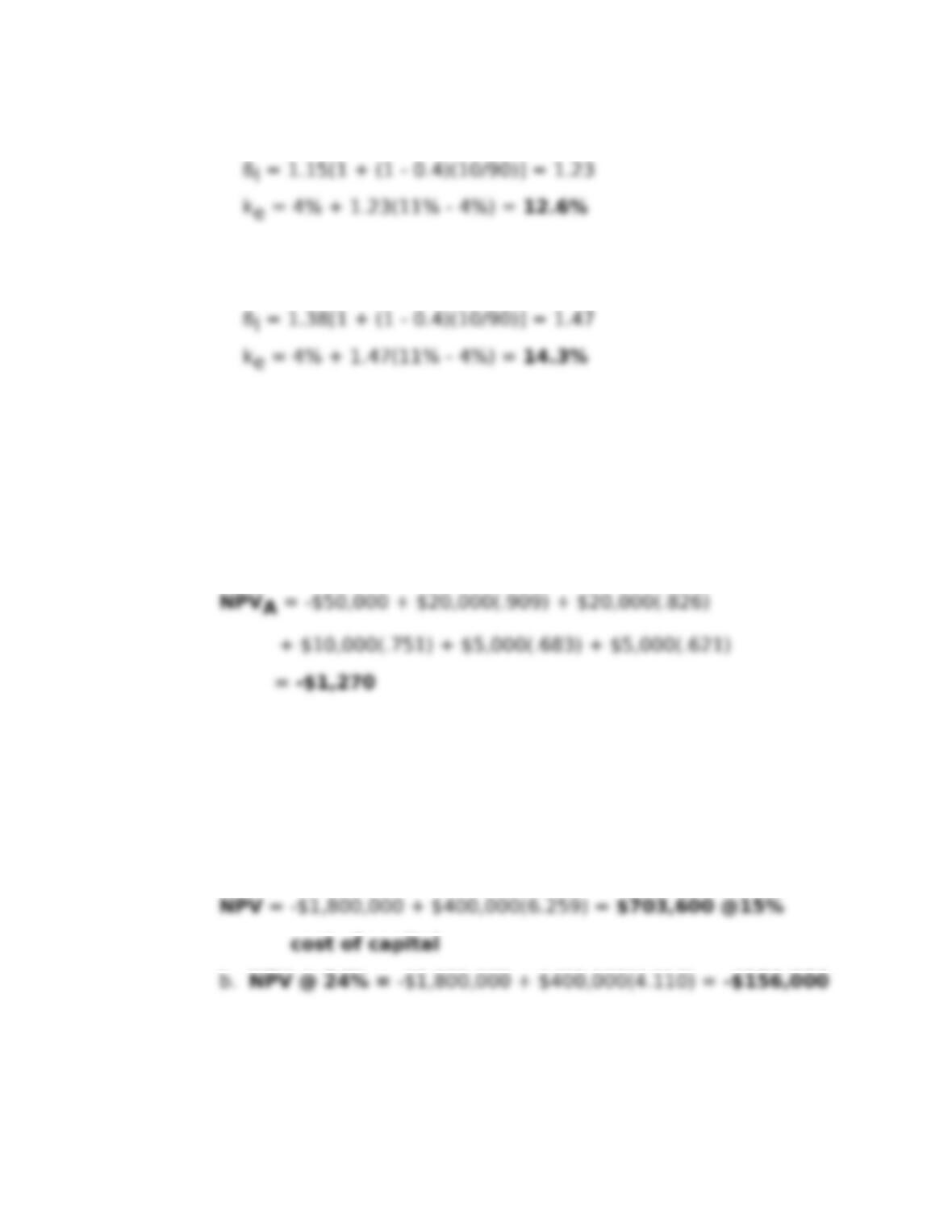
7. a. ßu = 1.5/[1 + (1 – 0.4)(.333/.667)] = 1.15
b. ßu = 1.6/[1 + (1 – 0.35)(.20/.80)] = 1.38
8. Payback: Project A = 3 years; Project B = 4 years
Project B is unacceptable because its payback period is too long.
Net present value:
Project A is unacceptable because it fails to meet the NPV
requirement. Therefore, neither
project should be undertaken by the company.
9. a. NPV = -$1,800,000 + $400,000( (PVIFA.15,20)
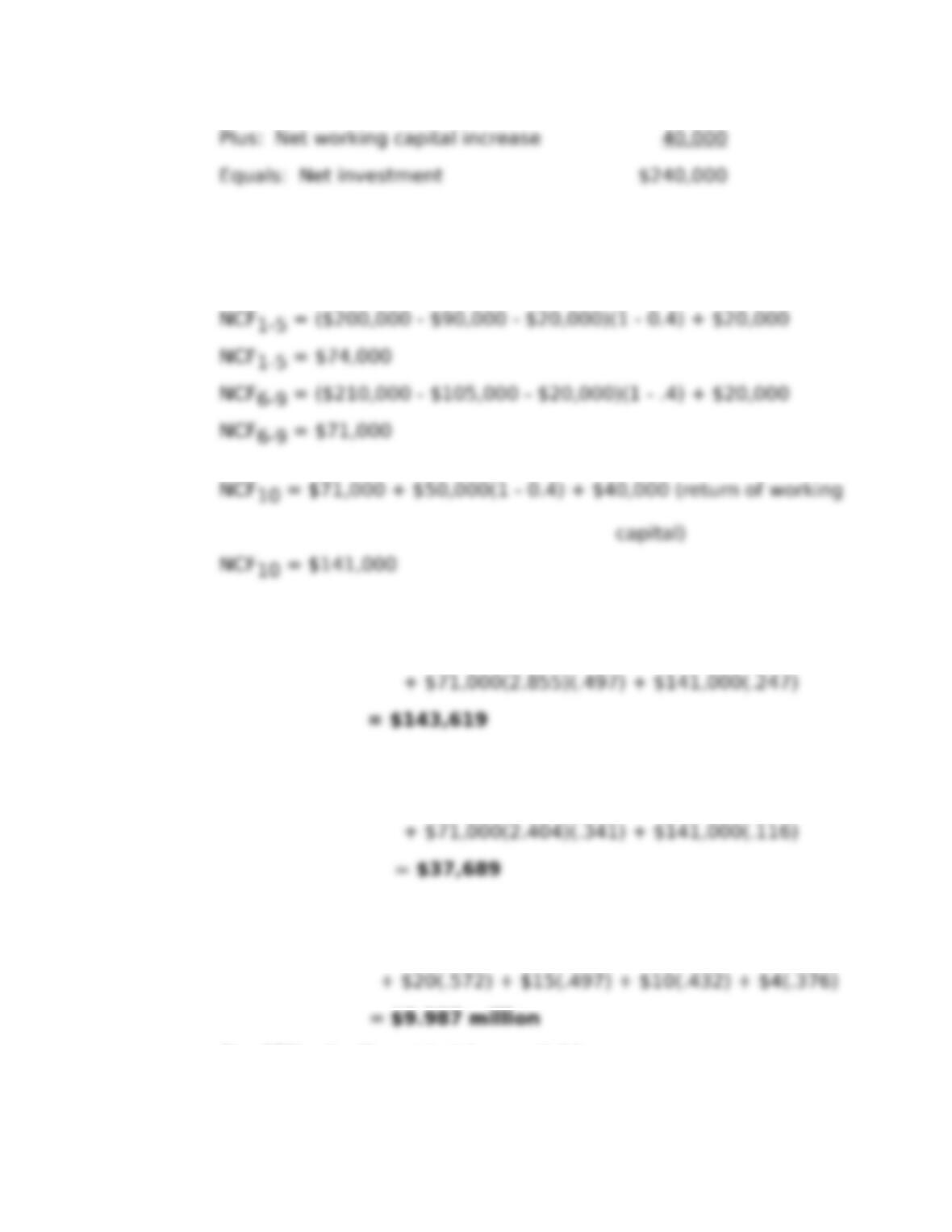
10. Net investment calculation:
Equipment cost $200,000
11-3
Chapter 11
Capital Budgeting and Risk
Depreciation = $200,000/10 years = $20,000/year
Net cash ow calculation:
a. NPV @ 15% = -$240,000 + $74,000(3.352)
b. NPV @ 24% = -$240,000 + $74,000(2.745)
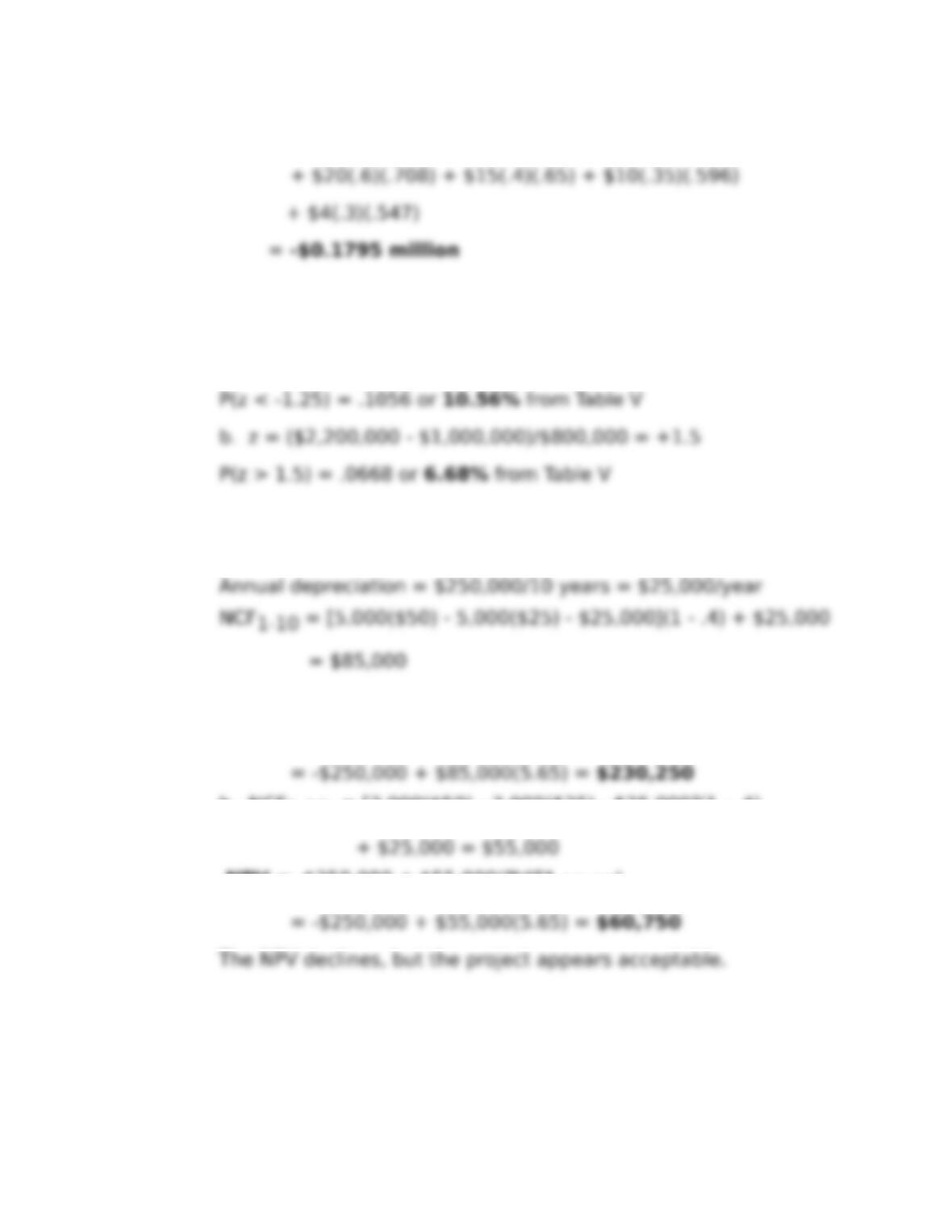
11. a. NPV @ 15% = -$35 + $5(.870) + $8(.756) + $15(.658)
At a 15% rate, the project is acceptable.
b. Certainty equivalent NPV @ 9%:
11-3
Chapter 11
Capital Budgeting and Risk
NPV = -$35(1.0) + $5(.95)(.917) + $8(.9)(.842)+ $15(.8)(.772)
c. The project is unacceptable.
12. a. z = ($0 – $1,000,000)/$800,000 = -1.25
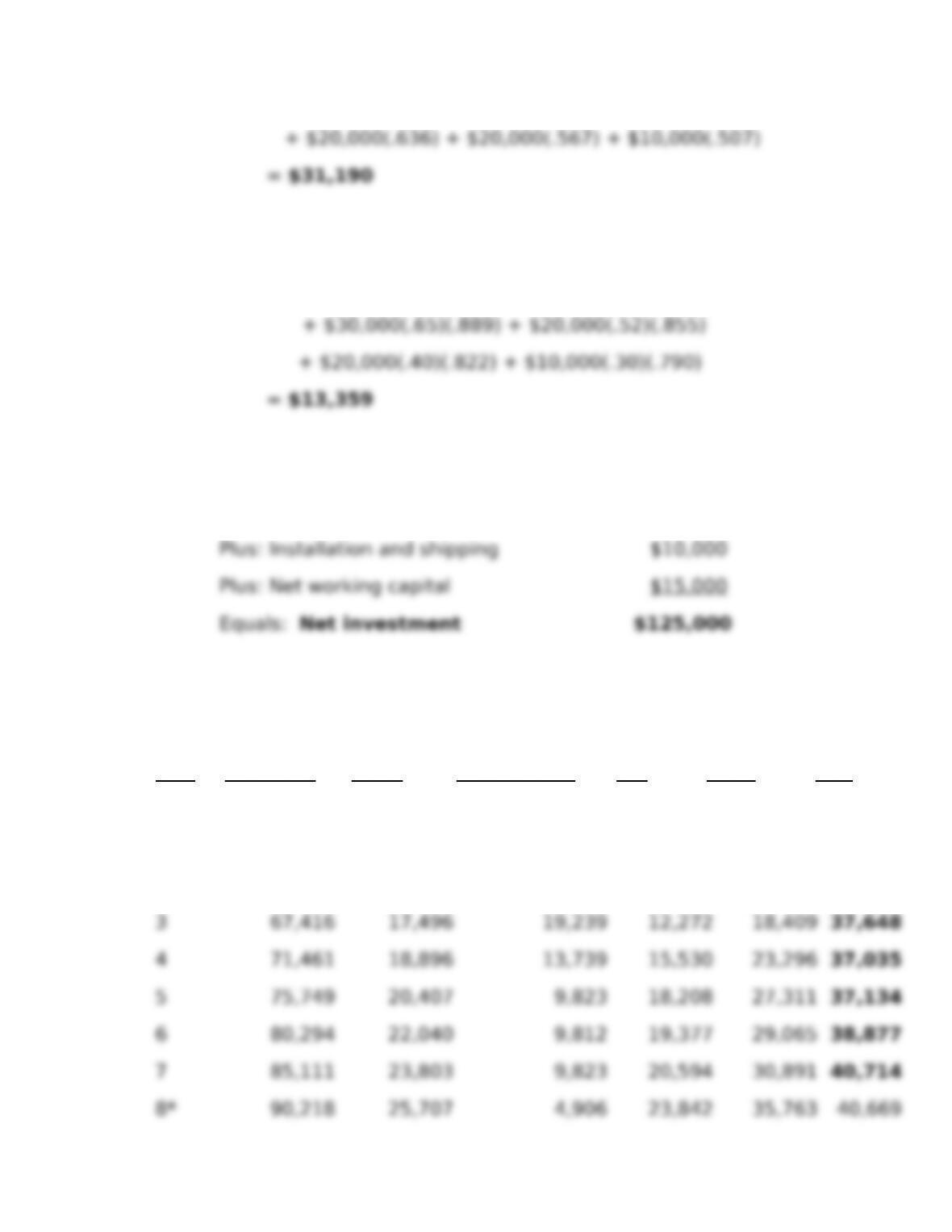
13. Net investment equals the equipment cost or $250,000
a. NPV = -$250,000 + $85,000(PVIFA.12,10)
b. NCF1-10 = [3,000($50) – 3,000($25) – $25,000](1 – .4)
NPV = -$250,000 + $55,000(PVIFA.12,10)
14. a. NPV calculation:
NPV = -$70,000 + $30,000(.893) + $30,000(.797) + $30,000(.712)
11-3
Chapter 11
Capital Budgeting and Risk
b. Certainty equivalent NPV:
NPV = -$70,000 + $30,000(.91)(.962) + $30,000(.79)(.925)
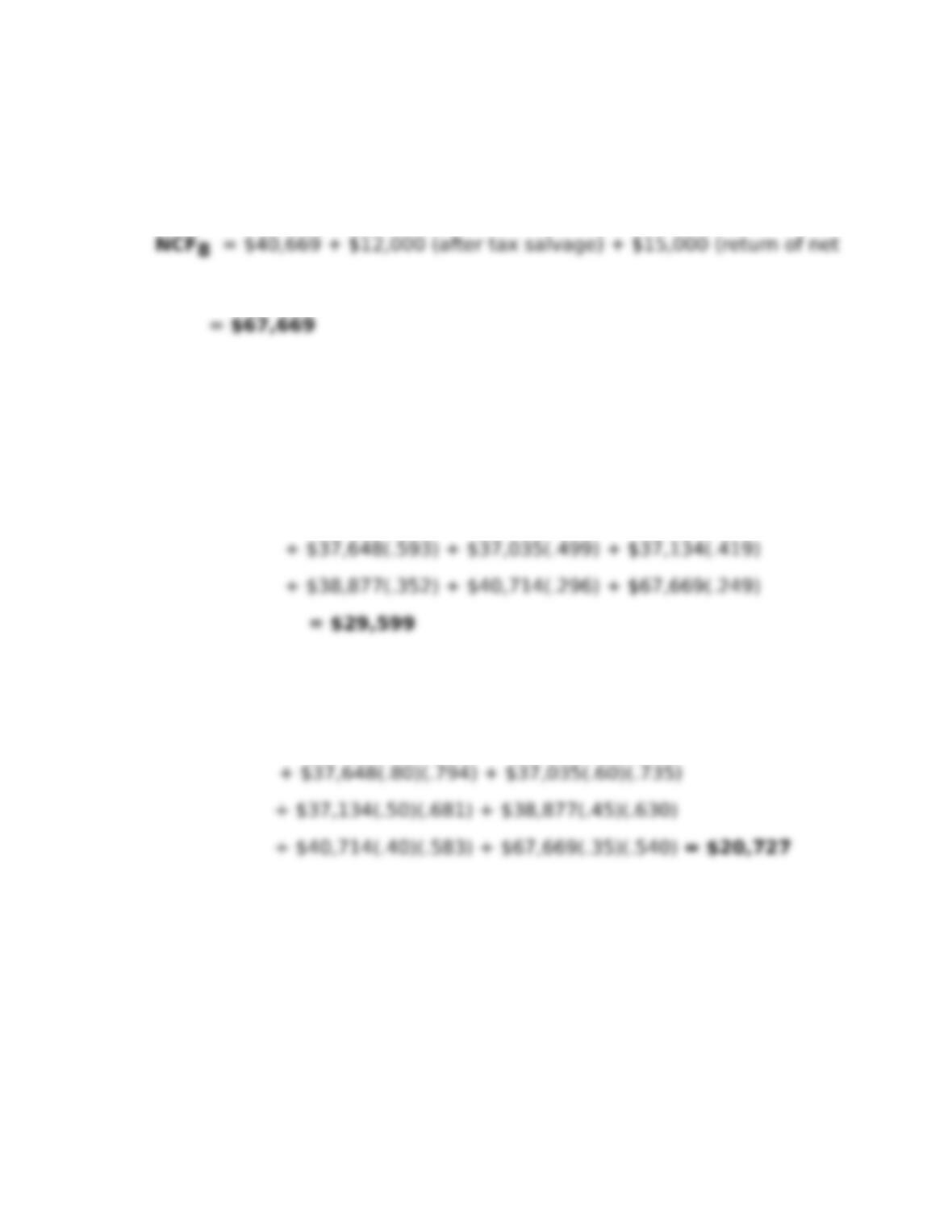
15. a. Net investment calculation:
Equipment cost $100,000
b. Net cash /ow calculation:
Operating
Year Revenues Costs Depreciation Tax OEAT NCF
1 $60,000 $15,000 $15,719 $11,712 $17,569
$33,288
2 63,600 16,200 26,939 8,184 12,277 39,216
11-3
Chapter 11
Capital Budgeting and Risk
*Operating cash /ows only
working capital)
c. NPV @ 19%: -$125,000 + $33,288(.840) + $39,216(.706)
s
d. Certainty equivalent NPV @ 8%:
NPV = -$125,000(1.0) + $33,288(.95)(.926) + $39,216(.90)(.857)
11-3