Chapter 10
Capital Budgeting Decision Criteria and Real Option Considerations
CHAPTER 10
CAPITAL BUDGETING DECISION
CRITERIA AND REAL OPTION
CONSIDERATIONS
ANSWERS TO QUESTIONS:
1. The net present value method computes the present worth of a project’s benefits over its costs,
evaluated using the firm’s cost of capital. If a project has a positive net present value it means
2. In the case of mutually exclusive investments it is possible for the net present value and
3. Multiple rates of return are likely to occur when a project’s cash flow stream contains more
4. The profitability index defines the number of dollars of present value benefits that are
Weaknesses: Does not consider cash flows beyond payback period; ignores time value of
6. The objectives of a project post-audit/review are:
a. To identify systematic biases or errors in the cash flow estimates by individuals,
b. To determine whether a project which has not lived up to expectations should be
7. In an inflationary environment, the level of capital expenditures by private firms tends to
10-4
Chapter 10
Capital Budgeting Decision Criteria and Real Option Considerations
decrease, because the cost of capital generally increases with inflation. It is possible that in some
8. The major problem is placing a dollar value on all costs and benefits generated by a project.
9. MACRS pushes the tax benefits of the project forward to the first 8 years of the project’s life,
10. Investment timing options – waiting-to-invest option, e.g., invest in a project today or wait to
Abandonment option – discontinue a project by shutting it down and selling the equipment,
Shutdown options – temporarily shutting down a project, e.g., a mine, to avoid negative cash
Growth options – undertaking a research or test marketing program before committing to a
Design-in options – input flexibility options (e.g., switching between alternative inputs
SOLUTIONS TO PROBLEMS:
1. NPV = -$20,000 + $3,000(PVIFA0.12,10)
PI = $3,000(5.650)/$20,000 = 0.85
2. a. Net Present Value
10-4
Chapter 10
Capital Budgeting Decision Criteria and Real Option Considerations
Year Cash Flows PVIF @ 12% Present Value
0 -$30,000 1.000 -$30,000
1 5,000 0.893 4,465
2 8,000 0.797 6,376
b. Because the project has a positive NPV it should be accepted.
3. Net investment = $8,000
NCF1-10 = (R – O – Dep)(1 – T) + Dep
10-4
Chapter 10
Capital Budgeting Decision Criteria and Real Option Considerations
4. Net investment = $375,000
a. NPV = -$375,000 + $80,000(PVIFA0.12, 9) + [$80,000 + $75,000
b. The project is acceptable, because its NPV is positive.
c. The value of the firm, and therefore the shareholders’ wealth, is
d. The IRR of this project is 18.71% using a calculator.
e. The net present value calculation assumes the net cash @ows are
6. After tax cost of net investment:
$100,000(1 – 0.4) = $60,000
NPV = -$60,000 + $10,000(PVIFA0.12,10)
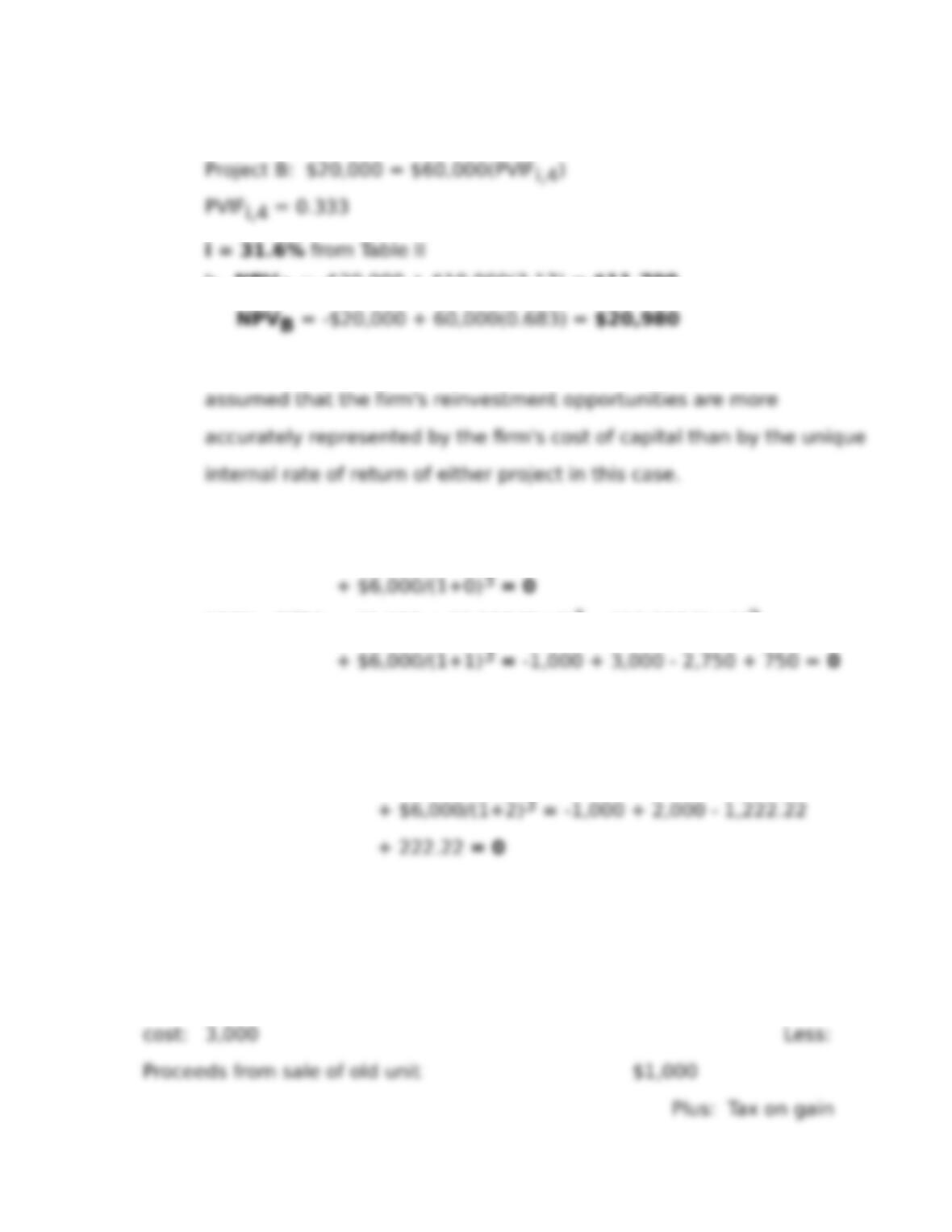
7. a. Project A: $20,000 = $10,000(PVIFAi,4)
10-4
Chapter 10
Capital Budgeting Decision Criteria and Real Option Considerations
i = 34.9% from Table IV
b. NPVA = -$20,000 + $10,000(3.17) = $11,700
c. Project B should be chosen because it has the higher NPV. It is
8. 0%: NPV = -$1,000 + $6,000/(1+0)1 – $11,000/(1+0)2
100%: NPV = -$1,000 + $6,000/(1+1)1 – $11,000/(1+1)2
200%: NPV = -$1,000 + $6,000/(1+2)1 – $11,000/(1+2)2
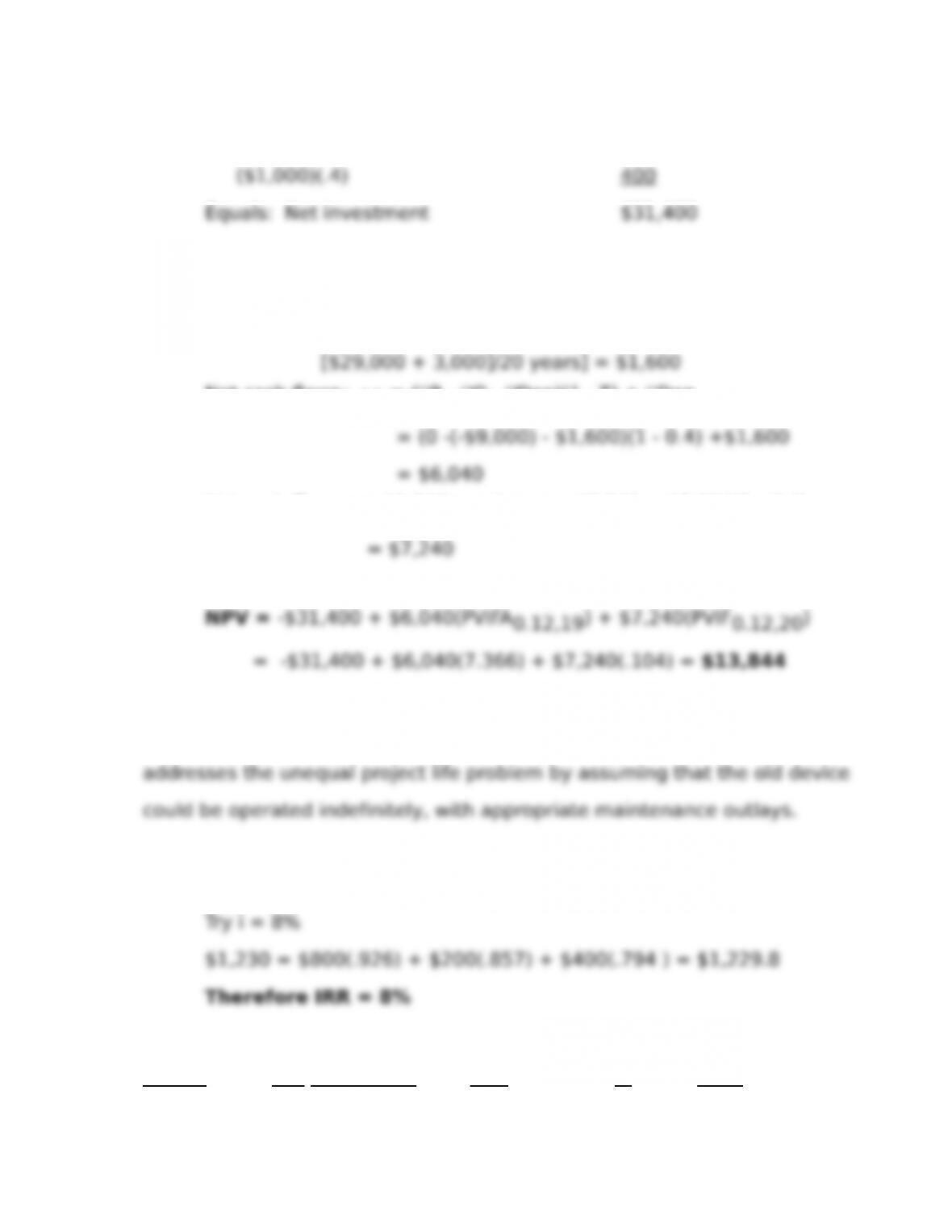
9. Computation of net investment:
New unit cost $29,000
Plus: Installation
10-4
Chapter 10
Capital Budgeting Decision Criteria and Real Option Considerations
from sale of old unit
Computation of net cash @ows:
Annual depreciation on new device =
Net cash @ows1-19 = (R – O – Dep)(1 – T) + Dep
Net cash @ow20 = $6,040 + salvage = $6,040 + $2,000(1 – 0.4)
Therefore, the old control device should be replaced. Note that this problem
10. $1,230 = $800/(1 + i)1 + $200/(1 + i)2 + $400/(1 + i)3
11.
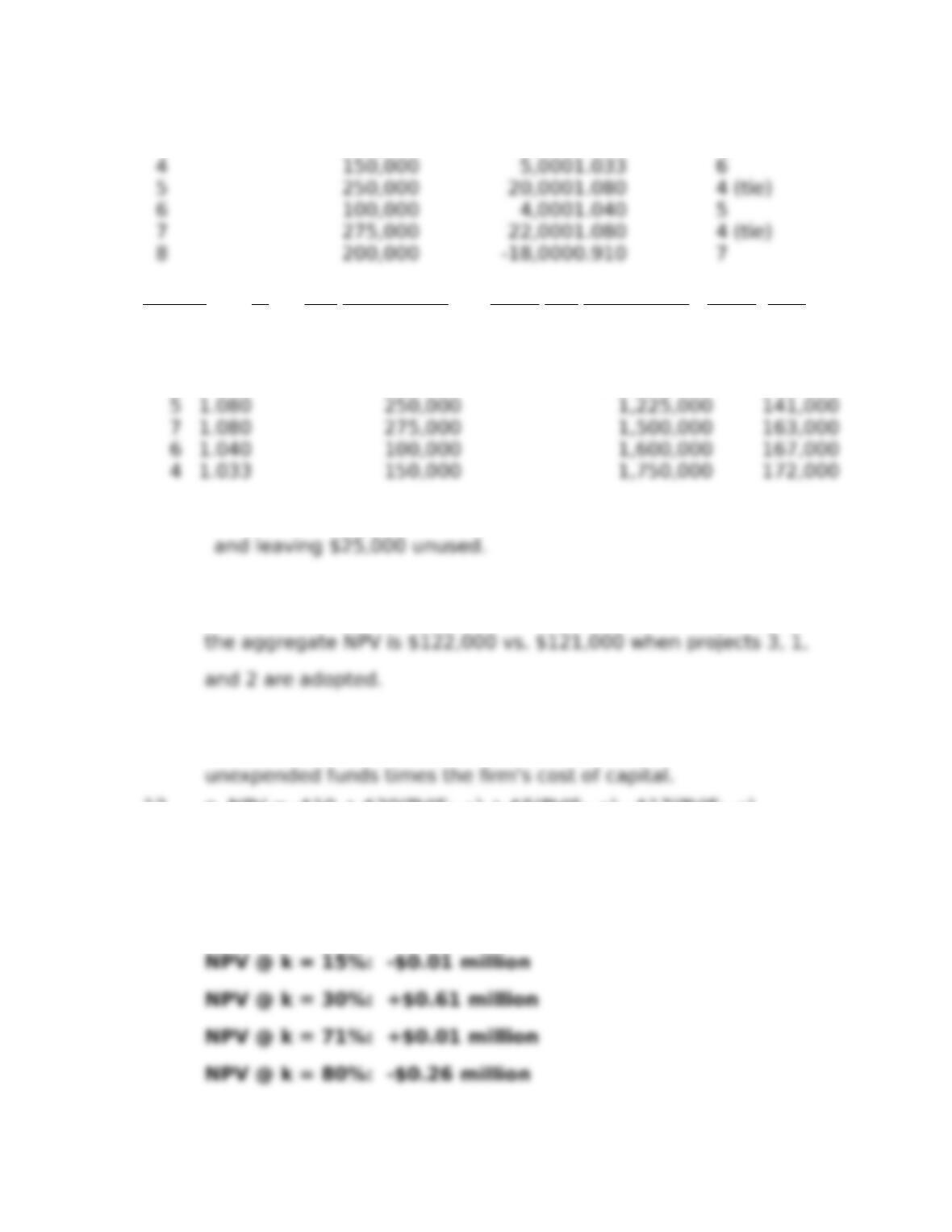
Project Net Investment NPV PI Rank
1 $200,000 $20,0001.100 2
10-4
Chapter 10
Capital Budgeting Decision Criteria and Real Option Considerations
2 500,000 41,0001.082 3
3 275,000 60,0001.218 1
Project PI Net Investment Cum. Net Investment Cum. NPV
3 1.218 $275,000 $275,000
$60,000
1 1.100 200,000 475,000 80,000
2 1.082 500,000 975,000 121,000
b. Projects 3, 1, and 2 should be adopted, using a total of $975,000
c. If projects 3, 1, 5, and 7 are adopted, all funds will be expended and
d. The opportunity cost of the unexpended funds is the amount of the
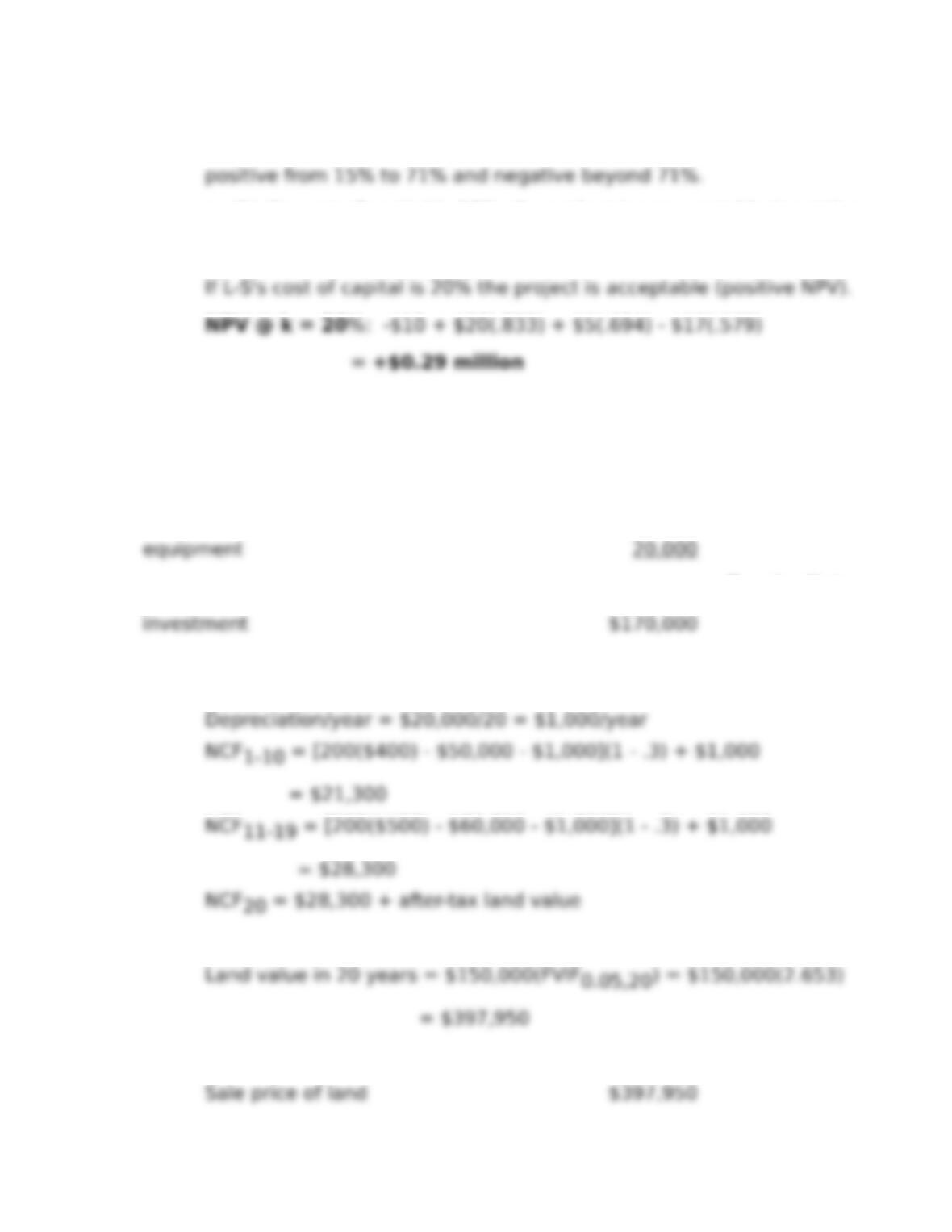
12. a. NPV = -$10 + $20(PVIFk,1) + $5(PVIFk,2) – $17(PVIFk,3)
NPV @ k = 5%: -$10 + $20(.952) + $5(.907) – $17(.864)
= -$1.11 million
NPV @ k = 10%: -$0.46 million
10-4
Chapter 10
Capital Budgeting Decision Criteria and Real Option Considerations
b. The NPV is negative at discount rates between 0% and 15%,
c. If L-S’s cost of capital is 10%, the project is unacceptable (negative
NPV).
13. a. Net investment calculation:
Land $150,000
Plus: Packing
Equals: Net
Net cash @ow calculation:
Tax on gain from land sale:
10-4
Chapter 10
Capital Budgeting Decision Criteria and Real Option Considerations
Less: Original cost
tax rate .30
Equals: Tax on gain $74,385
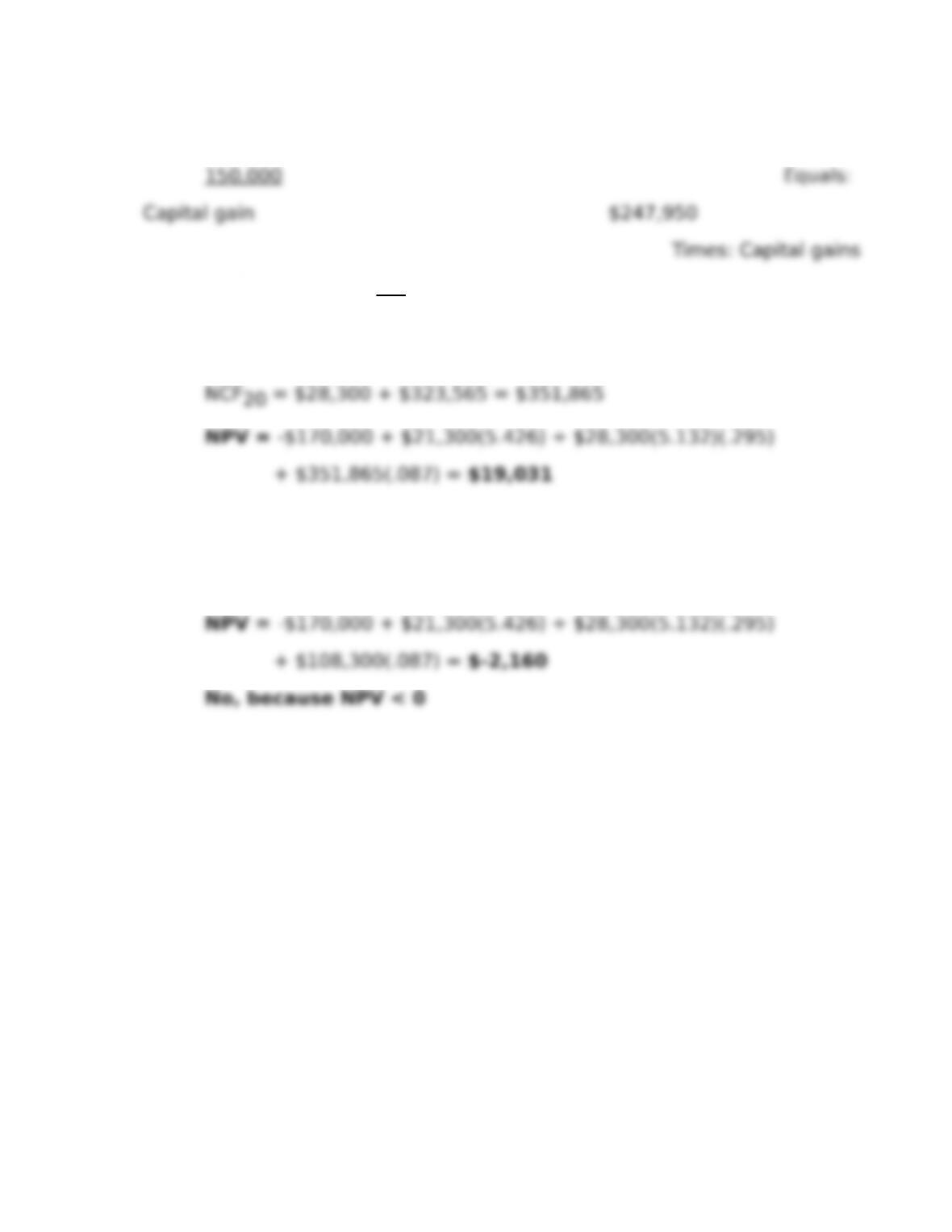
Land value net of taxes = $397,950 – $74,385 = $323,565
Yes, because NPV > 0
b. NCF20 = $28,300 + $50,000 + $100,000 loss(.30) = $108,300
10-4
Appendix 10A
Mutually Exclusive Investments Having Unequal Lives
10A-4