Chapter 9: Projecting Financial Statements
1
Chapter 9
PROJECTING FINANCIAL STATEMENTS
FOCUS
In this chapter, we focus on projecting financial statements for several years into the future.
Inadequate financial resources often constrains the venture’s ability to grow, is a primary cause
of financial distress, and can result in bankruptcy even though the venture may be profitable in
an accounting sense. The process of preparing projected financial statements based on percent-
of-sales relationships helps the entrepreneur anticipate and estimate additional external financial
capital needed to support the business model/plan. We also cover estimating sustainable sales
growth rates and estimating additional financing needed to support growth in this chapter.
LEARNING OBJECTIVES
1. Explain differences in forecasting sales for seasoned firms versus early stage ventures.
2. Understand the concept of a sustainable sales growth rate
3. Understand the process of identifying the quantity and timing of additional funds needed to
support the venture’s sales forecasts
4. Connect sales growth rates to the amount and timing of additional funds needed
5. Describe the percent-of-sales method for preparing financial plans
CHAPTER OUTLINE
9.1 LONG-TERM FINANCIAL PLANNING THROUGHOUT THE VENTURE’S LIFE
CYCLE
9.2 BEYOND SURVIVAL: SYSTEMATIC FORECASTING
A. Forecasting Sales for Seasoned Firms
B. Forecasting Sales for Early-Stage Ventures
9.3 ESTIMATING SUSTAINABLE SALES GROWTH RATES
9.4 ESTIMATING ADDITIONAL FINANCING NEEDED TO SUPPORT GROWTH
A. The Basic Additional Funds Needed Equation
B. Impact of Different Growth Rates on AFN
C. Estimating The AFN for Multiple Years
9.5 PERCENT-OF-SALES PROJECTED FINANCIAL STATEMENTS
A. Forecasting Sales
B. Projecting the Income Statement
C. Projecting the Balance Sheet
D. Forecasting the Statement of Cash Flows
E. Financing Cost Implications Associated with the Need for Additional Funds
SUMMARY
DISCUSSION QUESTIONS AND ANSWERS
1. Why is it usually easier to forecast sales from seasoned firms in contrast with early-stage
ventures?
Chapter 9: Projecting Financial Statements
2
It is usually easier to forecast a seasoned firm’s sales compared to early-stage ventures because a
2. Explain how projected economic scenarios can be used to help forecast a firm’s sales growth
rate.
3. Identify and describe the four-step process typically used to forecast sales for seasoned firms.
Forecasting sales or revenues for a firm that has been in operation for a number of years
usually begins with a review of the firm’s sales for the past several years. Typically, a five–
4. What are the three steps typically used to forecast sales for early-stage ventures?
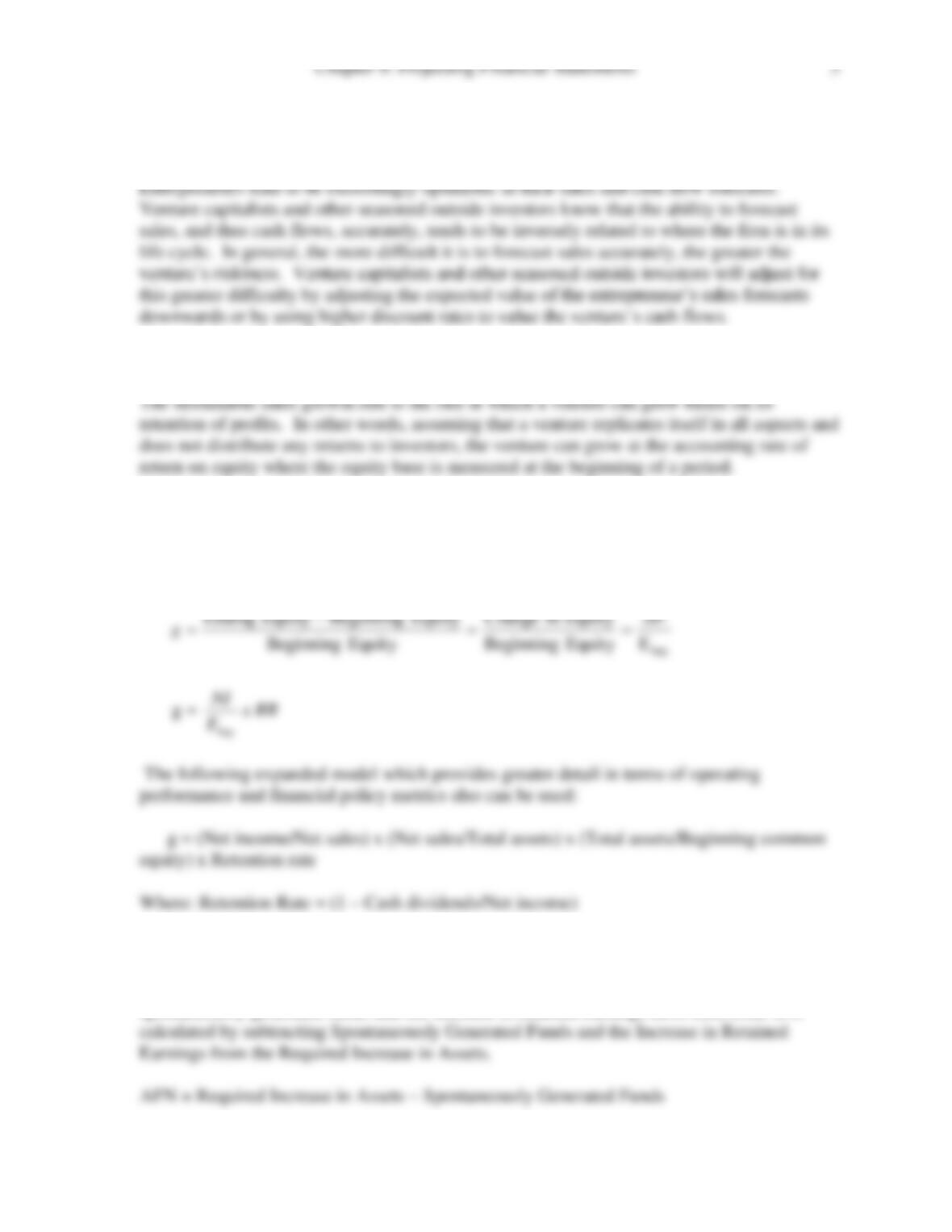
5. Describe the general relationship between the life cycle stage and the ability to accurately
forecast sales for a firm.
0
1
0
0
NS
NS
NS
10. List the major sources of funds typically available to ventures that have successfully entered
into their rapid-growth life cycle stage.
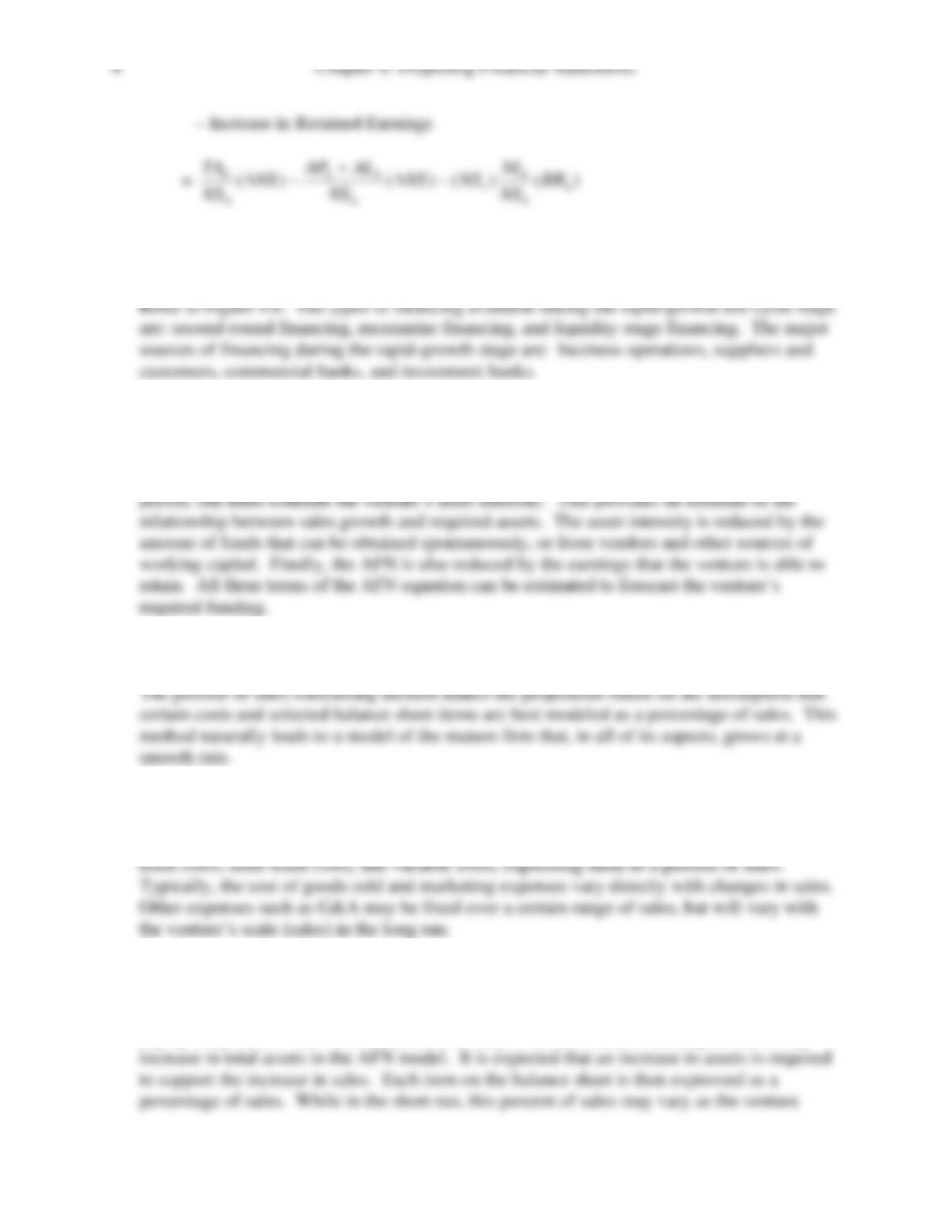
11. Explain how the AFN equation can be used to forecast the amount of funds that will be
needed over a several year period.
To use the AFN equation to forecast the amount of the funds needed over a several year
12. What is the percent of sales forecasting method?
13. After forecasting sales, describe how the income statement is projected.
Once one has projected sales, one can project the income statement by modeling the costs as
14. Describe how balance sheets are projected once a sales forecast has been made.
The balance sheet projection typically separates into Asset Projections and Liabilities and
Equity Projections. The Asset forecast is usually consistent with estimating the necessary
15. What role does the statement of cash flows play in long-term financial planning?
16. From the Headlines – Chipotle: Describe how cash budgets and projected financial
statements could be used in estimating how far $360 million could take Chipotle after its first
14 restaurants.
Answers will vary: With several restaurants in operations, projected financial statements
begin to take on more credibility. They also allow for the notion of “comparable stores”
INTERNET ACTIVITIES
1. Using a Web search, what is an expected long-term growth rate for the U.S. economy? What
are the current and longer-term expectations of inflation?
Web-researched results may vary due to the forecasting organization and sources used.
2. Using a Web search, find an industry report for an industry of your choosing. What are that
industry’s expected near-term and longer-term growth rates?
Web-researched results will vary by industry and existing near-term economic conditions.
EXERCISES/PROBLEMS AND ANSWERS

Chapter 9: Projecting Financial Statements
7
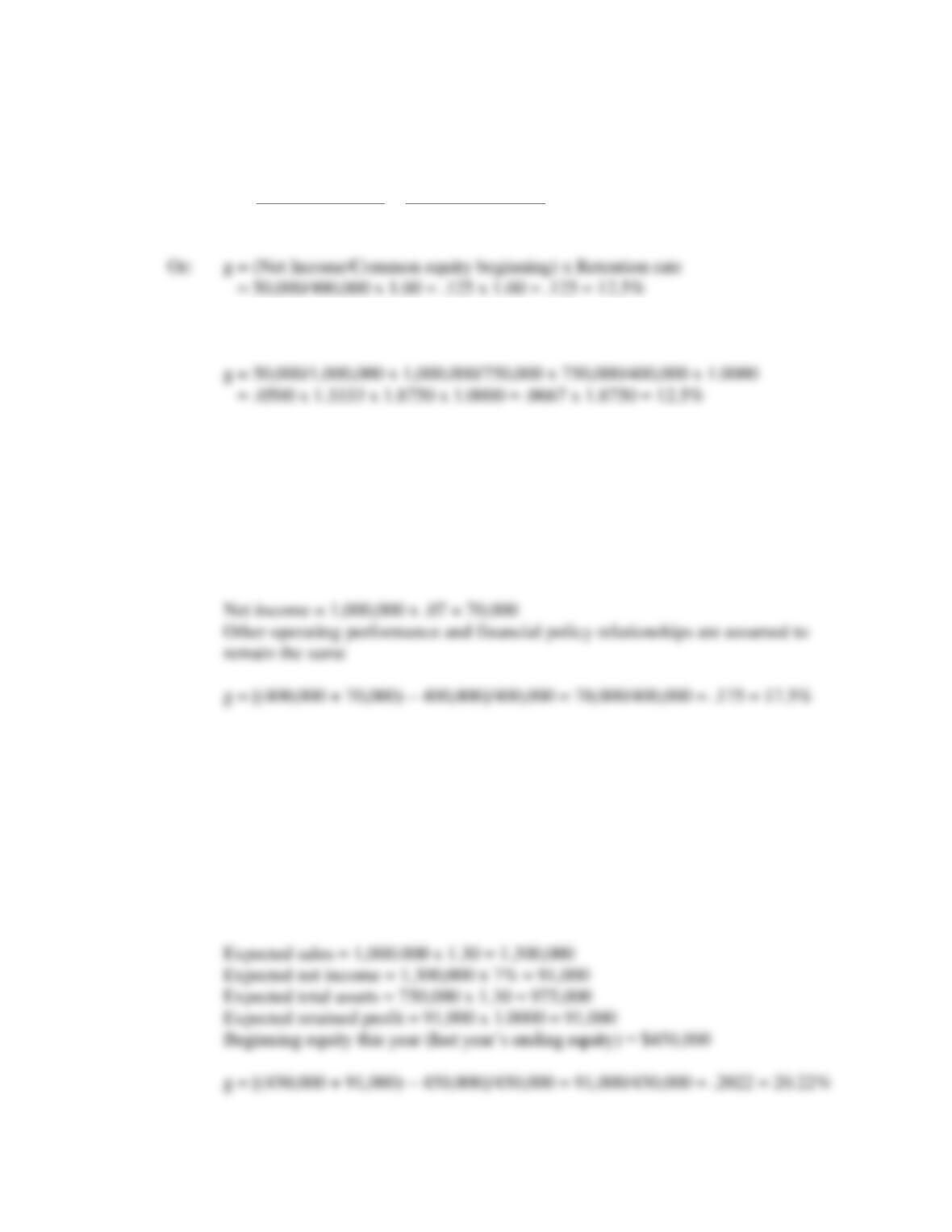
A. Estimate the sustainable sales growth rate for Petal Providers based on the information
provided in this problem.
g =
%5.12
000,400
000,400000,450
E
E
E
Beginning
Beginning
Ending =
−
=
−
Expanded model solution:
B. How would your answer in Part A change if economic growth is average and Petal
Providers’ net profit margin is 7 percent?
Note (Historical View): The 12.5% sustainable growth rate in Part A is based on last
year’s operating performance and financial policy relationships holding for this year. If
we just revise last year’s operating and financial relationships to reflect a net profit
margin increase from 5% to 7%, we would have:
Note (Forward-Looking View): If sales grow at 30% this year to $1,300,000 ($1,000,000
x .30) based on information in Problem 5, Petal Providers will need to improve its
operating performance, change its financial policies, and/or obtain additional equity funds
to support the “gap” between a forecasted growth rate of 30% and the 12.5% sustainable
growth rate calculated in Part A.
Looking forward and assuming the 30% sales growth rate can be funded this year and the
asset turnover ratio will remain the same, the sustainable sales growth rate for next year
can be estimated as follows:

Chapter 9: Projecting Financial Statements
8
Expanded model solution:
3. [Additional Funds Needed] Petal Providers Corporation, described in Problem 1, is
interested in estimating its additional financing needs to support a rapid increase in sales
next year. Last year revenues were $1 million, the net profit was $50,000, the investment in
assets was $750,000, payables and accruals were $100,000, and equity at the end of the year
was $450,000. The venture did not pay out any dividends and does not expect to pay
dividends for the foreseeable future.
A. What would be your estimate of the additional funds needed next year to support a 30
percent increase in sales?
AFN =
)()()()( 0
0
0
1
0
00
0
RR
NS
NI
NSNS
NS
ALAP
NS
NS
TA −
+
−
= (750,000/1,000,000 x 300,000) – (100,000/1,000,000 x 300,000) –
B. How would your answer in Part A change if the expected sales growth were only 15
percent?
Forecasted Sales = 1,000,000 x 1.15 = 1,150,000
4. [Sustainable Sales Growth Rates and Additional Funds Needed] The Minoso Corporation
anticipates a 20 percent increase in sales for 2017 over its 2016 level. Minoso is currently
operating at full capacity and thus expects to increase its investment in both current and fixed
assets in order to support the increase in forecasted sales.
Chapter 9: Projecting Financial Statements
9
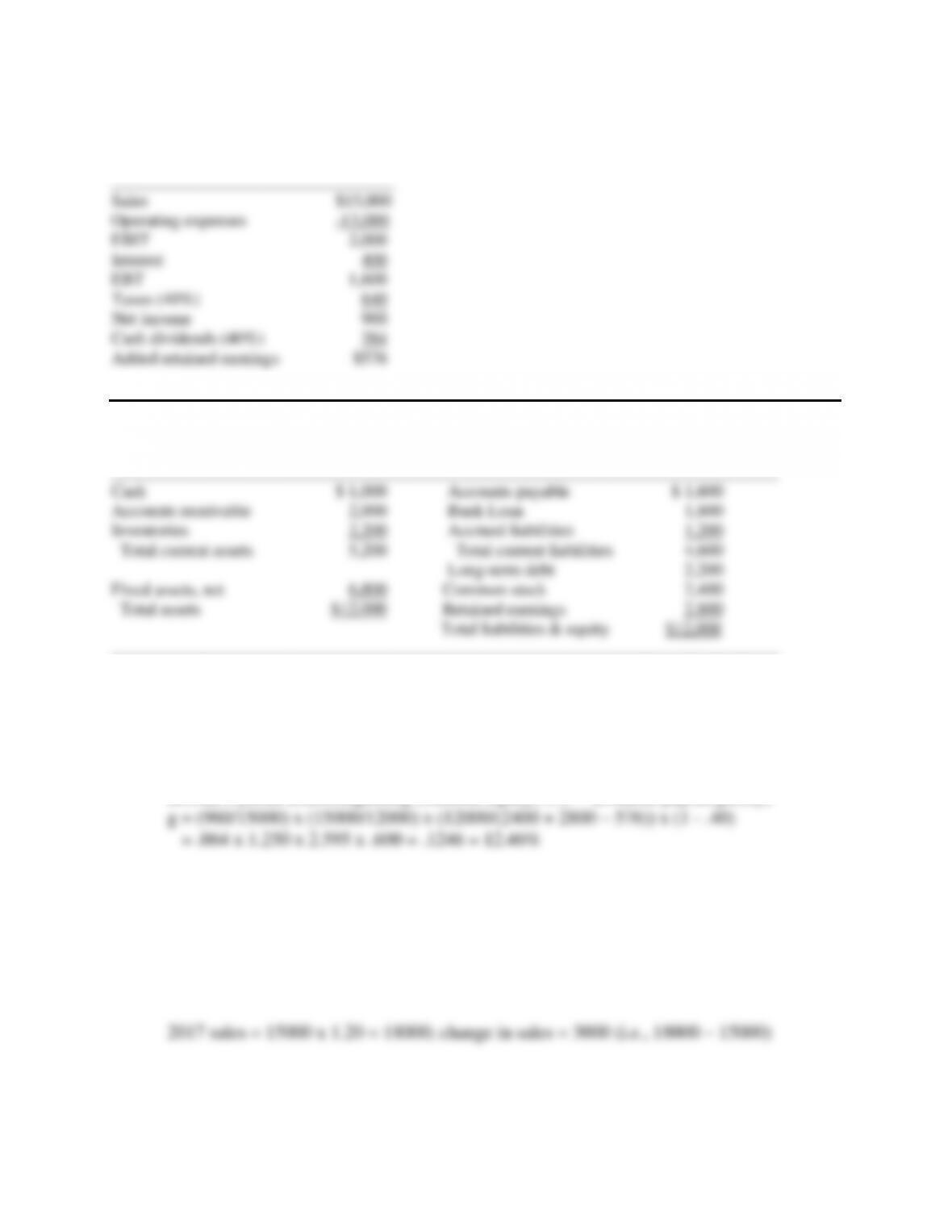
Minoso Corporation
Income Statement for December 31, 2016
(Thousands of Dollars)
Balance Sheet as of December 31, 2016
(Thousands of Dollars)
A. Estimate Minoso’s sustainable sales growth rate based on the financial data
relationships for 2016. In making your estimate, calculate each component of the firm’s
operating performance and financial policies.
g = operating performance x financial policies = (net profit margin x asset turnover (or
ROA)) x [(total assets/beginning common equity) x (1 – dividend payout policy)
Note: the beginning equity is the ending equity of 5200 (2400 + 2800) less the additional
retained earnings of 576 which equals 4624).
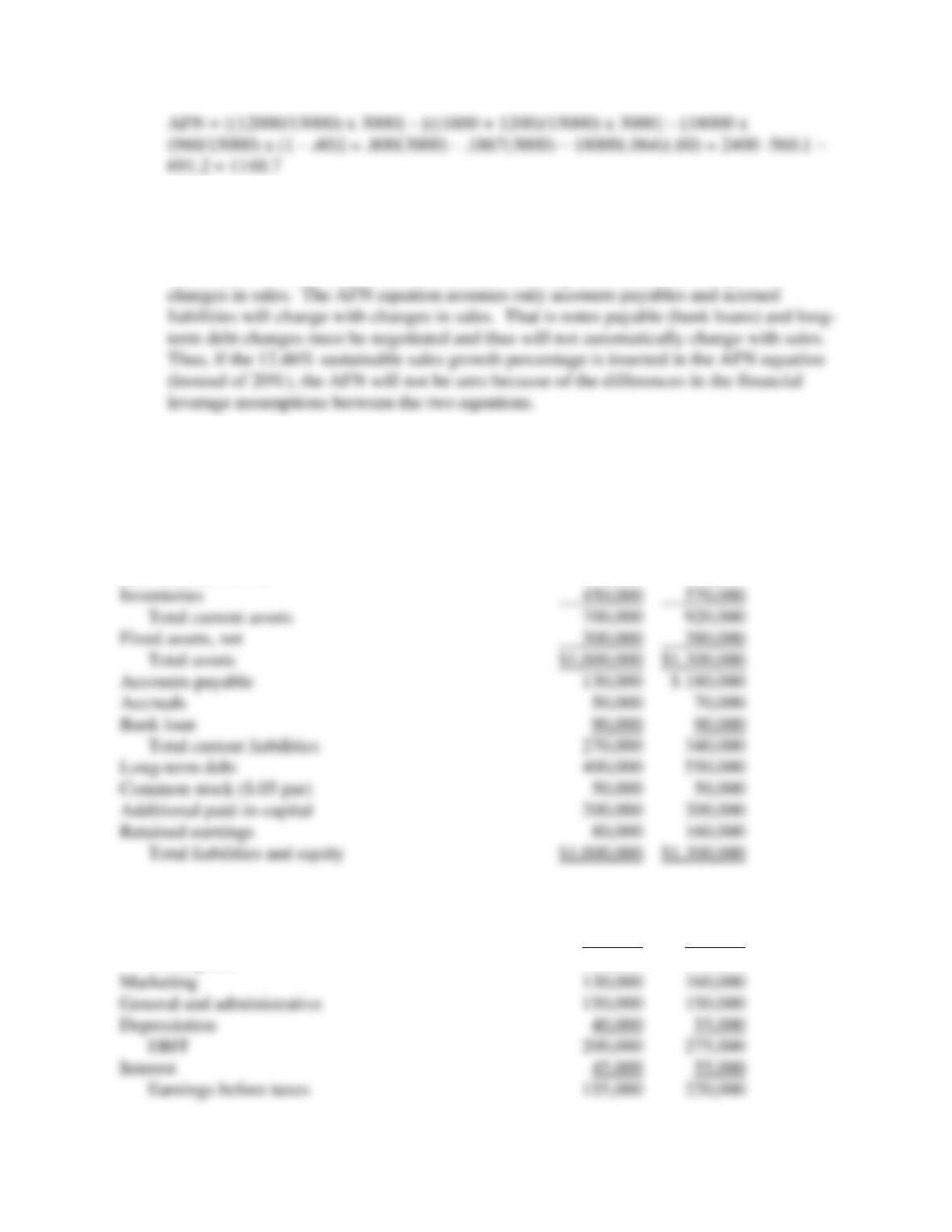
B. Estimate the additional funds needed (AFN) for 2017 using the formula or equation
method that is based on constant “percent of sales” relationships.
Chapter 9: Projecting Financial Statements
10
C. Briefly describe differences in calculation assumptions between Part A and Part B.
The sustainable sales growth rate calculation assume a constant financial leverage policy
such that all forms of debt (current liabilities and long-term debt) will change with
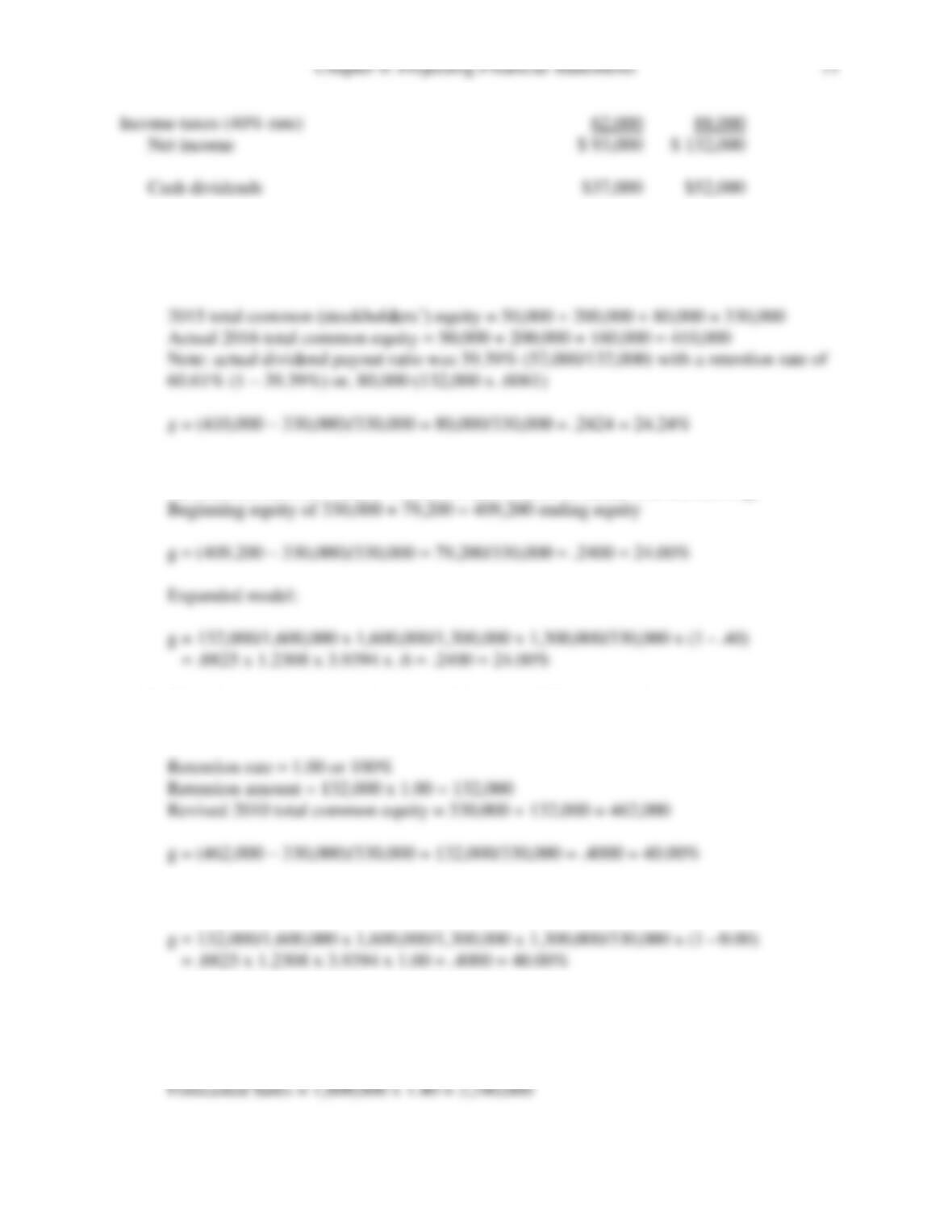
5. [Sustainable Sales Growth Rates and Additional Funds Needed] Following are two years of
income statements and balance sheets for the Munich Exports Corporation.
Munich Exports Corporation
2015
2016
Cash
$ 50,000
$ 50,000
Accounts receivable
200,000
300,000
Inventories
450,000
570,000
Total current assets
700,000
920,000
Fixed assets, net
300,000
380,000
Total assets
$1,000,000
$1,300,000
Accounts payable
130,000
$ 180,000
Accruals
50,000
70,000
Bank loan
90,000
90,000
Total current liabilities
270,000
340,000
Long-term debt
400,000
550,000
Common stock ($.05 par)
50,000
50,000
Additional paid-in-capital
200,000
200,000
Retained earnings
80,000
160,000
Total liabilities and equity
$1,000,000
$1,300,000
2015
2016
Net sales
$1,300,000
$1,600,000
Cost of goods sold
780,000
960,000
Gross profit
520,000
640,000
Marketing
130,000
160,000
General and administrative
150,000
150,000
Depreciation
40,000
55,000
EBIT
200,000
275,000
Interest
45,000
55,000
Earnings before taxes
155,000
220,000

Chapter 9: Projecting Financial Statements
12
D. Sales are forecasted to increase an additional 20 percent in 2018 over 2017. Estimate
the two-year AFN that the Munich Corporation will need to finance its 2017 and 2018
sales growth plans.
AFN = (1,300,000/1,600,000 x 1,088,000) – ((180,000 + 70,000)/1,600,000 x 1,088,000)
Alternatively, the AFN could be calculated separately for each of the two years.
SPREADSHEET EXERCISES/PROBLEMS
[Note: The following activities are for students with spreadsheet software skills.]