Chapter 4: Preparing and Using Financial Statements
67
Cash from Investing Activities:
Increase in gross fixed assets
–90
Net from Investing Activities
–90
Cash from Financing Activities:
Increase in bank loan
10
Increase in long-term debt
100
Cash dividends paid
–35
Net from Financing Activities
75
Total net cash increase (decrease)
–30
Cash at beginning of period
50
Total net cash increase (decrease)
–30
Cash at end of period
20
Part E:
Operating activities (-15) + Investing activities (-90) = -105 (annual net cash burn)
Part F:
Monthly burn rate = annual burn/12
–8.75
per
month
Time to Out of Cash = Cash/Mthly
Burn
2.3
months
7. [Variable Expenses and Survival Revenues Breakeven] The Castillo Products Company
described in Problem 6 had a very difficult operating year in 2015 resulting in a net loss of
$65,000 on sales of $900,000. In 2016, sales jumped to $1,500,000 and a net profit after
taxes was earned. The firm’s income statements are below.
CASTILLO PRODUCTS COMPANY
2015 2016
*Includes tax loss carryforward from 2015.
A. Calculate each income statement item for 2015 as a percent of the 2015 sales level.
Make the same calculations for 2016. Determine which cost or expense items varied
directly with sales for the two-year period?
Chapter 4: Preparing and Using Financial Statements
68
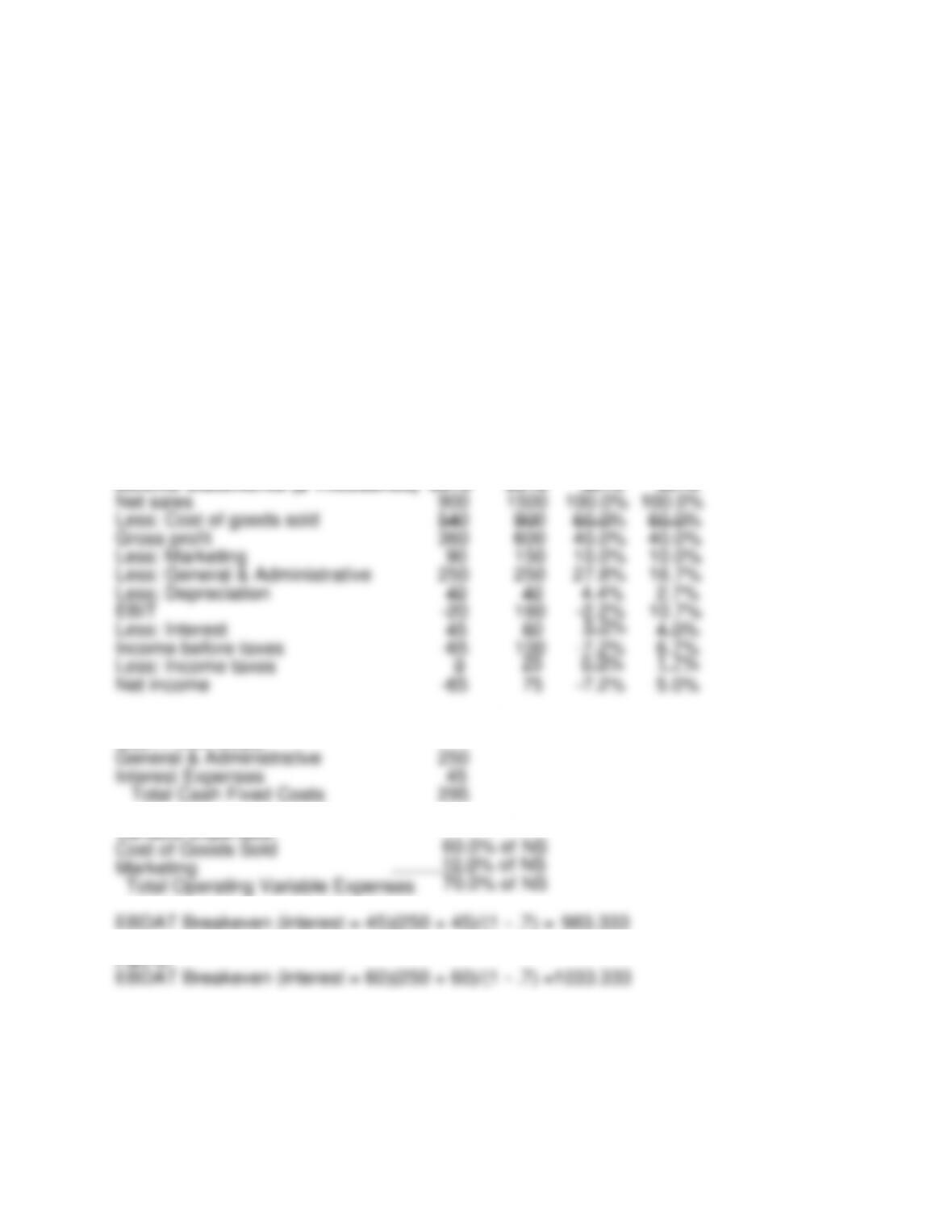
See spreadsheet calculations below.
B. Use the information in Part A to classify specific expense items as being either variable
or fixed expenses. Then estimate Castillo’s EBDAT breakeven in terms of survival
revenues if interest expenses had remained at the 2015 level ($45,000) in 2016.
See spreadsheet calculations below.
C. Estimate the dollar amount of survival revenues actually needed by the Castillo Products
Company to reach EBDAT breakeven in 2016 given that more debt was obtained and
interest expenses increased to $60,000.
See spreadsheet calculations below.
8. [Statement of Cash Flows and Cash Burn or Build] Salza Technology Corporation increased its
sales from $375,000 in 2015 to $450,000 in year 2016 as is shown in the firm’s income
CASTILLO PRODUCTS COMPANY
Part A:
% of Net Sales:
Income Statements ($ Thousands)
2015
2016
2015
2016
Net sales
900
1500
100.0%
100.0%
Less: Cost of goods sold
540
900
60.0%
60.0%
Gross profit
360
600
40.0%
40.0%
Less: Marketing
90
150
10.0%
10.0%
Less: General & Administrative
250
250
27.8%
16.7%
Less: Depreciation
40
40
4.4%
2.7%
EBIT
–20
160
-2.2%
10.7%
Less: Interest
45
60
5.0%
4.0%
Income before taxes
–65
100
-7.2%
6.7%
Less: Income taxes
0
25
0.0%
1.7%
Net income
–65
75
-7.2%
5.0%
Part B:
Cash Fixed Costs:
General & Administrative
250
Interest Expenses
45
Total Cash Fixed Costs
295
Variable Expenses:
Cost of Goods Sold
60.0% of NS
Marketing
10.0% of NS
Total Operating Variable Expenses
70.0% of NS
EBDAT Breakeven (interest = 45):
(250 + 45)/(1 – .7) =
983.333
Part C:
EBDAT Breakeven (interest = 60):
(250 + 60)/(1 – .7) =
1033.333

Chapter 4: Preparing and Using Financial Statements
69
statements presented below. LeAnn Sands, chief executive officer (CEO) and founder of the
firm expressed concern that the cash account and the firm’s marketable securities declined
substantially between 2015 and 2016. Salza’s complete balance sheets are also shown below.
Ms. Sands is seeking your assistance in the preparation of a statement of cash flows for Salza
Technology.
SALZA TECHNOLOGY CORPORATION
Annual Income Statements (in $ Thousands)
2015 2016
Net sales $375 $450
Less: Cost of goods sold 225 270
Gross profit 150 180
Less: Operating expenses 46 46
Less: Depreciation 25 30
Less: Interest 4 4
Income before taxes 75 100
Less: Income taxes 20 30
Net income 55 70
Cash dividends $17 $20
Balance Sheets as of December 31 (in $ Thousands)
2015 2016
Cash $ 39 $ 16
Accounts receivable 50 80
Inventories 151 204
Total current assets 240 300
Gross fixed assets 200 290
Less accumulated depreciation -95 -125
Net fixed assets 105 165
Total assets $345 $465
Accounts payable $ 30 $ 45
Bank loan 20 27
Accrued liabilities 10 23
Total current liabilities 60 95
Long-term debt 15 15
Common stock 85 120
Retained earnings 185 235
Total liabilities and equity $345 $465
A. Prepare a statement of cash flows for 2016 for the Salza Technology Corporation.
See spreadsheet calculations below.
B. Provide a brief description of what happened in terms of cash flows (both inflows and
outflows) for Salza between years 2015 and 2016.
Chapter 4: Preparing and Using Financial Statements
70
See spreadsheet calculations below.
C. Use your calculations from Part A for cash flows from operating and investing
activities to indicate the extent to which Salza was building or burning cash in 2016.
See spreadsheet calculations below.
D. Convert the 2016 annual cash build or cash burn to a monthly rate. If cash flow
activities relating to operations and investing for 2016 continue into 2017, indicate:
(1) how long it will be before Salza runs out of cash (if Salza is burning cash), or (2)
the expected 2017 year-end cash account balance if Salza is building cash. Assume
no changes in cash flows from financing activities in 2017 for calculation purposes.
See spreadsheet calculations below.
Chapter 4: Preparing and Using Financial Statements
71
9. [Survival Revenues Breakeven] LeAnn Sands wants to conduct operating breakeven analyses
of the Salza Technology Corporation for year 2016. Income statement information is shown
in Problem 8. For year 2016, the firm’s cost of goods sold is considered to be variable costs
and operating expenses are considered to be fixed cash costs. Depreciation expenses in year
2016 also are expected to be fixed costs. Calculate Salza’s EBDAT breakeven in terms of
survival revenues for year 2016.
10. [Survival Revenues Breakeven] LeAnn Sands has reason to believe that year 2017 will be a
replication of year 2016 except that cost of goods sold are expected to be 65 percent of the
SALZA TECHNOLOGY CORPORATION
Part A:
Statement of Cash Flows
2016
Cash from Operating Activities:
Net income
70
Depreciation
30
Increase in accounts receivable
–30
Increase in inventories
–53
Increase in accounts payable
15
Increase in accrued liabilities
13
Net from Operating Activities
45
Cash from Investing Activities:
Increase in gross fixed assets
–90
Net from Investing Activities
–90
Cash from Financing Activities:
Increase in bank loan
7
Increase in common stock
35
Cash dividends paid
–20
Net from Financing Activities
22
Total net cash increase (decrease)
–23
Cash at beginning of period
39
Total net cash increase (decrease)
–23
Cash at end of period
16
Part B:
Net cash flow from operating activities was a positive 45
Net cash flow from investing activities was a negative 90
Net cash flow from financing activities was a positive 22
The result was a decline in cash of 23 from 39 to 16
Part C:
Operating activities (45) + Investing activities (-90) = -45 (annual net cash burn)
Part D:
Monthly burn rate = annual burn/12
-3.75
per month
Time to Out of Cash = Cash/Mthly Burn
4.3
months
Chapter 4: Preparing and Using Financial Statements
72
estimated $450,000 in revenues. Other income statement relationships are expected to
remain the same in year 2017 as they were in year 2016. Calculate the EBDAT breakeven
point for 2017 for Salza in terms of survival revenues.
MINI CASE: JEN AND LARRY’S FROZEN YOGURT COMPANY
In 2016, Jennifer (Jen) Liu and Larry Mestas founded Jen and Larry’s Frozen Yogurt Company,
which was based on the idea of applying the microbrew or microbatch strategy to the production
and sale of frozen yogurt. [The involved reader may recall that we first introduced this yogurt
venture in the problems section at the end of Chapter 2.] Jen and Larry began producing small
quantities of unique flavors and blends in limited editions. Revenues were $600,000 in 2016 and
were estimated at $1.2 million in 2017.
Because Jen and Larry were selling premium frozen yogurt containing premium
ingredients, each small cup of yogurt sold for $3 and the cost of producing the frozen yogurt
averaged $1.50 per cup. Administrative expenses, including Brandie’s salary and expenses for
an accountant and two other administrative staff, were estimated at $180,000 in year 2017.
Marketing expenses, largely in the form of behind-the-counter workers, in-store posters, and
advertising in local newspapers, were projected to be $200,000 in year 2017.
An investment in bricks and mortar was necessary to make and sell the yogurt. Initial
specialty equipment and the renovation of an old warehouse building in Lower Downtown
(known as LoDo) occurred at the beginning of 2016 and additional equipment needed to make
the amount of yogurt forecasted to be sold in 2017 was purchased at the beginning of 2017. As a
result, depreciation expenses were expected to be $50,000 in year 2017. Interest expenses were
estimated at $15,000 in 2017. The average tax rate was expected to be 25 percent of taxable
income.
Note: For analysis and reference purposes Jen and Larry’s Frozen Yogurt Company income
statements and answers for (A) through (J) are shown below in spreadsheet format which should
be referred to for answer details.
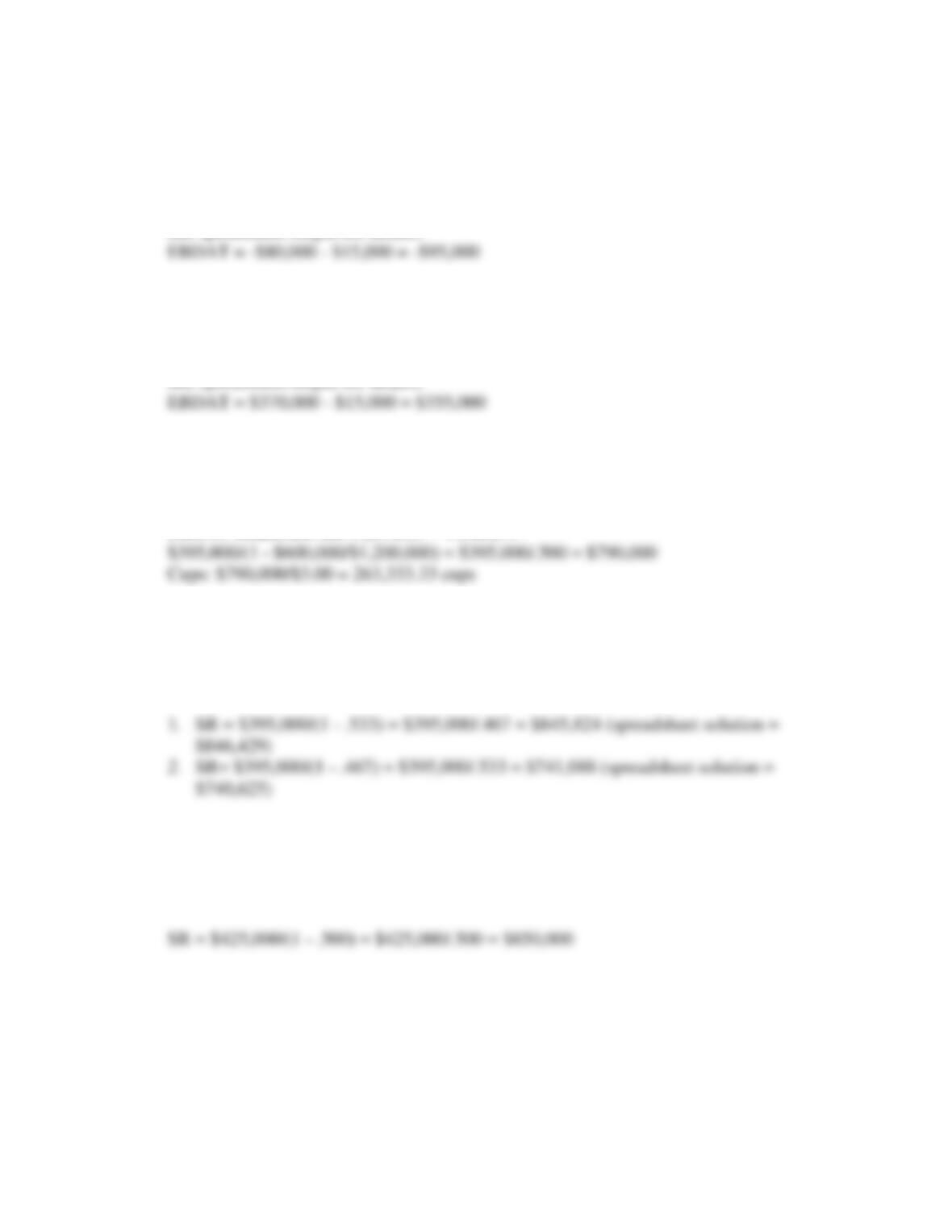
A. How many cups of frozen yogurt would have to be sold in order for the firm to reach its
projected revenues of $1.2 million?
B. Calculate the dollar amount of EBDAT if Jen and Larry’s Frozen Yogurt Company
achieves the forecasted $1.2 million in sales for year 2017. What would EBDAT be as a
percent of revenues?
Chapter 4: Preparing and Using Financial Statements
73
C. Jen and Larry believe that under a worst-case scenario yogurt revenues would be at the
2016 level of $600,000 even after plans and expenditures were put in place to ramp up
revenues in year 2017. What would happen to the venture’s EBDAT?
See spreadsheet output for details.
D. Jen and Larry also believe that under very optimistic conditions that yogurt revenues
could reach $1.5 million in year 2017. Show what would happen to the venture’s EBDAT
if this were to happen.
See spreadsheet output for details.
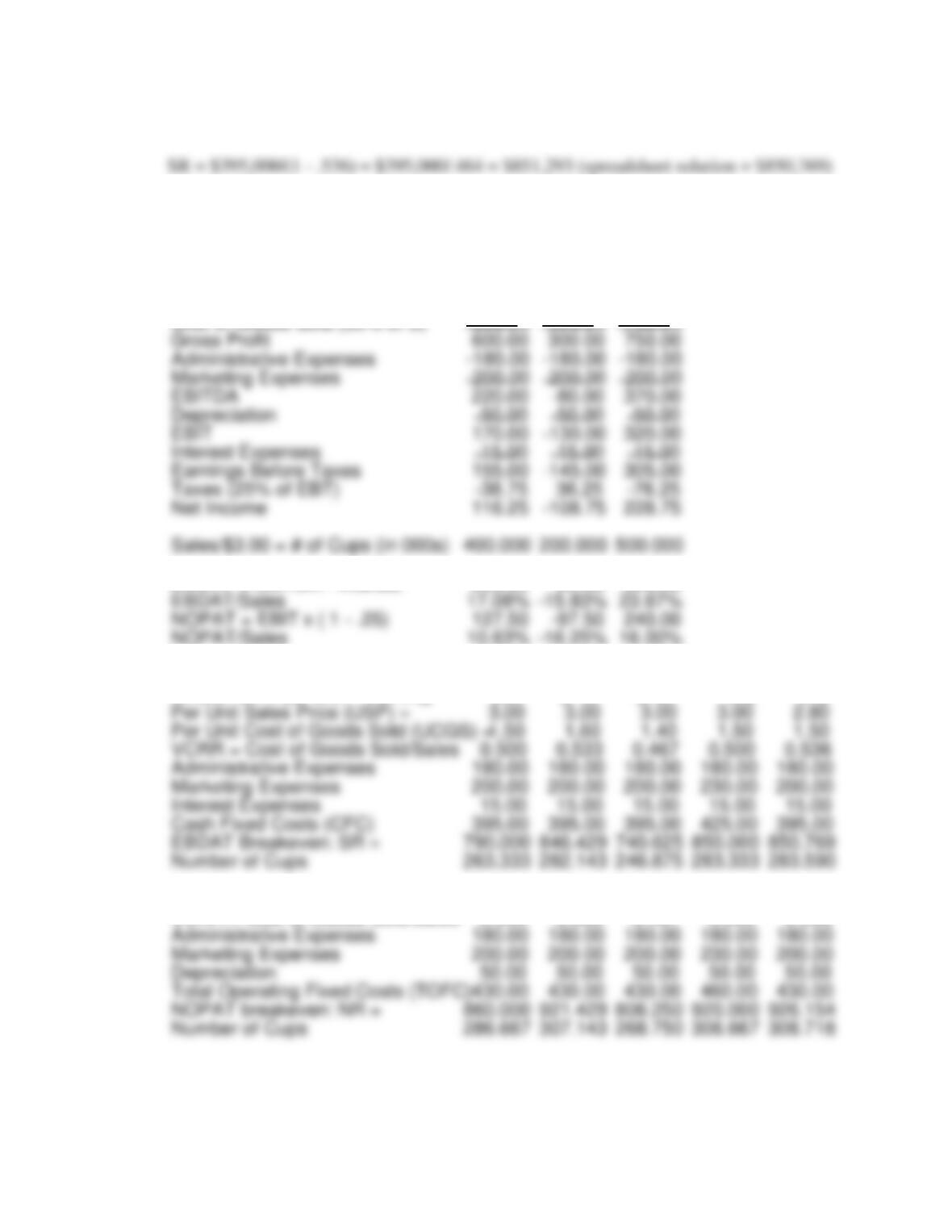
E. Calculate the EBDAT breakeven point for year 2017 in terms of survival revenues for Jen
and Larry’s Frozen Yogurt Company. How many cups of frozen yogurt would have to be
sold to reach EBDAT breakeven?
EBDAT breakeven: SR = [CFC/(1 – VCRR) =
F. Show what would happen to the EBDAT breakeven in terms of survival revenues if the
cost of producing a cup of yogurt increased to $1.60 but the selling price remained at
$3.00 per cup. How would the EBDAT breakeven change if production costs declined to
$1.40 per cup when the yogurt selling price remained at $3.00 per cup?
G. Show what would happen to the EBDAT breakeven point in terms of survival sales if an
additional $30,000 was spent on advertising in year 2017 while the other fixed costs
remained the same, production costs remained at $1.50 per cup, and the selling price at
$3.00 per cup.
H. Now assume that due to competition, Jen and Larry must sell their Frozen Yogurt for
$2.80 per cup in year 2017. The cost of producing the yogurt is expected to remain at
$1.50 per cup and cash fixed costs are forecasted to be $395,000 ($180,000 in
administrative, $200,000 in marketing, and $15,000 in interest expenses). Depreciation
expenses and the tax rate are also expected to remain the same as projected in the initial
discussion of Jen and Larry’s venture. Calculate the EBDAT breakeven point in terms of
Chapter 4: Preparing and Using Financial Statements
74
survival breakeven revenues.
Jen and Larry’s Frozen Yogurt Company
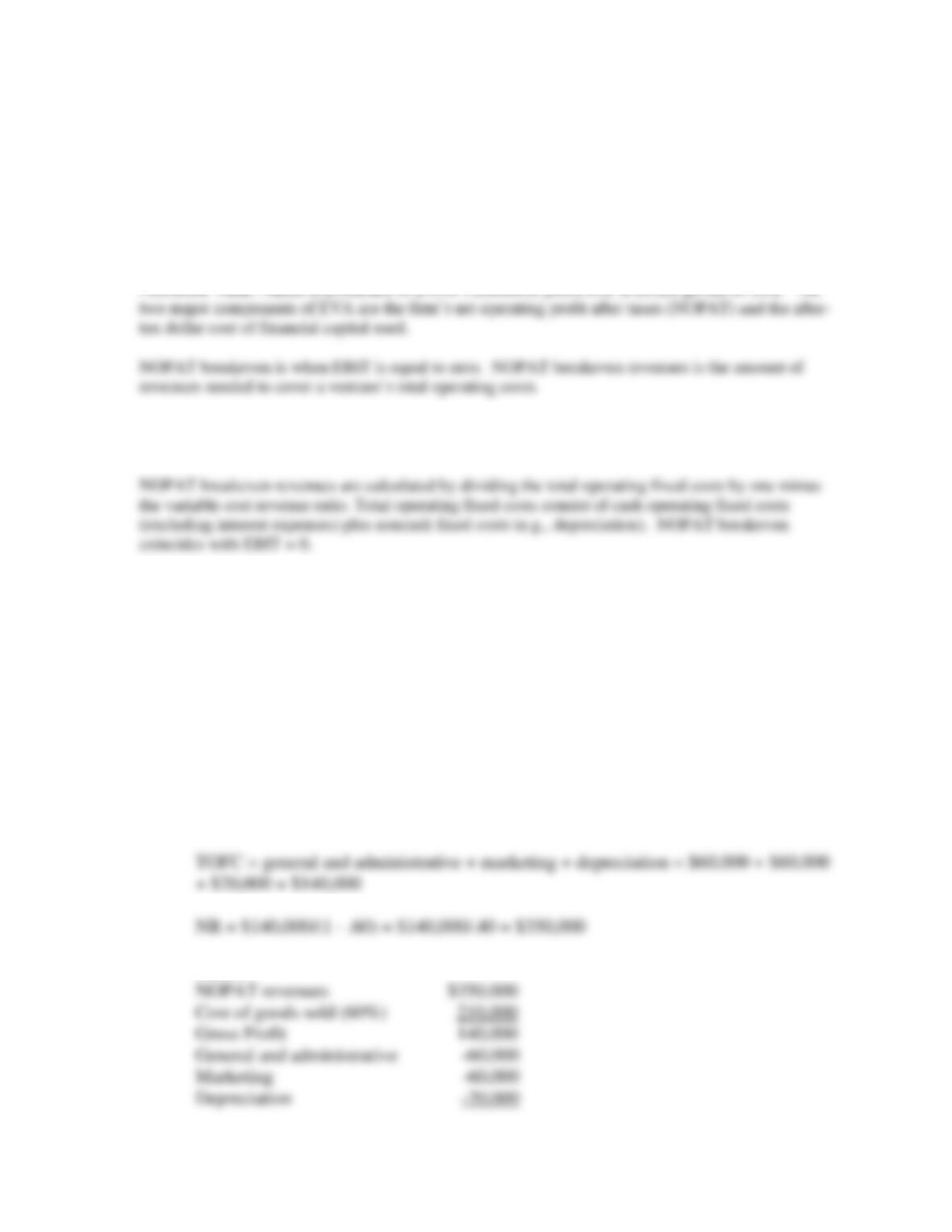
Answers for (A) through (D):
Projected Income Statements [$ Thousands]
Expected
Worst
Optimistic
Scenario
Scenario
Scenario
Sales
1200.00
600.00
1500.00
Cost of Goods Sold (50% of S)
-600.00
-300.00
-750.00
Gross Profit
600.00
300.00
750.00
Administrative Expenses
-180.00
-180.00
-180.00
Marketing Expenses
-200.00
-200.00
-200.00
EBITDA
220.00
-80.00
370.00
Depreciation
-50.00
-50.00
-50.00
EBIT
170.00
-130.00
320.00
Interest Expenses
-15.00
-15.00
-15.00
Earnings Before Taxes
155.00
-145.00
305.00
Taxes (25% of EBT)
-38.75
36.25
-76.25
Net Income
116.25
-108.75
228.75
Sales/$3.00 = # of Cups (in 000s)
400.000
200.000
500.000
EBDAT = EBITDA – Interest
205.00
-95.00
355.00
EBDAT/Sales
17.08%
-15.83%
23.67%
NOPAT = EBIT x ( 1 – .25)
127.50
-97.50
240.00
NOPAT/Sales
10.63%
-16.25%
16.00%
Answers for (E) through (H):
Where: SR = [CFC/(1 – VCRR)]
(E):
(F1):
(F2):
(G):
(H):
Per Unit Sales Price (USP) =
3.00
3.00
3.00
3.00
2.80
Per Unit Cost of Goods Sold (UCGS) =
1.50
1.60
1.40
1.50
1.50
VCRR = Cost of Goods Sold/Sales
0.500
0.533
0.467
0.500
0.536
Administrative Expenses
180.00
180.00
180.00
180.00
180.00
Marketing Expenses
200.00
200.00
200.00
230.00
200.00
Interest Expenses
15.00
15.00
15.00
15.00
15.00
Cash Fixed Costs (CFC)
395.00
395.00
395.00
425.00
395.00
EBDAT Breakeven: SR =
790.000
846.429
740.625
850.000
850.769
Number of Cups
263.333
282.143
246.875
283.333
283.590
Where: NR = TOFC/(1 – VCRR)
(G):
(H1):
(H2):
(I):
(J):
VCRR = Cost of Goods Sold/Sales
0.500
0.533
0.467
0.500
0.536
Administrative Expenses
180.00
180.00
180.00
180.00
180.00
Marketing Expenses
200.00
200.00
200.00
230.00
200.00
Depreciation
50.00
50.00
50.00
50.00
50.00
Total Operating Fixed Costs (TOFC)
430.00
430.00
430.00
460.00
430.00
NOPAT breakeven: NR =
860.000
921.429
806.250
920.000
926.154
Number of Cups
286.667
307.143
268.750
306.667
308.718
Chapter 4: Preparing and Using Financial Statements
75
APPENDIX A:
NOPAT Breakeven: Revenues Needed to Cover Total Operating Costs
DISCUSSION QUESTIONS AND ANSWERS
1. Define the terms EVA and NOPAT and describe the meaning of NOPAT breakeven and NOPAT
breakeven revenues.
Economic Value Added is a measure of a firm’s economic profit over a certain period of time. The
2. Identify and explain the formula for finding the NOPAT breakeven revenues. Relate this to breakeven
in terms of EBIT.
EXERCISES/PROBLEMS
1. Refer to Problem 5 in the chapter involving the SubRay Corporation.
A. Estimate the NOPAT breakeven amount in terms of revenues necessary for the SubRay
Corporation to break even next year.
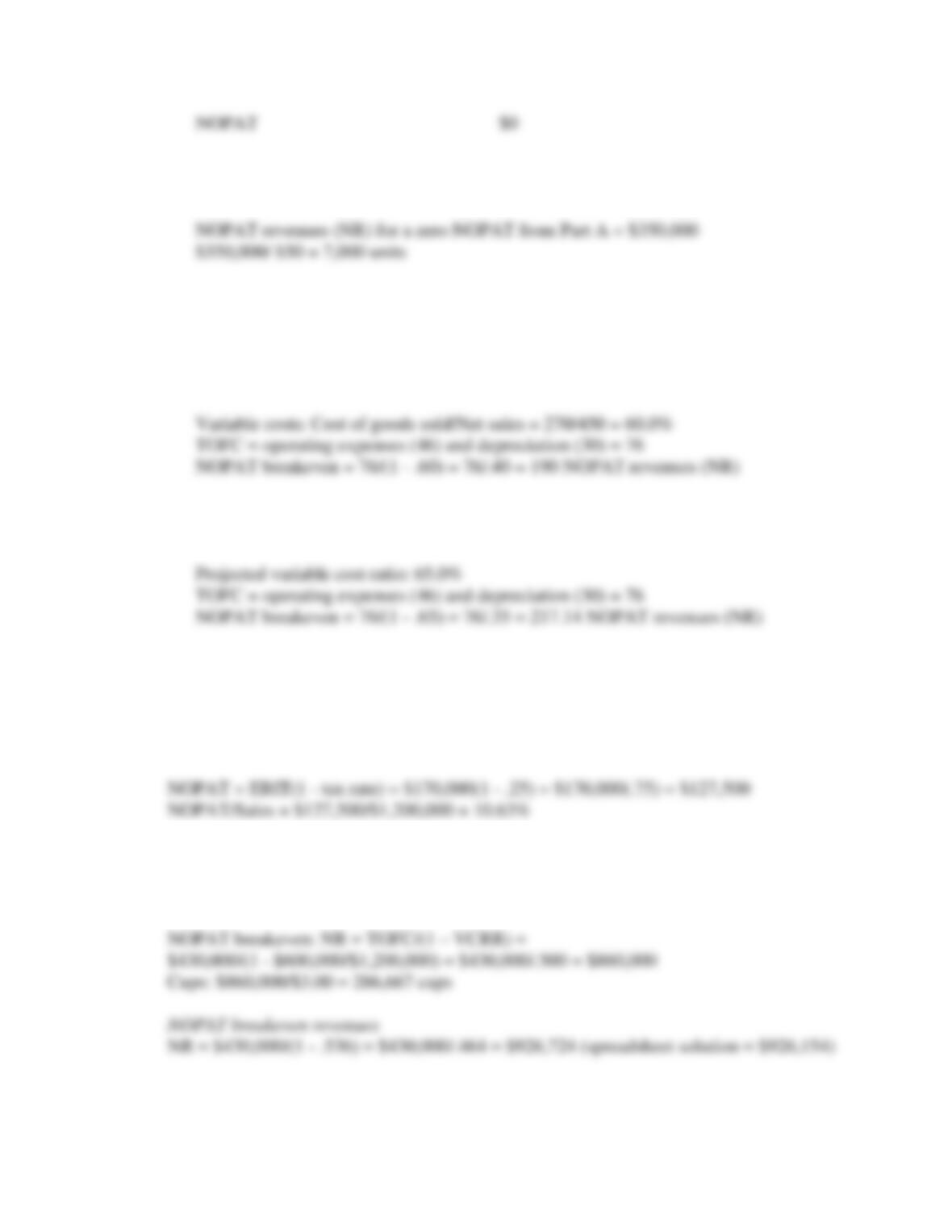
NOPAT breakeven revenues (NR) equals the amount of revenues needed to cover
total operating costs.
Total operating fixed costs (TOFC) = cash operating fixed costs (excluding interest
expenses) + noncash fixed costs (e.g., depreciation).
Check:
Chapter 4: Preparing and Using Financial Statements
76
B. Assume that the product selling price is $50 per unit. Calculate the NOPAT breakeven
point in terms of the number of units that will have to be sold next year.
2. Refer to Problems 9 and 10 in the chapter involving the Salza Technology Corporation (see
Problem 8 for the firm’s financial statements).
A. Calculate Salza’s NOPAT breakeven in terms of NOPAT breakeven revenues for year
2016.
B. Calculate the NOPAT breakeven point for 2017 for Salza in terms of NOPAT breakeven
revenues.
3. Refer to the Mini Case at the end of the chapter involving Jen and Larry’s Frozen Yogurt
Company.
A. Calculate the dollar amount of NOPAT if Jen and Larry’s venture achieves her forecasted
$1.2 million in sales in year 2017. What would NOPAT be as a percent of sales?
B. Calculate the NOPAT breakeven point for year 2017 in terms of NOPAT breakeven
revenues for Jen and Larry’s venture. How many cups of frozen yogurt would have to be
sold to reach NOPAT breakeven?