Chapter 3: Organizing and Financing A New Venture
47
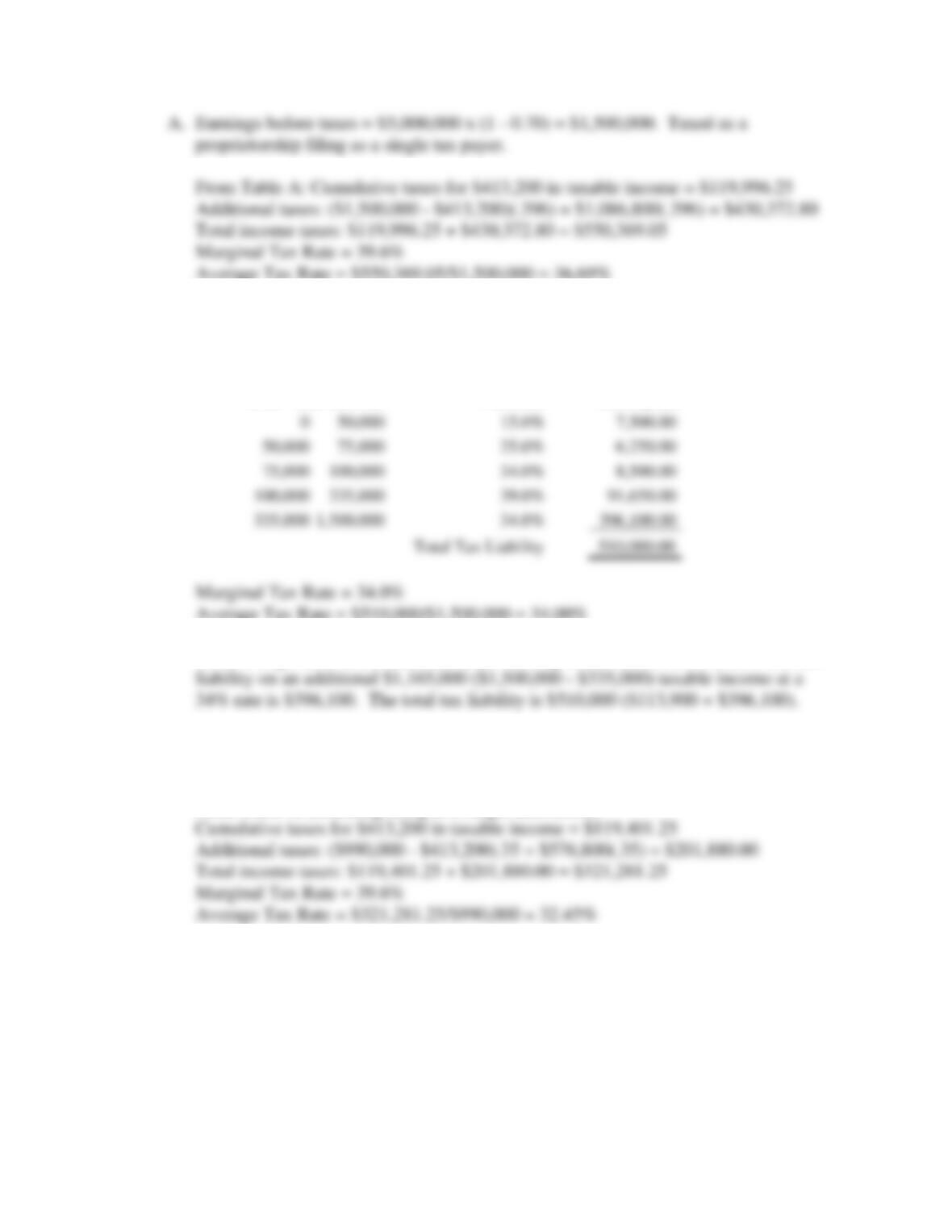
Average Tax Rate = $550,369.05/$1,500,000 = 36.69%
B. Taxed as a corporation.
Corporate
Marginal
Taxable Income
Over But not over
Tax Rate
Tax Payable
0
50,000
15.0%
7,500.00
50,000
75,000
25.0%
6,250.00
75,000
100,000
34.0%
8,500.00
100,000
335,000
39.0%
91,650.00
335,000
1,500,000
34.0%
396,100.00
Total Tax Liability
510,000.00
Marginal Tax Rate = 34.0%
Average Tax Rate = $510,000/$1,500,000 = 34.00%
Note: Using Table A, the cumulative tax liability on $335,000 is $113,900. The tax
C. Personal taxable Income from the receipt of corporate cash dividends (assumed
taxable at the ordinary income tax rate): $1,500,000 – $510,000 = $990,000
From Table A (assuming filing as a single individual):
7. [Income Taxes] Rolf Lee is now exploring whether it might be better to organize the
Capital-Ideas Company as a subchapter S corporation based on information contained in
Problem 5.
A. Calculate the amount of federal income tax that Capital-Ideas Company would pay
next year.

Chapter 3: Organizing and Financing A New Venture
48
Alternatively, (using cumulative tax amounts from Table A):
B. What would be the marginal tax rate on the last dollar of taxable income and what
would be the average tax rate?
8. [Income Taxes] Rolf Lee is also considering organizing the Capital-Ideas Company as a
limited liability company.
A. Use information contained in Problem 6 to estimate the federal income tax liability in
the second year of operation if Capital-Ideas is an LLC.
A limited liability company (LLC) has the same tax liability as a proprietorship.
B. What would be the marginal tax rate on the last dollar of taxable income and what
would be the average tax rate?
A limited liability corporation (LLC) has the same tax liability as a proprietorship.
See Part A of Problem 6 for calculations:
Chapter 3: Organizing and Financing A New Venture
50
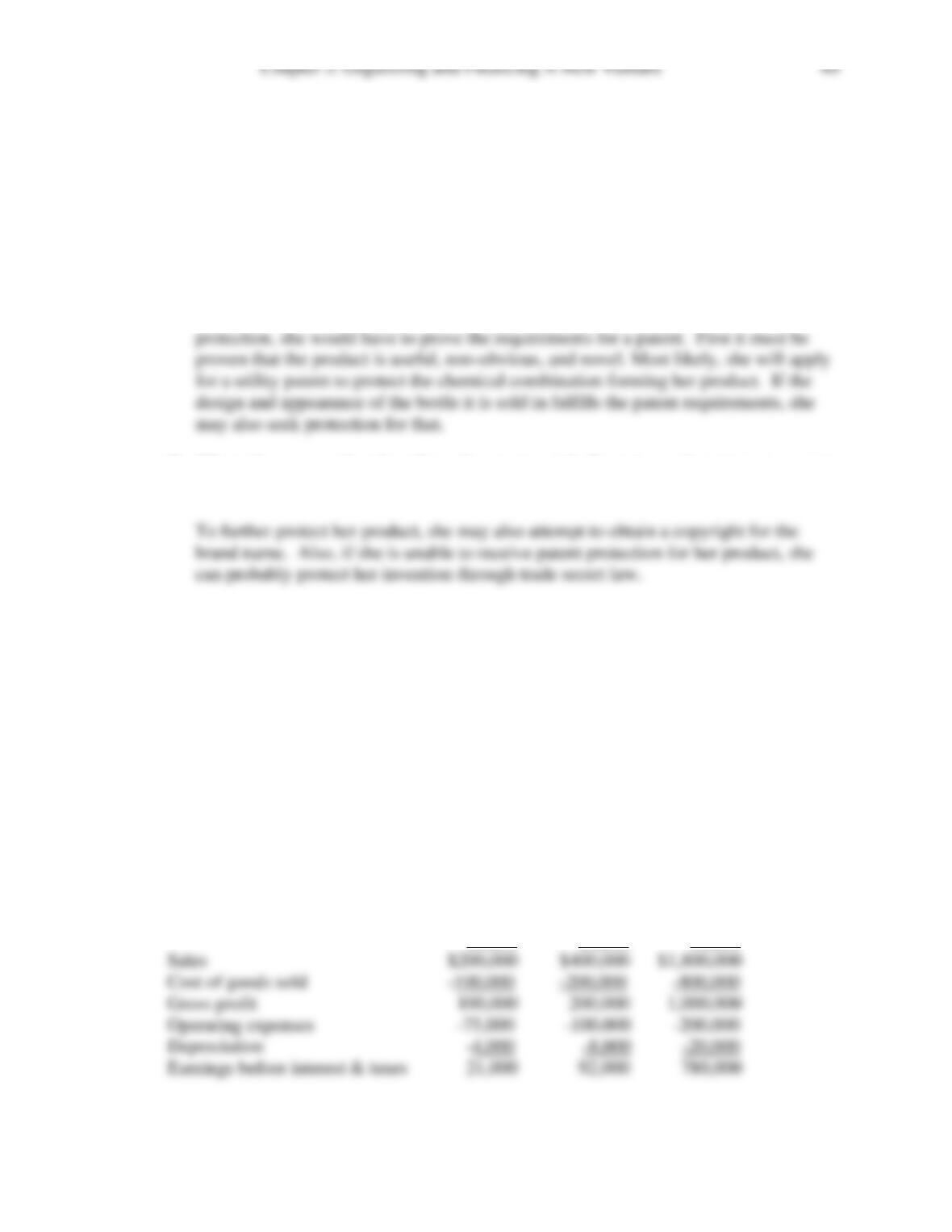
Year 1 Year 2 Year 3
A. Use the tax rate schedules presented in the chapter to estimate the dollar amount of
taxes that would have to be paid in each year by the HairCare Products Company if
the venture was initially formed as a corporation. Also calculate the after-tax net
income for each year.
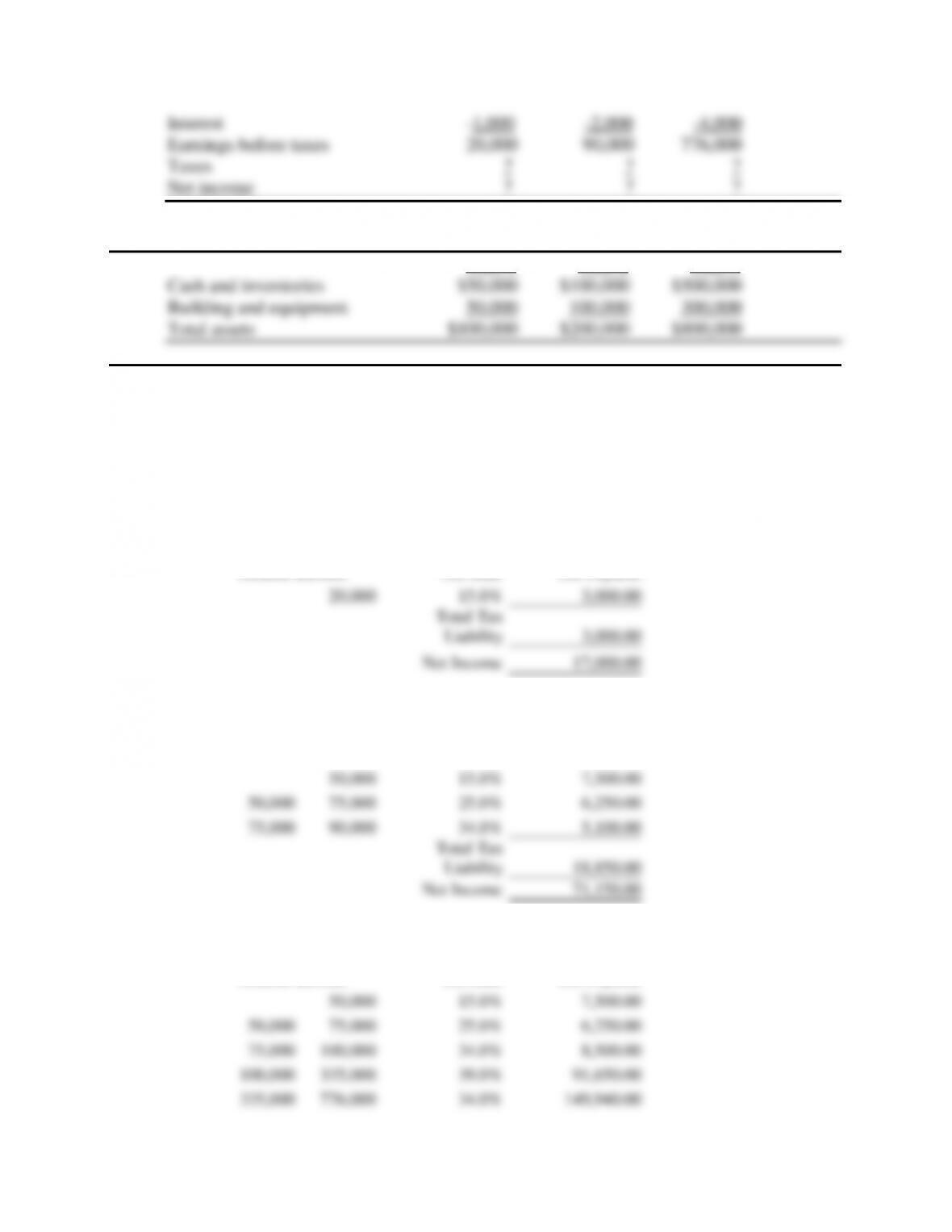
YEAR 1
Marginal
Taxable Income
Tax Rate
Tax Payable
20,000
15.0%
3,000.00
Total Tax
Liability
3,000.00
Net Income
17,000.00
YEAR 2
Marginal
Taxable Income
Tax Rate
Tax Payable
50,000
15.0%
7,500.00
50,000
75,000
25.0%
6,250.00
75,000
90,000
34.0%
5,100.00
Total Tax
Liability
18,850.00
Net Income
71,150.00
YEAR 3
Marginal
Taxable Income
Tax Rate
Tax Payable
50,000
15.0%
7,500.00
50,000
75,000
25.0%
6,250.00
75,000
100,000
34.0%
8,500.00
100,000
335,000
39.0%
91,650.00
335,000
776,000
34.0%
149,940.00

Chapter 3: Organizing and Financing A New Venture
51
Total Tax
Liability
263,840.00
Net Income
512,160.00
B. Use the tax rate schedules presented in the chapter to estimate the dollar amount of
taxes that would have to be paid in each year if the HairCare Products Company was
organized as a proprietorship, represented Francine’s only source of income, and she
was single. Also calculate the after-tax net income for each year.
Year 2: Earnings before taxes = $90,000
Year 3: Earnings before taxes = $776,000
C. Use ratios from Chapter 2 to calculate the return on assets (ROA) model and its net
profit margin and asset intensity ratios.
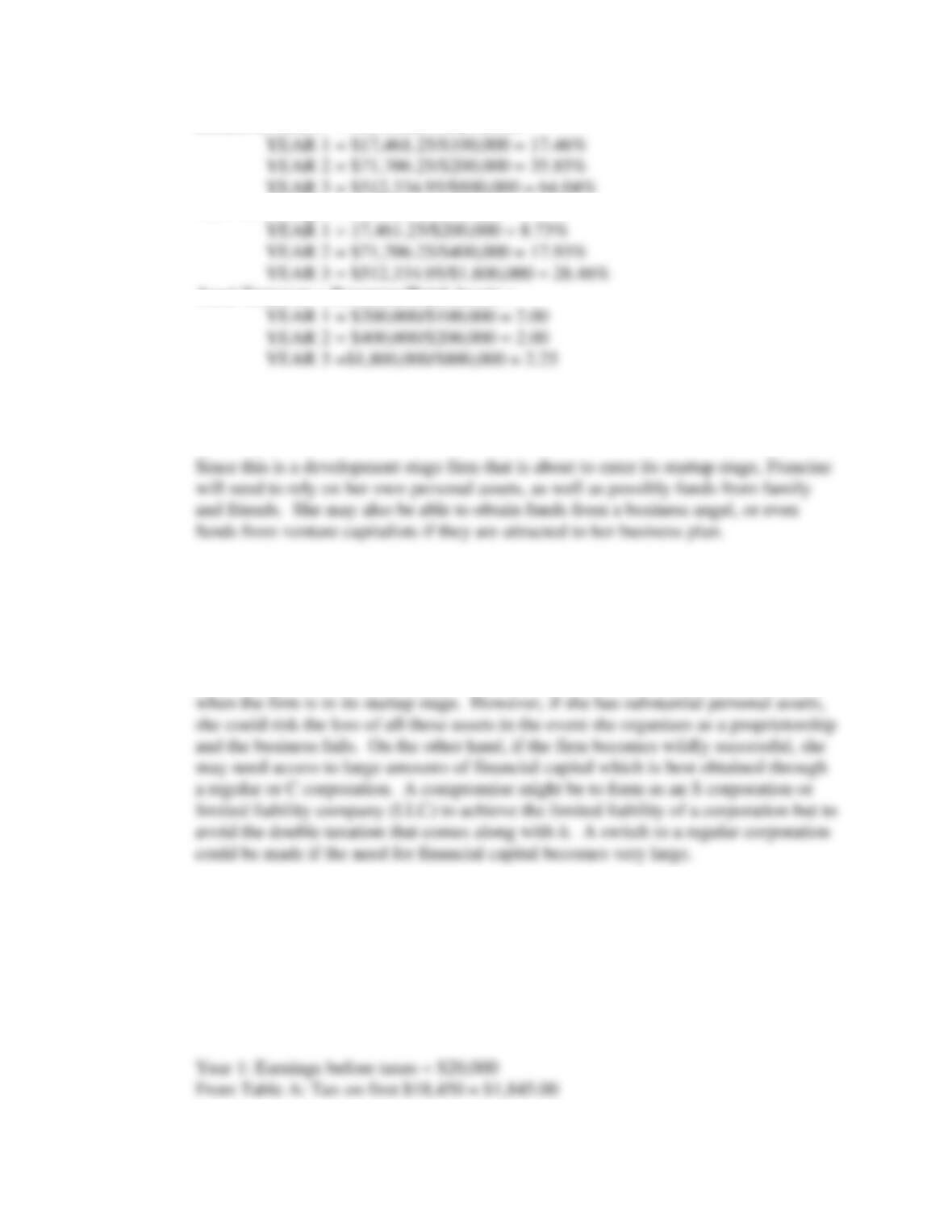
Assuming Taxed as a Corporation:
Return on Assets = Net Profit/Total Assets
Chapter 3: Organizing and Financing A New Venture
52
Return on Assets = Net Profit/Total Assets
Net Profit Margin = Net Profit/Revenues
Asset Turnover = Revenues/Total Assets =
D. In order to grow sales, HairCare Products will need to invest in assets to support
sales growth. How might the venture’s assets be financed?
E. Would you recommend that the HairCare Products Company be initially formed as a
proprietorship or as a corporation? Why? Should Francine consider changing the
form of business organization for the HairCare Products Company as the firm grows
over time?
By forming the business as a proprietorship, Francine may incur a lower tax liability
11. [Income Taxes and Ratios] Now let’s assume that Francine Delgado (see Problem 10)
organizes the HairCare Products Company as a proprietorship, is married, and files a
joint tax return with her husband, Franco.
A. Calculate the tax liability (using tax tables presented in the chapter) and net income
in each of the three years for the HairCare Products Company assuming no other
personal income or deductions.

Chapter 3: Organizing and Financing A New Venture
53
B. For this proprietorship scenario, calculate and make ratio comparisons with the
calculations in Part C of Problem 10.
Return on Assets = Net Profit/Total Assets
Net Profit Margin = Net Profit/Revenues
C. Would you recommend that the venture be organized as a proprietorship or as a
regular corporation? Why?
By forming the business as a proprietorship, Francine may incur a lower tax liability
D. What other forms of business organization might Francine consider when forming the
HairCare Products Company? What are their pros and cons?
Chapter 3: Organizing and Financing A New Venture
54
Francine might consider forming her business as an S corporation or limited liability
MINI CASE 1: INTERACT SYSTEMS, INC. (REVISITED)
Interact Systems, Inc. has developed software tools that help hotel chains solve application
integration problems. Interact’s Application Integration Server (AIS) provides a two-way
interface between central reservations systems (CRS) and property management systems (PMS).
At least two important trends in the hotel industry are relevant. First, hotels are shifting away
from the manual booking of room reservations and electronic bookings will continue to increase
as more bookings are made over the Internet. Second, competitive pressures are forcing hotels to
implement yield management programs and to improve customer service. By integrating the
CRS and PMS through Interact’s AIS, inventories can be better managed, yields improved, and
customer service enhanced.
All reservation traffic is routed from the CRS to individual hotel properties. This allows
Interact Systems to create a database that can be used to track customers and to facilitate
marketing programs, such as frequent stay or VIP programs, as a way of increasing customer
satisfaction. Interact forecasts application integration expenditures in the hospitality industry to
exceed $1 billion by 2018.
Greg Thomas founded Interact Systems in 2012 and developed the firm’s middleware
software and hospitality applications. He has twelve years of systems applications experience
and currently is Interact’s Chief Technology Officer. Eric Westskow joined Interact in early
2015 as President and CEO. Prior to that time, he worked in sales and marketing in the software
industry for over twenty years.
A. What are the advantages of having formed the company as a corporation?
An important advantage relates to investor liability whereby liability is limited to
B. What other organizational structures would have been appropriate?
Interact Systems might also have been organized as a Subchapter S (or just S) corporation or
C. Could Interact Systems qualify for S corporation status with the IRS? Why or why not?
Chapter 3: Organizing and Financing A New Venture
55
amounts of equity capital are not needed during the early part of its life cycle. Furthermore,
D. What is the intellectual property involved in Interact Systems’ business model?
Interact Systems has developed software tools and programs that help hotel chains solve
E. What methods of protection are available for Interact Systems’ intellectual property?
Intellectual property can be protected through (a) patents, (b) trade secrets, (c) trademarks,
and (d) copyrights. Interact Systems might be able to seek “utility” patents on its computer
F. What considerations are important in deciding whether to use an employment contract for
the newly hired CEO?
Eric Westskow joined Interact as CEO and president in early 2015. Greg Thomas had
founded Interact Systems in 2012 and was responsible for developing the venture’s software
and hospitality applications. Since it is unclear as to whether existing software programs
(intellectual properties) are protected, or the extent to which they may be undergoing changes
and improvements, an employment contract with the new CEO would seem to be important.
Employment contracts are agreements between an employer and employee about the terms
and conditions of employment. Of particular importance is the employee’s agreement to
keep confidential information secret and to assign ideas and inventions to the employer. The
CEO would need to fully understand the venture’s existing software products and new
products under development. Interact would, in turn, want to protect its intellectual property
in the event the CEO leaves the venture.

Chapter 3: Organizing and Financing A New Venture
56
MINI CASE 2: COOPERATIVE CONSTRUCTS
PART A
Several years ago, Dick and Barbara Harris were asked to attend an organizational meeting for a
newly-forming neighborhood baby-sitting cooperative. The idea was simple. Concerned and
caring parents would join together in the cooperative and exchange baby sitting services.
Although they were not particularly interested in committing to trading baby sitting favors as
their children were quickly approaching the age where babysitting services would be
unnecessary, Dick and Barbara felt socially obliged to attend the meeting with their two children.
Eight other families came to the meeting.
After a brief period of social exchange, Dick and Barbara listened, as much as possible
over the din of children playing, to the organizer, a CPA, explain how the formal accounting for
exchanged sitting services would take place. Using specially marked, yet ordinary, poker chips
as currency, members of the cooperative would receive an endowment of chips with various
colors corresponding to an hour, 30 minutes, and 15 minutes. When baby-sitting services were
received, payment was required, rounded to the nearest 15 minutes, in poker chips.
Conveniently, no family would need to keep records of whom or how much they owed. With the
creation of baby-sitting currency and some serious remarks about screening other families prior
to allowing them to join, the cooperative was launched although Dick and Barbara declined to
join.
Reflecting on some bad previous experiences with not-for-profit organizations, the
couple debated on the drive home what could be done to satisfy their concerns. Dick was
wondering how the organization could formally barter services among themselves without
organizing as a formal barter exchange and recognizing the receipt of poker chips as income.
Barbara was more concerned about babysitting for, or by, parents with which she had only a
passing acquaintance. Even if the barter arrangement were shielded from taxation (an item also
not discussed), they both contemplated who would be liable in the event of mishaps.
A. What type of an organization is necessary for the babysitting cooperative?
Although it is possible that the informally organized cooperative might be deemed an
“association” and thereby afforded some protection under state laws, it would be wise to seek
legal counsel and formally organize, possibly even as a not-for-profit corporation. Other
types of organization shielding the participants from liabilities for the acts of each other may
also be worth considering.
B. Is there potential for liability for members other than those directly involved?
There is almost always potential liability for members unless they have organized in such a
C. What are the non-tax differences between exchanging poker chips and charging $4 per hour?
Chapter 3: Organizing and Financing A New Venture
57
The currency (poker chip) is really just a type of accounting for a joint liability of the many
D. What is the difference between exchanging poker chips and charging $4 per hour from the
perspective of the Internal Revenue Service (IRS)?
would most likely be considered a type of barter exchange. Consequently, the exchange of
E. Assuming you had appropriately aged children, would you be willing to join the cooperative?
Answers will vary according to students’ understanding of the problem and the issues.
F. What, if any, are the intellectual property issues in an isolated cooperative?
In a given neighborhood or concentrated geographic area, there may be a “natural monopoly”
PART B
The organizers for Dick and Barbara’s cooperative had great success and many inquiries from
other neighborhoods on how to organize and operate. After helping several other groups
organize, the time commitment grew to the point where the organizers decided to form a
consulting practice, Cooperative Constructs, and charge fees for providing advice and materials
to startup cooperatives. Based on its extensive experiences, Cooperative Constructs had
accumulated many stories and experiences and some legal documents. After contracting a
videographer to tape one of its organization sessions, a startup package with video and
boilerplate agreement documents was ready for distribution.
A. Discuss different organizational structures for Cooperative Constructs and their
(dis)advantages.
Chapter 3: Organizing and Financing A New Venture
58
B. Identify the Cooperative Construct’s intellectual property.
C. What intellectual property protection is appropriate for their materials, organization name,
and approach?