35
CHAPTER 3
ORGANIZING AND FINANCING A NEW VENTURE
FOCUS
In this chapter, we focus on organizing the venture, obtaining and protecting intellectual property, and
early stage financing. Although an entrepreneur can change the legal form of the venture in the future,
the initial choice should carefully consider tax effects, liability implications, and the amount of financial
capital needed to start and initially operate the firm. Entrepreneurs who possess and protect intellectual
property will increase the chance that their ventures will survive and create value.
LEARNING OBJECTIVES
1. Describe the proprietorship, partnership, and corporate forms of business organization.
2. Identify the differentiating characteristics of a limited liability company (LLC).
3. Describe the benefits, risks, and basic tax aspects of various organizational forms.
4. Discuss the use of patents and trade secrets to protect intellectual property.
5. Discuss the use of trademarks and copyrights to protect intellectual property.
6. Describe how confidential disclosure agreements and employment contracts are used to protect
intellectual property rights.
7. Explain how financing is obtained via financial bootstrapping and through business angels.
8. Describe first-round financing sources.
CHAPTER OUTLINE
3.1 PROGRESSING THROUGH THE VENTURE LIFE CYCLE
3.2 FORMS OF BUSINESS ORGANIZATION
A. Proprietorships
B. General and Limited Partnerships
C. Corporations
D. Limited Liability Companies
3.3 CHOOSING THE FORM OF ORGANIZATION: TAX AND OTHER CONSIDERATIONS
3.4 INTELLECTUAL PROPERTY
A. Protecting Valuable Intangible Assets
B. What Kinds of Intellectual Property can be Protected?
1. Patents
2. Trade Secrets
3. Trademarks
4. Copyrights
C. Other Methods for Protecting Intellectual Property Rights
3.5 SEED, STARTUP, AND FIRST-ROUND FINANCING SOURCES
A. Financial Bootstrapping
B. Business Angel Funding
C. First-Round Financing Opportunities
SUMMARY
Chapter 3: Organizing and Financing A New Venture
36
DISCUSSION QUESTIONS AND ANSWERS
1. Describe the major differences between a proprietorship and a partnership.
2. What is a limited partnership?
3. Briefly describe the corporate form of business organization. What is meant by limited liability?
4. How does a subchapter S corporation differ from a regular corporation?
5. Describe the major characteristics of a limited liability company.
A limited liability company (LLC) is owned by its “members” or shareholders who have limited
6. Describe the major taxation advantages of a limited liability company or a subchapter S corporation
over a regular corporation.
7. What is meant by the term “intellectual property”?
8. Identify and briefly describe the types of patents used to protect valuable intangible assets.
Chapter 3: Organizing and Financing A New Venture
37
Patents: intellectual property rights granted for inventions that are useful, novel, and non-obvious.
There are four kinds of patents: (1) utility, (2) design, (3) plant, and (4) business method.
9. What was the purpose of the Leahy-Smith America Invents Act of 2011? Why is the U.S. Congress
working on possible passage of an “Innovation Act?”
10. What are the benefits and costs of having a patent?
11. What are trade secrets? How are they used to protect valuable intangible assets?
12. What are trademarks? Identify the four types of “marks” used to protect intellectual property.
13. What are copyrights and how are they used?
Chapter 3: Organizing and Financing A New Venture
38
14. What are confidential disclosure agreements? What are employment contracts?
15. What is seed and startup financing?
16. Describe the meaning of financial bootstrapping.
17. Describe some major characteristics of business angels.
Business angels are wealthy individuals who invest in early stage ventures in exchange for the
18. What is first-round financing that occurs during the survival life cycle stage?
19. From the Headlines – The Fantasticks: Describe the fundraising tactic for the producers of
The Fantasticks. What were the driving motivations for the angel investors?

Chapter 3: Organizing and Financing A New Venture
39
INTERNET ACTIVITIES
1. Access the Inc. magazine Web site at http://www.inc.com. Identify a list of recent articles
that relate to how to finance new ventures.
Web-researched results vary due to constant updating of the related web sites.
2. Access the http://www.garage.com Web site. Identify the angel matchmaking services that
are provided. Determine the site’s focus in terms of early stage versus later stage financing,
as well as the typical range of financing that is provided.
Web-researched results vary due to constant updating of the related web sites.
3. Access the Web sites of http://www.angeldeals.com, http://gatheringofangels.com, and
http://www.vcfodder.com. Determine the scope and focus of these sites in terms of
matchmaking financing services that are available for entrepreneurs.
Web-researched results vary due to constant updating of the related web sites.
EXERCISES/PROBLEMS AND ANSWERS
Figure 3.6 in the chapter is repeated here to support problem calculations involving federal
income taxes. We also provide in Table A incremental and cumulative income tax
calculations for corporate income taxes and for personal income taxes (for single filers and
married filing jointly).
FIGURE 3 6 2015 Personal and Corporate Federal Income Tax Rates

Chapter 3: Organizing and Financing A New Venture
40
Over — But not Over — Marginal Tax Rate
– 50,000 15%
50,000 75,000 25%
75,000 100,000 34%
100,000 335,000 39%
335,000 10,000,000 34%
10,000,000 15,000,000 35%
15,000,000 18,333,333 38%
18,333,333 ——– 35%
Marginal Marginal
Over — But not over — Tax Rate Over — But not over — Tax Rate
Taxable Income
Taxable Income
Married Filing Jointly
Single
Personal Marginal Income Tax Rates
Corporate Marginal Income Tax Rates
Taxable Income
Source: Internal Revenue Service, http://www.IRS.gov.

Chapter 3: Organizing and Financing A New Venture
41
Table A
2015 Personal and Corporate Federal Income Tax Rates
Corporate Income Taxes:
Taxable Income Marginal Incremental Cumulative
Over–— But not over —– Difference Tax Rate Taxes Taxes
0 50,000 50,000 0.15 7,500.00 7,500.00
50,000 75,000 25,000 0.25 6,250.00 13,750.00
75,000 100,000 25,000 0.34 8,500.00 22,250.00
100,000 335,000 235,000 0.39 91,650.00 113,900.00
335,000 10,000,000 9,665,000 0.34 3,286,100.00 3,400,000.00
10,000,000 15,000,000 5,000,000 0.35 1,750,000.00 5,150,000.00
15,000,000 18,333,333 3,333,333 0.38 1,266,666.54 6,416,666.54
18,333,333 0.35
Personal Income Taxes:
Single:
Taxable Income Marginal Incremental Cumulative
Over–— But not over —– Difference Tax Rate Taxes Taxes
0 9,225 9,225 0.10 922.50 922.50
9,225 37,450 28,225 0.15 4,233.75 5,156.25
37,450 90,750 53,300 0.25 13,325.00 18,481.25
90,750 189,300 98,550 0.28 27,594.00 46,075.25
189,300 411,500 222,200 0.33 73,326.00 119,401.25
411,500 413,200 1,700 0.35 595.00 119,996.25
151,200 230,450 79,250 0.28 22,190.00 51,577.50
230,450 411,500 181,050 0.33 59,746.50 111,324.00
411,500 464,850 53,350 0.35 18,672.50 129,996.50
464,850 0.396
will provide a musical sound as the bicycle is pedaled.
Phil plans to purchase materials for making the product from others, assemble the
products at the venture’s facilities, and hire product sales representatives to sell the Pedal
Pushers through local retail and discount stores that sell children bicycles. Phil will need to
Chapter 3: Organizing and Financing A New Venture
42
purchase plastic pedals and extensions, bolts, washers and nuts, reflective material, and a
“micro–chip” to provide the “music” when the bicycle is pedaled.
A. How should Phil organize his new venture? In developing your answer consider such
factors as amount of equity capital needed, business liability, and taxation of the venture.
Phil’s proposed business is not likely to be very capital intensive. That is, little
B. Phil is concerned about trying to protect the intellectual property embedded in his Pedal
Pusher product idea and prototype. How might Phil consider protecting his intellectual
property?
2. [Income Taxes] Assume your new venture, organized as a proprietorship, is in its first year
of operation. You expect to have taxable income of $50,000. Use the income tax rate
information contained in Figure 3.6 to estimate the amount of income taxes you would have
to pay.
A. Calculate the amount of your income taxes if you were filing as a single individual.
Personal Personal Personal
Marginal Taxable Amount
Tax Rate Income of Taxes
Note: This problem assumes there are no additional sources of personal taxable income.
B. Calculate the amount of your income taxes if you were married and filing jointly.
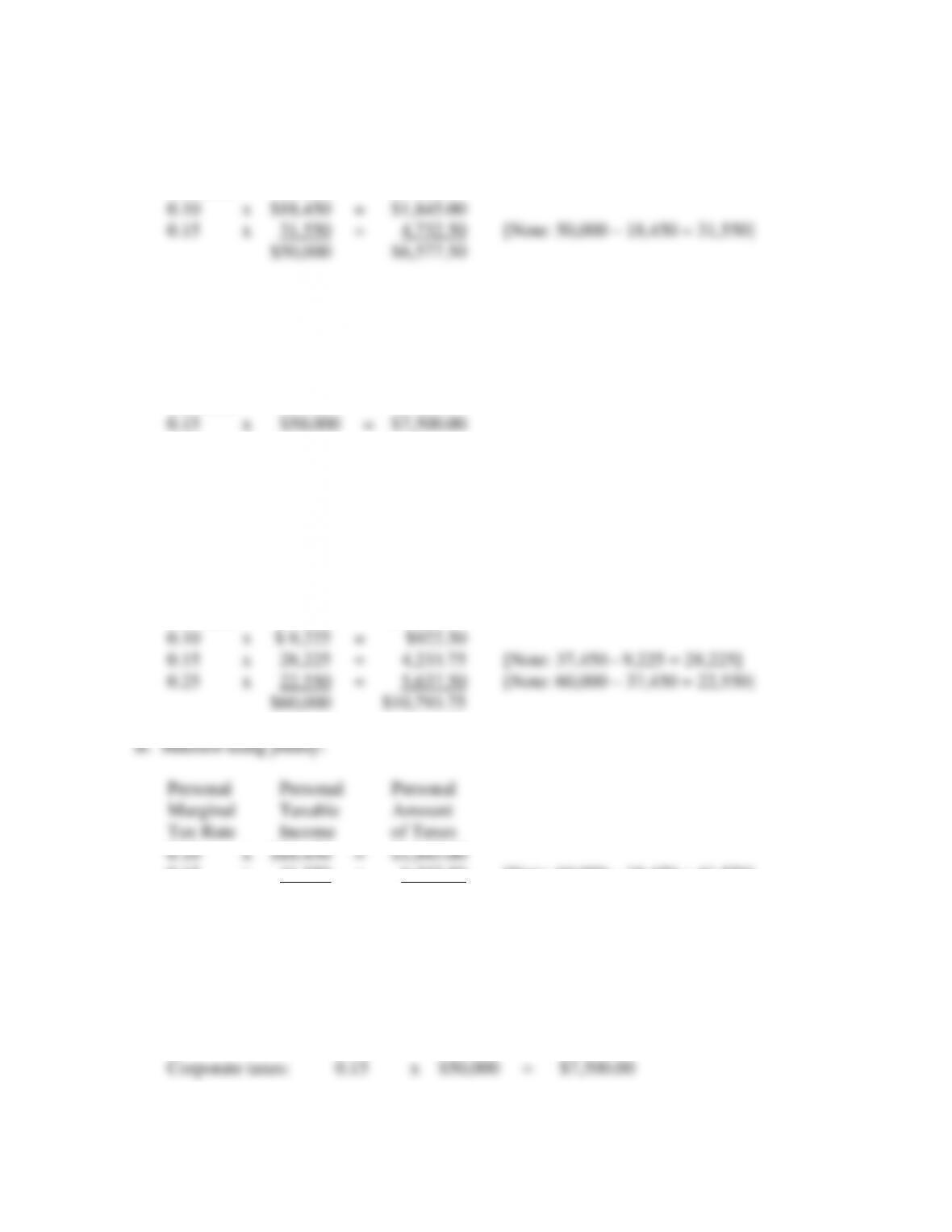
Chapter 3: Organizing and Financing A New Venture
43
Personal Personal Personal
Marginal Taxable Amount
Tax Rate Income of Taxes
C. If your venture had been organized as a standard corporation instead of a
proprietorship, calculate your income tax liability.
Corporate Corporate Corporate
Marginal Taxable Amount
Tax Rate Income of Taxes
3. [Income Taxes] Rework problem 2 under the assumption that in addition to your venture’s
taxable income of $50,000, you expect to personally earn another $10,000 from a second job.
A. Filing as a single individual:
Personal Personal Personal
Marginal Taxable Amount
Tax Rate Income of Taxes
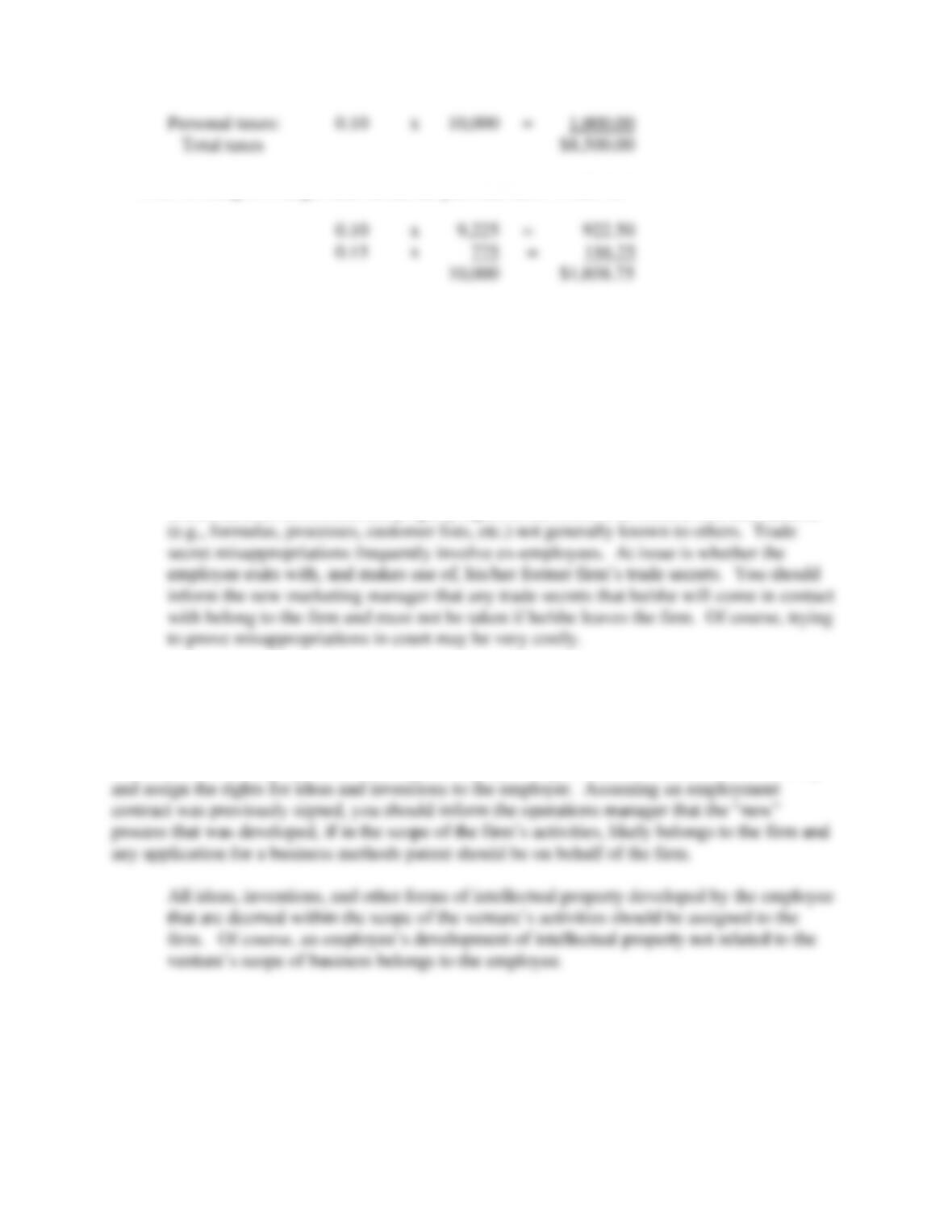
0.15 x 41,550 = 6,232.50 [Note: 60,000 – 18,450 = 41,550]
$60,000 $8,077.50
C. Taxed as a Corporation plus personal taxable income:
If married filing jointly:
Marginal Taxable Amount
Tax Rate Income of Taxes
Chapter 3: Organizing and Financing A New Venture
44
Note: if filing as a single individual, the personal taxes would be:
4. [Intellectual Property] As your venture has moved from the development stage to the startup
stage, a number of trade secrets have been developed along with an extensive client list. You
are in the business of developing and installing computer networks for law firms.
A. Your marketing manager has recently resigned and you are in the process of interviewing
new candidates for the position. How might you try to protect your venture’s intellectual
property since the marketing manager must have access to the trade secrets and client
list?
Trade secrets are intellectual property rights in the form of inventions and information
B. Your operations manager has developed a “new” process and you have heard that he
plans to personally apply for a business methods patent. What action(s) would you take?
Employment contracts are agreements between an employer and an employee about the terms
and conditions of employment, including the employee’s agreement to maintain confidentiality
5. [Income Taxes] The Capital-Ideas Company is in its development stage and is deciding how
to formally organize its business venture. The founder, Rolf Lee, is considering organizing
as either a proprietorship or as a corporation. He expects revenues to be $2 million next
year with total expenses amounting to $1.625 million resulting in a taxable income of
Chapter 3: Organizing and Financing A New Venture
45
$375,000. Rolf is interested in estimating his federal income tax liability based on the
schedules contained in Figure 3.6.
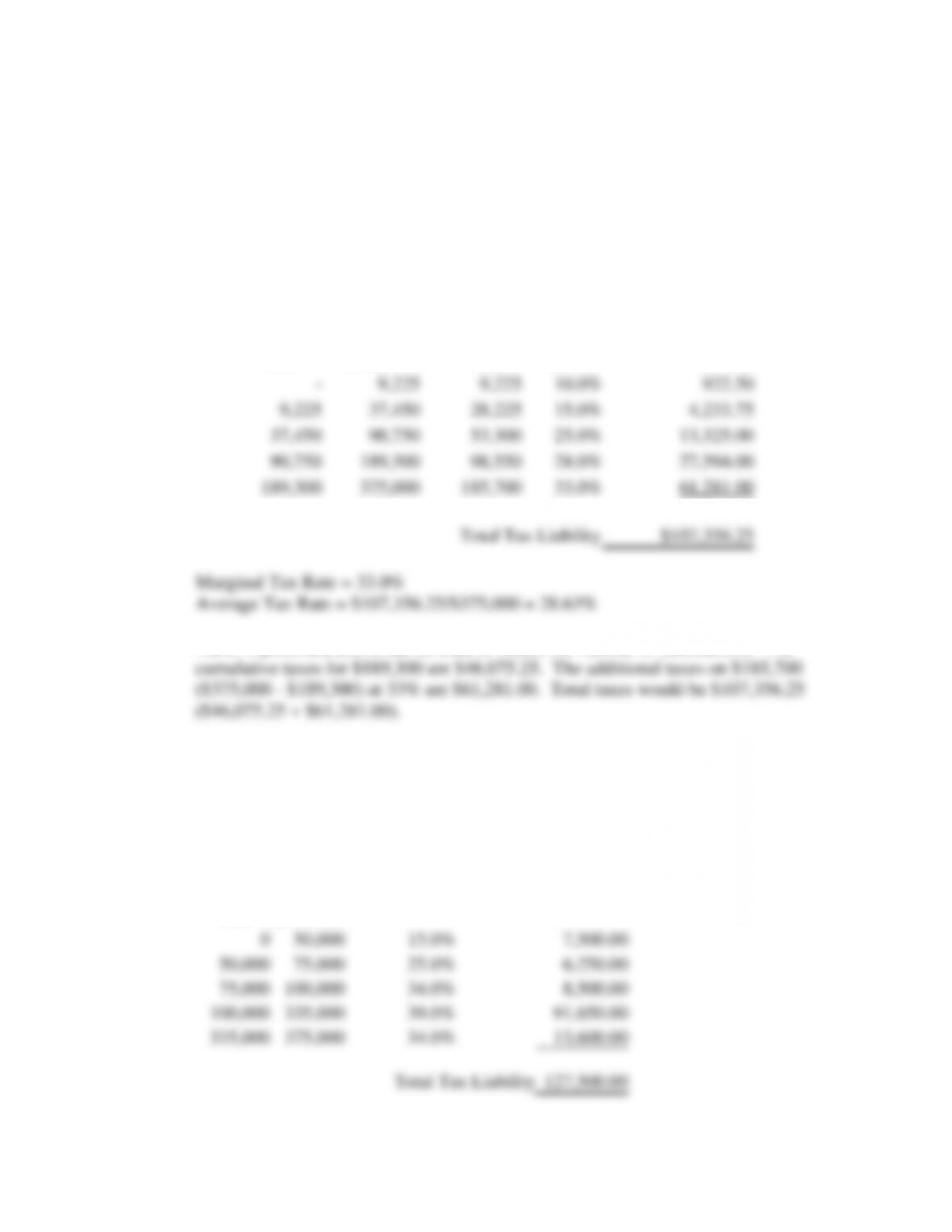
A. Calculate the amount of federal income tax that Rolf would pay if Capital-Ideas is
organized as a proprietorship. What would be the marginal tax rate on the last dollar of
taxable income and what would be the average tax rate?
Assume Rolf files as a single tax payer.
Table A presented above can be used to reduce the number of calculations. The
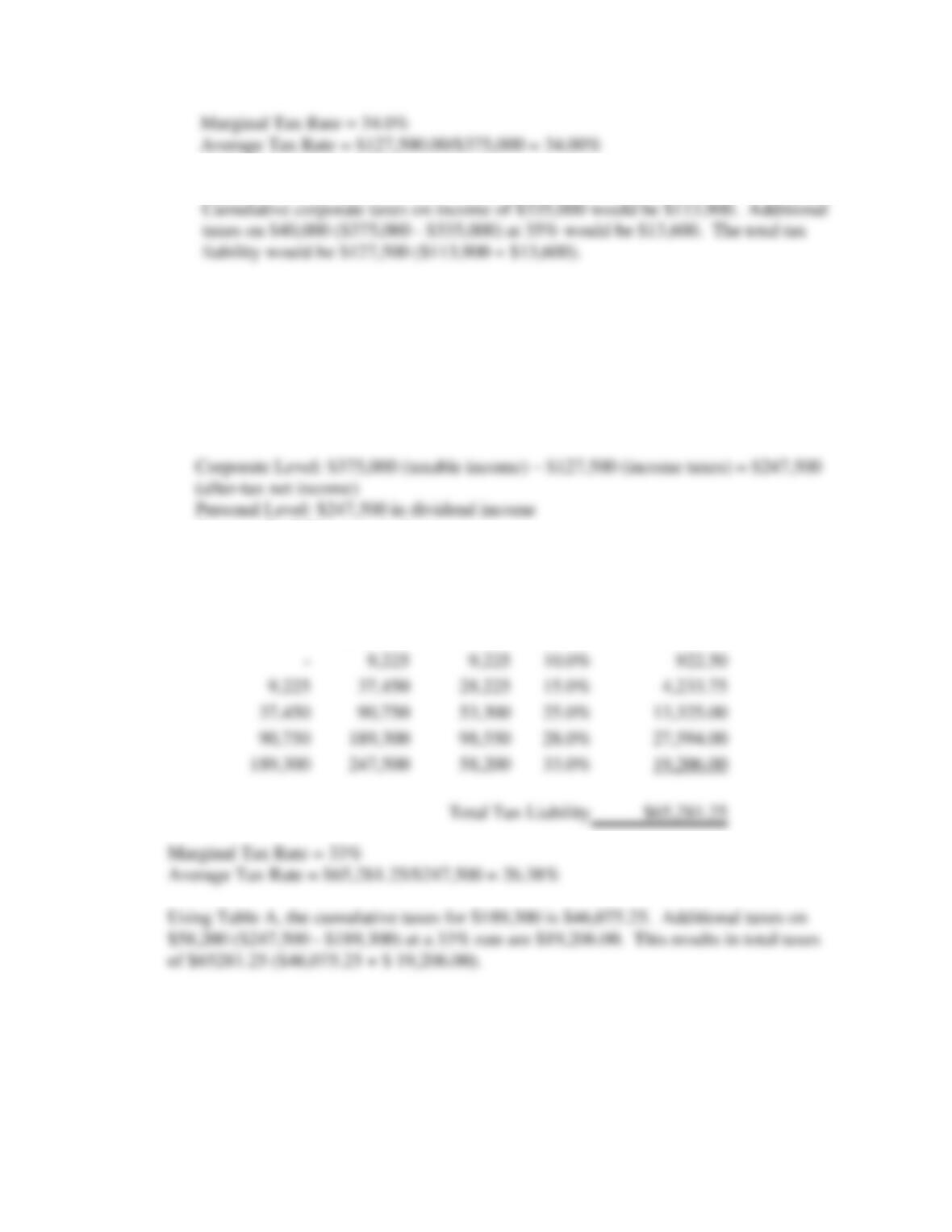
B. Calculate the amount of federal income tax that the Capital-Ideas Company would
have to pay if the venture is organized as a regular corporation. What would be the
marginal tax rate on the last dollar of taxable income and what would be the average
tax rate?
Corporate
Marginal
Taxable Income
Tax Rate
Tax Payable
Over But not over
0
50,000
15.0%
7,500.00
50,000
75,000
25.0%
6,250.00
75,000
100,000
34.0%
8,500.00
100,000
335,000
39.0%
91,650.00
335,000
375,000
34.0%
13,600.00
Total Tax Liability
127,500.00
Personal Taxable Income
Dollar
Marginal
Amount
Over But not over
Amount
Tax Rate
of Taxes
–
9,225
9,225
10.0%
922.50
9,225
37,450
28,225
15.0%
4,233.75
37,450
90,750
53,300
25.0%
13,325.00
90,750
189,300
98,550
28.0%
27,594.00
189,300
375,000
185,700
33.0%
61,281.00
Total Tax Liability
$107,356.25
Chapter 3: Organizing and Financing A New Venture
46
Note: Table A presented above could be used to reduce the number of calculations.
C. If the Capital-Ideas Company is organized as a corporation and all after-tax profits
are paid out as dividends to Rolf Lee, what additional personal income taxes would
be paid? What would be the marginal tax rate and the average tax rate on this
personal income received from the corporation?
Note: it is assumed that these dividends received would be taxed at ordinary income
tax rates.
Assume: Rolf files as a single tax payer
6. [Income Taxes] In the second year of operation, the Capital-Ideas Company forecasts
revenues to grow to $5 million dollars, and expenses before income tax to be 70 percent
of revenues. Rework Parts A, B, and C of Problem 5 to reflect this new level of revenues
and expenses.
Personal Taxable Income
Dollar
Marginal
Amount
Over But not over
Amount
Tax Rate
of Taxes
–
9,225
9,225
10.0%
922.50
9,225
37,450
28,225
15.0%
4,233.75
37,450
90,750
53,300
25.0%
13,325.00
90,750
189,300
98,550
28.0%
27,594.00
189,300
247,500
58,200
33.0%
19,206.00
Total Tax Liability
$65,281.25