215
Chapter 13
OTHER FINANCING ALTERNATIVES
FOCUS
In this chapter, we consider a variety of government and private sources of new venture
funding. We also consider financing traditionally available only to more mature ventures
including commercial banking loans.
LEARNING OBJECTIVES
1. Identify relevant sources of debt-oriented financing.
2. Discuss government loan guarantee and microcredit programs.
3. Identify several potential sources of funding for minority-owned enterprises.
4. Explain what differentiates venture lending and leasing from traditional lending
and leasing.
5. Describe factor financing and compare it to receivables financing through a bank.
CHAPTER OUTLINE
13.1 BUSINESS INCUBATORS, SEED ACCELERATORS, AND
INTERMEDIARIES
A. Business Incubators and Seed Accelerators
B. Intermediaries, Facilitators, and Consultants
13.2 BUSINESS CROWDSOURCING AND CROWDFUNDING
13.3 COMMERCIAL AND VENTURE BANK LENDING
13.4 UNDERSTANDING WHY YOU MAY NOT GET DEBT FINANCING
13.5 CREDIT CARDS
13.6 FOREIGN INVESTOR FUNDING SOURCES
13.7 SMALL BUSINESS ADMINISTRATION PROGRAMS
A. Overview of what the SBA does for Small Businesses
B. Selected SBA Loan and Operating Specifics
13.8 OTHER GOVERNMENT FINANCING PROGRAMS
13.9 FACTORING, RECEIVABLES LENDING, AND CUSTOMER FUNDING
13.10 DEBT, DEBT SUBSTITUTES, AND DIRECT OFFERINGS
A. Vendor Financing: Accounts Payable and Trade Notes
B. Mortgage Lending
C. Traditional and Venture Leasing
D. Direct Public Offers
SUMMARY
APPENDIX A:
Summary of Colorado Business Financial Assistance Options
Chapter 13: Other Financing Alternatives
216
DISCUSSION QUESTIONS AND ANSWERS
1. What are business incubators and seed accelerators? How do they differ?
A business incubator is an organization that helps startup companies develop by
providing management, operating, and financial services.
A seed accelerator is an organization that usually provides both an equity investment
and a mentoring and educational fixed-term, cohort program to help startup
2. What is meant by the terms business crowdsourcing and crowdfunding?
3. Describe the two major types of crowdfunding.
There are two types of crowdfunding: rewards-based crowdfunding and equity
4. What are the five C’s of Credit Analysis?
5. Name three of the common loan restrictions and explain their relation to new
venturing financing. What are some additional common loan restrictions?
While many different restrictions can be placed on businesses, a few are described
here: (1) Limits on total debt are placed on venture firms to limit the amount of
6. What is meant by venture banks? How do they differ from traditional commercial
banks?
7. Why are new ventures at a disadvantage in receiving debt financing?
8. Why is credit card financing attractive to entrepreneurs? What are the risks?
Chapter 13: Other Financing Alternatives
220
Depending on the type of business venture, funds from customers may be used to
help finance startups. Several models or approaches may be considered by
20. What is venture leasing? How does it differ from traditional leasing?
21. What is a direct public offering?
22. From the Headlines – Solix: Describe the alternative financing Solix arranged for
the launch of its biofuels production facility. Comment on your impressions of what
attracted the investors.
Answers will vary: Solix’s technology and development were initially subsidized by
Colorado State University and government grants. Then, to produce its large-scale
Chapter 13: Other Financing Alternatives
221
INTERNET ACTIVITIES
1. Locate your state’s small business credit facilitation web page. Describe the
resources you state makes available in broad categories.
Web-researched results will vary due to constant updating of the related web sites.
2. Find the web solicitation for a direct public offering under the new crowdfunding
regulations. (You might start at http://www.seedinvest.com/ offerings or other
similar sites.) Describe the venture and its prospects.
Web-researched results will vary due to constant updating of the related web sites.
EXERCISES/PROBLEMS AND ANSWERS
1. [Bank Loan Considerations] Assume you started a new business last year with
$50,000 of your own money that was used to purchase equipment. Now you are
seeking a $25,000 loan to finance the inventory needed to reach this year’s sales
target. You have agreed to pledge your venture’s delivery truck and your personal
automobile as support for the loan. Your sister also has agreed to cosign the loan.
During your initial year of operation, you paid your suppliers in a timely fashion.
A. Analyze the loan request from the viewpoint of a lender who uses the “five Cs” of
credit analysis as an aid in deciding whether to make loans.
Capacity to pay: depend on the venture’s ability to generate profits and cash flow
B. Assume you are currently carrying an accounts receivable balance of $10,000. How
might you use accounts receivables to obtain an additional bank loan?
Chapter 13: Other Financing Alternatives
222
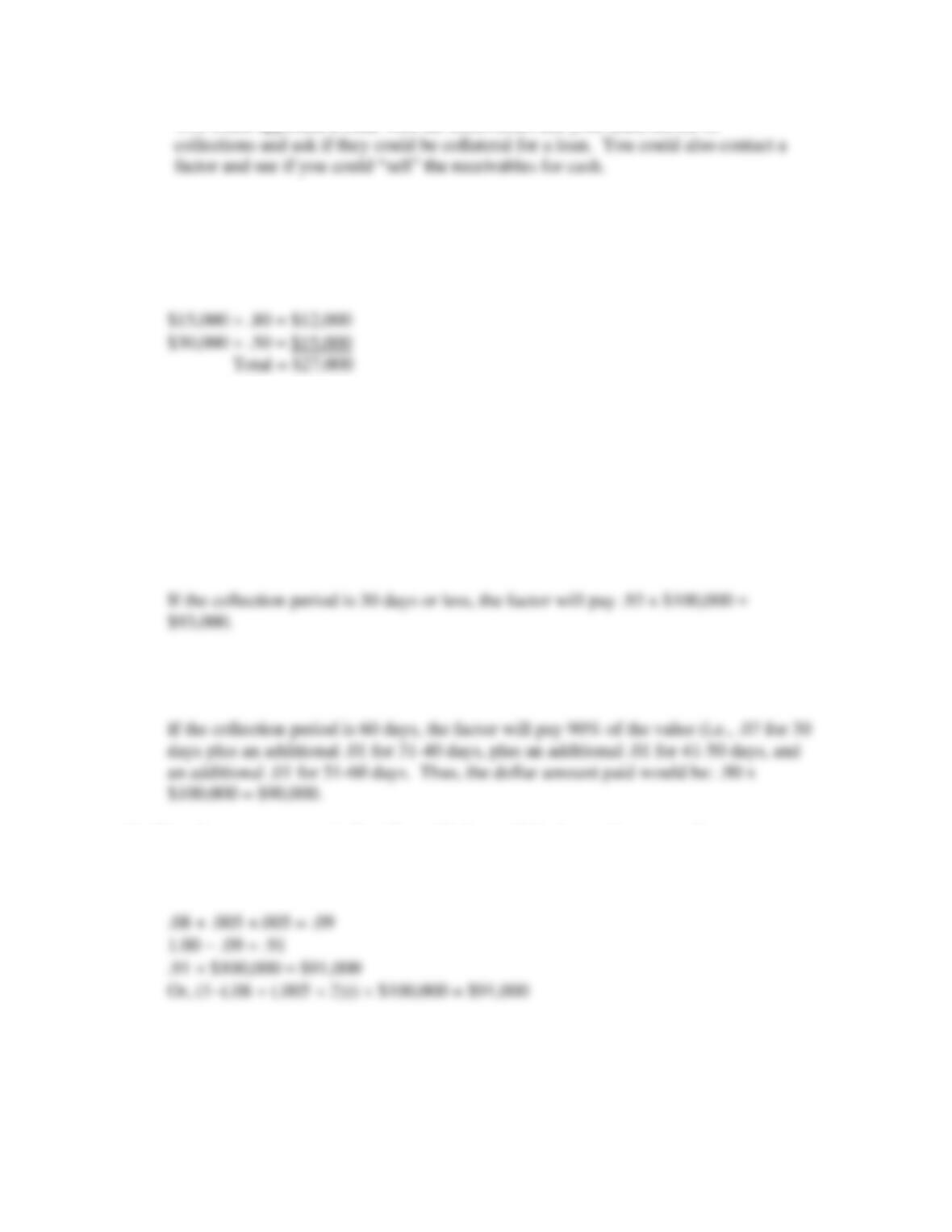
You could approach a bank with the receivables and your track record of
C. Assume at the end of next year, you will have an accounts receivable balance of
$15,000 and an inventories balance of $30,000. If a bank normally lends an amount
equal to 80 percent of accounts receivable and 50 percent of inventories pledged as
collateral, what would be the amount of a bank loan a year from now?
2. [Factor Financing] Assume the operation of your business resulted in sales of $730,000
last year. Year-end receivables are $100,000. You are considering factoring the
receivables to raise cash to help finance your venture’s growth. The factor imposes a 7
percent discount and charges an additional 1 percent for each expected ten-day average
collection period over thirty 30 days.
A. Estimate the dollar amount you would receive from the factor for your receivables if
the collection period was thirty 30 days or less.
B. Estimate the dollar amount you would receive from the factor for your receivables if the
average collection period was sixty days.
C. Show how your answer in Part B would change if the factor charges an 8 percent
discount and charges an additional .5 percent for each expected fifteen-day average
collection period over thirty days.
.08 + .005 +.005 = .09
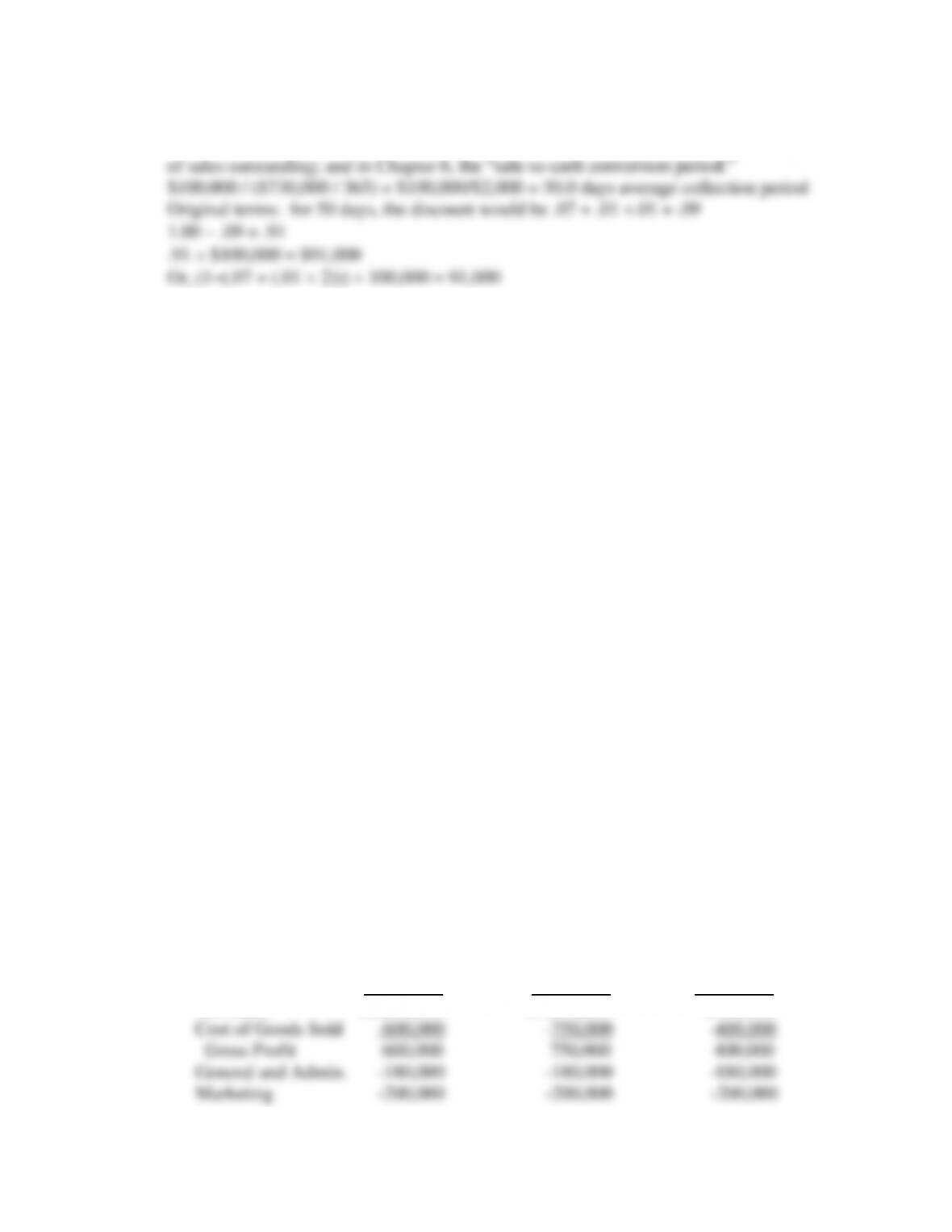
D. If the $730,000 in sales last year were evenly distributed throughout the year, an
average $100,000 in receivables outstanding would imply what average collection
period? Given the original terms stated in the problem, what dollar amount would you
expect to receive for your receivables?
Chapter 13: Other Financing Alternatives
223
Recall from Chapter 5 that the average collection period is also referred to as the days
MINI CASE: JEN AND LARRY’S FROZEN YOGURT COMPANY (Revisited)
In 2016, Jennifer (Jen) Liu and Larry Mestas founded Jen and Larry’s Frozen Yogurt
Company, which was based on the idea of applying the microbrew or microbatch strategy
to the production and sale of frozen yogurt. Jen and Larry began producing small
quantities of unique flavors and blends in limited editions. Revenues were $600,000 in
2016 and were estimated at $1.2 million in 2017.
Since Jen and Larry were selling premium frozen yogurt containing premium
ingredients, each small cup of yogurt sold for $3. The cost of producing the frozen yogurt
averaged $1.50 per cup. Administrative expenses, including Jen and Larry’s salary and
expenses for an accountant and two other administrative staff, were estimated at
$180,000 in 2017. Marketing expenses, largely in the form of behind-the-counter
workers, in-store posters, and advertising in local newspapers, were projected to be
$200,000 in 2017.
An investment in bricks and mortar was necessary to make and sell the yogurt. Initial
specialty equipment and the renovation of an old warehouse building in lower downtown
(known as LoDo) of $450,000 occurred at the beginning of 2016 along with $50,000
being invested in inventories. An additional equipment investment of $100,000 was
estimated to be needed at the beginning of 2017 to make the amount of yogurt forecasted
to be sold in 2017. Depreciation expenses were expected to be $50,000 in 2017 and
interest expenses were estimated at $15,000. The tax rate was expected to be 25 percent
of taxable income.
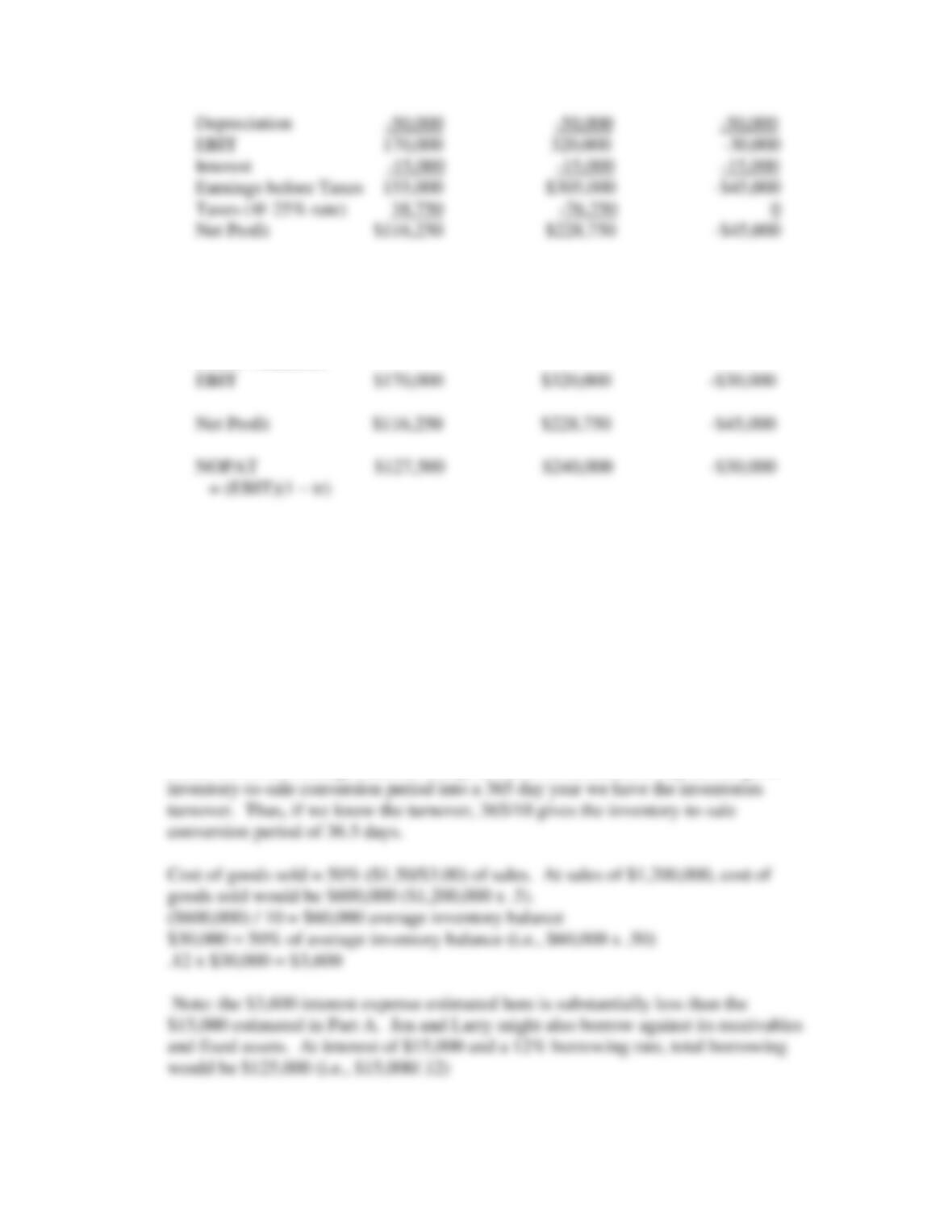
A. How much net profit, before any financing costs, is the venture expected to earn in
2017? What would be the net profit if sales reach $1.5 million? What would be the
net profit if next year’s sales are only $800,000?
Note: Cost of goods sold is: $1.50/$3.00 per unit = 50% of sales.
Scenario 1 Scenario 2 Scenario 3
Net Sales $1,200,000 $1,500,000 $800,000
Chapter 13: Other Financing Alternatives
224
Note: a venture’s profits can be measured in a number of different ways: before interest
and taxes (EBIT); net profit (or income) after financing and taxes; or net operating profit
after taxes (NOPAT) calculated as EBIT times (1 – tax rate).
Profit Measures:
Note: the tax rate is considered to be zero under Scenario 3 which indicates a negative
EBIT or loss.
B. If inventories are expected to turn over ten times a year (based on cost of goods
sold), what will be the venture’s average inventories balance next year if sales are
$1.2 million? How much might the venture be able to borrow if a lender typically
lends an amount equal to 50 percent of the average inventories balance? If the
borrowing rate is 12 percent, how much dollar amount of interest would have to be
paid on the loan?
Recall from Chapter 6 the discussion of the “inventory–to–sale conversion period”
which shows the average number of days to turnover inventories. By dividing the
Chapter 13: Other Financing Alternatives
225
C. How might the venture acquire and finance the new equipment that is needed?
Leasing and secured equipment lending are possibilities.
D. Identify potential government credit resources for the venture.
As co-owner, Jen may qualify for SBA and other special financing. Given the
E. Prepare a summary of the benefits and risks of Jen and Larry’s continued use of
credit card financing.
While credit cards may appear inexpensive and readily available, managing teaser
F. Prepare a summary of how the venture might benefit from receivables financing if
commercial customers are extended credit for thirty days on their purchases.
Jen and Larry are operating a retail business and are not likely to have receivables
from their day-to-day customer flow. If, however, Jen and Larry begin a larger scale
G. Discuss the impact of potential loan restrictions should the venture seek commercial
loan financing.
It is likely that Jen and Larry will have to maintain and provide (to the lender)
H. Comment on how the venture might be evaluated in terms of the five C’s of credit
analysis.
Chapter 13: Other Financing Alternatives
226
Capital: Jen and Larry’s personal investment in the business is not known (here)
but they do have some reputational capital in the business from previous