
Chapter 11
VENTURE CAPITAL VALUATION METHODS
FOCUS
In this chapter, we present several variations on the simplified valuation procedures and rules of
thumb frequently grouped under the designation “venture capital methods.” We introduce a three–
scenario approach to examining the value of different possible future venture outcomes.
LEARNING OBJECTIVES
1. Relate venture capital methods to more formal equity valuation methods.
2. Understand how valuation and percent ownership are related.
3. Calculate the amount of share to be issued to secure a fixed amount of funding.
4. Understand the impact of subsequent financing rounds on the structure of the current
financing round.
5. Construct multiple-scenario valuations and unify them in a single valuation.
CHAPTER OUTLINE
11.1 BRIEF REVIEW OF BASIC CASH FLOW-BASED EQUITY VALUATIONS
11.2 BASIC VENTURE CAPITAL VALUATION METHOD
A. Using Present Values
B. Using Future Values
11.3 EARNINGS MULTIPLIERS AND DISCOUNTED DIVIDENDS
11.4 ADJUSTING VCSCs FOR MULTIPLE ROUNDS
11.5 ADJUSTING VCSCs FOR INCENTIVE OWNERSHIP
11.6 ADJUSTING VCSCs FOR PAYMENTS TO SENIOR SECURITY HOLDERS
11.7 INTRODUCING SCENARIOS TO VCSCs
A. Utopian Approach
B. Mean Approach
SUMMARY
LEARNING SUPPLEMENT 11A:
Sustainable Growth
LEARNING SUPPLEMENT 11B:
PDC’S Equity Valuation: Synthesizing Equity Methods and VCSC Valuations
(Advanced)
DISCUSSION QUESTIONS AND ANSWERS
1. What is meant by “finding the value of a venture’s assets is the same as finding the
value of a venture’s debt plus equity”?
9. What are the common ways to estimate a terminal value for a venture?
10. What is the difference between the direct comparison method and the direct
capitalization method?
Direct comparison applies a direct comparison ratio to the related venture quantity
11. Describe two important motives for having an equity component in employee
compensation.
12. Describe the following terms from the perspective of venture performance: black hole,
living dead, and venture utopia. In what sense is the typical business plan utopian?
A black hole venture is a venture that results in a 100 percent loss to venture
investors. A living dead venture is a venture that provides minimal, if any, returns to
13. What is meant by the utopia discount process? Describe how expected present value
is calculated.
Utopia discount process: allows the venture investors to value their investment
14. Describe how expected present value is calculated when there are two or more
scenarios.
15. Discuss the type of data and the procedural changes necessary to implement a five-
scenario expected PV valuation for a venture investment.
To conduct a five scenario expected PV valuation, we would need to start with an
16. What is the difference between discounting expected cash flows from multiple
scenarios at a constant rate and averaging the scenarios’ PVs calculated with that
single discount rate?
17. From the Headlines — Excaliard: What ingredients would you need to conduct a
VCSC valuation for Excaliard? Does your calculation suggest that a $15.5 million
Series A round is reasonable?
Chapter 11: Venture Capital Valuation Methods
174
INTERNET ACTIVITIES
1. Web-surfing exercise: Using a particular industry as a focus, find an industry report
that covers several ventures having various levels of maturity and/or performance.
Compare their performances in recent years. Develop a model of how you would
conduct a multiple-scenario valuation for a newcomer in that industry. What type of
discount rate would be appropriate for your approach?
2. Visit one of the venture economics data collection services (e.g.,
http://www.pwvmoneytree.com) and examine a recent report on the short– and long-
term performance of venture capital funds. Relate what you find to a typical discount
rate of 50 percent.
EXERCISES/PROBLEMS AND ANSWERS
1. [Discount Rates] Calculate the discount rate consistent with a cap rate of 12% and a
growth rate of 6%. Show how your answer would change if the cap rate dropped to
10 percent while the growth rate declined to 5 percent.
Cap Rate = (r – g), so r = Cap Rate + g
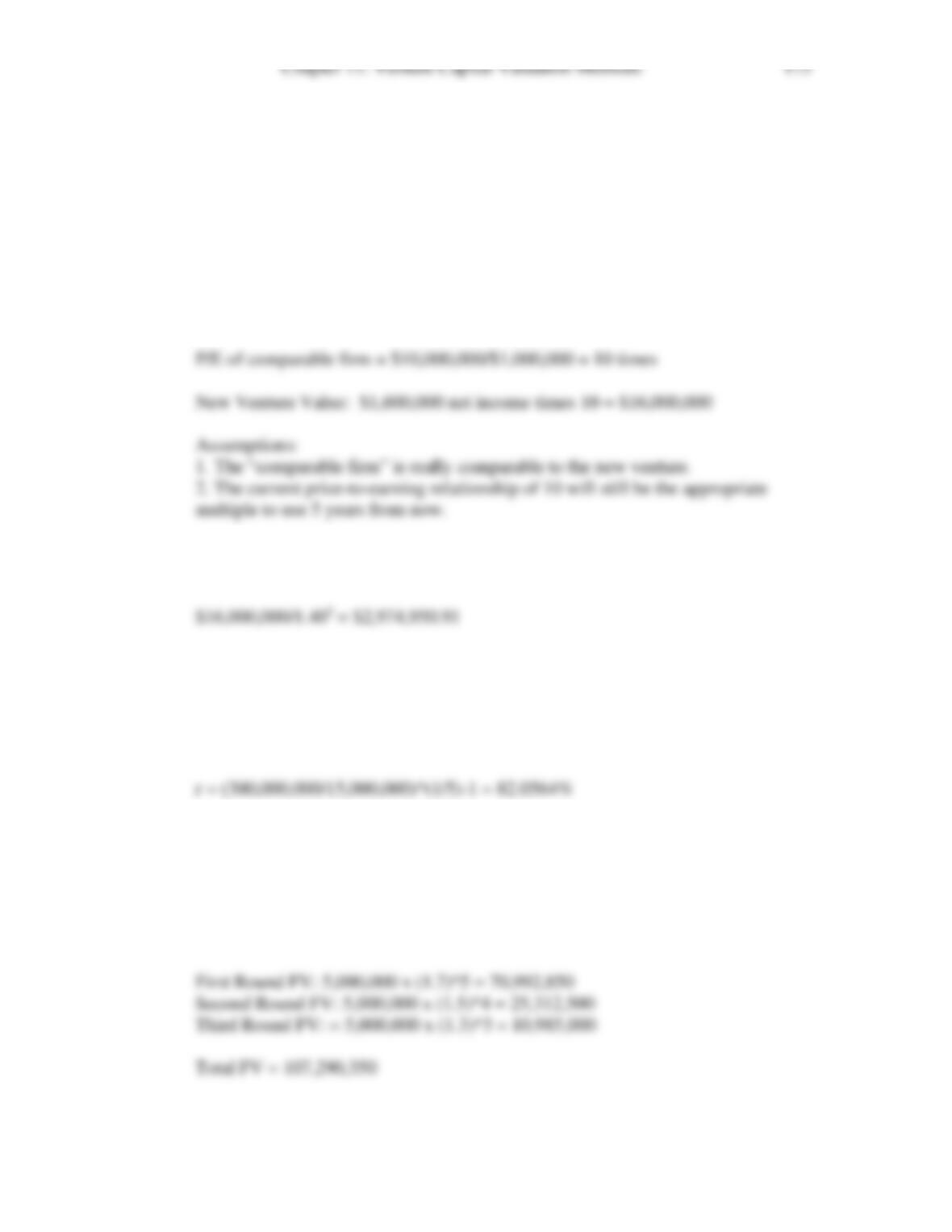
2. [Venture Present Values] A venture investor wants to estimate the value of a venture.
The venture is not expected to produce any free cash flows until the end of year 6
when the cash flow is estimated at $2,000,000 and is expected to grow at a 7 percent
annual rate per year into the future.
A. Estimate the terminal value of the venture at the end of year 5 if the discount rate
at that time is 20 percent.
B. Determine the present value of the venture at the end of year 0 if the venture
investor wants a 40 percent annual rate of return on the investment.
Chapter 11: Venture Capital Valuation Methods
176
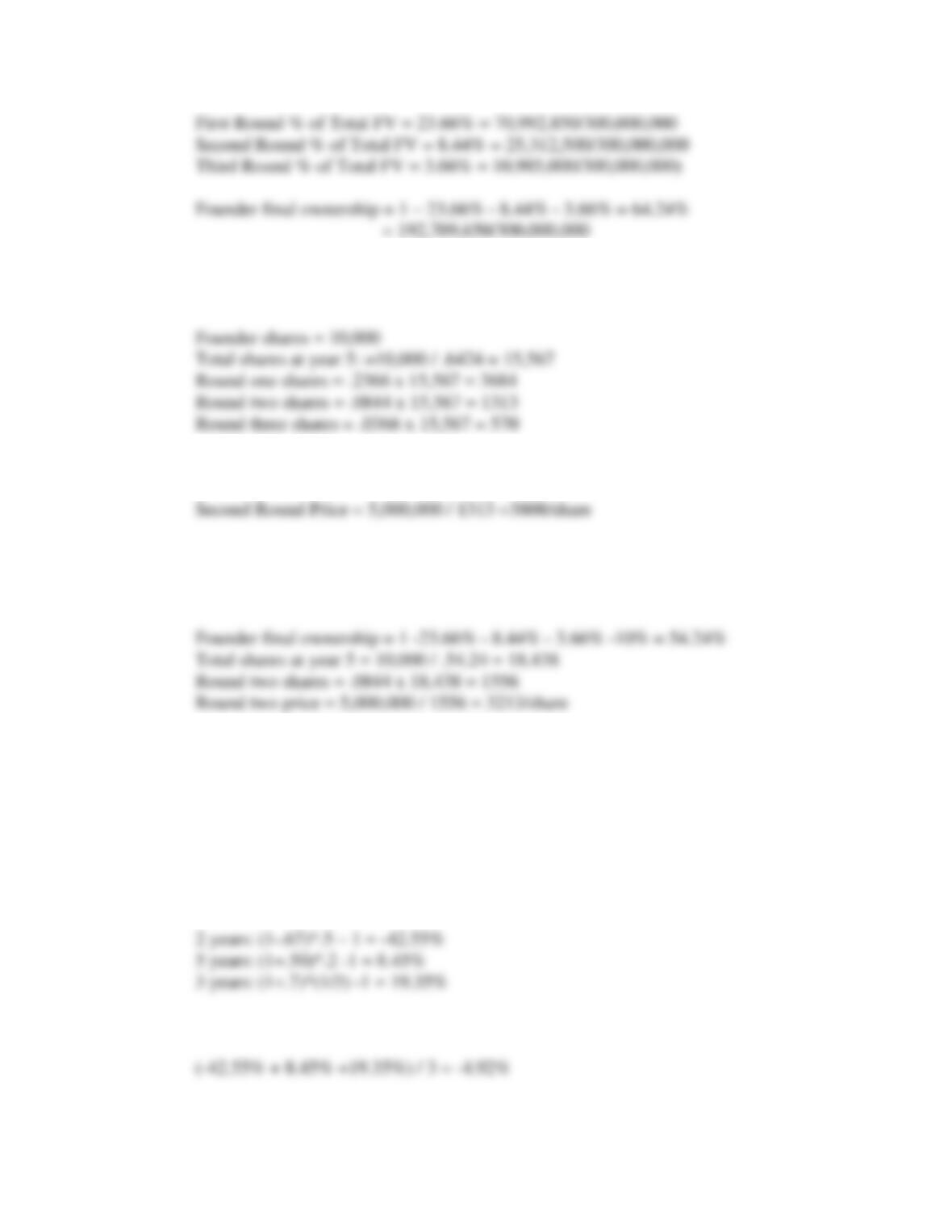
C. Assuming the founder will have 10,000 shares, how many shares will be issued in
rounds 1, 2 and 3 (at times 0, 1 and 2)?
D. What is the second round share price derived from the answers in Parts B and C?
Second Round Price = 5,000,000 / 1313 =3808/share
E. How does the answer to part D change if 10% of the year-five firm is set aside for
incentive compensation? How many total shares are outstanding (including
incentive shares) by year 5?
5. [Rates of Return] Suppose a venture fund wishes to base its required return (used in
discounting future terminal values) on its historical experience and suggests merely
averaging the rates on the last three concluded deals. These deals realized total
returns of –67% at the end of 2 years, 50% at the end of 5 years and 70% at the end
of three years, respectively.
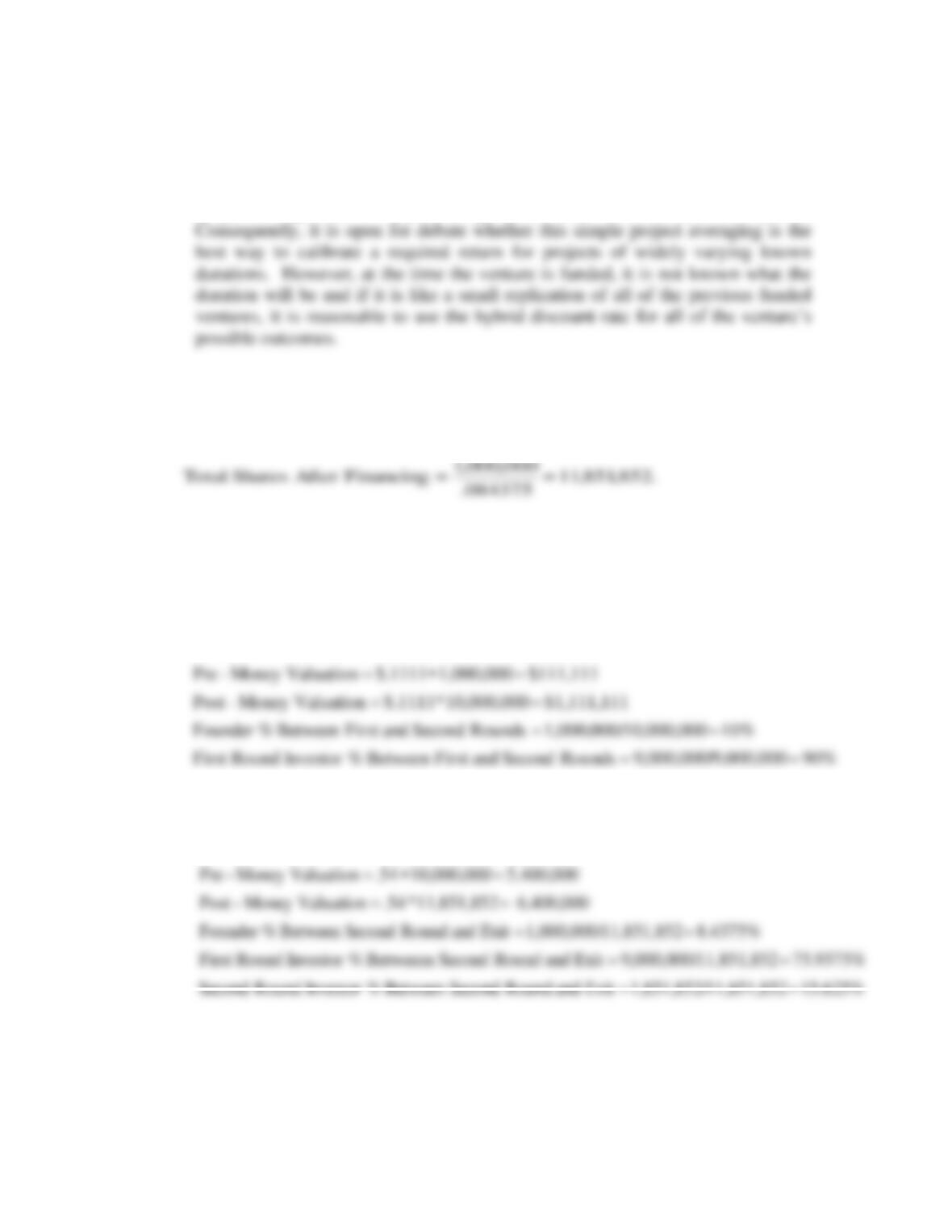
A. Assuming no intermediate flows before the terminal payoff, verify that the
associated annualized rates are –42.55%, 8.45% and 19.35%.
2 years: (1-.67)^.5 – 1 = -42.55%
B. What is the equally weighted average annualized return?
(-42.55% + 8.45% +19.35%) / 3 = -4.92%
Chapter 11: Venture Capital Valuation Methods
177
C. Does it make sense to use this as a single discount rate to apply across scenarios
involving different durations?
The returns have been realized over a total of 10 investment years. However, the
simple average here is only dividing by the three outcomes (not their years).
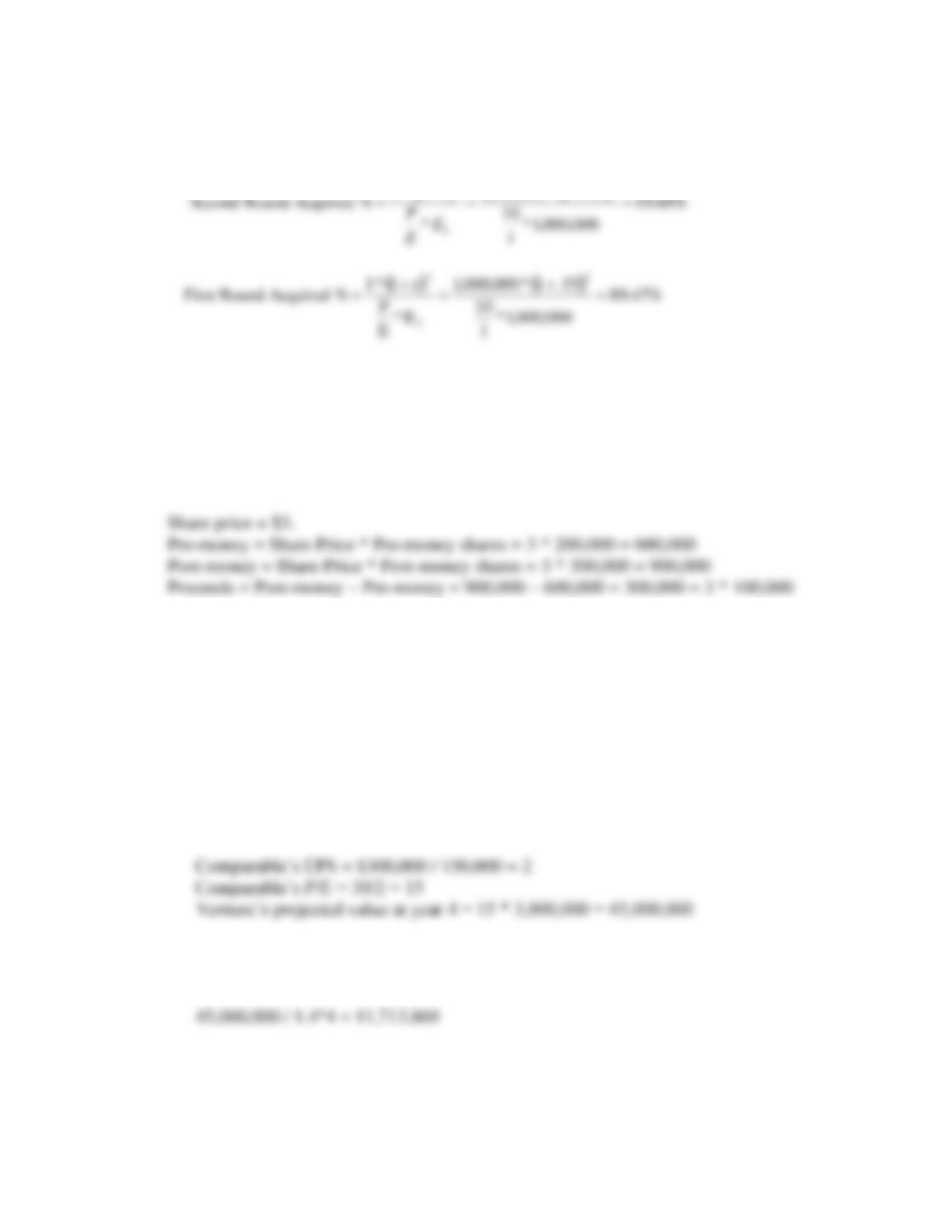
6. [Multiple Financing Rounds] Rework the two-stage example of section 10.5 with
1,000,000 initial founders’ shares (instead of the original 2,000,000 shares). What
changes?
.852,851,11
084375.
000,000,1
FinancingAfter Shares Total ==
15.625% 11,851,8521,851,852/ Exit and Round SecondBetween %Investor Round Second
75.9375% 11,851,8529,000,000/ Exit and Round SecondBetweeen %Investor RoundFirst
8.4375% 11,851,8521,000,000/ Exit and Round SecondBetween %Founder
6,400,000 11,851,852 * .54 Valuation Money –Post
5,400,00010,000,000 .54 Valuation Money –Pre
shareper $.54 1,851,852 / 1,000,000 Price Share
1,851,852 11,851,852 .15625 Issued Shares
==
==
==
==
==
==
==
Round Second
7. [Multiple Financing Rounds] Rework the two-stage example of section 10.5 with
first- and second-round required returns of 55% and 40% (instead of the original
90% 9,000,0009,000,000/ Rounds Second andFirst Between %Investor RoundFirst
shareper $.1111 9,000,000 / $1,000,000 Price Share
9,000,000 11,851,852 * .759375 Issued Shares
==
==
==
RoundFirst
Chapter 11: Venture Capital Valuation Methods
178
50% and 25%). Interpret your results as they relate to the founders’ ownership and
the feasibility of the financing.
( ) ( )
40.1*000,000,1
1*
2
+
+
rI T
%47.89
000,000,1*
1
10
E*
E
P
% Acquired RoundFirst 5
5
=
=
=
This venture is not financially feasible with these required returns.
8. [Pre-money and Post-money Valuations] Suppose you are considering a venture
conducting a current financing round involving an issue of 100,000 new shares at $3.
The existing number of shares outstanding is 200,000. What are the related pre-
money and post-money valuations?
9. [Venture Capital Valuation Method] A venture capitalist firm wants to invest $1.5
million in your NYDeli dot.com venture that you started six months ago. You do not
expect to make a profit until year four when your net income is expected to be $3
million. The common stock of BioSystems, a “comparable” firm, currently trades in
the over-the-counter market at $30 per share. BioSystems’ net income for the most
recent year was $300,000 and the firm has 150,000 shares of common stock
outstanding.
A. Apply the VC method to determine the value of the NYDeli at the end of four
years.
B. If VCs want a 40% compound annual rate of return on similar investments, what
is the present value of your NYDeli venture?
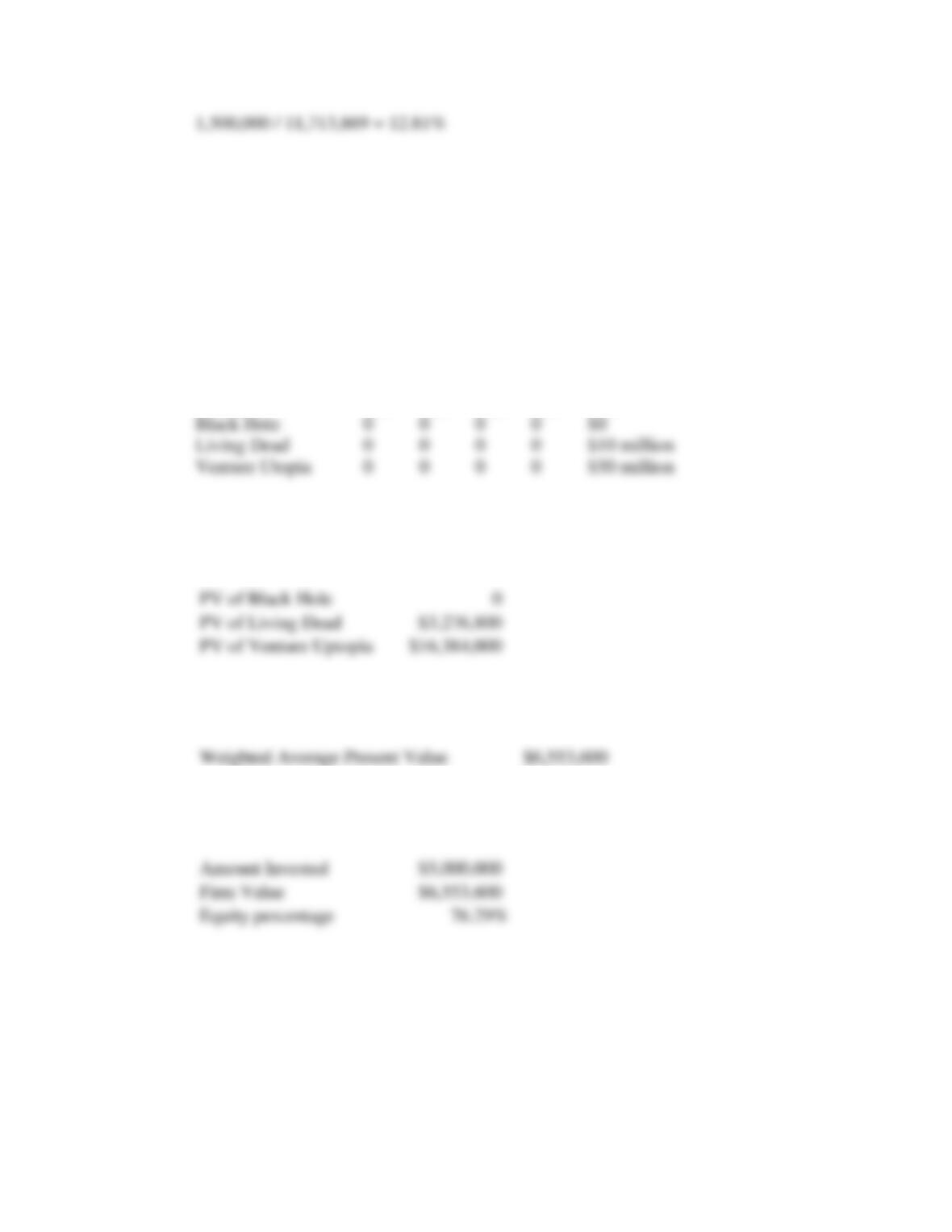
45,000,000 / 1.4^4 = 11,713,869
C. What percentage of ownership of the NYDeli dot.com venture will you have to
give up to the VC firm for its $1.5 million investment?
Chapter 11: Venture Capital Valuation Methods
179
10. [Present Values and Investor Ownership] Vail Venture Investors, LLC is trying to
decide how much percent equity ownership in Black Hawk Products, Inc. it will need
in exchange for a $5 million investment. Vail Venture Investors has a target
compound rate of return of 25 percent on venture investments like Black Hawk
Products. Depending on the success of products currently under development, Vail
Venture’s investment in Black Hawk could turn out to be a complete failure (black
hole), barely surviving (living dead), or wildly successful (venture utopia). Vail
Venture assigns probabilities of .20, .50, and .30, respectively, to the three possible
outcomes. Following are the 3 cash flow scenarios or outcomes for the Black Hawk
Products investment that Vail Venture expects to exit at the end of five years.
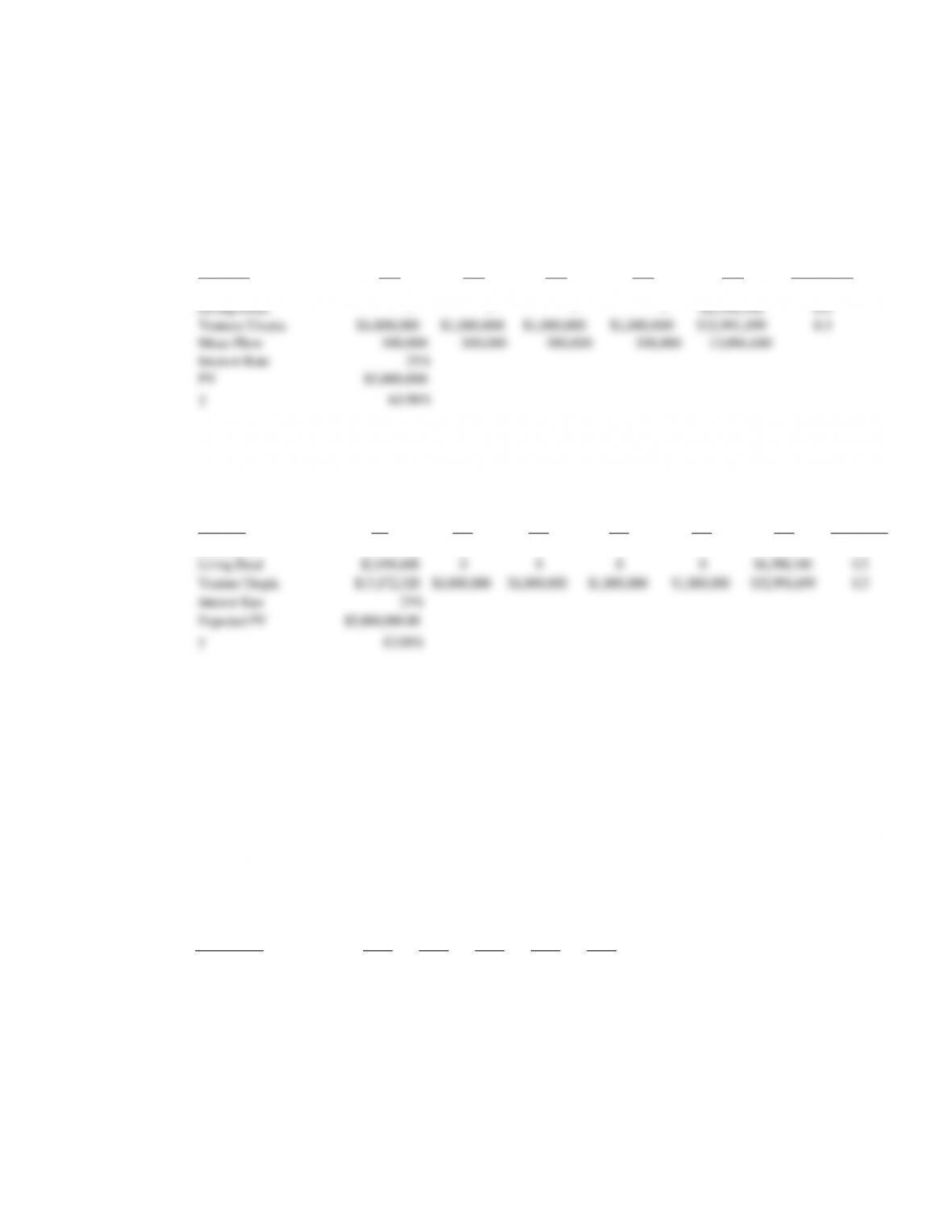
Outcome Yr1 Yr2 Yr3 Yr4 Yr5
Part A
A. Calculate the present value of each scenario or outcome for Black Hawk
Products.
PV of Black Hole 0
PV of Living Dead $3,276,800
PV of Venture Uptopia $16,384,000
B. Calculate the weighted average of the present values for the three scenarios.
What is the total equity value for the Black Hawk Products venture?
Weighted Average Present Value $6,553,600
C. Determine the acquired percentage of final ownership of Black Hawk Products
that Vail Venture Investors would need for its $5 million proposed investment.
Amount Invested $5,000,000
Firm Value $6,553,600
Equity percentage 76.29%
Part B
Now assume under the venture utopia scenario that, in addition to the $50 million cash
inflow in year 5, there will be an annual $1million preferred dividend (to be paid to Vail
Venture Investors but not other equity investors). Vail Venture expects to receive this $1
million dividend under the venture utopia scenario in each of the five years that the Black
Hawk investment will be maintained. No preferred annual cash flows are expected under
either the black hole or the living dead scenarios.
Chapter 11: Venture Capital Valuation Methods
180
D. Calculate the acquired percentage of final ownership of Black Hawk Products that
Vail Venture Investors would need to earn a 25 percent compound rate of return
on its investment. Use the “mean flow method” described in the chapter. [Hint:
use “goal seek” in a spreadsheet software program to find the necessary
percentage ownership.]
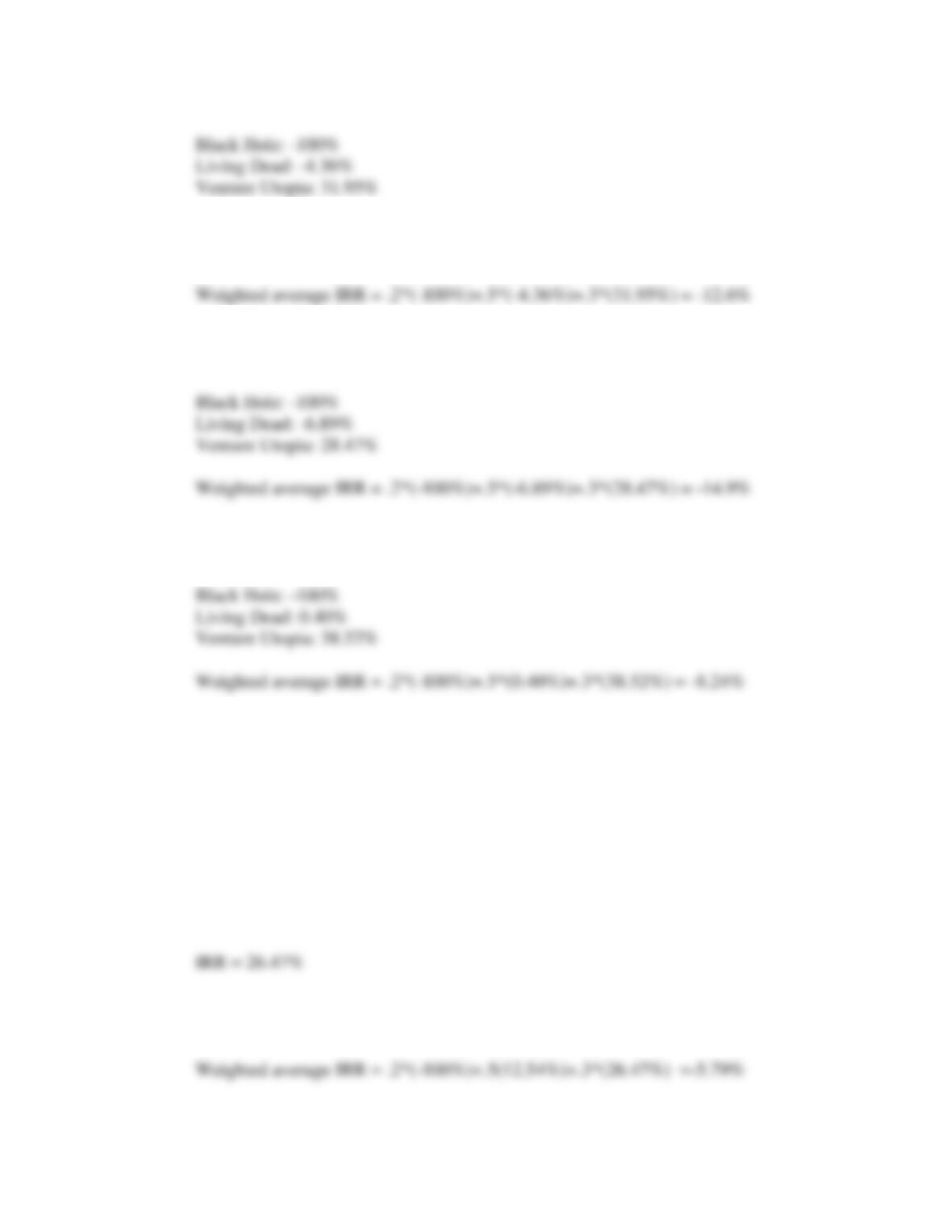
Outcome Yr1 Yr2 Yr3 Yr4 Yr5 Probability
Black Hole – – – – – 0.2
Living Dead – – – – $6,398,340 0.5
Venture Utopia $1,000,000 $1,000,000 $1,000,000 $1,000,000 $32,991,699 0.3
Mean Flow 300,000 300,000 300,000 300,000 13,096,680
Interest Rate 25%
PV $5,000,000
63.98%
E. Use the “expected present value (PV) method” described in the chapter when
solving for the acquired percentage of final ownership in the Black Hawk to Vail
Venture needs to earn its 25 percent target rate of return.
Outcome PV Yr1 Yr2 Yr3 Yr4 Yr5 Probability
Black Hole $0.00 0 0 0 0 $0 0.2
Living Dead $2,096,608 0 0 0 0 $6,398,340 0.5
Venture Utopia $13,172,320 $1,000,000 $1,000,000 $1,000,000 $1,000,000 $32,991,699 0.3
Interest Rate 25%
Expected PV $5,000,000.00
63.98%
11. [Internal Rates of Return] Vail Venture Investors, LLC has recently acquired a 40
percent equity ownership in Black Hawk Products, Inc. in exchange for a $5 million
investment. Vail Venture Investors is interested in estimating an expected compound
rate of return on its investment. Depending on the success of products currently
under development, Vail Venture’s investment in Black Hawk could turn out to be a
complete failure (black hole), barely surviving (living dead), or wildly successful
(venture utopia). Vail Venture has assigned probabilities of .20, .50, and .30,
respectively, to the three possible outcomes. Following are the 3 cash flow scenarios
or outcomes for the Black Hawk Products investment that Vail Venture expects to exit
at the end of five years.
Outcome Yr1 Yr2 Yr3 Yr4 Yr5
Black Hole 0 0 0 0 $0
Living Dead 0 0 0 0 $10 million
Venture Utopia 0 0 0 0 $50 million
Part A
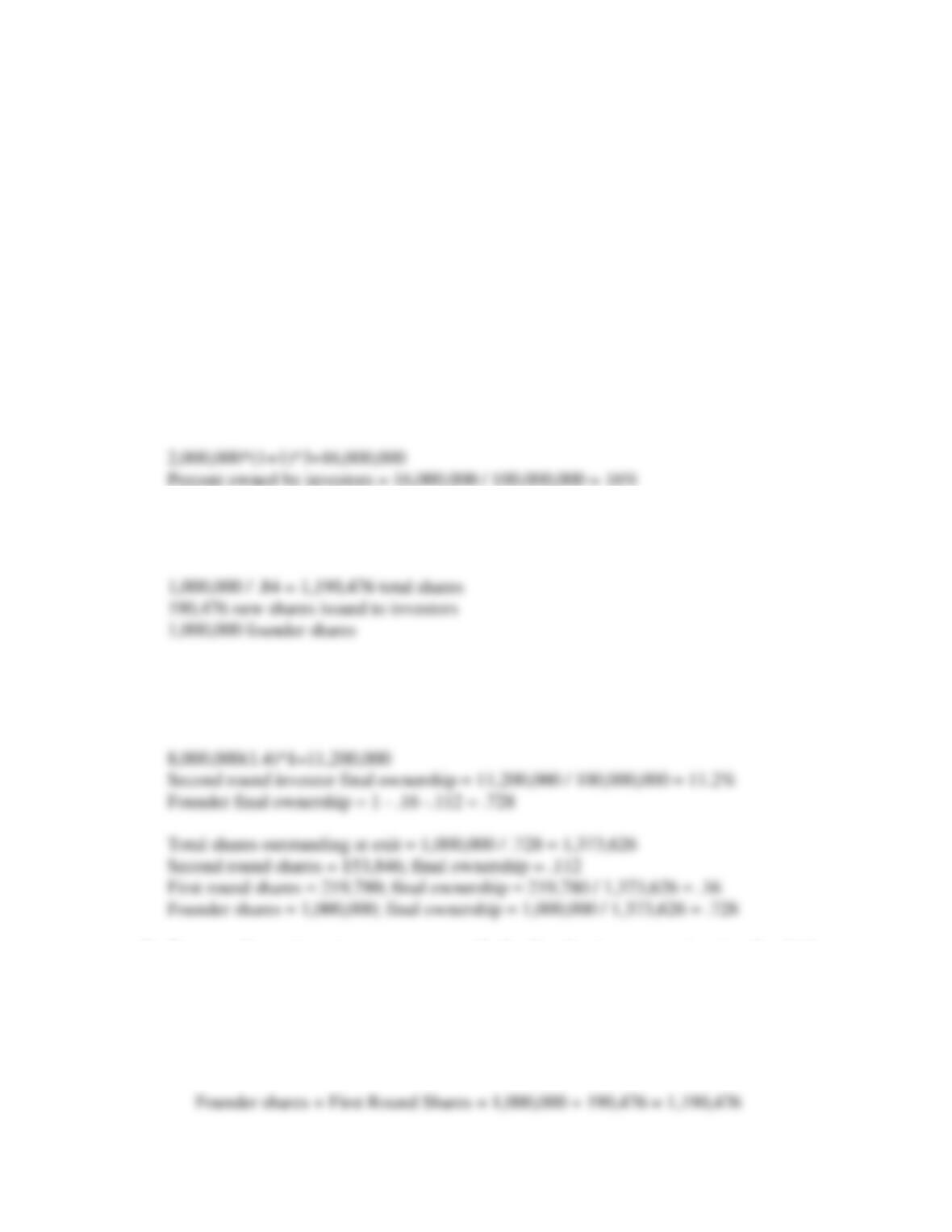
A. Calculate the internal rate of return (IRR) for each scenario or outcome for Black
Hawk Products.
Chapter 11: Venture Capital Valuation Methods
181
B. Calculate the weighted average of the IRRs for the three scenarios. What is the
expected IRR for the Black Hawk Products venture?
Weighted average IRR = .2*(-100%)+.5*(-4.36%)+.3*(31.95%) = -12.6%
C. What would be Vail Venture Investors expected IRR if its $5 million investment in
Black Hawk Products bought only a 35 percent interest in the venture?
D. Show how your answer in Part C would change if Vail Ventures received a 51
percent ownership stake in the Black Hawk Products venture for $5 million.
Black Hole: -100%
Part B
Now assume under the venture utopia scenario that, in addition to the $50 million cash
inflow in year 5, there will be an annual $1million preferred dividend (to be paid to Vail
Venture Investors but not other equity investors). Vail Venture expects to receive this $1
million dividend under the venture utopia scenario in each of the five years that the Black
Hawk investment will be maintained. No preferred annual cash flows are expected under
either the black hole or the living dead scenarios.
E. Calculate the revised internal rate of return for the venture utopia scenario if Vail
Venture’s equity ownership stake in Black Hawk Products is 40 percent.
F. What would be Vail Venture’s expected IRR on the Black Hawk Products
venture?
Chapter 11: Venture Capital Valuation Methods
182
MINI CASE: R.K.MAROON COMPANY
R.K. Maroon is a seed-stage web-oriented entertainment company with important
intellectual property. RKM’s founders, all technology experts in the relevant area, are
anticipating a quick leap to dot-com fortune and believe that their unique intellectual
property will allow them to achieve a subsequent (year 3) $100,000,000 venture value
with a one-time initial $2,000,000 in venture financing.
In contrast, similar dot-commers in their niche are currently seeking multistage
financing amounting to $10,000,000 to achieve comparable results. The founders have
organized with 1,000,000 shares and are willing to “grant” venture investors a 100%
return on their business plan projections.
A. What percent of ownership must be sold to “grant” the 100% three-year return?
B. What is the resulting configuration of share ownership (starting from the 1,000,000
founders’ shares?
1,000,000 / .84 = 1,190,476 total shares
C. Suppose the venture investors don’t buy the business plan predictions and want to
price the deal assuming a second round in year 2 of $8,000,000 with a 40% return.
What changes?
D. Suppose the venture investors agree with the founders’ assessment, price the deal
accordingly (as in Part B) and turn out to be wrong (an additional $8,000,000 at
40% must be injected for the final year).
1. What is the impact on the founders’ and round one investors’ final ownership
assuming the second round is funded by outsiders?
Founder shares + First Round Shares = 1,000,000 + 190,476 = 1,190,476
Chapter 11: Venture Capital Valuation Methods
183
2. Compare these to your results for Part C.
First round investors get less shares. Founders retain more percent ownership.
3. Who bears the dilution from an anticipated round?
Founders bear the costs of all rounds anticipated by the first round investor.
4. Who bears the dilution from an unanticipated round?
Instead of shifting second round dilution entirely onto the founders, the first round
E. Suppose that the deal is priced assuming the second round (as in Part C) and it turns
out to be unnecessary. Comment on the final ownership percentages at exit (year 3).
What do you conclude about the impact of anticipated but unrealized subsequent
financing rounds?
When first round investors get a share allocation that protects them from second
round dilution, the founders bear the cost of the first round investor’s hedging.