
143
Chapter 10
VALUING EARLY-STAGE VENTURES
FOCUS
In this chapter, we introduce basic concepts of valuation, the process of estimating
values. We consider the owner of a growing business who is beginning negotiations with
a potential investor. We introduce the mechanics of valuation and some mathematical
simplification that can be used to value the venture. By dividing the venture’s future into
an explicitly forecast period and a subsequent constant growth period, we can greatly
simplify the valuation problem faced by the venture’s entrepreneur. We discuss two
valuation methods that differ in how projected financial statements are created and when
credit for creating surplus cash is granted.
LEARNING OBJECTIVES
1. Explain why it is important to look to the future when determining a venture’s value.
2. Describe how the time pattern of cash flows relates to venture value.
3. Understand the need to consider both forecast period and terminal value cash flows
when determining a venture’s value.
4. Understand the difference between required cash and surplus cash.
5. Describe the process for developing the projected financial statements used in a
valuation.
6. Describe how pseudo dividends are incorporated into the discounted cash flow equity
valuation method.
7. Understand the differences between accounting and equity valuation cash flow.
CHAPTER OUTLINE
10.1 WHAT IS A VENTURE WORTH?
A. Does the Past Matter?
B. Looking to the Future
C. Vested Interests in Value: Investor and Entrepreneur
10.2 BASIC MECHANICS OF VALUATION: MIXING VISION AND REALITY
A. Present Value Concept
B. If You’re Not Using Estimates, You’re Not Doing a Valuation
C. Divide and Conquer with Discounted Cash Flow
10.3 REQUIRED VERSUS SURPLUS CASH
10.4 DEVELOPING THE PROJECTED FINANCIAL STATEMENTS FOR A DCF
VALUATION
10.5 JUST-IN-TIME EQUITY VALUATION: PSEUDO DIVIDENDS
10.6 ACCOUNTING VERSUS EQUITY VALUATION CASH FLOW
A. Origins of Accounting Cash Flows
B. From Accounting to Equity Valuation Cash Flows
SUMMARY
LEARNING SUPPLEMENT 10A:
Chapter 10: Valuing Early-Stage Ventures
144
Value Maximization and the First Entrepreneurial Team
LEARNING SUPPLEMENT 10B:
Discounting Growing Perpetuities
DISCUSSION QUESTIONS AND ANSWERS
1. What is meant by sweat equity?
2. What is a venture’s present value? Does the past matter?
3. Describe what is meant by the statement “If you’re not using estimates, it’s not a
valuation.”
4. Define the terms (a) explicit forecast period and (b) terminal or horizon value as they
relate to a venture’s discounted cash flow valuation.
5. What is meant by a capitalization (or cap) rate in reference to calculating a terminal
value? What other types of terminal values might be appropriate (i.e., other than
smooth growth procedures)?
6. What is a venture’s reversion value?
7. What is a stepping stone year? Why is it important in determining a venture’s value?
8. Explain the difference between pre-money valuation and post-money valuation.
9. Describe the equity valuation method.
10. Define required cash and surplus cash. Why does it matter how we treat surplus cash
for valuation purposes?
11. Briefly describe the process for projecting financial statements.
12. What is net operating working capital?
13. Identify and describe the major components that are used to calculate the equity
valuation cash flow.
14. Describe how pseudo dividends are used in the equity valuation method.
Pseudo dividend: excess cash not needed for investment in the assets or operations
to carry out the business plan
15. What is the relationship between equity valuation cash flows and dividends?
16. Why do the numerical examples of this chapter involve a large dividend in the last
year of the explicit forecast period?
Chapter 10: Valuing Early-Stage Ventures
148
EXERCISES/PROBLEMS AND ANSWERS
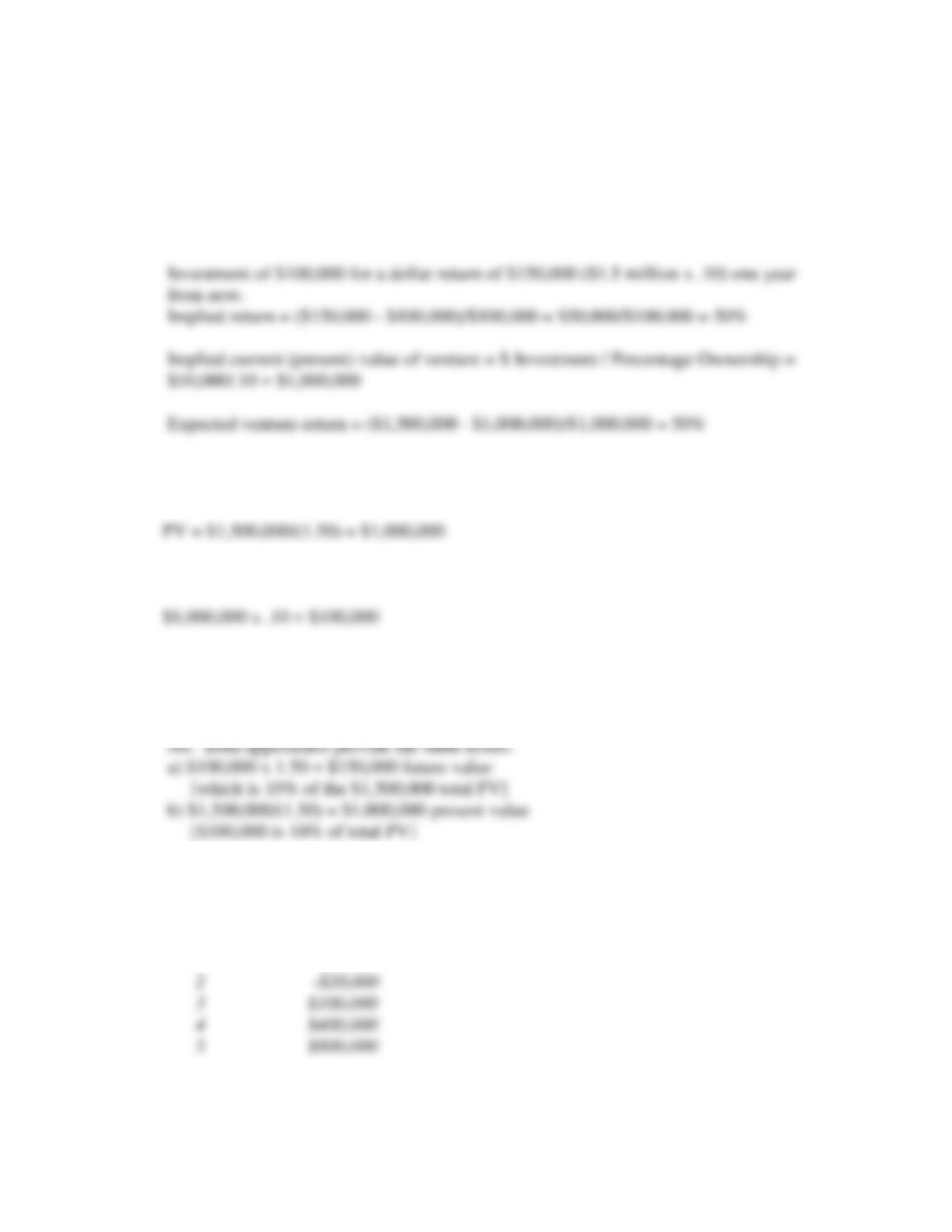
1. [Present Value Valuation Concepts] Assume you sell for $100,000 a 10 percent
ownership stake in a future payment one year from now of $1.5 million.
A. What are you saying about the implied return for the 10 percent owner?
B. What is the present value of the entire $1.5 million, using the implied return from Part
A?
C. What is 10 percent of the value determined in Part B?
D. Does it matter whether you grow the $100,000 at 50 percent to $150,000 and note it
is 10 percent of $1.5 million, or discount the $1.5 million at 50 percent to get $1
million and note that $100,000 is 10 percent of this present value?
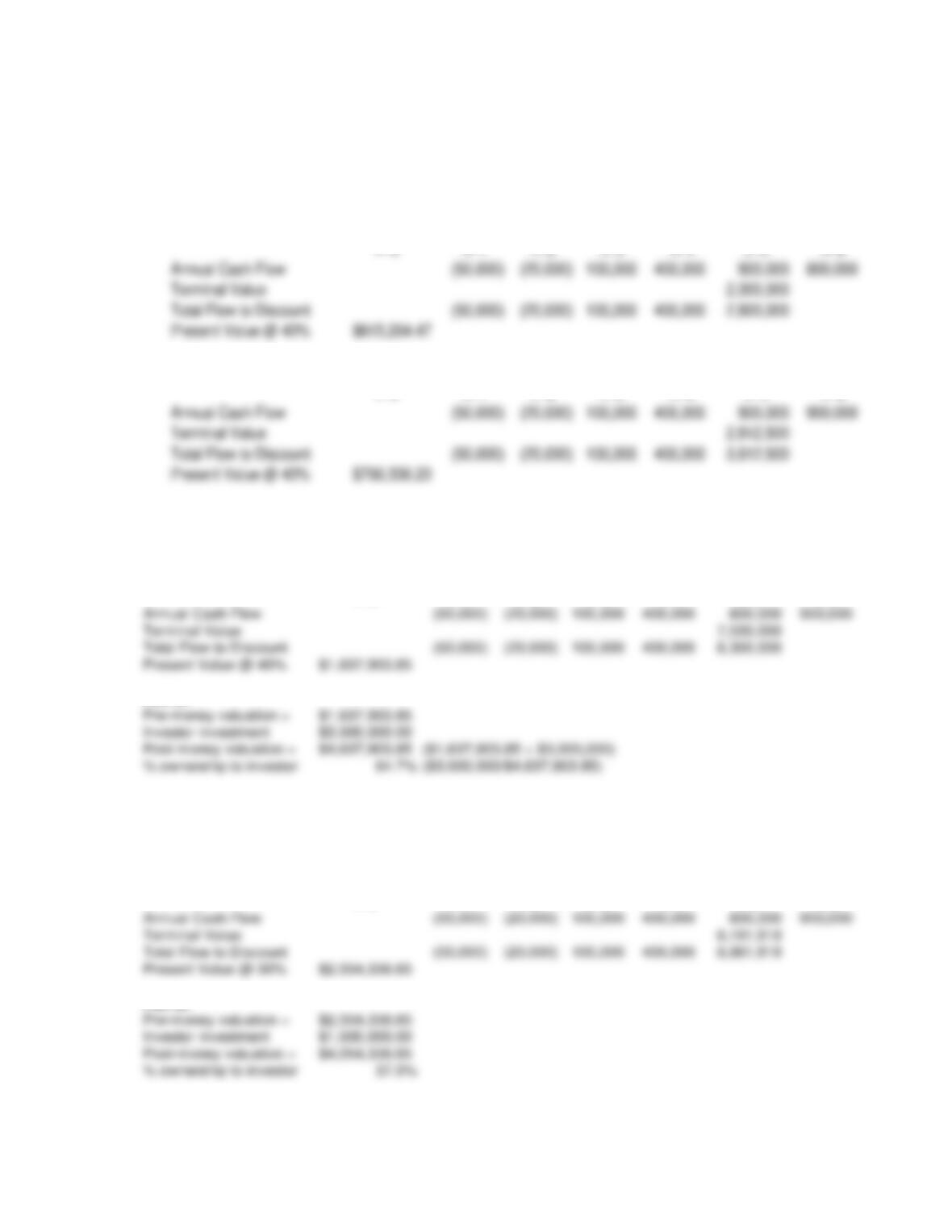
2. [Venture Present Values] The TecOne Corporation is about to begin producing and
selling its prototype product. Annual cash flows for the next five years are forecasted as:
Year Cash Flow
1 -$50,000
Chapter 10: Valuing Early-Stage Ventures
149
[Note: Following is a spreadsheet solution for Problem 2 (TecOne
Corporation) and Problem 3 (LowTec Corporation).]
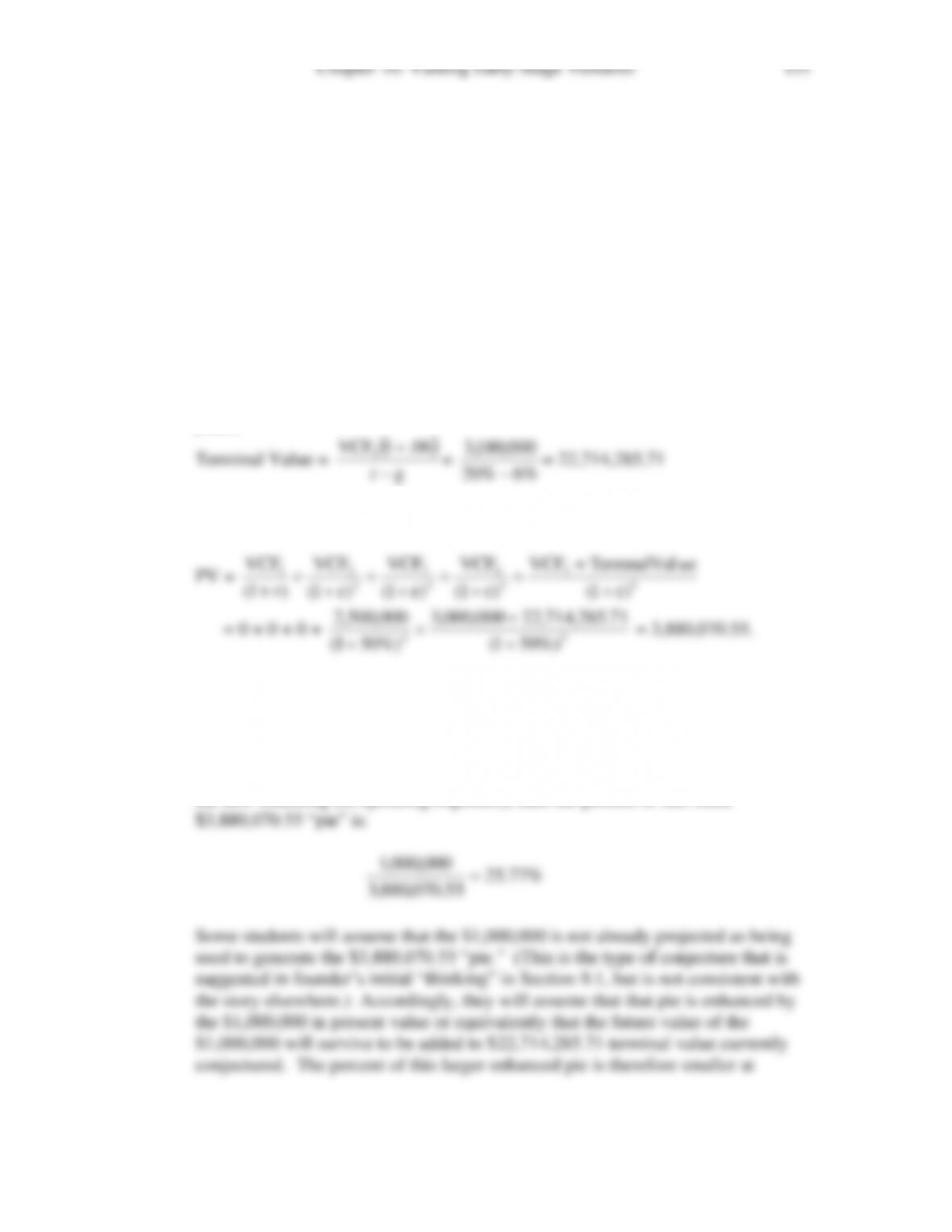
TecOne Corporation Solutions
Problem 1
Part A:
Yr 0 Yr 1 Yr 2 Yr 3 Yr 4 Yr 5 Yr 6
Annual Cash Flow (50,000) (20,000) 100,000 400,000 800,000 800,000
Terminal Value 2,000,000
Total Flow to Discount (50,000) (20,000) 100,000 400,000 2,800,000
Present Value @ 40% $615,264.47
Part B:
Yr 0 Yr 1 Yr 2 Yr 3 Yr 4 Yr 5 Yr 6
Annual Cash Flow (50,000) (20,000) 100,000 400,000 800,000 900,000
Terminal Value 2,812,500
Total Flow to Discount (50,000) (20,000) 100,000 400,000 3,612,500
Present Value @ 40% $766,336.20
Part C:
Yr 0 Yr 1 Yr 2 Yr 3 Yr 4 Yr 5 Yr 6
Annual Cash Flow (50,000) (20,000) 100,000 400,000 800,000 900,000
Terminal Value 7,500,000
Total Flow to Discount (50,000) (20,000) 100,000 400,000 8,300,000
Present Value @ 40% $1,637,903.85
Part D:
Pre-money valuation = $1,637,903.85
Investor investment $3,000,000.00
Post-money valuation = $4,637,903.85 ($1,637,903.85 + $3,000,000)
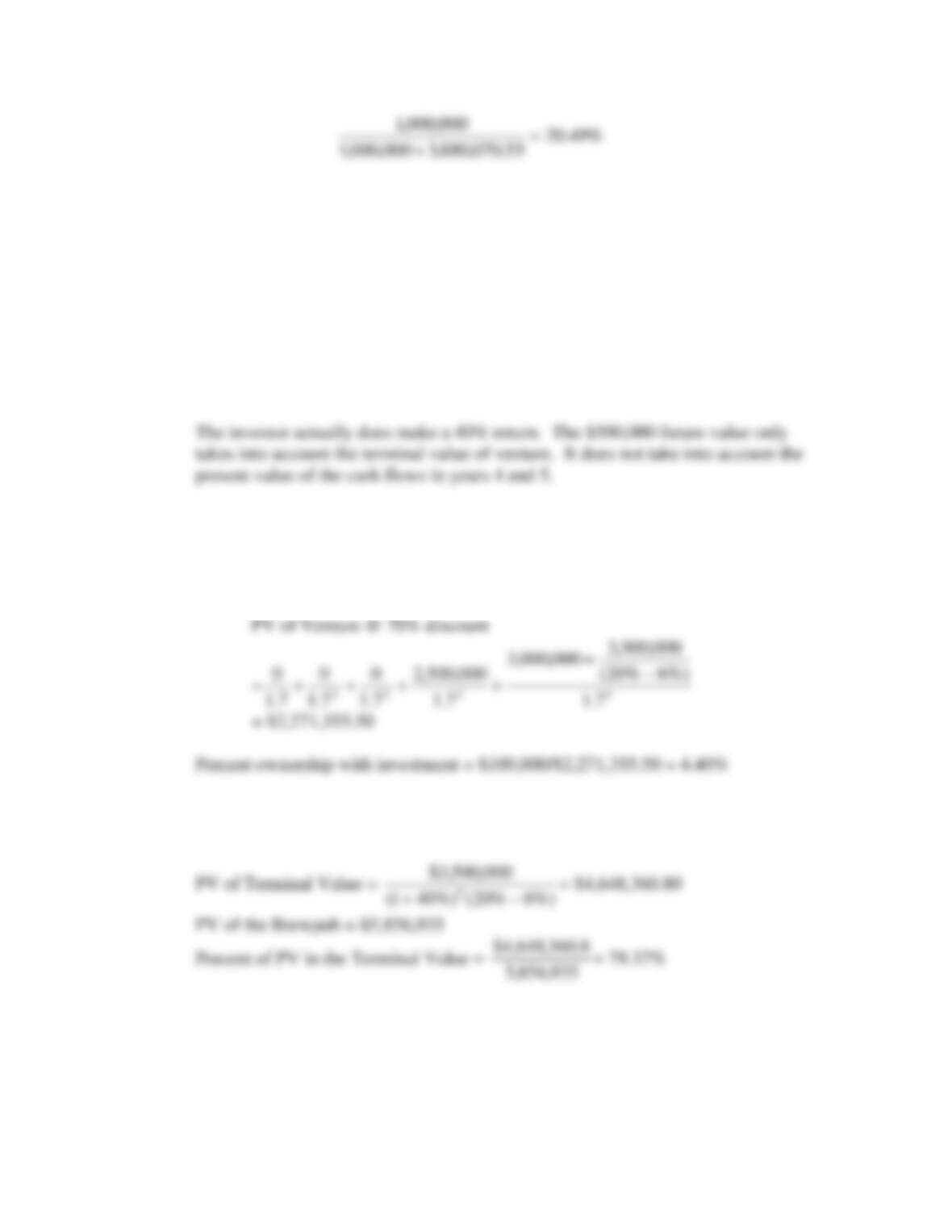
LowTec Corporation Solutions
Problem 2
Note: It is assumed that the cash flows in Part C of Problem 1 exist for the LowTec Corporation
Part A:
Terminal Value 8,181,818
Total Flow to Discount (50,000) (20,000) 100,000 400,000 8,981,818
Present Value @ 30% $2,554,336.65
Part B:

Chapter 10: Valuing Early-Stage Ventures
150
A. Assume annual cash flows are expected to remain at the $800,000 level after Year
5 (i.e., Year 6 and thereafter). If TecOne investors want a 40 percent rate of
return on their investment, calculate the venture’s present value.
See TecOne Corporation spreadsheet solution for Part A.
B. Now assume that the Year 6 cash flows are forecasted to be $900,000 in the
stepping stone year and are expected to grow at an 8 percent compound annual
rate thereafter. Assuming that the investors still want a 40 percent rate of return
on their investment, calculate the venture’s present value.
See TecOne Corporation spreadsheet solution for Part B.
C. Now extend Part B one step further. Assume that the required rate of return on the
investment will drop from 40 percent to 20 percent beginning in Year 6 to reflect
a drop in operating or business risk. Calculate the venture’s present value.
See TecOne Corporation spreadsheet solution for Part C.
D. Let’s assume that TecOne investors have valued the venture as requested in Part
C. An outside investor wants to invest $3,000,000 in TecOne now (at the end of
Year 0). What percentage of ownership in the venture should the TecOne
investors give up to the outside investor for a $3,000,000 new investment?
See TecOne Corporation spreadsheet solution for Part D.
3. [Present Value Valuation Concepts] Assume the forecasted cash flows presented in
Problem 2 for the TecOne Corporation venture also hold for the LowTec venture.
However, investors in LowTec have an expected rate of return of 30 percent on their
investment until Year 6 when the rate of return is expected to drop to 18 percent. The
perpetuity growth rate for cash flows after Year 6 is expected to be 7 percent.
A. Determine the present value for the LowTec venture.
See LowTec Corporation spreadsheet solution for Part A (presented under
Problem 2).
B. If an outside investor offers to invest $1,500,000 dollars today, what percentage
ownership in LowTec should be given to the new investor?
See LowTec Corporation spreadsheet solution for Part B (presented under
Problem 2).
Chapter 10: Valuing Early-Stage Ventures
152
%49.20
55.070,880,3000,000,1
000,000,1 =
+
5. [Venture Present Value Concepts] Refer to the FrothySlope microbrewery example at
the beginning of this chapter.
A. How does the $500,000 piece of the terminal value relate to the future value of the
$100,000? That is, the brewpub investor was looking for a 40% return. The five-
year-out future value of $100,000 growing at 40% is 100,000*(1.4)5 =$537,824,
slightly more than $500,000. Does this mean the investor is not really expected to
make 40% on the $100,000, even though we used that discount rate to arrive at
the initial $5,856,935 valuation? (Hint: What about explicit forecast period
flows?)
B. Returning to the brewpub spreadsheet with all flows included, how much more of
the venture’s ownership of surplus cash flows would have to be sold for the
$100,000 if the investor expected to make 70% (given Jim’s utopian vision of his
future)?
C. What percentage of the brewpub’s present value is contained in the present value
of the terminal value (the venture’s “reversion value”)?
000,500,3$
935,856,5
D. How much ownership of the brewpub cash flows would need to be sold to an
investor demanding 40% but agreeing that the mature brewpub venture would
terminally grow at a rate of 8% with a risk profile requiring a discount rate of
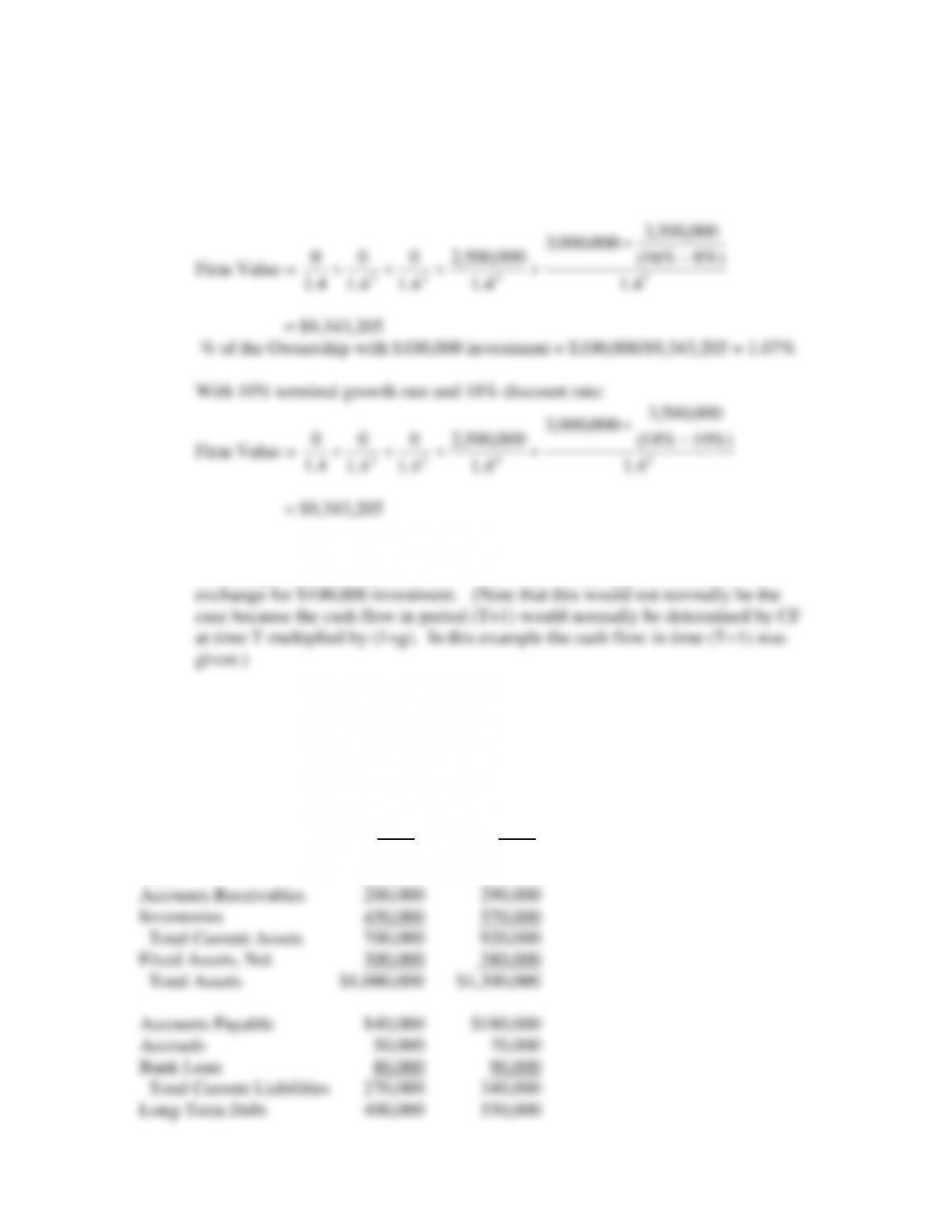
16%? What if the terminal growth rate were 10% and the discount rate 18%?
Chapter 10: Valuing Early-Stage Ventures
153
(The spread between the discount rate and the growth rate is sometimes referred
to as the “capitalization rate” for the terminal flows or just the “cap rate.”)
With a 40% discount rate, and 8% terminal growth with 16% discount:
As indicated above, the firm has the same value as with 16% discount and 8%
terminal growth rate, therefore the 1.07% of the ownership should be sold in
6. [Equity Valuation Cash Flows] Following are financial statements (historical and
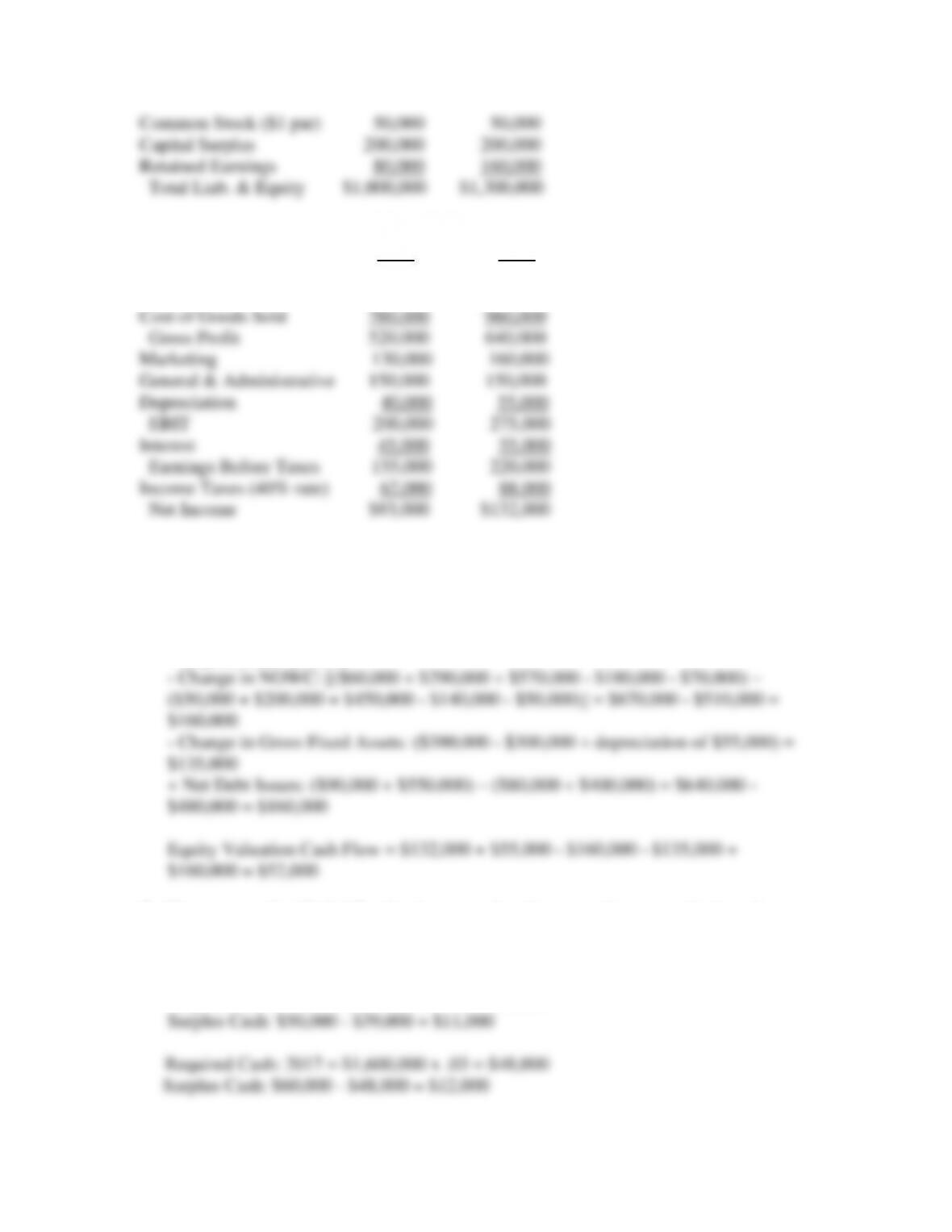
forecasted) for the Global Products Corporation.
GLOBAL PRODUCTS CORPORATION
Forecast
2016 2017
Cash $50,000 $60,000
Chapter 10: Valuing Early-Stage Ventures
154
Forecast
2016 2017
Net Sales $1,300,000 $1,600,000
A. Assume that the cash account includes only required cash. Determine the dollar
amount of equity valuation cash flow for 2017.
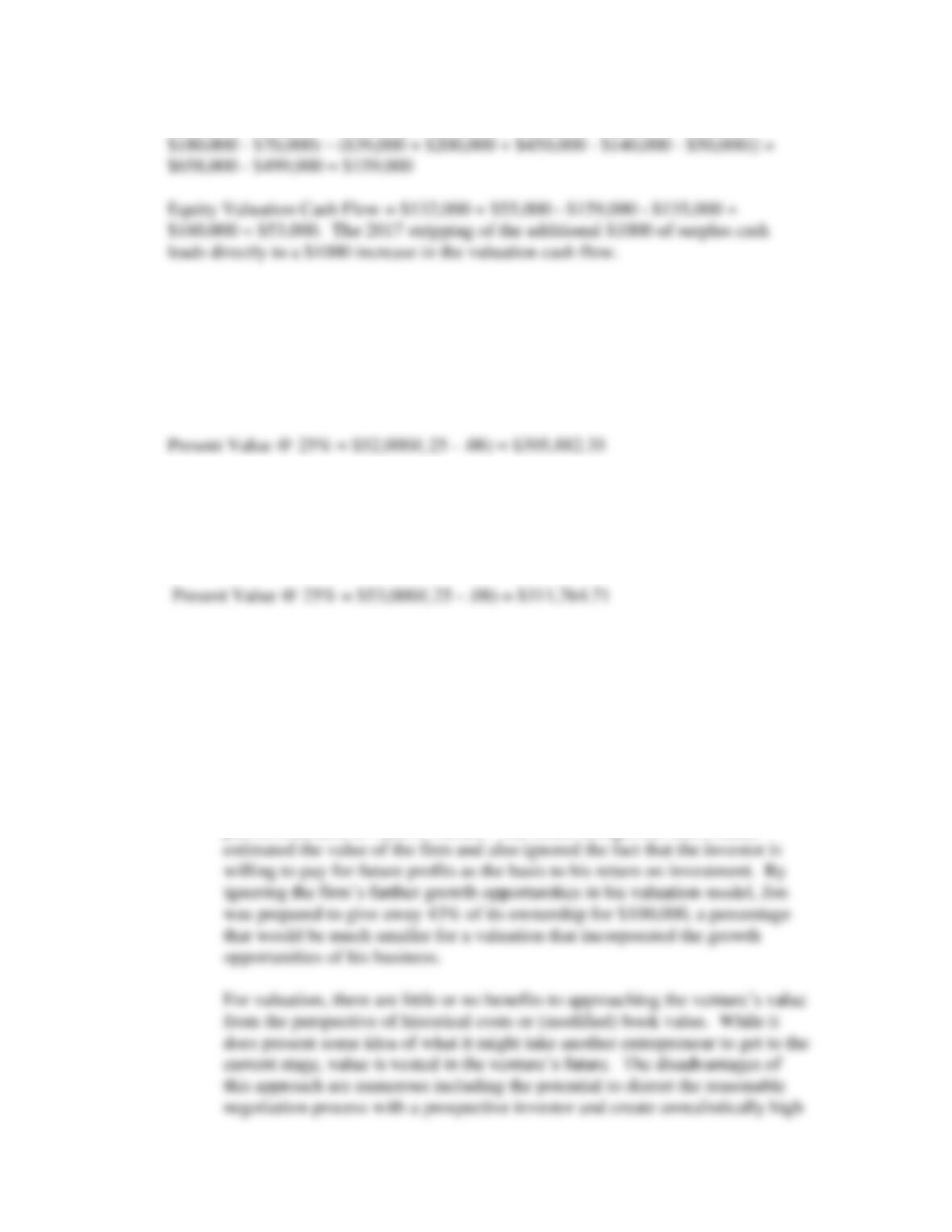
Equity Valuation Cash Flow =
Net Income: $132,000
+ Depreciation: $55,000
B. Now assume that Global Product’s required cash is set at 3 percent of sales. Any
additional cash would be surplus cash. Re-estimate the dollar amount of equity
valuation cash flow for 2017.
Required Cash: 2016 = $1,300,000 x .03 = $39,000
Chapter 10: Valuing Early-Stage Ventures
155
Change in NOWC (without surplus cash): [($48,000 + 290,000 + $570,000 –
C. Let’s assume that investors in Global Products want to estimate the venture’s present
value at the end of 2016. Forecasted financial statements reflect the stepping stone
year. Cash flows are expected to grow at a perpetual 8 percent annual rate beginning
in 2018. Assume that all cash is required cash as was done in Part A. What is the
Global Products venture’s present value if investors want an annual rate of return of
25 percent?
D. Work with the assumptions in Part B about Global Products required cash being 3
percent of sales. Calculate the present value of the Global Products venture at the
end of 2016 if investors want an annual rate of return of 25 percent and cash flows
are expected to grow at a perpetual 8 percent annual rate beginning in 2018.
7. Return to the discussion of the FrothySlope venture at the beginning of the chapter.
Formulate an answer for each of the five questions that are posed under the heading
“What Is a Venture Worth?
(1) What are the benefits and disadvantages of his approach to determining the
investor’s percent ownership?
The benefit of Jim’s approach is that it accounted for his sweat equity (in
reality sunk costs,) and that it was a rather simplistic way of looking at the
past as a method to value a venture. The disadvantages are that it under-