CHAPTER 5
Zooming In Critical Thinking Answers
In what ways would research (gathering information) have helped the
founders of MyEvent.com move beyond their original wedding platform
and remain relevant in the rapidly changing world of Internet businesses?
Collecting information is important to any businessperson, but especially to
those in rapidly changing environments. By collecting information from
What techniques can business communicators at MyEvent.com and other companies use to
generate ideas for new products as well as to improve business processes?
One of the best ways for business communicators to generate ideas for projects or to solve problems
is by brainstorming. This chapter describes techniques for effective brainstorming and brainwriting.
Have you experienced any crowdsourcing or crowdfunding activity among your friends or
relatives? Have you seen it in the news?
For years crowdsourcing has taken place with open-source computing. But now the concept is
sweeping the Internet with individuals and groups requesting funds for socially relevant causes as
well as for less altruistic goals such as funding a vacation or asking strangers to pay for one’s
Ethics Check Answers
How Sweet It Is
Is it unethical for companies to intentionally advertise using wording that would confuse
consumers?
Of course it is unethical for companies to intentionally use words that deceive consumers. Attorneys for
Splenda claimed it had never deceived consumers, but a French court ruled that it had intentionally
Is It Ethical for Zappos to Fix the Grammar and Spelling in Its Customers’ Reviews?
Estimates suggest that Zappos, the Internet’s most popular site for quality footwear, has spent
hundreds of thousands of dollars fixing more than a million of its customers’ online reviews. Does
this repair alter the authenticity of the reviews?
Correcting a reviewer’s grammar may not change the content of a review, but it certainly changes the
nonverbal message sent to a reader. If a writer cannot spell awesome, readers tend to devalue that
writer’s review of, let’s say, trail running shoes. Professor Panos Ipeirotis, who studies consumer reviews
on the Internet, asserts that well-written reviews help sell products, even when the write-ups are negative.
[Agger, M. 2011, May 10. Awsum shoes? Slate.com.] This may explain why Zappos has gone to so much
trouble to correct its customers’ reviews. Correctness definitely counts. Well-written reviews seem
trustworthy because of the favorable impression we have of the writer. Reviews littered with misspelling,
capricious punctuation, and Internet slang drain the review’s authority. However, fixing errors changes the
reader’s perception of the review and borders on unethical marketing behavior.
Critical Thinking Answers
1. Molly, a twenty-three-year-old college graduate with a 3.5 GPA, was hired as an administrative
assistant. She was a fast learner on all the software, but her supervisor had to help her with
punctuation. On the ninth day of her job, she resigned, saying: “I just don’t think this job is a
good fit. Commas, semicolons, spelling, typos—those kinds of things just aren’t all that
important to me. They just don’t matter.” For what kind of job is Molly qualified?
By refusing to develop fundamental language skills or to recognize their importance, Molly is limiting
2. Why is audience analysis so important in the selection of the direct or indirect strategy of
organization for a business message?
Audience analysis is important because it helps the writer decide whether the receiver will react
positively or negatively to the message. Help your students develop the habit of always thinking of
3. How are speakers different from writers in the way they emphasize ideas?
Speakers have an array of nonverbal cues they can use to express many more emotions and
nuances of meaning than are possible in writing. A speaker can raise an eyebrow, lower her voice,
utter a sigh, wipe her hand across her brow, or tap her fingers on the table. Each of these cues
4. Why are short sentences and short paragraphs appropriate for business communication?
Business readers want to see the main idea immediately. Short sentences and paragraphs convey
ideas quickly and are more readable than longer ones. In addition, today’s short-form digital
5. Ethical Issue: Discuss the ethics of the indirect strategy of organization. Is it manipulative to
delay the presentation of the main idea in a message?
All good writers practice empathy. Because the indirect pattern is used when receivers will be
uninterested, unwilling, displeased, or hostile toward the message, they certainly will not be pleased
Zooming In Solution
Your Turn: Applying Your Skills at MyEvent.com
To: Rob Hirscheimer (@ instructor.com)
From: Your Name
Subject: How Students Might Use Crowdfunding
Dear Mr. Hirscheimer:
First, we thank you for this opportunity to offer ideas that might help MyEvent.com expand its
do-it-yourself fund-raising programs to college campuses and university students.
Here are additional ideas for crowdfunding:
Raise money for a sick friend.
Raise money for a year abroad or a mission trip.
Raise money to help a relative or friend purchase needed medical equipment.
We hope these ideas are useful at MyEvent.com.
Sincerely,
Writing Improvement Exercises
5.1 Sentence Types
a. 1
5.2 Sentence Faults
a. Fragment. Revision: Although PepsiCo signed Beyoncé to endorse its soft drinks, sales continued to
plummet.
b. Fragment. Revision: In the beverage industry, the latest sales numbers are astonishing, but not
surprising.
5.3 Emphasis
a. Sentence 2 labels the important idea.
b. Sentence 2 emphasizes the exceptionalism of American burgers with vivid words.
c. Sentence 1 places the important idea first so that it is not lost in other verbiage.
5.4 Active Voice
a. Bank of America asked workers to wear badges with tiny sensors to monitor their communication
and activity patterns.
b. Many companies are installing tracking devices to gather real-time information on how employees
interact.
5.5 Passive Voice
a. A serious error was made in our annual tax figures.
b. The error was discovered too late to correct the annual report.
5.6 Parallelism
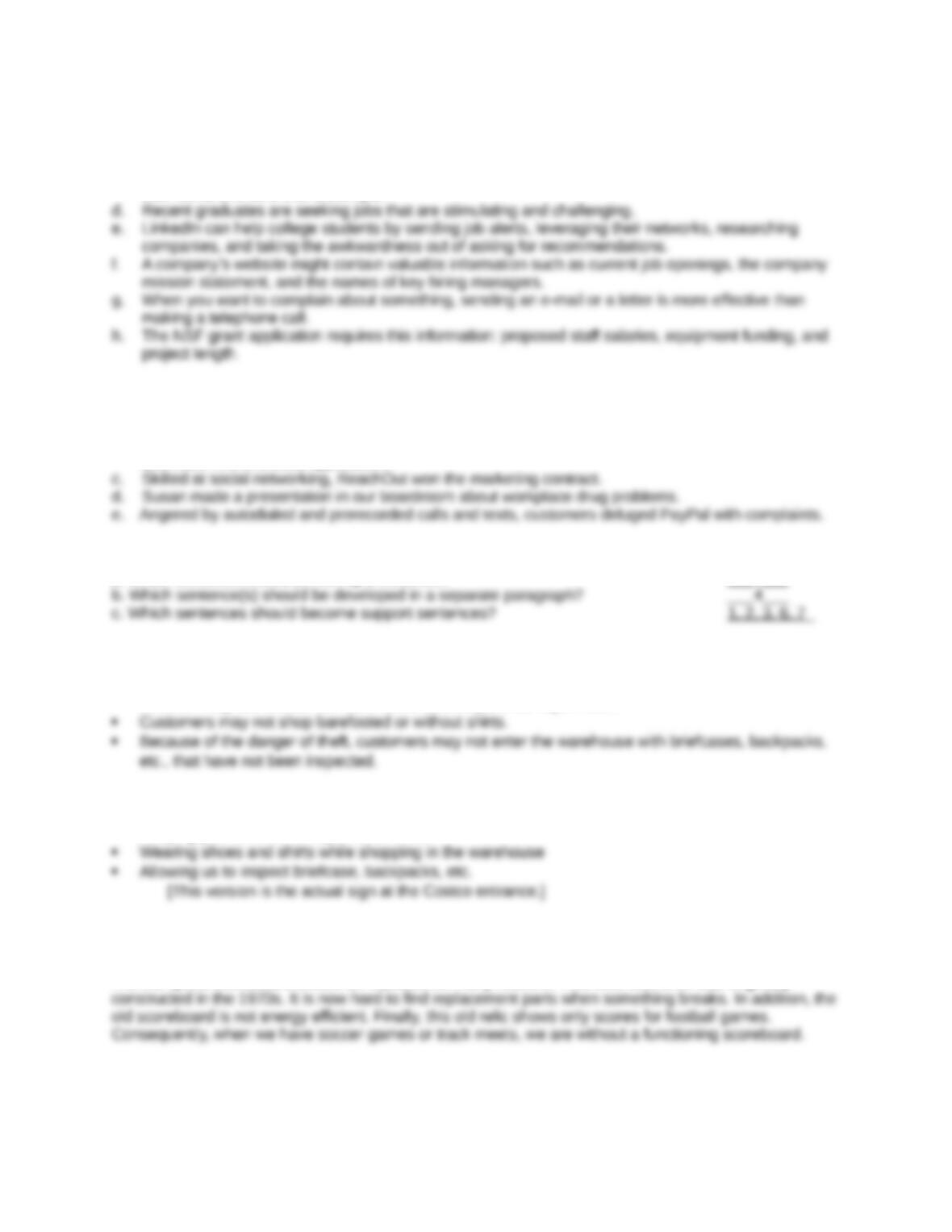
a. Critics complain that young people today are obsessed with playing video games, taking selfies, and
checking their Facebook pages constantly.
b. To be hired, an applicant must be reliable, creative, and enthusiastic.
c. Job seekers use the Internet to find job opportunities, market themselves to companies, showcase
their skills, and land that dream job.
5.7 Dangling and Misplaced Modifiers
a. When interviewing applicants, recruiters often ask questions about qualifications.
b. To be reimbursed, fill out and return the enclosed application. OR: To be reimbursed, you must fill out
and return the enclosed application.
5.8 Organizing Paragraph Sentences
a. Which sentence should be the topic sentence? ___5___
5.9 Helping Costco Word an Important Sign
Negative Version of Costco Entrance Sign
Children may not wander the warehouse without parental supervision.
Positive Version of Costco Entrance Sign
Thank you for . . .
Keeping your children with you at all times
5.10 Building Coherent Paragraphs
Note: Revisions will vary.
The old sports scoreboard should be replaced for many reasons. This tired warhorse was originally
5.11 Revising an Incoherent Paragraph
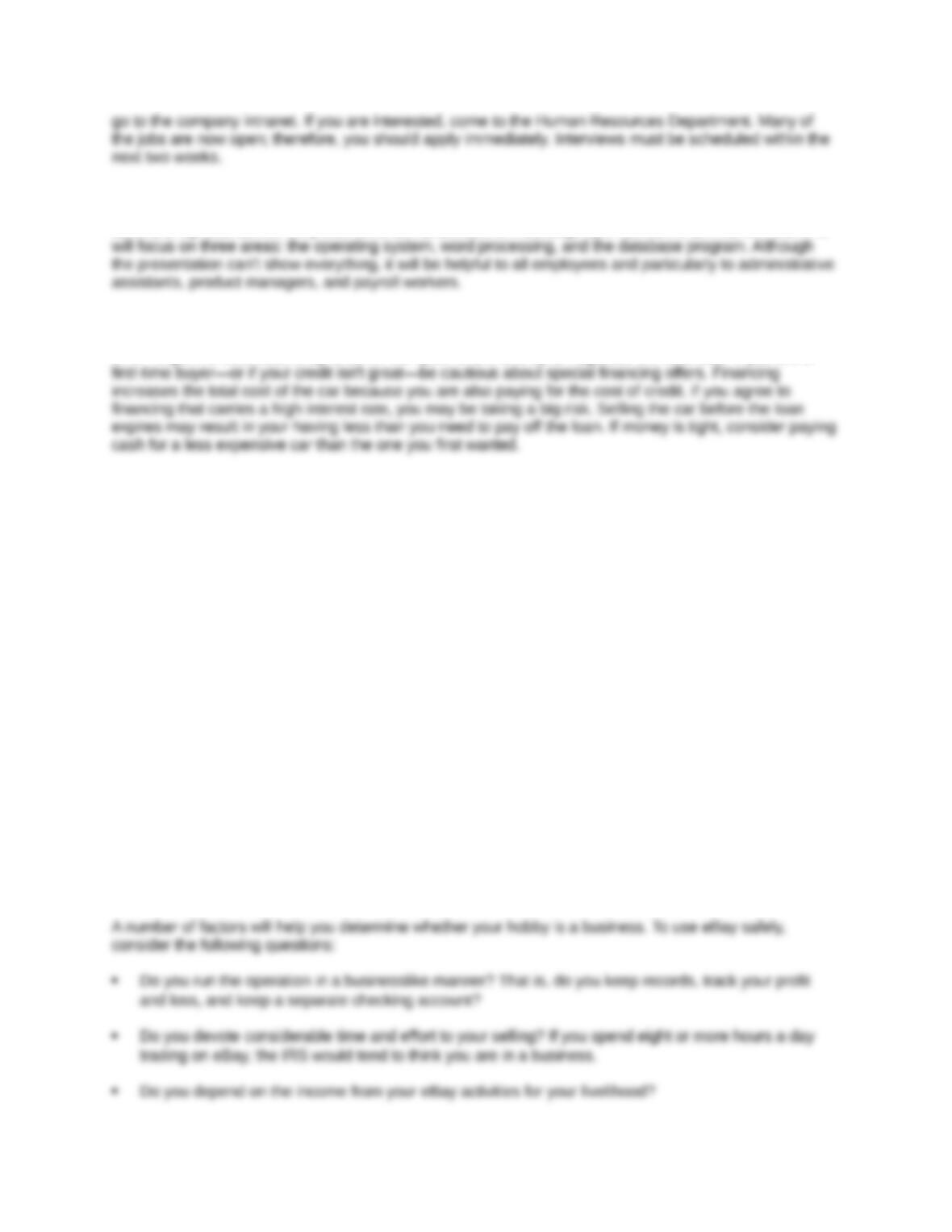
A number of high-level positions are available to current employees. These positions are in production,
marketing, and administrative support. To view the positions and their qualifications and job descriptions,
5.12 Revising a Wordy Paragraph
You are invited to a demonstration of our new software to be installed shortly. Joshua Travis, Quantum
Software representative, will present the demonstration on Tuesday, April 18, from 9 a.m. to 12 noon. He
5.13. Building a Coherent Paragraph
Buying a new or used car can be challenging. You have two payment options: pay in full or finance over
time. To get the best deal, shop around. Compare offers and try to negotiate the best deal. If you are a
Activities Solutions
5.14 Document for Analysis: Faulty E-Mail Message
Fragments: Sentences 1-2, 5-6, 12-13, 17-18, 19-20
Passive voice: Sentence 4
Dangling modifier: Sentence 8
Lack of parallelism: Sentence 10
Revision
To: Sierra.Maldonado@gmail.com
From: Justin.Corona@premierefinances.com
Subject: Responding to Your Question About eBay Profits
Hi, Sierra,
As your CPA, I’m happy to respond to your request for clarification of the tax status of profits from eBay or
one of the other online sellers such as Etsy, Amazon, and Bonanza.
As you are probably already aware, you can use eBay or one of the other sellers to clean out your closets
or to run a small business. You definitely should clarify your tax liabilities. Although no clear line separates
fun from profit or a hobby from a business, one thing is certain: the IRS taxes all income.
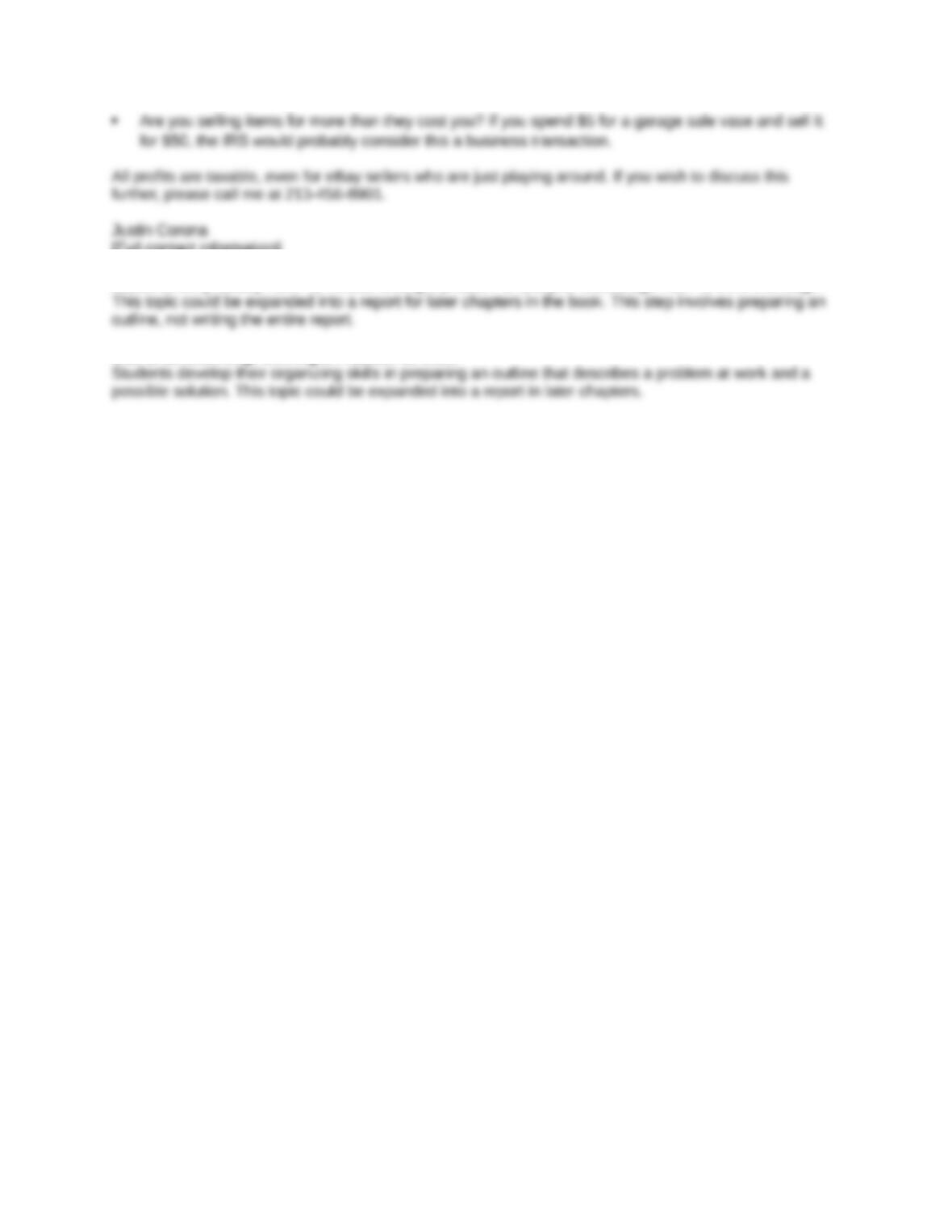
[Full contact information]
5.15 Brainstorming: Solving a Problem on Campus
Students will probably have no trouble finding a problem to analyze. Encourage them to think it through.
5.16 Brainstorming: Solving a Problem at Work