CHAPTER 11
Zooming In Critical Thinking Answers
Why are reports so important to organizations?
Factual, unbiased information is the lifeblood of business and other
Why do nonprofit organizations such as Pew Research Center provide their data free to the
public?
Having the means to conduct important rigorous research, this organization has devoted its resources
The Pew Charitable Trusts has evolved into a force for public good out of several trusts established
by the children of oil magnate Joseph N. Pew and his wife Mary Anderson Pew over three decades
Why do reports such as Searching for Work in the Digital Era contain graphics?
Effective graphics in long reports serve several functions. They break up long text, draw attention to
Ethics Check Answers
The High Cost of Fraudulent Research
Like other infamous cases of medical fraud, this hoax has legal and ethical ramifications. Researchers
acting against good clinical practice are usually fired, stripped of their academic titles, and investigated for
scientific misconduct. Even if no patients are permanently injured or die as a result of fraudulent or
manipulated research studies, hospitals can sue the rogue physician for damages. Some of the coauthors
Obviously, in studies involving human subjects, the consequences of fraud can be grave. For example,
researcher Andrew Wakefield manipulated evidence and violated ethical codes with the publication of his
Cribbing From References?
Opinions may vary on whether copying someone else’s sources without reading them constitutes
cheating. In any case, it is lazy scholarship and shows poor study habits. By relying on paraphrases in
secondary articles and not viewing the original piece, the writer risks misunderstanding or
misrepresenting the unread source. The reference we find in another article and don’t verify could have
been misused, which happens more often than report writers realize. Furthermore, each time students
seek shortcuts, they shortchange their education. When instructors ask for a minimum of sources, they
expect students to search for, read, understand, and skillfully integrate information from those sources
into their papers. Merely boosting the number of references does not constitute learning. On the other
hand, it is not dishonest to kick off one’s research by reviewing the list of references in relevant articles
and reading some of them to expand one’s grasp of the topic.
Critical Thinking Answers
1. Reflect on what work means to you and which companies you would like to work for. Do
you agree with Gallo? What lends his claims credibility?
Answers will vary. Carmine Gallo is intrigued by corporations that not only focus on the bottom
line but consider their workers to be their greatest asset. Of course, many companies pay lip
Carmine Gallo has credibility on several levels. First, he is an expert on leadership, a keynote
speaker, and best-selling author. As such, he does a lot of research that informs his books. His
2. Information graphics, also called infographics, are popular online for reporting and
illustrating complex data. Why do you think infographics continue to be popular? How
could infographics be useful in your field?
Infographics have become popular because they often present complex information clearly and
creatively. Engaging infographics (a) grab a reader’s attention; (b) communicate ideas more
quickly than traditional text can; (c) may combine traditional bar charts, diagrams, and pie charts
in one information graphic; and (d) tell a compelling story. Students should also explain how
3. Why do researchers often trust the reliability of information obtained from scholarly
journals, major newspapers, and well-known magazines? Why should researchers use
caution when accessing information from Wikipedia, online forums, and blogs?
Information obtained from professional journals and reputable newspapers and magazines has
generally been authenticated, edited, and reviewed. Professional journals are also refereed,
which means that the articles have undergone stiff peer review. Therefore, the information
obtained from these sources is generally considered to be valid, objective, and credible. However,
may be propaganda or advertising or worse. It is wise to scrutinize all Web data carefully. The
biggest problem with Wikipedia, anonymous blogs, and other crowd-generated content is that
they often don’t last and, therefore, are not always verifiable as sources. In contrast to print
publications and peer-reviewed journals, the quality of the contributions to these online resources
4. Some people say that business reports never contain footnotes. If you were writing
your first report for a business and you did considerable research, what would you do
about documenting your sources?
Although some people do assert that business reports never contain documentation, it’s
5. Ethical Issue: Consider this logical appeal under the heading “Reasons Students Hate
Writing Essays or Term Papers” and evaluate its validity and ethics.
The poor, suspicion-inducing prose aside, the anonymous writer of the passage from the website
of a paper mill is making a sophisticated unethical argument. The logic goes like this: Teachers
are overwhelming students, creating boring assignments, failing to explain, and not giving
Under the transactional view of rational self-interest, the plagiarist believes that cheating is
justified if the teacher is not putting much effort into the assignment or if the assignment is boring
and irrelevant. Situational ethics is invoked when the promotional copy describes the college
Activities Solutions
11.1 Report Functions, Strategies, and Formats
a. Function: analytical; strategy: indirect; format: manuscript with cover letter, most likely e-mailed or
submitted online as a PDF document
11.2 Collaborative Project: Looking Closely at Annual Reports
Free, full-text corporate annual reports in PDF format are easy to find on the Web and in research
databases. Students may want to consult LexisNexis for SEC filings. On the Web, the SEC provides
a searchable database of SEC filings at SEC Info; annual reports are also available at
AnnualReports.com.
11.3 Types of Data and Research Questions
a. Data forms: background or historical, statistical, individual or group opinion
Question: Will I need to add to the available data?
b. Data form: statistical
Questions: Is the source reliable? How were the figures derived? How recent are they?
11.4 Problem, Purpose, and Scope Statements
a: Problem question: Should North Laguna Hospital address irregularities in billing with its current
payment processing contractor Efficient Payment Systems, or should it hire a new claims processing
company before the current contract runs out?
Purpose: To analyze the error patterns stemming from Efficient Payment Systems processing to
b: Problem question: Which persuasive techniques should closers avoid to improve overall customer
ratings of the negotiation process?
Purpose: To examine current persuasive strategies and improve sales techniques to lower the
number of complaints and achieve higher customer ratings in after-sales surveys
Scope: This report will focus on sales strategies that raise the ire of most customers—that is,
c: Problem question: Has the introduction of hands-free devices significantly reduced traffic accident
rates?
Purpose: To study accident statistics to determine whether hands-free devices lower the incidence
d: Problem question: Should Old World Bakery hire a laboratory or a consultant to change its
production process and rewrite its package labels to meet new trans fat requirements imposed by
the FDA?
Purpose: To investigate how potential trans fat bans and FDA regulations might affect Old World’s
e: Problem question: How can Eddie Bauer train telephone service reps to motivate customers to
increase the number of items ordered per call?
11.5 Problem and Purpose Statements
Sample problem: Our business is losing customers because we are one of the few neighborhood
coffee bars that don’t offer free Wi-Fi service to our patrons. If the expense for the equipment is not
11.6 Plagiarism, Paraphrasing, and Citing Sources
a. Original Passage
Weaknesses: This paraphrase is very close to the original. The writer substituted a few words here
and there and slightly changed the sentence structure, but overall the passage is too close to the
Improved Passage
German luxury car manufacturers at first did not take Tesla seriously when the California-based
b. Original Passage
Weaknesses: This colorful quotation from Edward Tufte’s classic book Envisioning Information
[Cheshire, CT: Graphics Press, 1990, p. 34] is difficult to paraphrase and would most likely be cited
Improved Passage:
Extraneous features in poorly designed charts cannot compensate for a lack of substantive
c. Original Passage
Weaknesses: The paraphrased text follows the original too closely in sentence structure and word
Improved Passage
Casual online games offer several advantages over games designed for Xbox and similar consoles.
11.7 Factoring and Outlining a Problem
Outline Key:
I. Should the Virgin America tour training program be located in Burbank?
A. Does Burbank have adequate access to air travel?
B. Does Burbank have available school buildings?
C. Would Burbank officials cooperate with us?
II. What entertainment areas are available to serve as training sites?
A. Does NBC offer training seminars, guest speakers, and other resources for tour
operators?
B. Would Magic Mountain allow us to conduct training there?
C. Would Griffith Park allow tour trainees to practice there?
III. Who could be invited to serve on an advisory committee?
A. Would representatives of the travel community be interested?
B. Would executives of other major airlines be willing to serve with Virgin America people?
C. How could these people be motivated to participate?
11.8 Preparing a Work Plan
If your students are writing a long report, they should complete this exercise as part of their long
report assignment.
11.9 Experimenting With Secondary Sources
This exercise gives students an opportunity to practice using different techniques to record and
manage information they find when conducting research online. More important, they will
11.10 Exploring Campus Food Preferences With SurveyMonkey
SurveyMonkey is user-friendly and will hone students’ primary research skills. The goal is to
11.11 Studying Teen and Young Adult Media Use
The assignment can be a short informational report sent by e-mail or, if additional sources are
added, an analytical report. The analytical report should suggest ways advertisers could connect
with teens, the target population.
For instance, a recent study by Common Sense Media reveals that teens spend a lot of time
Pew Research Center has recently studied smartphone ownership among teens and how it
affects the way they communicate. Although almost three quarters of teenagers own
Because the behavior of teenagers and young adults is of keen interest not only to marketers
who salivate at the spending potential of this demographic, but also to parents and educators,
even a casual Internet search will yield many current statistics. Other target demographics could
11.12 Gathering Data: Target Aiming at a New Charitable Focus
This activity lends itself to several options. Potential assignments range from memos
summarizing research findings to informational as well as analytical reports after students study
Note that Walmart is the largest donor in absolute dollars in the United States; in one recent year
11.13 Gathering Data: Fortune Magazine’s 100 Best Companies to Work For
The themes that emerge after studying the winners in Fortune’s 100 Best Companies to Work For
11.14 Who Gets Hurt? Examining Infamous Plagiarism Scandals
The short answer is that plagiarism, fabrication, cheating, and similar offenses undermine the
public’s trust and may shake people’s belief even in reputable, legitimate science. Students could
individually focus on a single plagiarism case, or they could investigate multiple cases in the
In terms of who gets hurt, it can be argued that in the medical field the stakes for cheating are
particularly high because human lives are at stake. This doesn’t mean that academic or
A simple Google query using the keywords infamous plagiarists will return over 221,000 hits;
plagiarism, 36.6 million! As always, Wikipedia appears right at the top. The Wikipedia article can
be a helpful point of departure for student researchers as it lists many egregious, high-profile
plagiarism and fabrication cases for further research. Similarly, Salon is an online treasure trove
The excuses of plagiarists tend to sound similar; Doris Kearns Goodwin and others have
maintained their innocence, claiming they merely had “confused” their notes—an important
message to students to develop sound notetaking practices. Distinguished historian Stephen
Ambrose argued quite incredibly that he had forgotten to include quotation marks, although his
11.15 Selecting Graphics
a. Photo, map
b. Table for exact absolute numbers; line chart for trends
c. Bar chart, possibly pie chart
11.16 Creating a Bar Chart
..
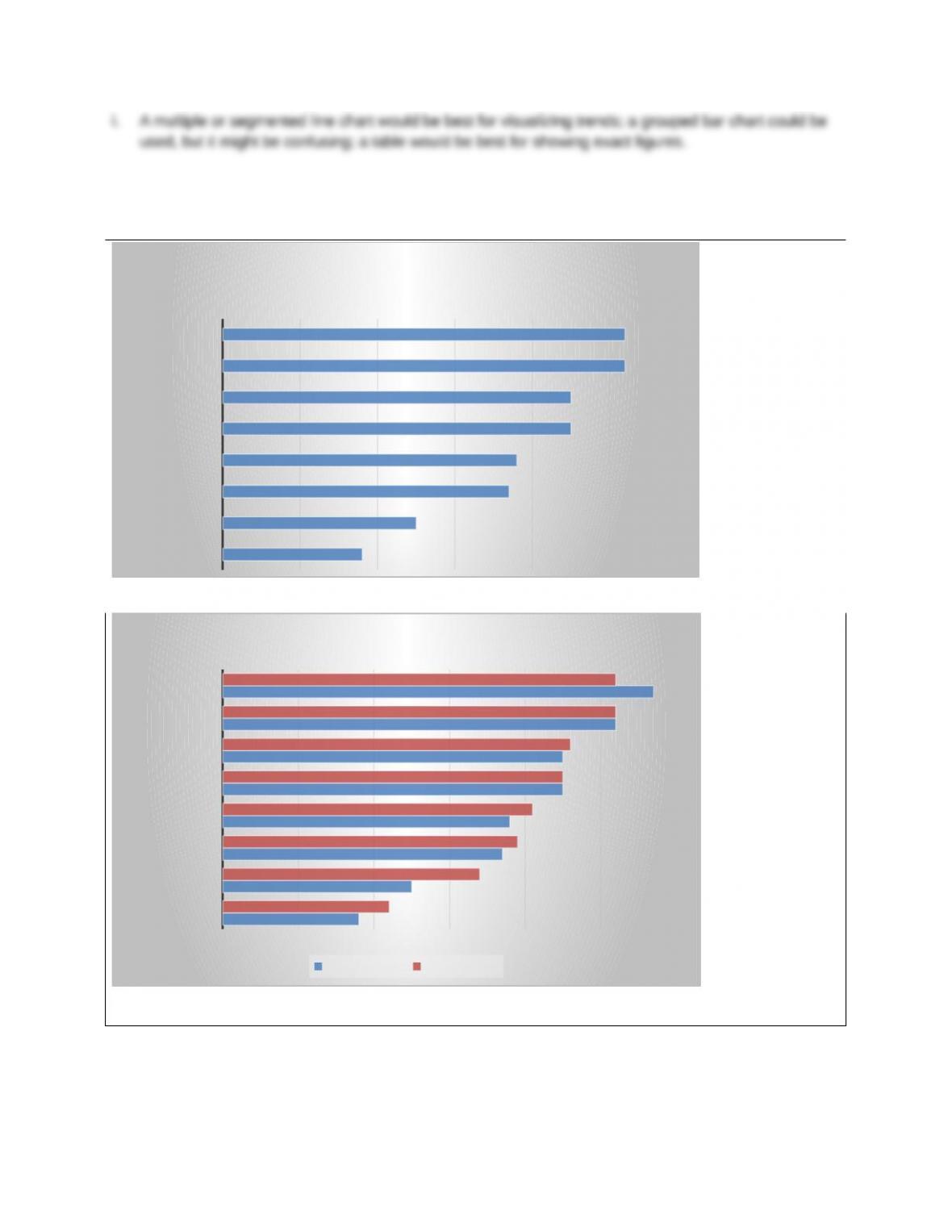
a. Students are to create two bar charts: (1) Tax Rate as Percentage of Gross Domestic Product and
(2) Tax Rate as Percentage of Gross Domestic Product – A Comparison…
Unites States
Japan
Canada
United Kingdom
Germany
Netherlands
Sweden
France
18%
25%
37%
38%
45%
45%
52%
52%
Tax Rates as Percentage of
Gross Domestic Product
…
Source: U.S. Central Intelligence Agency.
….
Unites States
Japan
Canada
United Kingdom
Germany
Netherlands
Sweden
France
0% 10% 20% 30% 40% 50% 60%
18%
25%
37%
38%
45%
45%
52%
57%
22%
34%
39%
41%
45%
46%
52%
52%
Tax Rate as Percentage of GDP--A Comparison In Percent
Previous Ye ar Most Recent
….
Source: U.S. Central Intelligence Agency
11.17 Creating a Line Chart
…
2012 2013 2014 2015 2016 2017
0.0
1.0
2.0
3.0
4.0
5.0
6.0
7.0
8.0
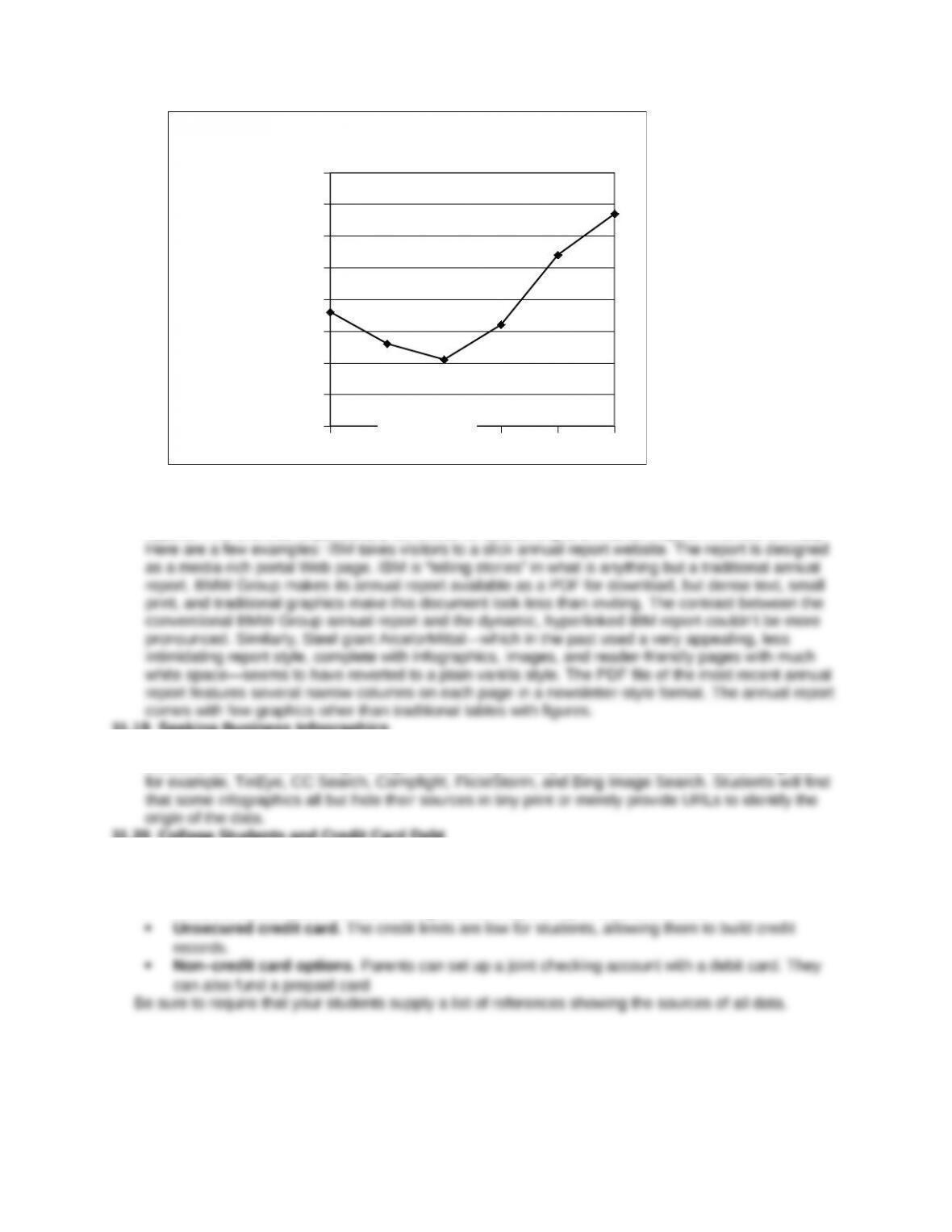
Sidekick Athletic Shoes Sales Trends
In Millions
…
11.18 Searching for Data Visualization and Infographics in Annual Reports
This can be a very informative exercise, especially for students who are not going to write long
reports. This exercise is particularly beneficial for accounting and finance majors. Answers will vary.
Here are a few examples: IBM takes visitors to a slick annual report website. The report is designed
as a media-rich portal Web page. IBM is “telling stories” in what is anything but a traditional annual
report. BMW Group makes its annual report available as a PDF for download, but dense text, small
print, and traditional graphics make this document look less than inviting. The contrast between the
conventional BMW Group annual report and the dynamic, hyperlinked IBM report couldn’t be more
pronounced. Similarly, Steel giant ArcelorMittal—which in the past used a very appealing, less
intimidating report style, complete with infographics, images, and reader-friendly pages with much
white space—seems to have reverted to a plain vanilla style. The PDF file of the most recent annual
report features several narrow columns on each page in a newsletter-style format. The annual report
comes with few graphics other than traditional tables with figures.
11.19 Seeking Business Infographics
The selections will vary. Many business-related infographics can be found online or in magazines.
Students can conduct a Google Image Search or try out any one of several visual search engines—
11.20 College Students and Credit Card Debt
Students are to write an e-mail or a memo information report. They should discuss some of the
following information:
Credit card on parents’ account. Parents get the bill and can track spending.
Secured credit card. A credit line is guaranteed by money in a bank account.
Year