
Chapter 9 CFIN5
Chapter 9 Solutions
9-1
6
1
1(1.10)
Value PV of CFs 36,950 36,950(4.355261) 160,926.88
0.10
é ù
–
ê ú
ê ú
= = = =
ê ú
ê ú
ë û
9-2 a.
4
1
1(1.16)
Value PV of CFs 104,000 104,400(2.798181) 292,130.06
0.16
é ù
–
ê ú
ê ú
= = = =
ê ú
ê ú
ë û
b.
4
1
1(1.12)
Value PV of CFs 104,000 104,400(3.037349) 317,099.27
0.12
é ù
–
ê ú
ê ú
= = = =
ê ú
ê ú
ë û
9-3
10
1
1(1.11)
NPV 3,600,000 600,000 0.11
é ù
–
ê ú
ê ú
=- + ê ú
ê ú
ë û
3,600,000 600,000(5.889232) 3,600,000 3,533,539.21 66,460.79=- + =- + =-
Calculator solution: CF0 = -3,600,000, CF1 – CF10 =600,000, I = 11; compute NPV = -66,460.79; IRR =
10.56%
Alternative calculator solution using TVM keys: N = 10, PV = -3,600,000, PMT = 600,000, FV = 0;
compute I/Y = 10.56% = IRR
The investment is not acceptable, because NPV < 0 and IRR < r = 11%.
9-4
5
1
1(1.09)
NPV 42,000 11,000 0.09
é ù
–
ê ú
ê ú
=- + ê ú
ê ú
ë û
© 2017 Cengage Learning. All Rights Reserved. May not be scanned, copied or duplicated, or posted to a publicly
accessible website, in whole or in part.
Chapter 9 CFIN5
9-5
3
1
1(1 IRR)
20,070 8,500 IRR
é ù
–
ê ú
+
ê ú
=ê ú
ê ú
ë û
9-6
6
1
1(1 IRR)
74,000 16,500 IRR
é ù
–
ê ú
+
ê ú
=ê ú
ê ú
ë û
9-7 a.
4
1
1(1.14)
NPV 75,000 26,000 0.14
é ù
–
ê ú
ê ú
=- + ê ú
ê ú
ë û
b.
4
1
1(1 IRR)
75,000 26,000 IRR
é ù
–
ê ú
+
ê ú
=ê ú
ê ú
ë û
c. Because IRR > r = 14% and NPV > 0, the project is acceptable.
© 2017 Cengage Learning. All Rights Reserved. May not be scanned, copied or duplicated, or posted to a publicly
accessible website, in whole or in part.

Chapter 9 CFIN5
9-8 a.
3
1
1(1.12)
NPV 34,000 14,150 0.12
é ù
–
ê ú
ê ú
=- + ê ú
ê ú
ë û
b.
3
1
1(1 IRR)
34,000 14,150 IRR
é ù
–
ê ú
+
ê ú
=ê ú
ê ú
ë û
c. Because IRR < r = 12% and NPV < 0, the project is not acceptable; but, just barely.
9-9 Data for NPV profile: Cost = 64,000, CF = 18,200 for five years
r NPV
0.00 $27,000.00
0.01 24,332.45
0.02 21,784.96
0.03 19,350.67
0.04 17,023.17
0.05 14,796.48
0.06 12,665.02
0.07 10,623.59
0.08 8,667.32
0.09 6,791.65
0.10 4,992.32
0.11 3,265.33
0.12 1,606.93
0.13 13.61
0.14 (1,517.93)
0.15 (2,990.78)
0.16 (4,407.86)
0.17 (5,771.90)
0.18 (7,085.49)
© 2017 Cengage Learning. All Rights Reserved. May not be scanned, copied or duplicated, or posted to a publicly
accessible website, in whole or in part.
Chapter 9 CFIN5
9-10. MIRR:
PV of Cash FV in Year 3 of
Year
CF Outflows @ 12% Cash Inflows @ 12%
0 (82,000) (82,000.00)
1 35,000 43,904.00
2 70,000 78,400.00
The investment is not acceptable, because MIRR < r = 12%.
9-11 IRR:
4
1
1(1 IRR)
5,500 1,800 IRR
é ù
–
ê ú
+
ê ú
=ê ú
ê ú
ë û
© 2017 Cengage Learning. All Rights Reserved. May not be scanned, copied or duplicated, or posted to a publicly
accessible website, in whole or in part.
NPV ($)
Chapter 9 CFIN5
9-12 IRR:
2
1
1(1 IRR)
90,000 54,000 IRR
é ù
–
ê ú
+
ê ú
=ê ú
ê ú
ë û
9-13 Traditional payback:
Year
CF CF
0 -270,000 -270,000
1 75,000 -195,000
2 75,000 -120,000
3 75,000 -45,000
4 75,000 30,000
5 75,000 105,000
© 2017 Cengage Learning. All Rights Reserved. May not be scanned, copied or duplicated, or posted to a publicly
accessible website, in whole or in part.
Chapter 9 CFIN5
45,000
PB 3 3.6 years
75,000
= + =
Alternative solution: Because the future cash flows represent an annuity, PB can be computed as
follows:
270,000
PB 3.6 years
75,000
= =
Discounted payback:
Year
CF PV of CF @ 11% PV of CF
0 (270,000) (270,000.00) (270,000.00)
1 75,000 67,567.57 (202,432.43)
2 75,000 60,871.68 (141,560.75)
3 75,000 54,839.35 (86,721.40)
4 75,000 49,404.82 (37,316.57)
5 75,000 44,508.85 7,192.28 = NPV
37,316.57
DPB 4 4.84 years
44,508.58
= + =
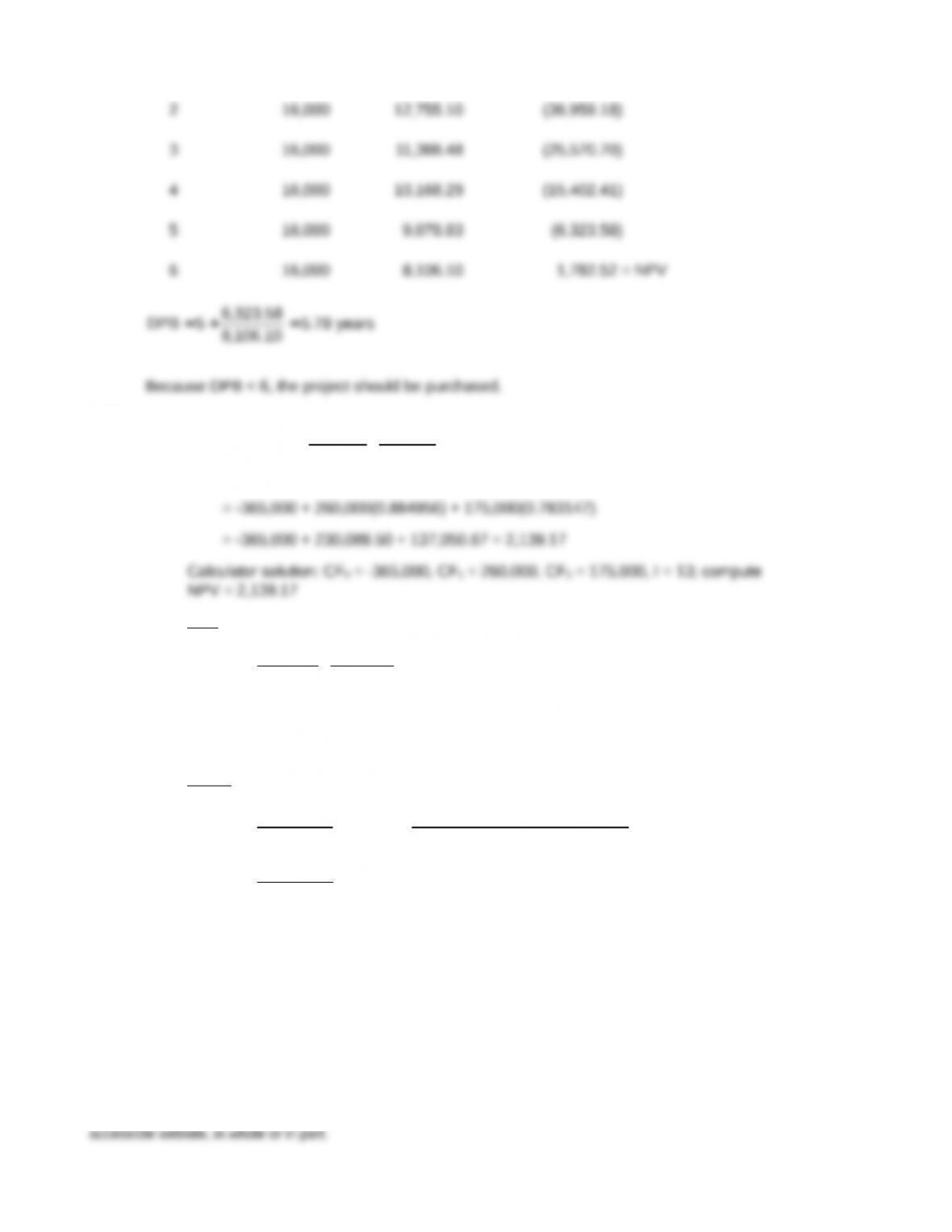
Because DPB < 5, the project should be purchased.
9-14 Traditional payback:
Year
CF CF
0 -64,000 -64,000
1 16,000 -48,000
2 16,000 -32,000
3 16,000 -16,000
Chapter 9 CFIN5
9-15 a.
1 2
260,000 175,000
NPV 365,000 (1.13) (1.13)
=- + +
b. IRR:
1 2
260,000 175,000
365,000 (1 IRR) (1 IRR)
= +
+ +
Calculator solution: CF0 = -365,000, CF1 = 260,000, CF2 = 175,000, I = 13; compute
IRR = 13.48%
c. MIRR:
1 0
n 2
2
TV 260,000(1.13) 175,000(1.13)
Cost 365,000
(1 MIRR) (1 MIRR)
468,800
365,000 (1 MIRR)
+
= = =
+ +
=+
Calculator solution: N =2, PV = -365,000, PMT = 0, FV = 468,800; compute I/Y = 13.33% = MIRR
The investment is acceptable, because MIRR > r = 13%.
© 2017 Cengage Learning. All Rights Reserved. May not be scanned, copied or duplicated, or posted to a publicly
accessible website, in whole or in part.
Chapter 9 CFIN5
9-16 Project Alpha:
a. NPV:
1
3
(1.14)
1
NPV 270,000 120,000 270,000 120,000(2.321632) 8,595.84
0.14
é ù
–
ê ú
=- + =- + =
ê ú
ê ú
ë û
Calculator solution: CF0 = -270,000, CF1-3 = 120,000, I = 14; compute NPV = 8,595.84
b. IRR:
1 2 3
120,000 120,000 120,000
270,000 (1 IRR) (1 IRR) (1 IRR)
= + +
+ + +
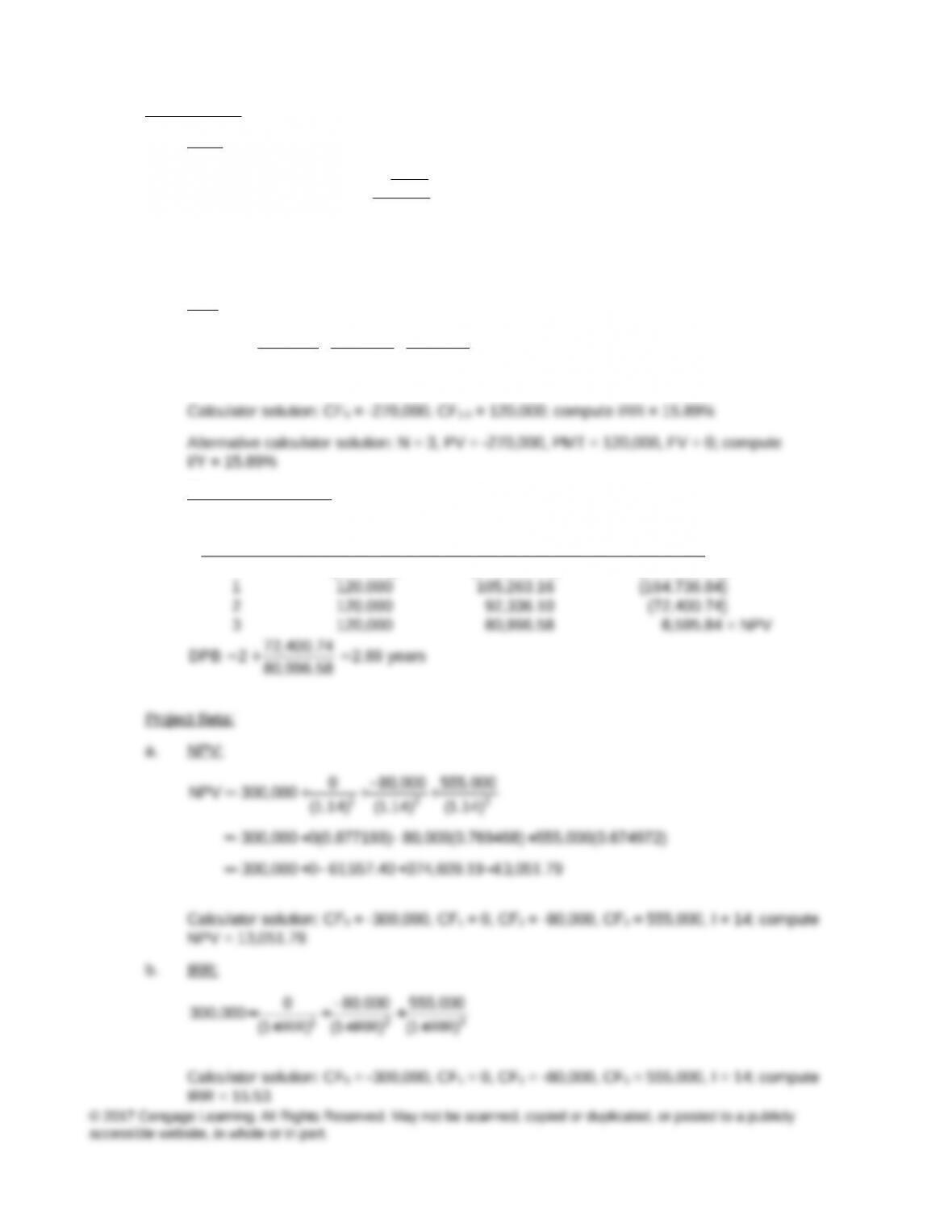
c. Discounted payback:
Year CF PV of CF @ 12% PV of C
0 (270,000) (270,000.00) (270,000.00)
Chapter 9 CFIN5
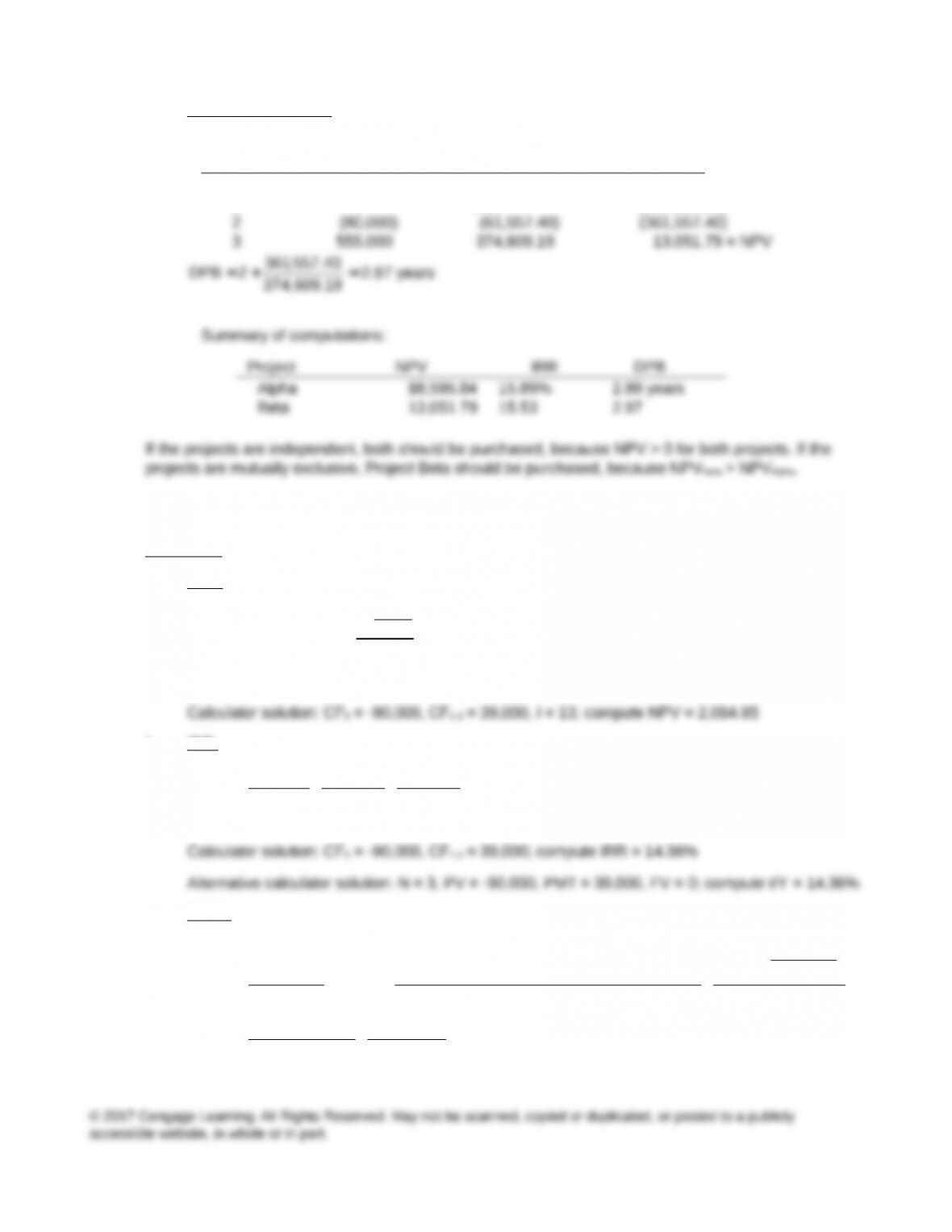
c. Discounted payback:
Year CF PV of CF @ 12% PV of C
0 (300,000) (300,000.00) (300,000.00)
1 0 0.00 (300,000.00)
9-17 Project AB:
a. NPV:
é ù
–
ê ú
=- + =- + =
ê ú
ê ú
ë û
1
3
(1.13)
1
NPV 90,000 39,000 90,000 39,000(2.361153) 2,084.95
0.13
b. IRR:
= + +
+ + +
1 2 3
39,000 39,000 39,000
90,000 (1 IRR) (1 IRR) (1 IRR)
c. MIRR:
é ù
–
ê ú
ê ú
+ + ë û
= = = =
+ + +
= =
+ +
3
2 1 0
n 3 3
3 3
(1.13) 1
39,000 0.13
TV 39,000(1.13) 39,000(1.13) 39,000(1.13)
Cost 90,000
(1 MIRR) (1 MIRR) (1 MIRR)
39,000(3.4069) 132,869.10
90,000 (1 MIRR) (1 MIRR)
Chapter 9 CFIN5
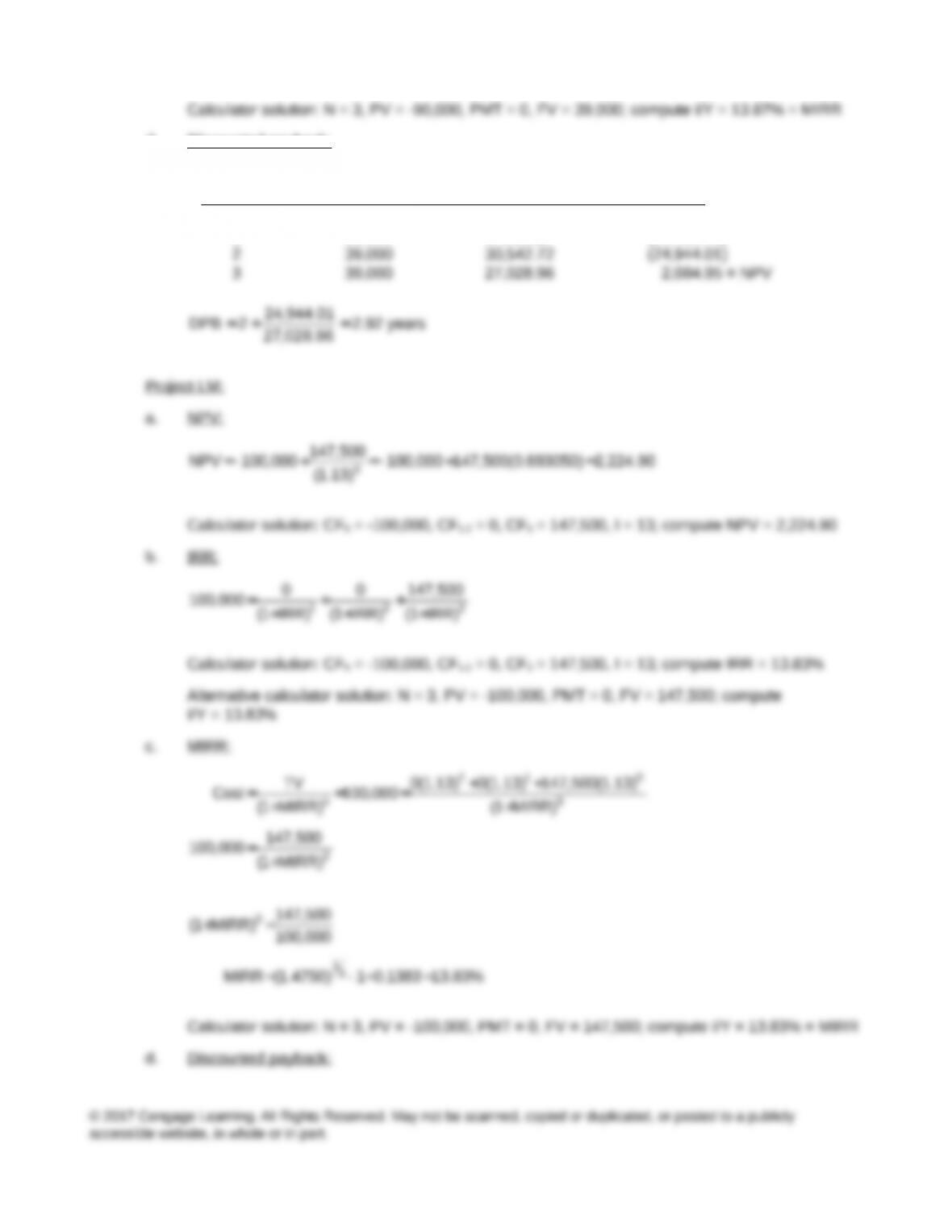
d. Discounted payback:
Year CF PV of CF @ 13% PV of C
0 (90,000) (90,000.00) (90,000.00)
1 39,000 34,513.27 (55,486.73)
Chapter 9 CFIN5
Year CF PV of CF @ 13% PV of C
0 (100,000) (100,000.00) (100,000.00)
1 0 0.00 (100,000.00)

Chapter 9 CFIN5
= + =
66,857.90
DPB 2 2.96 years
69,305.02
Summary of computations:
Project NPV IRR MIRR DPB
AB $2,084.95 14.36% 13.87% 2.92 years
LM 2,224.90 13.83 13.83 2.98
UV 2,447.12 13.89 13.63 2.96
If the projects are independent, all should be purchased, because NPV > 0 for all of the projects. If the
projects are mutually exclusive, Project UV should be purchased, because NPVUV > NPVLM > NPVAB.
9-18 NPV:
=- + + =- + +
=- + + =
S1 2
14,000 6,000
NPV 16,000 16,000 14,000(0.862069) 6,000(0.743163)
(1.16) (1.16)
16,000 12,068.97 4,458.98 527.95
Calculator solution: CF0 = -16,000, CF1 = 14,000, CF2 = 6,000, I = 16; compute NPV = 527.94
=- + + =- + +
=- + + =
T1 2
2,000 18,600
NPV 15,000 15,000 2,000(0.862069) 18,600(0.743163)
(1.16) (1.16)
15,000 1,724.14 13,822.83 546.97
Calculator solution: CF0 = -15,000, CF1 = 2,000, CF2 = 18,600, I = 16; compute NPV = 546.97 NPVT =
546.97 > NPVS = 527.94, thus Project T is the project that should be purchased.
IRR:
= +
+ +
1 2
2,000 18,600
15,000 (1 IRR) (1 IRR)
Calculator solution: CF0 = -15,000, CF1 = 2,000, CF2 = 18,600, compute IRR = 18.22%
Note: Students who use the projects’ IRRs to determine which project should be purchased would
choose Project S, because its IRR is 19.01 percent (Calculator solution: CF0 = -16,000, CF1 = 14,000,
CF2 = 6,000, compute IRR = 19.01%); thus, IRRS > IRRT. But, Project S should not be purchased
because its NPV is lower than Project T’s NPV; that is NPVS < NPVT.
9-19 a. Because they are independent and both projects have positive NPVs, both projects are
b. When a project has a positive NPV, we know that it is acceptable using both the NPV technique
9-20 a. Because all of the capital budgeting techniques listed in the table are based on time value of
money (TVM) concepts, they all must agree with respect to the accept/reject decision. The

Chapter 9 CFIN5
b. Because IRR > r when a project is acceptable and IRR < r when a project is not acceptable, the
© 2017 Cengage Learning. All Rights Reserved. May not be scanned, copied or duplicated, or posted to a publicly
accessible website, in whole or in part.