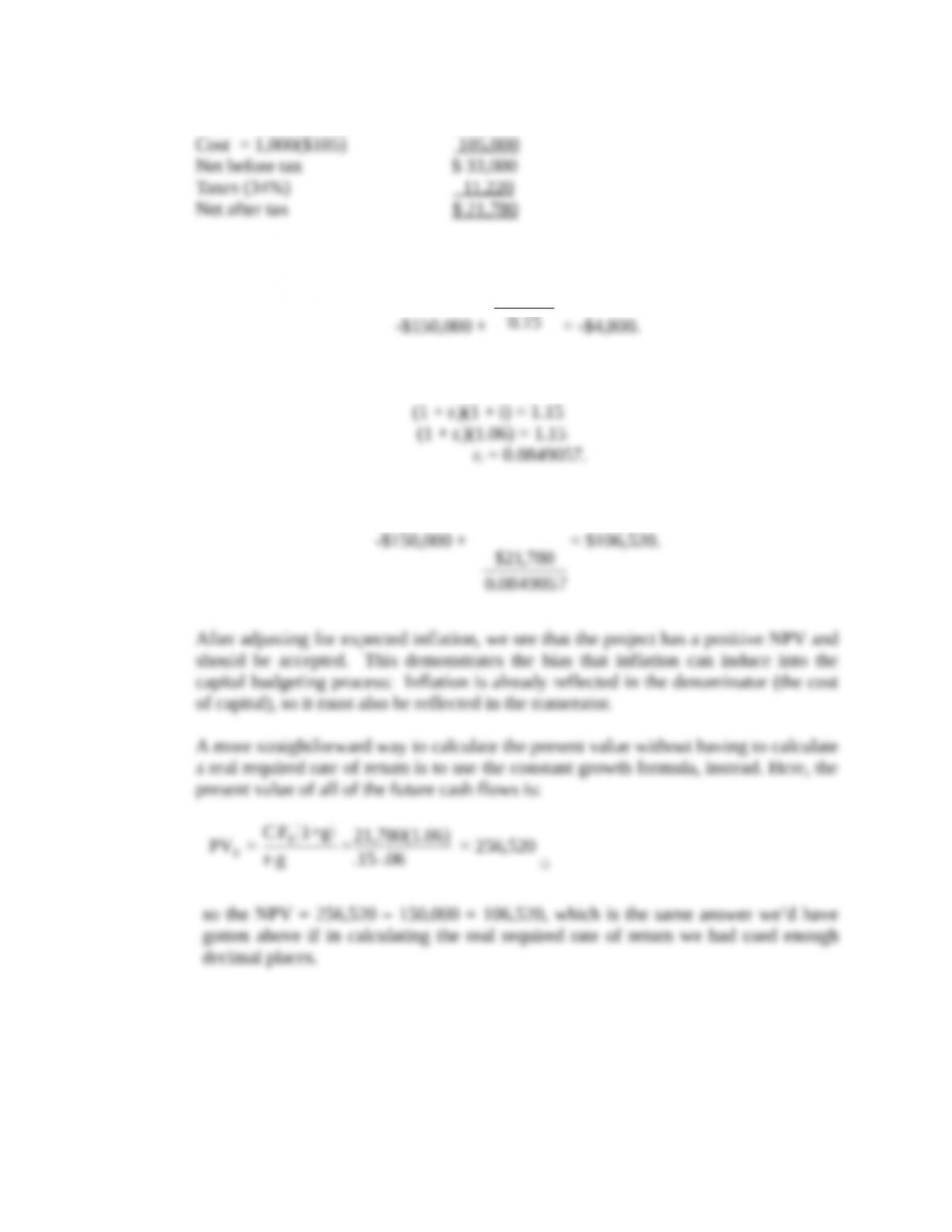
11-8 a. Sales = 1,000($138) $138,000
Not considering inflation, NPV is -$4,800. This value is calculated as
15.0
780,21$
Considering inflation, the real cost of capital is calculated as follows:
Thus, the NPV considering inflation is calculated as
0.0849057
780,21$
After adjusting for expected inflation, we see that the project has a positive NPV and
A more straightforward way to calculate the present value without having to calculate
PV0 = C F0
(
1+g
)
r-g =21,780(1.06)
.15-.06 = 256,520
❑
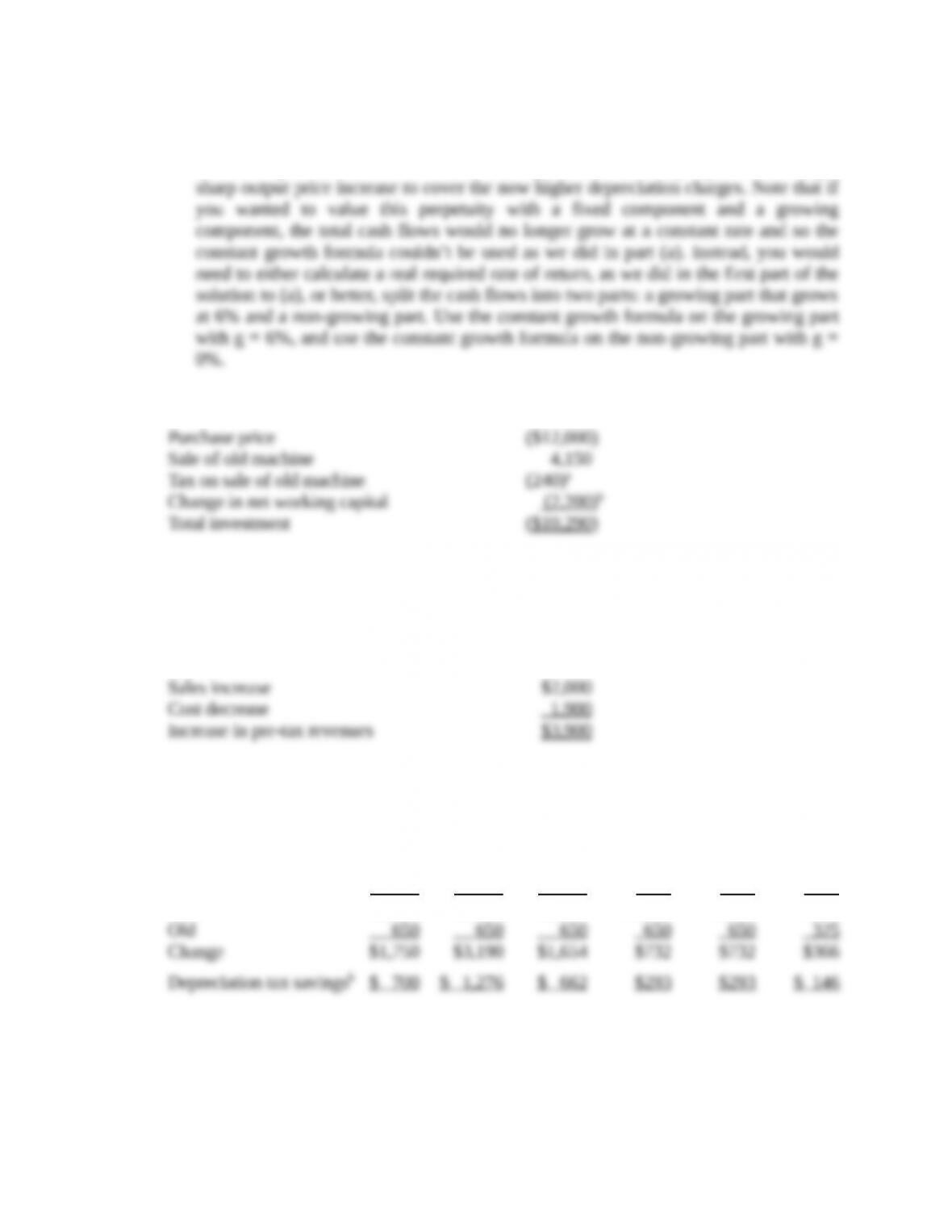
b. If part of the costs were fixed, and hence did not rise with inflation, then sales
revenues would rise faster than total costs. However, when the plant wears out and
must be replaced, inflation will cause the replacement cost to jump, necessitating a
11-9 First determine the net cash flow at t = 0:
a The market value is $4,150 – $3,550 = $600 above the book value. Thus, there is a $600 recapture of
depreciation, and Taylor would have to pay 0.40($600) = $240 in taxes.
b The change in net working capital is a $2,900 increase in current assets minus a $700 increase in current
liabilities, which totals to $2,200.
Now, examine the annual cash inflows:
After-tax revenue increase:
$3,900(1 – T) = $3,900(0.60) = $2,340.
Depreciation:
Year 1 2 3 4 5 6
Newa$2,400 $8,840 $2,304 $1,382 $1,382 $691
a Depreciable basis = $12,000. Depreciation expense in each year equals depreciable basis times the MACRS
percentage allowances of 0.2000, 0.3200, 0.1920, 0.1152, 0.1152, and 0.0576 in Years 1-6, respectively.
b Depreciation tax savings = T(Depreciation) = 0.4(Depreciation).
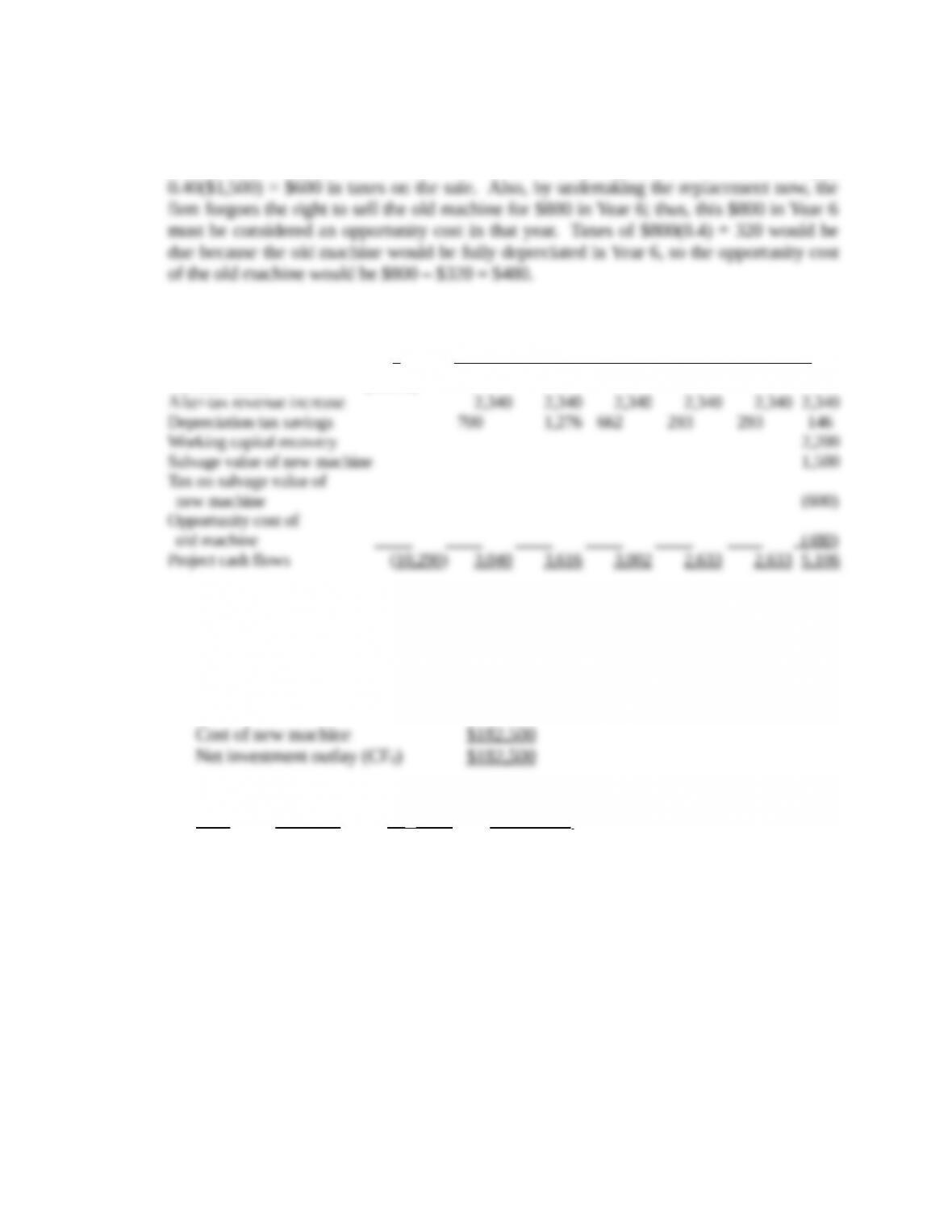
Now recognize that at the end of Year 6 Taylor would recover its net working capital
investment of $2,200, and it would also receive $1,500 from the sale of the replacement
machine. However, since the machine would be fully depreciated, the firm must pay
Finally, place all the cash flows on a time line:
0123456
|||||||
Net investment (10290)
The net present value of this incremental cash flow stream, when discounted at 15%, is
$2,083.51. Thus, the replacement should be made.
11-10 1. Net investment at t = 0:
2. After-tax
Year Earnings T( Dep) Annual CFt
15%
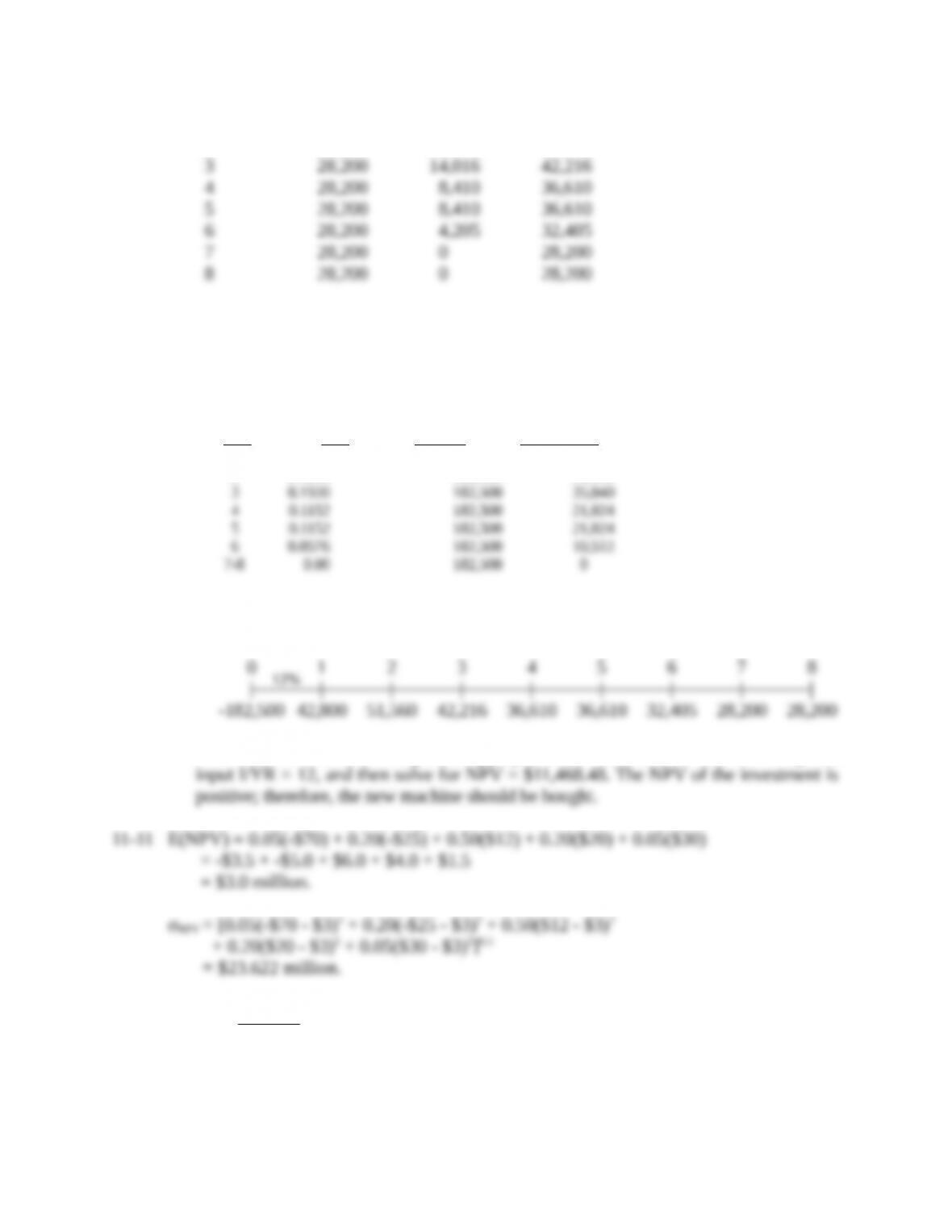
1 $28,200 $ 14,600 $42,800
2 28,200 23,360 51,560
Notes:
a. The after-tax earnings are $47,000(1 – T) = $47,000(0.6) = $28,200.
b. Find Dep over Years 1-8:
The old machine was fully depreciated; therefore, Dep = Depreciation on the new machine.
Dep Dep
Year Rate Basis Depreciation
1 0.2000 $182,500 $36,500
2 0.3200 182,500 58,400
3. Now find the NPV of the replacement machine:
Place the cash flows on a time line:
With a financial calculator, input the appropriate cash flows into the cash flow register,
CVNPV =
$3.0
$23.622
= 7.874.
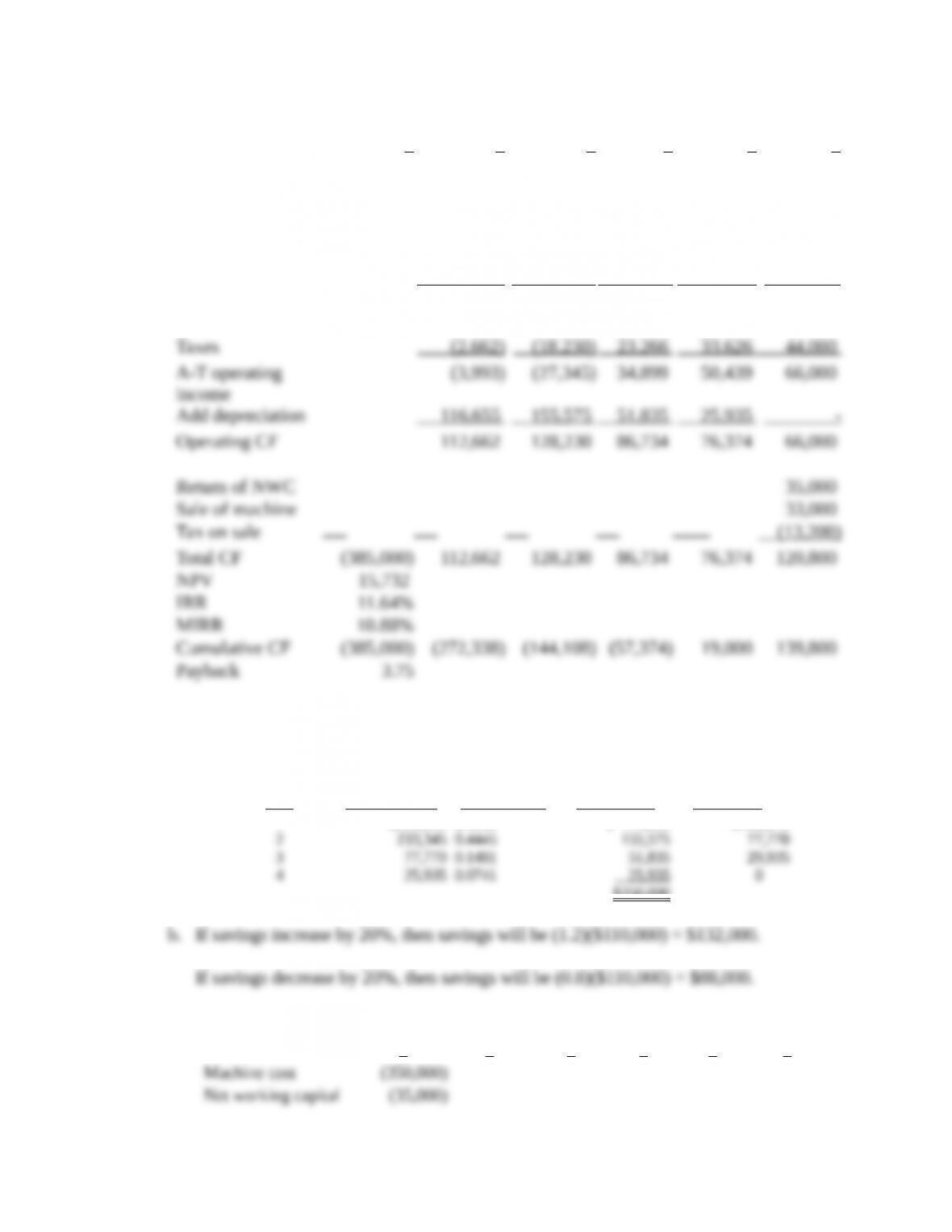
11-12 a.
0 1 2 3 4 5
Machine cost (350,000)
Net working
capital
(35,000)
Cost savings 110,000 110,000 110,000 110,000 110,000
Depreciation 116,655 155,575 51,835 25,935 –
Op. Inc. before
taxes
(6,655) (45,575) 58,165 84,065 110,000
Notes:
a Depreciation Schedule, Basis = $250,000
MACRS Rate
Basis =
Year Beg. Bk. Value MACRS Rate Depreciation Ending BV
1 $350,000 0.3333 $ 116,665 $233,345
$350 ,000
(1) Savings increase by 20%:
0 1 2 3 4 5
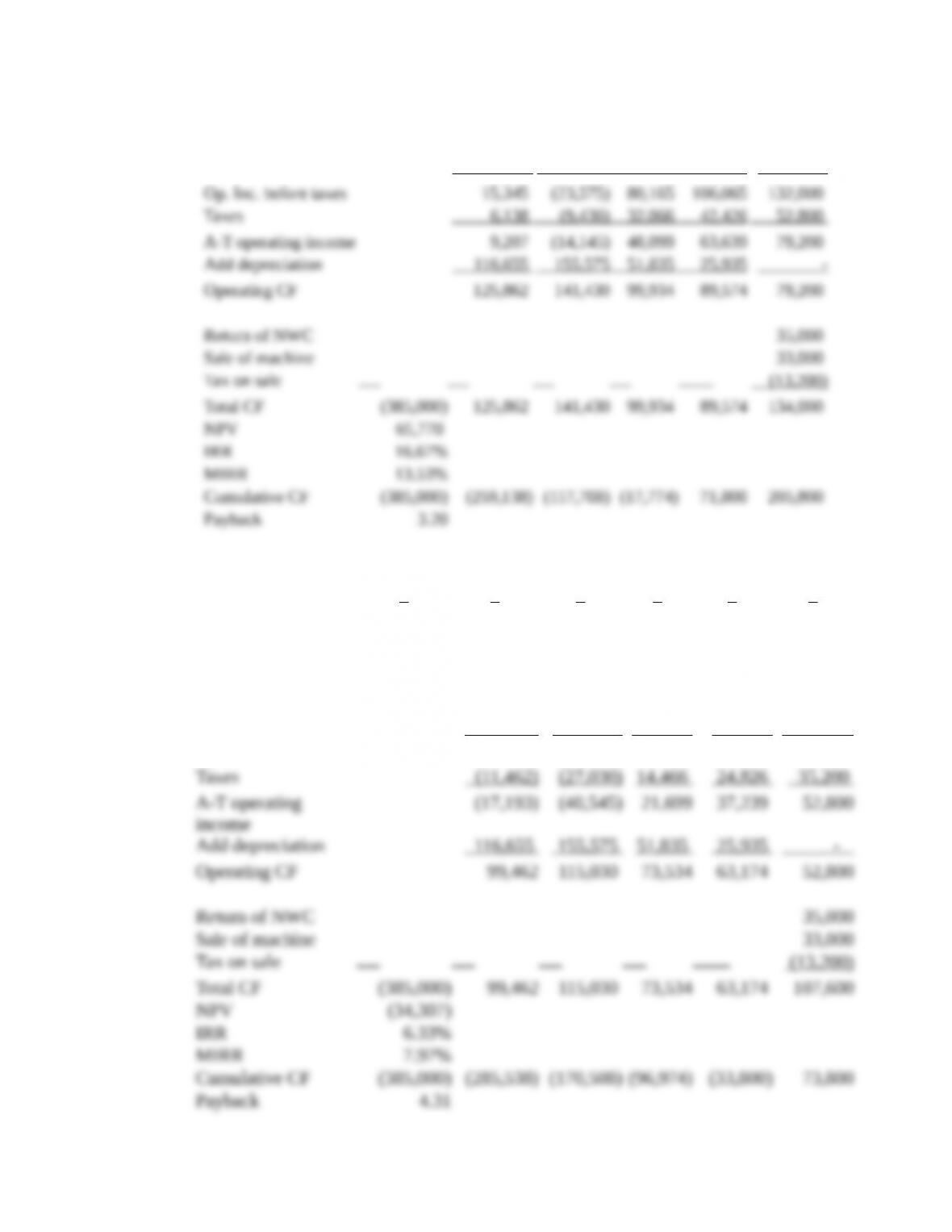
Cost savings 132,000 132,000 132,000 132,000 132,000
Depreciation 116,655 155,575 51,835 25,935 –
(2) Savings decrease by 20%:
0 1 2 3 4 5
Machine cost (350,000)
Net working capital (35,000)
Cost savings 88,000 88,000 88,00
0
88,000 88,000
Depreciation 116,655 155,575 51,835 25,935 –
Op. Inc. before taxes (28,655) (67,575) 36,165 62,065 88,000
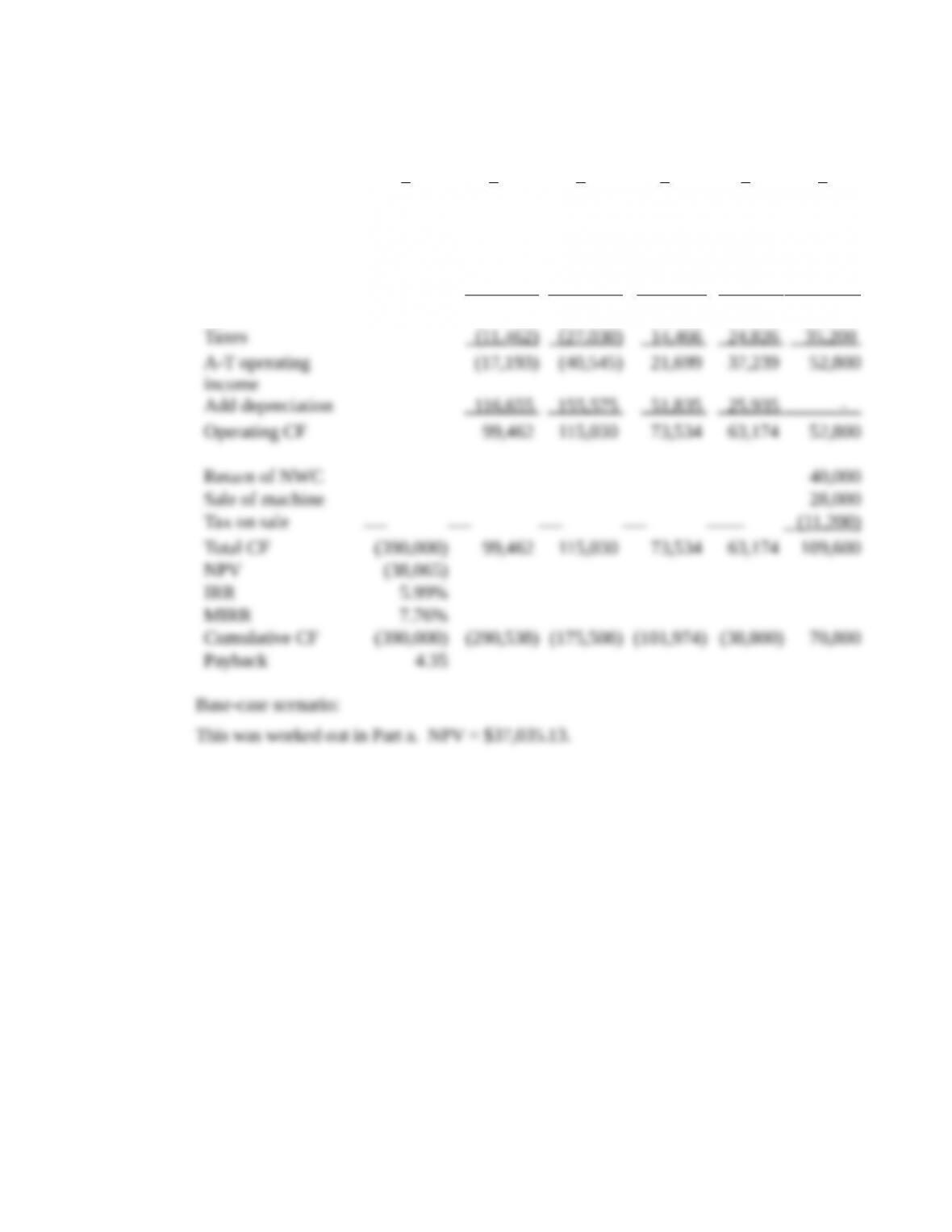
c. Worst-case scenario:
0 1 2 3 4 5
Machine cost (350,000)
Net working capital (40,000)
Cost savings 88,000 88,000 88,000 88,000 88,000
Depreciation 116,655 155,575 51,835 25,935 –
Op. Inc. before taxes (28,655) (67,575) 36,165 62,065 88,000
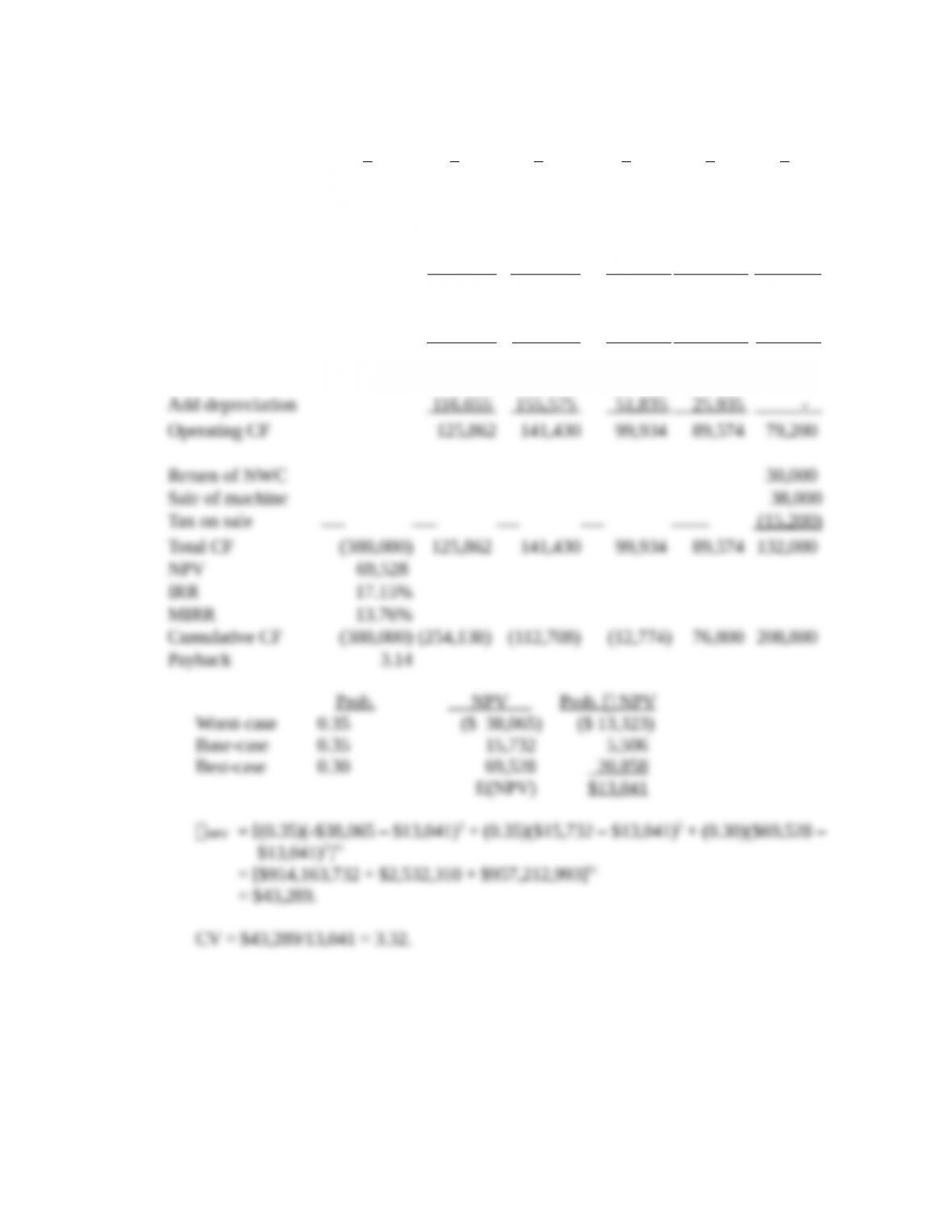
Best-case scenario:
0 1 2 3 4 5
Machine cost (350,000)
Net working capital (30,000)
Cost savings 132,000 132,000 132,000 132,000 132,000
Depreciation 116,655 155,575 51,835 25,935 –
Op. Inc. before
taxes
15,345 (23,575) 80,165 106,065 132,000
Taxes 6,138 (9,430) 32,066 42,426 52,800
A-T operating
income
9,207 (14,145) 48,099 63,639 79,200
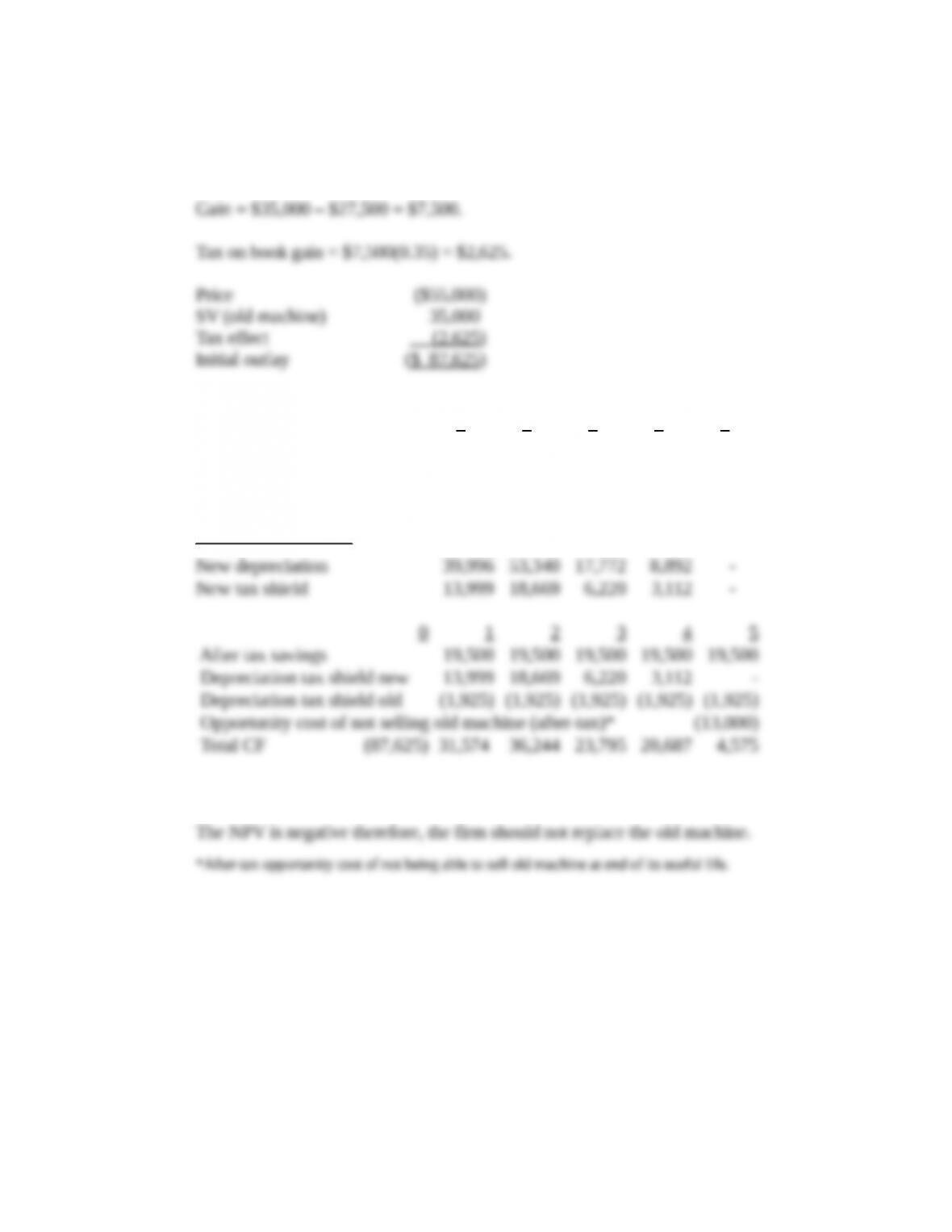
11-13 a. Old depreciation = $5,500 per year.
Book value = $55,000 – 5($5,500) = $27,500.
b.
12345
Old depreciation 5,500 5,500 5,500 5,500 5,500
Old tax shield 1,925 1,925 1,925 1,925 1,925
Basis 120,000
MACRS Rate
33.33% 44.45% 14.81% 7.41% 0.00%
c. NPV
(4,623)