
Teaching Human Relations: Principles,
Methods, and the Skills Approach
PRINCIPLES
Throughout the years, a number of teaching and learning principles have been found to facilitate human
relations training and development. These principles can set the stage for productive class sessions and
encourage students to relate to the material in ways that stimulate self-discovery and group discussion.
We encourage you to review these principles before beginning the course.
1. Try to get to know each student as well as possible. For example, you may ask the students to fill
out a one-page questionnaire about themselves during the first session. Questions might focus on
career goals, past work experiences, what they would like to learn from the course, and so on.
Discover what is unique about each class member.
2. Theory should be followed by opportunities to practice. A major goal of any human relations
course is to help students develop skills that can be applied in real-world situations. The
application exercises in this manual provide opportunities for students to put their knowledge into
action and to receive feedback.
3. Strive for an informal, relaxed atmosphere in the classroom and warm, friendly relationships with
students. If the general environment is supportive, students are more apt to share their true
thoughts and feelings. Often, the trust and two-way communication established between instructor
and students, and among the students themselves, is the key to a successful human relations
course.
4. If possible, select a classroom in which you can rearrange the chairs, vary the lighting, and create
a more informal setting. Ideally, students should be able to form small groups for discussion or
arrange their chairs in a large circle for group sharing. Being able to change the seating will be
useful for many of the application exercises.
5. Use a variety of teaching methods to add interest and liveliness to the course. We discuss several
appropriate teaching methods in the following pages. You should find these helpful when
presenting the text material or when conducting an exercise.
6. Help students focus on the purpose of each learning activity. Discuss the implications of their
behavior and reactions to the various situations, and provide helpful feedback. Often the most
direct approach is to ask students to write down their reactions in a journal or diary. How did they
feel? What did they learn? How will they handle the situation the next time? One of our primary
goals is to help students get in touch with their true feelings and create greater self-awareness.
ONLINE TEACHING ASSISTANCE
This course can be delivered as an online course using a learning management system. An instructor
may also choose to offer Effective Human Relations as a hybrid course using both face-to-face and
online methodologies. A Cengage MindTap subscription is available for the thirteenth edition.

viii Teaching Human Relations: Principles, Methods, and the Skills Approach
SELECTING THE APPROPRIATE TEACHING METHOD
Human relations training and development lends itself to a wide variety of teaching methods. As you
assess the material to be covered in each chapter, you can choose the most appropriate way to present
the information. This section reviews several teaching methods that will assist you in helping your
students develop skills, reshape their attitudes, and understand basic concepts of human behavior. These
methods include small-group discussion, role playing, videoing, field interviews, lectures, guest
speakers, and the use of audiovisual materials.
Small-Group Discussion Methods
On some occasions, you will want to tap the knowledge and experience of class members. Other times,
you may want to encourage constructive, creative thinking about a specific topic or problem area. The
four group discussion methods presented here will help you enhance the teaching/learning process by
involving your students in a variety of ways.
1. Dyad. Class members are divided into small groups of two persons each. When discussing a
problem or an issue, one member of the dyad may take the “pro” side while the other person takes
the “con” side.
Advantages. Every class member is actively involved in the teaching/learning process (no one can
be a passive onlooker). Participants who are more reluctant to express their views in class will feel
more comfortable in a small-group setting. Both sides of an issue can be discussed freely.
2. Small Group. Class members are divided into small groups of three or four persons. The groups
meet simultaneously to discuss a topic or perform a task assigned to them.
Advantages. A group consisting of several members may produce more solutions, or better
solutions, to a problem than the dyad might. Also, people who do not feel comfortable speaking in
a large group are more likely to contribute their ideas and suggestions in a smaller group.
3. Fish Bowl. The members of one small group (five to eight people) meet in a circle or cluster and
are observed by the members of a second group of the same size who sit around them in a larger
circle. The inner group discusses an issue or works on a problem supplied by the instructor.
Usually ten to fifteen minutes are allotted for discussion. The outer group members do not
participate but observe the inner group closely. At the end of the discussion time, the two groups
change places. The new inner group comments on ideas expressed by the first group and adds its
own ideas or observations. As before, the outer group can only observe.
Advantages. A more in-depth analysis of an issue or problem will usually emerge, and students
will have an opportunity to express a wide variety of views. People in the outer circle are in a
good position to give feedback to inner-circle members about their participation, whether they
hindered or helped the group, how supportive they were, and so on.
4. Debate. The class is divided into two teams and is given a topic to debate. One team takes the
affirmative side and the other team takes the opposing view. A fifteen– to twenty-minute
preparation period is provided before the debate begins. Each team elects a captain and a “second”
to the captain. When the debate begins, the captain is given five minutes to present his or her
team’s position, and the “second” is given three minutes. The opposing team’s captain and
“second” are given equal time to present their team’s arguments. After the formal presentations
are made, other team members may join in the debate. The instructor serves as moderator.
Advantages. Everyone takes a stand on the issue, so students develop a strong interest in the
subject. Both sides of the issue are thoroughly aired.

Teaching Human Relations: Principles, Methods, and the Skills Approach ix
Role Playing
Role playing has become increasingly popular as a teaching method in human relations classes. It can
be defined as a spontaneous acting out of a situation or incident portraying a human relations issue or
problem. Usually participants are selected by the instructor, but some may volunteer. Through role
playing, students learn to appreciate another person’s point of view, develop greater insight into their
own behavior and self-concept, and see the limitations or advantages of certain ways of behaving.
Learning situations in which this technique can be used are limited only by the imagination of the
instructor and the willingness of the students to participate. To ensure that your role play will be a
success, follow these steps:
1. Introduce the role play. Explain why you are using a role play and set the scene. Every role play
should have a purpose, and the objectives should be discussed with the group. Once you have
discussed the objectives of the role play, students will have a better idea of what is expected of
them.
2. Select and prepare the role players. You can call for volunteers or select students to play the
roles. Carefully describe the role-play situation and character descriptions. Help the role players
understand what they are trying to accomplish. In some cases you may want to use a written
script.
3. Prepare the observers. In most cases you will want to assign specific tasks to the observers. Give
them clear instructions on what to look for and what to write down. Tell the observers they will be
asked to discuss their observations at the conclusion of the role play.
4. Enact the role play. Most role plays are not smooth dramatizations. In some cases, a role player
will “drop out of character” or become repetitive. When this happens, stop the role play. Allow
the role play to continue until the objectives have been reached.
5. Discuss the role play. Encourage role players to discuss how things went for them. Then ask
observers to report what they saw and heard. Encourage an open discussion of viewpoints. As the
role-play facilitator, it is your responsibility to paraphrase and summarize responses. Help
students to integrate role-play results with material previously discussed.
Videoing
When possible, video-record role-playing situations and other student involvement activities. The
replay can provide feedback that would be difficult to capture in other ways. Students can study their
own behavior more closely and develop self-evaluation skills. This feedback will also help students
develop greater self-awareness.
Field Interviews
A carefully planned interview with someone already working in an organization can provide current
information not available to students from other sources. In addition, field interviews can give the
students practice in approaching and talking with executives, managers, supervisors, administrative
personnel, and others they are likely to encounter on the job. Planning is the key to an effective
interview. Students should develop a list of specific questions and present these to the instructor for
approval and suggestions. It is recommended that students report their findings to the class.
Lectures
A human relations class is not apt to be lecture oriented. However, there are times when short lectures
(fifteen to twenty minutes) are needed to present some types of material. Usually, illustrating the lecture

x Teaching Human Relations: Principles, Methods, and the Skills Approach
© 2014 Cengage Learning. All Rights Reserved. May not be scanned, copied or duplicated, or posted to a publicly accessible website, in whole or in part.
with real-world examples or some type of visual aid can maximize the impact of your presentation.
Encourage students to ask questions and to discuss the material.
Guest Speakers
A well-qualified guest speaker can supplement your own presentation, stimulate student interest in a
subject, and make the material relevant to real-life situations. Most guest speakers will be more
effective if they are asked to respond to specific questions or topics. You might suggest that before the
guest speaker arrives, students draw up a list of questions they would like answered.
Audiovisual Materials
Instructors can choose from a wealth of audiovisual materials developed for classroom use. Videos,
audiocassettes, projected images, and the like illustrate many human relations problems and methods of
handling them. These materials can give your students good exposure to actual work situations and
provide the basis for rewarding class discussions. PowerPoint slides are available for use by adopters of
the thirteenth edition of Effective Human Relations. A video package is also provided.
MAJOR TERM PROJECTS
The projects described in this section may require several weeks to complete. Therefore, introduce the
project or projects you select early in the term, and monitor student progress now and then.
Resources Available to Help Students Achieve Personal Goals or
Solve Personal Problems
Many people today face a level of uncertainty in their lives that can be very stressful. In their personal,
academic, or professional lives they may be coping with rapid change, time management problems,
health concerns, or some other barrier to happiness and success. The purpose of this project is to give
students a better understanding of the various forms of assistance available to them.
1
Throughout life we cannot, and probably should not, make all our important decisions without advice
and counsel from others. Sometimes we need help from a trained professional and sometimes we
simply need to spend time with a good listener. In some cases, a support group can be very helpful.
Step one of this project is to encourage students to engage in careful self-examination. They should
identify personal problems or goals that need to be addressed. Some students may want to look to their
futures and anticipate problems or challenges they may face that may require help from others. Once
they have identified these problems or goals, students should investigate the assistance available to
them. A list of relevant services that may be available at your school or from a local community agency
follows:
• Basic or remedial education
• Child-care assistance
• Finance counseling
• Counseling in coping with job loss
• Career planning
1
This learning activity was developed by Roger Lynch, a faculty member in the business department at
Inver Hills Community College. Each student enrolled in his human relations class establishes an
important goal and then investigates the factors that serve as barriers to goal achievement. In a three–
page paper, students report their findings as to how they will manage these barriers.

Teaching Human Relations: Principles, Methods, and the Skills Approach xi
• Job placement assistance
• Drug or alcohol abuse counseling
• Physical fitness programs
• Weight-loss programs
• Assistance for persons who have experienced child abuse
• Retraining programs
• Assistance for persons with hearing or visual impairments
Once their investigation is complete, students should prepare a written report that describes their
findings.
Personal Growth Through Journal Writing
A personal journal can be a vehicle for helping students (1) engage in self-expression and self-
development; (2) find personal connections to the class material; (3) explore their thoughts about the
course material; and (4) collect observations, responses, and data pertinent to the topics being studied.
A journal enables students to express feelings, clarify goals, and improve relationships with self and
others. Tristine Rainer, author of The New Diary, says that keeping a journal can help people
understand their past, discover joy in the present, and create their own future. She also believes that
journal writing provides a path to self-awareness and self-knowledge. Research is showing that journal
writing can have a profoundly positive effect on our mental and physical well-being.
2
There is no “best way” to keep a journal. You may want to give students journal writing assignments
that relate to specific chapter topics. The following instructions for Chapters 9 and 14 illustrate how
structured journal writing can be used in your classroom.
Chapter 9
It is important that you learn what things make you angry and how often these “anger triggers” surface
in your life. For a period of one week, record in your journal each episode of anger. Writing makes
anger events more concrete and puts them in a form that is easier for you to review. Be specific as you
write down the particular event that triggered the anger and describe your physical and mental response.
Once you become aware of your major anger triggers, you can determine how best to avoid them in the
future. At the end of the week, study the entries and then answer these questions:
1. What are the most common causes of anger in your life?
2. How well do you manage each anger episode?
3. Do you feel anger long after the incident that caused the anger has passed?
4. Do you express your anger in effective ways? (A list of effective ways to express your anger is
provided in the text.)
Chapter 14
For a period of one week, record in your journal all stressful events. One approach is to set aside a few
minutes at the end of the day and complete your journal entries. Another approach is to make entries
throughout the day as you feel stressed. This takes greater effort, but it will give you a more accurate
² Tristine Rainer, The New Diary (Los Angeles; Jeremy P. Tarcher, Inc., 1978), p. 18; Alice Lesch
Kelley, “Write From the Heart,” New Age, November/December 1999, p. 58.

xii Teaching Human Relations: Principles, Methods, and the Skills Approach
picture of how much stress you are experiencing each day and the specific events that might otherwise
escape your attention. At the end of the one-week period, review all of your entries and try to determine
what events cause the most stress in your life. Then think about ways to better cope with the stress in
your life. A careful examination of the stress management strategies described in your text will be
helpful as you develop your own stress management plan.
In most cases it is easier for students to use a loose-leaf notebook so that pages can be inserted, deleted,
or rearranged at will. Ask students to record the date of each entry, as these dates may serve as
important reference points in their later lives.
In addition to teacher-directed journal entries, some students may use their journals as a place to
express emotions such as anger, love, grief, fear, or jealousy. Some students record all of their
significant daily experiences; others are more selective about what they write. Students should be
encouraged to express themselves through sketches as well as words. Students might record thoughts,
feelings, and experiences in lists (a “happy list,” for example) using a narrative style that explains the
pros and cons of an issue or a creative, “what if” approach.
The personal growth journal may be a major project, but individual journal entries need not be major
essays. It is sometimes effective to ask students to take a five-minute “time out” during a classroom
discussion to record their immediate thoughts in the journals. This can be particularly valuable during
potentially volatile discussions surrounding topics such as values clarification, sexual harassment, or
conflict management. Relax the tension by inviting students to write for five minutes regarding their
thoughts about what is happening in the classroom, questions they want answered, or comments they
would like to throw out for further discussion. This process often helps students clarify their opinions
and calm their emotions so that they can continue their growth process in a more controlled manner.
Although the disclosure of journal entries can be a vehicle for personal growth, every student has the
right to privacy. No one should be forced to share a journal entry if this disclosure would be
uncomfortable.
THE SKILLS APPROACH TO HUMAN RELATIONS TRAINING
The skills approach to human relations training and development places greater emphasis on the
application of knowledge through practice followed by feedback and reinforcement. Students are more
actively involved in the teaching/learning process than in other approaches.
Robert Mager, author of Developing Attitudes Toward Learning and other books for trainers and
teachers, defined learning as “a change in behavior.” He said:
We teach or instruct because we hope that through our instruction the student will somehow be
different than he was before the instruction. We provide “learning experiences” with the intent
that the student will then be a modified person . . . in knowledge, in attitude, in belief, in skill.
3
The ultimate goal of any human relations training and development program should be changed
behavior. If the instructional program is a success, the student will think, feel, and act differently. And
in most cases, the changed behavior can be observed.
A skill might be thought of as the “doing” part of any job, the ability to use knowledge effectively in
the performance of tasks. It takes skill to identify the communication style of someone you meet for the
first time. It also takes skill to maintain eye contact during a conversation. Effective listening is
essentially a skill that must be learned.
3 Robert F. Mager, Developing Attitudes Toward Learning (Palo Alto, Calif.: Fearon Publishers, 1968),
p. 7.
Teaching Human Relations: Principles, Methods, and the Skills Approach xiii
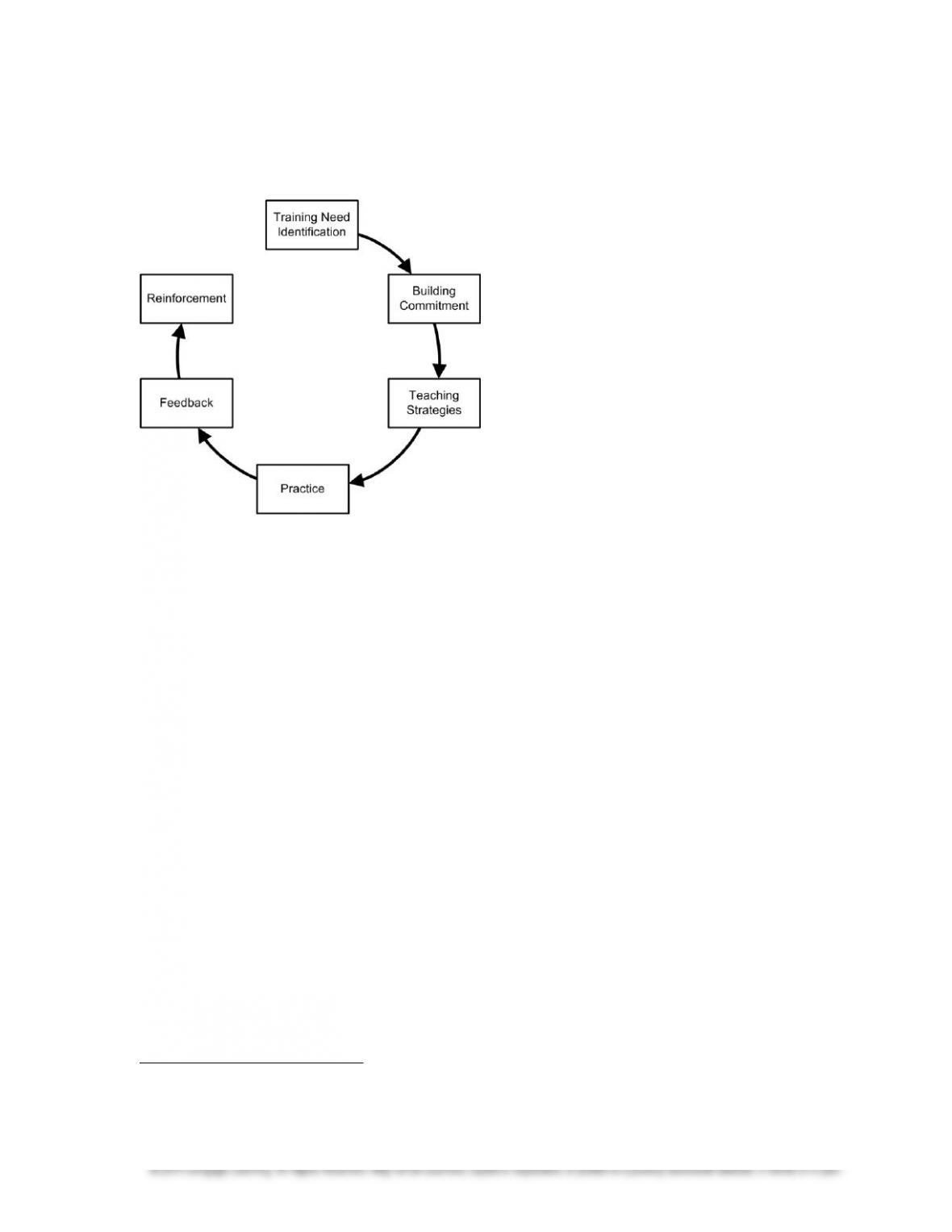
The skills approach to human relations training may require some changes in your thinking about the
teaching/learning process. The first step in preparing to use the skills training approach is to review the
following six-part model. This practical model provides a step-by-step plan that will guide you
throughout the skill development process.
Training Need Identification. Deciding what training requirements to focus your attention on is very
important. Skills training should begin with a set of clearly defined objectives. For example, coverage
of Chapter 11, “Developing a Professional Presence,” might feature this objective: to identify telephone
practices that create positive impressions.
Building Commitment. Learning is a self-activity. It is a fundamental truth that the learner controls the
switch that lets learning happen.
4
Always begin each class presentation with a brief rationale for
studying that particular human relations topic. Of course, one of the best ways to build commitment to
your instructional content is to emphasize the job application of the material you plan to present.
Teaching Strategies. Although the emphasis in skills training is placed on learning by doing, the student
must begin with a knowledge base. Therefore, you needn’t feel you must avoid the use of passive
teaching methods such as reading assignments, lectures, or videos. Once you have established a
knowledge base, however, turn to participative teaching methods such as role playing, skits, small–
group discussion, debates, or the use of self-assessment instruments.
Practice. Is it possible to master Internet search procedures without practice? How about learning
bookkeeping practices and procedures? Welding? How to close a sale? The answer to those questions
is, of course, no. The skills approach to human relations training emphasizes learning by doing. Give
each student a chance to perform those skills that you feel are important. If you are attempting to
develop the skill of giving positive reinforcement to another person, why not use role playing to give
students the opportunity to “do it” rather than just “talk about it”? If your students are employed,
schedule opportunities to practice skills on the job.
Feedback. With the aid of feedback, students learn how close they are to skill mastery. When role
playing is used, feedback can be provided by students and the teacher. When a role-playing situation or
skit is videoed, the student can receive excellent feedback simply by watching the replay. As a rule,
feedback should be constructive and supportive. Feedback should also be as specific as possible.
4 Martin M. Broadwell, “Above All, Remember That Learning Is a Self–Activity,” Training/HRD, April
1977, p. 40.
xiv Teaching Human Relations: Principles, Methods, and the Skills Approach
© 2014 Cengage Learning. All Rights Reserved. May not be scanned, copied or duplicated, or posted to a publicly accessible website, in whole or in part.
Reinforcement. Psychologists tell us that the frequency of reinforcement determines how fast the
student will learn and how long he or she will remember information or perform a skill. Reinforcement
of the correct behavior will reward students who are making progress toward skill mastery. Behavior
that is rewarded is more apt to recur in the future.
The many application exercises featured in the textbook and this manual will aid you in implementing
the skills approach to human relations training. These exercises emphasize “doing” types of activities
both inside and outside the classroom.
SUMMARY
We have designed this manual as a comprehensive resource guide to help you achieve your learning
objectives for the class. Teaching a course in human relations can be a challenging assignment. We
believe that the thirteenth edition of Effective Human Relations, and this Instructor’s Manual will make
that assignment a rewarding one as well.
B.L.R.
Chapter Teaching Resources