Instructional Games

69 Instructional Games
Instructional Games
Two instructional games have been developed for use with the thirteenth edition of Effective Human
Relations: Interpersonal and Organizational Applications. Each game simulates a realistic work
environment where employees must make difficult decisions. Students play these games to learn
without having to play for keeps.
ETHICAL DECISION MAKING
Introduction
Ethical dilemmas surface frequently in the workplace, and telling right from wrong can sometimes be
difficult. The purpose of this instructional game is to help students (1) develop greater awareness of the
ethical dilemmas people face every day at work and (2) make good decisions when confronted with
ethical choices. Participation in the game will stimulate in-depth thinking about the consequences of
their decisions.
Format
Ethical Decision Making includes four mini-cases that introduce various ethical dilemmas. Each mini-
case poses four solutions. In most cases, one solution will be the best selection from the options listed.
However, other choices may have merit. The answer key provides a point total for each solution and a
solution rationale. This instructional game requires one class period.
Note: It is suggested that you schedule this instructional game after students have read Chapter 5.
How to Play
Team competition adds an extra dimension of excitement to the game. Organize the class into teams of
three to four students, and appoint a group spokesperson. Then give a copy of the mini-cases to each
class member. Working alone, class members should select the best solution for each mini-case prior to
meeting with members of the group. Selection of solutions will require about 5–7 minutes. Once the
students have selected a solution for each mini-case, they should join their team for a discussion of their
choices. Instruct teams to reach a consensus, if possible, regarding the best solution. Teams should be
given 8–10 minutes to discuss the solution options for each mini-case. After each team has completed
its deliberations, begin posting the solution choices on the board or flip chart. Post all team choices for
the first mini-case and then encourage team members to discuss the rationale for their choice. After
each team has presented support for its choice, post the points earned for that mini-case. For example:
Team #1
Team #2
Team #3
Team #4
Case #1
A (−5 points)
B (10 points)
B (10 points)
C (5 points)

70 Instructional Games
After all mini-cases have been discussed and the points have been posted, total the points and announce
the winning team. Keep in mind that the most essential ingredient to successful administration of the
game is complete discussion of each ethical dilemma.
Note: To provide more time for discussion of each ethical choice, you may want to instruct students to
select the best solution for each mini-case prior to class. Student material starts on the next page.

Instructional Games 71
INTRODUCTION TO VISION 2000
Vision 2000, a comprehensive marketer of computers and computer services, was established seven
years ago. The company is departmentalized into four areas: new product sales; service (repair of
computers); accounting; and human resources. The human resources department is responsible for
hiring, orientation, training, and termination of employees. Throughout the first two years, the company
operated on a “break–even” status, but it started earning a profit early in the third year. Two years ago, a
direct competitor moved into the community and immediately became a major threat to the profitable
operation of Vision 2000. The owner, Sara Miller, reacted quickly to the new competition. She closed
the business for one day and met with all employees at a local conference center. During this one-day
retreat, employees were invited to suggest ways to improve company operations. The meeting was a
huge success. Several company policies and practices were reviewed and revised. A decision was made
to offer cash incentives to employees who came up with cost-saving ideas. The amount of the award
would be based on the estimated value of resulting increases in efficiency or cost cutting. In addition,
employees suggested that the company terminate any employee who deliberately damaged company
equipment or engaged in the theft of company resources. One week after the retreat, the human
resources department issued a memo to all employees that described the new policies concerning
damage to company equipment and the theft of company resources. The company orientation program
was revised to include information on these two topics. Today, Vision 2000 is earning modest profits,
but the pressure to maintain a competitive position in the marketplace continues to be intense.
MINI-CASE 1
You have held the position of service technician at Vision 2000 for the past six years. It’s 7:50 A.M. and
you receive a frantic phone call from Tim Robbins, a close friend and coworker. Tim has been with the
company for three years. Tim says he overslept and will be about 30 minutes late for work. He wants
you to punch his time card before 8:00 A.M., which is the starting time for all service department
employees. After a few moments of hesitation, you reluctantly agree to punch his card but say, “I will
never do this again.” After hanging up the telephone you recall a conversation with Tim held last week.
He said the department head had warned him that he had been late for work several times and if he was
late again, he would likely lose his job. Suddenly, you begin to have second thoughts about your
decision to punch Tim’s time card. What should you do?
A.
Punch Tim’s time card. After all, he is a coworker and a good friend.
B.
Punch Tim’s time card, and then meet quickly with the department head. Explain
that Tim will be late and you will work throughout the lunch hour to make up for
his missed time.
C.
Do not punch Tim’s time card. Let him explain his tardiness.
D.
Do not punch Tim’s time card, but tell the department head that Tim will be late due
to car trouble.

MINI-CASE 2
Vision 2000 is committed to workforce diversity and inclusion and has taken steps to develop and
implement nondiscrimination policies. The company recently hired two professional trainers to conduct
a diversity workshop for all employees. A major goal of this workshop was to help employees develop
sensitivity to differences. After the workshop, employees completed an evaluation form that was given
to the training staff. Late in the afternoon, on the day of the seminar, you are seated at your desk and
hear a conversation between the two trainers who are standing in the hallway. You hear one person say
to another, “We can’t give these evaluations to the head of human resources. They contain too many
critical comments.” What should you do?
A.
Walk to the hallway and enter the conversation, hoping to learn more.
B.
Visit with the head of human resources and give this person the information you
overheard.
C.
Call Sara Miller, owner of the company, and tell her what you overheard.
D.
You do not know what type of critical comments were made, so forget the
conversation and do nothing.
MINI-CASE 3
A few minutes ago you left your office to attend a two-hour meeting with the sales staff. As head of the
sales department, you are responsible for conducting a weekly meeting of the sales staff. Molly, your
receptionist, was told to take messages and tell callers you will return after lunch. Soon after the
meeting starts, a member of your sales staff introduces a product comparison chart that she developed
for use as a sales tool. During a break, you ask the salesperson to go to the office services center and
make copies of the chart so other members of the sales team can use it. When the salesperson returns,
she says, “We may have a problem. I need to see you after the meeting.” After the meeting she says,
“When I walked into the office services center, I noticed your receptionist was using the postage meter
machine. It looked to me like she was applying postage to wedding invitations.” You thank her for the
information and tell her you will check on the matter. As you walk back to your office, you recall that
your receptionist is scheduled to get married in about four weeks. As you approach her desk, you say, “I
understand you were using the postage meter this morning. Were you preparing a personal mailing or a
business mailing?” Immediately, tears come to her eyes and she says, “Weddings are so expensive. I
was just trying to save some money.” How should you handle this problem?
A.
Explain to her that what she did was unethical and violated company policy. Tell
her that if it happens again, you will recommend that she be fired.
B.
Ignore the violation of company policy. After all, no one should be fired a few
weeks before his or her wedding.
C.
Transfer her to a job where she does not have access to the postage meter and other
company resources.
D.
Recommend to human resources that she be fired. This decision is based on
company policy of termination for those guilty of theft.

74 Instructional Games
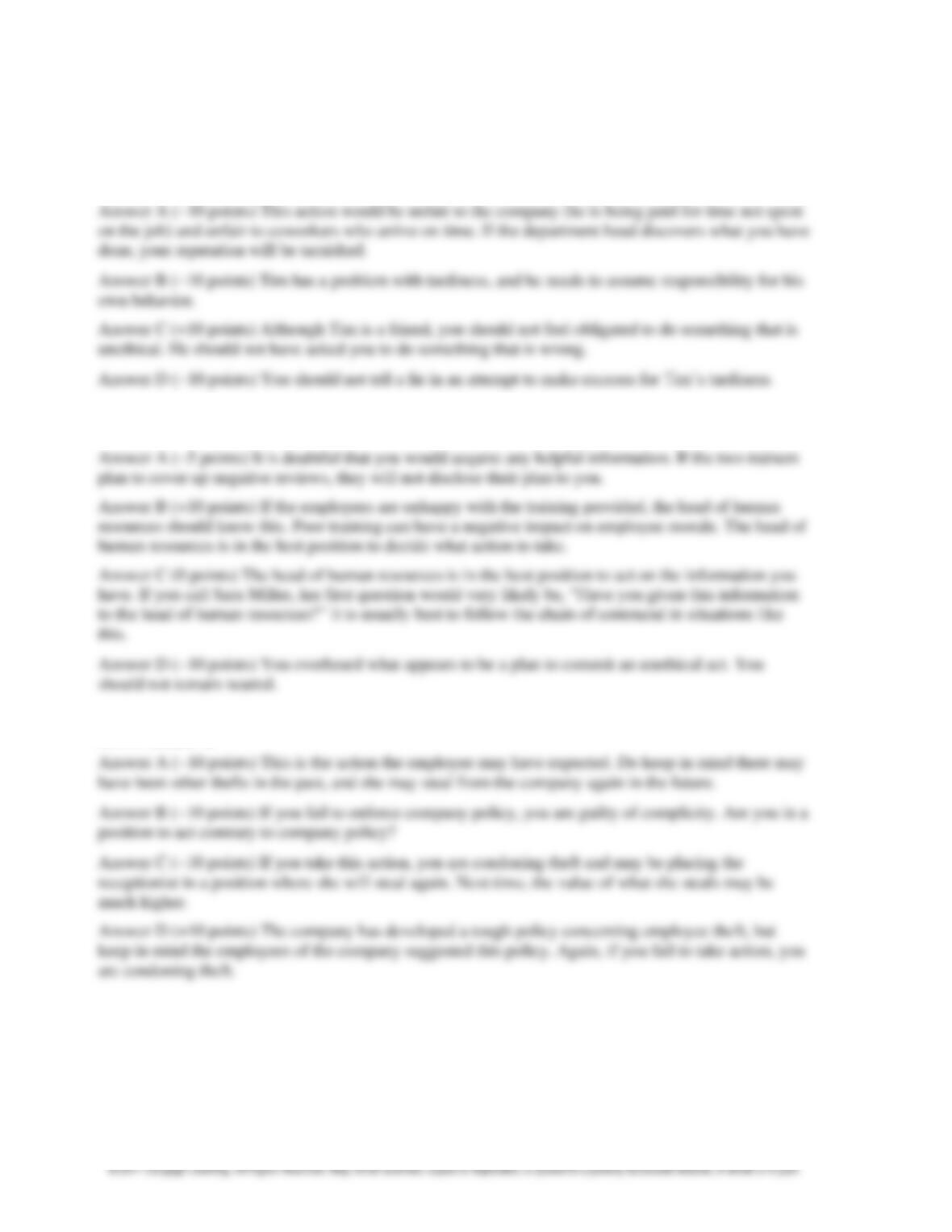
ANSWER KEY: ETHICAL DECISION MAKING
Mini-case 1
Mini-case 2
Mini-case 3

76 Instructional Games
COPING WITH ORGANIZATIONAL POLITICS
Introduction
Many employees complain that they spend a great deal of time and energy trying to cope effectively
with organizational politics. Organizational politics (also described as office politics or corporate
politics) is a collection of activities, good and bad, that can have a major influence on career success.
Organizational politics can destroy or enhance careers and organizations. Coping with Organizational
Politics is an instructional game designed to help students (1) develop greater awareness of
organizational politics and (2) make effective decisions when coping with the politics of an
organization. Participation in the game will provide students with an introduction to several real-life
political situations. It will stimulate in-depth thinking about the consequences of their decisions.
Format
Coping with Organizational Politics includes four mini-cases that introduce various political situations.
Each mini-case poses four solutions. In most cases, one solution will be the best selection from the
options listed. However, other choices may have merit. The answer key provides a point total for each
solution and a solution rationale. This instructional game requires one class period.
Note: It is suggested that you schedule this game after students have read Chapters 1 to 13.
How to Play
Organize the class into teams of 3–4 students, and appoint a group spokesperson. Then give a copy of
the mini-cases to each class member. Working alone, class members should select the best solution for
each mini-case prior to meeting with members of the group. Selection of solutions will require about 5–
7 minutes. Once the students have selected a solution for each mini-case, they should join their team for
a discussion of their choices. Instruct teams to reach a consensus, if possible, regarding the best
solution. Teams should be given 8–10 minutes to discuss the solution options for each mini-case and
the rationale for their choice. After each team has presented support for its choice, post the points
earned for that mini-case. For example:
Team #1
Team #2
Team #3
Team #4
Case #1
A (−5 points)
B (10 points)
B (10 points)
C (5 points)
After all mini-cases have been discussed and the points have been posted, total the points and announce
the winning team. Keep in mind that the most essential ingredient to successful administration of the
game is complete discussion of each political situation.
Note: To provide more time for discussion of each political situation, you may want to instruct students
to select the best solution for each mini-case prior to class. Student material starts on the next page.

Instructional Games 77
ORGANIZATIONAL POLITICS CASES
MINI-CASE 1
You are an employee of a large bank that offers a wide range of financial services. Three months ago
you were assigned to a five-member project team. The team is responsible for creating a plan to attract
new credit card customers and improve service to current credit card holders. At the first meeting, the
members decided not to select a team leader. At first, the team members worked well together, but now
the team is behind schedule, and it has already missed one deadline. A major reason for the delay is the
behavior of Aaron, a team member who recently became moody and temperamental. Aaron is often late
for meetings and becomes angry when team members start the meeting without him. He made
important contributions to the team effort during the first few weeks, but now his contributions are
minimal. He is responsible for completing one section of the plan, but he has not yet turned in the first
draft, which needs to be reviewed by other team members. It’s rumored that he is in the middle of a
messy divorce. Let’s assume that the team members ask you to correct the problem in the best manner
possible. What should you do?
A.
Contact Aaron’s supervisor, describe his behavior, and request that the supervisor
deal with the problem.
B.
Meet privately with Aaron and attempt to get him to open up and discuss personal
problems. Offer appropriate advice as necessary.
C.
Meet privately with Aaron and tell him that if his performance does not improve,
the team will request that he be replaced.
D.
Meet privately with Aaron and focus on behaviors that affect the team’s
performance. If he brings up personal problems, be a good listener, but avoid the
temptation to offer advice.
MINI-CASE 2
Verona Industries will celebrate 100 years of successful operations with a picnic to be held on Saturday
at a lakeside retreat owned by the company. Food and refreshments, including alcoholic drinks, will be
provided at no charge. You have worked for the company for five years and look forward to the
celebration. In terms of alcohol consumption, which of the following guidelines would be most
appropriate?
A.
If you drink alcohol, do so in moderation. Limit yourself to one to two drinks.
B.
Avoid drinking alcohol, and draw attention to the fact that you are sipping soda.
C.
Drink whatever amount you would normally consume if you were at home or
visiting a neighborhood bar.
D.
If you abstain from drinking alcohol on religious grounds or for health reasons,
avoid consuming alcohol, but do not make critical remarks about others’ drinking.

MINI-CASE 3
Throughout the first two years at Good Hope Community Hospital, you enjoyed your work and had no
thoughts of looking for another job. Work in the administration wing was both challenging and
interesting. Then Sidney joined the staff and everything seemed to change. Several weeks after he
joined the staff, you shared with him a cost reduction idea. He has a good understanding of accounting
procedures, and you wanted someone with his skills to critique the proposal. He listened carefully as
you outlined your proposal and said he would give you feedback later. One week later, you attended a
staff meeting and was shocked to hear the department head praising Sidney for his cost reduction
proposal. It became immediately apparent that he had presented your idea but gave you no credit. After
the meeting, you sat in your office and felt growing anger. He had no right to steal your idea! Then you
recalled another time when Sidney did something that caused you frustration. Over lunch, you told him
about a job opening at a competing hospital. One week later, a coworker stopped at your office and
said, “I understand you are planning to quit your job soon. Sidney told me you are leaving.” You
suddenly realize that Sidney, the nice, friendly coworker, is a backstabber. What should you do?
A.
Put your angry response in writing and place the correspondence on his desk where
he will see it when he arrives at work in the morning.
B.
Meet with your department head, and tell her what Sidney has done. Request that
she talk to him about his behavior.
C.
Make it a point to meet with other coworkers in the department, and tell them what
Sidney has done.
D.
Meet with Sidney immediately, and tell him you are upset that he took credit for
your idea. Clearly state that you are not going to put up with such behavior in the
future.

Instructional Games 79
MINI-CASE 4*
Mario felt a sense of despair and frustration as he read the e–mail message from Helen, his boss: “After
talking with several members of the sales force, I have decided we should meet twice a month for
dinner on Friday evenings. No other time seems to suit the schedules of our busy sales force.” The
rationale for meetings was quite convincing. The sales of media services had increased greatly once
members of the sales team began sharing information about the design of effective advertising
campaigns and ways to improve service to clients. Helen was promoted to sales manager two years ago,
and she immediately created a climate where salespeople felt comfortable working as a team rather than
competing against each other. Mario loved his job, but Friday evening was a special time for his family.
After an early meal at a local pizza restaurant, he usually took his wife and children to a sporting event
at the local high school. Most of the other salespeople were young and single, and they might actually
look forward to an informal dinner where business issues could be discussed. As Mario sat staring at
the computer monitor, he remembered something that Helen had said during his job interview: “The
hours will be long, but the compensation will be rewarding.” How should Mario handle this work-
family conflict?
A.
Send an e-mail message to Helen that indicates, in no uncertain terms, that he
cannot attend Friday evening dinner meetings.
B.
Send an e-mail message to Helen indicating that he understands the need for the
meetings, but he will not be able to attend due to family obligations. Request that a
written summary of the discussed information be available to him on Monday.
C.
Meet with Helen and explain the conflicts that the Friday evening meetings will
create. Then, suggest alternatives that might include breakfast meetings, luncheon
meetings, or even other weekday evenings.
D.
Go along with Helen’s meeting schedule, but in the meantime start searching for a
job that will meet his need for work-family balance.
*Based on information from Kirk O. Hanson, “Can a Boss Call Meetings on Friday Evenings?” San
80 Instructional Games
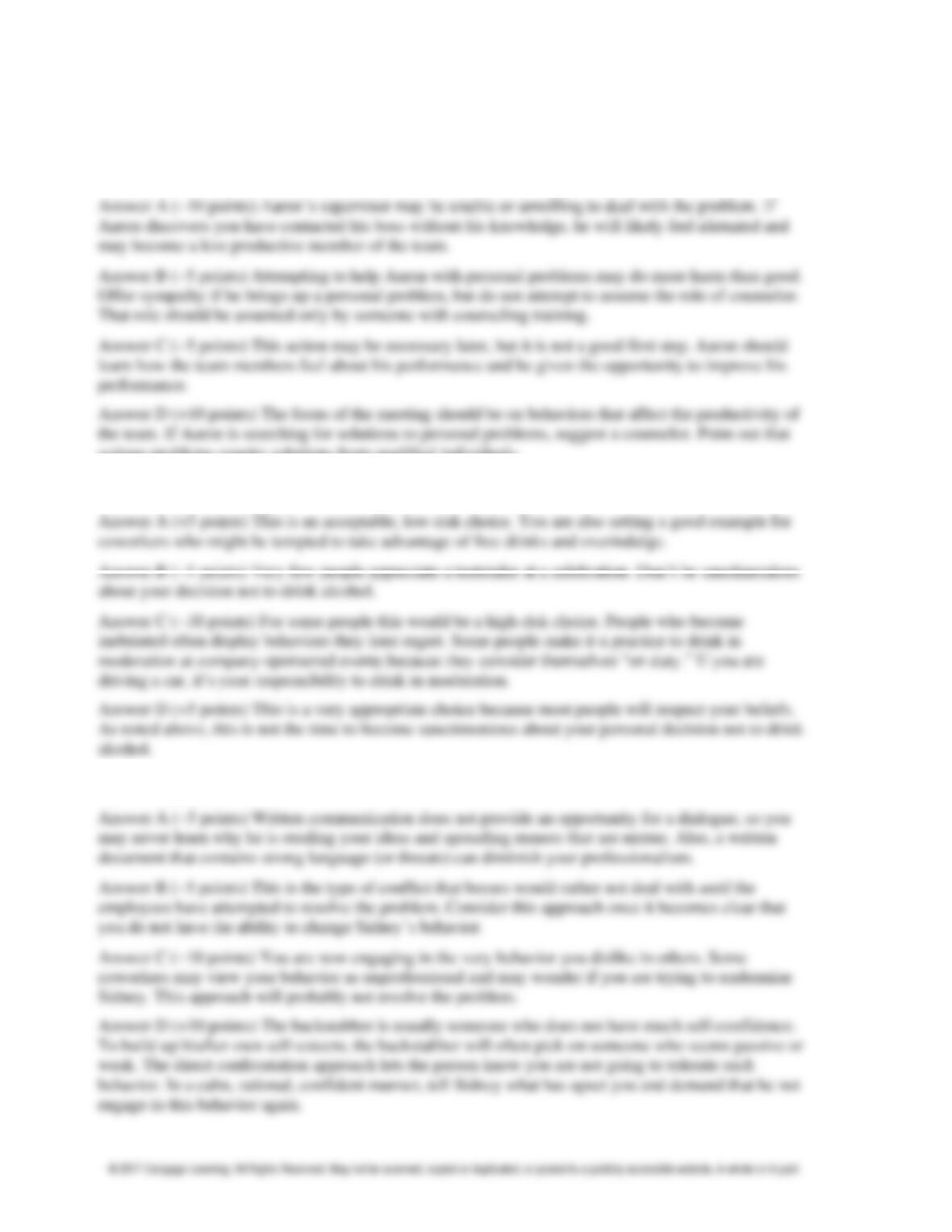
ANSWER KEY: COPING WITH ORGANIZATIONAL POLITICS
Mini-case 1
serious problems require solutions from qualified individuals.
Mini-case 2
Mini-case 3