
CHAPTER 3
Understanding Your Communication Style
CHAPTER PREVIEW
After studying this chapter, students should be able to:
1. Understand the concept of communication style and its effect on interpersonal relations.
2. Discuss the major elements of the communication style model.
3. Identify your preferred communication style.
4. Improve communication with others through style flexing.
PURPOSE AND PERSPECTIVE
Communication-style bias is a common problem and should be viewed as a major barrier to good
human relations. The major objective of this chapter is to help students understand the concept of
communication-style bias and its effect on interpersonal relations. Although the concept of
communication styles has been discussed in the literature since the late 1920s, most students will be
studying this material for the first time. The key to understanding communication-style bias is careful
study of the communication style model. This model is formed by combining two important dimensions
of human behavior: dominance and sociability. The model is divided into four quadrants that represent
the four basic communication styles: emotive, directive, reflective, and supportive. (Dominance is
represented by the horizontal axis and sociability by the vertical axis.) Students will be given the
opportunity to determine their own preferred style.
The final section of this chapter focuses on versatility, which is described as “the third dimension.”
Persons who can create and maintain interpersonal relations with others regardless of their
communication style are displaying versatility. Versatility—acting in ways that earn a social
endorsement—can be achieved through style flexing, which can be described as a deliberate attempt to
change or alter one’s style in order to meet the communication needs of another person.
Note to the Instructor: A WORD OF CAUTION. Some students will find it difficult to identify their
own communication style. This problem arises for two reasons. First, some students simply lack self–
awareness. A student who tends to give advice freely, frequently initiates demands, and is quite
competitive may nonetheless see himself or herself as low in dominance. Second, some students will
avoid checking statements on the dominance and sociability indicators they consider negative or
unflattering. People high in sociability may view the words unstructured and impulsive as negative and
thus avoid using them to describe themselves. Many of us find it difficult to be objective when
assessing ourselves.

Chapter 3: Understanding Your Communication Style 11
PRESENTATION OUTLINE
I. Communication Styles: An Introduction
A. Communication style defined
B. Communication-style bias
C. Personality and your communication style
D. Fundamental concepts supporting communication styles
1. Individual differences exist and are important
2. Individual style differences tend to be stable
3. There are a limited number of styles
4. A communication style is a way of thinking and behaving
5. To create the most productive working relationships, it is necessary to get in sync with
(mirror) the behavior patterns (communication style) of the people you work with
II. The Communication Style Model
A. The dominance continuum
B. Where should you be on the dominance continuum?
C. The sociability continuum
D. Where should you be on the sociability continuum?
E. Four communication styles
1. Emotive style
2. Directive style
3. Reflective style
4. Supportive style
III. Identifying Your Preferred Communication Style
A. Online assessment of your communication style
B. Variation within your communication style
1. Zone 1
2. Zone 2
3. Excess zone
C. Tips on style identification
III. Versatility: The Third Dimension
A. Achieving versatility through style flexing
1. Style flexing at work
B. Strategies for adapting your style
1. Flexing to the emotive style
2. Flexing to the directive style
3. Flexing to the reflective style
4. Flexing to the supportive style
IV. A Word of Caution
A. Strength/weakness paradox
CAREER INSIGHT EXERCISE
This learning activity will familiarize students with the Myers-Briggs personality inventory. They can
discuss the pros and cons of using Myers-Briggs results on name tags.
TRY YOUR HAND EXERCISES
1. Most students probably are familiar with Jimmy Fallon and will be able to place him on the
dominance continuum and the sociability continuum. They will likely agree that he has well-
developed style-flexing skills.

12 Chapter 3: Understanding Your Communication Style
2. Encourage students to use the Internet to find out more about the Myers-Briggs personality types
and the Jungian personality types. Each year 2.5 million Americans complete the Myers-Briggs
Types Indicator (MBTI). Students can complete the MBTI online to increase their self-awareness.
3. This learning activity will give students a better awareness of their communication style.
4. After assessing their communication styles online, students can reflect on situations in which they
have engaged in style flexing.
5. Students can familiarize themselves with communication training programs by visiting the
website of Wilson Learning Worldwide and doing an Internet search for “Inscape Publishing.”
Wilson Learning Worldwide’s program “Building Relationship Versatility: Social Styles at
Work” uses a four-quadrant model to designate individuals as analytical, driver, amiable, or
expressive; teach them to place others within this model; and use style flexing to improve
communication. Inscape Publishing has been incorporated into Everything DiSC (a Wiley
imprint); the DiSC instrument assesses the person’s affinity with each of four styles: dominance,
influence, conscientiousness, and steadiness.
CRITICAL THINKING CHALLENGE
1. This learning exercise will help students develop a better understanding of the dominance
dimension of the communication style model. Students can practice recognizing dominance–
related behaviors and evaluating their influence on interpersonal relations.
2. Similarly, this learning exercise will help students develop a better understanding of the
sociability dimension of the communication style model.
SELF-ASSESSMENT EXERCISE
After completing the assessment, students can select an attitude or skill to be improved upon. They
should then describe the steps required to achieve their improvement goal.
YOU PLAY THE ROLE EXERCISE
This role-play exercise will give students an opportunity to practice style flexing. Prior to the role-play,
students should study chapter material on style flexing and tips for communicating effectively with
someone whose communication style is different from one’s own.
CASE QUESTIONS
BELOW THE SURFACE: The Challenge of Unconscious Bias
1. Mr. Lynch’s reflective communication style is characterized by low dominance and low
sociability, and people who favor this style may be perceived as slow and cautious rather than
driven or ambitious, and as preoccupied rather than engaged with others. Mr. Lynch should
attempt to flex toward the styles of his superiors, who likely favor a directive or emotive style,
when interacting with them. For example, Mr. Lynch should think through meeting agenda items
in advance so he is prepared to express his views decisively, quickly, and logically during the
meeting. He should speak at a somewhat faster pace than he may be accustomed to, and ensure
that his nonverbal cues project confidence, affability, and engagement in the moment. Mr. Lynch
should take care not to appear buried in details, but should demonstrate understanding and
appreciation of large-scale ideas and goals. The best qualities of his reflective style—which have
Chapter 3: Understanding Your Communication Style 13
served him well in customer service—are his good listening skills, his in-depth exploration of
problems, and the care and thoughtfulness he exercises in developing and presenting solutions.
Through style flexing, he can make these good qualities more visible to others and overcome their
misconceptions of him.
2. The risks of “backslapping extrovert” behavior would be those associated with an emotive style in
the excess zone: overly emotional self-expression, outspokenness that may be offensive,
indifference to others’ views, and exaggerated gestures and facial expressions.
CLOSING CASE: Style Flexing
1. Eric needs to be well prepared for this meeting. He should project an image of strength and
confidence. Eric needs to use time efficiently. The pace of his presentation should be fast and
decisive.
2. She should present her views in a quiet, nonthreatening manner and avoid being pushy. She needs
to be a good listener and give relationship building a high priority.
3. Prior to the meeting, Eric should try to obtain information about Ms. Hernandez. Where did she
attend college? What types of jobs has she held? Is she active in any professional organizations?
Is she an active volunteer? What awards has she received? As noted in this chapter, we should not
try to classify a person, but instead classify that person’s strengths and preferences to act one way
or another under certain circumstances.
ADDITIONAL APPLICATION EXERCISES
1. One way to acquire skill in classifying another person’s communication style is to become
thoroughly acquainted with each of the two major dimensions of the communication style model:
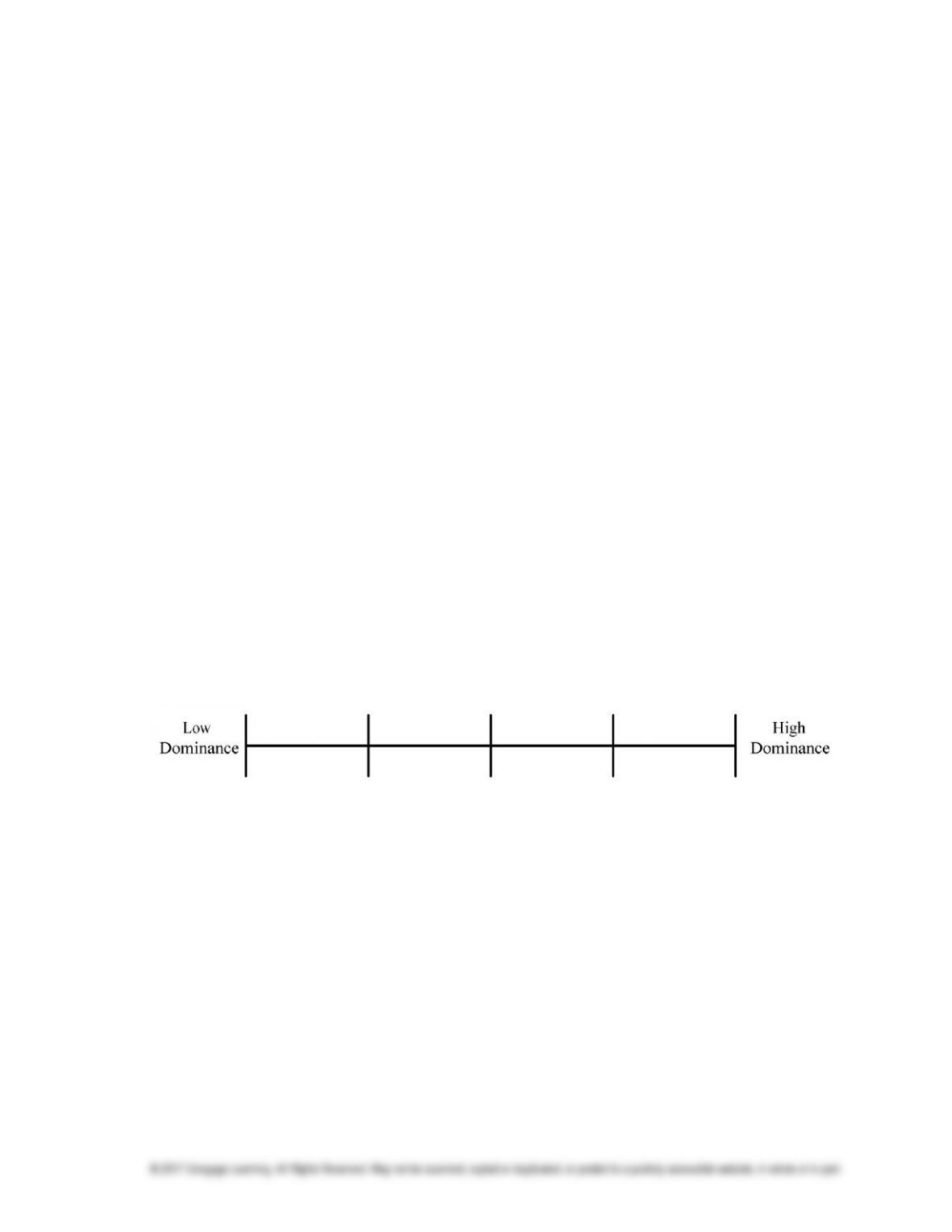
the dominance and sociability continuums. This exercise will focus on the dominance continuum.
Select four people who attend class with you and place them on the dominance continuum that
follows.
Share your observations with another class member who is familiar with the communication style
model and who is also familiar with the people you are attempting to classify. Are the two of you
in agreement?
Note to the Instructor: You may want to divide the class into pairs and instruct each pair to
identify four people for classification purposes. Each person in the dyad should initially work
independently; then the two students should compare their decisions. Circulate through the room
and monitor the work of your students.
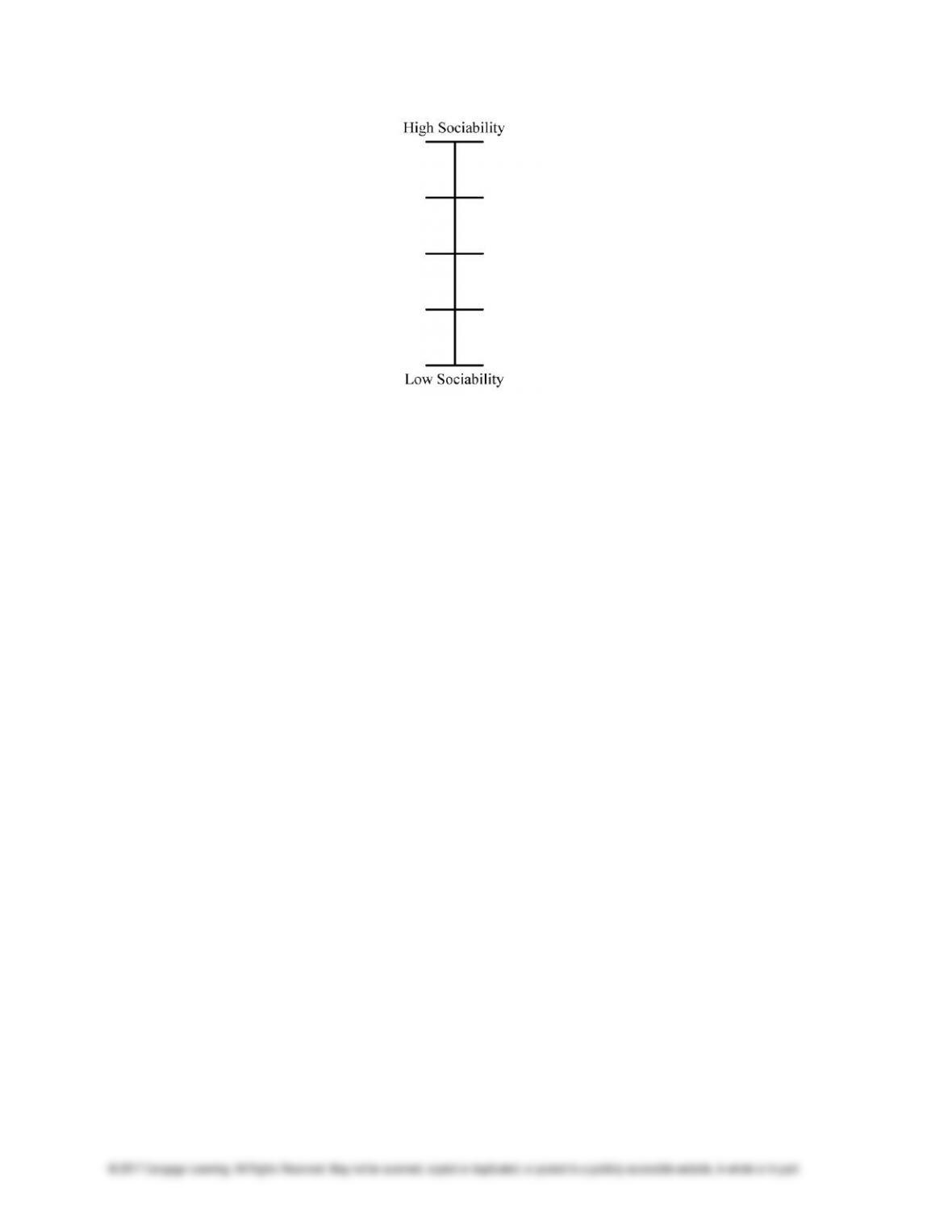
Repeat this process, but this time focus your attention on the sociability dimension. Select four
people who attend class with you and place them on the sociability continuum.
Note to the Instructor: Students are encouraged to gain experience with each continuum before
classifying people according to one of the four communication styles. When students are first
introduced to communication styles, they need to develop confidence in their ability to place
people accurately on each of the two continuums. In real life, the student should mentally place a
new acquaintance on these two continuums before making a decision regarding a specific
communication style.
14 Chapter 3: Understanding Your Communication Style
2. Assume the role of Mary Perkins, who is planning to purchase a small business. You (as Mary
Perkins) are quiet and reflective, and display a supportive communication style. Next week you
will meet with Luther Hodges to discuss a business that is for sale in your community. Mr.
Hodges is classified as having a directive style. To build rapport with Mr. Hodges, what sorts of
words should you use and actions should you display throughout the meeting? Consider both
verbal and nonverbal communication when answering this question.