
CHAPTER 16
The Changing Roles of Men and Women
CHAPTER PREVIEW
After studying this chapter, students should be able to:
1. Describe how the traditional roles of men and women are changing.
2. Understand problems facing women as a result of gender bias in organizations.
3. Understand problems facing men as a result of gender bias in organizations.
4. Discuss challenges and opportunities for working men and women.
5. Explain the forms of sexual harassment and how to cope with gender-biased behavior.
PURPOSE AND PERSPECTIVE
The traditional roles of both sexes are changing in today’s world. Conditioned gender-biased attitudes
and past role models for both men and women are being challenged. New role models and mentors
have encouraged men and women to seek nontraditional options in their lives, examine their values, and
make choices based on those values rather than on traditional expectations. Gender bias in
organizations is no longer a female-only issue. This chapter examines problems facing women in the
work force, including the wage gap between male and female employees and the glass ceiling. It also
examines the problems facing men in the work force, and the challenges that affect both women and
men: achieving a career/family balance, obtaining child care, and coping with or benefiting from
flexible work schedules. The chapter offers an explanation of sexual harassment and how to deal with
it. But it moves beyond these problems and offers support in understanding the different linguistic
styles of men and women and advice on how to flex one’s communication style to overcome gender–
specific language barriers.
PRESENTATION OUTLINE
I. Traditional Roles Are Changing
A. Changes in the role of women
1. Few women at the top
B. Changes in the role of men
C. The burden of job loss
II. Problems Facing Women in Organizations
A. The wage gap
B. The wage gap persists
C. The glass ceiling
D. Hostile work cultures in male-dominated industries
1. Building a better pipeline
E. Women on boards improves company performance
F. Balancing career and family choices
1. The “Mommy Track” and maternal wall bias
Chapter 16: The Changing Roles of Men and Women 61
III. Problems Facing Men in Organizations
A. Men working with women
B. Balancing career and family choices
IV. Challenges and Opportunities for Working Men and Women
A. The challenge of child care
B. Flexible work schedule presents both opportunities and problems
1. Flextime
2. Compressed workweek
3. Paid-time-off (PTO) banks
4. Job sharing
5. Telecommuting and virtual office
V. How to Cope with Gender-Biased Behavior
A. Sexual harassment in the workplace
1. Forms of sexual harassment
B. How to address sexual harassment
1. Clarification of the law
C. Learn to understand and respect gender differences
D. A few words of caution
CAREER INSIGHT EXERCISE
Encourage students to investigate the Entrepreneur IQ test website, SCORE, and other resources for
potential entrepreneurs and then share their discoveries and insights regarding the psychological
profiles of entrepreneurs.
TRY YOUR HAND EXERCISES
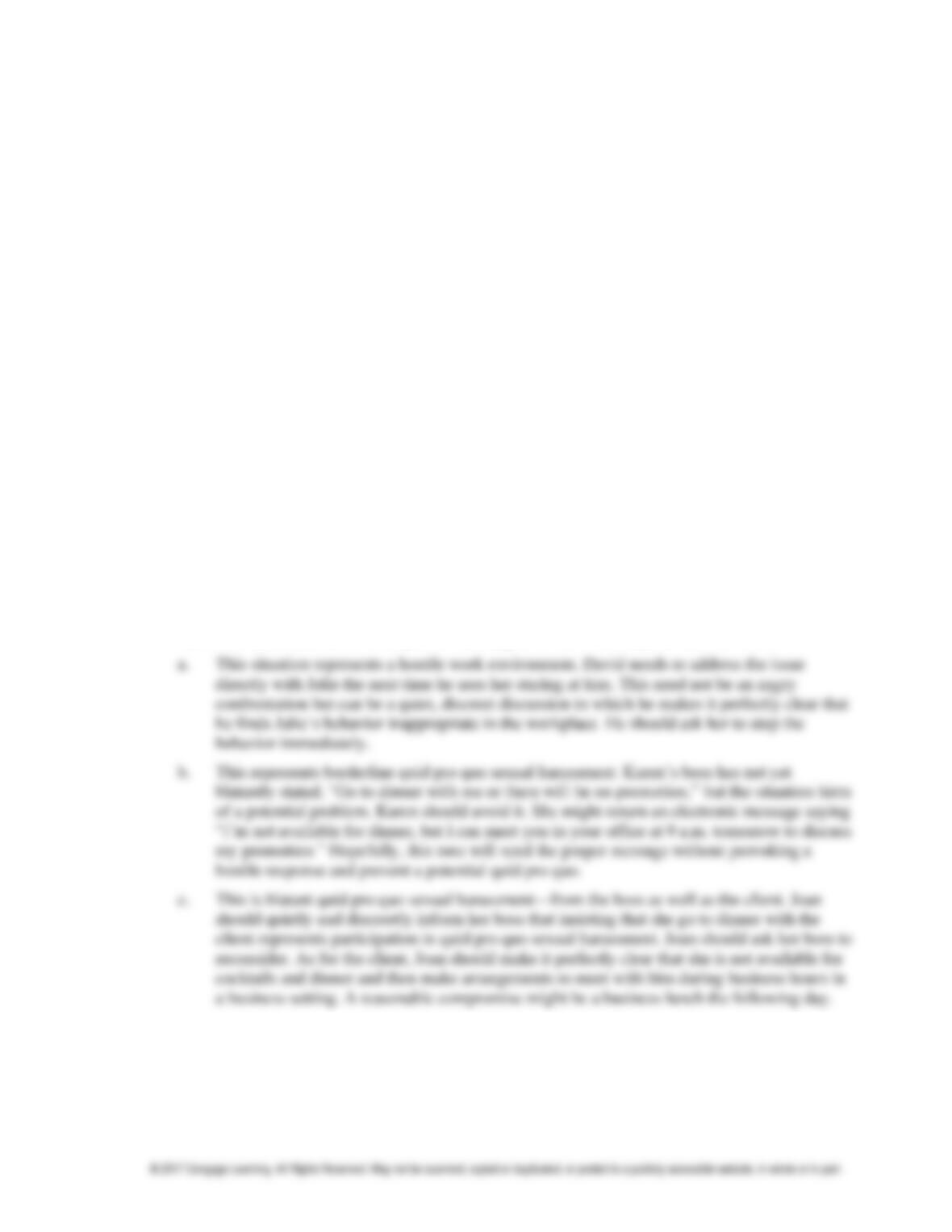
1. Answers may vary. The following are some suggestions for handling these situations.
2. Answers will vary. Encourage students to share their lists with fellow class members to expand
their thinking.
3. Answers will vary. However, it should be very interesting for female students to listen to their
male classmates’ reactions and vice versa.
62 Chapter 16: The Changing Roles of Men and Women
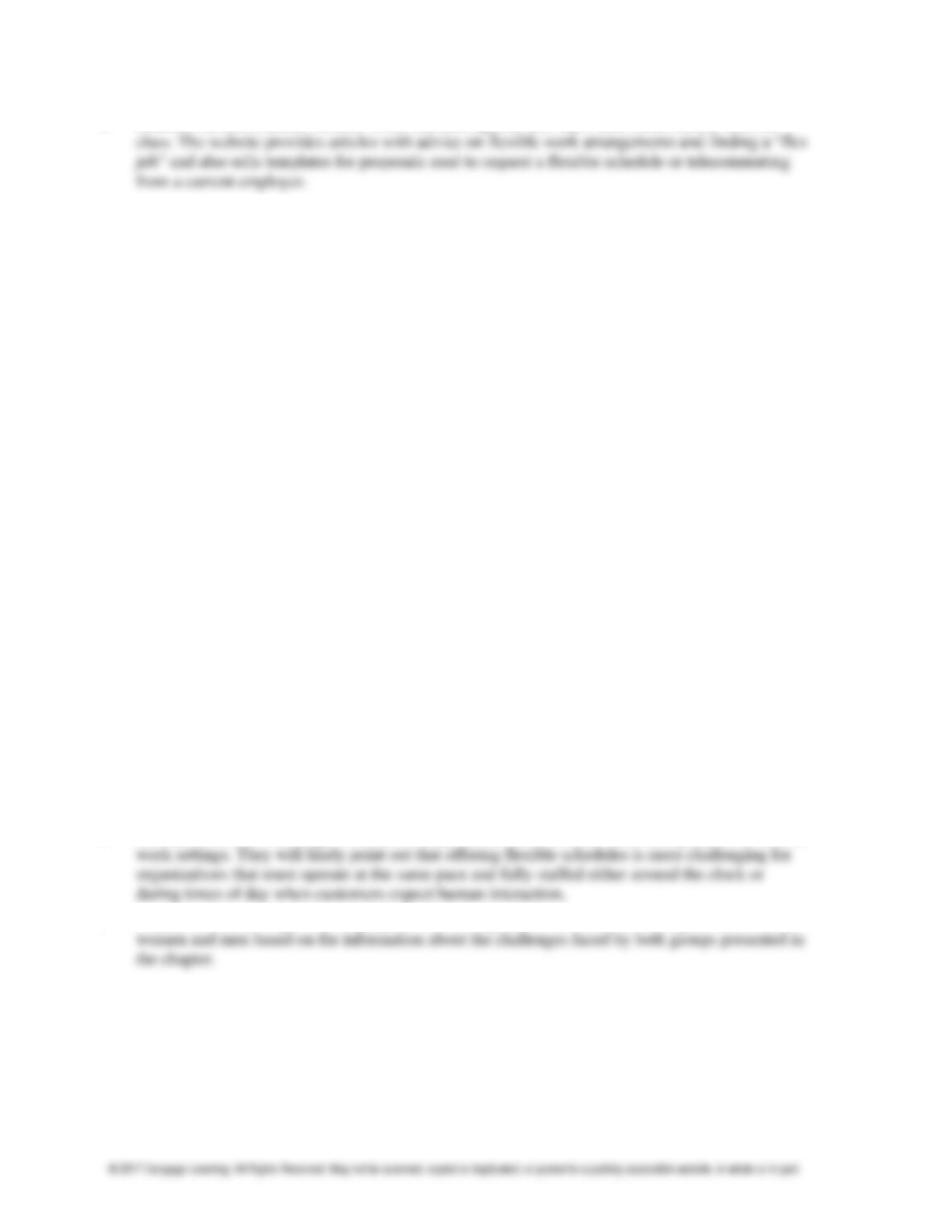
4. Students should examine flexible work-schedule options and share their observations with the
CRITICAL THINKING CHALLENGE
1. Students’ answers will vary. They should utilize the chapter information on changing gender roles
in their analysis.
2. Students’ answers will vary. Given today’s high divorce rate, these questions are very important.
SELF-ASSESSMENT EXERCISE
After answering the assessment questions, students should reflect on their attitudes toward negative
stereotypes and gender differences, and then formulate a written goal and plan for improvement.
YOU PLAY THE ROLE EXERCISE
This role-play can provide a valuable learning experience. Student preparation is very important; allow
time for students to write out their arguments in favor of (or against) a flexible arrangement before
beginning.
CASE QUESTIONS
BELOW THE SURFACE: Helping Women Reach the Top
1. Students should discuss the steps qualified women and organizations might take to increase the
number of women in top executive positions.
2. Students should voice their opinions on whether women are good at networking.
3. Students should debate whether it is realistic to hold senior managers responsible for meeting an
organization’s diversity goals. Refer students to the discussion of effective diversity promotion in
section 15-5 of Chapter 15.
CLOSING CASE: A Saner Workplace
1. This question should encourage students to create innovative flexible work plans.
2. This question will encourage students to study the merits of flexible work arrangements in several
3. Student should offer possible explanations for the appeal of flexible work arrangements for both
ADDITIONAL APPLICATION EXERCISES
1. Interview a female manager, executive, or administrator. Discover whether she experienced the
glass ceiling while establishing her career. How did she cope with it? Does she foresee any such
problems in the future as she continues to pursue her career goals? Talk with a man who has a
traditionally “female” job. What challenges has he had to face from both men and women
colleagues, friends, and family?

Chapter 16: The Changing Roles of Men and Women 63
2. Make a list of self-help books for men who want to pursue a nontraditional role in society. Make
another list of the books available for women who are seeking nontraditional employment.
Note to the Instructor: The more you can expose students to people in nontraditional jobs, the
more students will be able to clarify their feelings concerning this type of transition. We suggest
you bring into the classroom guest speakers (men and women) who are willing to share their
experiences of pursuing and succeeding in nontraditional careers or entrepreneurial activities.
3. Women have made significant gains in a wide range of traditionally male-dominated areas such as
finance, marketing, law, medicine, accounting, and college teaching. Many are now seeking
leadership positions. Search the Internet for leadership tips for women. Briefly summarize your
findings and prepare a report for class discussion.