
Designing Organization Structure •
efficiency and economies of scale, and there may be a lack of technical depth and
specialization.
3. Matrix Approach
a. The matrix can be highly effective in a complex, rapidly changing environment in
which flexibility and adaptability are important. Conflict and frequent meetings
allow new issues to be raised and resolved. The matrix makes efficient use of
human resources because specialists can be transferred from one division to
another.
b. Frustration and confusion arising from the dual chain of command can be a
significant problem, as can high conflict between the two sides of the matrix, and
time lost in meetings. Managers spend a great deal of time coordinating
meetings, taking time away from core work activities.
4. Team Approach
a. The team approach eliminates barriers across departments, increases cooperation
and compromise, and enables the firm to quickly adapt to requests and
environmental changes which speeds up decision making. Another advantage is
better morale and enthusiasm as a result of increased employee involvement.
b. Disadvantages include dual loyalties and conflict, time and resources spent on
meetings, and too much decentralization. Team members can often lose sight of
the big picture of the organization.
5. Virtual Network Approach
a. The biggest advantages are flexibility and competitiveness on a global scale,
drawing on resources and expertise worldwide. The virtual network structure is
the leanest of all because little supervision is required. There may only be two or
three levels of hierarchy, if that many, compared to ten or more in traditional
firms.
b. Lack of hands-on control is a significant disadvantage. Each partner in the
network acts in its own self-interest. Weak and ambiguous boundaries create
higher uncertainty and greater demands on managers for defining shared goals,
coordinating activities, managing relationships, and keeping people focused.
Employee loyalty can weaken and employees may feel concerned that they can be
replaced by contract services.
III. ORGANIZING FOR HORIZONTAL COORDINATION
A. The Need for Coordination Exhibit 7.10
1. As organizations grow and evolve, new positions and departments are added, and
senior managers have to find a way to tie all of these departments together.

Designing Organization Structure •
Coordination refers to the task of collaborating across departments. It is required
whether there is a functional, divisional, or team structure.
2. Coordination problems are amplified in the global arena because units differ not only
by goals and work activities but by distance, time, culture, and language.
Coordination is the outcome of information and cooperation. Managers can design
systems and structures to promote horizontal coordination and collaboration.
B. Task Forces, Teams, and Project Management Exhibit 7.11
1. A task force is a temporary team or committee designed to solve a problem involving
several departments. Task force members represent their departments and share
information that enables coordination. Companies also set up cross-functional teams
for coordination which work with continuing rather than temporary problems that
might exist for several years.
2. A project manager is responsible for coordinating the activities of several
departments for the completion of a specific project. A distinctive feature of a project
manager is that the person is not a member of one of the departments being
coordinated. Project managers need excellent people skills. They use expertise and
persuasion to achieve coordination among various departments.
C. Relational Coordination
1. Relational coordination refers to frequent, timely, problem-solving communication
carried out through employee relationships of shared goals, knowledge, and mutual
respect. It is not based on formal coordination roles or mechanisms.
IV. FACTORS SHAPING STRUCTURE
A. Structure Follows Strategy Exhibit 7.12, Exhibit 7.13
1. Porter’s strategies of differentiation and cost leadership typically require different
structural approaches. A simplified continuum illustrates how structural approaches
are associated with strategic and environmental goals. The terms mechanistic and
organic refer to organizations where efficiency is the goal in a stable environment
and organizations where innovation is the goal in a rapidly-changing environment,
respectively.
2. The pure functional structure is appropriate for achieving internal efficiency goals,
but it does not enable the organization to be flexible or innovative. A horizontal team
structure is appropriate when the primary goal is innovation and flexibility. The firm
can differentiate itself and respond quickly to change.
3. Other forms of structure represent intermediate steps on the firm’s path to efficiency
or innovation. The functional structure with cross-functional teams and project teams
provides greater coordination and flexibility than the pure functional structure. The
divisional structure promotes differentiation because each division can focus on

Designing Organization Structure •
specific products and customers.
B. Structure Fits the Technology
Technology includes the knowledge, tools, techniques, and activities used to transform
organizational inputs into outputs.
1. Woodward’s Manufacturing Technology Exhibit 7.14
a. Small-batch and unit production. Small-batch production firms produce goods
in batches of one or a few products designed to customer specification. Examples
include custom clothing, special-order machine tools, space capsules, satellites,
and submarines.
b. Large-batch and mass production. Mass production technology is distinguished
by standardized production runs in which a large volume of products is produced
and all customers receive identical products. Examples include automobiles,
tobacco products, and textiles.
c. Continuous process production. In continuous process production, the entire
work flow is mechanized in a sophisticated and complex form of production
technology. The process runs continuously and therefore has no starting or
stopping. Examples include chemical plants, distilleries, petroleum refineries,
and nuclear power plants.
2. Service Technology
a. Service organizations include consulting companies, law firms, brokerage houses,
airlines, hotels, advertising companies, amusement parks, and educational
organizations. Service technology also characterizes departments such as legal,
human resources, finance, and market research in large corporations. Service
technology involves:
• Intangible output. Services are perishable and, unlike physical products,
cannot be stored in inventory.
• Direct contact with customers. Employees and customers interact directly to
provide and purchase the service. Production and consumption are
simultaneous. Service firm employees have direct contact with customers.
SUGGESTED ANSWERS TO END–OF-CHAPTER DISCUSSION
QUESTIONS
1. If you wanted to add a group of big data scientists to a large organization such as PepsiCo,
would you centralize the scientists in a central pool at headquarters or decentralize them to
Designing Organization Structure •
separate divisions? Discuss your reasons.
2. How does relational coordination differ from teams and task forces? Do you think relational
coordination seems more valuable for a service technology or a manufacturing technology?
Explain your answer.
Relational coordination refers to frequent, timely, problem-solving communication carried out
through employee relationships of shared goals, knowledge, and mutual respect.
3. An organizational consultant was heard to say, “Some aspect of functional structure appears
in every organization.” Do you agree? Explain.

© 2017 Cengage Learning®. May not be scanned, copied or duplicated, or posted to a publicly accessible website, in whole or in part.
4. Some people argue that the matrix structure should be adopted only as a last resort because
the dual chains of command can create more problems than they solve. Discuss. Do you
agree or disagree? Why?
Many experts would agree that the matrix structure should be adopted only after other structures
5. What is the virtual network approach to structure? Is the use of authority and responsibility
different compared with other forms of departmentalization? Explain.
6. The Hay Group published a report that some managers have personalities suited to
horizontal relationships, such as project management, that achieve results with little formal
authority. Other managers are more suited to operating roles with much formal authority in
a vertical structure. What type of structure—functional, matrix, team, or virtual network—do
you believe your personality would best fit? Which structure would be the most challenging
for you? Give your reasons.
Designing Organization Structure •
© 2017 Cengage Learning®. May not be scanned, copied or duplicated, or posted to a publicly accessible website, in whole or in part.
matrix structure.
7. Describe the primary differences between manufacturing and service technology. How do
these differences influence the type of structure that will be most effective?
Joan Woodward described the following three types of manufacturing technology:
• Small-batch and unit production.
8. Experts say that organizations are becoming increasingly decentralized, with authority,
decision-making responsibility, and accountability being pushed farther down into the
organization. How will this trend affect what will be asked of you as a new manager?
9. The chapter suggested that structure should be designed to fit strategy. Some theorists argue
that strategy should be designed to fit the organization’s structure. With which theory do you
agree? Explain.

© 2017 Cengage Learning®. May not be scanned, copied or duplicated, or posted to a publicly accessible website, in whole or in part.
new, the argument for adapting structure to strategy is stronger. The major point to understand is
that structure and strategy must be compatible, regardless of which comes first.
10. Would you expect the structure of a company such as Facebook, which operates almost
entirely online, to differ from the structure of a bricks-and-mortar company such as AT&T,
which uses the Internet only for some things, such as customer service and business-to–
business transactions? Why or why not?
APPLY YOUR SKILLS: SELF-LEARNING
Organic versus Mechanistic Organization Structure
Students interview an employee at their university, such as a department head or secretary. The
employee will answer questions about his or her job and organizational conditions. Students will
then answer the same set of questions for a job that they have held.
A score of 52 or above suggests that a student or the other respondent is working in an organic
organization. The score reflects a loose, flexible structure that is often associated with uncertain
environments and small-batch or service technology. People working in this structure feel
empowered. Many organizations today are moving in the direction of flexible structures and
empowerment
A score of 26 or below suggests a mechanistic structure. This structure uses traditional control
and functional specialization, which often occurs in a certain environment, a stable organization,
and routine or mass-production technology. People in this structure may feel controlled and
constrained. Students can discuss the pros and cons of organic versus mechanistic structure.
APPLY YOUR SKILLS: GROUP LEARNING
Family Business
In this exercise, students assume the role of consultant to a family business and rank the priority
of departmental functions in order of importance for assigning additional resources to improve
business in the future. Students rank functions individually first, then discuss their individual
rankings in groups and develop a group ranking. Finally, they analyze what they learned about
organizational structure and design from the exercise.
Designing Organization Structure •
APPLY YOUR SKILLS: ETHICAL DILEMMA
A Matter of Delegation
1. Prepare a memo to Golopolus, summarizing the new safety guidelines that affect the
Rockingham product line and requesting his authorization for implementation.
2. Mind your own business. Golopolus hasn’t said anything about the new guidelines, and you
don’t want to overstep your authority. You’ve been unemployed and need this job.
3. Send copies of the reports anonymously to the operations manager, who is Golopolus’s boss.
APPLY YOUR SKILLS: CASE FOR CRITICAL ANALYSIS
Abraham’s Grocery
1. Based on the information available in the case, sketch a picture of the original structure
within an Abraham’s store and the store managers’ relationship with district specialist
managers. What type of structure is this? Explain.
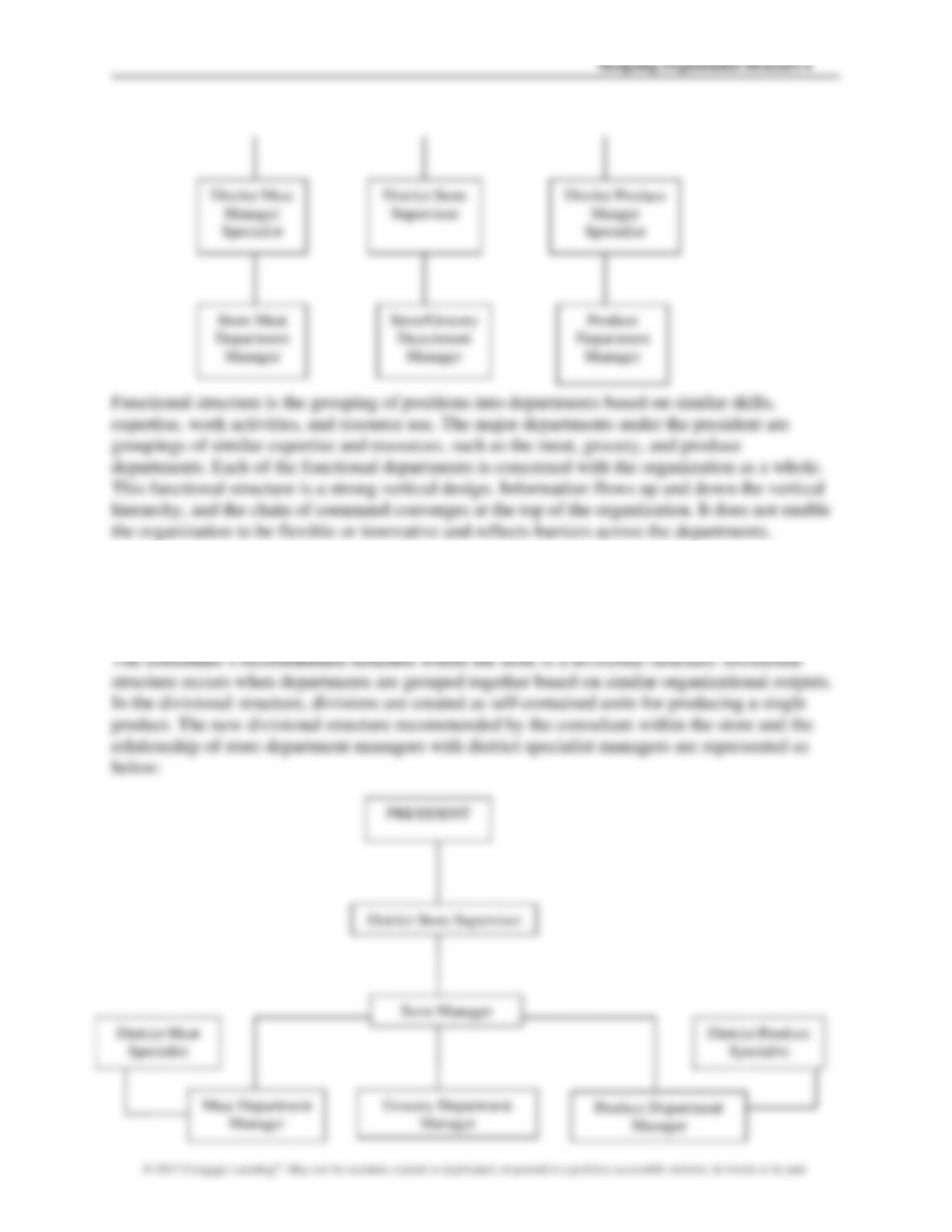
2. Based on the information available in the case, sketch a picture of the consultant’s
recommended structure within the store and the relationship of store department managers
with district specialist managers. What type of structure is this? Explain.
3. What are some of the advantages and disadvantages you see for the two types of structures?
Which structure do you think will work best for Abraham’s? Why?
Advantages of functional structure:
• Grouping employees by common task permits economies of scale and efficient resource
use.
ON THE JOB VIDEO CASE ANSWERS
Honest Tea: Designing Organization Structure
1. What are some of Seth Goldman’s responsibilities as “TeaEO” of Honest Tea? Provide at
least three detailed examples.

2. How does Goldman’s experience as the founder of the company influence his ability to
delegate?
3. Referring to Woodward’s research on manufacturing technology and structure, how would
you categorize Honest Tea’s production? In what ways has this probably influenced the
company’s structure?