
W. L. Gore – Culture of Innovation
1
W.L. Gore
INTRODUCTION
This case spotlights W. L. Gore & Associates, a company that is an outstanding
example of corporate entrepreneurship in action. Founded in 1958, this firm was far
ahead of its time in recognizing the intrinsic value of human capital. Using workforce
knowledge and skills to sustain a competitive strategy based on internal innovation, W.L.
Gore has become a successful modern business, well-known for maintaining a unique
organizational culture which fosters individual potential and creativity.
This case illustrates advanced human resource and strategic management concepts.
The case material describes the guiding principles that go back to the company’s
beginnings and shape W.L. Gore’s culture of innovation, the flat lattice structure that
supplants a typical organizational hierarchy and authority channels, the uniquely-
transformational leadership qualities of the organization, how the firm uses commitments
to define associate responsibilities and work, and the decision-making tools that steer
internal processes. The following questions use the resource-based model of above-
average returns to structure a review and discussion of the extraordinary practices used
by W.L. Gore to achieve success.
• Determine if W.L. Gore’s business formula corresponds with the theories of the
I/O model of above-average returns or the resource-based model of above-average
returns. Explain your response, and outline the steps for the model that best
reflects W.L. Gore’s situation.
• Define W.L. Gore’s tangible and intangible resources, and discuss their value to
the organization. Identify the capabilities and core competencies that support the
company’s competitive advantages.
• Evaluate the firm’s decision-making capabilities. How does W.L. Gore locate
attractive industries and select its strategic approach when pursuing promising
market opportunities?
• Consider W.L. Gore’s competitive strategy. Assess the fitness of the firm’s
organizational structure and controls to help the company achieve its strategic
objectives. Can you identify any problem areas that may develop as the company
faces oncoming competitive forces?
ANALYSIS
• Determine if W.L. Gore’s business formula corresponds with the theories of the I/O
model of above-average returns or the resource-based model of above-average
returns. Explain your response, and outline the steps for the model that best reflects
W.L. Gore’s situation.
The industrial organization (I/O) model of above-average returns emphasizes the
external environment’s dominant influence on a firm’s strategic actions. It suggests that
the industry in which a company chooses to compete has a stronger impact on
W. L. Gore – Culture of Innovation
2
W.L. Gore
performance than the choices and actions made by the company. This model is less
representative of W.L. Gore’s situation than the resource-based model of above-average
returns, which credits the firm’s internal resources and capabilities with high performance.
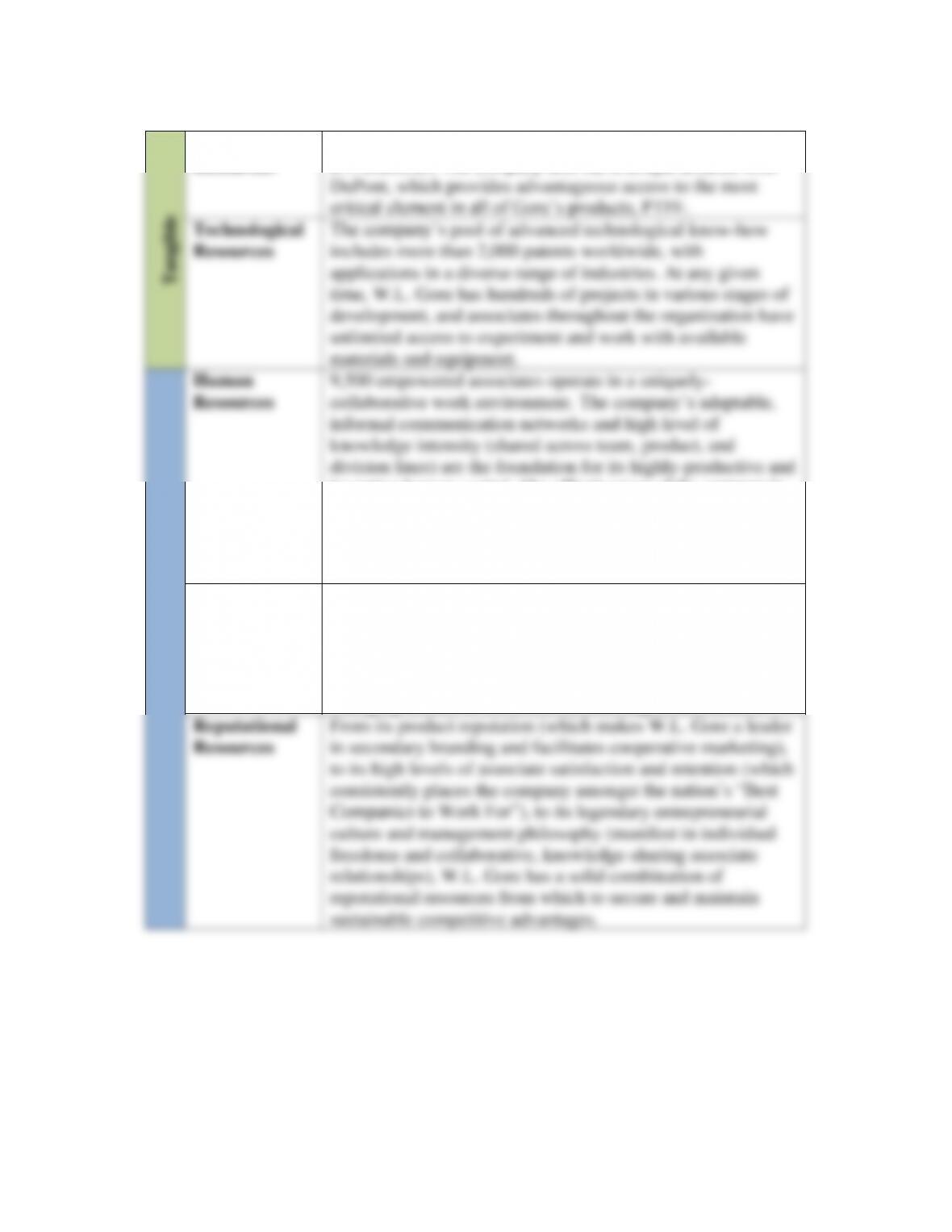
• Define Gore’s tangible and intangible resources, and discuss their value to the
organization. Identify the capabilities and core competencies that support the
company’s competitive advantages.
Tangible
Financial
Resources
With $3 billion in annual sales in 2012 (up 50% since 2007),
W.L. Gore has the financial resources to support deliberate
and continued global growth and a full range of strategic
capabilities.
Organizational
Resources
The value of W.L. Gores’ small, clustered, and integrated
business units is underscored by the firm’s guiding principles,
support functions, informal lattice structure, cross-functional
teams and processes, and its sponsor, leadership, feedback,
product champion, and decision-making systems.
W. L. Gore – Culture of Innovation
W.L. Gore
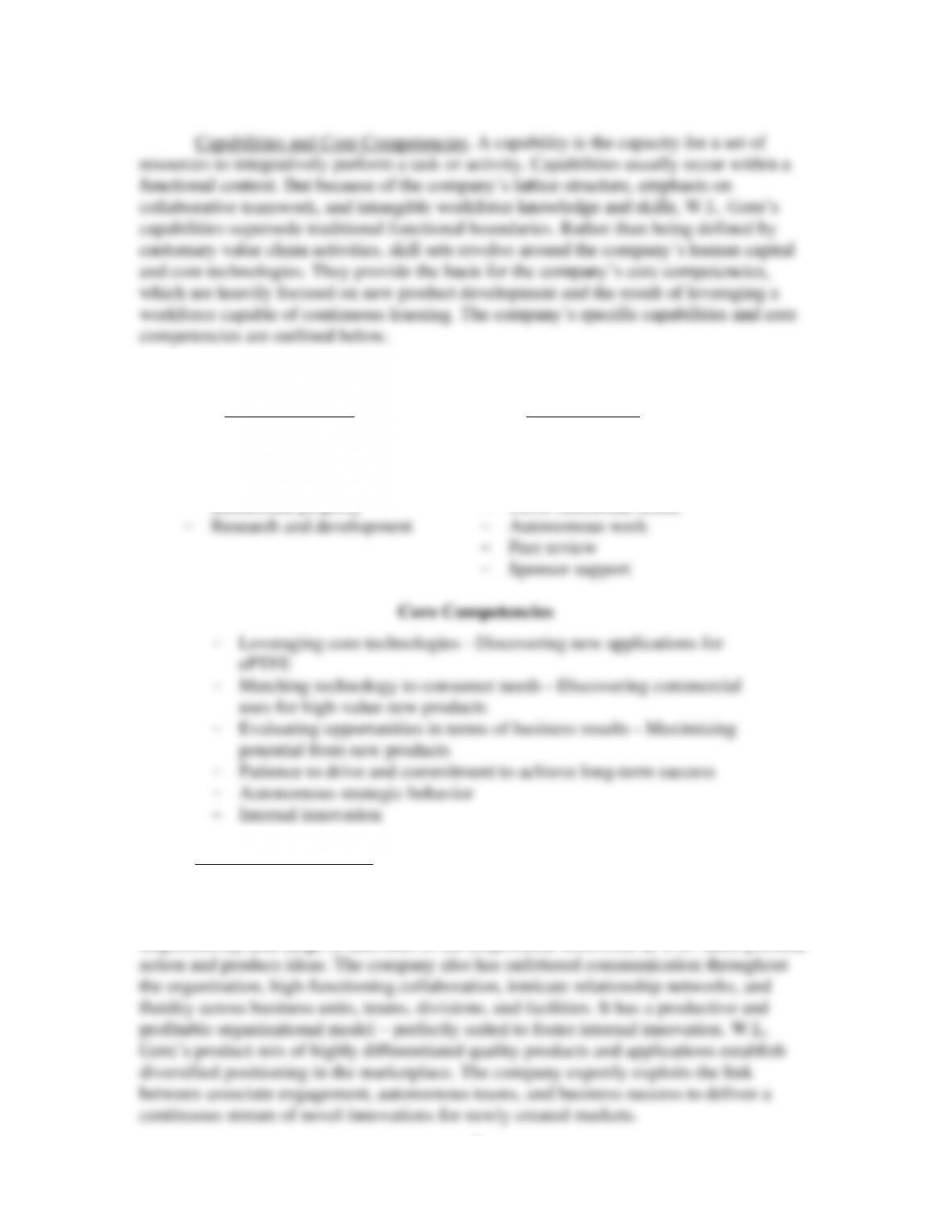
Tangible
Physical
Resources
Gore has 30 offices worldwide and manufacturing operations
in 5 countries. The company also has a unique alliance with
DuPont, which provides advantageous access to the most
critical element in all of Gore’s products, PTFE.
Technological
Resources
The company’s pool of advanced technological know-how
includes more than 2,000 patents worldwide, with
applications in a diverse range of industries. At any given
time, W.L. Gore has hundreds of projects in various stages of
development, and associates throughout the organization have
unlimited access to experiment and work with available
materials and equipment.
Intangible
Human
Resources
9,500 empowered associates operate in a uniquely-
collaborative work environment. The company’s adaptable,
informal communication networks and high level of
knowledge intensity (shared across team, product, and
division lines) are the foundation for its highly-productive and
inventive human capital. The effectiveness of the company’s
motivated workforce stems from flexible, strong, and trusting
relationships and the binding commitment and responsibility
of individuals. Self-awareness fuels independence and enables
associates to set their own limits.
Innovation
Resources
Evidence of W.L. Gore’s capacity to innovate is found in the
company’s resume of high quality, unique, and differentiated
products – which are predominantly the result of organic,
internal innovation. Social capital and dabble time, either self-
driven or “gifted”, are central to idea development and
emerging sources of novel (or breakthrough) innovations.
Reputational
Resources
From its product reputation (which makes W.L. Gore a leader
in secondary branding and facilitates cooperative marketing),
to its high levels of associate satisfaction and retention (which
consistently places the company amongst the nation’s “Best
Companies to Work For”), to its legendary entrepreneurial
culture and management philosophy (manifest in individual
freedoms and collaborative, knowledge-sharing associate
relationships), W.L. Gore has a solid combination of
reputational resources from which to secure and maintain
sustainable competitive advantages.
This case demonstrates how competently-managed human intellect can be
converted into useful innovative products to create value. W.L. Gore operates without job
descriptions or reporting structures, which gives associates freedom from structural
W. L. Gore – Culture of Innovation
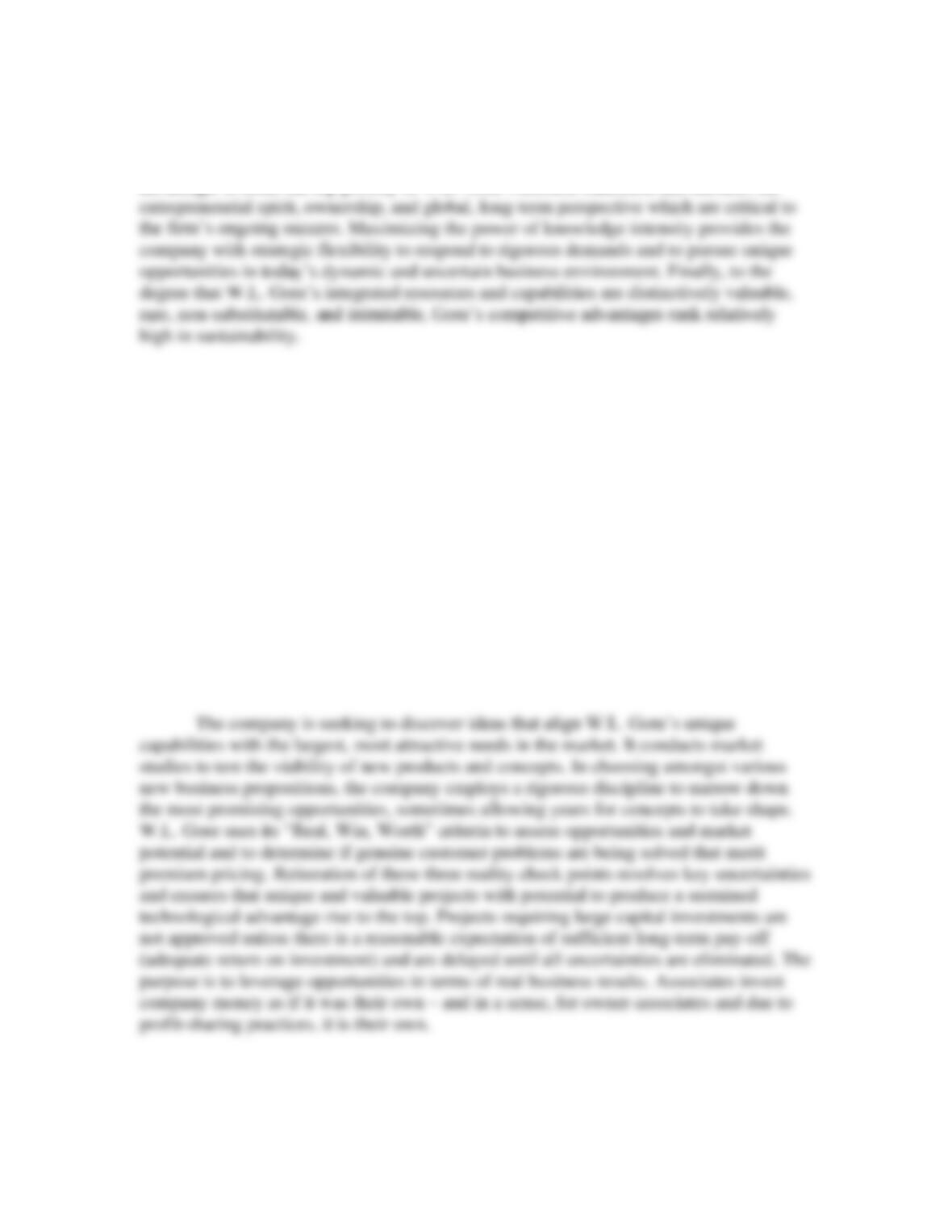
Capabilities
Core Technology
Human Capital
– Functional expertise
– Attracting and retaining top talent
– Technical disciplines
– Setting and meeting commitments
– Rigorous patent protection of
intellectual property
– Project management
– Cross-functional teams
– Research and development
– Autonomous work
– Peer review
– Sponsor support
W. L. Gore – Culture of Innovation
5
W.L. Gore
Finally, the value of the organizational culture based on Bill Gore’s deeply
ingrained management philosophies must be recognized as a strong source of competitive
advantage. It holds the top priority in W.L. Gore’s mission statement and nurtures the
• Evaluate the firm’s decision-making capabilities. How does W.L. Gore locate
attractive industries and select its strategic approach when pursuing promising
market opportunities?
W.L. Gore uses a variety of tools to enhance the quality of decisions made within
the firm. To begin with, the company has low barriers to experimentation and provides
ready access to equipment and materials for development purposes. In addition, it has a
high tolerance for mistakes. These factors contribute to an internal environment that
continuously generates new ideas. The company believes that its fluid problem-solving
teams preclude the bureaucracy that typically interferes with organizational decision-
making. As ideas develop and support emerges, peer reviews serve to check the ongoing
fitness of projects. Through consensus-based decision-making practices, associates solicit
feedback and commitment to projects prior to adoption, which keeps them safely below
the “Waterline”. Consulting with other associates before taking action prevents decisions
that can cause serious damage to the company and facilitates subsequent implementation.
To be attractive to W.L. Gore, an industry must present opportunities that can be
exploited by the firms’ specific set of resources, capabilities, and core competencies. It is
with intense focus on core technology that the company selects the industries within
W. L. Gore – Culture of Innovation
6
W.L. Gore
STRATEGY
• Consider W.L. Gore’s competitive strategy. Assess the fitness of the firm’s
organizational structure and controls to help the company achieve its strategic
objectives. Can you identify any problem areas that may develop as the company
faces oncoming competitive forces?
Organizational Structure. Strategy and structure have a reciprocal relationship.
When aligned properly, strong performance results. A differentiation strategy calls for
decentralized decision-making responsibility and authority. It also needs a structure
through which a strong technological capability can be developed and strategic flexibility
can flourish to enhance competitiveness against rivals. These traits boost the ability to
take advantage of opportunities created by evolving markets. To support creativity and
W. L. Gore – Culture of Innovation
7
W.L. Gore
descriptions, direct reports, or assignments to direct workforce activities. W. L. Gore’s
undefined, complex, and flexible internal working relationships play an important role in
facilitating the integration and teamwork required to implement its innovation-based
strategy.
The company’s collaborative, cross-functional product development teams sustain
powerful new product development processes that tailor unique core competencies to the
needs of the market and easily commercialize new products. Ongoing, face-to-face
communication characterizes how W.L. Gore’s teams function to promote integration for
the purpose of generating new product design ideas. In addition, the company’s focus on
marketing and R&D furthers these efforts.
W.L. Gore’s culture also fosters internal innovation to support the company’s
strategy of continued growth. One of the company’s guiding principles is for associates to
make and keep their own commitments. The combination of freedom (dabble time) and
resources (raw materials) produces viable new products. For innovation to be an effective
growth strategy, continuous diffusion of new knowledge and technological know-how are
required. And the analysis above provides strong evidence of W.L. Gore’s knowledge-
sharing capabilities.
While we can assume that the company monitors ongoing operational
performance, its focus is clearly on “the next big thing”. Confident in its strategy to find
and satisfy high-value markets, the firm is content to spend its resources on the search for
W. L. Gore – Culture of Innovation
8
W.L. Gore
new opportunities. W.L. Gore’s strategic controls are highly focused on learning and
growth and on examining the fit between what the firm might do (as suggested by
opportunities in its external environment) and what it can do (as indicated by its internal
organization in the form of its resources, capabilities, and core competencies).
The rapid diffusion of new technologies in today’s marketplace puts a competitive
premium on quick development and continual introduction of innovative products. Firms
must move quickly to use their knowledge in productive ways. W.L. Gore’s strategy of
deliberate growth through internal innovation is perfectly suited to the perpetual
innovation of new, information-intensive technologies. The company’s culture fosters
idea-generation and evaluation, which leads to the organic invention of new products and
creative extensions of existing product lines. And while patience is one way that W.L.
Gore secures long-term success, it does slow down the process of making decisions on
Continuous product innovation demands that people throughout the firm interpret
and take action based on information that is often ambiguous, incomplete, and uncertain.
Even in the face of constant change and uncertainty, W.L. Gore, like all firms, is tasked
to continuously identify the most attractive strategic opportunities to pursue. The
company has an entrepreneurial mind-set to develop innovations that can exploit
opportunities in the marketplace. But while the company may simultaneously look to the
W. L. Gore – Culture of Innovation
9
W.L. Gore
external social capital networks be expanded to boost the company’s capacity to uncover
new emerging fields or markets?
In addition, should the company be monitoring opportunities with enormous
potential that have been shelved due to lack of passion, product champion, or interest?
W.L. Gore’s strategic flexibility might be enriched by assembling a team that is
responsible for elevating attention to important projects that run the risk of being
neglected or urgent projects that run the risk of missing out in the marketplace.
Additionally, along these lines, the company may want to consider expanding beyond its
PTFE and ePTFE technology to overcome any competitive limitations linked to its focus
on a single core technology.