
Tim Hortons Inc.
1
Tim Hortons
INTRODUCTION
This case examines a Canadian fast food restaurant chain at a point when it is in
the final stages of being acquired by a large investment firm. In the third quarter of 2014,
Tim Hortons Inc. is poised for aggressive geographic expansion, is confronting critical
strategic choices, and faces tough competition, both domestically and internationally.
Based on the potential to generate a variety of ideas and recommendations, this case
analysis provides an excellent opportunity for a lively classroom discussion on the
company’s strategic options.
After a brief introduction, the case opens with data on the restaurant industry and
consumer trends. The history of Tim Hortons’ restaurants is then presented, along with
descriptions of the company’s organizational structure and goals, store locations, menu
items, franchise system, store operations, and financial performance. Comparative
information on the company’s main competitors follows. The case then closes with an
explanation of Tim Hortons’ five-year strategic plan, the impending acquisition by G3
Capital, and other strategic considerations.
In order to evaluate Tim Hortons’ strategic options, a case study should be
completed using internal and external environment analyses to produce a comprehensive
summary of the company’s strengths, weaknesses, opportunities, and threats (SWOT).
With competition intensifying for the Canadian restaurant chain, a thorough competitor
analysis should also be conducted so that appropriate business strategy proposals can be
weighed. Again, due to the complexity of choices and potential input from students’
personal experiences, a variety of strategic recommendations should emerge from the
analysis, and a vigorous classroom discussion should be possible.
• Perform an internal environment analysis of Tim Hortons Inc. Construct a
summary of the company’s strengths and weaknesses. Does the company
maintain any perceived competitive advantages?
• Perform an external environment analysis of the domestic and international
restaurant industries. Construct a summary of the company’s opportunities and
threats.
• Conduct a competitive comparison between Tim Hortons and its biggest
competitors in Canada and the U.S. What are the strategic implications of this
analysis?
• Using the results of your analysis, assess Tim Hortons’ strategic objectives and
five-year strategic plan. Does the analysis reveal any flaws in the company’s
direction? Make recommendations to strengthen the company’s strategy and to
improve its chances of achieving success.
Tim Hortons Inc.
2
Tim Hortons
ANALYSIS
• Perform an internal environment analysis of Tim Hortons Inc. Construct a
summary of the company’s strengths and weaknesses. Does the company maintain
any perceived competitive advantages?
A comprehensive look at Tim Hortons reveals substantial organizational strengths
and some weaknesses within the firm. The company’s internal strengths, weaknesses, and
competitive advantages are outlined and described below.
Strengths
» Franchise Model – 99.5% of Tim Hortons restaurants are franchise-owned, and the
company maintains a close relationship with its franchisees and their communities.
Even with steep fees and stringent terms, there is high demand for Tim Hortons
franchises because of their profit potential. The table below shows that the company’s
franchise revenues are on the rise, up $95 million in 2013 compared to additional
revenues of $40 million from product sales.
% Chg
Net Change
2013
2012
Sales (in 000’s)
1.8%
$40,225
$2,265,884
$2,225,659
Franchise revenues:
Rents & Royalties
5.2%
$40,229
$821,221
$780,992
Franchise Fees
47.9%
$54,575
$168,428
$113,853
Total Revenues
4.3%
$135,029
$3,255,533
$3,120,504
» Customer Convenience – Focus in the quick service category is on convenience for
the customer, and Tim Hortons caters to “on-the-go” consumers.
▪ Hours and Service – Tim Hortons is open 24 hours a day, offering take-out food
and drive-through service in addition to the typical restaurant dining space.
▪ Menu Items – The company’s menu items are fast to prepare and easy to consume.

Tim Hortons Inc.
3
Tim Hortons
▪ “We Fit Anywhere” – The company uses non-traditional locations (such as gas
stations, convenience stores, universities, hospitals, office buildings, and airports)
as well as co-locating with other franchise restaurants to extend its customer reach.
Its alliance with the Canadian Forces operation in Kandahar demonstrates the
company’s commitment to serving its loyal consumers. During the 5 years that
CF troops served in Afghanistan, Tim Hortons established a “temporary” shop
that served 4 million cups of coffee, 3 million donuts and half a million iced
cappuccinos and bagels to over 2.5 million customers from more than 37
countries.
» Menu Specialties – Tim Hortons specializes in coffee, baked goods, breakfasts, and
home-style lunches.
▪ Beverages – In addition to the coffee, Tim Hortons has an expanded offering of
hot and cold beverages, which includes teas, lattes, cappuccinos, iced teas and
coffees, smoothies, and iced lemonades.
▪ Breakfast Items – Beyond donuts and pastries, Tim Hortons serves oatmeal and
breakfast sandwiches on biscuits, bagels, and English muffins. Wildly popular,
the company holds 57% of the hot breakfast sandwich market in Canada.
Canada
U.S.
Gulf
Europe
Total
Stores
3,588
859
38
61
4,546
% of total
78.9%
18.9%
0.8%
1.3%
100.0%

Tim Hortons Inc.
4
Tim Hortons
▪ Tim Hortons Coffee Partnership – Assistance and connections with farmers in
Brazil, Guatemala, Honduras, and Columbia strengthen the company’s supply of
quality ingredients and build its social capital.
▪ Distribution Efficiencies – The company’s extensive offering of baked goods is
produced centrally, and corporate-owned trucks deliver frozen product and
supplies to dispersed store locations across Canada and the United States. This
highly sophisticated operation of 3 manufacturing facilities, 6 warehouse
distribution centers, and 1 warehouse services Tim Hortons’ North American
restaurants.
ratio is improving. Also, franchise fees are up 48% (see table on page 2).
Impressively, the company’s net income after taxes is currently 18.9%, which
compares to an industry average of 3-6%.
Canada
U.S.
Comparison
Percentage
Can. to U.S.
Tim
Hortons
Number of Employees (in millions)
1.1
13.5
8.15%
0.1
Number of Restaurants
81,000
900,000
9.00%
4,546
Revenue Dollars (in billions)
$ 57.5
$ 683.40
8.41%
$ 3.3
Revenues per Restaurant
$ 709,877
$ 759,333
93.49%
$ 725,913
Employees per Restaurant
14
15
90.53%
22
Growth Rate
4.7%
3.6%
130.56%
4.7%
Tim Hortons Inc.
5
Tim Hortons
» Product Innovation – Tim Hortons focuses on continuous development of menu
choices to meet evolving consumer tastes and preferences. The company invests in
product innovation to keep the menu fresh and responsive to food trends.
Weaknesses
» Iconic Canadian Brand – Tim Hortons’ brand and products are little known outside
of Canada’s borders.
» Quick Service Market Position – Tim Hortons operates in a sector with the lowest
average bills of all restaurant categories. This makes it more difficult to increase
revenues and positively impact same-store sales growth.
» International Merger – After merging with Wendy’s International in 2006, the
combined company separated just 3 years later, when TLD Group, Ltd. repatriated
itself to Canada. This raises concerns about the company’s impending acquisition by
G3 Capital.
» Financial Issues – Tim Hortons has strong financial performance, yet its records do
indicate some problem areas.
▪ Debt Exposure – Tim Hortons’ current ratio is 1.0, and its quick ratio is 0.4.
These liquidity ratios indicate a weakness in the firm’s ability to meet its current
financial needs, particularly its short-term obligations, without relying on period
sales. The company’s debt-to-equity ratio is 132.9%, which signifies that leverage
depends more on borrowed funds than shareholder contributions. In addition,
Tim Hortons Inc.
6
Tim Hortons
▪ Earnings per Share – EPS are also below target levels, which means that corporate
market stakeholder expectations are not being met.
▪ Employees per Store – Referring to the table on page 4, Tim Hortons’ restaurant
operations require more employees per store than the industry average – in both
Canada (by 62%) and the U.S. (by 47%). This is an indicator of operating
inefficiencies and is perhaps partially due to stores remaining open 24 hours per
Competitive Advantages
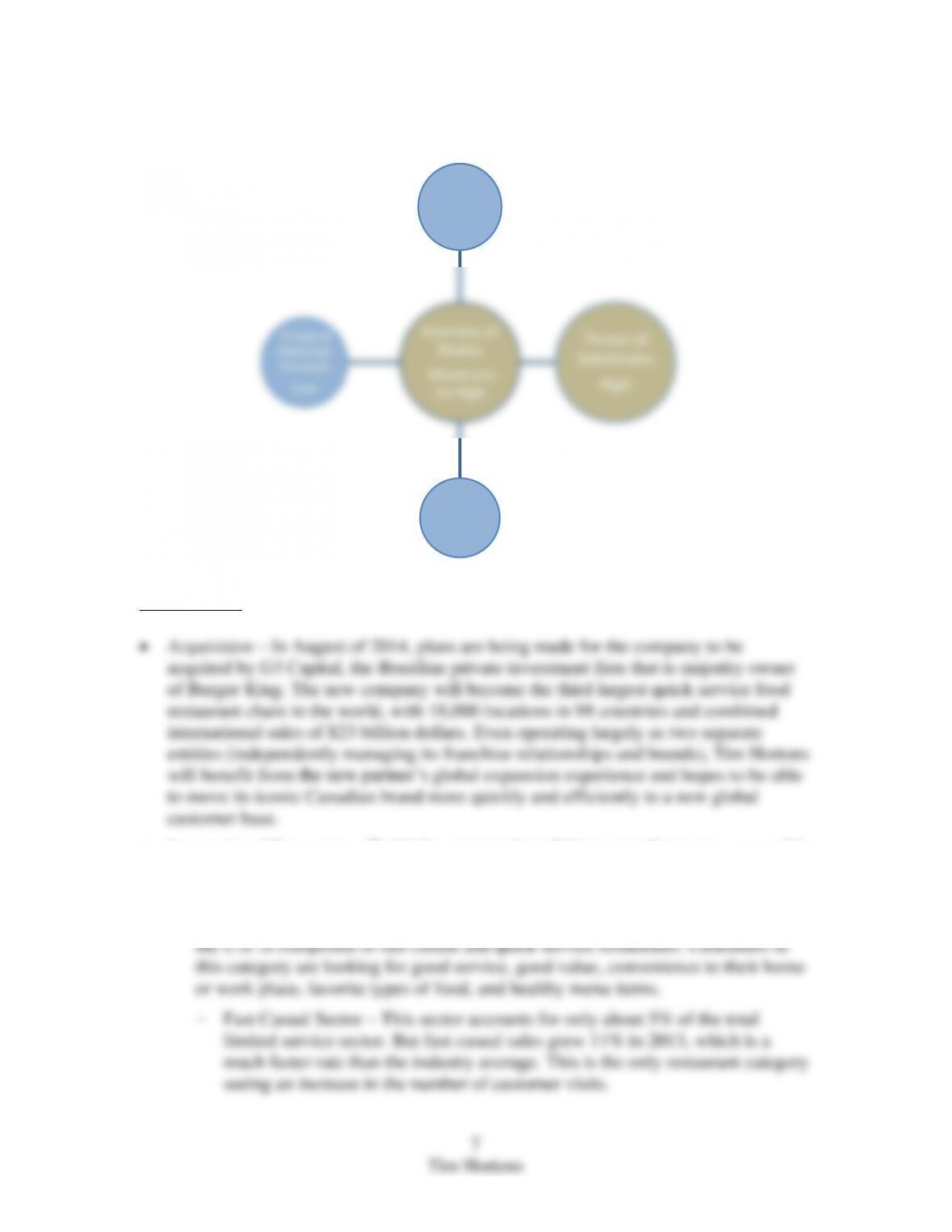
• Perform an external environment analysis of the domestic and international
restaurant industries. Construct a summary of the company’s opportunities and
threats.
Tim Hortons Inc.
Opportunities
• International Expansion – To hit the company’s ambitious growth targets, successful
expansion in foreign markets is essential.
▪ United States – Tim Hortons’ entry into the U.S. market is considered a “must–
win” battle by the company’s top management team. The limited service sector in
limited service sector. But fast casual sales grew 11% in 2013, which is a
much faster rate than the industry average. This is the only restaurant category
seeing an increase in the number of customer visits.
Intensity of
Rivalry
Moderate
to High
Supplier
Power
Low
Threat of
Substitutes
High
Buyer
Power
Low
Threat of
Potential
Entrants
Low
Tim Hortons Inc.
8
Tim Hortons
– Quick Service Sector – This sector is also growing faster than the industry
average.
▪ Emerging Economies – Growth rates in emerging economies make these
developing markets an appealing target for firms trying to expand their
international presence. As home base of acquirer G3 Capital and the location of
the coffee farms Tim Hortons sources from, South America might be a logical
• Domestic Expansion – In 2013, commercial food revenues grew by 4.7% in Canada,
1.1% faster than in the U.S. Restaurant growth can occur through an increase in the
average bill amount and/or an increase in foot traffic. Foot traffic is considered a
better indicator of a successful strategy. But as food prices continue to rise, there is a
reasonable expectation that increased bills can also contribute to increased sales.
• New Product Development – To achieve Tim Hortons’ ambitious performance targets,
product and menu innovation is a priority. It helps the company anticipate or respond
to evolving consumer tastes, and it enables the differentiation of product offerings.
• Industry Trends – Several favorable industry conditions align with Tim Hortons’
restaurant business model and create marketplace opportunities for the company.
Tim Hortons Inc.
9
Tim Hortons
▪ Technological Developments – Mobile and digital technologies offer new ways to
engage and attract consumers. Nearly all consumers are connected through their
mobile devices, which presents the company with new payment options, tools to
reward customers, and opportunities to enhance service levels.
Threats
• Acquisition – G3 Capital will become 51% owner of Tim Hortons in the proposed
$12.5 billion merger. Even operating largely as two separate entities, the new owner
will have strategic objectives that the company will need to fulfill, along with an
expectation of shareholder returns. Based on previous merger difficulties with
Wendy’s, the success of this acquisition is not guaranteed.
• Market Saturation – Some analysts believe that Tim Hortons has saturated its home
market in Canada. Meanwhile, all of its competitors are also seeking ways to expand
in their home and foreign markets.
Tim Hortons Inc.
10
Tim Hortons
▪ Number of Visits – This industry indicator of restaurant traffic is stagnant, and
experts estimate less than 1% growth for the next few years.
• Conduct a competitive comparison between Tim Hortons and its biggest
competitors in Canada and the U.S. What are the strategic implications of this
analysis?
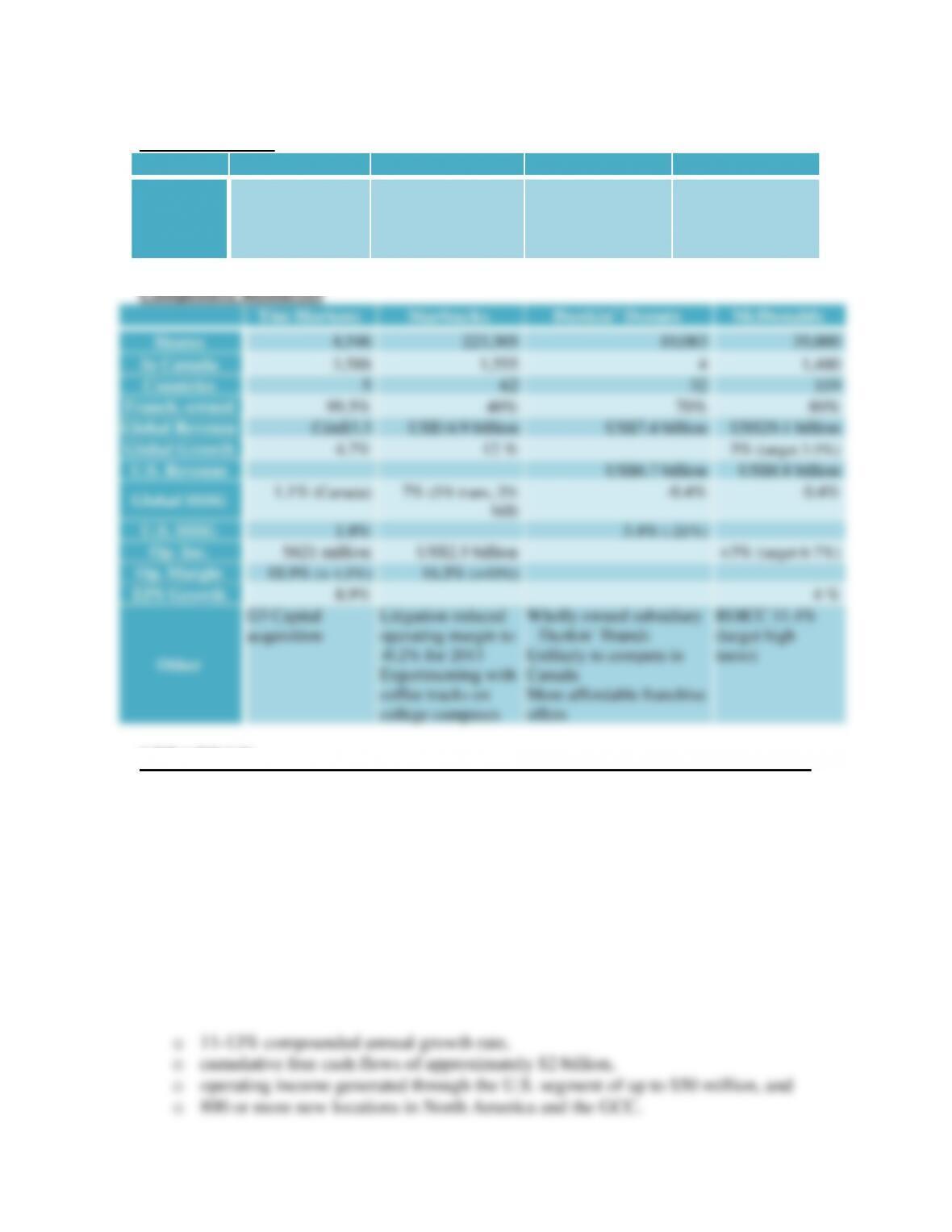
Menu Variations
Tim Hortons
Starbucks
Dunkin’ Donuts
McDonalds
Coffee
Quality
“Best–in–class” –
premium and
dark roast blends
Bolder tastes
Customizable
> 30 blends/flavors
Roasting facility
Fewer blends
High quality and
flavor
McCafe
Espresso-based
beverages
Less customizable
Baked
Goods
Centralized
production
Large variety
Pastries, fresh and
packaged
52 varieties of
donuts
Other baked goods
Beverages
Variety and
choice
Customizable
blended beverages
Ready–made drinks
Hot and cold
beverage
alternatives
Fountain soda,
shakes, fruit-based
smoothies
Breakfast
Breakfast
sandwiches –
57% Can. share
Oatmeal, yogurt,
fruit, and
sandwiches
Breakfast
sandwiches
Egg-based
sandwiches – 29%
U.S. share
Small
Meal
Soups, chili,
sandwiches,
crispy chicken
Fresh salads and
sandwiches
Healthy options
Chicken salad
sandwiches with
sides and combos
Distinct meal
options – burgers,
fries, salads, wraps
Snack
Pastries and
baked goods
Pastries, fruit, and
small pkg. snacks
All day donuts and
breakfast items
Ice cream based
desserts
Price
Lowest costs
Highest prices
Medium point
Low price point
Tim Hortons Inc.
Menu Variations cont.
Stores
Tim Hortons
Starbucks
Dunkin’ Donuts
McDonalds
Other
S. Am. coffee
partnership
C.A.F.E., ethical
sourcing, environ.
stewardship, corp.
responsibility
Loyal customers
Aggressive U.S.
and international
expansion plans
Menu innovation
Value platform
Leading quick
service retailer
Tim Hortons Inc.
Tim Hortons
While the company has revenue growth that exceeds the industry average, the
analysis shows that most of this growth is generated through franchise rent, royalties, and
fees. And while Tim Hortons’ profit margins are strong, it is not achieving the levels of
profitable same-store sales growth that is desired. This also follows for EPS growth. The
In Tim Hortons’ “Winning in the New Era” Strategic Plan for 2014-2018, the
company envisions a rejuvenated Canadian business that is the growth engine for the
period. The aim is to have a profitable U.S. business that is ready to be aggressively
scaled by 2018. The firm plans to build on its established, growing international presence
and to create above-market-average total shareholder returns. Tim Hortons’ plans are
based on four core ideas, which are outlined in the tables below. Using the strategic
analysis performed above, strategic fit with the environment is assessed. Then, discussion
and recommendations follow for each of the core points in the strategic plan.
Same-Store Sales
Strategy Components
Strategic Fit
Day category
segments
Hot and cold beverage
category
Snacks between meals
Capability, but potential for
segment growth is unknown
Strength matched with
opportunity
Marketing
Branding
New advertising/marketing
campaigns
Strength to overcome stagnant
conditions (threat)
Strength matched with new
opportunities to use
technological tools
Product innovation
Differentiation in U.S.
Strength matched with
opportunity
Tim Hortons’ same-store sales growth is underperforming. Because average bills
in the quick service segment are low, an increase in SSSG figures must come from an
increase in restaurant traffic. To be the fuel for the company’s expansion, it is critical to
overcome stagnant traffic trends. As the table above confirms, targeting same-store sales
Tim Hortons Inc.
Targeting snacks between meals is one of the strongest growing segment
opportunities matched with Tim Hortons’ core competencies and ability to cater to “on–
the-go” customers. The development of new menu items in this category, coordinated
with marketing, has the greatest potential to draw customers into existing stores. With the
company’s centralized production and distribution system, local sourcing is not a strong
option. However, the introduction of natural ingredients, healthy and nutritional menu
items, gluten-free pastry options, and trending ethnic flavor profiles fits with the growing
consumer demand for these types of products. Prepared and frozen “bites” fits with the
distribution system as well as the growing snack segment. As the company makes its new
menu selections, it will be important to consider the following factors:
The key is to innovate, differentiate, and create value and to compete on speed,
price, and convenience variables. Product differentiation is particularly important for U.S.
expansion, as it increases the company’s prospects of pulling competitors’ customers into
Tim Hortons’ stores. The ability to aggressively grow in the U.S. depends upon the
company’s ability to generate enthusiasm for the brand.
Brand management and marketing are crucial elements to the strategy. The
company has enormous opportunities to employ new technologies to effectively market.
Tim Hortons Inc.
14
Tim Hortons
cont.
New/Existing Markets
Strategy Components
Strategic Fit
Brand
Strength in domestic market to
overcome global weaknesses and
pursue international opportunities
Tim Hortons’ strategy to broaden its international presence and establish a
profitable U.S. business that can support a scaled launch by 2018 require a thoughtful
Broaching the U.S. marketplace, the following factors should be considered when
deciding how to move forward:
o How can the brand be shaped to facilitate success in new markets?
o Does brand awareness precede or coincide with new locations?
o How can Tim Hortons’ name recognition along the U.S. border be
Recall that in addition to good service, good value, favorite food types, and
healthy menu items, quick service customers are looking for convenience to their home
or work place. One of the most promising approaches for Tim Hortons to consider is the
use of alternative store formats, many with which the company already has experience.
[Note: even though alternative store formats are outside of the company’s successful
Tim Hortons Inc.
15
Tim Hortons
with powerful entrenched rivals? Younger customers, like college students, are an ideal
demographic due to their snacking trends, sensitivity to price points, and potential for
life-time loyalty. Thus, finding the “nooks” where this demographic can be serviced is a
promising approach. And again, this is a distinctively different way to meet the needs of
“on-the-go” customers than the fast-casual methods of some competitors. This is
particularly important because the U.S. market has more competition and much more
fragmentation than Canada’s. A precision micro-market strategy may be the way to
discover unoccupied space under the immediate radar of competitors.
In addition to the U.S., Tim Hortons has existing plans to aggressively expand in
the GCC during the plan period. This follows the logic of expanding in markets where
some inroads have already been made. However, in consideration of other international
opportunities beyond Canada, the U.S., and the GCC, it is important for the company to
conduct further global analysis to understand regional growth rates and market
distinctions. Then, its strategy can be defined. It is probably most fitting to select a
transnational international strategy that pursues both global efficiencies and local
responsiveness. However, decentralized decision making based on the needs of individual
markets weighs more heavily, so the multidomestic features of the international strategy
should take precedence over achieving global efficiencies. (This is consistent with Tim
Hortons’ different brand presences in each of its three existing jurisdictions – Canada, the
U.S., and the GCC.) Finally, the firm should select international markets based on
pursuing the most promising opportunities that best fit with the company’s strategy and
core competencies. Additional considerations, derived from the analysis above, include
conditions in Europe and opportunities in emerging nations.
Tim Hortons Inc.
16
Tim Hortons
on potential opportunities to expand in South American markets, beginning with
Brazil.
Growth in New Ways
Strategy Components
Strategic Fit
Standard restaurant design
Capacity
Throughput
Corporate resources to match
market opportunities
Equipment
Menu items
The redesign of restaurant space to maximize capacity and throughput is
consistent with the goal of enhancing convenience for “on-the-go” customers discussed
above. New store design also supports the flow of increased traffic required to grow
same-store sales. Interior and exterior elements should be designed in ways that reinforce
Core Competencies
Strategy Components
Strategic Fit
Business strengths
Vertical Integration
Supply Chain
Capabilities and opportunities are
uncertain.
Strengths exist, but specific
opportunities are unknown and
ability to apply beyond current
operations is uncertain
Tim Hortons Inc.
17
Tim Hortons
cont.
Core Competencies
Strategy Components
Strategic Fit
Franchise system
Strength not certain to match
conditions in international markets
The success of the company and brand is currently linked to its franchise system.
(As discussed above, all but a few of Tim Hortons’ restaurant sites are franchise-owned.)
However, the strength of the company’s franchise system may not succeed in markets
where its value is not perceived or where the market is saturated with well-known fast
food restaurants. Therefore, newer store formats and cooperative arrangements should be
given strong consideration, especially to facilitate flexibility and quick movement into
new convenient locations. This may become a key to successful international expansion
as it also provides valuable knowledge of new market conditions and enhances
performance.