
Starbucks Corporation: The New S-Curve
1
Starbucks
INTRODUCTION
Starbucks Corporation is a model of extraordinary business success. Known for
sourcing, roasting, and serving high quality coffee and for elevating and romanticizing
the consumer’s experience, Starbucks’ rapid growth seemed unstoppable – at least until
its store expansion strategy became unsustainable and imploded in financial crisis. This
case describes the diversified, multichannel, and multibrand business model that the
company implemented at the end of fiscal year 2010, after the crisis and a “painful, three–
year transformation”.
Following a brief introduction, the case immediately delves into new products and
categories that are defining a new era at Starbucks. It then steers back to the core coffee
business and renewed development, improvement, and global expansion initiatives.
Channel development is featured; then the case concludes with a discussion of leadership,
culture, employee engagement, and community service.
The purpose of the analysis is to evaluate the company’s diverse and growing
business portfolio and the strength of Starbucks’ new strategy. Follow the steps below to
conduct the analysis and to identify the advantages and disadvantages of the firm’s
strategic direction.
• Define and discuss the company’s corporate-level strategy. What are the benefits
and/or shortcomings of Starbucks’ diversified portfolio?
• Compare and evaluate the company’s product development strategies. What are
the advantages and disadvantages of each?
• Review the scope and performance of Starbucks’ international businesses. What
type of international strategy do you recommend for the company?
• Discuss Starbucks’ need for a new strategy in the late 2000s. Based on the
analysis, what are the strengths and weaknesses of Starbuck’s current strategy?
ANALYSIS
• Define and discuss the company’s corporate-level strategy. What are the benefits
and/or shortcomings of Starbucks’ diversified portfolio?

Starbucks Corporation: The New S-Curve
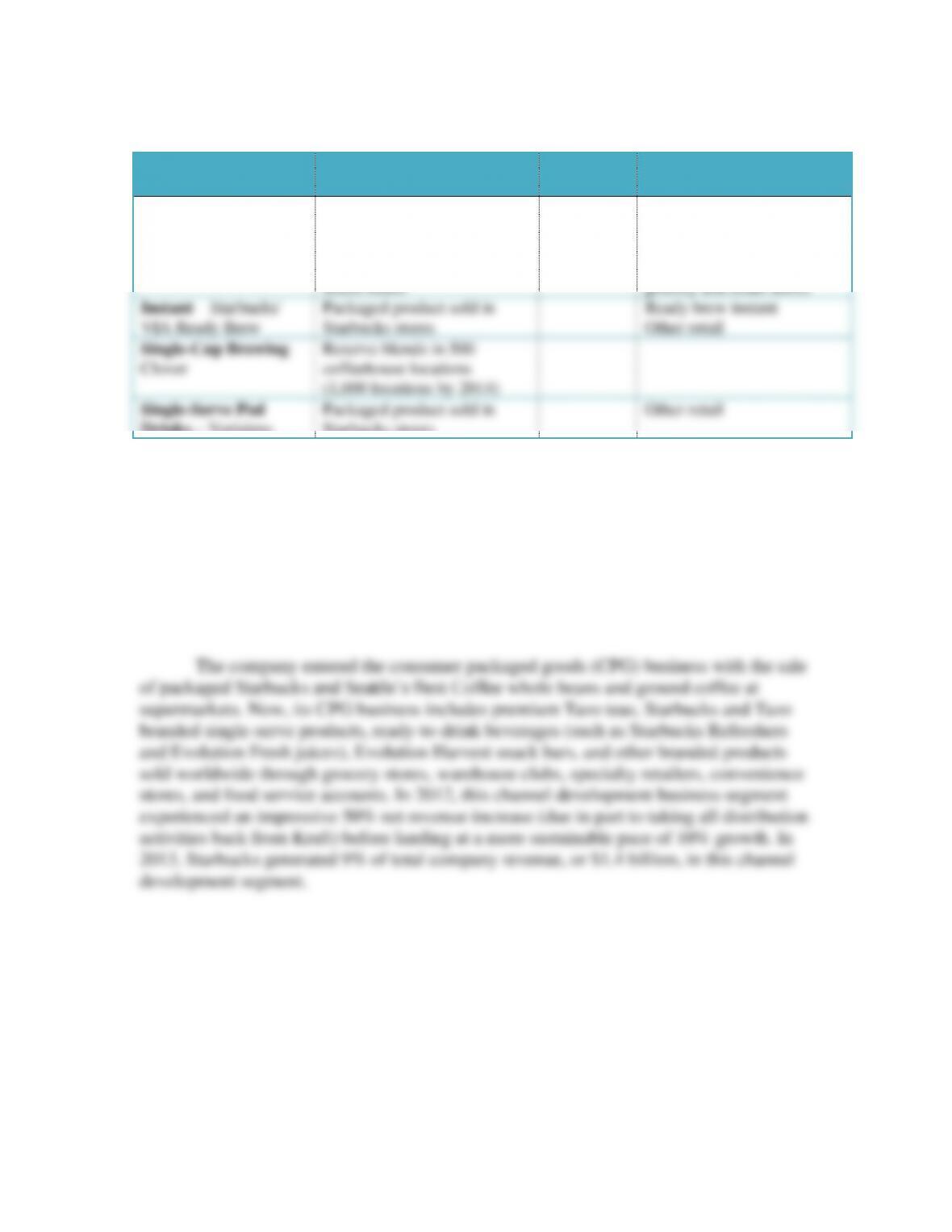
Product/Brand
Starbucks Coffee
Cafes
Branded Stores
Owned by
Starbucks
Grocery and Other
Channels
(CPG)
Juices – Evolution
Fresh
Ready-to-drink in 2,200
Starbucks stores
Fresh in 4 Evolution
Fresh stores
Ready-to-drink in 8,000
supermarket and
convenience stores
Baked Goods –
Bay Bread
Warm display in 3,500
Starbucks stores
Fresh in 19 La
Boulange Café &
Bakeries
Fruit and Nut
Bars – Evolution
Harvest
Packaged food item in
Starbucks stores
Whole Foods Market
Yogurt Parfaits –
Danone
Exclusive in Starbucks
stores (2014)
Grocery stores (2015)
Breakfast
Sandwiches
Served hot in Starbucks
stores
Bagged Teas –
Tazo
Bagged and single-
serve in Starbucks
stores
Bagged and ready-to–
drink in grocery/related
stores
Exclusive organic bagged
flavors at Whole Foods
Loose-Leaf Teas –
Teavana
Loose-leaf, packaged,
and shaken iced in
Starbucks stores (2014)
Oprah Chai Tea
Loose-leaf,
packaged, and
Oprah Chai Tea in
300 Teavana
shopping mall stores
3 flagship stand-
alone Teavana shops
Packaged loose-leaf
Coffees – Seattle’s
Best Coffee
Defunct Borders
bookstores
Ground and whole bean
packages in 50,000
partnership distribution
points
Packaged varieties in
grocery and retail stores
Carbonated
Beverages – Fizzio
Handcrafted caffeine-
free cold drink in select
U.S. and China markets
1/3 of Starbucks stores
(2014)
Energy Drinks –
Starbucks Refreshers
Iced fruity green coffee
extract drink in
Starbucks stores
Ready-to-make powdered
Canned carbonated
flavors
Alcoholic
Beverages –
Starbucks Evenings
Wine and beer in 23
select stores
Wine and beer in 1
non-branded Seattle
location
cont.
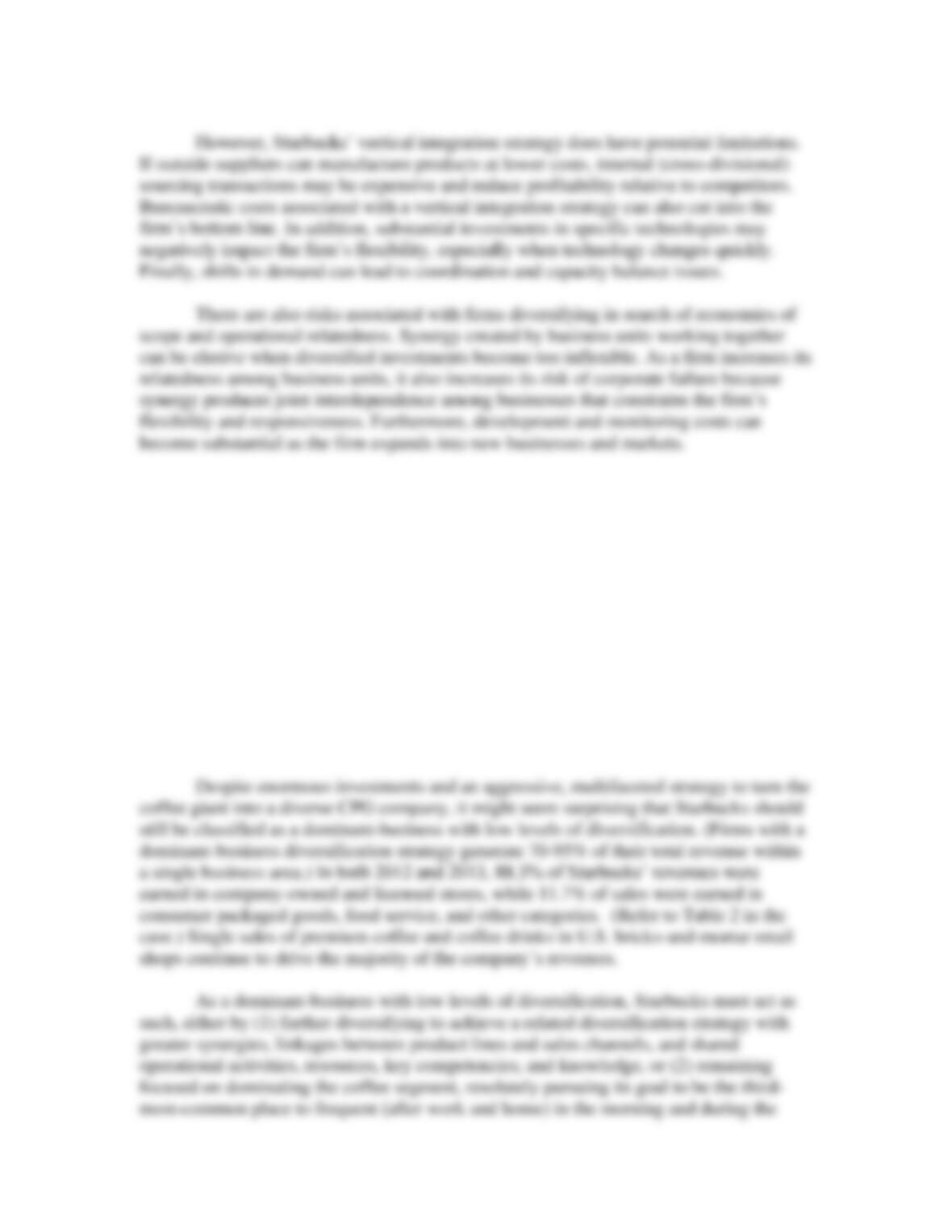
Starbucks Corporation: The New S-Curve
3
Starbucks
cont.
Coffee
Starbucks Coffee
Cafes
Branded
Stores
Grocery and Other
Channels (CPG)
Light Roast, Seasonal,
and Reserve Blends –
Starbucks
Lighter roasts, seasonals, and
macchiatos in Starbucks
stores
Exotic and limited blends in
select stores
Ready-to-drink frappuccinos
and iced coffees
Ground and whole bean
packaged varieties in
grocery and retail stores
Instant – Starbucks’
VIA Ready Brew
Packaged product sold in
Starbucks stores
Ready brew instant
Other retail
Single-Cup Brewing –
Clover
Reserve blends in 500
coffeehouse locations
(1,000 locations by 2014)
Single-Serve Pod
Drinks – Verisimo
Packaged product sold in
Starbucks stores
Other retail
Starbucks’ backward integration into the food product supply chain can enhance
the company’s market power over rivals. This market power can be gained as the firm
develops the ability to save on its operations, avoid sourcing and marketing costs,
improve product quality, possibly protect its technology from imitation by rivals, and
potentially exploit underlying capabilities in the marketplace. Vertically integrated firms
have access to complementary information and knowledge that can improve product
quality and foster new technologies. Market power is also created through strong ties
across productive assets for which no market prices exist.
The Starbucks name is nearly synonymous with coffee. The brand is certainly the
dominant premium coffee in the domestic market. And the company’s multifaceted
strategy blocks competitors on all fronts. Diversification can provide flexibility to shift
Starbucks’ investments to markets where the greatest returns are possible, rather than the
firm staying dependent on only one or a few markets. For instance, the company’s new
Evolution brands tap into the thriving health and wellness industry. Or in the case of its
Verisimo single-serve brewing line, Starbucks is targeting the home coffee drinker whose
daily routine does not include coffee shop purchases. In addition, the company stands to
benefit from economies of scaled production, driven by volumes that supply multiple
distribution channels.
Starbucks Corporation: The New S-Curve
4
Starbucks
Diversified firms must select a business-level strategy for each of the businesses
in which it decides to compete. The business strategy for each of Starbucks’ product lines
is clearly one of differentiation. For each of its premium brands, Starbucks offers
distinctive products for customers who value differentiated features more than they value
low cost. Product differentiation based on ingredients, quality, uniqueness, flavor, and
handcrafting is thoughtfully presented in store settings and coupled with service
programs to enhance consumers’ experiences. Café ambiance is a key distinguishing
element for the coffee brand, and the company has invested heavily in its Digital
Ventures business to attract and satisfy customers. Differentiation requires a thorough
understanding of what target customers value, the relative importance they attach to the
satisfaction of different needs, and for what they are willing to pay a premium. Going a
step further, Starbucks is exploiting this awareness and the power of its brands to drive
the sales of consumer packaged goods in alternative retail channels.
Starbucks Corporation: The New S-Curve
5
Starbucks
lunch and evening hours. The company will need to generate more than 30% of its
revenue beyond the Starbucks coffee shop to build a highly developed corporate
capability for transferring one or more core competencies across businesses. The
corporate-level strategy’s value is ultimately determined by the degree to which the
businesses in the portfolio are worth more under the management of the company than
• Compare and evaluate the company’s product development strategies. What are the
advantages and disadvantages of each?
Starbucks has engaged in a product diversification strategy to create value for
stakeholders and competitive advantages for the firm. The company has achieved new
product development in multiple ways – through acquisitions, internal innovation, and
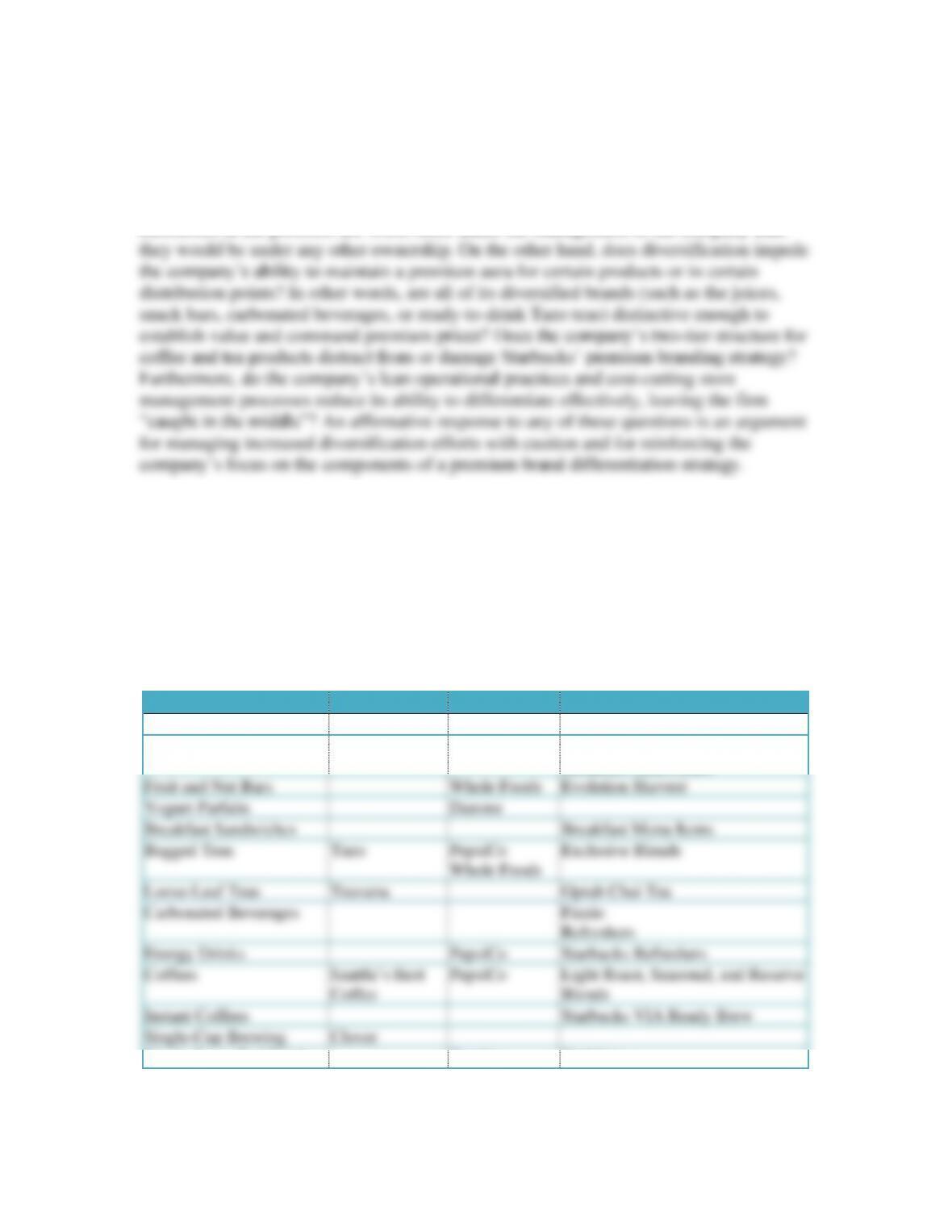
cooperative arrangements. The table below identifies the development strategy associated
with each of Starbucks’ new product lines.
Product/Brand
Acquisitions
Partners
Internal Innovation
Juices
Evolution Fresh
Baked Goods
Bay Bread
Baked Menu Items
Breakfast Sandwiches
Fruit and Nut Bars
Whole Foods
Evolution Harvest
Yogurt Parfaits
Danone
Breakfast Sandwiches
Breakfast Menu Items
Bagged Teas
Tazo
PepsiCo
Whole Foods
Exclusive Blends
Loose-Leaf Teas
Teavana
Oprah Chai Tea
Carbonated Beverages
Fizzio
Refreshers
Energy Drinks
PepsiCo
Starbucks Refreshers
Coffees
Seattle’s Best
Coffee
PepsiCo
Light Roast, Seasonal, and Reserve
Blends
Instant Coffees
Starbucks VIA Ready Brew
Single-Cup Brewing
Clover
Single-Serve Pod Drinks
Keurig
Verisimo
Starbucks Corporation: The New S-Curve
6
Starbucks
Through acquisitions, partnership agreements, and internal innovation, Starbucks
is striving to gain market power, improve performance, and fuel growth. The company is
simultaneously:
» upgrading café product offerings to drive same store sales growth (SSSG),
» vertically integrating to reduce costs and boost profits, and
» extending its reach into new sales channels to leverage brand and product
value.
In addition to complementary products that can be introduced in Starbucks stores, the
company has acquired or launched new product lines which can expand the firm’s
capabilities, access growing markets, improve quality, and perform outside of the
Starbucks coffee shop model.
Several of Starbucks’ acquisitions stemmed from targeted menu and product
sourcing decisions. By vertically purchasing firms that could be scaled to supply its
coffee shops, Starbucks forged opportunities to create value through backward value
chain integration. Strategic alignment and the control of product development, costs,
access, quality, and exclusivity are the benefits of the company’s vertical acquisition
strategy.
Starbucks Corporation: The New S-Curve
7
Starbucks
* Plus 3 new flagship stand-along neighborhood shops.
A competitive advantage results from an acquisition strategy only when private
synergy is created. This happens when acquired assets yield capabilities and core
competencies that could not have been developed by combining and integrating either
firm’s assets with any other company. Thus, the acquiring and acquired firms’ assets
need to be complementary in unique ways. Although difficult to create, the attractiveness
of private synergy is that, because of its uniqueness, it is difficult for competitors to
understand and imitate. Thus, it becomes the source of novel competitive advantages.
Beyond tangible product development, Starbucks has heavily invested in digital
innovation as a new source of both growth and operational excellence. In addition to
pioneering digital capabilities through its Digital Ventures division, the company has
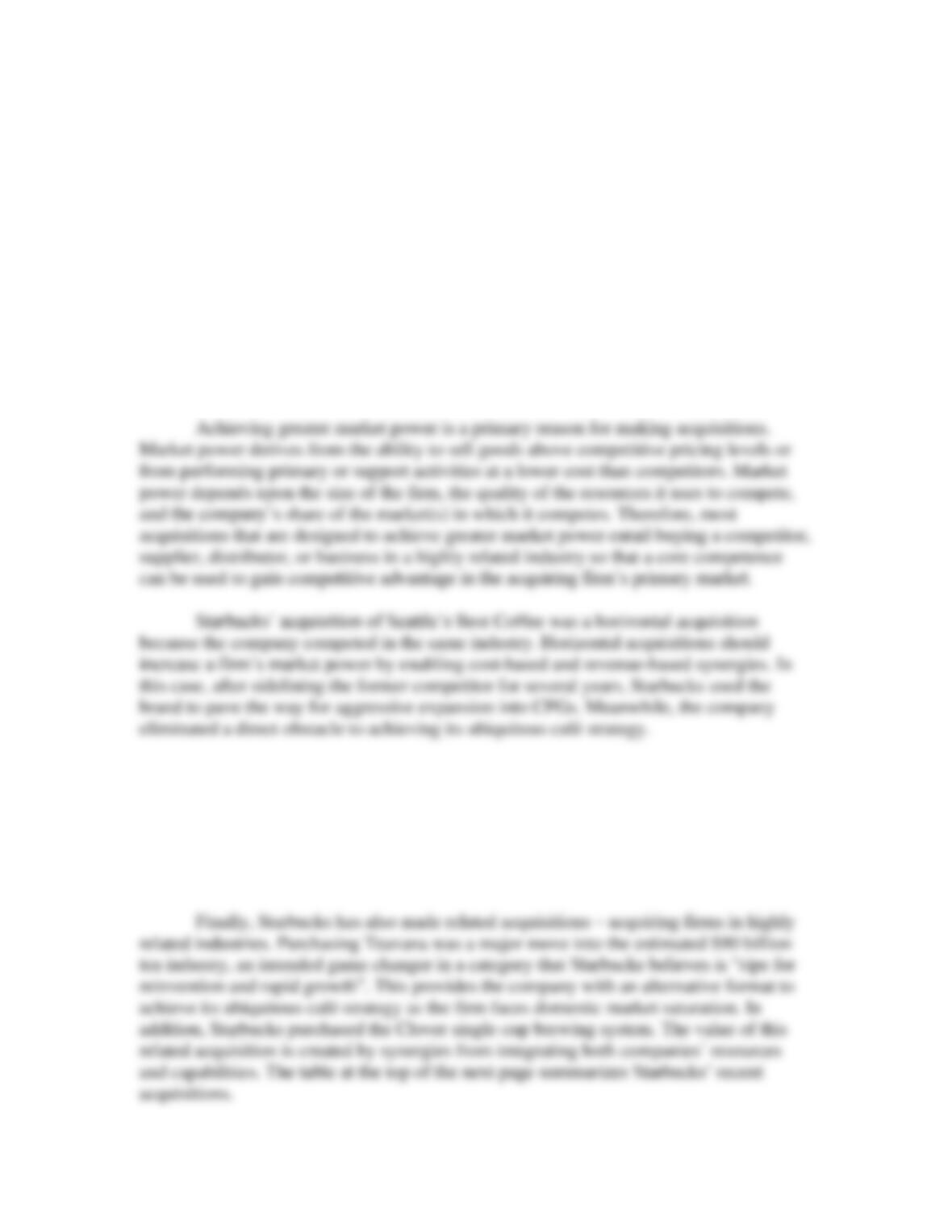
Product/Brand
Acquisitions
Acq. Price
Type
Stand-alone
CPG
Juices
Evolution Fresh
$30 million
Vertical
4
X
Baked Goods
Bay Bread
$100 million
Vertical
19
Bagged Teas
Tazo
Vertical
X
Loose-Leaf Teas
Teavana
$620 million
Related
300 Mall*
X
Coffees
Seattle’s Best
Horizontal
X
Single-Cup Brewing
Clover
Related
Starbucks Corporation: The New S-Curve
partnered with Internet giant, Google, and mobile payments start-up, Square, for access to
technologies that are linked to enhancing customer experiences, service, convenience,
and loyalty. These initiatives enrich the company’s marketing activities in the value chain;
and together with its use of social media tools, Starbucks is building a competitive
advantage in the firm’s management of the reach, richness, and affiliation of its customer
relationships. Consequently, the company clearly sees its Digital Ventures as a major
driver of new growth, customer loyalty, and shareholder value. Starbucks is the retail
industry’s “unquestioned” leader in mobile payment and mobile loyalty; and interestingly,
the company is now uniquely positioned to develop and monetize its digital leadership
into new platforms, revenue streams, and growth.
The advantages and disadvantages of acquisition, cooperative, and internal
innovation strategies are summarized in the following table.
New Product
Development Strategy
Advantages
Disadvantages
Acquisitions
– Access to new products –
especially to diversify
– Increased speed to market
– Lower risks
– Access to new capabilities
– Opportunities for private
synergies
– Loss of internal innovation
capabilities
– Integration difficulties
– Management challenges
– Difficulty achieving synergies
– Extensive debt (if used to fund
acquisitions)
– Loss of focus – potential for
overdiversification
– Potential to pay premium for
acquisitions
Partnerships
– Opportunities for collaborative
advantages and social capital
– Access to complementary
resources
– Shared risks and resources
– Increased new product
development speed
– Learning new knowledge and
business techniques
– Contract oversights
– Misrepresentation of skills
– Coordination difficulties
– Monitoring costs
– Misuse of resources
– Opportunistic behavior
– Unequal commitment
Internal Innovation
– Development of strategic
capabilities to outperform
competitors
– High R&D costs
– Low success rates
– High risks
– Competitor imitation
• Review the scope and performance of Starbucks’ international businesses. What
type of international strategy do you recommend for the company?
Starbucks Corporation: The New S-Curve
9
Starbucks
conducted in the Americas. Its other international divisions represent only a very small
percentage of corporate revenues.
Global Division
Percentage
of Revenues
Notes
Americas
74%
Limited growth opportunities in
domestic market
Interests in nearby South American
coffee-growing regions make it a
logical target market
Cash generation to fund expansion
Europe, Middle East, Africa (EMEA)
8%
Struggling with profitability
Flat SSSG
China/Asia-Pacific (CAP)
6%
Fastest growing business segment
Highest profit margin
Despite its prolific core retail coffee shop presence at home, Starbucks still
accounts for only a “small share of the total global coffee occasions”. “Significantly
under-stored” and “ripe for expansion in several markets”, the company is meeting
disparate conditions in different regions throughout the world in its efforts to expand
storefronts internationally.
In the Americas, particularly in North America, growth rates are stunted due to
market saturation. Future growth in the domestic market will depend heavily upon
increasing store traffic and same store sales receipts. With online traffic cutting into store
volume, Starbucks is also relying on digital investments to offset this trend.
this division. The company can apply its experience with this joint venture to overcome
entry difficulties in other nations where culture, norms, trade policies, local knowledge,
and competitive factors differ from Starbucks’ home market.
In order to be responsive to the needs and conditions in each of these global
regions, the arguments for adopting a multidomestic international strategy are strong.
This entails the use of decentralized decision making to allow each business unit the
Starbucks Corporation: The New S-Curve
10
Starbucks
STRATEGY
• Discuss Starbucks’ need for a new strategy in the late 2000s. Based on the analysis,
what are the strengths and weaknesses of Starbuck’s current strategy?
Prior to 2007, Starbucks’ growth strategy was aimed at global domination by
attempting to commoditize the premium coffee shop – or combining ubiquity with high-
end product offerings. The company’s dramatic, pre-transformation growth implosion
revealed the plan’s deficiencies. By 2013, the company was still aiming to be “the
leading retailer and brand of coffee” in its target markets, but this time through a
“disciplined” and selective expansion of stores in new and existing markets, as well as by
increased sales in existing stores. This new approach seems to have stabilized the
company’s foundation for growth and energetically established multiple avenues to create
value.
Starbucks Corporation: The New S-Curve
11
Starbucks
expertise, Starbucks has created real or perceived value as a strong basis for
differentiating its offerings and brand.
However, some concerns can be raised about the potential to overdiversify or
become too large. Increased levels of diversification can have a negative effect on
Starbucks’ long-term performance. (Refer to Figure 6.3 in the text.) Greater managerial
complexity and information processing can lead to over-reliance on financial rather than
strategic controls to evaluate business unit performance. This causes focus on short-term
outcomes at the expense of long-term investments and the achievement of strategic
Ultimately, the success of the strategy is measured by its effect on the company’s
value. Financial figures are limited in the case, but revenues, shares, and same store sales
growth metrics are positive. And the strategy does appear capable of establishing
sustainable and profitable growth. However, even though Starbucks is employing a more
disciplined approach, it is still aimed at commoditizing premium product offerings and
growth to the point of global market dominance. Fundamental economic principles are at